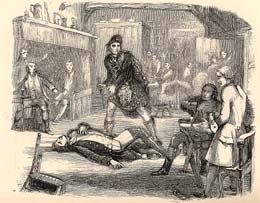
This short story is based on an account Scott had heard many years previously of the trial and execution in Carlisle of a Highland cattle drover accused of the murder of an English drover. Scott's source, which he acknowledged in the 'Magnum Opus' edition of Chronicles of the Canongate (1831), was George Constable (1719 - 1803), a friend of his father and the model for Jonathan Oldbuck in The Antiquary. It has not been established to date whether Constable's anecdote refers to a historically verifiable case.
Librarian Note: There is more than one author in the GoodReads database with this name.
Sir Walter Scott was a Scottish novelist, poet, historian, and biographer, widely recognized as the founder and master of the historical novel. His most celebrated works, including Waverley, Rob Roy, and Ivanhoe, helped shape not only the genre of historical fiction but also modern perceptions of Scottish culture and identity.
Born in Edinburgh in 1771, Scott was the son of a solicitor and a mother with a strong interest in literature and history. At the age of two, he contracted polio, which left him with a permanent limp. He spent much of his childhood in the Scottish Borders, where he developed a deep fascination with the region's folklore, ballads, and history. He studied at Edinburgh High School and later at the University of Edinburgh, qualifying as a lawyer in 1792. Though he worked in law for some time, his literary ambitions soon took precedence.
Scott began his literary career with translations and collections of traditional ballads, notably in his Minstrelsy of the Scottish Border. He gained early fame with narrative poems such as The Lay of the Last Minstrel and The Lady of the Lake. As the popularity of poetic storytelling declined, especially with the rise of Lord Byron, Scott turned to prose. His first novel, Waverley, published anonymously in 1814, was set during the Jacobite rising of 1745 and is considered the first true historical novel. The success of Waverley led to a long series of novels, known collectively as the Waverley Novels, which blended historical events with compelling fictional narratives.
Over the following years, Scott produced a remarkable number of novels, including Old Mortality, The Heart of Midlothian, and The Bride of Lammermoor, each contributing to the romantic image of Scotland that became popular throughout Europe. With Ivanhoe, published in 1819, he turned his attention to medieval England, broadening his appeal and confirming his status as a major literary figure. His works were not only popular in his own time but also laid the groundwork for historical fiction as a respected literary form.
Scott married Charlotte Genevieve Charpentier in 1797, and they had five children. In 1820, he was granted a baronetcy and became Sir Walter Scott. He built a grand home, Abbotsford House, near Melrose, which reflected his passion for history and the Scottish past. However, in 1825, financial disaster struck when his publishers went bankrupt. Rather than declare bankruptcy himself, Scott chose to work tirelessly to pay off the debts through his writing. He continued to produce novels and non-fiction works at a staggering pace despite declining health.
Walter Scott died in 1832, leaving behind a literary legacy that influenced generations of writers and readers. His works remain widely read and studied, and he is credited with helping to revive interest in Scottish history and culture. Abbotsford House, now a museum, stands as a monument to his life and achievements.
I’ve recently rediscovered an anthology of Scottish short stories I first encountered many years ago. I have never read any of Scott’s novels and I had forgotten I had ever read this story. It’s about a dispute between two good friends, the eponymous drovers. One is a Highlander and the other a Yorkshireman. Apparently it was inspired by a real life case.
I thought some of the spoken dialogue was execrable. Scott writes much of it in strong Scottish dialect, but that wasn’t what bothered me, it was more the stilted nature of the conversations.
The story itself has some merit. It’s essentially a clash of cultures – the friends fall out because they have different cultural values, and they are trapped within their own ways of thinking.
During the Romance Era, Sir Walter Scott, a Scottish author, used his works to confront social and political issues. Scott's short novella, "The Two Drovers," allows him to show and describe Highland culture, highlighting how it differs from well-known English culture. It also shows how the two drovers–Robin and Harry–can work together despite their differences, and how a lack of understanding of either culture may be disastrous. Scott shows his conviction in the function of art to induce comprehension by utilizing literature to explain and understand human reasons.
However, Scott also uses his narrative to express the conflicts that this understanding presents. Because we were able to understand why Robin acted as he did, we begin to question what is morally right and if it is fair that Robin should sustain the punishment for his crime. It provokes questions of whether law or custom should be adhered to. In this way, Scott is able to use literature as a means to promote understanding as well as generate reflection in a way that adheres to the trend of Romantic writers.
Chrystal Croftangry, narrator of Chronicles of the Canongate, presents The Two Drovers as an illustration of the Scottish Highland concept of honor. Set against a backdrop of cultural tension and misunderstanding, it tells the tragic tale of two cattle herders whose friendship is shattered by a clash of traditions. The narrative unfolds in a bygone era where the worlds of Scottish highlanders and English lowlanders collide. The story's protagonists, Robin Oig M’Combich and Harry Wakefield, each represent their respective cultures: Robin, the proud Scottish highlander, and Harry, the robust English lowlander.
I thoroughly enjoyed this finely crafted short story which centers on Scott's repeated themes of chivalry and honor. Even though Scott was very patriotic, he was not a Jacobite and this story is just another example of his desire for Scotland and England to put their feuds in the past. The Scots terminology slowed the read a bit but I had my Scots dictionary at hand. I highly recommend this story.
Reading this story in 2021 it is hard not to see the friendship breakdown between Robin Oig M’Combich and Harry Wakefield as a metaphor for the deteriorating political relationship between Scotland and England. One can only hope for a happier outcome than prevailed that night at a Cumbrian alehouse.
From V.S. Pritchett's, The Oxford Book of Short Stories:
One often models a "culture clash" as friction between beings who were raised in separate camps, hermetically sealed from one another. Suddenly the seal is broken and bang: in your face. The ostracising sneer and the ceasing of pleasantries. A Westerner stands on a coin, bearing the King's face, in Thailand. The odour of lèse-majesté emanates; faces drop, glares turn. An Englishman declines to tip in America. No more smiley server for you, you sour, indignant scrounger.
The widespread success of modern states in establishing a monopoly on legitimate violence leads one to forget that culture also includes the cultural justifications of the use of force; to forget that "culture clashes" in earlier states may frequently have been less a sneer or social ostracism, more the likes of a dirk (knife) in the heart. And I'm not talking solely about pre-modern states. Potentially deadly duelling is calmly mentioned and carried out between law-abiding citizens of France in Stendhal's (1830) 'The Red and The Black'. Texas and Washington states both still allow 'Mutual Combat' as a defence to assault charges in 2025. These are both relatively modern cultures that we can assume endorse limited vigilantism in defence of one's honour—'assume' because culture does not necessarily match the law, nor is it uniform, as this story shows. What happens when such violence is justified in one but not another of two clashing cultures? This is what occurs in Walter Scott's 1827 fictionalised reportage on a (supposedly real) deadly quarrel between two friends: a Highlander and an Englishman. The result at Carlisle Assizes is an execution.
Leave aside the punishment, in my mind the finding of murder is unassailable. The judge speaks true when he talks of the power of a state whose role is to forbid calculated acts of revenge. Tit-for-tats and blood feuds range and multiply in a kinship-based, retribution-centric culture, especially one coming into contact with alien combat norms. To have a formless mass step in and proclaim: "Vengeance is mine" and dispassionately execute the sentence demanded by impersonal norms is an extremely useful and civilising tool. And this is a genuine shame for the 'hill peoples' of the world—of famously successful resistance to state and cultural penetration—who end up coming a cropper of rules they have never heard of and indeed have been raised to view as cowardly. But the process of systematising and monopolising violence is really that valuable. I'm sorry that you weren't at fault in the original feud, but I like my civilisation, and I'm sorry that you came across it at this late stage, oh moral young Robin Oig M'Combich.
The more nuanced point being the long time periods over which real cultural penetration takes place; the 'deeper' socially-nurtured psychologies within which people justify and decide upon violence change only across generations. Of course Robin had encountered English culture on his yearly travails to Lincolnshire. But in his heart were differing convictions. Convictions that if acted upon must be suppressed. Assimilation is a long and dirty game. It seems the Celts hadn't relinquished this game in 1827, 1400 years after the coming of the Angles. A long, long game indeed—when played in the hills.
A sad story on the themes of passion, the law, cultural differences on applications of justice, and the value of death. The Scottish protagonist Robin and his English friend Harry fall into an initially minor disagreement through the fault of third parties, and through the escalations built by their emotions and their social environments and beliefs, both face tragic endings. The story is structurally divided into two segments; the first being a narrative of the events leading to the tragedy, and the second being a very compact elucidation on the effect of the law delivered by the judge of the resulting criminal case. The first segment slowly and beautifully builds up the characters by showing the strong and positive moral qualities of both Robin and Harry and embedding the reader into Robin’s motivations within this event. It is with this compassion that we then enter the climax of the first section and enter the analytical case judgment that explicitly delves into the role and responsibilities of the law. The underlying theme here is that while we should understand, recognise and sympathise with alternative systems of justice, the law cannot tolerate any application of deviations to the system in order to protect its civilisation. What the English law does, however, recognise is that people are prone to emotions and allows for the “compassionating the infirmities of humanity”, which unfortunately was not the case here.
Walter Scott dedicated to the epoch of The Middle Ages most of his masterpieces. Each of his works is based on a certain concept of the historical process at a definite time.
The story “The Two Drovers” starts with an introduction, “It had been a brisk market; several dealers had attended from the northern and midland counties in England, and English money had flown so merrily about as to gladden the hearts of the Highland farmers.” The description gives an image of the everyday life of people including economic and cultural processes.
The narration tells about the friendship of two main characters; a Scotsman and an Englishman. The plot of the story is partly magical and at the same time very realistic.
A short but powerful read, read this book in a course on Scottish Crime Fiction and used this book as a sort of departure into the genre. As a view into Scottish crime writing, this book is impactful in its presentations of dualities within Scotland (highland vs. lowland, England vs. Scotland, fate vs. agency, etc.), references to Calvinism, and inclusion of some mythological elements. As a novel (or short story) in its own right, the work touches on grand themes and explores the ever important consequences of misunderstanding between differing cultures and ways of life. A must read.
This is a really good introduction to the prose of Sir Walter Scott for those, like me, who are reluctant to get stuck into the main novels. Seven stories of varying length - some really short, others of novella quality. They are interesting and well plotted. My favourite is "The Highland Window" which is in the novella category. This edition has an excellent introduction by the renowned man of letters, Lord David Cecil. plus a recent updated preface by the book's editor, Graham Tulloch. Strongly recommended.
First published in 1934, The Two Drovers and Other Stories is a collection of 7 short stories first published over the years 1824-1831. Some of the stories make up a substantial part of 'Chronicles of the Canongate'. The stories are supported by copious notes, whilst the appendices include a shorter, earlier version of the ghost story 'The Tapestried Chamber'. Enjoyable, but unlikely to offer much that is new to regular readers of Scott's works.
A good story and all the more interesting because it is based on true events. The reaction of two people from different cultures to confrontation over a misunderstanding and perceived slight leads to drastic consequences. It is a little hard to understand in places because of Scott's use of local dialect, though I'm sure it is realistic and not a stereotype because he was Scottish.
The Scottish eye dialect and use of archaic words (i.e., "dirk" for dagger) make this short story a bit difficult to read. Interesting commentary on racial relations of Scotts/English in the late 1700s from a pedestrian perspective.
In the title story, Sir Walter Scott juxtaposes two codes of honor (English vs. Highland) to the detriment of both parties and their friendship. The characters are equally matched- handsome, likeable, hard-working, honorable, friendly. It is only the conflict of their custom (and the instigation of onlookers) that brings these two friends to naught.
Again, as with Wandering Willie's Tale, the Scottish brogue made parts of this very difficult to understand. A story of a l tragedy foretold, and enacted, due to a highland pride.
4* Rob Roy 3* The Heart of Mid-Lothian 4* Ivanhoe 3* Waverley 4* The Fair Maid of Perth 4* The Bride of Lammermoor 4* Kenilworth 3* The Antiquary TR Guy Mannering TR The Pirate TR The Waverly Novels: Anne of Geierstein TR The Two Drovers TR The Lady of the Lake TR Life of Napoleon Bonaparte, Volume I TR Life of Napoleon Bonaparte, Volume II TR Life of Napoleon Bonaparte, Volume III TR Life of Napoleon Bonaparte, Volume IV TR Life of Napoleon Bonaparte, Volume V TR The Abbot
About Walter Scott: TR Memoirs of Sir Walter Scott Vol. I TR Memoirs of Sir Walter Scott Vol. II