Describes comet workings & comet lore & gives a history of how astronomers have unraveled some of the mysteries. The fear of comets The paths of comets The return of Halley's Comet Dim comets The death of comets Nineteenth-century comets Comet tails and meteors The distant comets The birth of comets & the solar system Comets & catastrophes List of Illustrations Index
Works of prolific Russian-American writer Isaac Asimov include popular explanations of scientific principles, The Foundation Trilogy (1951-1953), and other volumes of fiction.
Isaac Asimov, a professor of biochemistry, wrote as a highly successful author, best known for his books.
Asimov, professor, generally considered of all time, edited more than five hundred books and ninety thousand letters and postcards. He published in nine of the ten major categories of the Dewey decimal classification but lacked only an entry in the category of philosophy (100).
People widely considered Asimov, a master of the genre alongside Robert Anson Heinlein and Arthur Charles Clarke as the "big three" during his lifetime. He later tied Galactic Empire and the Robot into the same universe as his most famous series to create a unified "future history" for his stories much like those that Heinlein pioneered and Cordwainer Smith and Poul Anderson previously produced. He penned "Nightfall," voted in 1964 as the best short story of all time; many persons still honor this title. He also produced well mysteries, fantasy, and a great quantity of nonfiction. Asimov used Paul French, the pen name, for the Lucky Starr, series of juvenile novels.
Most books of Asimov in a historical way go as far back to a time with possible question or concept at its simplest stage. He often provides and mentions well nationalities, birth, and death dates for persons and etymologies and pronunciation guides for technical terms. Guide to Science, the tripartite set Understanding Physics, and Chronology of Science and Discovery exemplify these books.
Asimov, a long-time member, reluctantly served as vice president of Mensa international and described some members of that organization as "brain-proud and aggressive about their IQs." He took more pleasure as president of the humanist association. The asteroid 5020 Asimov, the magazine Asimov's Science Fiction, an elementary school in Brooklyn in New York, and two different awards honor his name.
Naught but a dirty snowball in an eccentric orbit!
ASIMOV’S GUIDE TO HALLEY’S COMET is an entertaining and informative guide for the science lay person to the history of the development of our knowledge of comets - their source, their birth, their life, their death, their composition, their observation and, of course, the records of their passing. Our earthly encounters with comets might have been at a distance, at close enough quarters that we passed through the tail of the comet, or, indeed, some comets might even have met their demise by colliding with us! Like all of Asimov’s popular science books, ASIMOV’S GUIDE TO HALLEY’S COMET is easy enjoyable reading and deserves a place on the shelf of any lover of popular science.
Who would have thought that Asimov's science writing is more accessible than his fiction? I'm surprised!
Asimov's Guide to Halley's Comet ist just that. A short and sweet story of comets, with a particular focus on the one that is particularly well-known at it is the only comet that comes around every 75-ish years and can be seen from Earth with the naked eye.
It's a light and yet informative read. Asimov covers some basics sprinkled with fun facts. I didn't know for example that the name stems from the Greek word comets meaning "hairy". Asimov explains that in ancient times women would loosen their hair when mourning, so a comet was basically seen as a sign of disaster to come!
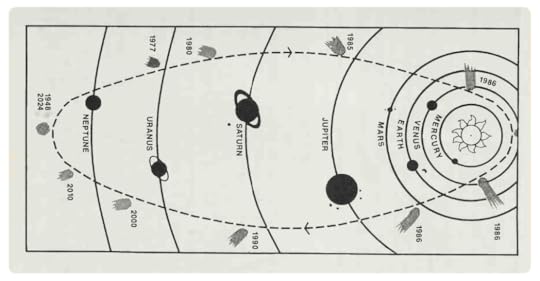
So from speaking of the comet as something people feared and superstitiously thought of as a bad sign, he explains the paths and origin, as well as the death of comets. All of the chapters are written in a conversational manner that doesn't require any prior knowledge of physics or astronomy. There are also various illustrations and graphics, which make the whole reading experience even more light-hearted and lively.
This was a lovely read, yet obviously also a tad out of date, having been written multiple decades ago! Maybe don't present things you've learned in here as hard facts (but then in science you probably should never do that, anyway), but don't let it stop you from a nice little excursion into the magical world of comets.
Short and sweet, accessible to anybody, this book was published just before the most recent return of Comet Halley. While discussing the history of Halley, important to cometary science, the book is not obsolescent with the comet's passing.
I've seen two comets thus far. The first was Kohoutek, "the Christmas monster" of 1973/74, barely visible in the night sky above DeKalb, Illinois, where I had come to stay with friends while taking the Graduate Record Examination. The second, equally unimpressive, was Halley itself in 1985/86.
Grandmother Layla would tell of the prior visit by Halley in 1910, that her elementary school teacher had dismissed class with finality one day, believing that Earth's passage through its tail would mean the end of civilization, if not of all planetary life. The show was far superior to that of '85/86, but the world wagged on.
A similar scare was promoted for Kohoutek in '73/74, my friends and I deriving amusement by handbills foretelling cosmic doom distributed by a Christian fundamentalist group. A year later, in seminary, it became customary for us to adopt power names. My favorites were "Condor, Son of Norway" for myself, "Vince Ramon" and "Kohoutek, the Christmas Monster".
Of course, it is somewhat out of date having been written as Halley’s Comet approached in 1985. Nonetheless it is a well written summary of what we knew about comets in general and Halley’s in particular. One of Asimov’s strengths is including the history on a subject as well as (then) current information. He also spent a fair amount of time on past and current fears about comets. No a comet’s approach is not why your grandmother died the next year. He also spent more time on the possibility of collision and concludes it is possible but not likely. I found information about a comet’s contents very interesting but what I found more interesting was how scientists found out this information. While it is obviously out of date and should be supplemented with more current information, this is still a good book to give to a student as an introduction to the field of comets.
La manera tan aposionante que tenia Asimov para escribir sobre divulgación es increible e inspiradora, les aseguro que disfrutaran este libro de principio a fin.
Highly fascinating! This was my first time reading any of Asimov's works all the way through, and I was throughly impressed with his witty remarks and novel-like pacing throughout this book. Seriously, the first few chapters were intriguing for vastly different reasons than the concluding ones, and the middle was full of informative segments that had me thinking "ok, this is nice, but will this tie into the rest of the "narrative" Asimov has laid out already?". In the end it all did come together very nicely, the last chapter is easily my favorite as I tend to love when the picture comes into full view. Underrated, short, and very engaging overall!
Puede que mi opinión sea sesgada porque el estilo divulgativo de Asimov me encanta, pero el libro hace una gran labor a la hora de contar la historia de la ciencia de los cometas. Si Asimov hubiese podido estar presente durante la misión DART, hubiese flipado.
Short book published when Halley's comet was getting near. It gives a good account of the history of comets, and Halley's comet's place as the first comet to be shown to recur.
Whilst I don't agree with all of Asimov's views, especially regarding superstition I did enjoy this concise book and it's a nice little primer on the subject.
Éstas son algunas de las apasionantes preguntas que Isaac Asimov se plantea y responde en este libro singular:¿La estrella de Belén fue en realidad un cometa? ¿La tremenda explosión que destruyó -en 1908- un perdido bosque de Siberia se debió a la caída de un caprichoso fragmento cometario? ¿Qué nuevos datos sobre la formación del Sistema Solar aportarán los vehículos espaciales que seguirán al cometa halley en 1986? La brusca desaparición de los dinosaurios, hace 65 millones de años, ¿fue causada por un invierno cometario provocado por las nubes de polvo de un cometa, semejantes a las nubes radiactivas del invierno nuclear que seguiría a una hipotética III Guerra Mundial?Entre noviembre de 1985 y abril de 1986 el cometa Halley estuvo cercano a la Tierra, como no lo estuvo desde 1910 y no volverá a estarlo hasta 2063. Este libro proporcionó toda la información para recibirlo como es debido.
This book was written just before the return of Halley's Comet in 1985 - 1986. I remember standing on the back porch with binoculars, trying to get a good look at the comet. Most of the information in this book is still relevant, however there are a few concepts that have sense been debunked. The biggest one being the idea that there are more Gas Giants beyond Pluto.
The book is interesting, and it has quite a bit of information about comets in general. Shortly after I read this I read an article about Comet Ison. That comet was making what was likely it's first approach to the sun. It is what is referred to as a Sun grazer comet, meaning it approaches within a million miles of the Sun. As I am writing this it looks like Ison was destroyed by the trip. If it did survive, it is supposed to be a spectacular show.
Hace poco vimos un eclipse total de una superluna (27/sept/2015), al otro dia en clase de Biología un compañero dijo que "los eclipses traian mala suerte" pude haberlo mirado raro, pero no porque antes leí "El cometa Halley" y entendí sus miedos.
Un libro donde Asimov nos cuenta las supersticiones, sueños y mitos que se han tejido alrededor de los fenomenos celestes que no logramos explicar, en esté caso: el cometa Halley, quien nos visita cada 76 años trayendo un espectaculo de luz (cada vez menor) y una serie de fantasias humanas.
El dato hermoso: Los chinos prendian palitos de polvora con la intención de asustar/espantar esos portadores de catastrofes, que se creian, eran los cometas
Asimov con su particular estilo cuenta la historia de los cometas, al principio nadie sabía como se comportaban: "Los cometas se han parecido siempre a las personas asustadas. En primer lugar, no parecen seguir las normas."
Y eso generaba miedo y superstición en la gente "Millones de ignorantes y supersticiosos siguieron creyendo que los cometas predecían desastres (del mismo modo que creían mil otras tonterías) y siguen creyéndolo en la actualidad."
Pero gracias a científicos como Halley y matemáticos como Gauss se descubrieron las leyes que gobiernan los movimientos de los cometas.
Hay muchas sorpresas en este libro el humor ácido de Asimov que siempre me ha encantado.
La manera que tiene Asimov al escribrir sus textos de divulgación es única. Logra explicar cualquier cosa de la manera más simple y fácil de entender, y lo que más me gusta, de una manera tan apasionada (e incluso a veces divertida u ocurrente). Esta es su obra de divulgación que más me ha gustado hasta el momento, me parece increíble cómo logra una narración tan amena, interesante, y que con cada capítulo te deja con ganas de seguir leyendo, tal como si de una obra de suspenso se tratase. Descargué este libro para leerlo porque vi que era algo corto y tenía ganas de una lectura corta (y Asimov siempre es una buena opción para leer), y se convirtió en uno de mis libros favoritos.
I found this book while weeding the collection. I vividly remember my parents bundling me in blankets to view Halley's Comet in the winter of 1985. I hope to see it again around 2063ish! I also hope that the words aphelion and perihelion find their way into my vocabulary!
Escrito en 1986, antes que el Halley volverá, Isaac Asimov, con la información de la época, te ilustar de maravilla todo sobre cometas. Desde lo más místico que es miedo a los cometas, hasta lo más tecnológico de ir hasta los cometas y destruirlos para salvarnos.
Un libro que permanece intacto a pesar del tiempo en el que fue escrito, con información aún muy valiosa en estos tiempos. Es una lectura ligera. Recomendado para amantes de la astronomía y curiosos de su mundo.
Cortito, chulo, interesante. Me ha llamado la atención ver hipotesis que actualmente ya estan confirmadas como la de la Nube de Oort o ver a señores que odio (Bessel hablo de ti) en ambitos que no esperaba.