Athletic and strong willed, Princess Emmajin's determined to do what no woman has done become a warrior in the army of her grandfather, the Great Khan Khubilai. In the Mongol world the only way to achieve respect is to show bravery and win glory on the battlefield. The last thing she wants is the distraction of the foreigner Marco Polo, who challenges her beliefs in the gardens of Xanadu. Marco has no skills in the "manly arts" of the horse racing, archery, and wrestling. Still, he charms the Khan with his wit and story-telling. Emmajin sees a different Marco as they travel across 13th-century China, hunting 'dragons' and fighting elephant-back warriors. Now she faces a different battle as she struggles with her attraction towards Marco and her incredible goal of winning fame as a soldier.
Author of eight books, including a memoir, When the Red Gates Opened: A Memoir of China's Reawakening, about her personal experiences as a reporter covering China. Also author of Daughter of Xanadu, a historical novel set in China in the time of Marco Polo, and The Secret Voice of Gina Zhang, about a Chinese immigrant girl in Seattle. A former Business Week correspondent in Hong Kong, Dori co-authored the best-selling business book Pour Your Heart Into It: How Starbucks Built a Company One Cup at a Time. For more, see https://dorijonesyang.com/.
Once more an unnecessary "romance" ruined a great adventure story with an amazing heroine. Is there some unwritten rule in publishlandia that demands damn near EVERY book written for girls/young women MUST have a romance, even when it makes no sense for it to be there? They certainly don't do that to books geared toward boys. Yes, I'm calling out sexist fail here.
I'm actually rating this 3.5 stars for not being the typical Eurocentric historical YA. It's always great to see more diversity in YA. Also for the awesome, non-whitewashed cover (unlike the cover of Eona: The Last Dragoneye which so pissed me off that I purchased the UK version of the book since it actually featured the Asian heroine). Ohm and even though I had no need of a romance, at least it was an interracial one (which softened the disappointment).
The Mongol Empire has always fascinated me, so being immersed in its mores was wonderful. I've seen yurts, but can't imagine what fermented mare's milk would taste like. I envisioned the thundering of hooves across grassy plains and the sound of hundreds of arrows being fired. When it came to narrative, this novel succeeds hugely. The opulence and splendor of Kublai Khan's palace felt like I was there. Granted, the young girl who wanted to be a warrior rather than a pampered princess or housewife isn't new, but I really loved Emmajin. I loved her determination to be more than what her gender dictated. She was great when learning the skills to be a warrior. Unfortunately the very traits I admired went sideways with the whole falling in love with a young famous Venetian adventurer and trader named Marco Polo which just wrecked the book for me. Once more, that whiff of testosterone and a kick-ass heroine lost her moxie. Suddenly the things she once fought for had to be weighed by feelings for the boy. Suddenly his tales about his life in the West, especially in his home of Venice, are enough to change her feelings about what it means to be a part of one of the greatest (and most feared) empires in the world. I could accept such a change had she come to that conclusion after experiencing the ugliness of war, or even speaking with her father, a prince and a Buddhist monk. It came from at first being 'disconcerted' by the foreigner (Polo), enough to forget the hours of training Emmajin went through in shooting arrows on horseback to realizing her dream to become a soldier only to risk it because of her developing feelings for him.
I don't know much about Mongolian history, but it's true that I don't have a liking for the Mongols after watching movies and reading storybooks depicting their barbaric acts. But now I realize it's just the way a story is portrayed that influences the reader's mind, thanks to Daughter of Xanadu. When a same story is told in two different perspectives, we will have different perceptions and feelings after reading them.
In this book, our heroine, the 16-year-old granddaughter of Kubilai Khan - Princess Emmajin has no intention of getting married and become a good wife. She sole ambition is to get enlisted in the army and fight for the Khan to gain fame and glory in order to make herself comparable to men. She wants to help contributing a part in helping the Great Khan conquer the whole world. But as she eventually befriends a Latin merchant named Marco Polo whom she is initially assigned to spy on, she learns about the countries which is far off the borders of the Mongolian empire. Marco's words about the bad effects of wars start to prick her consciousness, and she thinks about the possibility of attaining peace through an alternative solution. As time passes, Emmajin and Marco begins to develop special feelings for each other.
While being historically accurate and highly entertaining, Daughter of Xanadu is also a thought-provoking novel. It questions the act of waging a war simply because of one man's aspiration to be the supreme world ruler. You will not fail to discover the brutalities and grittiness of war, which is portrayed vividly in this novel during the Battle of Vochan. However, I must say that I really admire Marco's wit in introducing a special tactic that proved to work against the Burmese King's troops. I love the part where Emmajin, Suren and Marco helped in capturing live dragons (crocodiles) to be taken back to Khanbalik.
In the front pages of the book, you will find a map of the Mongol Empire under Kubilai Khan from 1275 - 1276, with translations of ancient names of places to today's standard names. Also, there is a page on Emmajin's family tree. The author really deserves compliments for her meticulous research on the Mongolian lifestyle and culture. She describes the scenery of the wide stretches of land in Mongolia skillfully using beautiful words which makes me feel as if I were in that place. Included in the back is a glossary of some of the Mongolian and Latin terms which is used by the characters in the novel.
Dori Jones Yang has created word images so vivid that it is almost like watching a movie. She takes you on a brilliant Odyssey through the often-discussed-but-seldom-written-about Mongolian history through the eyes of the courageous royal princess herself. I heartily recommend this book to everyone, especially those who has a keen interest in the history of China and Mongolia or the founding of the Yuan Dynasty.
I admit, I blurbed this, because I think it's a durn good book. The female hero is a Mongol princess who yearns to be a warrior in the Khan's army. She is strong in character and weapons, but the men scorn her because of her sex. She is given a chance, but she is assigned a truly unpleasant duty: she must be a companion to the strange-looking foreigner from the west and learn all of his secrets for the Khan. What she learns from this Marco Polo will change the way she looks at herself and at the world, as will her first experience of war. It's a powerful look at war, at prejudice against women and foreigners, at the conflict between religions and ways of life, and at one girl's willingness to change and keep changing.
Do you remember Mulan? Well here is someone with a new twist, it is Emmajin the granddaughter of Khubilai Khan. Yeah. We open up to beautifully written story that transfers you to the vast empire of Khubilai Khan. War is always happening, but it is a more peaceful time, a changing time. The vast conquests are still expanding, but so is the idea of bettering the people. Emmajin is a strong, athletic warrior of a girl who does not want the court life, but longs to be a soldier in the Khan's army. She practices with her prince half brothers and gains the attention of the Khan with her efforts. Now Emmajin is on a secret and special mission that will take her to dragons and to war. What comes after is where the pivotal part of the tale hits. The writing in this novel was so artistically done. I felt as if I could touch the grass in the vast open plains. See the marble palace, and fall in the heat of battle. There was not too much detail to as take away from the characters, but more than enough to becomes transfixed into this era of history. I loved the historical clarity and the references in time. I loved the mild romance and the thoughts the characters unveiled to us. Each section of the book held great depth and I was very pleased with this read. I recommend it whole heartedly to others and say to them: grab a cup of something warm, a chair and a blanket because you will not want to leave this one. It is a total finish with love, for me especially. Also on a note, the cover was beautiful.
Ah, it was okay. Emmajin began to grow on me as the book went along, and I thought her ambition was portrayed very well. The author also portrayed the questioning of her values and the subsequent reconciliation nicely. The details of Mongolian culture and just feeling the sheer amount of research that must have gone into the writing of this book--boy, am I hesitating giving this just three stars!
The thing is I wasn't convinced/swept away by the romantic subplot of the novel. I thought Marco Polo was a fine character--sort of preferred him to the protagonist, in fact--and I didn't like how she abused him for not being manly enough, didn't apologize outright for her behaviour, and still expected him to love her. The worst part is Marco Polo supposedly does love her throughout her ill treatment of him, and there weren't any major tiffies between the two of them (and there was certainly reason enough).
Look, I liked how female desire was a large part of this book--it's awesome, and I haven't read it in YA for a long time. But what I didn't like was how one minute, Emmajin would make Marco feel guilty for being such a nancy boy (god forbid he use his brains instead of his muscles, I mean, what kind of man is that?), and then the next minute, she'd be planning their future together. You'd think culture clash would produce more of a conflict--she does think he's barbaric in the beginning--but it feels like any misgivings she had toward him just dissolved without him actually being informed of it. I mean, what gives? The girl's not treating you right! You'd think such an articulate young man like Marco Polo would have confronted her about it, but no. It came to a point when I'd just start groaning whenever I knew some more romantic development was about to take place because I just wanted the two of them to come to their senses and I knew it wasn't going to happen.
It's sad because I really did want to love this book. It's a mix of everything I've been looking for: Asian historical a strong female protagonist, a lot of butt kicking, some nicely written (and warranted) angst, and a dash of romance. If you don't care too much for romance, then I wouldn't be able to recommend this book for you. But if you're willing to read a book about a strong female protagonist and don't mind having to sift through her problematic romantic encounters, then you're more than welcome to try this out.
This was recommended to me because I've read so many Mulan and Mulan-esque books. It was a very different sort of story about the great-great-granddaughter of Genghis Khan (Mongol emperor) and her meeting Marco Polo on his trip to the far East. I liked that it was told from her perspective, and she being only 16 is very narrow in her world view and experience, and we struggle right along with her to understand this odd foreigner who has shown up to her grandfather's court hoping to trade and get wealthy. I loved watching her change her dream of what she wanted by starting to realize other people have a right to exist, and that it's very hard to treat someone like the enemy when they look like someone you just made friends with.
This is kind of embarrassing to say but I decided I would because many of you might have the same perception. I flatter myself saying I love historical Fiction, I mean, I even made a challenge just to force myself to read more of it. So, duh. I can even tell you which ones are my favorite historical periods. Uh-huh. Yeah. Truth is, I totally avoided some periods. I looked at this title, saw the cover, and flinched because I know next to nothing about the Mongol Empire and I had never read about it. It didn't even sound appealing to me, at all. To some I might be ignorant and stupid here, to those of you: you are wise. Now problem is, and this might sound cliched--because it is-- that you cant say you don't like something unless you try it. Boy, what a huge lesson. In my mid-twenties, you'd think I would've learned it by now. Nope. BUT. I got it for review. Ah, well. What the heck. Start reading. Wait. I cant stop reading. This stuff is awesome! Oh, Marco Polo! [insert swoon] [insert sigh] you are hot, hot, HOT. I WANT TO FREAKING TIME TRAVEL NOW. I want to go back live in that time! I want to read more, know more. It's High Fantasy that... really happened. Who knew? Lesson learned.
Daughter of Xanadu was enchanting and brilliant. I now have a vivid image of the Mongol Empire and find myself curious and in awe of what the world was like then. Dori Jones Yang brilliantly brings ancient past to life with this charming tale about embracing our differences and seeking peace. As gripping and thrilling as any epic fantasy story, Daughter of Xanadu gives teens the chance to learn history in the most entertaining way possible.
I absolutely LOVED this story! The Characters were incredibly well done, the plot was an absolute page-turner and the cover was fitting and GREEN! (Sorry, I have a green obsession!) But seriously--warriors, dragons, yummy boy, fierce heroine, royalty, heart-pumping romance, battles with elephants... What else can I ask for? This is my first historical MUST READ of 2011.
I have to say, perhaps somewhat shamedly, that before this book I gave very little thought to the Mongolian empire in the times of the Great Khan Khubilai (Kublai Khan).
Beyond seeing them as the frightening, cruel people on Disney's Mulan... I really had very little to go on. My education was sorely lacking, having never discussed them in school, other than the passing comments that Kublai Khan was a powerful leader.
This book not only piqued my interest in Mongolian history, but it also, very skillfully, presented a culture who did, in fact, have some frightening war tactics... from the point of view of someone who saw those tactics as honorable and courageous... to the point where you too, as the reader, could understand that viewpoint and how one could be raised to see certain actions in such a glorious light.
This was the case of the main character, Emmajin Beki (or, Princess Emmajin), granddaughter of the Great Khan Khubilai. She wished to be a warrior and reveled in the stories told around the fire of great military wins for her people.
Then everything is thrown into new, confusing light with the arrival of a young Latin, Marco Polo. He looks on Mongolian practices at war as distasteful for the most part, and Emmajin is suddenly confronted with having to look at the military conquests of her people in a different light.
This book was fantastic. Emmajin was a wonderful, strong female character, worthy of any young girl's admiration. She dealt with the issues of obedience, love, loss, adventure, questioning her own beliefs and standing up for what she believed in, with grace and tact.
Not only that, but it provided historical terms and descriptions of traditions, buildings, outfits and other aspects of daily Mongolian life from the 1200s that I had never heard of before.
This story was both entertaining and informational, something that would keep teen readers deeply interested while introducing them to a world that, perhaps like myself, they never knew.
Did you see Disney's Mulan? Did you like it? If you answered "yes" to both of those questions then you need to make sure to read this book when it's released early next year.
This story of a Mongolian princess, Emmajin Beki, is a story that proves that love triangles do not need to exist in YA level books for them to be full of romance, adventure and feature a strong, willful female as the hero. Does that mean there isn't romance? No - there's a little but it's where it belongs, adding beautiful color to the background of this story instead of elbowing its way to the forefront and demanding all of the attention.
Emmajin has always wanted to be a soldier and, as the granddaughter of the Great Khan Khubilai, she can expect nothing of the sort. What can she expect? Marriage to one of those soldiers - someone high ranking and to spend a lifetime in the shadows, living the quiet life of a woman in a time where women were ignored and put aside while battles waged on around them.
However, Emmajin has a different plan for her life. This is a story of Emmajin's bravery, her struggle to prove herself, her sorrow as she learns the consequences for her actions and her message of hope and ultimate peace. It's filled with historical information about the time period, beautiful descriptions of the places and a glimpse of the man, Marco Polo - someone that, up until this point, I'd only been familiar with as a game.
I'll be looking for more by this author - I loved the way she wrote, I loved Emmajin's voice and the story had me flipping pages with excitement, anxious to learn more of the story.
If you’ve never read anything about the Mongolian empire, then pick DAUGHTER OF XANADU up. Writing in a style easily accessible to modern readers, Dori Jones Yang tells the surprisingly deep story of a girl caught between warring desires, who learns that dreams may change and that things are hardly ever what they seem.
Emmajin undergoes an incredible journey of self-growth, from a girl with a single-minded determination to be a soldier to a young woman with far more complicated feelings and desires. To tell the story of Emmajin’s self-discovery, Dori Jones Yang gives us a world full of marvelously fascinating details, first among the artificial glamour of court life, and then among the gruesome reality of mortality on the battlefield. This transition of her soldier aspirations from dream to reality truly affects Emmajin in ways that we who live many centuries after her time can still empathize with. I was in tears for the last few chapters of the book, so wrapped up in Emmajin’s development I was.
DAUGHTER OF XANADU is a great book if you’re looking for a story featuring a strong female character set in a fascinating “other world.” Expand the range of POC books you read with this one, and be swept away.
This novel stands apart from most others in the young adult genre. It carries an intellectual weight and a sense of timelessness that is a product both of refined, fluid prose and expert treatment of historical subjects.Yang has managed showcase Mongolian culture in as authentic a way as a modern-day author can while doing justice to themes that any teen today can relate to.
Princess Emmajin's voice stands out as unique and as representative of the Mongolian ideal of valuing glory on the battlefield. However, even in doing so she is highly relevant to the modern woman because to obtain her goals, she must go against everything is "proper" for a Mongolian woman. She navigates the waters of her first love with grace and maturity, all the time weighing her own feelings and desires against her responsibility to her society.
One thing I loved about this book is that the central focus was Emmajin's journey and development as a character. Although romance is an important and driving facet of the story, it is not the only thing we see. It's interesting to see how the ideas Marco brings from the West bring about changes in her mind and heart.
LIKES: the vivid, fabulously original mongol-empire setting. this is fantastically foreign for me, and for most YA readers. the outsider's view of marco polo's travels. the detail and obvious depth of research situates this story firmly in time and place. the cross-cultural interaction was impressively realistic. you could feel the distance between one reality and the other.
BEEFS: this book needs more polish somehow. i kept feeling the lack of something, but not being a writer myself, i can't put my finger on exactly what. AND **spoiler ahead** the "happy" ending was SO forced and unrealistic. i wish the author had had the courage to let the story end naturally. argh.
pg 13 for battle sequences
i got to read this book through a Good Golly Miss Holly ARC tour. cool, huh?
This is a pretty good read. It's a fictional tale about a romance in the Mongol Empire between the young Marco Polo and a grandaughter of the Great Khan Khubilai. Marco Polo is visiting Khan's Empire in hopes of winning the Emperor's favor and returning home and wonderful loot to trade. Emmajin is a princess who wants to serve in the army and experience battle. The Great Khan gives her an assignment: Get close to Marco Polo and find out as much about his home country, Italy, as she can. The Khan hopes to invade Christendom one day.
Very rich in history and full of intersting facts. Good story, but the ending didn't fit.
I read this book for the ATY 2019 Reading Challenge Week 21: Polarized (Ancient Civilization)
She's the Great Khan's granddaughter, a member of the Mongol Army, and she wants peace. Meeting and learning from Marco Polo has developed her empathy. How did this happen? Read of these long ago times to find out.
Daughter of Xanadu is my first book that I read of Dori Jones Yang and right now, I can say it won't be my last. Daughter of Xanadu engrosses many imaginative, fantasy readers with its powerful storytelling, a rich setting completed with vivid images, dashing adventures, and great, complex characters. Daughter of Xanadu is basically a retelling of Mulan, but creates a distinctive way of its own.
It's written to tell a story that occurs around in the 13th century about a normal female princess (Emmajin) who aspires to be a female warrior in the army of her grandfather, the Great Khan Khubilai and explains the story of how she becomes the female warrior. What Emmajin didn’t anticipate was falling in love with a foreigner, Marco Polo, but alas, fate brings them together. Conversation, time, and understanding play a chance in an unlikely friendship which transforms into something beautiful and sweet. Marco Polo’s whose character is the exact opposite of her whom special talent revolves around his charm of storytelling. Although he has a gift for stories, he’s not specialized in the “manly” arts like our female heroine is. As time passes, Emmajin sees a different, but beautiful side to the foreigner. Together, both of them traveled across lands and encounter fierce dragons and brave conquests.
First of all, I must start off with this review about the writing and the setting. The writing of Dori Jones Yang might seems average and simplistic to some, but personally, to me I think the writing was beautiful and helps capture the words, vivid images, and emotions just from a paragraph. As for the setting, it helped me picture the scenes and as well as the characters. The pretty writing and vigorous writing was very well done.
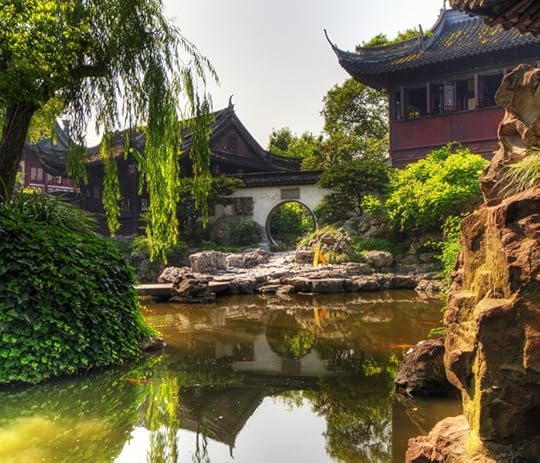
Like this peaceful setting right here....
Emmajin is one of my favorite characters of Daughter of Xanadu mainly because she’s strong-willed and so well-rounded that I find it very easy to relate to her. Her fierce determination/strengths can help achieve anything whether it’s the impossible. Dori Jones Yang creates such a realistic potrayal of a kick-ass heroine so alive and vivid on paper. It's astonishing, to be honest. I find Emmajin very relatable to read. There are many mistakes she makes, but she learns from it which helps her becomes stronger and risen to incredible heights. A horrible encounter which was deeply powerful and absolutely touching changed our female heroine for the better. This experience alters her character and results in her making a very difficult choice that will change her life. That special moment was deeply moving and Dori Jones Yang successfully handled the emotions and character development very well.
The romance between Emmajin and Marco Polo first started out as an unexpected encounter that grows gradually and slowly into a beautiful, surprising friendship that I grow to fond of. Their moments and times together always have a way of bringing a pleasant smile to my face. Their playful and cute banter strengthens their relationship with each other and is one of my favorite moments and joys of Daughter of Xanadu.
Overall, Daughter of Xanadu is an intriguing story mainly written to tell about the culture of the Mongols, a everlasting relationship, a woman’s valor in being a fierce warrior of her grandfather’s army, and the powerful emotions it has in store for many readers. I got only 2 words for you. Read it. You will be surprised by Daughter of Xanadu. (Just like I was!)
Recommended for: Fans of fantasy and adventure or those who wants to read a creative twist on the retelling of Mulan. Or those who want to read something short and sweet on a rainy-day. That--I will recommend.
Daughter of Xanadu by Dori Jones Yang is the story of young Emmajin, the eldest grandchild of the Great Khan. Her closest friend is her cousin, Suren, the eldest grandson of the Khan. Strength and fighting skills are valued in their culture, and Emmajin desperately wants to be allowed to serve in her grandfather's military. She would be the first.
Her grandfather gives her an important assignment. She is to become the companion and guide to the young traveler Marco Polo, and his father and uncle, who are traveling with them. She is basically a spy- sent to extract secrets that will make it easier for her grandfather to conquer their lands, and fulfill the prophecy from the Gods that their empire would unite the world.
Predictably, as Emmajin gets to know Marco better, she stops thinking of him as a stranger, or enemy and begins to consider him a friend, and then- more.
Although I found several parts of this story to be fairly predictable, I still really enjoyed the book. I thought that Emmajin was a great character, and we see a lot of growth in her over the course of the story. She really comes into her own. In the beginning, she is enthralled by the stories told in the courts about the mighty battles their warriors fought, and the grand acts of heroism and valor in battle. She can't imagine anything more rewarding or wonderful than being involved in something like that. But, as the story progresses, and she begins to learn more about Marco Polo's European ideals, and his desire for peace, she starts to question her belief systems, and view their culture from the eyes of an outsider. Eventually, Emmajin learns the hard way that battle is not all glory. The enemies have faces, lives, and stories of their own.
I loved watching her learn about differing points of view, and realizing that there isn't only one way of doing things. I thought Emmajin was a very well drafted and carefully thought out character. Unfortunately, she was about the only character I thought was fully imagined. Suren is Emmajin's best friend. They've been inseparable since they were tiny, and continue to be close as they grow. But, Suren is only ever fleshed out in relation to Emmajin. It's almost like he is only fully a person when sitting next to Emmajin. I felt like that about most of the other characters, including Marco Polo. To toss in a bit of philosophy, it reminded me of Idealism, which is the idea that there is no real reality. Everything we know/see only exists in relation to us. Sort of like The Matrix, except we aren't really plugged into any machines.
I wished that there had been more character development outside of Emmajin, but my biggest problem with the story was the ending. I thought that the ending was unrealistic. I don't want to go into details, because that really ruins the story, but I didn't believe it at all. I stopped believing what was happening as soon as Emmajin was sitting around the fire at the camp with Marco Polo, her grandfather and other members of the court and hunting party. It just would not have happened like that, and I feel like the author just needed a quick and happy resolution.
I do think this is a book worth reading. I wish the author had stayed a little truer to her characters when writing the ending. I think it was a disservice to both the characters and the reader to end it as she did. That being said, overall, I still enjoyed Emmajin's character and her discoveries about her world, and I enjoyed following her interactions with people.
Looking for a book for teens who crave adventure, romance, strong heroines, an exotic setting, and plenty of action? Look no further than Daughter of Xanadu, a 2011 release from author Dori Jones Yang.
East meets West in this tale of the fictional Princess Emmajin, an athletic, strong, and of course, beautiful young woman who keeps up with her male cousins in all kinds of athletic pursuits. She dreams of joining the army of her grandfather, the Great Khubilai Khan, and pursuing glory on the battlefield for the Mongol Empire, then at the peak of its power. She does not wish for a conventional pampered life of court gossip, marriage, and children like the other young Mongol women who surround her.
But Emmajin does not expect to meet the charming, handsome young merchant Marco Polo, who has come from the faraway city of Venezia, in a land known as Christendom not yet ruled by the Great Khan. They meet in Xanadu, the Khan's summer palace, with its lush and magical gardens described in Marco Polo's writings and inspiring the famous Coleridge poem. The Great Khan himself has asked Emmajin to get to know the foreigner, with the goal of gathering intelligence on their distant country. But as she gets to know the young Marco, she finds herself more and more attracted to his foreign ways, from his clear light eyes, to his strange red beard, to his lilting accent when speaking the Mongol tongue, to his gift for storytelling. As her heart's desire of galloping off with the army seems more and more possible, she is torn between her loyalty to Khan and country and her attraction to Marco. "What an impossible situation! I had always been loyal to my Khan and my people, but now that loyalty required me to make an enemy of a man who was gradually becoming my friend" When fate makes them traveling partners as they travel across China together, Emmajin with a military unit and Marco on a secret mission for the Khan, they grow even closer as they share many adventures together. But Emmajin knows Marco is not a suitable match as a husband for a Mongol princess--how will she handle this forbidden attraction, when his casual touch makes her tingle with desire?
Without divulging the ending, let me just comment that while the conclusion will probably please teen readers, it does not seem totally in keeping with the Mongol culture described in the novel. Nonetheless, I greatly enjoyed this swashbuckling tale of medieval China. Emmajin is a passionate, strong heroine facing difficult life choices as she is torn between her own ambition, what society and her family expect of her, and her forbidden attraction to a foreigner. Marco Polo himself has great appeal as a foil to the valiant Emmajin. The book is carefully researched, and full of fascinating vignettes of the exotic Mongol culture and how, at this time period, it was changing and absorbing more Chinese elements, ranging from palace architecture to the drinking of tea. Also noteworthy is the contrast between Mongol and Christian culture of the time, and the Khan's interest in hosting foreigners from all over the world.
Some readers may think the author was inspired to write this tale by the legend of Mulan, the Chinese woman who dressed like a man to take her elderly father's place in the army, she was in fact by the story of Ai-Jaruk or Khutulun, an actual niece of Khubilai Khan who accompanied the army on military campaign. Her story was told by Marco Polo in his memoirs.
I think this book will inevitably draw comparisons to Mulan, but the only similarity is that they both feature strong Asian female main characters. Mulan is Chinese, Emmajin is Mongolian. There is a difference. Also the ending of Mulan is happy, the ending in this book is left rather open, it could go either way. It is rather happy but I felt that there's enough story left to create another book but it's wrapped up semi-neatly to satisfy readers (or at least to satisfy me). I adored the historical details in this novel. Emmajin must teach Marco about Mongolian culture, through their dialogue I learned a ton of information about life for the Mongols at that time as well as life in Western Europe. The conversations between Emmajin and Marco were natural, they never felt forced as if the author needed to bring in historical information so she gave them dialogue. Instead their conversations naturally flow from a bit of shy flirtation to discussing whether or not the Pope will acquiesce to Mongol rule.
The romance is quite well done. It's not a mutual dislike relationship nor is it head-over-heels. There's a sense of mutual distrust or at least, a sense of wariness between Emmajin and Marco. The romance might develop too slowly for some, but for me, it was at the perfect pace. Seeing Marco through Emmajin's eyes was fascinating and somewhat amusing. Marco Polo has always been this distant historical figure, but now I feel as though I know a bit more about him and can (somewhat) imagine what he would have been like. A polite, charming young guy who loved adventures. I almost wish the story had been told in alternating perspectives though because I didn't feel that I got to learn as much about Marco Polo as I would have liked. Emmajin spends a lot of time with her cousin, Suren (who like Emmajin is fictional) but I don't feel that his character significantly developed nor were any of the other secondary characters.
Daughter of Xanadu is a luring tale that is impeccably well-researched, chockful of historical details that never overwhelmed me. The story is all about strong women but Emmajin never seems to be historically inaccurate in her fierceness. The ending being so open-ended is probably one of the few things that was fairly unlikely to happen historically, but since Emmajin is fictional, I don't think it's that big a deal. It would be if a sequel is made (which I hope there is!). Emmajin goes on a mesmerizing journey of self-discovery, the change is very visible, slow and genuine. She gradually begins to see her culture through the eyes of Marco and she's both shocked and pleased at how he views the Mongols. He forces her to question all that she holds dear, including joining the army. Ironically, it is the Khan whose army she wants to join that gives her some valuable advice "All enemies are people, like Marco. Every man, you kill in battle has a father, an uncle, a homeland, some skill, perhaps a sense of humor. everyone who joins the army must learn that." (pg. 131). War is hard and while Emmajin doesn't think it's glamorous, she isn't prepared for the chaotic battlefield. A small detail that pleased me: I had no idea what the dragons really were! I won't say more for fear of spoilers but once I found out what they were, it made total sense. A must-read for lovers of Mongolia, China, historical fiction/historical romance and those looking to travel via book.
Daughter of Xanadu was an interesting read for me as I have never read any books about the Mongolian empire so it was fascinating to read about it. Plus, I am not a huge historical fiction buff so this book was certainly different than what I usually read. Also, since I’m not real familiar with the Mongolian empire dynasty historical facts, I don’t know how much the author followed the actual history especially with the Marco Polo aspect. Regardless, this was a book that didn’t immediately draw you in – it took me a few chapters and then some to become slowly drawn in to Emmajin’s world of horseback riding, archery, and other “manly” skills.
Emmajin Beki was a certainly fascinating character – as the granddaughter of the great Khan, she lived a relatively lavish lifestyle yet rather than doing what usual girls her age were doing such as participating in court gossip and finding a possible suitor in marriage, her dream was to become a soldier in the great Khan’s army so she spent most of her time fighting, horseback riding and honing her archery skills. She definitely underwent a journey of self-growth and self-understanding as she changed from a girl who initially wanted to be a simple soldier to a woman who started to understand different feelings and desires by seeing things from different people’s eyes. Personally I did not find her exactly relatable but at the same time, I understood her and her values and beliefs. She is certainly a strong female character and was able to find her place in a male-dominated society. She also found her voice to speak up even though it was frowned upon and even unheard of for a female to offer wisdom and advice to the Khan.
Marco Polo was the Latin man in the book – the foreigner visiting the great Mongolian empire. He honestly was not a huge part of the book – the only times he showed up was when he was interacting with Emmajin or when Emmajin was thinking about him. Otherwise, much of him seemed to still be a mystery to me. The one thing I liked most about him was the fact that he challenged Emmajin to see more of the world around her – rather than narrowing her eyes at the empire only and serving the Khan only, he forced her to look at her beliefs with a new set of eyes. This allowed her to see Mongolians in a way other people saw them and this made her understand certain aspects that she had never thought of before. Maybe the sequel of this book will allow a better understand of Marco Polo and where he came from; however, I doubt I will actually read it.
The writing style is something I would like to touch upon here. For the most part, I enjoyed the vivid imagery that Dori drew out for me; however, there was a sense of this sort of wall between me and the characters. In some books, it is so easy for the readers to immerse themselves in the book completely but for Daughter of Xanadu, there was always that veil that somehow never allowed me to fully step into their world. There was always a clear distinction between my world and the Mongolian empire world that just never crossed. Perhaps it’s because it’s a historical fiction in a place I cannot really relate to but nonetheless, it was something that always nagged at the back of my head.
Overall, I would recommend this book to those who really enjoy historical fiction and for those who are interested in reading a book that is a little more diverse rather than the heavy-Western characters we usually have in YA.
Daughter of Xanadu is brilliant. Strong, steadfast and brave, Princess Emmajin wants nothing more than to join the Mongol army and serve her nation in the most honourable of ways imaginable: all the stories that have been passed from generation to generation, the heaping victories and the grand parades. After much strife, she is assigned a task by the Great Khan: to gain intelligence on the foreigner Latin merchants so that the Mongol army may invade Christendom (Europe). Aimed to please and to gain a place in the army, Emmajin gladly takes to the task. And then she meets Marco Polo, who seems to turn her world upside down.
Daughter of Xanadu interweaves the facts with fictional details. Before reading this, I had no previous knowledge of the happenings that surrounded the Mongol empire in its high-time of ruling. I feel that I have just come out of a really engaging, fun, stimulating and entertaining history lesson. I can say that the story was told with care. Yang really did a phenomenal amount of research for this book, so that I felt as though I was there, right where everything was happening.
If I wanted to categorize Daughter of Xanadu somehow, I think I would file it under “epic.” At least, epic in scope. The historical details are to the tee, with long descriptions of setting and relationships within the Kahn’s empire. There are numerous story lines weaving in and out, with numerous characters interacting with each other.
The main issue I had with it, though, was that I wanted it to be a bit more ambitious, or a bit less ambitious. I wouldn’t care either way, but I wanted either more of a big, huge storyline, or a more streamlined one.
I also found the character of Marco Polo…rather one-dimensional up until the very, very end. Which was a disappointment.
Other than those two things, I found Daughter of Xanadu to be lush in details (including the epic battle in the middle!), especially since this was an era and setting in history I have only remedial knowledge about. Anytime the Khan was on the page was made of win. Seriously. And I thought Emmajin’s inner-struggle with who she was and what she wanted to do within the strict rules governing her life was spot on. Really, a good, historical read.
It was one of my fastest read ever. Maybe because of its interesting write didn't allow me to read it divided. I was very got into the book, and it was nice to follow their path imagining the story behalf of her.
It is a nice story about how Emujin, who is granddaughter of Khubilai Khan of the Great Mongolian Empire is finding herself with such a different way of seeing the world looking through the eyes of legendary traveler Marco Polo. Unexpected, unexplained, and unwilling love to foreign guy made her struggle so much with herself, with her family and even with her country. But it also made her someone who has more meaningful life with such a bigger goal than being only glorious legendary first women warrior in history.
For me "Daugther of Xanadu" is definetely one of my favorite book, and it left me feel like wanting to read "The Son of Venice" of Dori Jones Yang also. I think it's gonna be very interesting to know what Marco Polo was feeling at the same time when all these things were happening to her. Even though it is dramatic novel, I just can't stop to imagine what would happen to them next once they start their journey to the "Kingdom of Christian" after all.
This book is the story of one girls fight to gain a place in a society that only accepts men. All she dreams of is to be a soldier until she meets Marco Polo, a traveler from Italy. While she wants to be a soldier, there is much she doesn't know about. When she finally starts to learn about distant lands from one who lived there, she sees that maybe being a soldier and conqureing the world isn't everything. This is a tale of adventure and excitement set in the time of the Mongols. There is also just the right amount of romance to change it from only war and action to a tale of Romeo and Juliet with a happy ending.
Daughter of Xanadu is an enchanting book. It was refreshing to learn more about the Mongolian culture at the time of Marco Polo's travels and it has prompted me to read more about him. The main character, Emmajin, is the granddaughter of Khubilai Khan. I enjoyed seeing her develop into an open-minded, strong young woman through her encounters with Marco Polo. Although touted as a Young Adult book, I recommend this book to lovers of historical fiction of all ages. It is an engaging, fun, and entertaining read.
Princess Emmajin has longed for, trained and schemed to be able to get to join the Khans army. However, just as she is about to achieve her goal, she is assigned the task of teaching a couple of foreigners their language and spying on them. From then on, every time she is almost successful of achieving her goal, she is distracted by visions of the foreigner, thus most likely proving everyone right about what a mistake it is to let her into the army.
Is this a romance? Is it a coming of age thing? Whatever it is, it isn't something that sat very well with me.
Daughter of Xanadu is an exciting book about the granddaughter of Kubilai Khan. Emmajin wants to become a warrior and must prove herself. Along the way she learns more about the greater world, rethinks her attitudes, and begins to understand herself and her true destiny. And, she meets Marco Polo!The novel is well written and provides a lot of historical information about 13th century Mogul culture . I highly recommend it.
Marco! Polo? I recall shouting Marco Polo in the pool as a child. And, wasn't Marco Polo the one who brought noodles back from China to Italy? Thanks to Dori Jones Yang for elevating my woeful knowledge of this historical figure and trabsforming him into a living, breathing character. Inside this exciting world he meets his match with Emmajin, Daughter of Xanadu. I couldn't put it down!