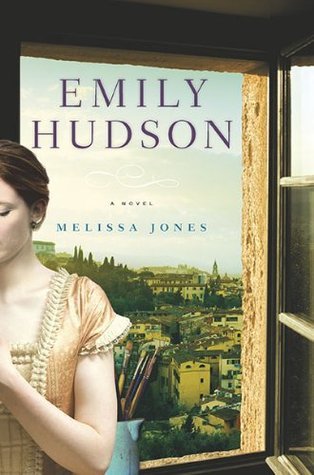
Inspired by an episode in Henry James's life-the story of an independent young woman's flight from convention.
After the start of the Civil War, Emily Hudson-an orphan who lost her family to consumption and fever-finds herself the begrudged guest at the home of her relatives in Newport. Emily's longing to be an artist is dismissed by her puritanical uncle, who wants nothing more than to rid himself of her through marriage. Her only friend is her aesthete cousin, William, an ailing young writer. When a promising engagement to the eligible Captain Lindsay is broken, William rescues Emily from an uncertain future by taking her to England. Lonely and desperate to escape her cousin-once her confidante, now her obsessively controlling patron-Emily sets out alone to meet her destiny in the eternal city of Rome.
Reminiscent of the novels of Edith Wharton, Emily Hudson is an exquisitely told tale about a heroine struggling to be true to herself, and also find love in a society where only marriage or an independent income guaranteed a woman the freedom to do as she pleased.
Melissa Jones was born in London in 1965. She has written three critically-acclaimed novels: Cold in Earth (1998), Sick at Heart (1999) and Emily Hudson (2010).
She has also written an architectural book called Interiors for Under 5s published by Wiley in 2005.
This has to be the most beautiful and exquisite book that I have read since “Stoner” by John Williams in 2015. I always know when a book is good as I cannot put it down and having read it over a two day period, my sleeping time was rather short. Sheer escapism you may wonder? Yes perhaps. What is interesting though is that "this novel was inspired by the book ‘A Private Life of Henry James: Two Women and his Art' by Lyndall Gordon, Vintage, 1999."
The one fascinating aspect is that this is an epistolary novel. The letters give a mesmerizing fabric to the work that I don’t believe would have been achieved without it.
Our heroine, Emily Hudson, an orphan, is a rather untoward, wayward young girl and inclined to follow her own thoughts and dreams, really not bothering to think before she opens her mouth. This does indeed get her into trouble as she is the ward of her uncle, who is rather religious, and it is the year 1861 when woman were more or less considered as prizes in the privileged classes to which they belonged, vying for a suitable husband. Their thinking capacity and aspirations were unimportant; producing a child and being the ideal wife was all that mattered. How incredibly boring for a young woman of my generation who like their say in everything in life! On reflection, whichever is better, I really would not like to comment on.
Now the location is Rochester, NY where Emily is considered as such an unreliable, outspoken nineteen year old that she is literally tossed out of her school and returned to a most unsupportive uncle.
Her life continues with incredible hardships but also love and passion. There are different places. In Boston, the first is Captain Lindsay who wishes to marry her and the inscrutable Lord Firle in London, who although married is captivated by her. Finally in Rome, she finds peace and is able to paint, her motivation in life but then she has to live with another enemy who DV will not thwart her?
You may wonder on the different locations, Boston, London and then Rome and it all boils down to the one person who is the catalyst and that is her cousin William. He deserves to be discussed on his own merits but not on this platform. William is an aspiring novelist and rather an invalid but for some obscure reason he is fascinated by Emily, his father’s ward and a girl with no financial prospects. You need to read the book to find out about Emily’s mother and then rather a lot will be explained. I do believe that it all gets down to genes.
Anyway, in the end William is responsible for Emily’s trip to London but he is rather Machiavellian and is following his own agenda.
Emily was a free spirit, who loved nature, the sea, especially going in it, untoward and rather like a wild creature, who I believe her cousin, William wished to control. Purely my thought.
All I can finally say is that this novel is multi-faceted, the layers are indeed quite unexpected, it is so finely written and the descriptions of the countryside are sublime. I was indeed entranced!
This book has been an unexpected treat. I started reading without too much previous research and I was more than positively surprised. A delightful and fresh prose mingles with an epistolary style, which exposes in a witty and elegant way, the feelings of Emily, the book's heroine. With reminiscences of great classics such as Jane Eyre of Henry Jame's "Portrait of a Lady", the novel finds a voice of its own resulting in an original but with a kind of homecoming taste that makes the story unconsciously appealing to the reader. But what I most valued of the novel is the way it deals with different subjects efficiently and with exquisite grace. Far from the typical coming of age novel, the story deals with much more, such as the right of a young woman in the XIXth century to be free and independent, to have a right to express her mind and to be rewarded by seeing her emerging stronger and wiser with each foe overcome. I also loved the epilogue, which stands out for its unusuality in comparison to the romantic classics, it gives the book this unique and outstanding touch. An author to be considered for further reading, that's for sure.
"Besides, in my belief, a person is always essentially themselves. That cannot be changed or altered" "But that is cultures, is it not - built on blood?"
Emily Hudson is very Bronte in its lengthy recitation of horrors and misfortune visited upon a spirited young woman, her journey from innocence into jaded adulthood and eventually, the gaining of her independence and personal freedom.
It all started very promisingly, but quickly became tedious when I realized how slowly everything was moving. The summary of it made me believe Emily would go to London, realize her cousin was a manipulative creep, and then find adventure as an artist once she escaped to Rome, where the story would really start. But Rome turned out to be at the very end of the book, so the synopses basically gave it all away, which was unusual and not a little disappointing.
Emily herself was at first a character I really liked because she was so spirited and loved to go on adventures with her best friend, but I began to hate her after awhile. It's admirable that she is a pacifist, and hates war on principle, and with good reason. But her absolute refusal to see it as an inevitable necessity was childish and obnoxious.
It's absolutely incredible to me that in the entirety of a book about an American girl during the Civil War there is not one single mention of slavery, or secession, or President Lincoln. What does she think they're fighting the war for? Catfish and cornbread? She was overly naive about pretty much everything, and it seems a massive oversight that nobody ever says anything about the reasons for a war that ate up an entire nation.
Emily was actually pretty dumb, in my opinion. She lives in a self-centered bubble where hanging at the beach, protesting a war that's being fought to secure human freedoms, and looking down on girls who like to giggle and shop for hair accessories makes her really special. She's the original loner girl who thinks she's too cool for everyone because she's got opinions and makes art. If she lived today she'd have a really dumb blog.
Now that I've written that last part of this review (which started at 4 stars) I realize I don't like this book or its heroine as much as I thought I did.
“‘Are you not aware that too much thought is bad for the female nerves?’ ‘Did you not only a moment ago say that it was wrong for women to be unthinking, Sir?’”
Orphan Emily Hudson (nearly eighteen years old) is sent to the home of her uncle after being found by her school mistress to be disruptive, “too vigorous, too quick to question”. But she can also be remote, choosing to be with the cat rather than taking part in activities with the other girls. Except of course in her friendship with Augusta Dean where Emily is deemed to be a bad influence.
This is partly an epistolary tale as Emily pours out her thoughts and feelings in letters to Augusta, but it is in the letter to Augusta in which she says almost nothing that she reveals a great deal to the reader. The storyline pretty much takes second place in this novel which focuses on Emily's thoughts and feelings. She feels growing isolation as she can do nothing to please her uncle and aunt, and she is sent to her room on the slightest pretext. Her uncle reminded me of a boa constrictor trying to squeeze every bit of joy and spontaneity out of her. Even her cousin Mary acknowledges: “‘This is a nest of vipers, my dear girl. You are not safe among us.’” Her cousin William is fascinated by her - her exuberance, her outspokenness, her keen intelligence - and initially he is a comfort to her. He is apparently kind, but he behaves in an insidious and duplicitous manner which is soon revealed to the reader, if not to Emily. William is obsessive and is an ace manipulator. He gives Emily metaphorical wings, and then he cuts them.
Not everyone is unkind to her, and she does experience love and friendship. But she lives in a society where there is little, if any, freedom for a woman to express herself in art or opinion. Saying what she thinks invariably gets her into trouble, and causes banishment of one form or another. At one stage Emily longs to be uncorseted, but even there she is thwarted - no freedom whatsoever! And in the nineteenth century women are kept dependent on men, whether it is a parent, an uncle or a spouse. If the woman isn't on the arm of a man it is unseemly for her to enter an establishment where she might dine or have tea on her own. Even having a cup of tea with a gentleman when being unchaperoned is something to worry about, and leaves feelings of guilt. The slightest incident could cause a lady to lose her reputation, and once a lady is ruined... well, no decent person will want to associate with her. Indulging in literary endeavours or art is fine as long as they are only dabbled in and not taken seriously.
Emily finds much ambiguity and many contradictions at home and in society, but she learns to keep her thoughts mostly to herself. She finds consolation in nature (particularly the ocean), her art, music, and her correspondence with Augusta. On seeing Bernini's sculpture of Daphne and Apollo she is enthralled by “the sense of longing and flight”.
##### Author's Note This novel was inspired by an incident in Henry James's life, but is not a retelling of that event.
This was author Melissa Jones's motivation: “So in the book there are three things I wanted to explore: the plight of women in the nineteenth century; the relationship a writer has with his inspiration; and the possibility of finding love without money - most nineteenth-century novels do not allow that to happen."
"My book is very much about overcoming enormous odds, about growing up, about realising what love really is.”
The authors succeeds admirably.
##### Excerpts: “It seems I am to do as I please, within his limits, but be watched closely. Yet how can I be watched if the people who are watching do not see?”
“You will be glad to know that I have refrained from engaging anyone on the subject of the cruelty of war; I would doubtless be reprimanded strongly. It seems mankind feels compelled to consume itself either from within or without.” (At that time the American Civil War is raging, and in Italy the Unification is taking place. The action in the novel takes place in America, England and Italy.)
“‘It is only to achieve our ideals that we fight.’ He was measured and sure. 'Fighting is the enemy of ideals.’”
“High spirits brought on by the beauty of the day caused me to forget myself - that is I treated the breakfast table to a glimpse of my happiness, and I do believe there is nothing this family hates so much as happiness."
"My uncle is deep into a treatise on The Blasphemy of Thought."
“In this unknown country there was so much to look at but - she quickly discovered -very little to say. Nobody wanted to know what she thought and felt about anything, even while they were admiring her with their eyes."
"I shall write to you when I am no longer poring over the obscure map of the future. When I can decipher it, you shall hear."
‘You should be forgiven for making that mistake. So few people listen and think at the same time, don’t you find? Particularly in the presence of beauty.’
‘It is strange how in this English light the wishes and the answers do not appear the same.’
"‘I am no patriot, Sir,’ said Emily. ‘Merely a human being who cannot abide a stupid opinion.’"
"She would not have him. But indeed to what does she succumb in his stead? The tendrils of the tree, the leaves, the solid imprisonment of herself?” [Daphne and Apollo]
##### I felt quite wrung out after reading this novel - pretty much how I felt after reading Stoner by John Williams.
I was so excited that I won an advanced proof of this book from Goodreads giveaways. The novel’s synopsis seemed rather promising, as it was “inspired by an episode in Henry James’s life.” Basically, a notable Henry James expert and biographer theorized that James had been in love with his cousin, Mary (Minnie) Temple, with whom he shared a lengthy correspondence, though he never acted upon his feelings. She’s also supposedly the inspiration behind James’s most noteworthy heroines: Isabel Archer, Daisy Miller and Milly Theale. Interesting to note that upon Minnie’s death from consumption at age 24, he destroyed all of his correspondence to her, but preserved her last three letters to him. And in essence, the story of Emily Hudson stems from this theory.
Unfortunately, Melissa Jones’s take on this theory didn’t live up to my expectations. The best summary for this book I think comes from Emily’s own reflections, “[She wondered:] if William had indeed been right: she merely flitted from feeling to feeling, loyalty to loyalty, and had no anchor of any kind.” Emily’s progression throughout the book is truly a mess! The book spans her various experiences from age 19 to 23, through a mix of narration and an epistolary format. Initially, Emily appears youthful and impulsive. She’s very free and open in her comments and I could understand her cousin William’s initial interest in her. And I liked her budding relationship with Captain Lindsay.
What killed this book for me was the second section, which highlighted her antics in London. This section sullies the image that the reader’s formed of Emily—from youthful exuberant innocence to willful duplicity and melodrama. She knowingly engages in a relationship with Lord Firle, a known philanderer, despite having been previously warned of his wicked ways by several acquaintances. Yet, while she engages in this affair with Firle, which fills her “with an improbable overweening joy,” she still claims that she has feelings for the Captain. Yuck! I was waiting for her cousin William to pull her aside and tell her off, but as her actions got worse, he gradually pulled himself away, leaving her to her own devices. What a disappointment.
The third section, which describes Emily’s convalescence in Rome, (she suffers from consumption, an illness she exacerbated by spending an evening out in a storm, followed by a dip in the ocean) was slightly better. But it tries to write off Emily’s actions as merely being the impulsive actions of youth. I’m sorry, but too much had happened for her antics to be solely categorized under the label of “youth.”
Despite those problems in terms of the plot, the writing isn’t that bad, and I rather liked the pairing of narration and letter writing. It gave more substance to the characters. If I compare this book to other examples of historical fiction that I’ve read, I consider this book better than Victoria Holt’s Mistress of Mellyn, but not as good as some of the Catherine Cookson novels that I love.
This is one of those books that had I been able to Look Inside! over on Amazon, I would have known immediately that it is not for me.. I've heard stories like this referred to as Jane Austen style. I have never read Jane Austen or if I did, it was so long ago I don't remember. The prose made me think of Georgette Hayer minus all the fancy words. At least this one didn't have me running to the dictionary every 2 minutes.
The story is SLOW and half of it is told thru letters. Now some people like that.. I don't. It's basically one pompous, polite, and proper conversation after another either between Emily and her cousin, William or Emily and the captain, or.. well, you get the drift. What we don't find out thru pompous, polite, and proper prose, we find out in these annoying letters (all in italics) to her very dear friend, Augusta. Personally, I thought there was more to this friendship between women than meets the eye but I'm not saying a thing more..
Emily is kicked out of school. She has to live with her uncle. In order to escape her uncle, she leaves with her obsessed cousin, William for England.. Then she has to escape William... and la de da.
I understand this is based on a real life woman that inspired some writer named Henry James.. I don't know who he was. If I had read his work, I probably would have appreciated this more.
I am a person who really enjoys historical fiction, and while my particular interest usually lies in Tudor England, I also have a great love for the Victorian era. In the past several years, I have read several really good books by modern-day authors written in the Victorian tradition, and this was one of them.
Lately, I've just felt the books I've been reading were "so-so". This one grabbed me from the beginning and had me hooked until the end. There were lots of unlikeable characters, tons of importance placed on the manners of the day, and all sorts of little subtleties to the plot. The ending was tidy, and a little of what you would expect, but I found myself relieved when things turned out well.
I don't want to say much about the plot, except that Emily Hudson was orphaned as a teenager, and was considered "wild". Her Uncle took her in, and thus began a series of controlling types that continued to influence her path, for good or bad. Some have commented in other reviews on the lack of discussion material here, but I believe I could find a lot to talk about-- whether it was the culture of the time, or the themes of friendship, love and control.
Emily Hudson is the story of a free-spirited young woman who must make her way in a late nineteenth-century world of constricting corsets and stifling mores. Her winding path to independence requires that she free herself from the demeaning and manipulative male figures in her life while navigating unfamiliar romantic territories.
The plot and characters of this book immediately bring Henry James’s The Portrait of a Lady to mind, much to its detriment. Unlike James, Melissa Jones, the author of Emily Hudson, creates fairly unlikeable characters, introduces them in ways that seem unnatural, and forces the development of their relationships in quick and irrational ways.
The novel does pick up steam around page 200, but this unfortunately does not entirely cover the earlier wrongs. I did not find myself attached to the protagonist and did not fully buy into the ending of the book as the natural outcome for the story.
Pleasantly though, this book is only 360 pages unlike James’s 600+.
Note: I received this book for free through Goodreads First Reads.
Q: What’s the difference between a three and four-star book rating?
A: A plot.
Although this novel delivered the extraordinary cast of characters so similarly used by classic authors and dialogue that can almost rival that of Jane Austen herself, plot was the one feature that was missing from the pages. If books were food, this one would be an unfinished burger. Without the substance of a plot, like the lack of patties in a hamburger, the novel is only held together by two slices of who and where while disregarding the what or why.
The bread of the book is the sophisticated style of storytelling written in the vein of Jane Austen and largely reminiscent of Emily Bronte. Fans of both will be delighted to see resemblances in Melissa Jones’ Emily as a classy heroine of which Austen is famous for portraying and similarities in Bronte’s infamous and extremely unlikeable Heathcliff in Jones’s William Cornford, the difference being in William’s milder personality that can’t quite equal the volatile attitudes of Heathcliff. It was refreshing to witness a modern-day writer tackle the 18th century characteristics of complex personalities in literary characters.
All in all, I am left with the impression that Melissa Jones has major potential in becoming an influential author in an age where classics like Pride and Prejudice and Wuthering Heights go largely ignored in preference to movies based on books and Cliffs Notes. With an impressive debut novel, Jones may eventually inspire short-cut readers to feast their eyes on the written word instead of the movie screen.
This novel is a puzzle to me as on the one hand, I loved the Victorian atmosphere of the author's writing, on the other, the entire book read like an outline for four or five prospective novels, all of which were dropped like participles from a sentence and left undeveloped. Point one: The first chapter makes me feel like I am to meet a spirited heroine like Anne Of Green Gables. Instead I meet a girl who is fearful of her own shadow and so worried about what others think of her, she can barely function at all. Point two: She never meets the men who show an interest in her for more than a couple of times before she promptly tells them to forget her. Yet one man who she barely knows and has only spoken to a few times, she continues to pine for. If I meet a man a few times and then he vanishes from sight, I can promise I will forget him within the week! Point three: The dark character of her cousin William, the most prominent man in her life is never developed into any depth. I do not know how this book got into publication because there is no development of romance in here and when we get to the moment the first man comes back into her life, the book slams shut, all courtship, romance developing and so on entirely skipped. There is also no development with any of the other men in this novel as they seem to pop up and disappear just as fast. Point four: I found many dispensable characters in here. I also think Emily's poor health could have been dispensed with. Readers are not looking for a Victorian character expressing herself through letters and showing signs of hysterics, a common female complaint in those days. We want a good solid romance. We want to see it developed. We want to see the characters grow in their love and at the same time develop depth. What are the motives of the darker characters in the book? Is William bisexual, gay? what is this obsession with his cousin? We never find out. Too many questions remain unanswered, too many threads not woven into a whole. I think this author should rethink this book and go back and write a real romance as this one has proved disappointing. I can not even call it a romance.
I thoroughly enjoyed reading this book of 19th century manners. It concerns the dilemma placed on Emily, a young girl orphaned when her parents and siblings succumb to consumption. She is ahead of her time with an independent spirit that refuses to be reigned in by her austere relatives with whom she’s been sent to live. An interesting account of Victorian traditions and the formality and stilted speech they used to communicate. Jones does a good job relating her story by using 3rd person narrative combined with letters written by and to Emily—the transitions are smooth.
It is not a novel, however, that provokes deep thought, but a light and enjoyable read with many customs of the time that either upset me or made me want to laugh. My husband and I often share what we are reading and when I told him about the doctor’s cure for Emily’s cousin Mary’s nerves was butter (which did calm her but also made her plump), we found a good solution for minor disagreements. Now, if he or I get a little testy, we just get out a stick of butter (or threaten to) and have a good laugh. We don’t make Mary’s mistake of eating it.
The back cover says the story was inspired by an episode in the writer Henry James’ life and I’m curious about the particulars of that. As Emily’s cousin William, James is not portrayed in a very flattering light. I’ve never read James or know much about him, but if Jones’ impression is correct, he was portrayed as a rude, pompous, pathetic jerk. But back to Emily—I thought it interesting that every man she meets is attracted to her—was she that beautiful? Or did they secretly admire her independent spirit? Or, were they just bored with the typical Victorian female who apparently spent her time sewing and being seen but not heard???
This is a book where I could have used the half star rating. I enjoyed reading it—the story kept me entertained. But, it isn’t a book of profound literary merit nor one that I’d necessarily read again. It’s good, not great. I’ll give it 3 stars, but it deserves 3 ½.
I loved it the connection with Henry James and everything. The consequences of TB for me was all the more poignant ad i am a fan of the Brontes who also shared similar tragedies. Writing that is told through letters is a favourite of mine want to read more books from her.
Good story, easy to read, a few of the character's seemed a little over bearing. It ends abruptly. The traveling to England and Italy at the time of the Civil War was interesting.
This is one of those novels that is just so beautifully written that you want to forgive it anything. That doesn't mean I disliked it or thought it was beautiful yet shallow, because I did like it and it isn't. The whole book is told from either Emily's POV or in letters back and forth between Emily and others. I usually don't enjoy these books that much, but it really worked for this one. The story was well told, of a girl becoming a woman in a time where women had very little to no control over their own lives. Emily has no control, but she finds a way to grab hold of a piece of life for herself. Parts of it were so well written I was actually reaching for the tissues, which I rarely do while reading.
That being said there are a few things I think take away from 5 stars: -It's the Civil War, but it is barely mentioned. -She does surprisingly little for herself, and must be nearly shown how to live -She sort of falls in insta-love, then falls deeper by letters, which I guess is okay, BUT -She comes off as lesbian in EVERY letter between her and her "BFF" and was kicked out of her finishing school for being "too close" to this girl and potentially "corrupting" her. -Yet she ends up with a man with whom she seems to have little chemistry because his whole appearance in the book takes up maybe 10 pages compared to her bff's like 3rd of the book.
I feel like though it wasn't intentional, there was some queer baiting going on. Don't get me wrong, as a bisexual woman I want more bisexuals in my books, but I also recognize a lesbian when I read one, and that girl needs to have her girl. At least she got her mostly HEA.
This entire review has been hidden because of spoilers.
-absolutely hated William. Great characterization, and showing lines in manipulaitve relationships where you trust, and want to please, even while something is saying it's wrong -why did a review say "erotic?" It's not -strong heroine, yet not without a heart -love that there was a happy ending, I expected demise -love how fear of consumption is sprinkled throughout, and Emily's love for life and clinging to it makes more sense as story goes on -also love how she matures in and thru hwr spunkiness, and how she makes stupid mistakes -not the best thing I've ever read, but still quite good.
This entire review has been hidden because of spoilers.
This book was a Christmas Gift given to me as "A Blind Date with a Book" of historical fiction. Although not the typical historical fiction I normally go for, I did enjoy it.
The book is loosely based on author Henry James and his relationship with his cousin Minny Temple. In this book, the role of Minny Temple is the heroin Emily Hudson. The book explores Emily's relationship's including the one with her cousin William Cornford (representing Henry James). Emily is an orphan and when she is kicked out of school she is sent to live with her Uncle's family.
I was surprised how much I liked this story after the negative reviews. But I love great characterisation, and someone maturing in their own time and gaining their own agency.
Emily Hudson is orphaned and taken in by a stern uncle during the civil war. She is unconventional, and not trained in high Boston society of her times. I found the book historically interesting with a surprise ending!
Story supposedly loosely based on Henry James and his cousin. The writing style is very similar to James’, with many inane conversations that have no meaning and say nothing. No action and slow and repetitious. Gave up on it after the fifth chapter.
Heartbreaking and yet inspiring. Women's place in the 20th century was untenable and I felt myself getting quite angry at parts in the book. Very definitely worth a read.
This book exceeded my expectations and the ending surprised me. Emily Hudson is a novel told in alternating epistolary and narrative style about a young woman who experiences a series of trials and a world that continually thwarts her true desires. Orphaned at a young age, dismissed from boarding school, disapproved of by her uncle, and constantly making faux paus that encourage the wrath of her family, Emily is a headstrong young lady who wishes to be an artist and choose her own path in life.
I did feel at a disadvantage because I am not familiar with the Henry James' story that inspired this novel and so cannot comment on the similarity in this novel and was unable to recognize where the novel followed or diverged from its source.
From the very beginning, it is clear that Emily's personality is at odds with the social conventions expected of women at that time period. The book opens with Emily being asked to leave her boarding school because of her "extravagant friendship" with another student and her other many faults: "she is too vigorous, too quick to question, and her temper is variable. You will not find any consistency in her behavior. She is by turns bewildered, good-humored, angered, merry, pained and aloof. She always says what comes into her head, as if she has a right to her peculiar thoughts. She laughs loudly. She is untidy. She almost expects to make an impression. She suffers from a lack of meekness, a lack of decorum, a lack of discipline. It is as if she is surprised that there are rules by which she must be controlled" (5-6). Yet despite everyone's judgment that Emily has no discipline or control, I was impressed by Emily's convictions to stay true to her desires and her ability to reject temptation. Although repeatedly tempted by Lord Firle, ultimately, Emily is able to make the right choice for herself; "Wrong for my soul. And I do not care to be ruined. I am to be an artist. Not some ruined, dying girl" (251).
Emily's cousin William seems to be the only relative and friend Emily has that is willing to come to her rescue. William offers to take Emily to England after a marriage proposal falls through. Yet unknown to Emily, William is deceiving Emily and manipulating the course of her life through several secret correspondences with those in Emily's life; "This letter is written without my cousin's knowledge, for reasons I am sure you will understand" (166). I was relieved when William's true character is revealed to Emily, because his generosity did not excuse his behavior.
It was odd to me that one of the main characters in the novel, Emily's boarding school friend Augusta, is not present until the last chapter of the novel. Emily writes letters to Augusta throughout the book, and despite the fact that the novel shows reply letters from other characters, none of Augusta's responses are featured. This is, of course, a great way for the author to directly write about Emily's private feelings, yet it did seem odd to never hear the voice of Emily's great friend and presumably a great influence on her life. Augusta's arrival in Rome to visit Emily at the end of the novel seemed like a long overdue meeting with her mysterious, yet faithful school friend. It was also interesting to have a book about an American in the Civil War for whom the war seems such a minimal event. Although she has several cousins in the war, Emily, and her overseas correspondence even, seem largely unaffected by the war.
I was surprised by the ending yet satisfied by it. It feels as if Emily got to truly explore who she was as a woman and confront her fears of illness and loneliness and was ready to welcome her fate by the conclusion of her story.
Para começar devo dizer que este livro é e sempre será especial para mim por ser uma prenda de dois amigos trazida duma cidade que nunca visitei mas que domina o meu imaginário e que conheço e amo de filmes séries e outros livros, por isso, já é especial independentemente do seu conteúdo.
Devo também dizer que desconhecia por completo esta escritora e como tal foi com curiosidade que iniciei a sua leitura, mas como sempre para dizer se gosto ou não do seu trabalho de uma forma justa terei que ler outras obras dela para emitir uma opinião válida e justa.
Gostei da personagem principal mas realmente por ser produto da sua época e pela educação que era dada às mulheres nessas alturas, a transformou numa mulher ingénua, imatura e algo frivola, mas louvo a coragem dela de ir contra as convenções, e aventurar-se a ser independente (mesmo quando obviamente dependia dos desmandos do primo) em perseguição do seu sonho e dos seus ideais, e também valorizo a sua noção de amizade leal e constante tanto como com a melhor amiga como com Miss Drake, Miss Caroline.
Achei algo rídicula a separação dela e do Capitão Lindsay,mas compreendo que a autora desejasse arranjar algum motivo (fraco na minha opinião) para que a vida romântica da protagonista não fosse simplista de mais...
Gostei da surpresa de uma Miss Norton, com quem simpatizei apesar do seu ar inicial de mulher austera, e dos poemas de Elizabeth Browning's Sonnets from the Portuguese.
Gostei tb das imagens de Italia mas achei pouco detalhe na descrição de Londres, Boston e Newport. Em geral gostei da história e do final tb.
-----
To start I have to say that this book is and will remain special for me because it was a gift brought to me by two friends that visited a city that lives in my imaginarium I have never visited but I know it from books, movies and series and for that alone makes it a very very special book for me independent of it's contence.
I also must say that I'm unfamiliar to this author work so I was curious starting to read this book and I think that I can only validate a fair opinion on her and her work if I'm to read any other work of hers and I intend to do it soo.
I Like the main characther but because she's a product of her time and education, she end up being, in my humble opinion, a little imature and naíve but I comend her loyal and constant fridship towards people, and her courage to seek independence and to mark off conventions, (even under her cousin's unseen grip) to chase her dreams and ambitions.
I fond somewaht ridiculus the breaking up off her and Captain Lindsay, but I that the author wanted a not so simple romantic life for her caracther...
I liked the surprise of a Miss Norton (my family name)with whom I simpatized, even with the initial air of severeness, and was surprise by the offer of a Elizabeth Browning's Sonnets from the Portuguese.
I liked the Images of Italia and the rest of the location of the book, but I found the description little detailed. In sum, I liked the story and the ending also.
I received this book from Goodreads' First Reads giveaway. I note that the story is inspired by an episode in the life of Henry James. While I am unfamiliar with the man's life, I have read several of James' novels. I saw a bit of Daisy Miller as well as a smidgen of Washington Square in the tale of Emily Hudson.
The story takes place over the course of the Civil War and the voice is true to the period. I have to admit that I had difficulty in the beginning of the book, as it shifts from letters of correspondence to narrative. However, once I was accustomed to the flow of the story, it was quite engaging.
Emily Hudson is thrust upon her maternal uncle after being asked to leave her school due to the "unsettling effect she has on her fellow students." She is alone in the world, her entire family having succumbed to illness. It is obvious from the beginning that she is unwanted and unwelcome. Emily is a free spirit. Her uncle is staid, humorless and deeply disapproving. Her aunt is silent and stiff. Her cousin Mary appears to both disapprove of and envy Emily's desires to be her own person. Cousin William is the only one of the family who seems to appreciate Emily's pluck.
She wants to return to school to learn art. Her uncle simply wants her married and out of his house. She reminds him of his sister... of whom he disapproved. He finds Emily too willful, too opinionated, too unkempt, too flighty, too free.
Emily finds a kindred spirit in a young man who is soon to leave for the war. However, when the illness that took her family from her threatens her as well, she turns away from him, not wishing to burden him with sickness. Cousin William rescues her from her unhappiness and arranges to take her to London so she can study art. However, his expectations become increasingly oppressive and he becomes as critical and disapproving as her uncle. A poignant moment occurs as Emily asks her English friend, Caroline, if they might leave their corsets behind while they are vacationing in a rented house. Caroline laughs and answers "But of course we cannot, my love."
I thoroughly enjoyed Emily's journey from young orphan to confident young woman. The book brings forth so much emotion that I found myself actually commenting out loud on occasion. I laughed and cried, separately and together. I am very happy to have been given the opportunity to read Melissa Jones' novel and I look forward to her next venture.
Emily, an orphaned young lady, is returned to her uncle from her boarding school due to her "unladylike" behavior and influence on another student, her close friend, Augusta.
Emily lives with her uncle whom treats her and all others without any tenderness or affection, he is consumed in his study of theology with no time or patience for Emily
Her cousin William, selfishly, nurtures her independence, sabotages her marriage proposal to captain Lindsay and invites her to come abroad with him to London to pursue her career of study in the arts....
Eventually Emily runs away to Rome after her last illness with consumption and there she truly flourishes, under the tutelage of Miss Drake, matures, and realizes how much she cares for Lindsay, after making contact is MIA in the Civil War...epilogue ends nicely with a telegram that after a year he is ok and wants to come to Rome...they marry and finally Emily can have a chance at some happiness in her life
Setting: Newport, Rhode Island, Emily is sent to the home of her uncle, in the summer after being dismissed from her boarding school. He is strongly opposed to her unladylike manners. Her family died of consumption (Charlie bro, Isabella and Helena)
In the fall she is invited to live with them among the high society of Boston, Emily struggles to find her place, her personality being refined and molded into the type readily accepted in her day
After refusing proposal of Captain Lindsay (she fears consumption will eventually be her demise, as with her family) , Emily is invited to live in London with her cousin William. He sets her up in her own two roomed place, enroll her in art school, dines with her rarely, and leaves on her own, while he attends to his career in London.
Emily suffers badly with her lungs (coughing up blood after running away to the ocean after a disagreement with her cousin)
After she has recovered some, William invites her to a dinner party, she's much smaller than she was before due to her illness, but she is excited and resolved not to embarrass her cousin by speaking her mind and opinions. Of course this doesn't work out as she planned...a gentleman riles her by challenging her presence in London, and her thoughts about the savagery of the war....
Henry James from the POV of one of the models for his characters--what's not to like? Read The Master by Colm Toibin as well for a balance, and then reread The Portrait of a Lady. Ralph becomes deeply sinister from that perspective.
As a novel in and of itself, this one is structurally flawed (see And They Lived Happily Ever After ending for the most egregious example). But not enough to discourage this reader.
The use of letters is a potent device when handled well, as Jones often does. What is omitted from a letter is crucial to our understanding of James' processes and of the way of communication/obfuscation of the times. Perhaps the inclusion of Cousin William's letter to Capt. Lindsay could have been left out. I prefer not to be beaten insensible with plot points. And in places Jones gets lazy and uses letters, especially toward the end, to share plot movements, and this subverts the more subtle art of her other uses.
As always, when a modern woman writes of one 150 years older than she, we get a few odd anachronisms. But they are very few, and not so jarring as one finds in other books of the type where Our Heroine, although acting in the middle ages, or Regency England, or the court of the Sun King, appears to have been born and bred in the US in 1983. Emily's impulsivity (by Victorian standards) is believable, given her upbringing and heritage.
The relentless shaming of her cousin and his family as well as the social norms she continually offends results in apology-itis, a disease still prevalent among girls and women today, and possibly more damaging than consumption. But this reader wondered if her case of it would have been so severe if she had not also been exposed to the severe corrections in childhood. One wonders if the excessive sorry-for-living attitude isn't more the author's than the character's.
I heartily recommend this novel as a satisfying read, and a welcome addition to our vision of who Henry James was as a human.