Jenny Nimmo was born in Windsor, Berkshire, England and educated at boarding schools in Kent and Surrey from the age of six until the age of sixteen, when she ran away from school to become a drama student/assistant stage manager with Theater South East. She graduated and acted in repertory theater in various towns and cities: Eastbourne, Tunbridge Wells, Brighton, Hastings, and Bexhill.
She left Britain to teach English to three Italian boys in Almafi, Italy. On her return, she joined the BBC, first as a picture researcher, then as an assistant floor manager, studio manager (news) then finally a director/adaptor with Jackanory (a BBC storytelling program for children). She left BBC to marry a Welsh artist David Wynn Millward and went to live in Wales in her husband's family home. They live in a very old converted watermill, and the river is constantly threatening to break in, as it has done several times in the past, most dramatically on her youngest child's first birthday. During the summer they run a residential school of art, and she has to move her office, put down tools (type-writer and pencil, and don an apron and cook! They have three grown-up children, Myfawny, Ianto, and Gwenwyfar.
Another in a subgenre of children’s fantasies that plays with elements of Welsh myth and legend, as in Susan Cooper’s The Dark is Rising series and Alan Garner’s The Owl Service but Nimmo’s stories don’t have the complexity or emotional heft of either Cooper’s or Garner’s. All three of Nimmo’s books deal with some element of familial trauma: the loss of a sister; a broken relationship and presumably post-partum psychosis; and, in the particularly problematic final piece, a soldier relative who’s recovering from PTSD after a tour of duty in Belfast. The first novel’s by far the strongest, part supernatural tale, part glimpse at the Otherworld inhabited by the Welsh fair folk who spirit away human children, all mixed together with a coming-of-age narrative focused on young, farmer’s son Gwyn who’s inherited magical powers handed down through generations. But a balance between reality and fantasy is never really achieved, the fantasy elements are underdeveloped, hinted at but too vague and sometimes formulaic. There are some wonderfully atmospheric passages and I liked some of the folkloric content. But there’s a general tendency for the writing to be overly literal and clunky, also the representation of gender tends towards annoyingly broad stereotypes, in which man equals action and woman equals domesticity. The final instalment exploits aspects of the fraught situation in Northern Ireland during the late 80s, portrayed in a way I found extremely off-putting and incredibly simplistic, as was the aspect of the story centred on an older male villain who’s apparently irresistible to women and very young girls. A disappointment overall, but the first novel works well as a standalone so it’s worth a try for anyone who enjoys this kind of escapist, mythic fantasy.
“Time to find out if you are a magician, Gwydion Gwyn.”
This book. This book. I always wondered when I read reviews that start with “This book”… I mean, what does that even mean? This book….what? Now I understand. Because, guys, this book.
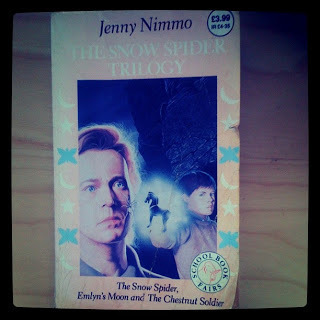
I first read this book (I don’t really need italics do I? You get it. I love this book) when I was eight. I found it in our ‘library’ (we don’t really have a library by the way, we had a book shelf that we called the library) and I was intrigued instantaneously. OK, well no… that’s a lie. I was terrified instantaneously because this is my cover.
Isn’t it horrifying? And retro? And horrifyingly retro?!
Anyway, I picked it up and devoured it and it instantly became one of my favourite series.
Fast forward a few years when I was cleaning out my room when I had returned from university and I was suddenly inundated with Norton Anthologies and about three copies of Heart of Darkness (I swear they multiply) and I found my copy again. After the initial “What is with this cover? I fear it may be possessed by evil!” panic, I opened it with giddiness knowing that I had loved it but not really remembering why. I read the first chapter, and then the second and then about an hour later, I realised I’d actually read the first book. Twenty one year old Jo was no longer allowed to exist because eight year old Jo had pushed her way forward and was currently immersed in a land of magic. And if that wasn’t lovely enough, I realised/remembered that these books were set in Gwynedd where I went to university. It’s like it was fate… except I wasn’t a magician.
Or a farmer.
Anyway, when I decided I was going to do a Welsh Week on my blog, I knew that this series had to be featured because, to me, it is the ultimate celebration of all things Welsh.
In three books, you have Welsh culture, myths, legends, traditions, sheep (no seriously, sheep play quite a big part in the first book), other worlds, magicians, cursed toy horses, possessed strangers, mad princes, art projects, a passionate celebration of all things natural, family, community, the importance of friendships, trust, malevolent forces, sheep dogs, unicorns (I know, right?), children getting into mischief and going against their parent’s wishes, ships made of seaweed, glow in the dark flowers, cake.
And that’s just a snippet.
I tend to read these books in one go so, to me, they are all one book but if I had to pick my favourite it would be Emlyn’s Moon, the second book. Here we meet the wonderful and brilliant Nia Lloyd, the middle of seven (soon-to-be eight) children who befriends a mysterious boy named Emlyn and his father, even though she is told to stay away. It’s all about family secrets and dark forces and the past and feuds and magic. Also, arts and crafts projects, which I feel is an extremely underrated subject in children’s fiction. I know a few people might be a bit “Um…?” about the lack of world building in this series and, even though this book and I are for keeps, I am not completely blinkered. I understand that the magic and the shenanigans that happen within this book aren’t feasible, even in Wales where dragons roam free and where spoons are classed as magical instruments of love. And I know that there are plot holes and there are unanswered questions but even in the bestest of books you get them. And, whatever, I just don’t care. Maybe I am a little blinkered, I think that’s allowed with your favourite children’s books though. Magic happens in this book and you have to just go with it. This is a series for people who can believe in magic unconditionally. I am one of those people and I hope to be one of those people forever and ever.
It's like the author read The Dark Is Rising Sequence, thought, "I could do that!", but couldn't. A 2-star rating might seem mean, but hear me out.
Normally, this would be a lacklustre "3" from me - forgettable, somewhat disappointing, ho-hum.
The big issue I have with this is that the first book (the titular The Snow Spider) came out in 1986 (1989 for the last in the trilogy, The Chestnut Soldier), and this has been in print almost continuously since then until 2018ish. And it might be reissued again soon, seeing as even Goodreads has this listed as a 'classic'.
It's just NOT that good. It really isn't. And I read a lot of bad, cheap children's lit from yesteryear (Armadas and Topliners amongst them, to give you some idea).
Everything about this series sounded ideally suited to my tastes: juvenile low-fantasy, Welsh mythology, a boy wizard... And yet the reviews..! I try to expunge Goodreads reviews immediately from my memory if I have decided to place a book on my 'To Read' list. They're full of spoilers anyway (I'm the sort of person who won't even read the backcover or inside flap of a book before reading it in its entirety!). All I really use them for is to make the decision as to whether or not I should seek out said book.
And though I put this on my 'To Read' list years back, I can still feel the trepidatious uncertainty with which I clicked that green button - there were negative or at least lukewarm reviews by people who really know their books, and by people with tastes akin to mine. The warnings were there. I overlooked them. The overall average rating of this was too high to ignore - maybe those reviewers I remembered were somehow wrong!
They weren't. I've learned my lesson. I've even got an 'Uncertain' list set-up, and though this one fell into the wrong pile, the next that has those sorts of reviews from experienced readers might not. NB - I did order in a copy of this because the 'spider' in the title satisfied a reading challenge requirement. So it might have languished in my book purgatory longer if not for an opportune title.
This particular copy won me over because, hey, all 3 books for a little more than the cost of just the first in the trilogy? Deal! Also - pretty irridescdent cover! Unfortunately, in the last quarter or so of this edition, the proofreader must've fallen asleep: strom for storm, errant periods in confusing locations that cause you to re-read sentences, a ' where perhaps a sentence break was overlooked, Even instead of Evan, and an 'on' for a 'no'. There were others, but I didn't start keeping track until there were too many to ignore. If you hate typos, this edition (Egmont, 2018) should be avoided.
Seeing as these stories are nearly 40 years old now (!), I'm sure any criticism I'd level at it now would be a bit late to be useful. But, if only to assuage my guilt at slapping a 2-star rating on this, I'll quickly summarize:
- I didn't like a single character. Not one. I might have, had they been less.. well, I'd say 'wooden' or 'cardboard', but I think "1980s Day Time Soap Actors" is the best. Unconvincing. It was honestly like reading the script for a play - missing a lot of inner life
- I really don't care for Jenny Nimmo's style of writing. I haven't read her Charlie Bone series, and at this rate, I likely never will. There's an awful lot of 'telling rather than showing' going on, and, oddly, sometimes not enough of either. She'd just sort of state what had occurred in climactic moments, and I'd spend the whole time thinking, "No... no, you have to flesh that out! What just happened?! A magic system needs to be carefully nurtured and then clung to! Here you are just chucking this exciting turn of events in, and seemingly out of the blue, and then not even retroactively explaining (sufficiently) what went on, how, and why, and what it portends!" Sloppy!
- Conversely, it was the complete opposite with the characters. I guess credit should be given that she made sure that anyone could read one of these three books as a standalone and not be left wondering about backstories. But the way she stated things... for example, what should have been a complex or still nascent, scarred familial bond between protagonist Gwyn and his formerly estranged cousin (and combatant), Emlyn, was all smiles and knowing winks. That didn't seem to fit easily, between Emlyn's Moon and The Chestnut Soldier. And there was a lot of this sort of thing
- I hated Nia. I found her utterly unrelatable, and it only got worse as she took central roles in the latter two stories. What a crap character. All the Lloyds were, really. And when young Iolo gets pressed into action in the final story, we don't get enough of his character to really continue to carry the story through; after he's played his bit, he's sidelined, again, anyway, so, pfft, so much for that one, too
- I should have loved Nain (Rhiannon Griffiths, Gwyn's eccentric grandmother). I didn't. And it wasn't the character, so much as the lack of depth and personality. She should have been easy to flesh out, and we didn't get as much depth as we ought to have had
- There were too many characters to keep track of. The Lloyds are a family of 8 (9 with Evan); the Griffiths 4 (incl. Nain); Emlyn's group comprises 4; there are the two Mrs. Olivers; the Bowens; the Davies; Ty Coch; the teachers and headteacher and school kids; and then a bunch of other townspeople whose names and allegiances we're sort of meant to keep in mind. That's the thing - all of her characters lack depth, but to compensate for that she gave full personalities to all of her NPCs, and has them pop up now-and-then. It's messy and it detracts from the story, especially when she's having to rehash who they are each time they recur. A better author could have done this, but probably wouldn't have attempted it. Nerys in the final story is a great example - she's basically just there for the sake of one hurtful scene. And it could have been deftly condensed into a single page. But because the 'plain' sister was going to be humiliated for being unpretty, we had to put up with plain old Nerys looking silly in lipstick, and Nerys wearing an out-of-character blouse, and Nerys having put aside her glasses, shoved in higgledy-piggledy throughout the story, just to lead into her being insulted. It was totally unnecessary. All of this could have been put into that single scene, but instead we've got to hold in our minds what not just Nerys but all secondary characters are up to throughout the entirety of the story. It's exhausting and just, yeah, badly written
- I have more complaints, but they're all corollaries of the 'too many characters' one. There are too many inconsequential side-plots. And I just never got the feeling that the book was well-crafted or structured - her use of foreshadowing didn't seem to build into a single, appropriate climax, and so then I have to assume she was going for 'atmosphere', but, yeah, there's too much happening to have any good sense of foreboding
I'm sure I'll think of more to say, but the TL:DR is: Skip this and read The Dark Is Rising Sequence instead. If you've already read it, reread it. Or maybe try The Hounds of the Mórrígan, which blows this one to bits.
I have fond memories of this book. It enchanted me, and got me interested in Welsh myths and legends, which in turn have spurred my desire to visit the country. I loved reading the foreign Gaelic names. I remember it being a quiet book, with moments that created more unease in me than most thrillers. I still recall writing a book report on this, and drawing the cover of the report with a silver Sharpie marker on black construction paper, which was oddly satisfying.
I think what is really interesting in books is where they start to get away from you. I know that makes no sense so let's work it through a little and see where we end up. Every book has an edge, I think, a space where you know what the story is and you know it very clearly. And then there's the edge where beyond that, you might know what the story might be but maybe you don't. Maybe there's an intimation as what that story might be, a suggestion as to where the plot might go, maybe it's all mapped out, sharp as day, and maybe it's not. That's the edge. The barrier between what you know and what you don't. The moment where the what if gets in.
(I think this all ties in with some other thoughts that I've been having. I was at a thing recently where they said that writing for children should be simple, direct, uncomplicated. And that's fine advice in some senses, but equally I found it really bothered me. I think that there should be some things that are unknown. Words that you've never come across but you can make out from context. Ideas that you might not understand then but all of a sudden do. Things that simmer away and then come to the boil. It is alright to have things not make sense. It is alright to have a bit of a story remain unknown to you).
And so this brings us to The Snow Spider trilogy, a series I have been meaning to read forever and apparently read in 2015 and rated as two stars? Reader, I was an idiot. Or perhaps, more accurately, more kindly, I was reading differently then. People change and books change and finally, when I came back to it now, I adored it. I loved the unknowable edge of it. I loved the way that Nimmo presents you with a rather traditional form of story, one that's familiar and understood, a boy coming into his self, a story of growing up and coming to terms with tragedy, a story of language and myth and folklore; familiar, familiar, and then all of a sudden: not.
All of a sudden: the slender edge of the world, the world beyond that, a silver spider, people from myth and legend becoming fact and truth, a simple, straightly told story with a dark and unknowable depth, traumas being confronted on the wild edge of the mountain, people standing up when the world tells them to sit, all of it so familiar, so unfamiliar, so full of wilderness.
And every now and then, a moment where the story took its own rhythm and became something happening, almost without me, existing so vibrantly and so endlessly into the dark -
There is a lot to love here. There's a lot to love in how genuinely Nimmo frames her story and how the immediate demands of the everyday butt up against the wildly magical. I loved how there were moments when I felt myself wondering where this was going to go and what it was going to go do and I loved, loved, loved that I didn't know. This book got away from me and all I could do was run and keep up. I loved it, I adored it.
Wow, it's YEARS since I read this. And I don't think I realised originally where the stories came from -- it was only after I read the Mabinogion a couple of times last year that I remembered this, and joined the dots. Then I was rereading the Four Branches earlier and decided to dig it out.
In many ways, it's a lot more childish than I remember, but then, it's a children's book and I was in primary school when I read it. It's also quite dated -- while my edition was published in 2005, the novels themselves came out in the 80s, and it shows. For most of the first two books that was just in the absence of modern technology and the way everyone lived (somewhat behind the times even for the period, in some cases), but the third book had some direct references to the Troubles, with Evan having been wounded in Northern Ireland -- references that, of course, went right over my head as a child.
Anyway, it's a children's book, and in some ways not one that has aged particularly well, but it was one of my early experiences of medieval Welsh literature. This and Alan Garner contributed to a number of childhood nightmares, I think. It took a few more years for me to find the stories themselves, but I got there in the end. Funny how these things sneak up on you.
Spent a long ole time trying to find this book after reading it as a child. Obviously stuck with me, even though I couldn’t remember any of the details. Worth reading again though. Would recommend to fans of Welsh. Four stars!
A simple book with simple narrative, very much appropriate to kids' understanding. Some children's books are equally suitable for adult reading as they are for juvenile reading (Harry Potter series, Narnia series to name two). This is more childlike and child type than those. It tries to combine magic with sci-fi, to a certain extent, but soon decides to stay true to magic.
I first read this book when I was 10 and was completely transfixed by it. I grew up in the Welsh countryside myself & I found that it helped me to connect with the characters in the stories. Having managed to find the same copy a few years back, I've recently re-visited it as part of a reading challenge some friends and I are doing. I've enjoyed it this time (at 33) as much as when I first read it, with the added memories of how it made me think and feel then, as to now, seeing the characters in a different more mature light and probably understanding some of the finer details better. It still lends itself to readers of both ages and still has that almost believable thread of magic; unexaggerated by hollywood and with a link to all the Celtic myths and legends of Old that were told to me in school from the Mabinogion. While the peril, threat and climaxes aren't quite at the same level of intensity as you would find in a more adult fiction, there is certainly no naivety or lack of detail. Whether you have a link to rural Wales or not, it is still a well written glimpse into youth, the tumultuous battle with emotions, fears and passions that we wrestle with growing up, and just a little added sparkle of myths and magic.
I feel I must defend my 3-starating as i did not find this book as fantastic as some others that i have also given 3 stars. However, this is due more to the target audience of the book (people much younger than myself) and not the quality of it.
This is a fantastic as a children's book, but it is one of the children's books that while it may be enjoyed by adults, is somewhat less enjoyable to them as I can perceive it would be to children due to the realistic (sometimes illogical) childishness which with the very young characters are written.
Gosh these books are gorgeous. Mature themes, beautiful writing, cleverly incorporated mythology. There are sections of the second one sometimes I just develop a longing for, and I have to go back and read it out of the blue because it's just so gorgeous.
I really wanted to love this trilogy. There was a lot of wonderful storytelling and it was very engaging. I think the best from the three was probably the first book. But, even though I'm not the right target audience there was a lot lacking in the stories. Now that I've read all three books I couldn't understand the choices made by the adults. It's one thing when adults don't tell children the full story of events and people, because they don't think children understand. It's quite another when the adults don't try and get their daughter back or put a stop to an ill behaved adult. Why only when Gwyn is nine does Bethan/Eirlys send him the spider? Seems to me she was wanting help. It doesn't seem possible the child could be happy when she left behind her family. One would think that gave her unconditional love and yet there is no mention of love of the fairies. She's forever a child and yet there was no mention of what made her happy there. She went through a lot to say "Gwyn you're a magician". Her whole appearance changed and I can't see how that means a person is happy. To be really happy is to accept yourself as you are. Then, the whole episode of Gwyn and his cousin Emlyn doesn't seem believable or possible. Throughout it all Emlyn's father didn't seem to care about his wife or even his son. I don't quite believe the story around Evan would be sufficient for bad behaviour. Then again, Evan doesn't do anything that's evil. There was no clear connection between him and the horses. Now if he was seen near the areas or even looked angry at Glory it would have been easier to see an evil force around him or aura. All it seemed to happen was that he stayed out late and did some shouting at the children and made Nerys a bit tearful. The fact that all the other adults murmured he was in a battle, with no injuries, poor lamb he can definitely disgrace a teenager, his cousin, yes yes...Throughout the second and third books the women/girls were secondary at best. Nia having all those siblings was a problem because there were too many to develop into characters. The idea of having seven siblings seemed to be quite unnecessary and distracting. Although the one story starts out with Nia she never grows as a character. She seemed to have a crush on Emlyn and then it fell away to the adult Evans and that in itself is very problematic. But because no one seems to really develop into characters the read can relate to I couldn't understand why all the women fawned over Evan. Nothing about his personality stood him out from the fathers of these books and all the fathers seemed to be too similar to each other at times I forgot who was who. Gwyn himself seemed to almost mature and then went right back to being nine years old. Nain/Rhiannon, initially a very interesting strong character, gets pushed to one side for all the extra children, including Alun. The addition of the other children changed the excitement of the first book and it was an unfortunate choice. The way the first book ended it didn't seem necessary to have added another two books. There was also a need to have developed more of Gwyn interacting with his ancestors and why they were/are even relevant. I had rather hoped that the author could have woven in the importance of Nain/Rhiannon's mother being a witch and why Gwynedd, Gwydion and Gilfaethwy were powerful. At the end it felt like a lot was missing from these stories. All in all the three stars are for a compelling narrative even though the stories were very flawed.
Feeling a need to reconnect to my childhood books in search of magic and wonder, seeing as my life is something of a dumpster fire right now. I can remember Emlyn's Moon and The Chestnut Soldier being televised back in the 90's but it was impossible to keep to a viewing schedule at the time. Consequently I had a very incomplete picture, and with all three books in one volume, going cheaply on eBay, and a gap in my reading schedule, I decided to give it a whirl! In all three books, a profound emotional crisis strikes a small knot of friends and families up in the Welsh mountains not far from Harlech. And young Gwyn, heir to magical powers, becomes a key player towards resolving or healing these. There's a good deal of Welsh mythology and some Welsh language. As a young teenager in Wales when these were first doing to rounds it really took me back, and I was quite surprised to read that the Author isn't actually Welsh, although she has lived there a long time. The sense of location was spot-on! Anyway, charming and vivid, the stories fairly rattle along. My only criticisms are that, yes, as others have noted, sometimes the cast is just too large. Too many relatives and siblings with walk-on parts. That can get the books a bit bogged down, especially TCS which seems to rumble on unnecessarily in the latter half. Secondly (and this Nimmo shares with Susan Cooper IMHO), is that with all the emphasis on ambience and mood, the writing and the plot can get a bit abstract, and sometimes that affects the clarity of the story. It isn't always immediately clear what exactly has happened, or to whom. Ah well, it was fun to reconnect to the stories after all these years, and they did the job of distracting and entertaining this grumpy adult. I don't quite get all the low scores here on Goodreads, but perhaps I am biased. As a twelve year old I thought these were thrilling. I mean, not quite Alan Garner thrilling- they lack his steely ability to terrify! But definitely a respectable addition to that tradition.
This book has been sitting on my shelf for several years; I bought it while I was waiting impatiently for Jenny Nimmo to complete the Children of the Red King series, but never got around to reading it!
I finally picked it up earlier in the week and devoured it over the course of just a few days. It's a relatively simple story with a magical theme; not so involved as to overwhelm the intended readership, but not so childish as to patronise either. I really enjoyed the book and struggled to put it down at times!
While I accept some of the reviews by adults about it not being the greatest storyline in the world, I do think it serves its purpose perfectly and it is certainly worthy of a read.
The only thing that I would say is that the trilogy in one book makes for a pretty hefty tome, which might be difficult for children to hold. It might, therefore, be worthwhile purchasing the books individually for them. And who knows? All the typos that I found in book 3 might have been corrected by now too! 😉
I only read the first story of this book, so I don't feel comfortable giving it a proper rating. The story was alright, definitely for kids of course, but it wasn't bad by any means. I would give that one 3 stars. I guessed the truth about Bethan and Eirlys pretty much as soon as they were described, and the way Gwyn's father's attitude changed from being a rather horrible man to being cheerful only confirmed my suspicions. The thing is, I got through the first part in one sitting, but I have no desire to continue the trilogy and finish the book. As nice as it was to see some familiar names and all that, this trilogy is just not my thing. Once again, I can't speak for all the stories but the first one is enjoyable enough, but would probably be more so for a child, which I am not.
This book is excellent, and was my first introduction to Welsh mythology. It gives you an appreciation of the folklore and the myths, each installment adds unto the world. It is a living world, with living characters that make you love each of them. No, it is not a perfect book. But, it was my favorite read during my childhood. One that I fondly remember, for all the magic and beauty it inspired within me. Some say it is for children, I say nay. No books are for children. It manages to handle really complex themes, such as: generational trauma, PTSD, childhood trauma, anxiety, and primordial fear. This book, I recommend to anyone who wants a little extra magic in their lives. Because, when you read, you feel like a magician. And magicians can do anything.
A mystical children's classic that still stands the test of time. On his ninth birthday Gwyn is given mystical items full of power by his "Nani" to test to see if he is a true magician like his ancestors. Over the course of the trilogy Gwynand his friend Nia has to battle otherworldly beings, icy children, an evil prince that has possessed one of their relatives and all with the aid of a magical snow spider called Arianwen. Beautiful and lyrical this is a true children's classic and sadly the kind of novel you don't see anymore in modern literature.
This book reminds me of "Prince Ombra" by Roderick MacLeish. Drawing from Welsh Mythology, this story takes us on a very unique journey. Although, I must say that I have no idea what time period this is supposed to take place in. The language seems to belong in one time period, so when there are references to a Range Rover, it seems rather jarring. All in all, this is a story well-told. If you are at all familiar with the Mabinogion, I am certain this will be an enjoyable read.
While I liked the first book in this trilogy, I didn't think the other two books were very good or necessary. The three books could have been made into maybe just one or twp books. Mr. Griffith's behaviour was never properly explained nor how he and his wife managed to keep Mrs. Lloyd hidden for two years. It seemed to me to be improbable that Mr. Lloyd would be so forgiving. Other parts could have been left out.
Though this is a children's book, I really enjoyed it. Perhaps it was the catapult into nostalgia as it reminded me strongly of reading the Over Sea Under Stone series as a child, not just because it is about a child discovering their magical abilities, but also particularly as it was set in the Welsh countryside. It was also just a cozy read that you could turn your brain off and just sink into.
4 and a half stars. This book was intriguing and totally engrossing. I can't decide if it was for children or adults - the main characters are children, but the themes are quite adult. I took off half a star for the several times the author used the word "slither" instead of "sliver". Snakes slither, a gap in the curtains shows a sliver of light. Where are the editors? Still, I found it to be very very good.
I can no longer write detailed reviews because I’m looking after a husband with Alzheimer’s. While I did enjoy it I found the number of characters extremely confusing. The first book was definitely the best. I’m sure a lot of the problems were because of all the superfluous characters .
Loved the mythology and the close-knit family aspect, the stories were intriguing, but sometimes there were pacing issues or events were a bit confusing.
The growth of a young boy not only physically and mentally but magically. How he tries to handle his gifts, those he grows to help, be helped by and his extended family.