

What do you think?

The Arringtons and Wright-Gordons #2
The Sergeant's Lady
Highborn Anna Arrington has been "following the drum," obeying the wishes of her cold, controlling cavalry officer husband. When he dies, all she wants is to leave life with Wellington's army in Spain behind her and go home to her family's castle in Scotland.Sergeant Will Atkins ran away from home to join the army in a fit of boyish enthusiasm. He is a natural born soldier, popular with officers and men alike, uncommonly brave and chivalrous, and educated and well-read despite his common birth.As Anna journeys home with a convoy of wounded soldiers, she forms an unlikely friendship with Will. When the convoy is ambushed and their fellow soldiers captured, they become fugitives-together. The attraction between them is strong-but even if they can escape the threat of death at the hands of the French, is love strong enough to bridge the gap between a viscount's daughter and an innkeeper's son?94,000 words
400 pages, Kindle Edition
First published August 23, 2010
Ratings & Reviews
Friends & Following
Create a free account to discover what your friends think of this book!
Community Reviews
Displaying 1 - 30 of 71 reviews

September 5, 2010
I really enjoyed this book. The setting is different, in the harsh realities of war in Spain, and the characters are very different. The heroine is the heiress of a nouveaux riches upstart, who worked his way from obscurity to fortune in India, and the hero is the relatively well-educated son of an innkeeper. So, in reality, their origins are not so far apart - the granddaughter of a curate and an educated innkeeper's son - but her wealth and his lack of it, place them far apart in the eyes of Society, since she can afford a London Season, and he cannot afford to buy an officer's commission. It really is a great choice of lead protagonists.
The writing is also great. It's clear, concise, but with just the right amount of detail, and doesn't rush. It's like every word is carefully selected to give just the right meaning, with none to spare, and the effect is absolutely brilliant. I felt an emotional connection I hardly, if ever, feel in historical romances.
Extremely enjoyable. This author is now on my watch list!! I can't wait for her next book out in April 2011.
The writing is also great. It's clear, concise, but with just the right amount of detail, and doesn't rush. It's like every word is carefully selected to give just the right meaning, with none to spare, and the effect is absolutely brilliant. I felt an emotional connection I hardly, if ever, feel in historical romances.
Extremely enjoyable. This author is now on my watch list!! I can't wait for her next book out in April 2011.

June 19, 2011
The Carla Kelly-ish title is an excellent choice for this Carla Kelly-ish story, a well-written, intelligent and authentic feeling romance set during the Penisular War. The title has a second layer of meaning however, because the romance is between a lowly enlisted sergeant and a daughter of an earl -- a "lady" he can never have.
I'm not a big fan of wartime stories, but couldn't resist these brave, kind, appealing characters, who love each other so tenderly. And I appreciated how they realistically recognize the obstacles between them, yet keep striving for solutions, when the possibilities present themselves. Best of all, the story doesn't go in several obvious directions: A lovely story for those who appreciate a gentle romance.
I'm not a big fan of wartime stories, but couldn't resist these brave, kind, appealing characters, who love each other so tenderly. And I appreciated how they realistically recognize the obstacles between them, yet keep striving for solutions, when the possibilities present themselves. Best of all, the story doesn't go in several obvious directions: A lovely story for those who appreciate a gentle romance.

April 25, 2011
Loved it! This book surprised me. I have pretty high standards for books taking place in the midst of the Peninsular Wars. I love the 'following the drum' stories and stories where there is a class difference between the hero and the heroine. This one is one of those rare ones where the hero is of a lower class than the heroine. The story was not one of those where all the action happens in a week. It plays out over time which adds to the believability of the H/h's feelings. The only thing really that could have been better was a little more description of physical things to help set the scene. I'll be reading more of this author.

June 20, 2014
I toyed with the idea of shaving off half a star (and rejected it for reasons that will be clear in the course of this review), for the occasional tendency to make the hero sound holier than thou, throwing his vivid characterisation out of balance. The hero's portrait is one of a very interesting and decent man (and it is difficult to make decency interesting and sexy ), yet at times, and unnecessarily, bordered on the insipid. Since the writer can write very well, I can only blame the pressure writers in the genre come under to produce male characters (especially) in accordance with formula specifications, overriding more important factors, like the internal requirements of the story, of characterisation, of place and setting, of social and gender relations, etc. For example, I don't know why it was not deemed enough to establish the goodness and decency of the hero that a) he rescued the heroine (btw, the danger she faced was plausible and not the result of heedlessness or customary heroine inanity), b)he fully understood the terrible marriage the heroine had and the failures of her late husband, c) became the heroine's friend and confidante, d)loved and admired her for her spirit and goodness. So for what strange reason did we need to see him asking for the heroine's consent every time he bent to kiss her? What in his or her attitude could possibly leave room for misinterpretation? It was more than obvious that the heroine was willing (significant clue: if she threads her fingers through your hair, her mouth is giving you a hickey and her ankles are crossed around your lower back, that is a loud and clear YES). What purpose did all that insistence on the heroine's voiced consent serve? It is more than obvious that we are 5,000 miles from the nearest BR, or from even the mildest form of seduction, so what was the need for that flashing neon lights sign of CONSENT plastered on the page? I bet even those readers who like their heroes as bland as possible rolled their eyes a couple of times. I'm ranting on here because it was the only incongruous element in an otherwise well thought out and structured book.
That out of the way, I have nothing but praise for this book. Ms Fraser's story is exemplary both in conception and execution. The narrative flow is impeccable, the dramatic turns of events never feel like writer manipulations, the characters (both main and secondary) are well drawn (the above issue aside, the hero too was vivid and full of volume), the dialogues are those of intelligent people who had thoughts, ideas and opinions, confidences, memories and personal histories to share with each other, and the developing love is exciting and makes for absorbing reading.
I particularly liked the fact that the conditions of a class society do not only figure prominently but also drive the story. They are also not fully circumvented, although they are challenged. All this gave the book a particular weight that other HRs , to their detriment, completely lack. The world is not and cannot be (unless you are a bad writer and a bad reader) something stated and then conveniently forgotten, the love of Anna and Will is in the world and from the world. And it is precisely this presence and the ties and character traits it forges that makes the lovers' defiance of the world's edicts all the more powerful, moving and substantial. Romantic love (in reality as in fiction) gives one strength to question the rightness (not just the validity) of certain norms, and that results both in transformation of self (Anna is very aware that the girl who married her first husband would've never had noticed a man like Will) and in being prepared to pay the price , for the world will come after you. In short, you don't challenge social norms and are invited to dine with your uncle the earl, or have the duke of Crapelot throw a grand ball in your honour.
Fortunately, Susanna Fraser reads like that rare breed of HR writers, she's neither careless nor a historiophobe Thus, in her book good people, who loved and cared for the heroine all her life, reject her and her child, despite the fact that Will was a war hero (and what they suggest to her cannot be simply understood as cruel. The kind relatives know that Anna and her child spell ostracisation and disgrace for the whole family). Nor is the hero made into a captain/England's celebrated hero-cum-ambassador to Patagonia. He remains a sergeant, even after 11 years of dutiful service and after his numerous acts of heroism, because of his social origins, and after the loss of an arm in battle, he's discharged (there's a wonderful passage, before the heroine leaves Spain, where she, a very rich heiress, contemplates purchasing a commission for him to elevate him socially, and rejects the idea after careful consideration. In her reasoning there's revealed a whole world of inequalities and the way those are reinforced through military hierarchy).
It is very rare that a HR resist the oppressive standard demand that a pink ribbon be tied around everything. It is rare and refreshing to see a book in this genre, where standards are lower than Hades, not be afraid to reproduce mimetically the world it depicts, rather than pull some vague and abstract concoction out of the HR platitudes bag and be done with it. And it is rare to achieve so much by way of substance, while coming up with a passionate and intelligent romance, an exciting story, and a HEA that does not insult a reader's basic intelligence.
I should also add that there is no caricature Spaniard or Frenchman in sight, and the animals that make an appearance leave a lasting impression.
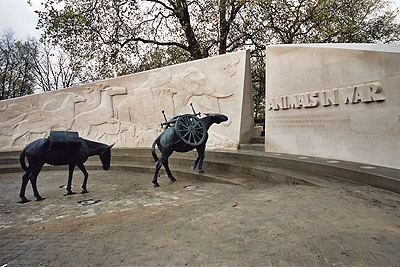
Animals in War Memorial (London)
That out of the way, I have nothing but praise for this book. Ms Fraser's story is exemplary both in conception and execution. The narrative flow is impeccable, the dramatic turns of events never feel like writer manipulations, the characters (both main and secondary) are well drawn (the above issue aside, the hero too was vivid and full of volume), the dialogues are those of intelligent people who had thoughts, ideas and opinions, confidences, memories and personal histories to share with each other, and the developing love is exciting and makes for absorbing reading.
I particularly liked the fact that the conditions of a class society do not only figure prominently but also drive the story. They are also not fully circumvented, although they are challenged. All this gave the book a particular weight that other HRs , to their detriment, completely lack. The world is not and cannot be (unless you are a bad writer and a bad reader) something stated and then conveniently forgotten, the love of Anna and Will is in the world and from the world. And it is precisely this presence and the ties and character traits it forges that makes the lovers' defiance of the world's edicts all the more powerful, moving and substantial. Romantic love (in reality as in fiction) gives one strength to question the rightness (not just the validity) of certain norms, and that results both in transformation of self (Anna is very aware that the girl who married her first husband would've never had noticed a man like Will) and in being prepared to pay the price , for the world will come after you. In short, you don't challenge social norms and are invited to dine with your uncle the earl, or have the duke of Crapelot throw a grand ball in your honour.
Fortunately, Susanna Fraser reads like that rare breed of HR writers, she's neither careless nor a historiophobe Thus, in her book good people, who loved and cared for the heroine all her life, reject her and her child, despite the fact that Will was a war hero (and what they suggest to her cannot be simply understood as cruel. The kind relatives know that Anna and her child spell ostracisation and disgrace for the whole family). Nor is the hero made into a captain/England's celebrated hero-cum-ambassador to Patagonia. He remains a sergeant, even after 11 years of dutiful service and after his numerous acts of heroism, because of his social origins, and after the loss of an arm in battle, he's discharged (there's a wonderful passage, before the heroine leaves Spain, where she, a very rich heiress, contemplates purchasing a commission for him to elevate him socially, and rejects the idea after careful consideration. In her reasoning there's revealed a whole world of inequalities and the way those are reinforced through military hierarchy).
It is very rare that a HR resist the oppressive standard demand that a pink ribbon be tied around everything. It is rare and refreshing to see a book in this genre, where standards are lower than Hades, not be afraid to reproduce mimetically the world it depicts, rather than pull some vague and abstract concoction out of the HR platitudes bag and be done with it. And it is rare to achieve so much by way of substance, while coming up with a passionate and intelligent romance, an exciting story, and a HEA that does not insult a reader's basic intelligence.
I should also add that there is no caricature Spaniard or Frenchman in sight, and the animals that make an appearance leave a lasting impression.
Animals in War Memorial (London)
This entire review has been hidden because of spoilers.

August 22, 2010
If The Sergeant's Lady, by debut author Susanna Fraser, is a representative sample of what Carina Press (the digital arm of Harlequin) is publishing, then readers are in for a treat. If my schedule allowed it, I would have read the entire book straight through in one sitting. You should know, though, that this is no ballroom-banter historical, so if you want light-hearted smooching on the veranda, look elsewhere.
The Sergeant's Lady has a traditional Regency feel and is set in Spain and Portugal during the Napoleanic Wars. Both the setting and style reminded me of Carla Kelly--there are some gritty scenes of survival that are a far cry from Almack's or the Pump Room. The H/H are thrown together when their military convoy encounters a French detachment. They flee and make their way back to the main British encampment by themselves.
Forced to rely on each other, the heroine, a well-bred lady, and the hero, a smart, well-read, but wholly unsuitable sergeant in the 95th Rifles, forge a bond that rapidly develops into love. Fraser's writing is straightforward and unadorned, a style that works effectively to convey the setting of war-torn Spain in the summer.
I thoroughly enjoyed this book, which is, at heart, a story of two decent people doing their best to survive the miserable circumstances in which they find themselves. Fraser succeeds in making their class differences believable, but ultimately surmountable, given the characters of the H/H. She was smart to make the heroine Scottish, and therefore less rigid and high-on-the-instep than an English heroine with a similar lineage.
I have no doubt that I'll be rereading this book, along with anything else that Susanna Fraser writes. If you've enjoyed Carla Kelly's recent books set during the Peninsular War (Marrying the Captain, Marrying the Royal Marine), then there's a good chance that you'll like Susanna Fraser as well.
The Sergeant's Lady has a traditional Regency feel and is set in Spain and Portugal during the Napoleanic Wars. Both the setting and style reminded me of Carla Kelly--there are some gritty scenes of survival that are a far cry from Almack's or the Pump Room. The H/H are thrown together when their military convoy encounters a French detachment. They flee and make their way back to the main British encampment by themselves.
Forced to rely on each other, the heroine, a well-bred lady, and the hero, a smart, well-read, but wholly unsuitable sergeant in the 95th Rifles, forge a bond that rapidly develops into love. Fraser's writing is straightforward and unadorned, a style that works effectively to convey the setting of war-torn Spain in the summer.
I thoroughly enjoyed this book, which is, at heart, a story of two decent people doing their best to survive the miserable circumstances in which they find themselves. Fraser succeeds in making their class differences believable, but ultimately surmountable, given the characters of the H/H. She was smart to make the heroine Scottish, and therefore less rigid and high-on-the-instep than an English heroine with a similar lineage.
I have no doubt that I'll be rereading this book, along with anything else that Susanna Fraser writes. If you've enjoyed Carla Kelly's recent books set during the Peninsular War (Marrying the Captain, Marrying the Royal Marine), then there's a good chance that you'll like Susanna Fraser as well.

October 16, 2012
I'm re-reading Susanna Fraser's two already-published books (this one and A Marriage of Inconvenience) because she has another one coming out at the beginning of November and I want to refresh my memory of the her earlier work before reading the new one.
I love Fraser's writing because she can tell a good story and a good romance and dispense with a number of extremely tired old tropes of historical romance. Some examples from The Sergeant's Lady:
* In most historical romances, one of the rules seems to be that while poverty (or even the absence of massive wealth), working hard to support oneself, and a working-class upbringing can add interest to a protagonist, those things have to go away in the happily ever after. Riches must be retained or gained; working hard can stay but it ought to be voluntary (a demonstration of good character rather than a requirement for survival), and the working-class origin is revealed to be by misfortune, not by birth. The hero of The Sergeant's Lady is working-class (or at most, lower middle-class) by birth. He likes to read, but never had a chance to learn the classics. He knows that if he rose above the rank of sergeant, he wouldn't fit in socially with the gentlemen officers. None of this goes away, and yet lo! he is still the hero of a romance novel. And he's a very very good one.
* In most historical romances, if potential social scandal is an obstacle to the romance, it's played for drama and angst, but softened over at the end. The couple will worry and scheme and try to keep apart because of the consequences should the scandal (whatever it is) be discovered. But in the end, when true love wins out, it's okay. The people who can't accept them are shown to be villains who aren't worth knowing anyway, and the true friends and loyal family members enact a brazen show of solidarity to force the rest of society to respect the protagonists. Not so here.
* Less central, but just as important to me: the story opens with the hero trying to help a Spanish woman, a camp follower, to give birth. The heroine also helps, and this is how the hero and heroine meet. In many stories, I would expect that the Spanish woman's only purpose to be an exciting reason for the couple to meet and impress each other with their level-headedness and charity. But in The Sergeant's Lady, this woman, Juana, is actually an important secondary character. She becomes a friend to both protagonists, takes important actions throughout the story, and clearly is a person with her own life to make decisions about -- not just scenery.
I love Fraser's writing because she can tell a good story and a good romance and dispense with a number of extremely tired old tropes of historical romance. Some examples from The Sergeant's Lady:
* In most historical romances, one of the rules seems to be that while poverty (or even the absence of massive wealth), working hard to support oneself, and a working-class upbringing can add interest to a protagonist, those things have to go away in the happily ever after. Riches must be retained or gained; working hard can stay but it ought to be voluntary (a demonstration of good character rather than a requirement for survival), and the working-class origin is revealed to be by misfortune, not by birth. The hero of The Sergeant's Lady is working-class (or at most, lower middle-class) by birth. He likes to read, but never had a chance to learn the classics. He knows that if he rose above the rank of sergeant, he wouldn't fit in socially with the gentlemen officers. None of this goes away, and yet lo! he is still the hero of a romance novel. And he's a very very good one.
* In most historical romances, if potential social scandal is an obstacle to the romance, it's played for drama and angst, but softened over at the end. The couple will worry and scheme and try to keep apart because of the consequences should the scandal (whatever it is) be discovered. But in the end, when true love wins out, it's okay. The people who can't accept them are shown to be villains who aren't worth knowing anyway, and the true friends and loyal family members enact a brazen show of solidarity to force the rest of society to respect the protagonists. Not so here.
* Less central, but just as important to me: the story opens with the hero trying to help a Spanish woman, a camp follower, to give birth. The heroine also helps, and this is how the hero and heroine meet. In many stories, I would expect that the Spanish woman's only purpose to be an exciting reason for the couple to meet and impress each other with their level-headedness and charity. But in The Sergeant's Lady, this woman, Juana, is actually an important secondary character. She becomes a friend to both protagonists, takes important actions throughout the story, and clearly is a person with her own life to make decisions about -- not just scenery.

June 24, 2011
I am so in love with this story. I do so love reading romances that involve genuine, real love between two honest and mature people who beat seemingly insurmountable odds in order to stay together. I also adore 'forbidden love' romances, especially when it involves lovers who are separated by social class.
This book is the kind that leaves me feeling very warm and fuzzy and happy inside, and I'm so glad I found it. Will and Anna were so likeable and their stories were so interesting. From the moment they found one another I just wanted them to be together. The challenges they faced did not stem from silly misunderstandings or stubbornness. Instead the author placed obstacles in their path that were realistic, and these characters handled them and overcame them realistically.
I was also impressed with the depth of the author's research into the historical aspects of The Peninsular War. I appreciate when an author takes the time to include real historical details as often as possible, and to take creative license when it is appropriate.
This reminds me of another book I read a while back: Ship of Dreams, which also involves lovers separated by social class who beat the odds, and also which surrounds the details of a real historical event. If you liked The Sergeant's Lady for the same reasons I noted above, you will probably also like Ship of Dreams.
This book is the kind that leaves me feeling very warm and fuzzy and happy inside, and I'm so glad I found it. Will and Anna were so likeable and their stories were so interesting. From the moment they found one another I just wanted them to be together. The challenges they faced did not stem from silly misunderstandings or stubbornness. Instead the author placed obstacles in their path that were realistic, and these characters handled them and overcame them realistically.
I was also impressed with the depth of the author's research into the historical aspects of The Peninsular War. I appreciate when an author takes the time to include real historical details as often as possible, and to take creative license when it is appropriate.
This reminds me of another book I read a while back: Ship of Dreams, which also involves lovers separated by social class who beat the odds, and also which surrounds the details of a real historical event. If you liked The Sergeant's Lady for the same reasons I noted above, you will probably also like Ship of Dreams.

July 3, 2016
I was nervous about this. I liked Anna in the first book (sister of the hero in that book and the heroine of this one). But for an author to jump from a traditional ballroom setting to a 'following the drum' cross-class romance seemed like a heck of a leap. However, I think Fraser has managed it. I liked this even more than the first of this series. Fraser has grown in confidence and you can tell.
The setting is not something I usually go for. Following the drum stories aren't for me, because, frankly, mud and death and horror aren't romantic. Not to mention the untold horrors that often befall women on a campaign trail. I don't think this has changed my fundamental opinion about that, but it was very well done.
Let's start with characters. Anna, who I loved from the first book. The flighty, flirty, confident younger sister. We find her here broken down by her marriage. World weary and trapped, but finding some fulfillment in being an army wife (although not from the 'wife' bit). When she's finally freed from that marriage, there's a sense she finds herself in the arms of Will and the love and understanding he shows, whilst also growing from within. She has a very well-done character arc, particularly when looked at across the two books.
Will, less successful. I love a working class boy done good, one of my absolute favorite things. But, I think it was undersold by Fraser in every respect other than the most annoying one - namely, the we can't possibly be a couple because of our disparate stations, *woe*. I'd liked to have seen more of his roots in his character or his speech, something. That said, he's a great hero. Fundamentally good and lovely and everything Anna's awful husband was not.
The story worked very well for me, although I'd have liked a bit more development of the romance outside their mutual attraction. It feels a little bit insta-love, with a measure of wartime heroics thrown in. But by the end I had a real sense these two people were made for one another and I was genuinely emotional as Anna fought to make her way back to Will.
Obligatory sex mention: Fraser writes it very nicely, not too purple, yet book and setting appropriate.
Overall, I really liked this and on the strength of the two books in this series I will be looking up the rest of Fraser's back catalogue.
The setting is not something I usually go for. Following the drum stories aren't for me, because, frankly, mud and death and horror aren't romantic. Not to mention the untold horrors that often befall women on a campaign trail. I don't think this has changed my fundamental opinion about that, but it was very well done.
Let's start with characters. Anna, who I loved from the first book. The flighty, flirty, confident younger sister. We find her here broken down by her marriage. World weary and trapped, but finding some fulfillment in being an army wife (although not from the 'wife' bit). When she's finally freed from that marriage, there's a sense she finds herself in the arms of Will and the love and understanding he shows, whilst also growing from within. She has a very well-done character arc, particularly when looked at across the two books.
Will, less successful. I love a working class boy done good, one of my absolute favorite things. But, I think it was undersold by Fraser in every respect other than the most annoying one - namely, the we can't possibly be a couple because of our disparate stations, *woe*. I'd liked to have seen more of his roots in his character or his speech, something. That said, he's a great hero. Fundamentally good and lovely and everything Anna's awful husband was not.
The story worked very well for me, although I'd have liked a bit more development of the romance outside their mutual attraction. It feels a little bit insta-love, with a measure of wartime heroics thrown in. But by the end I had a real sense these two people were made for one another and I was genuinely emotional as Anna fought to make her way back to Will.
Obligatory sex mention: Fraser writes it very nicely, not too purple, yet book and setting appropriate.
Overall, I really liked this and on the strength of the two books in this series I will be looking up the rest of Fraser's back catalogue.
July 29, 2024
3.5 stars. If class difference is the main impediment to a relationship, I need to feel the stakes and separation a little more.

April 5, 2011
I loved this book! Susanna Fraser does a wonderful job of constructing a gut twisting romance with some of the most believable and lovable character I have ever had the pleasure of meeting on the page.
Set against the wonderfully rich back drop of the Napoleonic Wars the story follows Lady Anne Arrington as she "follows the drum," traveling with a husband that does not love her and the English forces. The fact that Lady Anne has chosen to follow her husband adds a unique level of gritty realism and danger that is sometimes missing from more traditional historical novels. The best thing about Lady Anne was how well she was crafted. I laughed and cried with her and she has remained with me even though the story has ended. She was one of those rare literary gems - a completely believable heroine who has her own strengths and gut wrenching experiences only she can deal with. When she finds herself falling for the one man she could not have she was faced with at best more scandal and a ruined reputation and at worse destroying the career of the man she loves.
After the scandalous demise of her cruel husband, Lady Anne finds herself under the protection of the 95 Rifles and Sergeant Will Atkins. It did not take me long to start thinking of Sergeant Atkins as My Sergeant. He was hands down the best soldier I have every read on the pages of a romance, historical or otherwise. Will is a ran away who joined the army because he was not ready to get married and take over the farm. There are no deep dark secrets behind his soldiering and he is not Rambo. He is a natural born soldier, popular with everyone. Will is brave and chivalrous, and self-educated. He is also handsome and romantic as hell as he discovers that his feelings for Lady Anne go beyond anything he could imagine.
Filled with a slew of villains and obstacles there were times I did not know if Anne and Will would get their happily ever after. When they finally where able to be together and over came everything that had been standing in their way I cheered.
This was a wonderful read and I highly recommend it.
Five Mystique Moons. (Outstanding)
Class Three sensuality. (Standard Romance)
Set against the wonderfully rich back drop of the Napoleonic Wars the story follows Lady Anne Arrington as she "follows the drum," traveling with a husband that does not love her and the English forces. The fact that Lady Anne has chosen to follow her husband adds a unique level of gritty realism and danger that is sometimes missing from more traditional historical novels. The best thing about Lady Anne was how well she was crafted. I laughed and cried with her and she has remained with me even though the story has ended. She was one of those rare literary gems - a completely believable heroine who has her own strengths and gut wrenching experiences only she can deal with. When she finds herself falling for the one man she could not have she was faced with at best more scandal and a ruined reputation and at worse destroying the career of the man she loves.
After the scandalous demise of her cruel husband, Lady Anne finds herself under the protection of the 95 Rifles and Sergeant Will Atkins. It did not take me long to start thinking of Sergeant Atkins as My Sergeant. He was hands down the best soldier I have every read on the pages of a romance, historical or otherwise. Will is a ran away who joined the army because he was not ready to get married and take over the farm. There are no deep dark secrets behind his soldiering and he is not Rambo. He is a natural born soldier, popular with everyone. Will is brave and chivalrous, and self-educated. He is also handsome and romantic as hell as he discovers that his feelings for Lady Anne go beyond anything he could imagine.
Filled with a slew of villains and obstacles there were times I did not know if Anne and Will would get their happily ever after. When they finally where able to be together and over came everything that had been standing in their way I cheered.
This was a wonderful read and I highly recommend it.
Five Mystique Moons. (Outstanding)
Class Three sensuality. (Standard Romance)

December 14, 2011
I read the second book before the first one, despite the many positive reviews it got - now I've finally got around to reading this and it interlocks with the flashback that is the plot of the second novel in a beautiful way.
I thought Will Atkins wasn't too much of an unbelievable guy, he remained down to earth with his men and the education he had given himself via books made him still (or maybe even more) aware of his position in society. The way that the attraction between Anna and Will came to be seemed natural even though it would have been much too fast in peace time. When he rescued her from that nefarious French officer (he and Lieutenant Montmorency seemed to be the only over-the-top characters for me) he thought ahead, he kept his head trying to get Anna to safety without risking his men.
The successful escape of the two is by far the strongest part of the book, when they reenter the normal world and Lieutenant Montmorency starts acting dastardly its a bit abrupt (it was highlighted that he would play a major role from the first, because apart from Will and Anna in third person he also had a viewpoint). I liked the women in this book, except for Anna's aunt at the end... it's a bit of a pity this first book didn't have as much work for the uncle, I really enjoyed him in the second one.
The description of Bajadoz and its aftermath was properly gripping, dramatic and sad, as was Anna's labour - and then the book just ended very fast. Lots of coincidences after Anna finally finds out what happened to Will.
I thought Will Atkins wasn't too much of an unbelievable guy, he remained down to earth with his men and the education he had given himself via books made him still (or maybe even more) aware of his position in society. The way that the attraction between Anna and Will came to be seemed natural even though it would have been much too fast in peace time. When he rescued her from that nefarious French officer (he and Lieutenant Montmorency seemed to be the only over-the-top characters for me) he thought ahead, he kept his head trying to get Anna to safety without risking his men.
The successful escape of the two is by far the strongest part of the book, when they reenter the normal world and Lieutenant Montmorency starts acting dastardly its a bit abrupt (it was highlighted that he would play a major role from the first, because apart from Will and Anna in third person he also had a viewpoint). I liked the women in this book, except for Anna's aunt at the end... it's a bit of a pity this first book didn't have as much work for the uncle, I really enjoyed him in the second one.
The description of Bajadoz and its aftermath was properly gripping, dramatic and sad, as was Anna's labour - and then the book just ended very fast. Lots of coincidences after Anna finally finds out what happened to Will.

September 9, 2010
I really liked this book. Really, really. There aren't too many books I say that about.
This is set during the Peninsular Wars of England in Spain & Portugal while Napoleon was in power. The story opens with the hero helping a woman in labor. He's a sergeant in the Rifle Regiment (the 95th), the woman is his best friend's Spanish wife, and the best friend can't help (he faints, or something), but he won't go find help, because he won't leave his wife. The heroine stumbles upon the group, sends her maid for help, and stays to do what she can.
She's obviously a "gentlewoman" who is married to an officer and traveling in the army's train. The marriage is not good, which is obvious early on when the husband shows up and demands his wife leave these rabble to their own fate. She refuses, things get ugly, but she's left to do as she wishes-which is to help the woman in labor. But there are repercussions when she finally catches up to the house where she is billeted with her husband that night.
The conflict is obvious. The hero is an innkeeper's son and a non-commissioned officer in the army. A commoner. The heroine has an earl for an uncle, and maybe for her brother too. There are lots of twists and turns, plenty of plot--and I found all of it believable. Fraser made it work. (And I've done a LOT of research about this era.) And yes, there is a happy ending, though really--there are lots of moments when you wonder if it really is possible.
This is my first Carina Press Book, but I will be buying more.
This is set during the Peninsular Wars of England in Spain & Portugal while Napoleon was in power. The story opens with the hero helping a woman in labor. He's a sergeant in the Rifle Regiment (the 95th), the woman is his best friend's Spanish wife, and the best friend can't help (he faints, or something), but he won't go find help, because he won't leave his wife. The heroine stumbles upon the group, sends her maid for help, and stays to do what she can.
She's obviously a "gentlewoman" who is married to an officer and traveling in the army's train. The marriage is not good, which is obvious early on when the husband shows up and demands his wife leave these rabble to their own fate. She refuses, things get ugly, but she's left to do as she wishes-which is to help the woman in labor. But there are repercussions when she finally catches up to the house where she is billeted with her husband that night.
The conflict is obvious. The hero is an innkeeper's son and a non-commissioned officer in the army. A commoner. The heroine has an earl for an uncle, and maybe for her brother too. There are lots of twists and turns, plenty of plot--and I found all of it believable. Fraser made it work. (And I've done a LOT of research about this era.) And yes, there is a happy ending, though really--there are lots of moments when you wonder if it really is possible.
This is my first Carina Press Book, but I will be buying more.

November 27, 2011
I really loved this story of how, during the Peninsular Wars in Spain, a corporal under Wellington becomes friends with the wife of an officer in his regiment. It is an unhappy marriage, her husband is awful to her and he gets what he deserves before long. A widow now, she and the corporal develop a closeness, though forbidden. After he rescues her from captivity from a mad French general, they spend four night's together on the road alone and ... well, they can no longer deny the attraction that's been brewing between them. But when they return to the army camp, they must act as if nothing happened. How can these two who have fallen in love be together when society forbids an enlisted man to marry the widow of an officer? It's just not done. Their growing love for one another and the moments they share together before the inevitable parting were both wonderful and bittersweet. My heart went out to them. This is a tender love story that was hard to put down for I had to see how it ended. Will they be reunited or not? This romance was a nice surprise and I will definitely read more by this author. It wasn't until after I finished it, I realized this is the 2nd book in the series. Oh well... I'll have to get to the first book now - pronto!
4.5/5
4.5/5

May 30, 2012
Did I enjoy this book? Yes. But to be totally honest, I think it pales in comparison to its prequel, A Marriage of Inconvenience. Still, it is well-written, well-plotted, and engaging. I wish Susanna Fraser had more published works in the stacks, as I truly enjoy the way she crafts a story.

April 9, 2020
I could and have read this book over and over. I found the H so sexy, so intelligent and kind and with such a pure love for the heroine. It’s the kind of story that shouldn’t have a HEA (high born lady falls in love with soldier etc) but because of the genre it does. And I love that. Like a warm blanket. One of my favorite romances. Such a wonderful writer.

August 29, 2010
The Sergeant's Lady by Susanne Fraser
Carina Press, 2010
266 pages
Romance; Historical
4/5 stars
Source: Received a free copy via Netgalley in exchange for an honest review.
First, I liked the setting during the Peninsular campaigns against Napoleon although fortunately the fighting was not the primary concern. Instead the book looked more at the developing relationship between the hero and heroine. Will is a good man and soldier but is considered far beneath the likes of Anna, married to a cruel officer. After his death, they end up as prisoners of a crazed French officer. When his overtures to Anna turn violent, the two flee, falling in love in the process.
I really liked Will and Anna. They are good, principled, compassionate people with similar interests who spend quite a bit of time together before consummating their relationship. They recognize the difficulties posed by a disapproving society (especially their families) but they cannot deny the deep love they feel for each other. However they are torn apart, each returning to their families missing their love and hoping to be reunited and married.
Besides the main lovers, the supporting characters were also good as were the historical details. This isn't a common time period for me to read about but I felt comfortable that most of what I read was consistent with the times if not entirely true.
SPOILER-something I didn't like:
I really disliked that Anna became pregnant and gave birth out of wedlock; it was pretty inevitable due to the lack of birth control during the time and Anna and Will's passion but I would have preferred marriage before baby.
SPOILER-something I really liked:
At the end, Will is set to travel to India to make his fortune and thereby prove himself worthy of Anna. She supports his desire to embark on this new career but makes the very valid point that if they wait to marry until he is rich, then they will have missed out on valuable years together with their children around them. This is such a great point about something that seems to reoccur in historical romances. I loved its inclusion here!
Overall: A nice historical romance between two deserving characters.
Carina Press, 2010
266 pages
Romance; Historical
4/5 stars
Source: Received a free copy via Netgalley in exchange for an honest review.
First, I liked the setting during the Peninsular campaigns against Napoleon although fortunately the fighting was not the primary concern. Instead the book looked more at the developing relationship between the hero and heroine. Will is a good man and soldier but is considered far beneath the likes of Anna, married to a cruel officer. After his death, they end up as prisoners of a crazed French officer. When his overtures to Anna turn violent, the two flee, falling in love in the process.
I really liked Will and Anna. They are good, principled, compassionate people with similar interests who spend quite a bit of time together before consummating their relationship. They recognize the difficulties posed by a disapproving society (especially their families) but they cannot deny the deep love they feel for each other. However they are torn apart, each returning to their families missing their love and hoping to be reunited and married.
Besides the main lovers, the supporting characters were also good as were the historical details. This isn't a common time period for me to read about but I felt comfortable that most of what I read was consistent with the times if not entirely true.
SPOILER-something I didn't like:
I really disliked that Anna became pregnant and gave birth out of wedlock; it was pretty inevitable due to the lack of birth control during the time and Anna and Will's passion but I would have preferred marriage before baby.
SPOILER-something I really liked:
At the end, Will is set to travel to India to make his fortune and thereby prove himself worthy of Anna. She supports his desire to embark on this new career but makes the very valid point that if they wait to marry until he is rich, then they will have missed out on valuable years together with their children around them. This is such a great point about something that seems to reoccur in historical romances. I loved its inclusion here!
Overall: A nice historical romance between two deserving characters.

September 1, 2010
THE SERGEANT'S LADY by Susanna Fraser is a historical romance set in 1808-1814 Spain and England. It is well written with details and depth. It is fast paced, page turner. It has romance, sensuality, military life, breaking social barriers,hardship, and true love. Can a Viscount's daughter and an innkeeper's son break the social barrier to true love....The hero, Will is a natural born soldier, a sergeant, brave, handsome, well educated, and an innkeeper's youngest son. The heroine, Anna, is beautiful, lonely,a viscount's daughter,is following her cold, controlling cavalry officer husband through Spain. She meets Will and a friend of his who is having a baby on the side of the trail. She stops to help, her husband is furious and forbids her to do so, but she does any way. After Anna's husband is killed trying to rape a village girl, Anna's cousin sends her with Will and his convoy. She only wants to go back home to her beloved Scotland, but their convoy is captured by a French patrol. The French commandant, is out to rape Anna. Will learns of this and he and she escapes and go on the run. They face hardship, cold, lack of food, patrols, and along the way love blooms. This is a wonderful story of love and facing social pressure, finally each other and breaking those barriers. I would highly recommend this book especially if you enjoy military, romance, true love and sweet surrender. This book was received for review from Net Galley and details can be found at Carina Press and My Book Addiction and More.

July 24, 2014
Para ser justa, el libro está bien. La edición está muy bien y creo que es el primer libro que leo donde todo lo que han escrito en castellano está perfecto…
El fondo histórico en el que está ambientada la historia está muy bien descrito, es muy realista y no había leído nada por el estilo. Supongo que el hecho de qué esté situado en España para mí ha sido un plus.
Donde ha fallado, en mi opinión, es en la parte del romance, y aquí entran mis gustos personales. No soy fan de las historias donde los personajes principales están separados más tiempo del que están juntos y tampoco me gustan las historias en las cuales ambos personajes saben desde el principio que lo suyo es imposible y que la separación va a llegar antes que después, para mí eso enfría muchísimo la historia y no me deja disfrutarla. Además me han parecido muy frías las actitudes de los protagonistas, en ningún momento se han rebelado contra lo preestablecido o luchado por su amor, ambos han aceptado la situación con la cabeza fría…es raro, porque no me gustan las historias con angustia, pero en esta me he quedado con la sensación de que si no acababan juntos, pues, bueno, tampoco pasa nada…
Y por último, ha sido excesivo, además del tiempo que han pasado separados, todas las trabas y los baches que la autora les ha echado encima…parecía que no lo iban a conseguir en la vida.
Lo dicho, aunque para mí no ha terminado de funcionar no es una historia mala, igual para ti funciona.
El fondo histórico en el que está ambientada la historia está muy bien descrito, es muy realista y no había leído nada por el estilo. Supongo que el hecho de qué esté situado en España para mí ha sido un plus.
Donde ha fallado, en mi opinión, es en la parte del romance, y aquí entran mis gustos personales. No soy fan de las historias donde los personajes principales están separados más tiempo del que están juntos y tampoco me gustan las historias en las cuales ambos personajes saben desde el principio que lo suyo es imposible y que la separación va a llegar antes que después, para mí eso enfría muchísimo la historia y no me deja disfrutarla. Además me han parecido muy frías las actitudes de los protagonistas, en ningún momento se han rebelado contra lo preestablecido o luchado por su amor, ambos han aceptado la situación con la cabeza fría…es raro, porque no me gustan las historias con angustia, pero en esta me he quedado con la sensación de que si no acababan juntos, pues, bueno, tampoco pasa nada…
Y por último, ha sido excesivo, además del tiempo que han pasado separados, todas las trabas y los baches que la autora les ha echado encima…parecía que no lo iban a conseguir en la vida.
Lo dicho, aunque para mí no ha terminado de funcionar no es una historia mala, igual para ti funciona.

March 23, 2011
I just finished reading Susanna Fraser's debut The Sergeant's Lady for the second time.
I don't know where to begin talking about the book. The multi-layered conflict is gripping from page one. The prose is stark when it needs to be stark, and lush when lush is warranted. Most importantly, I will remember the characters, Anna and Will, as among my favorites in Romance.
Not many romance novelists would tell the story of Officer's wife who is "following the drum" (traveling with her husband's regiment during the peninsular campaign). Fewer still would be so fearlessly honest when describing her marriage gone wrong and widowhood followed by her deeply transformative relationship to a very unsuitable gentleman. I loved feeling through these characters as they struggled against their attraction and I loved watching them develop the will to fight for the love they know will sustain them.
When I write, I return to a single theme over and over: the difference between a partner the world thinks is suitable and a partner others may condemn but whose love brings light and hope to the character's life. This story carries that theme to a deeper level.
If you enjoy novels about characters who must fight to survive and, in learning to fight, also learn to thrive, then this is a book you cannot miss.
Originally posted to my blog www.wendylacapra.com on 3/23/2011
I don't know where to begin talking about the book. The multi-layered conflict is gripping from page one. The prose is stark when it needs to be stark, and lush when lush is warranted. Most importantly, I will remember the characters, Anna and Will, as among my favorites in Romance.
Not many romance novelists would tell the story of Officer's wife who is "following the drum" (traveling with her husband's regiment during the peninsular campaign). Fewer still would be so fearlessly honest when describing her marriage gone wrong and widowhood followed by her deeply transformative relationship to a very unsuitable gentleman. I loved feeling through these characters as they struggled against their attraction and I loved watching them develop the will to fight for the love they know will sustain them.
When I write, I return to a single theme over and over: the difference between a partner the world thinks is suitable and a partner others may condemn but whose love brings light and hope to the character's life. This story carries that theme to a deeper level.
If you enjoy novels about characters who must fight to survive and, in learning to fight, also learn to thrive, then this is a book you cannot miss.
Originally posted to my blog www.wendylacapra.com on 3/23/2011

May 13, 2011
If you haven't read Fraser's second book, An Inconvenience Marriage, go read it first. This for those who like to read stories in their proper sequence.
Anna, a lady, unhappily married to an officer, is following the drum in Spain, where the Brits are warring with the French. The Sergeant, Will, is intelligent and far better educated then his fellow soldiers. he reads sonnets and shares his love of books with his Captain.
This is a story of forbidden love. Not only forbidden because she's initially married but hampered by the strictures of social class. Huge hurdles these two have to overcome to find their HEA.
There so much to like about this book. The beautifully expressed, quiet desperation of star-crossed lovers - the drama is left for the grittiness of war and other parts of the story.
The only weakness I found was the ending. It felt conveniently and quickly wrapped up. I almost wished Will went alone to India and returned triumphantly a few years later to reclaim Anna. Because the backlash regarding their social inequality, without overriding success and acclaim, would only follow them to India and make a HEA a difficult outcome.
All that aside, still a fantastic read. One I will reread again and again.
Enjoy!
Anna, a lady, unhappily married to an officer, is following the drum in Spain, where the Brits are warring with the French. The Sergeant, Will, is intelligent and far better educated then his fellow soldiers. he reads sonnets and shares his love of books with his Captain.
This is a story of forbidden love. Not only forbidden because she's initially married but hampered by the strictures of social class. Huge hurdles these two have to overcome to find their HEA.
There so much to like about this book. The beautifully expressed, quiet desperation of star-crossed lovers - the drama is left for the grittiness of war and other parts of the story.
The only weakness I found was the ending. It felt conveniently and quickly wrapped up. I almost wished Will went alone to India and returned triumphantly a few years later to reclaim Anna. Because the backlash regarding their social inequality, without overriding success and acclaim, would only follow them to India and make a HEA a difficult outcome.
All that aside, still a fantastic read. One I will reread again and again.
Enjoy!

June 21, 2012
Really good book. Very engaging heroine and hero. She's smart, capable and practical. He's kind, honest and self-aware.
The backdrop for their romance is Spain during the Peninsular War. The author did a great job of weaving in historical fact rather than large info dumps. Anna and Will escape capture from French troops and the middle part of the book is their trek to get back to the English encampment. It gives them lots of time to get to know each other and reveal their characters. The love they develop is very believable and romantic.
What I really loved about this romance is the lack of cartoon villains, big secrets and silly misunderstandings. Will and Anna are honest with each other and practical in how they handle the difficulties they face. She's an aristocrat and he's an inn-keeper's son so in addition to all the obstacles they face just trying to stay alive during the war, they also have societal obstacles. How the HEA comes about seems realistic and it is very satisfying.
The backdrop for their romance is Spain during the Peninsular War. The author did a great job of weaving in historical fact rather than large info dumps. Anna and Will escape capture from French troops and the middle part of the book is their trek to get back to the English encampment. It gives them lots of time to get to know each other and reveal their characters. The love they develop is very believable and romantic.
What I really loved about this romance is the lack of cartoon villains, big secrets and silly misunderstandings. Will and Anna are honest with each other and practical in how they handle the difficulties they face. She's an aristocrat and he's an inn-keeper's son so in addition to all the obstacles they face just trying to stay alive during the war, they also have societal obstacles. How the HEA comes about seems realistic and it is very satisfying.

April 24, 2011
This is a great historical romance. The first half of the book is set in Spain during the Napoleonic wars, the second half in England.
Sergeant Atkins and Mrs. Arrington are traveling alone together after her husband dies and she and Atkins are separated from the regular army. In spite of the gulf between their stations -- she is an heiress and niece to an earl, he is an enlisted man and son of an innkeeper -- they fall in love. They know their affair will be short lived. They cannot marry, he has his duty to the army and she must return home.
This really represents the BEST in historical romance: fine writing, compelling plot well-seated in history, well- developed, realistically portrayed characters, and a unique setting. I loved reading about the war and about soldiers and the author's research was obvious.
Highly recommend this e-book, especially to historical romance readers who are looking for something a little different.
Sergeant Atkins and Mrs. Arrington are traveling alone together after her husband dies and she and Atkins are separated from the regular army. In spite of the gulf between their stations -- she is an heiress and niece to an earl, he is an enlisted man and son of an innkeeper -- they fall in love. They know their affair will be short lived. They cannot marry, he has his duty to the army and she must return home.
This really represents the BEST in historical romance: fine writing, compelling plot well-seated in history, well- developed, realistically portrayed characters, and a unique setting. I loved reading about the war and about soldiers and the author's research was obvious.
Highly recommend this e-book, especially to historical romance readers who are looking for something a little different.

September 11, 2010
Wow I wish all debut authors were this good!
What a wonderful Historical Romance. What I deal I got when I was able to snatch "The Sergenant's Lady" for free. It was a wonderful story. The story had enough angst to keep me going and added it the right amount of adventure and longing for the main characters to succeed. There was a perfect recipe for danger, villians and a need for a HEA that made me keep reading on.
For a debut author, there were none of the obvious errors that new authors made. I was completly thrilled with Susanna Fraser's writing and will hesitate to pay full price for her next novel.
What a wonderful Historical Romance. What I deal I got when I was able to snatch "The Sergenant's Lady" for free. It was a wonderful story. The story had enough angst to keep me going and added it the right amount of adventure and longing for the main characters to succeed. There was a perfect recipe for danger, villians and a need for a HEA that made me keep reading on.
For a debut author, there were none of the obvious errors that new authors made. I was completly thrilled with Susanna Fraser's writing and will hesitate to pay full price for her next novel.
March 1, 2018
A tender and heart wrenching story. I really didn't know how they were going to achieve a their HEA, but I was so happy when it did happen. It was really interesting how the class system worked within the British army and society, and how their love would have been looked down upon by others, and how even though her first husband was abusive he would have been seen as better than the respectful and loving sergeant, because he was considered a gentleman.

November 10, 2012
An interesting book with a hero from a lower class than the heroine. The plot kept throwing one awful, tragic event after another at the characters. These events pushed and pulled the hero and heroine together and apart. I will admit this just exhausted me otherwise I would have given this a higher rating.

January 17, 2016
I LOVED THIS BOOK!
I think Will is one of the sweetest, and most tender heros i had the pleasure to read.
He was always so earnest and caring not to mention brave and soo funny (even if humor wasnt the dominnat genre of this story, I loved when will's witticisms took place), he was so adorable and just swoonworthy. I coudnt help to fall in love with him just as Anna did.
I think Will is one of the sweetest, and most tender heros i had the pleasure to read.
He was always so earnest and caring not to mention brave and soo funny (even if humor wasnt the dominnat genre of this story, I loved when will's witticisms took place), he was so adorable and just swoonworthy. I coudnt help to fall in love with him just as Anna did.

July 13, 2021
An incredible adventure!
The story had thrill, adventure, excitement, intimacy, love, joy, laughter... The list goes on! I really enjoyed the plot, the twists, and the characters. This author made them come alive and fleshed them out. They present hope at times it was needed. This author made the story real and relatable. Five huge, bright stars to Susanna Fraser!
The story had thrill, adventure, excitement, intimacy, love, joy, laughter... The list goes on! I really enjoyed the plot, the twists, and the characters. This author made them come alive and fleshed them out. They present hope at times it was needed. This author made the story real and relatable. Five huge, bright stars to Susanna Fraser!

June 19, 2021
Recommended by Historical Harlots' FB Group
What a nice surprise. Sometimes recs disappoint but not this time. A new author for me but one I intend to follow.
Great character development with plenty of steam. Love story worth the time. Do yourself a favor and enjoy it.
What a nice surprise. Sometimes recs disappoint but not this time. A new author for me but one I intend to follow.
Great character development with plenty of steam. Love story worth the time. Do yourself a favor and enjoy it.

August 31, 2010
Reading this for the second time (got my hands on a pre-release version), and liking it just as much despite knowing how it all turns out! I'll write a fuller review after I finish this re-read.

September 2, 2010
I enjoyed this a lot, and suspect I may be turning around and re-reading it again fairly soon. So exciting to find a new (to me) Regency author.
Displaying 1 - 30 of 71 reviews