

What do you think?

Seize the Daylight: The Curious and Contentious Story of Daylight Saving Time
Benjamin Franklin conceived of it. Sir Arthur Conan Doyle endorsed it. Winston Churchill campaigned for it. Kaiser Wilhelm first employed it. Woodrow Wilson and Franklin Roosevelt went to war with it, and more recently the United States fought an energy crisis with it. For several months every year, for better or worse, daylight savings time affects vast numbers of people throughout the world. And from Ben Franklin's era to today, its story has been an intriguing and sometimes-bizarre amalgam of colorful personalities and serious technical issues, purported costs and perceived benefits, conflicts between interest groups and government policymakers. It impacts diverse and unexpected areas, including agricultural practices, street crime, the reporting of sports scores, traffic accidents, the inheritance rights of twins, and voter turnout. Illustrated with a popular look at science and history, Seize the Daylight presents an intriguing and surprisingly entertaining story of our attempt to regulate the sunlight hours.
272 pages, Unknown Binding
First published January 1, 2005
About the author
David Prerau
1 book2 followersDavid Prerau has a PhD from Massachusetts Institute of Technology and is one of the world’s foremost experts on daylight saving time. He has authored/co-authored three extensive US Government reports to Congress on daylight saving time, and has written two books, Developing and Managing Expert Systems and Worldwide Intelligent Systems.
Ratings & Reviews
Friends & Following
Create a free account to discover what your friends think of this book!
Community Reviews
Displaying 1 - 30 of 42 reviews

August 31, 2018
♫ It’s astounding;
Time is fleeting;
Madness takes its toll.
But listen closely:
Not for very much longer.
I’ve got to keep control.
I remember doing the time-warp
Drinking those moments when
The Blackness would hit me
And the void would be calling...
Let’s do the time-warp again.
[I always believed this song from the Rocky Horror Picture Show actually deals with Daylight Saving Time (or lack thereof) and should be sung on the last Sunday in October for the two hours between 2am and 3am; when DST ends in many countries of the Northern hemisphere]
One would think that the subject of “Daylight Saving Time” is a bit dull, but that’s not the case. The history of time change is fascinating to read and, in my opinion, a prime example of human folly. For over a hundred years now, there has been a worldwide dispute over the Emperor’s beard (a German saying that means “engage in a pointless argument”). I don’t want to know how much time was wasted that way. A British by the name of William Willett (1856-1915) was the first who campaigned in favor of DST but failed. DST was not introduced during his lifetime. It was German Emperor Wilhelm II who ordered DST by decree in 1916 in order to save energy in war production. Never let it be said that war prevents progress.
In my opinion the problem starts with the term “daylight saving”. You simply cannot save daylight. The famous Denizens of Schilda already had to recognize this when they collected light in bags in order to illuminate the new townhall where they had forgotten to install windows. The number of hours of sunshine as a function of the day in the year (and location on earth), that is the time between sunrise and sunset, does not depend on the figure to which the hour hand of a clock points to. I prefer a continuously running clock that doesn’t spring forward (towards summer time) or falls back (in winter) twice a year. I appreciate if every day in the year has exactly 24 hours and there are not 363 days (364 in leap years) with 24 hours and two that have 23 and 25 hours respectively. All sorts of curious paradoxical situations can occur. Basically it is only a concept. If instead of DST the term EWT (early working time) had been established and people had been told that they have to start working one hour earlier in the summer months, this whole time changing chaos might not have become so popular. There are people who follow the sun (like small children for instance) and there are people who prefer to follow the clock (like business people). You can’t please all groups at the same time and we have only one sun and it remains incorruptible.
In the book the history of DST is told chronologically. There are a whole lot of wonderful anecdotes, cartoons, newspaper clippings and legal texts, illustrating what can go wrong with a change of time and which consequences can be observed. A short chapter deals with how time (that is the numbers on the clock) came into being at all, and explains terms like (local) solar-time and mean- and standard-time. In this context it was new for me that until the late 13th century hours had no fixed length. Depending on the season there were different lengths of hours; e.g. in London from 38 to 82 minutes. All in all this is an enjoyable reading that often animates to shake one’s head, or roll one’s eyes. Unfortunately I found the book a bit too much on the USA side. I would have liked to have heard more of the oddities from other countries; I can’t think only US-Americans have struggled so hard with this issue.
The latest Schilda prank comes from the European Union (not included in the book, because it’s too new): In a Europe-wide public survey, the EU’s population recently displayed overwhelming support for the idea to get rid of seasonal clock changes. The poll drew a total of 4.6 million respondents, over 80% of whom were in favor of abolishing DST. It will take considerable time to submit a bill that then has to clear the EU parliament and then has to be approved by all of the EU’s 28 member states (or 27 depending on Brexit), before it can take effect. Rumors have it that the member states can decide for themselves whether they switch to year-long standard time or to daylight saving time, and we’ll most likely will end up with even more confusion than we have now.
Perfect. *facepalms*
____________
UPDATE 14 September 2018
From the official press release by the EU commision on the proposal to put an end to seasonal clock changes; 12 September 2018:
1. The phrasing "once and for all" seems a little over optimistic. For instance in Germany seasonal clock changes were introduced and abolished three times since 1916. What makes you think it will be different this time?
2. There is no such thing as "wintertime". The correct word would be "standard time".
3. Perhaps you would like to think again about which of the "neighbouring countries" in the EU should coordinate with one another. Last time I checked, all countries (except Great Britain and Ireland) are connected through internal borders.
____________
UPDATE 10 October 2018
As expected, the plan of the EU Commission to abolish time change does not help to reduce confusion: Portugal, Cyprus and Poland want to keep summer time, similar plans have come out of Germany and Austria. Portugal would then switch to Central European Time, Germany, Poland and Austria to Eastern European Time and Cyprus to Moscow Time. Finland, Denmark and the Netherlands, on the other hand, want to keep their standard time and time zone (CET). Greece is the only EU country (so far) that wants to retain the time change. This is not even envisaged in the EU Commission's plan.

This work is licensed under a Creative Commons Attribution-NonCommercial-ShareAlike 3.0 Unported License.
Time is fleeting;
Madness takes its toll.
But listen closely:
Not for very much longer.
I’ve got to keep control.
I remember doing the time-warp
Drinking those moments when
The Blackness would hit me
And the void would be calling...
Let’s do the time-warp again.
[I always believed this song from the Rocky Horror Picture Show actually deals with Daylight Saving Time (or lack thereof) and should be sung on the last Sunday in October for the two hours between 2am and 3am; when DST ends in many countries of the Northern hemisphere]
One would think that the subject of “Daylight Saving Time” is a bit dull, but that’s not the case. The history of time change is fascinating to read and, in my opinion, a prime example of human folly. For over a hundred years now, there has been a worldwide dispute over the Emperor’s beard (a German saying that means “engage in a pointless argument”). I don’t want to know how much time was wasted that way. A British by the name of William Willett (1856-1915) was the first who campaigned in favor of DST but failed. DST was not introduced during his lifetime. It was German Emperor Wilhelm II who ordered DST by decree in 1916 in order to save energy in war production. Never let it be said that war prevents progress.
In my opinion the problem starts with the term “daylight saving”. You simply cannot save daylight. The famous Denizens of Schilda already had to recognize this when they collected light in bags in order to illuminate the new townhall where they had forgotten to install windows. The number of hours of sunshine as a function of the day in the year (and location on earth), that is the time between sunrise and sunset, does not depend on the figure to which the hour hand of a clock points to. I prefer a continuously running clock that doesn’t spring forward (towards summer time) or falls back (in winter) twice a year. I appreciate if every day in the year has exactly 24 hours and there are not 363 days (364 in leap years) with 24 hours and two that have 23 and 25 hours respectively. All sorts of curious paradoxical situations can occur. Basically it is only a concept. If instead of DST the term EWT (early working time) had been established and people had been told that they have to start working one hour earlier in the summer months, this whole time changing chaos might not have become so popular. There are people who follow the sun (like small children for instance) and there are people who prefer to follow the clock (like business people). You can’t please all groups at the same time and we have only one sun and it remains incorruptible.
In the book the history of DST is told chronologically. There are a whole lot of wonderful anecdotes, cartoons, newspaper clippings and legal texts, illustrating what can go wrong with a change of time and which consequences can be observed. A short chapter deals with how time (that is the numbers on the clock) came into being at all, and explains terms like (local) solar-time and mean- and standard-time. In this context it was new for me that until the late 13th century hours had no fixed length. Depending on the season there were different lengths of hours; e.g. in London from 38 to 82 minutes. All in all this is an enjoyable reading that often animates to shake one’s head, or roll one’s eyes. Unfortunately I found the book a bit too much on the USA side. I would have liked to have heard more of the oddities from other countries; I can’t think only US-Americans have struggled so hard with this issue.
The latest Schilda prank comes from the European Union (not included in the book, because it’s too new): In a Europe-wide public survey, the EU’s population recently displayed overwhelming support for the idea to get rid of seasonal clock changes. The poll drew a total of 4.6 million respondents, over 80% of whom were in favor of abolishing DST. It will take considerable time to submit a bill that then has to clear the EU parliament and then has to be approved by all of the EU’s 28 member states (or 27 depending on Brexit), before it can take effect. Rumors have it that the member states can decide for themselves whether they switch to year-long standard time or to daylight saving time, and we’ll most likely will end up with even more confusion than we have now.
Perfect. *facepalms*
____________
UPDATE 14 September 2018
From the official press release by the EU commision on the proposal to put an end to seasonal clock changes; 12 September 2018:
Today the European Commission is proposing to end seasonal clock changes in Europe in 2019, giving Member States the freedom to decide once and for all whether they want to permanently apply summer- or wintertime. The legislative proposal seeks to ensure that any changes are made in a coordinated way between neighbouring countries so as to safeguard the proper functioning of the internal market and avoid fragmentation, which could arise if some Member States kept seasonal clock changes arrangements while others discontinued them.Three remarks:
1. The phrasing "once and for all" seems a little over optimistic. For instance in Germany seasonal clock changes were introduced and abolished three times since 1916. What makes you think it will be different this time?
2. There is no such thing as "wintertime". The correct word would be "standard time".
3. Perhaps you would like to think again about which of the "neighbouring countries" in the EU should coordinate with one another. Last time I checked, all countries (except Great Britain and Ireland) are connected through internal borders.
____________
UPDATE 10 October 2018
As expected, the plan of the EU Commission to abolish time change does not help to reduce confusion: Portugal, Cyprus and Poland want to keep summer time, similar plans have come out of Germany and Austria. Portugal would then switch to Central European Time, Germany, Poland and Austria to Eastern European Time and Cyprus to Moscow Time. Finland, Denmark and the Netherlands, on the other hand, want to keep their standard time and time zone (CET). Greece is the only EU country (so far) that wants to retain the time change. This is not even envisaged in the EU Commission's plan.
This work is licensed under a Creative Commons Attribution-NonCommercial-ShareAlike 3.0 Unported License.

December 26, 2018
Nice little microhistory of the struggle to save the world a little energy and a lot of frustration by making time uniform within time zones. Most countries in the world that aren't equatorial or majority rural/farming use daylight saving time. It makes lots of sense. I hate the day of the change, too, but really it's just not in question, with over 100 years of evidence, that following DST is a net benefit in energy savings and safety increases for all modes of transportation.
Needless to say, pockets of resistance in the US are GOP-led and/or religious nuts. The state of Arizona, in its desert-sunstruck glory, has a point in avoiding extra sunlight hours. Still and all, no matter what, the story of the people who created the concept and rammed it down the throats of the populace is really involving. Not sorry I read it.
The missing stars are all for the repetitive nature of telling a small story like this at too great a length. I think you'd need to be as interested as I am in the strange corners of Time to find it a good read...on balance, I liked it but expect that most others might not.
Needless to say, pockets of resistance in the US are GOP-led and/or religious nuts. The state of Arizona, in its desert-sunstruck glory, has a point in avoiding extra sunlight hours. Still and all, no matter what, the story of the people who created the concept and rammed it down the throats of the populace is really involving. Not sorry I read it.
The missing stars are all for the repetitive nature of telling a small story like this at too great a length. I think you'd need to be as interested as I am in the strange corners of Time to find it a good read...on balance, I liked it but expect that most others might not.

March 11, 2017
Benjamin Franklin first came up with the idea of Daylight Saving Time. He was living in France and woke up one day to realize the sun was shining. Perhaps, he theorized, if people woke earlier then they could accomplish more? Instead of rising at noon, a person could wake at 6 AM and get six more hours of work completed! Then instead of complaining about the cost of candles being wasted, productivity would increase, which would mean an increase in earnings.
Early to bed and early to rise makes a man healthy, wealthy, and wise.
This book is an exhaustive review of the history of DST (Daylight Saving/Savings Time) and how it came to be an accepted part of our lives. It was not an idea readily accepted by anyone, with opposition coming from citizens and farmers and industrial magnates in every nation. But it was inevitable and thus it is now a part of our social fabric.
When you grow up in balmy Mediterranean climates, seasonal change doesn't really occur very dramatically. Therefore, DST was the defining line, something that meant we had to prepare for a change. Now that I'm older, I appreciate the extra sunshine while commuting home but insist upon darkness returning for Halloween.
Very good research throughout the pages here, I just wish it was a little bit more enthralling.
Book Season = Spring (spring forward)
Early to bed and early to rise makes a man healthy, wealthy, and wise.
This book is an exhaustive review of the history of DST (Daylight Saving/Savings Time) and how it came to be an accepted part of our lives. It was not an idea readily accepted by anyone, with opposition coming from citizens and farmers and industrial magnates in every nation. But it was inevitable and thus it is now a part of our social fabric.
When you grow up in balmy Mediterranean climates, seasonal change doesn't really occur very dramatically. Therefore, DST was the defining line, something that meant we had to prepare for a change. Now that I'm older, I appreciate the extra sunshine while commuting home but insist upon darkness returning for Halloween.
Very good research throughout the pages here, I just wish it was a little bit more enthralling.
Book Season = Spring (spring forward)

September 10, 2012
Having also recently read Spring Forward by Michael Downing, I can say with complete conviction that this is by far the better book. So if you read only one book on DST this year, make it this one!
I hate to make this review just a comparison of the two books (both published in the same year, if you can believe it), so I'll just say this: where Spring Forward is like a file drawer full of facts, Seize the Daylight is an actual cohesive and chronological narrative. Possibly for that reason alone, it makes a far better complete picture of the past and present of DST. I applaud Prerau for his excellent and accessible writing.
Okay, so what do I think of DST after reading this book? Well, I'm as firm as I ever was in my belief that DST is an incredibly unfortunate invention and that its use is increasingly baffling in our "modern" times. However, I do now have a much better appreciation for how DST came to exist and how it may have been the only practical way to get people in the early 1900s to start their work days an hour earlier in the summer.
My own arguments against DST are neatly summed up in a quote on page 17 from the editors of Nature magazine: "All that is needed is for banks, places of business, and schools to open at an earlier hour during the summer months...To introduce confusion into the whole system of time-reckoning because some people in cities have not sufficient strength of mind to make the best use of daylight hours would be to acknowledge that, as we cannot alter our national habits and customs, Acts are passed by which we pretend to change them while they remain the same." (Emphasis mine.) I could not agree more. To me, the most irritating aspect of DST is that it mucks about with a measurement of a natural phenomenon in order to affect a change in human habit. Pragmatically, I'll admit that it might (might!) work, but I hate to think that it's the best idea we can come up with to make the best use of our time.
To me, it's a simple matter: if you want to do something earlier in the day, DO IT EARLIER IN THE DAY! You do NOT need to change your damned clock! Another fabulous quote from The New York Times addressing the concern that the United States would be at a disadvantage if its stock market no longer shared an hour with London's: "We cannot see why if any great number of people want to begin and stop work earlier on summer days, they shouldn't go ahead and do it, without any childish fooling."
And yet, apparently people were (and are) slavishly tied to the clock. You would swear the thing was forcibly restraining them from doing things at non-prescribed hours!
And thus, I think I finally fully understood the enormous impact of trains in this era. Trains, apparently, did indeed run according to the clocks and not at all according to the needs of their customers. Case in point: DST in Massachusetts caused the B&M railroad to run its trains so early that New Hampshire farmers would have to get up at 01:30 in the morning to milk their cows. They refused to run later. It's madness. And though it's never spelled out as such, I found that trains not only featured prominently in this book, they also ended up being the most powerful (de facto law) and (to the hapless user of train services) convincing argument for the shifting of clocks to influence national behavior.
It's this one-size-fits-all nature of DST that makes it so incredibly, frustratingly bone-headed. Some industries and professions benefit from starting an hour earlier. Many do not. Farming most certainly does not. Animals and plants do not give a hoot if it's five o'clock or six o'clock in the morning. To falsify the time on a clock face to try to improve all human activity is like fumigating your house to kill pests while you and your pets are still living in it. It's a very blunt weapon indeed.
I was very surprised to find a heroic attempt to do the logical thing by, of all people, President Warren G. Harding (surprised because I've honestly never heard a positive thing said about President Harding and I, for one, thought this was positive). In 1922, Harding requested that all government departments start an hour earlier in the summer. The initial reaction was positive, but for reasons that completely defy logic it quickly devolved into confusion and anger. For me, the leaps of logic required for some of the complaints about this common-sense request is baffling. I simply cannot understand why this did not work.
For me, this is the recurring theme of DST: the hyperbole and rhetoric of the pro-DST crowd is hard to take seriously (the most basic axiom and basis for most of the pro arguments is that we are somehow "gaining" an extra hour in the day - a preposterous claim). What I fail to have read anywhere is anything that addresses the common-sense question: why can we not simply shift our activities an hour forward instead of the clocks? This is precisely the same as asking why we cannot wear a sweater in the house rather than putting fake graduations on the thermometer to tell ourselves that it is ten degrees warmer.
If I had any complaint about Seize the Daylight, it is that the book makes no attempt to debunk the pro or con arguments for DST. It's all just laid out for the reader to decide. The closest thing you'll find to an actual examination of the effectiveness of DST are the "The Impacts of DST" section at the end of Chapter Eight and all of Chapter Nine, "Modern Times". But neither of these bring up any serious debate about the topic.
While I remain as firmly opposed to DST as I ever was, I do at least feel I am much better informed in my opinion.
I want to finish this with something positive. After all, I am giving this a 4/5 star review, which is quite high. So here it is: in the introduction, Prerau includes a graphical chart showing the hours of daylight and darkness as they vary from winter to summer. It clearly illustrates how noontime remains at the center of the day throughout the year while the sunrise and sunset times expand and contract in equal measures. It also shows how DST shifts a slice of the day from the sunset to the sunrise portion.
This chart is nearly identical to one I made on my own when discussing DST with others in my very own kitchen. I firmly believe that no logical discussion of DST can take place until a graphic like this is used to show what the hell DST really does! I heartily, heartily applaud its inclusion!
I hate to make this review just a comparison of the two books (both published in the same year, if you can believe it), so I'll just say this: where Spring Forward is like a file drawer full of facts, Seize the Daylight is an actual cohesive and chronological narrative. Possibly for that reason alone, it makes a far better complete picture of the past and present of DST. I applaud Prerau for his excellent and accessible writing.
Okay, so what do I think of DST after reading this book? Well, I'm as firm as I ever was in my belief that DST is an incredibly unfortunate invention and that its use is increasingly baffling in our "modern" times. However, I do now have a much better appreciation for how DST came to exist and how it may have been the only practical way to get people in the early 1900s to start their work days an hour earlier in the summer.
My own arguments against DST are neatly summed up in a quote on page 17 from the editors of Nature magazine: "All that is needed is for banks, places of business, and schools to open at an earlier hour during the summer months...To introduce confusion into the whole system of time-reckoning because some people in cities have not sufficient strength of mind to make the best use of daylight hours would be to acknowledge that, as we cannot alter our national habits and customs, Acts are passed by which we pretend to change them while they remain the same." (Emphasis mine.) I could not agree more. To me, the most irritating aspect of DST is that it mucks about with a measurement of a natural phenomenon in order to affect a change in human habit. Pragmatically, I'll admit that it might (might!) work, but I hate to think that it's the best idea we can come up with to make the best use of our time.
To me, it's a simple matter: if you want to do something earlier in the day, DO IT EARLIER IN THE DAY! You do NOT need to change your damned clock! Another fabulous quote from The New York Times addressing the concern that the United States would be at a disadvantage if its stock market no longer shared an hour with London's: "We cannot see why if any great number of people want to begin and stop work earlier on summer days, they shouldn't go ahead and do it, without any childish fooling."
And yet, apparently people were (and are) slavishly tied to the clock. You would swear the thing was forcibly restraining them from doing things at non-prescribed hours!
And thus, I think I finally fully understood the enormous impact of trains in this era. Trains, apparently, did indeed run according to the clocks and not at all according to the needs of their customers. Case in point: DST in Massachusetts caused the B&M railroad to run its trains so early that New Hampshire farmers would have to get up at 01:30 in the morning to milk their cows. They refused to run later. It's madness. And though it's never spelled out as such, I found that trains not only featured prominently in this book, they also ended up being the most powerful (de facto law) and (to the hapless user of train services) convincing argument for the shifting of clocks to influence national behavior.
It's this one-size-fits-all nature of DST that makes it so incredibly, frustratingly bone-headed. Some industries and professions benefit from starting an hour earlier. Many do not. Farming most certainly does not. Animals and plants do not give a hoot if it's five o'clock or six o'clock in the morning. To falsify the time on a clock face to try to improve all human activity is like fumigating your house to kill pests while you and your pets are still living in it. It's a very blunt weapon indeed.
I was very surprised to find a heroic attempt to do the logical thing by, of all people, President Warren G. Harding (surprised because I've honestly never heard a positive thing said about President Harding and I, for one, thought this was positive). In 1922, Harding requested that all government departments start an hour earlier in the summer. The initial reaction was positive, but for reasons that completely defy logic it quickly devolved into confusion and anger. For me, the leaps of logic required for some of the complaints about this common-sense request is baffling. I simply cannot understand why this did not work.
For me, this is the recurring theme of DST: the hyperbole and rhetoric of the pro-DST crowd is hard to take seriously (the most basic axiom and basis for most of the pro arguments is that we are somehow "gaining" an extra hour in the day - a preposterous claim). What I fail to have read anywhere is anything that addresses the common-sense question: why can we not simply shift our activities an hour forward instead of the clocks? This is precisely the same as asking why we cannot wear a sweater in the house rather than putting fake graduations on the thermometer to tell ourselves that it is ten degrees warmer.
If I had any complaint about Seize the Daylight, it is that the book makes no attempt to debunk the pro or con arguments for DST. It's all just laid out for the reader to decide. The closest thing you'll find to an actual examination of the effectiveness of DST are the "The Impacts of DST" section at the end of Chapter Eight and all of Chapter Nine, "Modern Times". But neither of these bring up any serious debate about the topic.
While I remain as firmly opposed to DST as I ever was, I do at least feel I am much better informed in my opinion.
I want to finish this with something positive. After all, I am giving this a 4/5 star review, which is quite high. So here it is: in the introduction, Prerau includes a graphical chart showing the hours of daylight and darkness as they vary from winter to summer. It clearly illustrates how noontime remains at the center of the day throughout the year while the sunrise and sunset times expand and contract in equal measures. It also shows how DST shifts a slice of the day from the sunset to the sunrise portion.
This chart is nearly identical to one I made on my own when discussing DST with others in my very own kitchen. I firmly believe that no logical discussion of DST can take place until a graphic like this is used to show what the hell DST really does! I heartily, heartily applaud its inclusion!

March 4, 2010
Well... I still don't like DST much, but I understand it better and damn, am I ever glad I missed the political battles surrounding it! I had no idea that just regulating time was such a struggle. National DST wasn't fully instituted until 1986, and before that the entire country was basically a patchwork, with some choosing standard time and some springing and falling each year. And that doesn't even get into the initial struggle to figure out what time it was at any given place prior to standardized time zones... Oy.
(Also, hint: It wasn't about farmers, which is what I'd always been told. They hated it more than pretty much anybody and vehemently opposed it. Who knew?)
(Also, hint: It wasn't about farmers, which is what I'd always been told. They hated it more than pretty much anybody and vehemently opposed it. Who knew?)

December 3, 2010
This book is perfect for reading on a plane, which I did. Jet lag really brings home the issues of time and transportation. It's odd for me to realize how even the standard time zones are a relatively recent invention, and only really necessary once railroads and transportation developed and people could move from town to town rapidly. It was fun to learn why the Eastern Time Zone kept expanding west, and how even now there are some issues with Daylight Saving Time.
It's also interesting to note how DST was really linked to war efforts for World War I and II. It has been such a piecemeal process, and the current national level DST has only really been around 50 years.
It's also interesting to note how DST was really linked to war efforts for World War I and II. It has been such a piecemeal process, and the current national level DST has only really been around 50 years.

June 12, 2008
My son Ben got me this for Christmas. It's the surprisingly entertaining story of how we got Daylight Savings Time. And no, it wasn't an American invention, as most people think. It was first proposed by an Englishman. The idea was hated and debated for years before being adopted by countries around the world. In fact, you'll be amazed at the energy and effort that was expended in Congress and elsewhere to promote, and oppose, this simple concept. The subtitle says it all: "The curious and contentious story of Daylight Saving Time." A fun and interesting read.

June 19, 2010
I always thought DST was thought up to help the farmers -- I wasn't ever sure how that worked, but that is what I believed...how wrong I was. The farmers didn't like the idea, and fought it even when it was the patriotic thing to have DST, as Savings Time was instated to help the war effort. First WWI and then WWII -- even during Vietnam -- DST = Patriotism. The book gets a bit repetitive, as the same arguments keep coming up...even today.

June 26, 2009
this was a good book. i never knew anythign about dst and now i know too much.

January 25, 2010
One of the most irritating books I've finished in a long time.

July 22, 2014
Interesting but detailed discussion of the evolution of DST
August 30, 2020
Never realized how complicated pushing the clock ahead and back and hour can be.

April 4, 2024
We are repeating history. All the many times we cry out, "Stop making us change the clocks twice a year!" has been cried out by our ancestors for 100 years. The worldwide history of daylight saving time is curious and contentious indeed!
Written by David Prerau, this is a thoroughly-researched history lesson going all the way back to the ancient Egyptians that had me shaking my head in wonder, disbelief, total agreement, and consternation—over and over. It is fascinating and troubling all at the same time. But this is no dry historical recounting. Interspersed with the data, statistics, and facts are amusing, horrifying, and astonishing stories and anecdotes of the unintended consequences of daylight saving time—from death row prisoners to train wrecks to Madame Tussaud's Wax Museum to the birth of twins.
Find out:
• Who (in modern times) first came up with the idea of moving the clocks ahead in the spring and summer and the No. 1 benefit he touted. Hint: It didn't involve energy savings or advantages for commerce.
• At the stroke of midnight on New Year's Day, the ball drops in New York's Times Square. Find out the precursor to this, specifically when and where a daily (DAILY!) time ball was dropped so observers could set their timepieces.
• The only two times the country was in full agreement that daylight saving time should be enacted—and quickly. (Hint: War!)
• Between the two world wars, the United States returned to year-round standard time—except not really. Dozens of individual cities enacted daylight saving time even when the towns around them stayed on standard time. It gets weirder: In Ithaca, New York, Cornell University went on DST while the town of Ithaca stayed on standard time. Find out how and why this happened and why the courts allowed it. Talk about confusing!
• In 1974, the United States went on year-round daylight saving time in response to a Middle East oil embargo. Find out the advantages, disadvantages, and the public's reaction both before and after the time change.
• How we got to the place we are now with daylight saving time beginning in the United States on the second Sunday in March and ending the first Sunday in November.
This book is both entertaining and educational. Old newspaper articles, poems, and editorial cartoons are scattered throughout the book, adding a whimsical touch.
This is the true test of a good nonfiction book: As I was reading, I kept telling my husband bits and pieces of it, usually beginning with, "You won't believe this!" The next time the subject comes up in conversation with friends, I'll have some good stories to share.
Written by David Prerau, this is a thoroughly-researched history lesson going all the way back to the ancient Egyptians that had me shaking my head in wonder, disbelief, total agreement, and consternation—over and over. It is fascinating and troubling all at the same time. But this is no dry historical recounting. Interspersed with the data, statistics, and facts are amusing, horrifying, and astonishing stories and anecdotes of the unintended consequences of daylight saving time—from death row prisoners to train wrecks to Madame Tussaud's Wax Museum to the birth of twins.
Find out:
• Who (in modern times) first came up with the idea of moving the clocks ahead in the spring and summer and the No. 1 benefit he touted. Hint: It didn't involve energy savings or advantages for commerce.
• At the stroke of midnight on New Year's Day, the ball drops in New York's Times Square. Find out the precursor to this, specifically when and where a daily (DAILY!) time ball was dropped so observers could set their timepieces.
• The only two times the country was in full agreement that daylight saving time should be enacted—and quickly. (Hint: War!)
• Between the two world wars, the United States returned to year-round standard time—except not really. Dozens of individual cities enacted daylight saving time even when the towns around them stayed on standard time. It gets weirder: In Ithaca, New York, Cornell University went on DST while the town of Ithaca stayed on standard time. Find out how and why this happened and why the courts allowed it. Talk about confusing!
• In 1974, the United States went on year-round daylight saving time in response to a Middle East oil embargo. Find out the advantages, disadvantages, and the public's reaction both before and after the time change.
• How we got to the place we are now with daylight saving time beginning in the United States on the second Sunday in March and ending the first Sunday in November.
This book is both entertaining and educational. Old newspaper articles, poems, and editorial cartoons are scattered throughout the book, adding a whimsical touch.
This is the true test of a good nonfiction book: As I was reading, I kept telling my husband bits and pieces of it, usually beginning with, "You won't believe this!" The next time the subject comes up in conversation with friends, I'll have some good stories to share.

May 7, 2024
And now I know that it's Daylight Saving not Daylight Savings.

August 14, 2014
In a discussion with a colleague, he recommended this book. It took me a few years to get around to it. I find time and clock time an almost completely arbitrary aspect of modern life and this book supported that sense. I'm amazed to learn just how modern is the practice of time keeping which essentially was not practiced like it is today until trains. Of course, hand-held computers and international networks have upped the ante and people now pursue the time of their schedule with a vigilance that must ensure a quicker discovery of the grave.
Even though I remember changes to daylight savings time, this book reminded me just how recently some changes were made. Most will remember the most recent change in 2007 which extended the duration of daylight savings time in the U.S. by a few weeks. I remember vaguely the change back in 1985. Still surprising to consider that really not until the 1960's did daylight savings time really take form. The two World Wars providing the most practice and leading to today's more stable practice of this arbitrary clock time adjustment.
If you think about time a lot, I highly recommend the book. You'll be surprised and supported. The focus is a bit heavy on the U.S. but the historical parts of the book find root in other parts of the world to give some balance. A bit too anecdotal at times but enough of the anecdotes are fun to read.
Even though I remember changes to daylight savings time, this book reminded me just how recently some changes were made. Most will remember the most recent change in 2007 which extended the duration of daylight savings time in the U.S. by a few weeks. I remember vaguely the change back in 1985. Still surprising to consider that really not until the 1960's did daylight savings time really take form. The two World Wars providing the most practice and leading to today's more stable practice of this arbitrary clock time adjustment.
If you think about time a lot, I highly recommend the book. You'll be surprised and supported. The focus is a bit heavy on the U.S. but the historical parts of the book find root in other parts of the world to give some balance. A bit too anecdotal at times but enough of the anecdotes are fun to read.
December 28, 2016
I learned so much from this book. In a random internet sort of way, I learned that despite always getting the blame, farmers actually hated DST. It was set up for leisure and maybe the leisure class. Ben Franklin started us down this road because he was not in fact an early riser. The very contentious very fractured and very circuitous path to the world especially America adopting DST was almost riveting. Along the way WWI, WWII, the oil crisis, and more big world events play their roles. Really a fascinating book whether it has ever dawned on you to wonder about time on a clock v time of the sun you will after reading this

November 10, 2012
This is a quick and good overview of the political history of daylight savings time. The author focuses on how DST was established in England first and then the United States. How DST struggled to obtain a foothold in the day to day life of the United States s a good example of Kingdon's discussions of American path development theory.

January 5, 2010
A rather plodding account of the back and forth nature of adopting our current daylight saving time policies. I was hoping for a more critical analysis of whether there's any merit to the great benefits promised by proponents of this practice, but I was disappointed.

April 3, 2016
Some interesting stories and explanation about why daylight savings time is useful. A few too many anecdotes about variations in use/non-use in small towns that could have been edited out. If we all just switched our clocks by 30 minutes, could we not every switch them again?

July 20, 2017
An intriguing book that covers the history of DST pretty thoroughly. It's not terribly interesting (the subject matter is daylight savings time...) but it was interesting enough to make it worth reading.

September 6, 2008
Great fun. The history of daylight savings truly is curious and contentious, and Prerau does a great job of writing its history in an entertaining way.

March 8, 2009
i tried, tried, tried to finish this book. for a book about time, it really is well-written and accessible. if you're REALLY interested in the subject, it's kinda interestign.

January 12, 2010
A very entertaining and enlightening book. Highly illuminating and well-written. A fascinating story about a rather prosaic subject.

April 23, 2010
Learned more than I ever wanted to know about DST. Somewhat dry subject material nicely interspersed with interesting and humorous information.

July 4, 2011
Exceedingly okay in an informative way.

July 8, 2012
I had no idea the reason for or the controversy behind daylight savings time. I know it sounds like a lame thing to read about, but I actually found it very fascinating.

December 18, 2013
Interesting story about how Daylight Savings Time came to be. It can be a little dry/textbooky in some chapters. Lol.

April 17, 2018
Great history of Daylight Saving Time. Very thorough and informative.

April 1, 2021
We talk about DST all the time in my family. My parents bought this book and let me read it. It is a very well researched book and very informative! I can tell that the author is in favor of DST but he does a very good job of presenting both sides of the argument.
For years I have wanted to abolish DST. However, after reading this book I have learned that even if there are some problems with having to deal with the time change twice a year it would be much worse if we threw a wrench into the whole thing again! It took roughly 50 years for people to get to a settled state on this whole DST issue. I find it funny that this book was published in 2005 right when our most recent change to the system was made. The author presents the current state of things as having been unchanged since 1986. Which was true when he published the book but quickly became less true.
DST might not be the most fun thing to deal with but it certainly does have its advantages. I certainly don't want to add one more thing for people to fight about. We already have enough! Let's just let well enough alone and leave it as it is!
For years I have wanted to abolish DST. However, after reading this book I have learned that even if there are some problems with having to deal with the time change twice a year it would be much worse if we threw a wrench into the whole thing again! It took roughly 50 years for people to get to a settled state on this whole DST issue. I find it funny that this book was published in 2005 right when our most recent change to the system was made. The author presents the current state of things as having been unchanged since 1986. Which was true when he published the book but quickly became less true.
DST might not be the most fun thing to deal with but it certainly does have its advantages. I certainly don't want to add one more thing for people to fight about. We already have enough! Let's just let well enough alone and leave it as it is!

September 28, 2022
Daylight Saving is a wonky subject that comes up twice a year, but if it interests you, it's a worthy read. The approach here is more from a legislative and historical perspective, so if you're looking for scientific arguments for or against Daylight Saving, you won't really find them here in great depth. But you will get an interesting catalog of the history of the act and hear many of the conventional arguments for it and against it. The World Wars spurred it on to save energy, and in the US, the oil embargo of the early 1970's really helped lock it in.
One tidbit I found interesting is by all rights, based on dividing the 360° of the globe in to 24 (one for each hour of the day) segments of 15°, my home state of Michigan should by rights be in the eastern edge of Central Time, and in fact, it was originally. Detroit moved their clocks ahead to Eastern in 1915 (to Match New York and steal an extra hour of evening daylight) and the rest of the state followed 16 years later. Definitely explains the absurdly late summer sunsets back home. (see map)
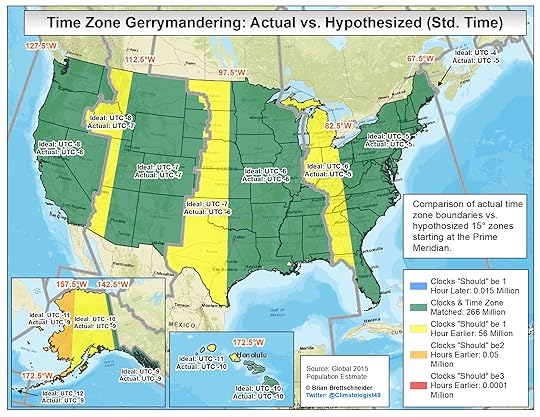
One tidbit I found interesting is by all rights, based on dividing the 360° of the globe in to 24 (one for each hour of the day) segments of 15°, my home state of Michigan should by rights be in the eastern edge of Central Time, and in fact, it was originally. Detroit moved their clocks ahead to Eastern in 1915 (to Match New York and steal an extra hour of evening daylight) and the rest of the state followed 16 years later. Definitely explains the absurdly late summer sunsets back home. (see map)
Displaying 1 - 30 of 42 reviews