Jump to ratings and reviews
Rate this book

LOYALTIES

Rate this book
During the miners' strike in the 1980s, a worker is killed in the striking coalfields of Wales. Some months later, a government minister thought to be connected with the death is also shot. Lewis Redfern—once a radical but now a political analyst and journalist—pursues the sniper, a lonely hunt that leads him through an imbroglio of civil service leaks to a secret a source of insurrection far more powerful than anyone could have suspected known as the Volunteers. In this fast-paced narrative of espionage and intrigue, Redfern, through his obsessive pursuit of justice, finally encounters the truth about himself as the novel discusses the conflict between moral choice and political loyalty.

384 pages, Paperback

First published September 19, 1985

3 people are currently reading
26 people want to read

About the author

Raymond Williams

215 books277 followers
Raymond Henry Williams was a Welsh academic, novelist, and critic. He taught for many years and the Professor of Drama at the University of Cambridge. He was an influential figure within the New Left and in wider culture. His writings on politics, culture, the mass media and literature are a significant contribution to the Marxist critique of culture and the arts. His work laid the foundations for the field of cultural studies and the cultural materialist approach. Among his many books are Culture and Society, Culture and Materialism, Politics and Letters, Problems in Materialism and Culture, and several novels.

Ratings & Reviews

What do you think?
Rate this book

Friends & Following

Create a free account to discover what your friends think of this book!

Community Reviews

5 stars
3 (37%)
4 stars
1 (12%)
3 stars
3 (37%)
2 stars
0 (0%)
1 star
1 (12%)
Displaying 1 of 1 review
Profile Image for Ian "Marvin" Graye.
961 reviews2,805 followers
June 21, 2022
CRITIQUE:

Competing Loyalties

I recall Raymond Williams more as a socialist and cultural theorist than a novelist.

Still, this was actually his fifth novel (though it's the first I've ever seen), the blurb for which asks the questions, "What is loyalty? What is treachery? What does it mean to find that one of your friends is a spy?" But that is not the whole story. It's an oversimplification of a complex, meticulously planned novel.

On first reading, "Loyalties" is slightly dull and unimaginative in execution, although once I'd finished it, I re-read my notes and got a better understanding of how issues had been foreshadowed and resolved.

As the title suggests, there are multiple, sometimes conflicting loyalties (plural, rather than singular):

"Say, for example, you were in a situation where your loyalties were divided. Where you could feel the pull of both but had still to choose one or the other."
In the novel, these loyalties arise in the private, social, public, work, and political lives of various members of the British Left from the Spanish Civil War, to the Second World War, to the Cold War, to the Vietnam War, and the UK miners' strikes in 1984.

Most of the long list of characters (1) belonged to the Welsh working class, even though some of them ended up in the public service, academic and research institutions.

Their politics ranges from union membership, small "l" liberal views, support of the UK Labour Party, card-carrying membership of the Communist Party of Great Britain, fellow travelling, fighting in the Popular Front against Spanish Fascists and German Nazis, and espionage on behalf of the Soviet Union.

The conflicting loyalties are owed variously to your self, your family, your lover(s), your friends and peers, your class, your trade union, your political party, your community, your church, your country, the government of your country, the human species, and the planet.

description
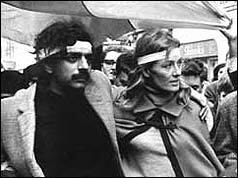
[Tariq Ali and Vanessa Redgrave march on the US Embassy on 17 March, 1968: Copyright: Robert Newsom http://news.bbc.co.uk/onthisday/hi/wi... For different images, see also https://www.npg.org.uk/collections/an...]

"The Ugly Truth Makes Every One of Us a Liar"

Many of the characters in the novel had been or remained members of the Communist Party. While there is obvious secrecy about Party membership, most of the characters were friends and knew of each other's membership, having joined the Party when they studied at Cambridge University (each was "a working-class boy in upper-class Cambridge"). For some, their party or political affiliation is the ugly truth, particularly in retrospect and when their lifestyles are in peril from revelations by defectors.

One of the characters, Emma, is also a high ranking Party official, and would have known whether her peers were members. In 1936, her brother, Norman, went to France to help supporters of the Popular Front enter Spain.

Before his departure, Norman had a relationship with an inexperienced young (seventeen year old) working class Welsh girl. Before his departure to France, the Party instructed him to discontinue the relationship. However, immediately before his departure, Norman learned that Nesta was pregnant with a son who would become the protagonist, Gwyn. Nesta subsequently married Bert, had two more children and became an artist.

Norman had a Party card up until 1939 or 1941 (the novel mentions both dates), at which time he surrendered his card, and sought to distance himself from the Party, ostensibly to obtain clearance to work in his field of scientific expertise (early computer science, in which the Soviet Union had a "deficit"), which was of ongoing interest to the Soviet Union. He married a respectable bourgeois liberal, Sarah, and ultimately they purchased a beautiful middle class home, so that they could lead a comfortable bourgeois life. (2)

Much of the novel concerns Gwyn's attempt to find out why Norman had been absent from his life, and whether he was involved in espionage on behalf of the Soviet Union (i.e., did Norman breach his loyalties to Nesta, Gwyn and Great Britain?). (3) If he was disloyal, was it out of loyalty to a greater cause? And what cause is great enough to justify disloyalty to someone who otherwise deserves our loyalty?

Sufficient Cause

In 1936, Emma says:

"What it is, Jim, beyond even smashing capitalism, is stopping fascism. If we don't we'll be back to slavery and barbarism, not just unemployment. It's coming across the whole continent. I saw it myself in Vienna. There was Italy and Germany and now there's Spain. We've got no choices left; we've got to stand against it now."

Divided Cause

By 1956, Emma was becoming conscious of increasing divisions on the Left:

"I keep getting this misplaced idea of class, from these younger ones since the war. They make it subjective, though they're supposed to be Marxists. But class is objective: objective membership and objective affiliation...What they especially don't realise is the kind of clarity, the kind of hardness if you like, that we learned in what was our own class. To grow up in what was very consciously a ruling class...

"Once you've seen the world from a ruling-class point of view, you always know the real score, you see through all the little evasions and compromises, and you know in your own life that you just have to be on one side or the other. There aren't any other real places...It's what we can give to the Party, wherever we come from: what can be given, especially, by those of us who know how the ruling class thinks."


Just Kids Taken for a Ride

Emma's certainty of belief receives a blow when she hears "these Krushchev disclosures about Stalin".

Her response is unrealistic:

"The full details are awful, of course, but it's all being put right, it's all being corrected."

To which, Norman responds:

"How do you correct the dead? But I mean beyond that. To the already disillusioned, the already sceptical, comes a new fear..There's a whole long sequence of misconceptions and errors, some of them crimes. Unless you're armoured by blind faith you watch it as it goes, you try to unravel it. But still as you unravel it you are knitting something else. Knitting up some new position, some new personality. And all that is your actual growth...And when any of it comes close it's a tearing, a tearing from that past, from that otherwise composed and lived-through past..."

"We all thought...we were thinking for ourselves. And we were just kids being taken for a ride...Getting older makes that worse. Seeing the same follies the third or fourth time around...I'm past those perfectionist fantasies of the Left."

Later, Norman theorises about how the follies, errors and mistakes are passed on to subsequent generations of children and grand-children, "not guilt by association but guilt by transmission".

Gwyn doesn't accept any share of the guilt:

"My only guilt in the matter is that I was born."

The Twilight of the Common Cause

Even when supporters of the Left "find common cause", it's just "moments of temporary fusion."

By 1968, the common cause has become fanciful, and the whole of the Left is paying the price:

"I have the strong impression that a gravely weakened Party is now tagging along behind any column it sees moving: Trotskyites, Anarchists, Flower Children, New Left..."

"...Someone like you can look back and identify this or that error, this or that disappointment or deception. But that's not really what they are or what they cost. Only we who lived them know the true cost. And a terror then comes, not so much in any danger of disgrace or punishment but in the appalling reminder that none of us at any time , can know enough, can understand enough, to avoid getting much of it wrong."

Gwyn suspects that his biological father is driven by selfishness:

"...What you once called communism...is a frame for your ego. For your indifferent self and for its interests...What you once thought about communism...is no more than a projection of what suited you at the time. The fact that for others each belief is substantial merely enabled you to deceive them. For with them it is a bond. It imposes trust and continuity. It is that imposition which makes their choice real...

"You are unfit to relate to others, and because of that you corrupt every belief you assume."


"Loyalties", being more focussed on family and friends than the subject of the struggle, lacks the thrill of a Cold War thriller in the style of John Le Carre, but for readers interested in left-wing politics in the twentieth century, it is definitely worth seeking out and reading.


FOOTNOTES:

(1) If you can find and read a copy of this novel, I recommend that you create a list of the characters (and their relationships) as soon as you start.

(2) Emma and Norman are the least working class of the characters. Their father was a British ambassador resident in Vienna, making them upper class socialists.

(3) Nesta argued that Norman's departure allowed her to find a better man and father for Gwyn.


I ALMOST MARRIED A COMMUNIST
[What Remains of a Memory]


In my second last year at university, my girlfriend at the time, Judy, told me one night in our shared single dorm bed that she and her parents were, and had always been, members of the Communist Party.

It was a surprise, but it didn't worry me. I was a social democrat, but was studying political philosophy as part of a political science degree. This included the theory and practice of Liberalism (year two) and Marxism (year three). So at least- it seemed - I would be able to talk to someone about it.

Up until then, the most radical thing I had done was to attend a protest against the Governor General's dismissal of Gough Whitlam as the Prime Minister of Australia. Another protester quite near me broke a window of a room in which the Governor General was dining. I thought it discreet to flee, before the police got more aggressive.

After Judy's revelation, things made a lot more sense. As we drove around in her red Alfasud, we were often followed by straight-faced men in hotted-up muscle cars that could easily outrun us. Judy explained that they were from ASIO and always followed her family around.

In my Liberalism course, I sat next to a mature age student I'll call Toby. He was an easy-going and friendly kind of guy. We often ended up in the Union Bar at the end of our lectures. I didn't really care, though it seemed that he worked in the Department of Education. Before that he had been a Patrol Officer in New Guinea. He had returned to Australia when New Guinea obtained its independence.

The following year when we started our course in Marxism, we got a lot closer, which means that we spent more and more time drinking at the Union Bar. We also invited a few other friends, so effectively it became a regular drinking (and thinking) group.

Toby became a close confidant, when I told him about Judy, though he didn't pry. However, at the end of the year, he gave me a lot of valued advice when Judy and her family left Australia without any warning or discussion with me. I was devastated, and I told Toby everything that was on my mind.

The following year, having finished my undergraduate degree, I saw less of Toby, until finally the drinking group disbanded. I never saw him again after that, but one of the other drinkers once told me that he (Toby) was an ASIO agent and that he had been keeping a file on me.

I thought no more of it until, 35 years later, I joined a gym and became part of a group of "seniors" who shared a personal trainer (they let me in to make up the numbers). One of them was a distinguished but amiable ex-lawyer called Mark, who, it turned out, had also been a patrol officer in New Guinea. I asked him if he had known Toby (he had), and whether he knew where he had ended up (he didn't hesitate to mention ASIO, because it had offered positions to a lot of the returning patrol officers, including some of his other friends).

Apparently, after a certain time, you can get access to your ASIO file. I'm tempted to make an application one day, when I eventually retire. But to be honest, the fiction would probably be more interesting than the fact. And I don't really want to learn that they never had a file on me after all.


SOUNDTRACK:
Displaying 1 of 1 review

Can't find what you're looking for?

Get help and learn more about the design.