

What do you think?

Autofab
Band 7 von Philip K. Dick - Sämtliche Erzählungen in 10 Bänden.
Das Buch beinhaltet die erste Hälfte von
"The Days of Perky Pat - The Collected Stories of Philip K. Dick Vol. Four" erschienen 1987 bei Underwood-Miller, San Francisco.
Inhalt:
Autofab [Autofac]
Kundendienst [Service Call]
Liefermonopol [Captive Market]
Nach Yancys Vorbild [The Mold of Yancy]
Der Minderheiten-Report [The Minority Report]
Erinnerungsmechanismus [Recall Mechanism]
Die unverbesserliche M. [The Unreconstructed M.]
Entdecker sind wir [Explorers We] – übersetzt von Frank N. Stein
Kriegsspiel [War Game]
Das Buch beinhaltet die erste Hälfte von
"The Days of Perky Pat - The Collected Stories of Philip K. Dick Vol. Four" erschienen 1987 bei Underwood-Miller, San Francisco.
Inhalt:
Autofab [Autofac]
Kundendienst [Service Call]
Liefermonopol [Captive Market]
Nach Yancys Vorbild [The Mold of Yancy]
Der Minderheiten-Report [The Minority Report]
Erinnerungsmechanismus [Recall Mechanism]
Die unverbesserliche M. [The Unreconstructed M.]
Entdecker sind wir [Explorers We] – übersetzt von Frank N. Stein
Kriegsspiel [War Game]
287 pages, Hardcover
First published November 1, 1955
About the author
Philip K. Dick
1,942 books23.3k followersPhilip Kindred Dick was a prolific American science fiction author whose work has had a lasting impact on literature, cinema, and popular culture. Known for his imaginative narratives and profound philosophical themes, Dick explored the nature of reality, the boundaries of human identity, and the impact of technology and authoritarianism on society. His stories often blurred the line between the real and the artificial, challenging readers to question their perceptions and beliefs.
Raised in California, Dick began writing professionally in the early 1950s, publishing short stories in various science fiction magazines. He quickly developed a distinctive voice within the genre, marked by a fusion of science fiction concepts with deep existential and psychological inquiry. Over his career, he authored 44 novels and more than 100 short stories, many of which have become classics in the field.
Recurring themes in Dick's work include alternate realities, simulations, corporate and government control, mental illness, and the nature of consciousness. His protagonists are frequently everyday individuals—often paranoid, uncertain, or troubled—caught in surreal and often dangerous circumstances that force them to question their environment and themselves. Works such as Ubik, The Three Stigmata of Palmer Eldritch, and A Scanner Darkly reflect his fascination with perception and altered states of consciousness, often drawing from his own experiences with mental health struggles and drug use.
One of Dick's most influential novels is Do Androids Dream of Electric Sheep?, which served as the basis for Ridley Scott's iconic film Blade Runner. The novel deals with the distinction between humans and artificial beings and asks profound questions about empathy, identity, and what it means to be alive. Other adaptations of his work include Total Recall, Minority Report, A Scanner Darkly, and The Man in the High Castle, each reflecting key elements of his storytelling—uncertain realities, oppressive systems, and the search for truth. These adaptations have introduced his complex ideas to audiences well beyond the traditional readership of science fiction.
In the 1970s, Dick underwent a series of visionary and mystical experiences that had a significant influence on his later writings. He described receiving profound knowledge from an external, possibly divine, source and documented these events extensively in what became known as The Exegesis, a massive and often fragmented journal. These experiences inspired his later novels, most notably the VALIS trilogy, which mixes autobiography, theology, and metaphysics in a narrative that defies conventional structure and genre boundaries.
Throughout his life, Dick faced financial instability, health issues, and periods of personal turmoil, yet he remained a dedicated and relentless writer. Despite limited commercial success during his lifetime, his reputation grew steadily, and he came to be regarded as one of the most original voices in speculative fiction. His work has been celebrated for its ability to fuse philosophical depth with gripping storytelling and has influenced not only science fiction writers but also philosophers, filmmakers, and futurists.
Dick's legacy continues to thrive in both literary and cinematic spheres. The themes he explored remain urgently relevant in the modern world, particularly as technology increasingly intersects with human identity and governance. The Philip K. Dick Award, named in his honor, is presented annually to distinguished works of science fiction published in paperback original form in the United States. His writings have also inspired television series, academic studies, and countless homages across media.
Through his vivid imagination and unflinching inquiry into the nature of existence, Philip K. Dick redefined what science fiction could achieve. His wor
Raised in California, Dick began writing professionally in the early 1950s, publishing short stories in various science fiction magazines. He quickly developed a distinctive voice within the genre, marked by a fusion of science fiction concepts with deep existential and psychological inquiry. Over his career, he authored 44 novels and more than 100 short stories, many of which have become classics in the field.
Recurring themes in Dick's work include alternate realities, simulations, corporate and government control, mental illness, and the nature of consciousness. His protagonists are frequently everyday individuals—often paranoid, uncertain, or troubled—caught in surreal and often dangerous circumstances that force them to question their environment and themselves. Works such as Ubik, The Three Stigmata of Palmer Eldritch, and A Scanner Darkly reflect his fascination with perception and altered states of consciousness, often drawing from his own experiences with mental health struggles and drug use.
One of Dick's most influential novels is Do Androids Dream of Electric Sheep?, which served as the basis for Ridley Scott's iconic film Blade Runner. The novel deals with the distinction between humans and artificial beings and asks profound questions about empathy, identity, and what it means to be alive. Other adaptations of his work include Total Recall, Minority Report, A Scanner Darkly, and The Man in the High Castle, each reflecting key elements of his storytelling—uncertain realities, oppressive systems, and the search for truth. These adaptations have introduced his complex ideas to audiences well beyond the traditional readership of science fiction.
In the 1970s, Dick underwent a series of visionary and mystical experiences that had a significant influence on his later writings. He described receiving profound knowledge from an external, possibly divine, source and documented these events extensively in what became known as The Exegesis, a massive and often fragmented journal. These experiences inspired his later novels, most notably the VALIS trilogy, which mixes autobiography, theology, and metaphysics in a narrative that defies conventional structure and genre boundaries.
Throughout his life, Dick faced financial instability, health issues, and periods of personal turmoil, yet he remained a dedicated and relentless writer. Despite limited commercial success during his lifetime, his reputation grew steadily, and he came to be regarded as one of the most original voices in speculative fiction. His work has been celebrated for its ability to fuse philosophical depth with gripping storytelling and has influenced not only science fiction writers but also philosophers, filmmakers, and futurists.
Dick's legacy continues to thrive in both literary and cinematic spheres. The themes he explored remain urgently relevant in the modern world, particularly as technology increasingly intersects with human identity and governance. The Philip K. Dick Award, named in his honor, is presented annually to distinguished works of science fiction published in paperback original form in the United States. His writings have also inspired television series, academic studies, and countless homages across media.
Through his vivid imagination and unflinching inquiry into the nature of existence, Philip K. Dick redefined what science fiction could achieve. His wor
Ratings & Reviews
Friends & Following
Create a free account to discover what your friends think of this book!
Community Reviews
Displaying 1 - 30 of 58 reviews

May 26, 2019
First printed in Galaxy (Nov. 1955), “Autofac” develops the themes of autonomous robots and self-perpetuating systems within a post-apocalyptic context. And of course—since this is Philip K. Dick—he tells us a good story too.
During a devastating war, humans set up robotic factories to fulfill all their basic needs in what they knew would soon become a post-war environment of scarcity. Now the war is over, and the surviving communities of people are once again capable of taking control, but they have found that this won’t be easy: the robots, programmed to produce the good necessary to satisfy human wants, are determined to keep producing them no matter what happens—and no matter what the humans want. Meanwhile, the robot factories their unwanted care packages, depleting the scarce resources of the earth.
This story—an account of a rebel group who devise a method for thwarting the robots—is ingenious and believable. And the consequences of their actions are both chilling . . . and believable.
(The Amazon series Electric Dreams features an “Autofac” episode. It is, however, much different from the orginal Dick story.)

January 2, 2021
Autofac is a science fiction short story by the American writer Philip K. Dick. It was originally published in “Galaxy Science Fiction” for November 1955.
The story is post-apocalyptic. Five years earlier, during the Total Global Conflict, all civilisations on Earth were devastated. A network of hardened automatic factories, or “Autofacs” had been established during that time. They had cybernetic controls to determine which food and consumer goods needed to be manufactured and delivered. Now the human survivors are totally dependent on these Autofacs—but they want to take back control for themselves.
At the beginning of the story, we meet three men: Perine and Morrison from one settlement and O’Neill from another, who are waiting for a truckload of supplies to arrive from the factory. However, they are not there to gratefully receive the goods; Earth’s resources are dwindling. They are determined to stop the stripping of the land of these valuable resources, and convince the system of automated factories that they no longer want the goods it provides. As soon as a truck arrives, they destroy all the crates it unloads, but to no avail. Immediately, a second identical batch is despatched from the truck. Their next attempt is to make a show of drinking the milk delivered, and pretend to be revolted, as if it is bad. The Autofac is programmed to deal with various situations, and this is one:
“Curious, the truck came slowly back. Electronic synapses clicked and whirred, responding to the situation; its antennae shot up like a flagpole.”
It ejects a metal cylinder containing a form to complete about the product, with multiple choice answers. At the end of the form, the men write: “the milk is thoroughly pizzled”. They hope that by writing nonsense, and confusing the Autofac, they will at last make contact with the factory. They simply have to to find some way to stop the system and shut it down, before the Autofacs completely ravage the planet.
A robot from the factory arrives in response to their complaint, a quasi-human with:
“functional upright biped chassis, with data-receptors mounted at the top, effectors and proprioceptors mounted in a downward worm that ended in floor-grippers.”
It introduces itself in pleasant tones, clearly from a taped message recorded by some human long ago, when these emergency measures seemed a good idea. Then the robot voice kicks in.
The “factory representative” denies that the milk is substandard, and asks for a definition of “pizzled”. O’Neill tries to broaden out the conversation, by saying that it means the production of something when it is no longer needed, trying to make it clear that they no longer want the milk. But the Autofac knows that there are no cows in this area, and that:
“Original taped instructions describe milk as an essential to human diet.”
Since all the cows are dead, only synthetic milk can be made. O’Neill says in desperation that they would rather go without milk until they can find cows, but the Autofac’s logic cannot be refuted. Since there is no outside production, it says, synthetic production will go on. O’Neill finds it impossible to move the Autofac off the specific job it has, to discuss the problem of the factory in general terms.
Morrison realises that this is a paradox. They cannot use semantics to outwit the machine.
Several of Philip K. Dick’s stories tell of the dangers of automation, and also the consequences of unrestrained consumerism on the economy. Here the premise seems sound. The Autofacs were set up at a time during a nuclear war, when they were badly needed—but the production continued long afterwards. Despite humanity’s best efforts to shut them down, to preserve Earth’s dwindling resources, they cannot undo the deprogramming. The end result will be the destruction of every natural resource on Earth, and perhaps throughout the galaxy.
This is an example of Philip K. Dick’s laws of robotics: all systems and bureaucracies will carry on doing what they are programmed to do, even past the point of absurdity. It is also one of the earliest stories to feature self-replicating machines.
It is also interesting that the three men who profess to want to destroy the machine are quite happy to reinstall automation when it is in their own interest and under their control. They constantly disparage the primitive ruins-squatters, but because of the ending to this story, we begin to wonder whether non-technological people living in a similar way to late Stone Age peoples, will survive for longer. They are not competing with the Autofacs for resources in the same way. They do not really need metals and fossil fuels, and have even started raising domesticated animals.
Also the Autofac helps humanity to meet its basic needs, but in the progress it limits innovation. It cannot develop new products, but only insist on standardising, making sure that everything conforms to what has been specified. This can only lead to entropy. The primitive ruins-squatters have only made a beginning, but it promises much.
This story is an interesting take on the now common idea of robots, or some sort of artificial intelligence, exceeding its original programming, and trying to destroy its creator. What is interesting here, is that it is not a machine which has mutated, or started to run amok for some reason. The Autofacs are doing exactly what their original creator and programmers had intended them to do—no more, no less. The fault lies with human error. Thus yet again, Philip K. Dick has written a story which makes us confront the idea that the destruction of humanity may come about as a consequence of our own bad decisions and actions. It is an unusual technological parable, because we are not fighting the robots, or the machines. We are fighting ourselves, or more specifically we are fighting our own natures: fighting what it is to be human.
As an aside, in Autofac, Philip K. Dick coined a catch-phrase. “This milk is pizzled” invented the word “pizzled”, trying to confuse a robot, and convince it that something was faulty. The word “pizzled” has now entered our vocabulary to mean faulty, in some unstated—and perhaps unspecifiable—way.
Autofac has been reprinted in several collections, including “The Variable Man” published in 1957, and “Robots, Androids, and Mechanical Oddities” published in 1984. It can now be found as the first story in “Minority Report and Other Classic Stories by Philip K. Dick”, and also in “Philip K. Dick’s Electric Dreams”, published to accompany the 2017 TV series of the same name. Travis Beacham adapted the story for a one-hour episode, but there are considerable differences in the plot and outcome.
Often good Science or speculative fiction will seem somehow relevant to today’s world, even if the hard science is outdated. That is true here.
I found myself reading this at the beginning of the coronavirus outbreak, in 2020. The government of my country decided that it needed to protect certain sections of the population, because if the hospitals became overwhelmed with Covid 19 cases and could not accept them, these people might not survive on their own. Sounds futuristic, doesn’t it? A plague sweeping the world? And predictably it was all “going to be over in a few weeks”.
We would have 3 weeks’ lockdown, then 3 weeks normal life, then another 3 weeks—and hopefully we would soon be out of it. But we must protect these people who were designated by various criteria to be officially “Clinically extremely vulnerable”. They would have priority slots for internet supermarket deliveries and volunteers from the community to help in various ways. New terms such as “socially distanced” were coined. Science fiction always has its own jargon.
Clinically extremely vulnerable people were told to stay indoors, away from any risk. They could sit by the window or on their back steps for “fresh air”. If they were fortunate enough to have their own garden, they could walk outside there, but nowhere else. And food parcels were sent weekly, for those who were finding it difficult to get food. These were all identical, and sometimes inappropriate. No fruit, only one or two root veg, an abundance of pasta and rice, plus various tins.
I found myself in the position of the three men in this story, with inappropriate foodstuffs which were more likely to kill me than sustain me. Some tried to cancel the food parcels, but the vans dropped off the food and went away as fast as they could, to ensure “social distancing”. Attempting to telephone to cancel met with a bureaucratic mess worthy of Philip K. Dick. An internet cancellation worked for me, but for some, the parcels kept coming, left outside the wrong address, or to houses that were empty.
The process was abandoned after a few months. Such “shielding” (another new word) long term was found to cause other problems; often psychological ones. Philip K. Dick might have been surprised that we have a pandemic, but he would not be surprised that automation, and bureaucracy, however well meant, can fail, or grow into a huge elephantine mess of rules, which hardly anybody properly understands.
Or that in some parts of the world, humanity can sometimes lose sight of the enemy—of what we are actually all fighting together—so spectacularly.
The story is post-apocalyptic. Five years earlier, during the Total Global Conflict, all civilisations on Earth were devastated. A network of hardened automatic factories, or “Autofacs” had been established during that time. They had cybernetic controls to determine which food and consumer goods needed to be manufactured and delivered. Now the human survivors are totally dependent on these Autofacs—but they want to take back control for themselves.
At the beginning of the story, we meet three men: Perine and Morrison from one settlement and O’Neill from another, who are waiting for a truckload of supplies to arrive from the factory. However, they are not there to gratefully receive the goods; Earth’s resources are dwindling. They are determined to stop the stripping of the land of these valuable resources, and convince the system of automated factories that they no longer want the goods it provides. As soon as a truck arrives, they destroy all the crates it unloads, but to no avail. Immediately, a second identical batch is despatched from the truck. Their next attempt is to make a show of drinking the milk delivered, and pretend to be revolted, as if it is bad. The Autofac is programmed to deal with various situations, and this is one:
“Curious, the truck came slowly back. Electronic synapses clicked and whirred, responding to the situation; its antennae shot up like a flagpole.”
It ejects a metal cylinder containing a form to complete about the product, with multiple choice answers. At the end of the form, the men write: “the milk is thoroughly pizzled”. They hope that by writing nonsense, and confusing the Autofac, they will at last make contact with the factory. They simply have to to find some way to stop the system and shut it down, before the Autofacs completely ravage the planet.
A robot from the factory arrives in response to their complaint, a quasi-human with:
“functional upright biped chassis, with data-receptors mounted at the top, effectors and proprioceptors mounted in a downward worm that ended in floor-grippers.”
It introduces itself in pleasant tones, clearly from a taped message recorded by some human long ago, when these emergency measures seemed a good idea. Then the robot voice kicks in.
The “factory representative” denies that the milk is substandard, and asks for a definition of “pizzled”. O’Neill tries to broaden out the conversation, by saying that it means the production of something when it is no longer needed, trying to make it clear that they no longer want the milk. But the Autofac knows that there are no cows in this area, and that:
“Original taped instructions describe milk as an essential to human diet.”
Since all the cows are dead, only synthetic milk can be made. O’Neill says in desperation that they would rather go without milk until they can find cows, but the Autofac’s logic cannot be refuted. Since there is no outside production, it says, synthetic production will go on. O’Neill finds it impossible to move the Autofac off the specific job it has, to discuss the problem of the factory in general terms.
Morrison realises that this is a paradox. They cannot use semantics to outwit the machine.
Several of Philip K. Dick’s stories tell of the dangers of automation, and also the consequences of unrestrained consumerism on the economy. Here the premise seems sound. The Autofacs were set up at a time during a nuclear war, when they were badly needed—but the production continued long afterwards. Despite humanity’s best efforts to shut them down, to preserve Earth’s dwindling resources, they cannot undo the deprogramming. The end result will be the destruction of every natural resource on Earth, and perhaps throughout the galaxy.
This is an example of Philip K. Dick’s laws of robotics: all systems and bureaucracies will carry on doing what they are programmed to do, even past the point of absurdity. It is also one of the earliest stories to feature self-replicating machines.
It is also interesting that the three men who profess to want to destroy the machine are quite happy to reinstall automation when it is in their own interest and under their control. They constantly disparage the primitive ruins-squatters, but because of the ending to this story, we begin to wonder whether non-technological people living in a similar way to late Stone Age peoples, will survive for longer. They are not competing with the Autofacs for resources in the same way. They do not really need metals and fossil fuels, and have even started raising domesticated animals.
Also the Autofac helps humanity to meet its basic needs, but in the progress it limits innovation. It cannot develop new products, but only insist on standardising, making sure that everything conforms to what has been specified. This can only lead to entropy. The primitive ruins-squatters have only made a beginning, but it promises much.
This story is an interesting take on the now common idea of robots, or some sort of artificial intelligence, exceeding its original programming, and trying to destroy its creator. What is interesting here, is that it is not a machine which has mutated, or started to run amok for some reason. The Autofacs are doing exactly what their original creator and programmers had intended them to do—no more, no less. The fault lies with human error. Thus yet again, Philip K. Dick has written a story which makes us confront the idea that the destruction of humanity may come about as a consequence of our own bad decisions and actions. It is an unusual technological parable, because we are not fighting the robots, or the machines. We are fighting ourselves, or more specifically we are fighting our own natures: fighting what it is to be human.
As an aside, in Autofac, Philip K. Dick coined a catch-phrase. “This milk is pizzled” invented the word “pizzled”, trying to confuse a robot, and convince it that something was faulty. The word “pizzled” has now entered our vocabulary to mean faulty, in some unstated—and perhaps unspecifiable—way.
Autofac has been reprinted in several collections, including “The Variable Man” published in 1957, and “Robots, Androids, and Mechanical Oddities” published in 1984. It can now be found as the first story in “Minority Report and Other Classic Stories by Philip K. Dick”, and also in “Philip K. Dick’s Electric Dreams”, published to accompany the 2017 TV series of the same name. Travis Beacham adapted the story for a one-hour episode, but there are considerable differences in the plot and outcome.
Often good Science or speculative fiction will seem somehow relevant to today’s world, even if the hard science is outdated. That is true here.
I found myself reading this at the beginning of the coronavirus outbreak, in 2020. The government of my country decided that it needed to protect certain sections of the population, because if the hospitals became overwhelmed with Covid 19 cases and could not accept them, these people might not survive on their own. Sounds futuristic, doesn’t it? A plague sweeping the world? And predictably it was all “going to be over in a few weeks”.
We would have 3 weeks’ lockdown, then 3 weeks normal life, then another 3 weeks—and hopefully we would soon be out of it. But we must protect these people who were designated by various criteria to be officially “Clinically extremely vulnerable”. They would have priority slots for internet supermarket deliveries and volunteers from the community to help in various ways. New terms such as “socially distanced” were coined. Science fiction always has its own jargon.
Clinically extremely vulnerable people were told to stay indoors, away from any risk. They could sit by the window or on their back steps for “fresh air”. If they were fortunate enough to have their own garden, they could walk outside there, but nowhere else. And food parcels were sent weekly, for those who were finding it difficult to get food. These were all identical, and sometimes inappropriate. No fruit, only one or two root veg, an abundance of pasta and rice, plus various tins.
I found myself in the position of the three men in this story, with inappropriate foodstuffs which were more likely to kill me than sustain me. Some tried to cancel the food parcels, but the vans dropped off the food and went away as fast as they could, to ensure “social distancing”. Attempting to telephone to cancel met with a bureaucratic mess worthy of Philip K. Dick. An internet cancellation worked for me, but for some, the parcels kept coming, left outside the wrong address, or to houses that were empty.
The process was abandoned after a few months. Such “shielding” (another new word) long term was found to cause other problems; often psychological ones. Philip K. Dick might have been surprised that we have a pandemic, but he would not be surprised that automation, and bureaucracy, however well meant, can fail, or grow into a huge elephantine mess of rules, which hardly anybody properly understands.
Or that in some parts of the world, humanity can sometimes lose sight of the enemy—of what we are actually all fighting together—so spectacularly.

January 19, 2018
Rating: 4* of five, rounded down a half-star for a few head-scratchers in the story
Available as a free download on The Internet Archive.
A wonderful indictment of mindless end-stage capitalism, this. The autofacs are destroying the Earth because they're programmed to produce goods for humans while the humans are busy destroying each other, and the autofacs aren't programmed to stop producing until ordinary human-led production is up to capacity to replace their output.
But there aren't enough people left after the war to produce goods. So the autofacs keep producing. And they've ravaged the planet, extracted *all* the resources, and are on the brink of a crisis.
Enter some human chauvinist survivors, people living on the autofacs' deliveries but longing to remake their own means of production. How? First, stop the autofacs from tunneling the Earth into a honeycomb as the automated resource locators locate more resources to make into things. They figure out how to do this by making the machines that control everything stop to figure out what the word "pizzled" means. Machine language skills are dependent upon examples and usages to interpret human wishes, so "pizzled"—a word invented on the spot—is guaranteed to stop the low-level machines in their tracks and get the problem of figuring out what's wrong to the higher-ups.
Bureaucracy/hierarchy is eternal and not species dependent.
This plot succeeds and, using the information they extrapolate from this success, the human chauvinists figure out a way to Stop The Autofacs!! And it WORKS!! But the basic question they've failed to devise an answer for is, "Now what?"
I liked the story, and have spent this much time and effort creating a book report on it, because like most of PKD's work it leaves the reader with more questions than answers. That's why I started reading his stuff long ago, and why I was willing to take up with his ouevre after a decades-long hiatus. Amazon is using some of its ungodly billions to autofac...I mean create...screen-based entertainments rooted in PKD's storytelling. Two of PKD's daughters are exec-producing a show called Philip K. Dick's Electric Dreams, and this story is an episode of that series.
The episode refocuses the stakes of the story in a major, major way that I can't discuss without spoilers. The episode also modernizes the manner in which Autofac, transmogrified from a descrptive term for a technological artifact into a corporate name, is hacked and what the consequences of the Big Reveal are constitute the major reorientation of the concerns of society. Consumption is still the problem, though the reasons it's a problem have shifted. For that reason, I'd give the episode an extra half-star over the source material.
I'd buttress that half-star addition with a major change that I like a lot: A woman is the center of the episode's story, and for a very significant reason. Contrast this with the role of the only woman in PKD's story, wife of one of the human chauvinists, who serves coffee and asks Mary Sue questions, which are answered condescendingly by any male around. In one of the story's illustrations in Galaxy Magazine's November 1955 edition, in fact, the woman is depicted lying in the dirt between two men, watching something unfold beneath them, IN. A. SKIRT. that's modestly covering her knees.
Ha. Ha ha. Clearly the artist has never worn a skirt. How the hell would she have gotten down on her belly in the dirt bound up by one of those things? And more to the point, how the hell would she get back up? And WHY would she wear one of those impractical items in a post-apocalyptic world when trousers are vastly more practical?
Also agreeably different in the filmed version is the inclusion of sex. As in, the female lead gets some sex and the focus is on the attractive man sexing her up to her liking. In a radical departure from previous norms, the attractive young man stays naked after the sex scene, is lingered over by the camera, and is emotionally needy of the woman's love and approval in the afterglow. He even says The Big Three to her! First!
I love this. It's about goddamned time. If for no other reason that it points up in a quiet, even positive, way the conventional tropes and their ubiquity without nastiness or negativity. Well done, producers and writers, well played, actors, and say Hallelujah, consumers! We're finally, in small first-steps ways, seeing the positive effects of the unleashed anger of a generation of mad-as-hell women. Don't take it anymore, keep reframing the conversation, and leave more questions than answers. Growth will happen.
Available as a free download on The Internet Archive.
A wonderful indictment of mindless end-stage capitalism, this. The autofacs are destroying the Earth because they're programmed to produce goods for humans while the humans are busy destroying each other, and the autofacs aren't programmed to stop producing until ordinary human-led production is up to capacity to replace their output.
But there aren't enough people left after the war to produce goods. So the autofacs keep producing. And they've ravaged the planet, extracted *all* the resources, and are on the brink of a crisis.
Enter some human chauvinist survivors, people living on the autofacs' deliveries but longing to remake their own means of production. How? First, stop the autofacs from tunneling the Earth into a honeycomb as the automated resource locators locate more resources to make into things. They figure out how to do this by making the machines that control everything stop to figure out what the word "pizzled" means. Machine language skills are dependent upon examples and usages to interpret human wishes, so "pizzled"—a word invented on the spot—is guaranteed to stop the low-level machines in their tracks and get the problem of figuring out what's wrong to the higher-ups.
Bureaucracy/hierarchy is eternal and not species dependent.
This plot succeeds and, using the information they extrapolate from this success, the human chauvinists figure out a way to Stop The Autofacs!! And it WORKS!! But the basic question they've failed to devise an answer for is, "Now what?"
I liked the story, and have spent this much time and effort creating a book report on it, because like most of PKD's work it leaves the reader with more questions than answers. That's why I started reading his stuff long ago, and why I was willing to take up with his ouevre after a decades-long hiatus. Amazon is using some of its ungodly billions to autofac...I mean create...screen-based entertainments rooted in PKD's storytelling. Two of PKD's daughters are exec-producing a show called Philip K. Dick's Electric Dreams, and this story is an episode of that series.
The episode refocuses the stakes of the story in a major, major way that I can't discuss without spoilers. The episode also modernizes the manner in which Autofac, transmogrified from a descrptive term for a technological artifact into a corporate name, is hacked and what the consequences of the Big Reveal are constitute the major reorientation of the concerns of society. Consumption is still the problem, though the reasons it's a problem have shifted. For that reason, I'd give the episode an extra half-star over the source material.
I'd buttress that half-star addition with a major change that I like a lot: A woman is the center of the episode's story, and for a very significant reason. Contrast this with the role of the only woman in PKD's story, wife of one of the human chauvinists, who serves coffee and asks Mary Sue questions, which are answered condescendingly by any male around. In one of the story's illustrations in Galaxy Magazine's November 1955 edition, in fact, the woman is depicted lying in the dirt between two men, watching something unfold beneath them, IN. A. SKIRT. that's modestly covering her knees.
Ha. Ha ha. Clearly the artist has never worn a skirt. How the hell would she have gotten down on her belly in the dirt bound up by one of those things? And more to the point, how the hell would she get back up? And WHY would she wear one of those impractical items in a post-apocalyptic world when trousers are vastly more practical?
Also agreeably different in the filmed version is the inclusion of sex. As in, the female lead gets some sex and the focus is on the attractive man sexing her up to her liking. In a radical departure from previous norms, the attractive young man stays naked after the sex scene, is lingered over by the camera, and is emotionally needy of the woman's love and approval in the afterglow. He even says The Big Three to her! First!
I love this. It's about goddamned time. If for no other reason that it points up in a quiet, even positive, way the conventional tropes and their ubiquity without nastiness or negativity. Well done, producers and writers, well played, actors, and say Hallelujah, consumers! We're finally, in small first-steps ways, seeing the positive effects of the unleashed anger of a generation of mad-as-hell women. Don't take it anymore, keep reframing the conversation, and leave more questions than answers. Growth will happen.
May 31, 2021
How Our Needs Are Defined for Us
In his short story Autofac, which was published in Galaxy in 1955, PKD addresses various unsettling questions, some of which were extremely perceptive for the time the story was written. Once again, Dick takes us into a post-war world, which is riddled with destruction and disorder: Vast ranges of landscape are uninhabited, only roamed by animals, such as rats and birds, that have grossly mutated as a consequence of the radiation set free by nuclear weapons. Humanity seems to fall into two groups – those who live in areas that are provided for by the eponymous Autofacs, i.e. automatized factories that assess the need for and produce food and other consumer goods, and those who live cut off from these supplies, and whose lives are characterized by scarcity, but also by independence from mass-produced goods. However, even the dwellers of the regular settlements have got a serious problem: The Autofacs only produce off-the-shelf products and they do this along the lines of the programmes they received before the war came into its hotter phases, and therefore these products no longer really fulfil the needs of the people that depend on them. An even worse side effect is that by producing these things en masse, the plants use up more and more of the already declining resources, thus endangering future welfare. Consumers have basically no chance to change the system, for example by redefining their needs and voicing their requirements for new kinds of products and for economizing on the dwindling resources. All efforts at communicating with the machines that provide a link between the factories and consumers having hitherto failed, some of the settlement dwellers eventually start playing off one factory against another by creating a conflict over scarce resources – with unforeseen, and hardly-wished-for, consequences.
This story has aged extremely well because in our day and age it is even easier to acknowledge the danger that our consumer society poses to the ecological integrity of our environment, it being clear that we have to adjust our way of life with a view to the limitations of our ecosystem. The settlers around O’Neill want to take industrial production into their own hands because they perceive that if the factories keep on running automatically, natural resources would come to an end quite soon. At the same time, however, they do not envisage for themselves a life like that of the people outside the scope of the Autofacs – a life that can probably best be summarized by using the adjectives Hobbes came up with in order to describe human life. In fact, some of the settlers voice their abhorrence and lack of understanding for these people’s lives, and once the factories concentrate on the production of weapons again, the dwellers’ own lives deteriorate rapidly. It should be noted, however, that their community does not disintegrate and that they learn to cope with these new restrictions, which is, of course, far from letting their new life appear in the light of something desirable. The lesson O’Neill and his friends have to learn, though, seems to me that for consumers it is by far more difficult to take control of the economic system than they might anticipate because the economy works in its own ways (here represented by a programme that consumers cannot understand and hardly really communicate with).
With a view to our modern life, we might say that this pattern perceived by Dick can be seen by how nowadays certain alternative lifestyles are pandered to by the economy, giving consumers the feeling that they are changing something although they are still part and parcel of the system they want to stand out from. Just take the recent example of ersatz meat products for vegetarians or vegan people – one might ask why a vegetarian would want something he likes to eat to look like a steak or why a vegan person would want to eat something resembling cheese. What was there before – the product or the need for it? And does this need really make any sense? These are questions that can be asked in many respects.
In his short story Autofac, which was published in Galaxy in 1955, PKD addresses various unsettling questions, some of which were extremely perceptive for the time the story was written. Once again, Dick takes us into a post-war world, which is riddled with destruction and disorder: Vast ranges of landscape are uninhabited, only roamed by animals, such as rats and birds, that have grossly mutated as a consequence of the radiation set free by nuclear weapons. Humanity seems to fall into two groups – those who live in areas that are provided for by the eponymous Autofacs, i.e. automatized factories that assess the need for and produce food and other consumer goods, and those who live cut off from these supplies, and whose lives are characterized by scarcity, but also by independence from mass-produced goods. However, even the dwellers of the regular settlements have got a serious problem: The Autofacs only produce off-the-shelf products and they do this along the lines of the programmes they received before the war came into its hotter phases, and therefore these products no longer really fulfil the needs of the people that depend on them. An even worse side effect is that by producing these things en masse, the plants use up more and more of the already declining resources, thus endangering future welfare. Consumers have basically no chance to change the system, for example by redefining their needs and voicing their requirements for new kinds of products and for economizing on the dwindling resources. All efforts at communicating with the machines that provide a link between the factories and consumers having hitherto failed, some of the settlement dwellers eventually start playing off one factory against another by creating a conflict over scarce resources – with unforeseen, and hardly-wished-for, consequences.
This story has aged extremely well because in our day and age it is even easier to acknowledge the danger that our consumer society poses to the ecological integrity of our environment, it being clear that we have to adjust our way of life with a view to the limitations of our ecosystem. The settlers around O’Neill want to take industrial production into their own hands because they perceive that if the factories keep on running automatically, natural resources would come to an end quite soon. At the same time, however, they do not envisage for themselves a life like that of the people outside the scope of the Autofacs – a life that can probably best be summarized by using the adjectives Hobbes came up with in order to describe human life. In fact, some of the settlers voice their abhorrence and lack of understanding for these people’s lives, and once the factories concentrate on the production of weapons again, the dwellers’ own lives deteriorate rapidly. It should be noted, however, that their community does not disintegrate and that they learn to cope with these new restrictions, which is, of course, far from letting their new life appear in the light of something desirable. The lesson O’Neill and his friends have to learn, though, seems to me that for consumers it is by far more difficult to take control of the economic system than they might anticipate because the economy works in its own ways (here represented by a programme that consumers cannot understand and hardly really communicate with).
With a view to our modern life, we might say that this pattern perceived by Dick can be seen by how nowadays certain alternative lifestyles are pandered to by the economy, giving consumers the feeling that they are changing something although they are still part and parcel of the system they want to stand out from. Just take the recent example of ersatz meat products for vegetarians or vegan people – one might ask why a vegetarian would want something he likes to eat to look like a steak or why a vegan person would want to eat something resembling cheese. What was there before – the product or the need for it? And does this need really make any sense? These are questions that can be asked in many respects.
February 15, 2019
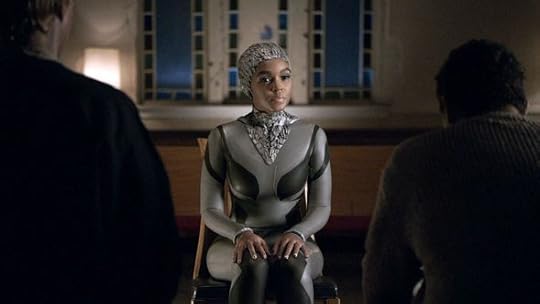
The 1955 Philip K. Dick short story which the Electric Dreams episode Autofac, starring Juno Temple, was based upon.
In a post-apocalyptic world automated factories have taken over production of all goods, which they deliver automatically to the surviving humans.
The survivors want to take over production themselves again, as they get delivered goods they don’t deem necessary and also resources are running low as the factories just keep producing and producing and producing.
They try to get in contact with the autofac by filing a complaint about a delivery of milk. The autofac delivery bot wants them to fill out a form. But instead of choosing one of the default answers they tell it the milk had been pizzled. Which puzzles the autofac bot.
The autofac sends a unit to discuss the matter of the pizzled milk. And the humans try to convince it that autofacs aren‘t necessary anymore and they can produce all goods themselves. But the autofac bot outsmarts them and so they proceed with more drastic measures to stop the automated production.
This story can be read as a parable on consumerism and unnecessary, if not to say outright stupid, bureaucracy. Though PKD leaves it mostly to the reader to decide what’s the actual point of the story.
Unfortunately the characters are very flat, there isn‘t much atmosphere and the autofac units seem a little dated by now. Though one has to consider this was written 64 years ago.
I have to say I didn’t enjoy this story much and think the, unsurprisingly, more modern Electric Dreams episode works a lot better. The two stories differ in many aspects, but especially in how they end. I loved the twist at the end of the TV episode, while I think the ending of the short story wasn’t bad.
Overall, in my opinion, not one of his better works.
The PKD short story: 1.5/5
The Electric Dreams episode: 7/10
In a post-apocalyptic world automated factories have taken over production of all goods, which they deliver automatically to the surviving humans.
The survivors want to take over production themselves again, as they get delivered goods they don’t deem necessary and also resources are running low as the factories just keep producing and producing and producing.
They try to get in contact with the autofac by filing a complaint about a delivery of milk. The autofac delivery bot wants them to fill out a form. But instead of choosing one of the default answers they tell it the milk had been pizzled. Which puzzles the autofac bot.
The autofac sends a unit to discuss the matter of the pizzled milk. And the humans try to convince it that autofacs aren‘t necessary anymore and they can produce all goods themselves. But the autofac bot outsmarts them and so they proceed with more drastic measures to stop the automated production.
This story can be read as a parable on consumerism and unnecessary, if not to say outright stupid, bureaucracy. Though PKD leaves it mostly to the reader to decide what’s the actual point of the story.
Unfortunately the characters are very flat, there isn‘t much atmosphere and the autofac units seem a little dated by now. Though one has to consider this was written 64 years ago.
I have to say I didn’t enjoy this story much and think the, unsurprisingly, more modern Electric Dreams episode works a lot better. The two stories differ in many aspects, but especially in how they end. I loved the twist at the end of the TV episode, while I think the ending of the short story wasn’t bad.
Overall, in my opinion, not one of his better works.
The PKD short story: 1.5/5
The Electric Dreams episode: 7/10

November 17, 2021
This story has stuck in my memory since I first read it more than 15 years ago, but upon rereading I’m not sure why.
In Autofac humans in a post-nuclear-destruction future are grappling with a problem. That problem is the Autofac; self-guided robotic factories meant to provide goods for humans in need during wartime. The humans, however, no longer feel that they are in need as the war is long since over. They are ready to resume the burdens and rewards of production. But there’s no way for them to communicate with the factories, or get them to stop producing goods that are no longer necessary. How to prevent a machine that’s programmed to perform a duty from performing its duty? Not easily it turns out.
Interesting idea, but the story is quite boring, and it’s missing the manic paranoia that makes Dick so strangely charming.
In Autofac humans in a post-nuclear-destruction future are grappling with a problem. That problem is the Autofac; self-guided robotic factories meant to provide goods for humans in need during wartime. The humans, however, no longer feel that they are in need as the war is long since over. They are ready to resume the burdens and rewards of production. But there’s no way for them to communicate with the factories, or get them to stop producing goods that are no longer necessary. How to prevent a machine that’s programmed to perform a duty from performing its duty? Not easily it turns out.
Interesting idea, but the story is quite boring, and it’s missing the manic paranoia that makes Dick so strangely charming.
![Profile Image for [ J o ].](https://i.gr-assets.com/images/S/compressed.photo.goodreads.com/users/1673171874i/4639825._UY200_CR4,0,200,200_.jpg)
May 14, 2018
A good dystopian after-the-tech story of a group of survivors who just want to work the land and forget the past, but are dogged by automatic factories that are continuously ruining the land because it "thinks" the humans need their products.
Pretty similar in taste to his others and the themes are nice to explore. The characters were completely flat, which in short stories is pretty much standard, and the atmosphere was never truly built. I didn't feel the dystopian or ravaged land, it just sort of thudded in to you on occasion.
The enjoyment flows from the devastating effects of tech, especially "auto" tech and how their help is often incredibly limited. It's a nice little parable and, of course, was written well, but was lacking in depth which short stories often do.
One can imagine all these PKD short stories being rifled through, just waiting for that spark to ignite a full, complete story...
Pretty similar in taste to his others and the themes are nice to explore. The characters were completely flat, which in short stories is pretty much standard, and the atmosphere was never truly built. I didn't feel the dystopian or ravaged land, it just sort of thudded in to you on occasion.
The enjoyment flows from the devastating effects of tech, especially "auto" tech and how their help is often incredibly limited. It's a nice little parable and, of course, was written well, but was lacking in depth which short stories often do.
One can imagine all these PKD short stories being rifled through, just waiting for that spark to ignite a full, complete story...

November 14, 2022
I can't help but view Autofac as a perfect expression of Gothic horror. In
Limits of Horror
, Fred Botting argues that Gothic horror's terror of doubles derives from the Industrial Revolution's automation of human labour. Despite a global order of increasing secularisation, phantoms proliferate in culture, first as spirits, then as puppets, carriages, railroads, factories, consumer appliances, genes and nanomachines. Like
Frankenstein
and
Capital
, Gothic remnants permutate into speculative nightmares.
In Autofac, production has been automated by a cybernetic system programmed to sustain humans during World War III. This system is completely autonomous, capable of extracting resources and producing goods without human labour. The issue is that the system is too good at what it does; it extracts from the Earth so efficiently that the landscape is in ruins. Autofac isn't about an AI going rogue, but rather an AI doing exactly what it is programmed to do. It's about the total automation of the Earth's destruction by capital, headless and perfect.
I find this variant of AI horror far more interesting than techbro singularity and simulation shit. The horror of the past few centuries has been the slow automation of everything, from physical labour, to cognitive labour, to emotional labour. The horror of Autofac is the absurdity of rationality severed from reflexivity. Consciousness won't kill us—nonconsciousness will. The maintenance of a homeostatic normal that drives all other homeostatic systems into crisis. The haunt of a never-ending, never-changing Industrial Revolution, whose conflation of technological progress with social progress ends in apocalypse.
In Autofac, production has been automated by a cybernetic system programmed to sustain humans during World War III. This system is completely autonomous, capable of extracting resources and producing goods without human labour. The issue is that the system is too good at what it does; it extracts from the Earth so efficiently that the landscape is in ruins. Autofac isn't about an AI going rogue, but rather an AI doing exactly what it is programmed to do. It's about the total automation of the Earth's destruction by capital, headless and perfect.
I find this variant of AI horror far more interesting than techbro singularity and simulation shit. The horror of the past few centuries has been the slow automation of everything, from physical labour, to cognitive labour, to emotional labour. The horror of Autofac is the absurdity of rationality severed from reflexivity. Consciousness won't kill us—nonconsciousness will. The maintenance of a homeostatic normal that drives all other homeostatic systems into crisis. The haunt of a never-ending, never-changing Industrial Revolution, whose conflation of technological progress with social progress ends in apocalypse.
February 5, 2017
post-apocalyptic Earth with automated factories running out of control
November 12, 2021
This story is quite boring to me, I couldn't stay focused whilst reading it at all - I think this is because the main plot isn't strong enough. In my opinion, I feel like the story somewhat just gives a brief overview of everything that occurs, nothing is written in-depth and there aren't different dimensions in the story. In other words, the readers can't understand the story from the perspectives of different characters, to me, this makes me unengaged with the story whilst reading. In regards to the plot, I feel like it isn't strong due to the lack of description of the important factors that will truly move the story forwards. The language used is simple - too simple, it lacks the 'showing' factor. This story heavily relies on directly telling the readers what happens throughout the story rather than simply showing and allowing the readers to somewhat personalize the story through the use of one's imagination and creativity. As for the dialogues used in the story, I feel as if the speeches are indifferent to every other narration in the story. It doesn't give the character any depth, it doesn't serve as a form of indirect characterization - the readers don't get a deeper understanding of the characters at all. However, the idea behind this story is quite clever as it touches on a subject that is relevant in the present; having humans live under the control of AI doesn't seem impossible at all. What makes the idea even more astonishing is the fact that this was written in the 1950's, this shows that the dangers of advanced technology have been around since forever yet we choose to neglect it because of all the positive aspects. Sooner or later, it will no longer be a problem we can turn a blind eye to and we'll eventually look back at these books wondering why we didn't do something sooner. Overall, I wouldn't really recommend this book to anyone due to the lack of actual action. The only sense of action we get is the war that occurs between the factories but barely any information is given. This story lacks the entertainment factor, there is no feeling of suspense or any parts that make you squirm like some sci fi books.

November 10, 2021
It was quite a boring story for me, there's plenty of telling instead of showing. The story doesn't suit my taste at all, but I don't do 1, so 2 is the lowest I could give. The idea of AI invading earth and turning it into a different place is quite a lame plot for me. AI is often portrayed as wicked technology that controls humanity. Nevertheless, this book was written in the 50s and that scares me. Why in the world would science fiction writers be thinking about this stuff back when wifi isn't even a thing yet? Are they some kind of time travelers? I REFUSE to trust people from the 50s, they are Doraemon.
However, it still fascinating to see people from the past come up with advanced ideas decades ahead of their time. Who will actually imagine the world where the robots rule and just simply feed us. The idea itself is definitely 10/10 but how Philip K tells the story, I would rate it 2. It keeps me distracted and I have to pause the story before resuming it later on.
Not recommending this to people who actually looking for a story with some plot twists and an interesting hook. also, people who like "showing not telling" would be unlikely to be found in this story (accept Mr.Adam, maybe?). hehehe
However, it still fascinating to see people from the past come up with advanced ideas decades ahead of their time. Who will actually imagine the world where the robots rule and just simply feed us. The idea itself is definitely 10/10 but how Philip K tells the story, I would rate it 2. It keeps me distracted and I have to pause the story before resuming it later on.
Not recommending this to people who actually looking for a story with some plot twists and an interesting hook. also, people who like "showing not telling" would be unlikely to be found in this story (accept Mr.Adam, maybe?). hehehe

February 16, 2023
A simple story that seems at first glance to be an example of "us against the machines" and which didn't really grab my interest until the last dozen or so paragraphs, when I finally realised that wasn't the point of the story at all.

September 4, 2019
I wish if my distaste of the story was because of the dated technology, which have definitely contributed to making it less gripping. (The truck antennas going up and down whenever it's communicating with the factory, felt rather cartoonish to say the least)
I don't think there is a story to be enjoyed without identifiable characters. Written names on paper with actions and reactions won't be enough for the reader to feel the human presence of a character. Unfortunately in this case, the three protagonists flow was as automated as the Autofacs !
Yet I won't deny that Autofac left me thinking for quite some time, going back and forth into the idea of creating a very powerful yet containable/controllable AI. How ridiculous it is to think that the exponential technological advancement would simply allow us to create such a divine pet without the major risk of losing the upper hand.
Giving robots our purpose will always lead to our demise, simply because you can't give what you don't have. The Autofacs in the story are driven by their purpose to produce, while maintaining the human existence by providing the requirements for minimum living (survival).
Assuming there are infinite resources, the machines will never stop processing and producing because of that embedded purpose, all its artificial intelligence and fantastic power will be used to serve the purpose of fulfilling an infinite need for more.
I don't think there is a story to be enjoyed without identifiable characters. Written names on paper with actions and reactions won't be enough for the reader to feel the human presence of a character. Unfortunately in this case, the three protagonists flow was as automated as the Autofacs !
Yet I won't deny that Autofac left me thinking for quite some time, going back and forth into the idea of creating a very powerful yet containable/controllable AI. How ridiculous it is to think that the exponential technological advancement would simply allow us to create such a divine pet without the major risk of losing the upper hand.
Giving robots our purpose will always lead to our demise, simply because you can't give what you don't have. The Autofacs in the story are driven by their purpose to produce, while maintaining the human existence by providing the requirements for minimum living (survival).
Assuming there are infinite resources, the machines will never stop processing and producing because of that embedded purpose, all its artificial intelligence and fantastic power will be used to serve the purpose of fulfilling an infinite need for more.

November 12, 2021
3.5/5; To be honest, I felt the most sleepy while trying to read this haha. I did think the writing style was nice though, and the storyline flowed fairly well. I think that I kind of lost interest halfway through it, but I actually enjoyed the ending part. I think the author built suspense pretty well on when they found the underground factory and the twist ending of the factory duplicating itself was delivered great. To add, even though the story is written after WW2, I don't really see it reflected in the story? Maybe that's just me though. Like others, I agree that this story had great potential, but most likely a poor execution.
November 15, 2021
This book really doesn't do it for me. The premise itself isn't anything new (in these days, even though it was probably revolutionary back then) The book itself isn't a very enjoyable or interesting read. Scenes that seem like it fits 5 page fit 10 on this book. The characters themselves aren't anything to write home about either. The themes of machine turning on man is there in this book, but it's not executed as well as other modern stories. The themes this book contains are quite deep and interesting but this book makes them shallow and boring.
November 15, 2021
I feel that as I was reading this story I got lost and by the time I realize it I just don't understand the story. Also, the story is very long plus boring. But after I finish the story, and understand the plot. I would say it was an interesting story, the story shows like how the afterworld looks like. Also, the technology in this story is like what we have nowadays like AI or like those factory's robots.
November 10, 2021
The overall concept is very intriguing. A world where robots and humans are not on the friendliest of terms. We've seen it before but Philip K, dick adds his own unique spin to the formula.
Part I:
In part one it's just some small exposition setting up the story. We meet our main protagonists Morrison, O'Neil and Perine, each trying to achieve a similar goal. We get introduced to the main antagonist of the story as well, robots, specifically the Autofac. Hijinks ensues as they try to climb their first obstacle, a lack of communication. Through all the odds they manage to get into the factory, however not in the best of situations. It is a solid opener but I feel like it drags on for a bit too long. The characters however, are very well written and have a clear objective. One thing that I like is the way Philip K. Dick builds up an atmosphere since he is very descriptive in his settings.
Part II:
The humans get caught and destroy one of the robots. The robots are kind of upset and force the humans to find a resource that is very scarce in order to continue production. The second part just feels like an extension to the first part where not much goes on. I feel like most of it is wasted just explanation rather than any form of action.
Part III:
This is where the story starts to get interesting. We find out that there is another factory that is competing for the exact same material. We also learn that they are both spying on each other with drones disguised as insects. This whole part is where I was beginning to get hooked on the story. The conflict idea is one I've rarely seen between two factories that are completely run by A.I. I also like how they teased that the materials were going to be used for weapons.
Part IV:
This is just the conclusion section. We do get introduced to a third party (San Francisco) in the form as a hawk. They also find out that the robots aren't making weapons, which is honestly kind of disappointing but this story would be much longer if that was the case. I think it was a decent ending, it closed up a few loose threads and honestly was quite bittersweet since they ended up right back where they started.
Closing thoughts:
It wasn't may favorite story but it wasn't bad either. They characters were likable and the plot was very intriguing. The story does drag on at some points, looking at you part II, but overall it was fairly suspenseful and the twists were well executed overall. The robots were written in a way that makes them seem neutral but actions speak louder than words and oh boy did they ever. I think the story was good overall but I guess that it's not for me personally.
Part I:
In part one it's just some small exposition setting up the story. We meet our main protagonists Morrison, O'Neil and Perine, each trying to achieve a similar goal. We get introduced to the main antagonist of the story as well, robots, specifically the Autofac. Hijinks ensues as they try to climb their first obstacle, a lack of communication. Through all the odds they manage to get into the factory, however not in the best of situations. It is a solid opener but I feel like it drags on for a bit too long. The characters however, are very well written and have a clear objective. One thing that I like is the way Philip K. Dick builds up an atmosphere since he is very descriptive in his settings.
Part II:
The humans get caught and destroy one of the robots. The robots are kind of upset and force the humans to find a resource that is very scarce in order to continue production. The second part just feels like an extension to the first part where not much goes on. I feel like most of it is wasted just explanation rather than any form of action.
Part III:
This is where the story starts to get interesting. We find out that there is another factory that is competing for the exact same material. We also learn that they are both spying on each other with drones disguised as insects. This whole part is where I was beginning to get hooked on the story. The conflict idea is one I've rarely seen between two factories that are completely run by A.I. I also like how they teased that the materials were going to be used for weapons.
Part IV:
This is just the conclusion section. We do get introduced to a third party (San Francisco) in the form as a hawk. They also find out that the robots aren't making weapons, which is honestly kind of disappointing but this story would be much longer if that was the case. I think it was a decent ending, it closed up a few loose threads and honestly was quite bittersweet since they ended up right back where they started.
Closing thoughts:
It wasn't may favorite story but it wasn't bad either. They characters were likable and the plot was very intriguing. The story does drag on at some points, looking at you part II, but overall it was fairly suspenseful and the twists were well executed overall. The robots were written in a way that makes them seem neutral but actions speak louder than words and oh boy did they ever. I think the story was good overall but I guess that it's not for me personally.
This entire review has been hidden because of spoilers.
November 15, 2021
The idea of the story is okay, considering that it was written in 1950s, but I feel like the story is quite a drag. The beginning and the end was okay, but I just went blank in the middle. I found myself dozing off during those parts. The characters didn't develop much; they were quite flat and uninteresting. The plot wasn't that deep too. I feel like the story could be summarized into 1-2 pages and you'd understand the whole story.

November 10, 2021
I can't stop yawning when I was reading this story. Either it was due to lack of oxygen or the story is just boring. The idea is really nice. The characters are interesting. The story just feel so underwhelming to think that this was written just after WWII. I'm just going this a 3 instead of a 2 because this story don't have any kids.
November 12, 2021
Overall, I found the story mostly boring. I was actually dozing off while reading lol. I wasn't able to fully understand some parts of the plot while reading. Personally, it was confusing and hard to understand. The characters were very flat, and I just couldn't really get into the story. However, I think that his idea was definitely ahead of his time, as seeing how big worldwide companies are nowadays, which I assume was a different case in the 1950s.
November 14, 2021
I found it to be pretty dull, and the plot was uninteresting. The fact that it was published in the 1950s astonished me in terms of how science fiction authors consider the future and how to create fiction about it. Overall, I don't think it's terrible, so I'll give it a three. People who are interested in wars, on the other hand, could find it interesting...
This entire review has been hidden because of spoilers.

November 15, 2021
I didn't enjoy it much. The concept of artificial intelligence being out of control and ruining humanity is a recurring theme I see in generic sci-fi stories. (No hate to Wall-E I still love Wall-E). It gets boring over time and I forgot the characters involved in the story already. I wouldn't recommend this, but overall it's a good story to dissect.

November 15, 2021
Well, story wasn't all that horrible, but rather lacked depth in terms of character development. The only thing that comes to mind is that the characters are uninteresting. On the other hand, the plot was weak; the first part is a bit pointless, but the ending is favorable. But aside from that, everything was fine.

November 15, 2021
the plot and all were just okay for me, I have no better way of describing it. I kept zoning out while reading it, my brain goes blank after the first couple of sentences and then after I read the whole paragraph or so, I had to read it again because I forgot to understand it. I would say this is something I would enjoy reading that much.

November 17, 2021
I personally think that this book isn't that engaging and I feel like this is a good book for a bedtime story because after I read a few paragraphs. I need to find something to drink or else I'm going to sleep. The idea of robots ruining the human world is okay, but the story was too boring.
Read
November 23, 2021I think this book is quite interesting. In his era, these will be a strong and impossible idea. While, I'm born in this era, it seems possible. Nowadays, the factories wasn't shutdown as Mr. Dick wrote in his book

March 23, 2025
It is an amazing ecological SF tale read for Dickapedia research.

March 10, 2018
In a world where consumerism is driven by autofacs (automated factories), life gets tough when you no longer wish to receive the endless stream of products they produce. However, convincing them of that fact proves tough, since they - perhaps in the necessity of concocting a reason for their existence - believe (if such a term can be ascribed to non-sentient objects) humans are in need of their goods.
But the humans find a way. In a world of dwindling resources, even autofacs are willing to go to war over... a pile of tungsten.
I read this story after watching the Electric Dreams screen adaptation. Although the two are significantly different, the screen adaptation definitely has echoes - and perhaps a bit more - of the original story. But the main difference is in the endings. And in that the story surprised me. And gave me something to smile at - if wryly. I love stories with a sting in the tail, and this one certainly has one. Excellent stuff.
But the humans find a way. In a world of dwindling resources, even autofacs are willing to go to war over... a pile of tungsten.
I read this story after watching the Electric Dreams screen adaptation. Although the two are significantly different, the screen adaptation definitely has echoes - and perhaps a bit more - of the original story. But the main difference is in the endings. And in that the story surprised me. And gave me something to smile at - if wryly. I love stories with a sting in the tail, and this one certainly has one. Excellent stuff.

March 1, 2018
Self-replicating machines that simply will not stop! Great story! Could have been a full-novel!

December 9, 2017
“Autofac” (1955)
Initiating a fight against the computer factory. But when they think they have won the war they discover that the factory preserves itself and it's 'species' by spawning their metallic seed further into the universe. Brilliant story. ****
Self-replicating machines! It is set some years after an apocalyptic world war has devastated Earth's civilizations, leaving only a network of hardened robot "autofacs" in operation to supply goods to the human survivors. Once humanity has recovered enough to want to begin reconstruction, the autofacs are immediately targeted for shutdown since they monopolize the planet's resources, but the ability to control them was lost in the war. This leaves the future of humanity, and the planet, in uncertainty as the autofacs consume every resource they can attain to produce what they perceive as needed. The story involves the human survivors as they try to steal the supplies they need and search for a way to take the power of production back into their own hands
Opening line:
Tension hung over the three waiting men. They smoked, paced back and forth, kicked aimlessly at weeds growing by the side of the road. A hot noonday sun glared down on brown fields, rows of neat plastic houses, the distant line of mountains to the west.
"Almost time," Earl Ferine said, knotting his skinny hands together. "It varies according to the load, a half second for every additional pound."
- - -
"Communication," Morrison agreed in his deep, chesty voice. "Yes, we can't get in touch with the damn thing. It comes, leaves off its load and goes on -- there's no contact between us and it."
"It's a machine," Ferine said excitedly. "It's dead -- blind and deaf."
"But it's in contact with the outside world," O'Neill pointed out. "There has to be some way to get to it. Specific semantic signals are meaningful to it; all we have to do is find those signals. Rediscover, actually. Maybe half a dozen out of a billion possibilities."
- - -
In the dull shadows, the figure looked almost human. For a brief moment, O'Neill thought it was a settlement latecomer. Then, as it moved forward, he realized that it was only quasi-human: a functional upright biped chassis, with data-receptors mounted at the top, effectors and proprioceptors mounted in a downward worm that ended in floor-grippers. Its resemblance to a human being was testimony to nature's efficiency; no sentimental imitation was intended.
The factory representative had arrived.
- - -
Close:
The bits were in motion. Microscopic machinery, smaller than ants, smaller than pins, working energetically, purposefully -- constructing something that looked like a tiny rectangle of steel.
"They're building," O'Neill said, awed. He got up and prowled on. Off to the side, at the far edge of the gully, he came across a downed pellet far advanced on its construction. Apparently it had been released some time ago.
This one had made great enough progress to be identified. Minute as it was, the structure was familiar. The machinery was building a miniature replica of the demolished factory.
"Well," O'Neill said thoughtfully, "we're back where we started from. For better or worse . .. I don't know."
"I guess they must be all over Earth by now," Morrison said, "landing everywhere and going to work."
A thought struck O'Neill. "Maybe some of them are geared to escape velocity. That would be neat -- autofac networks throughout the whole universe." Behind him, the nozzle continued to spurt out its torrent of metal seeds.
- - -
Initiating a fight against the computer factory. But when they think they have won the war they discover that the factory preserves itself and it's 'species' by spawning their metallic seed further into the universe. Brilliant story. ****
Self-replicating machines! It is set some years after an apocalyptic world war has devastated Earth's civilizations, leaving only a network of hardened robot "autofacs" in operation to supply goods to the human survivors. Once humanity has recovered enough to want to begin reconstruction, the autofacs are immediately targeted for shutdown since they monopolize the planet's resources, but the ability to control them was lost in the war. This leaves the future of humanity, and the planet, in uncertainty as the autofacs consume every resource they can attain to produce what they perceive as needed. The story involves the human survivors as they try to steal the supplies they need and search for a way to take the power of production back into their own hands
Opening line:
Tension hung over the three waiting men. They smoked, paced back and forth, kicked aimlessly at weeds growing by the side of the road. A hot noonday sun glared down on brown fields, rows of neat plastic houses, the distant line of mountains to the west.
"Almost time," Earl Ferine said, knotting his skinny hands together. "It varies according to the load, a half second for every additional pound."
- - -
"Communication," Morrison agreed in his deep, chesty voice. "Yes, we can't get in touch with the damn thing. It comes, leaves off its load and goes on -- there's no contact between us and it."
"It's a machine," Ferine said excitedly. "It's dead -- blind and deaf."
"But it's in contact with the outside world," O'Neill pointed out. "There has to be some way to get to it. Specific semantic signals are meaningful to it; all we have to do is find those signals. Rediscover, actually. Maybe half a dozen out of a billion possibilities."
- - -
In the dull shadows, the figure looked almost human. For a brief moment, O'Neill thought it was a settlement latecomer. Then, as it moved forward, he realized that it was only quasi-human: a functional upright biped chassis, with data-receptors mounted at the top, effectors and proprioceptors mounted in a downward worm that ended in floor-grippers. Its resemblance to a human being was testimony to nature's efficiency; no sentimental imitation was intended.
The factory representative had arrived.
- - -
Close:
The bits were in motion. Microscopic machinery, smaller than ants, smaller than pins, working energetically, purposefully -- constructing something that looked like a tiny rectangle of steel.
"They're building," O'Neill said, awed. He got up and prowled on. Off to the side, at the far edge of the gully, he came across a downed pellet far advanced on its construction. Apparently it had been released some time ago.
This one had made great enough progress to be identified. Minute as it was, the structure was familiar. The machinery was building a miniature replica of the demolished factory.
"Well," O'Neill said thoughtfully, "we're back where we started from. For better or worse . .. I don't know."
"I guess they must be all over Earth by now," Morrison said, "landing everywhere and going to work."
A thought struck O'Neill. "Maybe some of them are geared to escape velocity. That would be neat -- autofac networks throughout the whole universe." Behind him, the nozzle continued to spurt out its torrent of metal seeds.
- - -
Displaying 1 - 30 of 58 reviews