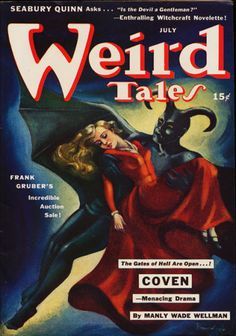
Peter Haining's 1990 "Weird Tales" anthology takes a different tack from two other similar anthologies that I've recently read. "Weird Tales: 32 Unearthed Terrors" (1988) had cherry-picked one story from each year of the celebrated magazine's 32-year run (1923-1954), while Marvin Kaye's "Weird Tales" collection of that same year had included not just stories from the publication's classic years, but from the five reincarnations dating from 1973-1987. Haining's collection, on the other hand, while dishing out half the page length of the earlier two, has the unique asset of being "facsimile reproductions of the actual pages of 'Weird Tales'"; that is to say, the pages in the book are photocopies from the pages of the original magazines from which the volume's 22 stories have been drawn. Thus, the pages are presented in two vertical columns of type, complete with letters from the readers ("The Eyrie"), wonderful illustrations, occasional weird poetry filler and priceless advertisements. Thus, at 263 pages, the book comes off as the biggest issue of "Weird Tales" ever to hit the newsstands; a fine representation of what "The Unique Magazine" was all about.
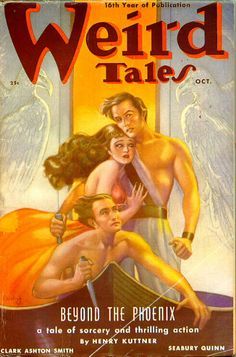
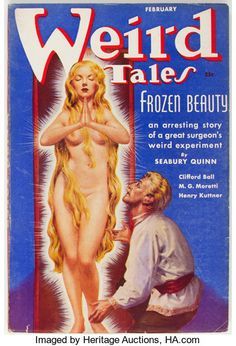
As would be expected, Haining has given us a fair sampling of the authors most closely associated with the classic pulp. H.P. Lovecraft's posthumous "Beyond the Wall of Sleep" may make you wonder about your own oneiric wanderings, while Robert E. Howard's "Black Hound of Death," incorporating both a psychotic black madman AND a half-canine madman, is as pulpy and un-PC as can be (wonderfully entertaining, though!). Seabury Quinn, who placed more stories in "Weird Tales" over the years than any other author (146!), is here represented by one of his 93 Jules de Grandin tales, "Frozen Beauty," which manages to conflate Communist agents, human corpsicles and, uh, cold-blooded killings into one effective stew. Henry Kuttner, a disciple of both Lovecraft and Howard, and who would achieve major fame in the sci-fi field in the '40s in collaboration with wife C.L. Moore, is represented here by one of his Elak of Atlantis fantasies, "Beyond the Phoenix"; a swift-moving and action-packed tale. August Derleth, a champion of Lovecraft and founder of Arkham House publishing, here gives us a fine, traditional haunted-house story, "The Shuttered House." Edmond Hamilton's classic and oft-anthologized (and for good reason!) "The Man Who Returned" is included, as well as Clark Ashton Smith's "The Garden of Adompha"; this Zothique tale, like all of Smith's best fantasy work, reads almost like prose poetry. Robert "Psycho" Bloch, another name closely associated with "Weird Tales," is here, too, with his mad-scientist story "The Beasts of Barsac" (from the July '44 "Weird Tales"; not July '42, as the book erroneously tells us). Algernon Blackwood, aka "The Ghost Man," is shown to good effect with "Roman Remains," a tale that would have fit very nicely into his classic collection from 1912, "Pan's Garden." And Ray Bradbury's "Bang! You're Dead!" shows us that war isn't necessarily hell, after all!
And then there are the lesser-known names, who were nevertheless extremely popular with "Weird Tales" readers decades ago. Alison V. Harding, whose "Damp Man" story had earlier impressed me greatly, here gives us "Take the Z Train," a tale that all NYC subway riders should enjoy. Mary Elizabeth Counselman turns in a lovely, eerie story of the old South in "The Shot Tower Ghost," while Nictzin Dyalhis (the Scottish author's real name) gives us the tragic fantasy "The Heart of Atlantan." Henry S. Whitehead's Haitian voodoo story, "The Passing of a God," is a genuinely creepy and yucky affair, while Manly Wade Wellman's "The Valley Was Still" finally tells us the real, devilish truth about how the South lost the Civil War. As you can see, the book is a generous offering of varied authors and story subjects, and I have not even mentioned the contributions by such luminaries as Theodore Sturgeon, Fritz Leiber, Eric Frank Russell and Anthony M. Rud (the latter's "Ooze," from "Weird Tales"' very first, March 1923 issue, is now considered a classic of sorts). In all, a wonderful collection of tales, in a very nice and pleasing presentation.
Oh...I would be remiss if I didn't mention how entertaining those cheezy advertisements can be for the modern-day reader! These ads only started to appear in the magazine in the late '30s, Haining tells us in his very informative introduction, but what a hoot they are! Just wait until you read the one from the March '48 issue; the one from the Rest-O-Rator Laboratory in Pomona, CA, for a "Therapeutic Vibrator" to release excess energy....