

What do you think?
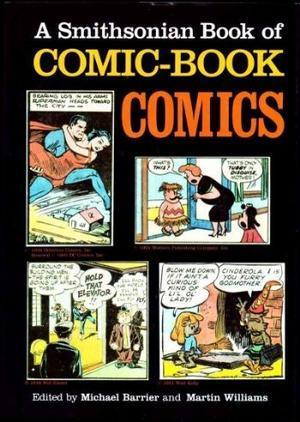
A Smithsonian Book of Comic-Book Comics
Presents selections from comic books from 1938 to 1955 that feature the adventures of characters such as Superman, Batman, Pogo, Captain Marvel, and Donald Duck
336 pages, Hardcover
First published April 1, 1982
Ratings & Reviews
Friends & Following
Create a free account to discover what your friends think of this book!
Community Reviews
Displaying 1 - 30 of 32 reviews
June 13, 2020
This is a collection from 1981 of twenty-eight comic book stories originally published between 1938 and 1955. One of them is only one page long; the longest is thirty-three pages. Seventeen of them are primarily comic and five are dramatic (including super-hero adventures). The six stories featuring Plastic Man, Captain Marvel, and The Spirit are all comic adventure tales.
The book is divided into twelve sections, of which two are each about a specific character (Superman and Batman), one is about comics from a particular company (E. C.), and the rest are about specific characters and the artists who were the primary forces behind them. I was familiar with most of the characters; I don't recall reading Scribbly or Dr. Dimwit before, although I may have.
The tales of Superman and Batman (then known as "The Bat-Man") are so much a part of American (and probably international) culture that there is not much to say about them. The stories reprinted here are the first comic book stories about those characters. Surprisingly, the Superman tale has very little back-story and the Batman has none at all.
I was not around when most of these stories were first published and I don't remember Plastic Man, Captain Marvel, or The Spirit from my childhood, but I have read a few of their adventures previously. The ones appearing here are all highly imaginative. The design of the "fantasy" sequence in the 1941 story of The Spirit is very impressive; I can't recall seeing anything like it before. (However, the portrayal of Ebony, The Spirit's very caricatured African-American assistant, is unfortunate.)
The three purely dramatic stories that are not about super heroes are all from E.C. The introduction to that section of the book says that the initials originally stood for "Educational Comics," which was later changed to "Entertaining Comics." Two of the dramatic stories are set in Korea during the Korean War. The stories are "Air Burst" and "Corpse on the Imjin," both written and illustrated by Harvey Kurtzman. The drawing is raw, bordering on ugly, but effective. I think that both of these stories are quite good, unusually somber for comic books.
The E.C. story "Master Race," drawn by Bernard Krigstein, seems extraordinary to me. I grew up reading Dell, Harvey, Disney, and DC comic books, all pure entertainment. (I know that these companies printed more serious comics as well, but I seldom read them, with the occasional exception of DC's "Sergeant Rock.") This is a post-Holocaust drama, dealing with a former concentration camp commander and one of his former prisoners. This is far from being a "comic" book.
The other two E.C. stories are parodies from Mad. One is "Superduperman!," a parody of Superman comic books by the highly-regarded artist Wallace Wood. I very often love Wood's work; however, I dislike the cluttered drawing here. The story shows Superduperman battling Captain Marbles (based on Captain Marvel) and being rejected by the voluptuous (as many of Wood's portrayals of women were) reporter Lois Pain (based on Lois Lane). Some of the wall signs are funny and I like the ever-changing emblem on Superduperman's chest, but a lot of this I think is more silly than really funny.
The other Mad story is "Howdy Dooit," a parody by Bill Elder of the children's television show Howdy Doody. My favorite panel here is on the top left of page 324, in which three of the children in the audience have quietly changed into sheep. I think that most of this will make little sense to readers not old enough to remember the television show.
I recently read an entire book devoted to the work of George Carlson, represented here by three stories, all from Jingle Jangle Comics. The best of the three is titled "The Fashionable Fireman and the Soft-boiled Collar-button." All of them are very funny, very well-drawn, and impossible to summarize. Read these and any other Carlson comics you can find. (The book that I mentioned, by the way, is Perfect Nonsense: The Chaotic Comics and Goofy Games of George Carlson.)
Walt Kelly's stories of anthropomorphic animals living in the Okefenokee Swamp began in comic books but became truly famous as the wonderful comic strip "Pogo." The swamp adventures began in Animal Comics and then moved to another comic book, Pogo Possum. Many of the characters are the same as the ones in the comic strip, some of the gags are similar, but the look is very different. There are four "Pogo" tales here. One, "Albert Takes the Cake," is from Animal Comics from 1942. Pogo looks much more possum-like than he later became. However, the main character is a the only human being, Bumbazine, a young African-American boy; he did not appear in the later stories. The drawing is fine and funny, with good background details. This is the only entry in the book in which the dialogue is in both upper and lower case; in all the others, the dialogue is totally in upper case (although one of the "The Spirit" stories uses both cases for the narration). And then, oddly, the next three stories look vastly different both from the earlier version and from the later comic strip. The introduction to this section says, "Backgrounds are sparser"- a considerable understatement. The "Pogo" comic strip was renowned for the beauty of the drawing. To say that the drawing in these three stories is drab is to be very generous. They are funny but decidedly un-lovely.
The introduction to the chapter about "Scribbly" by Sheldon Mayer explains that the title character was "a would-be boy cartoonist." In the one "Scribbly" story shown in this book, Scribbly is a secondary character. The star is a costumed super-hero (sort of), the Red Tornado, who is actually Scribbly's neighbor, Mrs. Hunkel. This is played largely for laughs; the basis of the Red Tornado's costume appears to be a red flannel union suit, and the helmet is a cook pot with eye holes cut in it. I think that this is a better, funnier satire of super-heroes than the Wallace Wood story mentioned above.
Basil Wolverton has two entries in the book. One is a one-page slapstick feature titled "Dr. Dimwit." The doctor and his patient discuss the implement that the doctor should use to remove the patient's tonsils. They consider a pruning-hook, an ax, an egg-beater, a shovel, and a scythe.
The other Wolverton entry features Wolverton's variation of a super-hero, Powerhouse Pepper. Powerhouse is a generally peaceable man with a peculiar, small, bullet-shaped, entirely bald head. He is also incredibly strong. The story in the book has a Western setting. Powerhouse saves a town from the vile outlaw, Rawjaw McClaw. The story is filled with alliteration and rhyming dialogue. For example, when Powerhouse goes up against McClaw on a Western street, Powerhouse assures the citizens, "DON'T GET YOUR BLOOD IN A FLOOD, MEN! MAYBE I CAN HANDLE HIM!" A cowering bystander replies, "YO'RE PLUMB MAD, LAD! McCLAW WOULD CHAW YOUR JAW RAW WITH ONE PAW!" A sign behind Powerhouse says, "DON'T SAG ON THE MAIN DRAG." And that's just part of one panel.
My favorite sign in the story is coming from a spiny cactus, saying, "QUICK WATSON, THE NEEDLE!" Parents must have loved explaining the drug-addict joke to children.
The famous cartoonist Jules Feiffer said that he disliked Wolverton's work because it is "ugly." It is, I suppose, but distinctively and effectively so. It appears to me that Wolverton influenced a number of later cartoonists.
There is a long Walt Disney Donald Duck story by the great Carl Barks here. It is titled "Letter to Santa," and it comes from the first of the annual Walt Disney's Christmas Parade comic books from 1949. The story begins on Christmas Eve day, when Donald Duck realizes that he had forgotten to mail his three nephews' letter to Santa Claus. With not enough time left to get the letter to Santa, Donald opens the letter and finds that his nephews had only a single request, but that was for a steam shovel! Donald knows that a big piece of earth-moving equipment like a steam shovel would be very expensive, so he goes for help to his uncle, Scrooge McDuck, "richest tycoon in the universe."
This looks fantastic, with splendid, imaginative artwork. Panels are in many different shapes and some of the pages are adorned with small Christmas-themed insets, such as holly leaves, ringing bells, and a burning candle. There is rather more violence than I would have liked, although the sequence with battling steam shovels, one red and green, the other yellow, red, and blue, looks terrific. There are some fine jokes: Donald asks a man carrying a mountain of wrapped presents, "SAY, MISTER, HOW MUCH WOULD YOU SAY A STEAM SHOVEL COSTS?" And the reply is, "ABOUT AS MUCH AS A WIFE AND SIX KIDS!" The judge in night court is, appropriately, an owl. The "reindeer" pulling Donald and Scrooge in a rented sleigh is the world's most sway-backed horse, with antlers tied on to his head.
And one odd dash of realism- Donald walks by a building with a sign saying, "FLOP 25¢." That would likely be another thing for parents to need to explain.
I remember reading Little Lulu comic books when I was a child, but I don't recall them being as funny as the four stories reprinted here. Some of these would be my choices for the funniest entries in this book. They are not the prettiest comics; for one thing, Lulu's horrible hairstyle is a constant annoyance.
I think that the tale "The Spider Spins Again" is good, but the least impressive of these four. The oldest of the four is "At the Beach" from 1945. This looks significantly different from the later stories. For one thing, Lulu's friend Tubby is much chubbier than he later became. More importantly, almost every character in every picture has cheeks with round pink circles with white dots in the centers of the circles. Also, Lulu and Tubby are frequently drawn without mouths. But the spirit is very much Lulu-ish.
"Five Little Babies" is the longest of the Lulu stories. Lulu seeks revenge on the members of Tubby's club for humiliating her with a mean trick. Her plan was good and truly nasty. Lulu didn't know that none of the club members really had anything to do with it. The trick was played by the rich kid, Wilbur Van Snobbe, who was allowed to join the club later. There is nothing in the story to indicate that Lulu's "revenge" was unjustified. Morality aside, this is a good, amusing story. (In my copy, pages 168 and 169 are reversed.)
The best of the Little Lulu stories, and my choice for the funniest story in the book, is "The Little Rich Boy." Lulu is coerced into telling a story to Alvin, her unpleasant young neighbor. The story that she tells is very funny, the circumstances under which she tells it even more so. The tale that Lulu tells has two main characters, the Little Rich Boy and the Poor Little Girl, who looks exactly like a shabbily dressed version of Lulu. I will call the girl in the interior story Lulu¹.
Some of my favorite things in this story are Lulu¹ escaping from the dog pound and all the dogs then following her in subsequent panels, Lulu¹'s improbable jailbreak, the runaway Ferris Wheel rolling to oblivion, the herd of elephants at work cracking walnuts, and, especially, my pick for the funniest single panel in the book, the right hand picture in the third row on page 180, in which a crowd of people all yell at Lulu.
Some other information about the stories in the book:
▪️The "Superman" story was written by Jerry Siegel and illustrated by Joe Shuster.
▪️The "Batman" story is by Bob Kane.
▪️ "Plastic Man" was written and illustrated by Jack Cole.
▪️This "Captain Marvel" story was by C. C. Beck.
▪️All of these "Little Lulu" stories were written by John Stanley. Stanley also illustrated "At the Beach."
▪️The stories about "The Spirit" are by Will Eisner.
The introductions to each section were written by the editors of the book, Michael Barrier and Martin Williams. They contain a lot of valuable information.
There is a good bibliography, which is now somewhat out of date.
All of these comics and their creators deserve much more commentary than I can give here. They made generations of people happy. They still do.
The book is divided into twelve sections, of which two are each about a specific character (Superman and Batman), one is about comics from a particular company (E. C.), and the rest are about specific characters and the artists who were the primary forces behind them. I was familiar with most of the characters; I don't recall reading Scribbly or Dr. Dimwit before, although I may have.
The tales of Superman and Batman (then known as "The Bat-Man") are so much a part of American (and probably international) culture that there is not much to say about them. The stories reprinted here are the first comic book stories about those characters. Surprisingly, the Superman tale has very little back-story and the Batman has none at all.
I was not around when most of these stories were first published and I don't remember Plastic Man, Captain Marvel, or The Spirit from my childhood, but I have read a few of their adventures previously. The ones appearing here are all highly imaginative. The design of the "fantasy" sequence in the 1941 story of The Spirit is very impressive; I can't recall seeing anything like it before. (However, the portrayal of Ebony, The Spirit's very caricatured African-American assistant, is unfortunate.)
The three purely dramatic stories that are not about super heroes are all from E.C. The introduction to that section of the book says that the initials originally stood for "Educational Comics," which was later changed to "Entertaining Comics." Two of the dramatic stories are set in Korea during the Korean War. The stories are "Air Burst" and "Corpse on the Imjin," both written and illustrated by Harvey Kurtzman. The drawing is raw, bordering on ugly, but effective. I think that both of these stories are quite good, unusually somber for comic books.
The E.C. story "Master Race," drawn by Bernard Krigstein, seems extraordinary to me. I grew up reading Dell, Harvey, Disney, and DC comic books, all pure entertainment. (I know that these companies printed more serious comics as well, but I seldom read them, with the occasional exception of DC's "Sergeant Rock.") This is a post-Holocaust drama, dealing with a former concentration camp commander and one of his former prisoners. This is far from being a "comic" book.
The other two E.C. stories are parodies from Mad. One is "Superduperman!," a parody of Superman comic books by the highly-regarded artist Wallace Wood. I very often love Wood's work; however, I dislike the cluttered drawing here. The story shows Superduperman battling Captain Marbles (based on Captain Marvel) and being rejected by the voluptuous (as many of Wood's portrayals of women were) reporter Lois Pain (based on Lois Lane). Some of the wall signs are funny and I like the ever-changing emblem on Superduperman's chest, but a lot of this I think is more silly than really funny.
The other Mad story is "Howdy Dooit," a parody by Bill Elder of the children's television show Howdy Doody. My favorite panel here is on the top left of page 324, in which three of the children in the audience have quietly changed into sheep. I think that most of this will make little sense to readers not old enough to remember the television show.
I recently read an entire book devoted to the work of George Carlson, represented here by three stories, all from Jingle Jangle Comics. The best of the three is titled "The Fashionable Fireman and the Soft-boiled Collar-button." All of them are very funny, very well-drawn, and impossible to summarize. Read these and any other Carlson comics you can find. (The book that I mentioned, by the way, is Perfect Nonsense: The Chaotic Comics and Goofy Games of George Carlson.)
Walt Kelly's stories of anthropomorphic animals living in the Okefenokee Swamp began in comic books but became truly famous as the wonderful comic strip "Pogo." The swamp adventures began in Animal Comics and then moved to another comic book, Pogo Possum. Many of the characters are the same as the ones in the comic strip, some of the gags are similar, but the look is very different. There are four "Pogo" tales here. One, "Albert Takes the Cake," is from Animal Comics from 1942. Pogo looks much more possum-like than he later became. However, the main character is a the only human being, Bumbazine, a young African-American boy; he did not appear in the later stories. The drawing is fine and funny, with good background details. This is the only entry in the book in which the dialogue is in both upper and lower case; in all the others, the dialogue is totally in upper case (although one of the "The Spirit" stories uses both cases for the narration). And then, oddly, the next three stories look vastly different both from the earlier version and from the later comic strip. The introduction to this section says, "Backgrounds are sparser"- a considerable understatement. The "Pogo" comic strip was renowned for the beauty of the drawing. To say that the drawing in these three stories is drab is to be very generous. They are funny but decidedly un-lovely.
The introduction to the chapter about "Scribbly" by Sheldon Mayer explains that the title character was "a would-be boy cartoonist." In the one "Scribbly" story shown in this book, Scribbly is a secondary character. The star is a costumed super-hero (sort of), the Red Tornado, who is actually Scribbly's neighbor, Mrs. Hunkel. This is played largely for laughs; the basis of the Red Tornado's costume appears to be a red flannel union suit, and the helmet is a cook pot with eye holes cut in it. I think that this is a better, funnier satire of super-heroes than the Wallace Wood story mentioned above.
Basil Wolverton has two entries in the book. One is a one-page slapstick feature titled "Dr. Dimwit." The doctor and his patient discuss the implement that the doctor should use to remove the patient's tonsils. They consider a pruning-hook, an ax, an egg-beater, a shovel, and a scythe.
The other Wolverton entry features Wolverton's variation of a super-hero, Powerhouse Pepper. Powerhouse is a generally peaceable man with a peculiar, small, bullet-shaped, entirely bald head. He is also incredibly strong. The story in the book has a Western setting. Powerhouse saves a town from the vile outlaw, Rawjaw McClaw. The story is filled with alliteration and rhyming dialogue. For example, when Powerhouse goes up against McClaw on a Western street, Powerhouse assures the citizens, "DON'T GET YOUR BLOOD IN A FLOOD, MEN! MAYBE I CAN HANDLE HIM!" A cowering bystander replies, "YO'RE PLUMB MAD, LAD! McCLAW WOULD CHAW YOUR JAW RAW WITH ONE PAW!" A sign behind Powerhouse says, "DON'T SAG ON THE MAIN DRAG." And that's just part of one panel.
My favorite sign in the story is coming from a spiny cactus, saying, "QUICK WATSON, THE NEEDLE!" Parents must have loved explaining the drug-addict joke to children.
The famous cartoonist Jules Feiffer said that he disliked Wolverton's work because it is "ugly." It is, I suppose, but distinctively and effectively so. It appears to me that Wolverton influenced a number of later cartoonists.
There is a long Walt Disney Donald Duck story by the great Carl Barks here. It is titled "Letter to Santa," and it comes from the first of the annual Walt Disney's Christmas Parade comic books from 1949. The story begins on Christmas Eve day, when Donald Duck realizes that he had forgotten to mail his three nephews' letter to Santa Claus. With not enough time left to get the letter to Santa, Donald opens the letter and finds that his nephews had only a single request, but that was for a steam shovel! Donald knows that a big piece of earth-moving equipment like a steam shovel would be very expensive, so he goes for help to his uncle, Scrooge McDuck, "richest tycoon in the universe."
This looks fantastic, with splendid, imaginative artwork. Panels are in many different shapes and some of the pages are adorned with small Christmas-themed insets, such as holly leaves, ringing bells, and a burning candle. There is rather more violence than I would have liked, although the sequence with battling steam shovels, one red and green, the other yellow, red, and blue, looks terrific. There are some fine jokes: Donald asks a man carrying a mountain of wrapped presents, "SAY, MISTER, HOW MUCH WOULD YOU SAY A STEAM SHOVEL COSTS?" And the reply is, "ABOUT AS MUCH AS A WIFE AND SIX KIDS!" The judge in night court is, appropriately, an owl. The "reindeer" pulling Donald and Scrooge in a rented sleigh is the world's most sway-backed horse, with antlers tied on to his head.
And one odd dash of realism- Donald walks by a building with a sign saying, "FLOP 25¢." That would likely be another thing for parents to need to explain.
I remember reading Little Lulu comic books when I was a child, but I don't recall them being as funny as the four stories reprinted here. Some of these would be my choices for the funniest entries in this book. They are not the prettiest comics; for one thing, Lulu's horrible hairstyle is a constant annoyance.
I think that the tale "The Spider Spins Again" is good, but the least impressive of these four. The oldest of the four is "At the Beach" from 1945. This looks significantly different from the later stories. For one thing, Lulu's friend Tubby is much chubbier than he later became. More importantly, almost every character in every picture has cheeks with round pink circles with white dots in the centers of the circles. Also, Lulu and Tubby are frequently drawn without mouths. But the spirit is very much Lulu-ish.
"Five Little Babies" is the longest of the Lulu stories. Lulu seeks revenge on the members of Tubby's club for humiliating her with a mean trick. Her plan was good and truly nasty. Lulu didn't know that none of the club members really had anything to do with it. The trick was played by the rich kid, Wilbur Van Snobbe, who was allowed to join the club later. There is nothing in the story to indicate that Lulu's "revenge" was unjustified. Morality aside, this is a good, amusing story. (In my copy, pages 168 and 169 are reversed.)
The best of the Little Lulu stories, and my choice for the funniest story in the book, is "The Little Rich Boy." Lulu is coerced into telling a story to Alvin, her unpleasant young neighbor. The story that she tells is very funny, the circumstances under which she tells it even more so. The tale that Lulu tells has two main characters, the Little Rich Boy and the Poor Little Girl, who looks exactly like a shabbily dressed version of Lulu. I will call the girl in the interior story Lulu¹.
Some of my favorite things in this story are Lulu¹ escaping from the dog pound and all the dogs then following her in subsequent panels, Lulu¹'s improbable jailbreak, the runaway Ferris Wheel rolling to oblivion, the herd of elephants at work cracking walnuts, and, especially, my pick for the funniest single panel in the book, the right hand picture in the third row on page 180, in which a crowd of people all yell at Lulu.
Some other information about the stories in the book:
▪️The "Superman" story was written by Jerry Siegel and illustrated by Joe Shuster.
▪️The "Batman" story is by Bob Kane.
▪️ "Plastic Man" was written and illustrated by Jack Cole.
▪️This "Captain Marvel" story was by C. C. Beck.
▪️All of these "Little Lulu" stories were written by John Stanley. Stanley also illustrated "At the Beach."
▪️The stories about "The Spirit" are by Will Eisner.
The introductions to each section were written by the editors of the book, Michael Barrier and Martin Williams. They contain a lot of valuable information.
There is a good bibliography, which is now somewhat out of date.
All of these comics and their creators deserve much more commentary than I can give here. They made generations of people happy. They still do.

June 9, 2015
A couple of fine folks noticed my rating for this book, so I thought I'd re-read it and see how well it held up. I have to say that I was a little less impressed with it all these years later, mainly due to a couple of selections that I don't think hold up as well as I once thought.
The real value to this collection, especially when it was first published back in 1981, was simply a chance to have a sample representation of golden-age comics available in a nice hardback format. Other than a couple of the big DC characters, I certainly wasn't aware of any kind of compilations like this at that time. Nowadays, it's pretty common, and so that's kind of a knock against this effort--it just isn't unique anymore.
No anthology is going to please everyone, but some of the selections could have been pared down to just one story rather than three or four, thereby giving room for even a wider sampling. That the compilers felt the need to include artwork by George Carlson is an editorial choice that I could accept if they didn't force feed us three stories, and even though I'm a John Stanley/Little Lulu fan, I can see how four stories was too much. Same with Scribbly.
So I'm taking back a star, but that's all--Barks' work on the Ducks, Stanley on Little Lulu, and Kurtzman at Mad all deserve a spotlight, even if there has been a revival of interest in a lot of these artists in the last 20 years. And can you ever get enough of Eisner? To me, the perfect audience for this book is not your comic book aficionado, but a casual reader who may have enjoyed comics as a youngster, but whose interest is probably limited to the diversionary appeal of an anthology of this type. At the very least, it should provide a few chuckles, as that was an element of these old books the compilers chose to focus on. There's very few of the old super-heroes here, so if that is your main interest, I think you give this one a pass and look for another anthology. But if you are looking for a very broad spectrum of what all was being done in the medium prior to the comics code, this is a pretty good sampler.
The real value to this collection, especially when it was first published back in 1981, was simply a chance to have a sample representation of golden-age comics available in a nice hardback format. Other than a couple of the big DC characters, I certainly wasn't aware of any kind of compilations like this at that time. Nowadays, it's pretty common, and so that's kind of a knock against this effort--it just isn't unique anymore.
No anthology is going to please everyone, but some of the selections could have been pared down to just one story rather than three or four, thereby giving room for even a wider sampling. That the compilers felt the need to include artwork by George Carlson is an editorial choice that I could accept if they didn't force feed us three stories, and even though I'm a John Stanley/Little Lulu fan, I can see how four stories was too much. Same with Scribbly.
So I'm taking back a star, but that's all--Barks' work on the Ducks, Stanley on Little Lulu, and Kurtzman at Mad all deserve a spotlight, even if there has been a revival of interest in a lot of these artists in the last 20 years. And can you ever get enough of Eisner? To me, the perfect audience for this book is not your comic book aficionado, but a casual reader who may have enjoyed comics as a youngster, but whose interest is probably limited to the diversionary appeal of an anthology of this type. At the very least, it should provide a few chuckles, as that was an element of these old books the compilers chose to focus on. There's very few of the old super-heroes here, so if that is your main interest, I think you give this one a pass and look for another anthology. But if you are looking for a very broad spectrum of what all was being done in the medium prior to the comics code, this is a pretty good sampler.

November 11, 2017
After the most perfunctory glance at Superman and Batman, the editors, like kids at heart, focus on the kind of comics THEY like, which are stuff like Pogo, Little Lulu, and Jingle Jangle tales.
Scribly and the Red Tornado get more space than the other superheroes combined.
Granted, there was no need to cover the same ground as Jules Feiffer, but one gets the sense from his selections, and especially from his commentary, that he has much better taste for comics and understands them infinitely better.
Which leads to one point in this book's favor, that it rectifies the omission of Captain Marvel from The Great Comic Book Heroes with an epic story from Captain Marvel Adventures 100, with Dr. Sivana travelling back in time to kill Billy Batson before he ever learns the wizard Shazam's name.
A couple of Kurtzman's war stories and a Carl Bark's Donald Duck Christmas story were also standouts.
On the whole, a self-indulgent, non-representative anthology which was nonetheless worthwhile.
Scribly and the Red Tornado get more space than the other superheroes combined.
Granted, there was no need to cover the same ground as Jules Feiffer, but one gets the sense from his selections, and especially from his commentary, that he has much better taste for comics and understands them infinitely better.
Which leads to one point in this book's favor, that it rectifies the omission of Captain Marvel from The Great Comic Book Heroes with an epic story from Captain Marvel Adventures 100, with Dr. Sivana travelling back in time to kill Billy Batson before he ever learns the wizard Shazam's name.
A couple of Kurtzman's war stories and a Carl Bark's Donald Duck Christmas story were also standouts.
On the whole, a self-indulgent, non-representative anthology which was nonetheless worthwhile.

October 17, 2020
An interesting collection of pre-code comics, but it's definitely hampered by the editor's biases against romance and teen comics, which honestly feels like a statement that sums up comics scholarship in a nutshell.

October 2, 2018
I believe this is the first time I have given 5 stars to a graphic collection, but Barrier and Williams set out to collect the best comic book stories that could be crammed into the page count, and they just about succeeded. The weakest stories in the collection are the first Superman and first Batman stories, included for historical interest, and they are OK, but the collection soars thereafter. This book is a must have, unless you have the original comics.
July 16, 2023
A splendid collection of pre-code comics by some of the very best in the business. Several I already had in other forms but most were first time reads! An amazing thrift store find! Worth seeking out for fans of the art form.

May 18, 2022
A wonderful collection of Pre-Comics Code American comics. Including the origins of Superman and Batman. A selection of EC stories, Little Lulu, Donald Duck, Pogo, The Spirit, Plastic Man, Captain Marvel (Shazam), Basil Wolverton - all perennial favourites.
I was unfamilar with Sheldon Mayer's Scribbly (a well-drawn early parody/spoof of superhero comics) and George Carlson's Jingle Jangle Comics. You can see where Carlson had a big influence on P. Craig Russell's art.
The reprinting is really bad at times but I do like how they look and feel like old comics. Many reprints lose the original feeling of the older comics by printing on glossy paper where the colors print too bright.
I was unfamilar with Sheldon Mayer's Scribbly (a well-drawn early parody/spoof of superhero comics) and George Carlson's Jingle Jangle Comics. You can see where Carlson had a big influence on P. Craig Russell's art.
The reprinting is really bad at times but I do like how they look and feel like old comics. Many reprints lose the original feeling of the older comics by printing on glossy paper where the colors print too bright.

January 14, 2013
This is one of the best comic book reprint collections you will find, since it crosses all genres and doesn't just settle for super-hero comics. This has some great EC Comics tales (which could easily stand in for a modern story even now), Walt Kelly's Pogo, George Carlson's lyrical Jingle-Jangle Tales and Carl Barks' Donald Duck. Of course, superheroes are represented, with the first tales of Superman, Batman, and Plastic Man, along with stories starring the original Captain Marvel and the Spirit. Definitely worth a read or two by any comic book fan!

October 19, 2014
This is simply the greatest collection of Golden Age comics I've ever come across. I was in seventh grade when I first came upon it and it left a huge impression on me. The editor did an excellent job of highlighting the true gems of the era. It's amazing how well some of these stories have held up, especially the EC contributions.
I'd been in the Lunch Buddy program at my wife's school, where I mentored younger kids without male role models, and this book was always a great ice-breaker. Powerhouse Pepper never failed to get them laughing.
I'd been in the Lunch Buddy program at my wife's school, where I mentored younger kids without male role models, and this book was always a great ice-breaker. Powerhouse Pepper never failed to get them laughing.

October 22, 2007
The finest historical survey of mainstream comics ever produced. Covering 1938-1955, the collection offers not only the super-heroes such as Superman, Batman, Plastic Man, Captain Marvel, and The Spirit but also Scribbly, Little Lulu, and Pogo. Includes selections from E.C., Basil Wolverton, and George Carlson. The only knock on this collection is that the reproductions are not as clear as they should be, but this is a small complaint. A must for any serious comic book fan.

November 23, 2009
An excellent anthology of early comic book material. It includes the classic Captain Marvel story "Plot Against the Universe" and the Ma Hunkel Red Tornado story.

January 24, 2019
I enjoy any book about comic book history but the admitted bias the authors hold in favor of 'humor' comics over superhero ones dulled my enjoyment of this one.
November 27, 2022
This is one of those books I remember having from my first collection (that was stolen). This book was published in 1981; meaning I was 3 or 4 when it was released. I don't think that's when my parents bought it for me. I somehow remember seeing this book advertised on TV and wanting it really, really bad. I also remember opening the book from its shipping box on my parents' kitchen table and looking through it and being disappointed...
Over the years, as I read the book again and again, I came to appreciate it a little more each time. When I found this book recently once more at my favorite used book store, I finally understood this book's brilliance!
This book isn't comprehensive. While Superman, Batman and Captain Marvel are examined in this book, other important early superheroes like Captain America and Wonder Woman are noticeably not just absent, I don't think either are mentioned in any of the essays written by comic book historians J. Michael Barrier and Martin T. Williams.
This book covers comics published up to 1955, right when the industry imposed the self regulated Comics Code Authority. A good stopping point if you were writing a multi-volume look at the history of comic books. EC Comics was the main target of the evils found in comic books from Dr. Wertham and state senators. As a result, no less than 5 stories from that legendary publisher are included in this book. Yet none of them are of the sci-fi or horror titles that ignited the comic book scare of the 1950s!
A number of legendary creators are examined. There are works from Walt Kelly and his critter creation, Pogo, John Stanley's version of Little Lulu and Tubby and Will Eisner's The Spirit. A seasonal story from Carl Barks starring Donald Duck and Uncle Scrooge are also included. I would have finished this book a couple of weeks ago. But I wanted to enjoy Barks' 'A Letter to Santa' during the holiday season. Thus I waited.
To my big surprise, the stories I was the most enamored with were the Scribbly stories, featuring the Ma Hunkel Red Tornado stories. Created by Sheldon Mayer (Golden Age Green Lantern), these stories were clever parodies of the age of mystery men, lively illustrated and just oh-so fun to read. To my knowledge, those stories have never been collected. Thus, other than the 4 stories comprised here, unless I max out my credit cards, I'm probably never going to get to read Ma's further adventures.
I really enjoyed this collection. The artwork is so starkly different from what I grew up with and primitive compared to modern comics. The scripts are like works of art. They capture the dialect and tone of the times. For a kid born anywhere after 1977, these things are like trying to read Shakespeare. When I was young, everything just looked off and I couldn't really understand the stories. Now I am 45 and I felt like I was in the presence of greatness. and well into that presence I was.
Over the years, as I read the book again and again, I came to appreciate it a little more each time. When I found this book recently once more at my favorite used book store, I finally understood this book's brilliance!
This book isn't comprehensive. While Superman, Batman and Captain Marvel are examined in this book, other important early superheroes like Captain America and Wonder Woman are noticeably not just absent, I don't think either are mentioned in any of the essays written by comic book historians J. Michael Barrier and Martin T. Williams.
This book covers comics published up to 1955, right when the industry imposed the self regulated Comics Code Authority. A good stopping point if you were writing a multi-volume look at the history of comic books. EC Comics was the main target of the evils found in comic books from Dr. Wertham and state senators. As a result, no less than 5 stories from that legendary publisher are included in this book. Yet none of them are of the sci-fi or horror titles that ignited the comic book scare of the 1950s!
A number of legendary creators are examined. There are works from Walt Kelly and his critter creation, Pogo, John Stanley's version of Little Lulu and Tubby and Will Eisner's The Spirit. A seasonal story from Carl Barks starring Donald Duck and Uncle Scrooge are also included. I would have finished this book a couple of weeks ago. But I wanted to enjoy Barks' 'A Letter to Santa' during the holiday season. Thus I waited.
To my big surprise, the stories I was the most enamored with were the Scribbly stories, featuring the Ma Hunkel Red Tornado stories. Created by Sheldon Mayer (Golden Age Green Lantern), these stories were clever parodies of the age of mystery men, lively illustrated and just oh-so fun to read. To my knowledge, those stories have never been collected. Thus, other than the 4 stories comprised here, unless I max out my credit cards, I'm probably never going to get to read Ma's further adventures.
I really enjoyed this collection. The artwork is so starkly different from what I grew up with and primitive compared to modern comics. The scripts are like works of art. They capture the dialect and tone of the times. For a kid born anywhere after 1977, these things are like trying to read Shakespeare. When I was young, everything just looked off and I couldn't really understand the stories. Now I am 45 and I felt like I was in the presence of greatness. and well into that presence I was.

October 27, 2025
This is a wonderful collection of pre-comics-code American comics spanning 1938-1955. The sampling by the editors could be argued with, as they focus on non-romance and non-teenage (e.g., Archie) comics such as Little Lulu, Donald Duck, Pogo, etc. Superhero comics—Superman, Batman, Plastic Man, and Captain Marvel—are included but make up a fairly small percentage of the book. No survey like this would be complete without Will Eisner’s The Spirit and there are three excellent examples included. No anthology will please everyone, but there is enough broad representation to please most readers.
In some cases, I wish the editors would have cut back their selections to one or two stories instead of three or four so that more titles could have been included. In its favor, the anthology includes some mature content from EC—definitely not kid stuff. There were a couple of titles that I was not well acquainted with, namely Scribbly by Sheldon Mayer and especially George Carlson’s Jingle Jangle Comics. It’s a shame that Carlson’s work is largely out of print—his absurd silliness looks to rival something by Dr. Suess, or as the editors note, "a kind of George Herriman for little children." I’d like to see more of his output.
One of the Little Lulu stories, "Five Little Babies," has some content that didn’t age well for me. It shows her being manipulated by a boy to don a collar and leash and act like a dog—yikes! The story goes on to show Lulu savagely wreaking revenge on the boys for this humiliating trick. (Note: pages 168 and 169 are reversed.)
The quality of the reprinting is less than optimal. It looks like they just scanned original, yellowing copies. This gives the stories the look of old comics, which gives the reader a sense of digging through a stack of old issues, but it sometimes loses the details of the originals.
When this book was published in 1981, there wasn’t a lot of historical material about early comic books, so this book filled a need to spotlight some of the then rapidly fading from memory golden-age titles. Nowadays, there are tons of retrospectives, but I think this book still fills a niche to provide an overview of pre-code comics, especially for casual readers, in a quality, hardcover format. The editors’ introductions and bibliographies contain valuable, if somewhat dated, information that doesn’t get in the way of the reader’s enjoyment of the comics themselves.
In some cases, I wish the editors would have cut back their selections to one or two stories instead of three or four so that more titles could have been included. In its favor, the anthology includes some mature content from EC—definitely not kid stuff. There were a couple of titles that I was not well acquainted with, namely Scribbly by Sheldon Mayer and especially George Carlson’s Jingle Jangle Comics. It’s a shame that Carlson’s work is largely out of print—his absurd silliness looks to rival something by Dr. Suess, or as the editors note, "a kind of George Herriman for little children." I’d like to see more of his output.
One of the Little Lulu stories, "Five Little Babies," has some content that didn’t age well for me. It shows her being manipulated by a boy to don a collar and leash and act like a dog—yikes! The story goes on to show Lulu savagely wreaking revenge on the boys for this humiliating trick. (Note: pages 168 and 169 are reversed.)
The quality of the reprinting is less than optimal. It looks like they just scanned original, yellowing copies. This gives the stories the look of old comics, which gives the reader a sense of digging through a stack of old issues, but it sometimes loses the details of the originals.
When this book was published in 1981, there wasn’t a lot of historical material about early comic books, so this book filled a need to spotlight some of the then rapidly fading from memory golden-age titles. Nowadays, there are tons of retrospectives, but I think this book still fills a niche to provide an overview of pre-code comics, especially for casual readers, in a quality, hardcover format. The editors’ introductions and bibliographies contain valuable, if somewhat dated, information that doesn’t get in the way of the reader’s enjoyment of the comics themselves.

January 23, 2021
Most of the comics live up to the classic designation, but this can hardly be called representative of all the best work of the pre-Code period. The editors admit their bias towards humor comics upfront, although their argument that the art form had never recovered from the imposition of the Comics Code is dubious at best, an excuse not to sully their hands with any of Marvel and DC's Silver Age superhero stories, or even the underground humor comics of Robert Crumb et al. The bias towards humor comics unfortunately results in many first-rate artists and writers being omitted; in particular the formidable team of Joe Simon and Jack Kirby is sorely missed. The bias especially impacts the section on EC Comics; four of the five comics selected are from Harvey Kurtzman, and only one is from Al Feldstein.
Incidentally, the 1988 documentary Comic Book Confidential suffers from the exact opposite bias. Too much space is devoted to alternative and underground comics of the late Sixties and afterwards, while the classic humor comics of the Forties and Fifties are contemptuously dismissed. And while the movie dedicates plenty of well-earned time to EC's horror and science fiction books, Harvey Kurtzman's war comics are barely even mentioned.
Incidentally, the 1988 documentary Comic Book Confidential suffers from the exact opposite bias. Too much space is devoted to alternative and underground comics of the late Sixties and afterwards, while the classic humor comics of the Forties and Fifties are contemptuously dismissed. And while the movie dedicates plenty of well-earned time to EC's horror and science fiction books, Harvey Kurtzman's war comics are barely even mentioned.

June 29, 2024
This is one of the most enjoyable collections of comic book stories from the 40s and 50s I've ever seen. Instead of relying on the most famous superhero comics - though the first episodes of Superman and Batman are included here - it collects mostly stuff I've not seen elsewhere - stories of Little Lulu by John Stanley, Donald Duck by Carl Barks, Captain Marvel by C.C. Beck, the Spirit by Will Eisner and stories by artists I didn't know well like Basil Wolverton and George Carlson. There are also five short episodes of Scribbly by Sheldon Mayer, featuring his superhero parody the Red Tornado. And some genuinely great EC tales, too.
It's a collection that meant to set a canon of comic books, but it didn't catch on. As such, it's available very cheaply from used sellers on the internet. I promise it will show that comic books could achieve brilliance long before the time they became known as graphic novels.
It's a collection that meant to set a canon of comic books, but it didn't catch on. As such, it's available very cheaply from used sellers on the internet. I promise it will show that comic books could achieve brilliance long before the time they became known as graphic novels.

December 1, 2022
This is one of the better comics anthologies that I've read. The editors' section introductions clearly explain the significance of the selections without getting bogged down in too much detail. The one place that I think they failed is in devoting more than 10% of the book to a single title, that being "Pogo," which is really better remembered today--and with good reason--as a newspaper strip. Two choices near the end, "Corpse on the Imjin" and "Master Race" show the power that a comic can have and that even in those early decades, there were artists and writers who were pushing the envelope on just what could be conveyed in an art/literature genre that is often and unfortunately considered a juvenile form.

February 27, 2023
This is a pretty important slice of history, since it contains the first appearances of Superman and Batman, plus some fun stories about Captain Marvel (the "Shazam!" guy, not any of the many Marvel Comics characters to use the name) and Plastic Man. It also has a Carl Barks comic about Disney's beloved Duck family, some early E.C. comics, and many more. As an anthology, not every story is going to be a winner, despite what the editors seemed to think. Most of the "funny animal" comics were useless to me, as was the "Superduperman" parody toward the end of the book. Still, it's worth looking through this book if you want to see a collection of Golden Age stories that inexplicably pretends that Timely/Atlas/Marvel Comics never existed.
June 4, 2025
kinda gold standard! obviously as with any compilation it's a mixed bag, but all the inclusions here, even the less riveting ones to actually read, make perfect sense to create a varied portrait of Golden/Atomic Age comic books...i'm especially happy to have print copy of Master Race through this book, which brilliantly divides pre-code and post-code comics...like that one panel sequence will live rent-free in my head forever!!
outside of that, there's Scribbly, which is the ancient ancestor of Captain Underpants and Dog Man...a ton of Little Lulu, which was striking enough to warrant a wider dive later...Basil Wolverton's incredibly expressive slapstick...and of course MAD, which is far better than i could have imagined!
outside of that, there's Scribbly, which is the ancient ancestor of Captain Underpants and Dog Man...a ton of Little Lulu, which was striking enough to warrant a wider dive later...Basil Wolverton's incredibly expressive slapstick...and of course MAD, which is far better than i could have imagined!

January 9, 2018
From super hero like Superman and Batman, children's stories like Little Lulu and Donald Duck to war stories like Corpse On The Imjin! and parody like SuperDuperMan! A Smithsonian Book of Comic-Book Comics has old collation of comics for everyone. While some stories may not of age well still fun read.
May 10, 2022
In fact, comics are too popular. Each story book has its own content, but one thing in common is to arouse the curiosity of the reader. I was introduced to a good application. I can choose many topics like comics, novels, books on that app. It is Asura Scans APK you can experience: https://techzapk.com/asura-scans.htm

March 17, 2020
Total sausagefest!

November 26, 2020
It’s interesting, seeing and reading all of these old comics, and their affect on culture today.

December 13, 2021
Good companion book with Wild Minds about Golden Age of animation.
April 3, 2023
What a find! Early stories from early comics.
January 2, 2012
There are outright bad strips in here, but this book is a must. Like doubting Thomas, I wanted to believe, and this book shows me that my faith in the comic book as an artistic medium is not misplaced. Martin Williams - who also compiled the original (since replaced) and fabulous edition of the Smithsonian Collection of Jazz - does the hard work for you. Instead of reading thousands of worthless strips to find the gems amid the dross, he's already panned for the gold.

October 5, 2012
This is a classic collection of vintage Golden Age comic book stories from various publishers. What makes it interesting is the inclusion of many different genres from throughout that era. A great collection for the enthusiast who is interested comic book history. The only downside is that the reproductions are not as crisp as they should be.

April 27, 2009
Why is the Little Lulu section so huge? Anyway, this was my first exposure to Kurtzman-era Mad Magazine, which remains this book's lasting legacy for me.

January 29, 2010
Every kid who was into comics went to their nearest big library at one time and gravitated to this great introduction to a whole new world of comics. Informative and fun.

September 25, 2010
Exciting! Powerhouse Pepper, Jingle Jangle Tales, Little Lulu, Captain Marvel! Five dollars (with shipping!) on the internet! It's a beautiful world.
Displaying 1 - 30 of 32 reviews