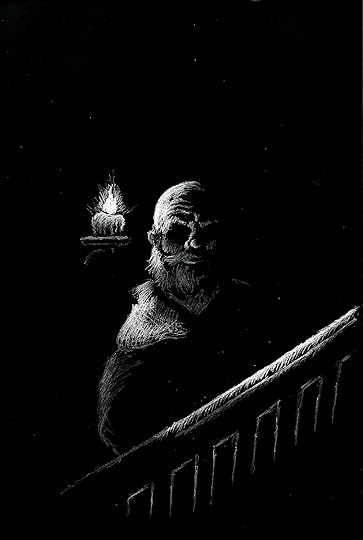
Henri René Albert Guy de Maupassant was a popular 19th-century French writer. He is one of the fathers of the modern short story. A protege of Flaubert, Maupassant's short stories are characterized by their economy of style and their efficient effortless dénouement. He also wrote six short novels. A number of his stories often denote the futility of war and the innocent civilians who get crushed in it - many are set during the Franco-Prussian War of the 1870s.
L'incubo in questi racconti non deriva solo dall'elemento sovrannaturale, ma spesso nasce da dall'ipocrisia e dalla crudeltà; falsità, tradimenti, umanissima follia. La povertà che porta a compiere atti immorali e crudeli, l'avidità che conduce alla rovina, la solitudine che uccide, la pazzia che divora: è cinico e disincantato, Maupassant, a leggere queste opere l'impressione è quella che non provasse molto amore per gli uomini, e nessuna fiducia. E ancor meno per le donne. C'è un grande amore per la natura, di contro: descrizioni meravigliose di paesaggi, di fiumi e boschi, tanto suggestive da sembrare dipinti. Una natura bellissima, però in grado di farsi minacciosa e crudele, perché nemmeno di lei ci si può fidare: come tutti, tradisce.
Tutto è cambiato, dalla stesura di questi scritti, fuorché l'uomo. Non si fanno più narrazioni al lume di una candela, o attorno al focolare. Chiunque può ottenere all'istante informazioni, dati e/o immagini su qualsivoglia argomento, con una semplice connessione in rete. La curiosità di allora verso la lontananza, qualsiasi lontananza, fisica o concettuale, non esiste quasi più, così come si è persa l'abitudine (e la necessità cognitiva) di trascorrere del tempo comune in conversazioni divulgative, o speculative. Non si dà più credito alla credibilità tout-court, scettici come siamo, presuntuosamente informati o, semplicemente, non provando più interesse alcuno verso l'esperienza altrui, in un misto di disillusione (da "tutto già visto") e di autoreferenzialità cieca e sorda (ma non muta!) L'uomo, tuttavia, e la sua paura intima, nascosta, irrazionale, iperbolica, dinanzi a ciò che non conosce è lo stesso di allora. La difficoltà a misurarsi con l'inspiegabile e l'incomprensibile continua a generare in lui fantasmi e terrori, talvolta incontrollati. Ciò rende universali questi racconti e assoluta la genialità del loro inventore.
Only a few of the stories in this collection either involved the supernatural or were all that frightening to me, but I enjoyed it anyway. I'd suggest going through it slowly. Reading more than a couple a day made them get a little tedious, though I'm not sure how much of that is due to the translation, which seemed awkward at times.
My favorite stories were the strange ones that most felt like nightmares, "A Night in Paris," "The Dead Girl," and "Who Knows?" Some of the stories about obvious madness were also really compelling. I had less luck with the tales that focused just on sheer human meanness. The little frame stories in some of these selections also didn't work for me, though again, maybe those parts where the narrator tells us about meeting the person who told the story flow better in the original French.
Some of the stories have a more dated feel than others. There were, for example, three stories that involved quartering Prussian troops in the French countryside. The wide influence of de Maupassant will also make some of this book very familiar to horror readers. His story "The Inn" has the same general "snowed-in winter hotel caretaker driven mad" premise as The Shining.
I'd recommend this for anyone who likes atmospheric horror or is interested in getting into the roots of the genre.
French horror stories. Entertaining, well-crafted, very smart, and most of them quite short. I think Maupassant was a serious artist. I read just a sample:
____ THE HORLA (1887)
“…the Horla will make of man what man has made of the horse and of the ox.”
The longest and most complex of the bunch. Is the horror cosmic or psychological? I prefer a supernatural explanation, since the latter is not just a Poe imitation but too sad as well, especially in light of Maupassant’s imminent madness. However, the narrator is written with more depth than what’s found in the usual speculative fare. In the same breath he will haughtily dismiss God and praise Mesmer, then later burst out begging for there to be a God. Though the man could be haunted, or even hypnotized, he nevertheless exhibits signs of mental illness before the weird phenomena begin. A modern reader will find it difficult not to give a diagnosis. But how boring these times are, that blame mood swings on bipolar disorder and not on vampires from outer space!
“…in this world one is certain of nothing, since light is an illusion and noise is deception.”
The story becomes engrossing once the entity starts playing tricks on him. It is a cross between invasion and plague literature: an enemy that spreads into France from a Brazilian ship. Imagine the bubonic plague but where the illness is madness and the rat an invisible alien. Because you are in the head of a narrator who claims to be under mind control, it is interesting to determine where any wayward thoughts are coming from, and the meaning behind them, such as his sudden transports about butterflies—butterflies as big as worlds and fluttering from star to star.
How do you defeat a foe who’s at once inside and outside your mind? It’s both funny and pathetic to see the narrator try to nonchalantly sneak up on it.
____ THE HAND (1883)
A horror icon, before The Evil Dead or The Adams Family. The description of the hand is the best part. Belonging to an American, it is both monstrous and realistically portrayed: black, with yellow nails and enormous tendons, severed cleanly.
At the end Maupassant seems to know we’d prefer his stories to be supernatural, but feigns to reject any such notions.
____ THE FLAYED HAND (1875)
“Sir,” responded Pierre, with much gravity, “you insult a hand which does not merit it. Know you that it belonged to a man of high breeding?”
An earlier one, written when M. was 25, during Flaubert’s tutelage. I actually liked it better than the more famous “The Hand.” It’s fun to look at the latter as a sequel.
This one is full of fiendish touches. Here the hand is found after the effects of an old sorcerer are sold. I love all these stories that feature drunk French students:
“But what are you going to do with this horror?” we cried.
“Eh! parbleu! I will make it the handle to my door-bell and frighten my creditors.”
“My friend,” said Henry Smith, a big, phlegmatic Englishman, “I believe that this hand is only a kind of Indian meat, preserved by a new process; I advise you to make bouillon of it.”
“Rail not, messieurs,” said, with the utmost sang froid, a medical student who was three-quarters drunk, “but if you follow my advice, Pierre, you will give this piece of human debris Christian burial, for fear lest its owner should come to demand it. Then, too, this hand has acquired some bad habits.”
Another quote:
“In his delirium strange words escaped him, and, like all madmen, he had one fixed idea.”
____ BESIDES SCHOPENHAUER’S CORPSE (1883)
There’s a lot going on in this ghastly little humor piece. It seems to take some jabs at those who would look for life beyond the grave, unlike the great German philosopher. The joke may be on the watchers of the corpse—fancying the body is still alive right before it blasts them with a terrible smell of death—in which case the smile on the philosopher’s face becomes rather mocking. But of course Maupassant’s comic handling of the corpse is hardly respectful, and the narrator’s language when eulogizing Schopenhauer, that “greatest shatterer of dreams,” is double-edged. My impression is that Maupassant agreed with the brutal honesty of the man without softening its implications. I felt a little sorry for the disciple, though, himself dying of consumption and reading such stuff as Schopenhauer.
____ THE DEVIL (1886)
Tale of some dreary French peasants that ends very remarkably. Throughout the brief story the title provides suspense, as you wonder when the devil will appear, and in what form. Spoiler: the novel method of murder (scaring someone to death) is darkly amusing. I thought there was subtlety and a lot of truth in the way the washerwoman didn’t start out evil, but was quickly corrupted by the greed of the dying woman’s son.
____ DIARY OF A MADMAN (1885)
Macabre and stale. A magistrate becomes a serial killer. For him the murders are a twofer, because he gets to sentence the falsely accused to death. The diary starts off with some Nietzschean anthropology about bloodlust. Though Maupassant knew German philosophy (to judge from his little tribute to Schopenhauer) it does not seem possible he read Nietzsche. N. did love M. though.
____ THE TERROR (1883)
Aka “He?” Story of a man who gets married because he saw a ghost one night. Minor but it held my interest.
____ APPARITION (1883)
“I caught a leaf with my teeth and chewed it, from sheer gladness of heart at being alive…”
The author comes up with the creepiest thing you could think to do with a ghost: combing her hair. The narrator is kind of funny.
____ WAS IT A DREAM? [1887? I believe the original French title is “La Morte” or “The Dead Girl.” There’s a lot of confusion with all these names, due to loose translations and M.’s predilection for generic and overlapping titles]
A spooky parable about the dead rising from their graves and rewriting their epitaphs to be less phony. I would’ve preferred a less misanthropic ending. It would’ve been moving if the dead girl alone was good.
____ A NIGHT IN WHITECHAPEL [spurious work misattributed to M.]
Albino horror. The only tale here where I was bored, and of course it turns out not to be by M. Apparently there’s not even a French version.
____ WHO KNOWS? (1890)
I wasn’t at all in the mood for another sad glimpse into M.’s now rapidly approaching nervous breakdown (in fact he slashed his throat not two years later), but this turned out to be one of the best of the bunch.
It’s a fantasia (literally like the Disney movie), possibly ether-induced. Kafkaesque, 25 years before Kafka, the dream logic is very well done. The similarities are especially apparent once the police become involved in the plot. It’s about a recluse who values his possessions more than people and ends up getting betrayed by his furniture and forced out of his retreat. As hastily as M. apparently wrote all these, nothing ever seems left to chance. If there’s no magic in this story and only madness, then why do the police happen to mention a woman who’s an old sorceress? “Who knows?”
____ A NIGHT IN PARIS (1887)
A Twilight Zone episode about a never-ending night. Hallucinatory. It’s yet another story about teetering sanity and being betrayed by what you love. Perhaps an allegory of death. I sort of loved how nihilistic the vision is, just a hymn to blackness. Reminded me of later Coen bros. Doesn’t pull any punches.
____ THE GRAVE (1883?)
A wild elegy on the death of a loved one, a wailing lament against oblivion itself, the utter annihilation when we die. This predicament is so universally felt, though seldom spoken of, that the story ends on a surprisingly comforting note, as the man whose love led him to embrace a rotting corpse is acquitted by a once hostile jury.
____ FEAR (1882)
A couple campfire-type stories, one an Imperial Gothic tale set in the desert, the other in the forests of northern France. Each enjoyable but with mundane explanations.
____ THE WOLF (1882)
An almost mythical wolf terrorizes a town. It’s a familiar creature feature, ably related, but as usual M. throws in a wrinkle. Here it’s the two brothers—unusually tall, bony, hairy, and violent men “with rage in their hearts,” who seem even more animalistic than the wolf, making the showdown more exciting.
____ THE INN (1886)
This one is simple but cool. It’s set in a remote little hotel closed for the off-season, high up in the Swiss Alps and surrounded by the white immensities of the snowy summits. The setting and the craziness that comes from isolation and/or a haunted house made me wonder if the story inspired The Shining, but it seems not.
The main character and the dog going crazy is funny, though it ends sadly. The role of the girl and the fate of the old man seem purposefully mysterious.
[Note: I must mention, just by chance tonight, I read in Arthur Conan Doyle’s memoir that he happened upon this very inn, which inspired him to write a story with the same premise, minus the dog, and by a chance of his own soon after saw the M. story. To quote Doyle: “But what is perfectly marvellous is that in that short journey I should have chanced to buy the one book in all the world which would prevent me from making a public fool of myself, for who would ever have believed that my work was not an imitation? I do not think that the hypothesis of coincidence can cover the facts. It is one of several incidents in my life which have convinced me of spiritual interposition…”]
_________________________ Further reading that leans towards horror:
On the River Was He Mad? [A Madman?] The Drowned Man
Superb. Surely the best of Maupassant, though just as I was finishing it I became aware of a short story called Am I Mad?, which unfortunately isn’t included here.
When he writes on the subject of insanity few writers can compare, and here several of the stories deal with madness, the best being Diary of a Madman, and Who Knows?. In the stories concerning the more sane, the stand-outs (though that really is a difficult task to do) are The Horla of course, perhaps his best known story, and The Inn, which I have read before in another collection, with the name The Mountain Inn.
Maybe not horror but dark and just so enjoyable to read! And the author has a taste for antique furniture which was much appreciated. Weirdly the best known Horla felt very mid comparing to all the other storiea, The Head of Hair though !!!!
Foreword essay by Ramsey Campbell 3.5⭐ Introduction essay by Arnold Kellett 4⭐ The Horla • [Le Horla • 3] • (1972) (trans. of Le Horla 1887) 5⭐ Fear • [La peur • 1] • (1972) (trans. of La peur 1882) 5⭐ The Hand • [La main d'écorché • 2] • (1972) (trans. of La main 1883) 3.5⭐ The Mannerism (trans. of Le tic 1884) 4⭐ Apparition • (1972) (trans. of Apparition 1883) 4.25⭐ The Wolf • (1972) (trans. of Le loup 1882) 3.5⭐ Terror • [La peur • 2] • (1972) (trans. of La peur 1884) 4.25⭐ The Diary of a Madman • (1976) (trans. of Un fou 1885) 5⭐ The Smile of Schopenhauer • (1972) (trans. of Auprès d'un mort? 1883) 4⭐ On the River • (1972) (trans. of Sur l'eau 1876) 4⭐ He? • (1972) (trans. of Lui? 1883) 4.25⭐ The Head of Hair (trans. of La chevelure 1884) 4⭐ The Inn • (1972) (trans. of L'auberge 1886) 4⭐ Was He Mad? • (1972) (trans. of Un fou ? 1884) 3⭐ The Dead Girl • (1972) (trans. of La morte 1887) 5⭐ Mademoiselle Cocotte • (1976) (trans. of Mademoiselle Cocotte 1883) 4.25⭐ A Night in Paris • (1972) (trans. of La nuit 1887) 5⭐ The Drowned Man • (1972) (trans. of Le noyé 1888) 4.25⭐ Who Knows? • (1972) (trans. of Qui sait 3.25⭐
Imagine having Flaubert as your mentor. And him such a disciplinarian, artistically and intellectually, that he doesn't approve of your work sufficiently for its publication for 6 years or so. But then he pronounces it genius.
MFA SchmeMFA.
So, upon reading this, I've been thinking (again) about syphilis. How many artists and writers of around this time were said to have suffered from it, and how it drove their work, or ended it dramatically. Here's an interesting article: https://www.theguardian.com/books/201...
It's interesting that some of the same authors have also been diagnosed in hindsight as having been bipolar. Are both true? Because, reading the Horla, man, the character sure sounds exactly bipolar/ schizoaffective w psychotic breaks. And w classic sleep paralysis thrown in. Without knowing Maupassant had syphilis, that's what I would have gone with.
I'm finding this observation interesting at the moment, something to shelve for further rumination.
The stories that are blunt summaries of what war or country life were like--no twist, just flat accounts. Not really even stories, just descriptions... Also interestingly horrifying.
So anti-peasant, in the way that many of the Russian writers were.
The Poe and Hoffman influences are evident, but he clearly intends (and often outright states) to make his own mark. And has.
I've rated the individual stories separately, as some I've read in various anthologies previously.
Collection is varied here, but the 'tales of terror and the supernatural' subtitle I felt was a bit of a stretch. Lots of murder and grim tales but not quite what I'd class as 'terror', still maybe it's a matter of taste.
"Coco" - An aging horse, favorite of the lady of the house, is allowed to live out its days being cared for by a young boy at the chateau. But the boy resents the horse, and follows his brutish anger to its logical conclusion. A bitter and sad little conte cruel, with a poetic final image.
"The Blind Man" - An elderly blind man is resented by his family (for being useless) and they move in their anger from shunning him, to playing cruel tricks, and finally to direct, sadistic assault, before sending him into the winter streets to beg, where he eventually dies of neglect. Another bitter and sad conte cruel that illustrates man's inhumanity to man.
This collected works by France's Guy de Maupassant will shake you because of the darkness, psychological extremes and terror that they convey. While not for everyone, all will agree that they are wonderfully and creatively written. I have been a fan of this man's for over 20 years ago when I picked up an anthology that contained his masterpiece, "The Horla." There are some treasures in this anthology.
If you read this exclusively for entertainment, I think you'll be disappointed, as most of these stories might be considered dated, and most readers now seem to crave quick shine and sharp and stark splayed pretty-pink nakedness, the violent thrust and grunt of transactional fictionalized love and death, entry and exit into such mercurial narrative we deem desirable, all the while licking our fingers slick to get out all the sticky all the good and to better turn the page before it crumbles to ash and we sweep it out our palms. Dust to dust, and all that...
Guy de Maupassant died at 42, suffered from madness, and was known for nesting stories within stories. Losing our way while traversing our delicate synaptic bridges may be one of the most lonesome and terrifying things imaginable. We humans, we readers, we lovers, we are frail creatures before the darkness, and yet we still gaze, and wonder, and sometimes enter.
I think these stories are best taken in a swallow, and never mind what spills on the chin and damps the throat.
Despite my 3/5 rating, I quite enjoyed these. It's probably more like 3.5/5, possibly 3.75/5. I'm just feeling stingy at the moment.
He's a bit Poe, a bit Hoffmann, and a bit Gogol, but also very realist and psychological. Some of these stories are especially dark. One deals with pedophilia, rape, and murder. Many deal with war, and aren't exactly horror in the traditional sense, but more horror in the expose of man's cruelty to man. Very few stories are actually supernatural in nature, despite the title. The final story, Who Knows? reminds me a lot of Gogol's absurdist fantasies, but with an even darker bent. Maupassant died insane in his early 40s after a suicide attempt, and was a syphilitic drug addict; his incipient madness is on full display in some of these stories. I'm reminded of the great Japanese writer Ryonsuke Akutagawa, who took his own life after developing adult-onset schizophrenia, and whose final works are autobiographical in nature, dealing with his fragmenting mind.
Ah Maupassant, when writing over the natural is this beautiful, it only enhances the mystique of the supernatural! In fact, they seem intimately wedded in these stories, with the psychological mind in the middle as the interpreter of the world around us. The number of mad fellows in this hearty collection of 31 stories surely rivals Poe. This is a superb translation by Kellett.
Making this collection extra creepy is 1) de Maupassant prefer to write from the POV of the person being haunted or going mad, which brings the reader into the experience & 2) de Maupassant kinda went nuts himself, so his later fiction is especially unnerving.
The Darkside is a collection of short stories by Guy de Maupassant. They all are around the central theme of horror and psychopathic actions. This is because he suffered from schizophrenia most of his life, so he was just as insane as many of his characters. Most of the stories start with a character telling someone about a story, and then he tells them it, which is the real story Maupassant has to tell. The writing style used in this book is interesting, with most stories being people telling stories instead of just going straight into the main story, like Everything Stuck to Him. A few stories show logged time passing(in a journal) which I personally enjoy, because it lets you get a sense for how long parts of the story take. The tone for his stories all seemed to start out calm, but end up much darker. One thing I dislike about the stories are the repeated endings. Almost every single story ends up with someone dying, and about half of the time it is the crazy person. I dislike this because after a while, the stories get really cliche. Maybe if the endings of just a few were different, then I would have a different opinion. Even though there are many stories, they all can fall under one theme. I believe this theme is, never trust someone by their looks. THis is because multiple times, an innocent looking person turns out to be the bad guy. I would recommend this book to anyone 12+.
Come dice Henry James nella sua preziosa introduzione, è nei racconti che emerge appieno il genio di Maupassant. E questi Racconti dell'incubo permettono al nostro di scandagliare sino in fondo, sino alle estreme conseguenze, la falsità e la crudeltà dei rapporti umani: in molti casi, infatti, il cauchemar è generato dai protagonisti stessi, è conseguenza diretta della loro normale esistenza, delle loro azioni quotidiane. Senza dubbio questi racconti devono molto a Poe, ma sono arricchiti dalla straordinaria capacità descrittiva di Maupassant, dal suo essere impregnato di impressionismo (si vedano le descrizioni dei paesaggi, che percepiamo immediatamente come in un quadro di Monet) e dal suo vivere, sifilitico, scettico e cinico, nella società stupidamente positivista della Francia di fine ottocento, nella quale una superficie di convenzioni e false certezze riesce appena a coprire i drammi esistenziali e sociali di cui si nutre. Meraviglioso il saggio di Henry James che fa da prefazione al volume: l'autore anglosassone sembra essere incerto tra il riconoscimento dell'indiscusso genio del francese e la critica alla sconvenienza e alla licenziosità delle tematiche da lui trattate.
To Goodread's Friend, Plch who read these stories in 1993 and retrospectively awarded it 5 stars. I have 4 or 5 books of G de M's short stories and generally think they are some of the best ever written, or perhaps I should say the best I have so far come across!!!
However I don't think I have read any/many of these supernatural stories. A difficult genre, I feel. Put all in one book, they can point up weaknesses eg., cliches and repetitions and absurdities that lessen the chill and consequently the credibility.
Your 5 stars of 1993 may not have been given in 2012, almost 21 years later. Mmmm...what a conundrum, Plch!!!!!!(less)
I was quite disappointed by this. Maupassant wrote The Horla which is one of the absolutely best supernatural horror stories ever. One of my top five favorites. What was I saying? Oh, yes... so, I bought this book hoping for some more macabre genius. Well, there just wasn't much worth reading in here. They were nearly all obvious and more or less pedestrian in style. The Horla seems to have been a fluke.
I rented the book just to read the short story "A Vendetta," which is set in the southern Corsican town of Bonifacio.
The result: highly lame.
I'm waiting for Merimee's "Colomba" to come in to read a better account of a Corsican Vendetta. At the very least, I know I can count on Dumas' "Corsican Brothers" to spice things up!
I recently read another collection of Maupassant stories and I feel that this one suffered from poor translation. The title of the collection also conveys the wrong impression. The vast majority of these tales were structured around basic human cruelty and not the fantastic.
Although some readers may be disappointed that not all the stories have supernatural elements, as the name of the book suggests, these tales are vivid, earthy and beautifully written. They are all masterclasses in storytelling.
i was looking for creepy stories to read to get in the halloween spirit, this was a good choice. definately give it a shot if your in the mood for the hairs on your neck to stand up.