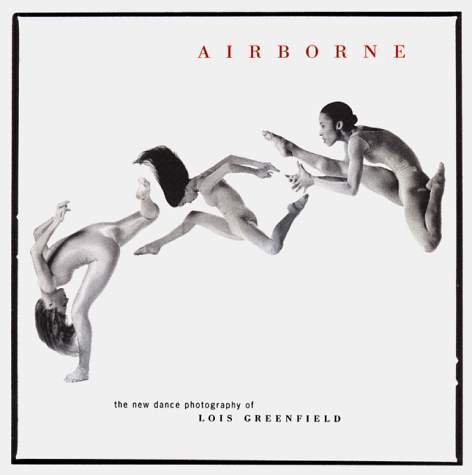
Breaking Bounds brought Lois Greenfield's pioneering work in dance photography widespread acclaim and a dedicated following. Now with Airborne, her first book in over six years, Greenfield takes us to spectacular new heights. Collaborating with some of the world's finest dancers from such illustrious dance companies as the Martha Graham Dance Company, Pilobolus, San Francisco Ballet, the Parsons Dance Company, and Ballet Tech, she captures moments of startling grace and power. In 90 duotone images, Greenfield's dancers defy gravity and push the limits of the possible. A preface takes us behind the scenes in her studio, and the photographer's own captions illuminate the challenges of making pictures that recreate the seeming effortlessness of dance. As inspiring as it is technically remarkable, this collection of incomparable images is sure to captivate dance lovers, photographers, and all who admire the beauty and strength of the human body.
If you're interested in dance, Lois Greenfield is your go-to photographer. If you're interested in photography as well, you're really in for a treat. Because despite all the challenges inherent in photographing something like dance, which is by definition a sequence of movements in three-dimensional space, Lois Greenfield consistently captures images that suggest movement even though they're still. And by freezing one moment, we get to really see a dancer's body and expression. We can see the illusion of peace on their face and the truth of exertion in their straining muscles. All the things we miss during performance.
The book itself is nice, with the photographs presented in an uncluttered way that asks you to really look. Short descriptions are offered at intervals throughout the book, although several of my favorite photographs had no more information than the dancers' names, companies, and the date. Nevertheless - a can't-miss collection.
Oh man, this was beautiful. There's not much more to say about it than that. If you're interested in photography or dance, pick this up.
I initially thought the photographs were stand alone and I liked that, studying each one and getting out of it what I could. Then I realized every 25 photos or so Greenfield stopped to list the dancers and a little note about the background of that particular photo. I loved that it wasn't juxtaposed with the images so it didn't impact my own interpretation, and it was so fascinating to read about the process later. This format gave us the best of both worlds in my opinion.
Not really my cup of tea. I'm no art critic, but I was not particularly taken by Greenfield's photographs. Perhaps it was their emphasis on the human body, maybe it was the weird tight-suits everyone wears, or maybe it was the collection's whole premise (people in positions that are generally impossible to photograph as stills) that did not appeal to me. Of course for all I know this, as the preface suggests, is a monumental addition to the 'tradition' of photography.
Some of the best staged shot dance photography of its era, decent commentary. Still like Breaking Bounds better - less additive focus - but I'm weird like that for dance stuff.
Lois Greenfield's photographic tribute to the art of dance
Lois Greenfield is an amazing photographer, to put it mildly. Since the 1980s, her photos have made their indelible imprint on the world of dance, and her claim to fame is her amazing ability to capture the human form in motion. Some have compared her work with Eadweard Muybridge for his exploration of human locomotion, and with Henri Cartier-Bresson for capturing the elusive moment and doing it artfully.
Airborne: The New Dance Photography of Lois Greenfield was first published in 1998, and my copy shows how often I've thumbed through it over the years, pausing to view her extraordinary images time over. I've gifted this book in the past because it's not only an excellent photography book, but one that's good for students of dance in that so many forms are here on the pages in beautifully reproduced black and white.
The preface was written by William E. Ewing, the former director of the Musée de l'Elysée in Lausanne, Switzerland. Ewing is a noted author of books on photographic representation of the human body and curator of numerous international exhibitions on the subject. From there we explore various full and double-page plates, which are presented in two sections: Earthbound, and Airborne. There are also commentaries by the author on the plates in each section.
Lois Greenfield launched her career as a photojournalist while at Brandeis University in Massachusetts, working for Boston's alternative and independent newspapers. Three years after graduating, she moved back to New York City, in 1973, where she established herself as a photographer specializing in the dynamic cultural sphere of the time. It was an assignment for the Village Voice to photograph a Rudolf Nureyev collaboration with Paul Taylor that whetted her appetite for the dance, and additional work followed for the Village Voice, Time, Newsweek, Rolling Stone, Dance Magazine and other publications.
Working with some of the best dance talent of the era, Greenfield saw that a whole new vocabulary and grammar of dance was evolving, and that New York City was at the very center of this experiment. Soon she had convinced her editors at the Village Voice to run her pictures alongside their regular dance reviews, and this would prove an excellent and long-lasting alliance.
Her compositions of beautiful bodies frozen in space in this book are truly awe-inspiring, and her carefully-chosen photographic gear (Hasselblad cameras and Broncolor studio strobes) afford her to concentrate on the image and it's composition. But what really stands out to this reader is that Ms. Greenfield is a true master of lighting, as we find perfection in each of the images of this book.
It goes without saying that her work has appeared in numerous advertising campaigns and editorial spreads, along with many gallery showings, and this book offers a sampler of her extensive portfolio at the time that it was published. Her editorial clients have included Elle, Vogue, Life, The New York Times Magazine, Sports Illustrated and Time. You'll find her photographs in print ads for Capezio, Cutty Sark, Raymond Weil watches, Pepsi, Epson, AT&T, IBM, Xerox, Rolex, DuPont fabrics, Sony Music, Orangina and others. She currently also creates advertising and promotional photos for dance companies around the world.
Once you've seen the images in this book, it won't be difficult to recognize her photographic signature in much of the print media we see today.
Airborne is one of those books that will trigger questions like, "How did the dancers get in those positions?" But after that initial reaction, settle back and enjoy the exquisite images that you'll find within the pages of this book. It's a true photographic tribute to the art of dance, and presented by a master.