

What do you think?

Hitler's Vienna: A Portrait of the Tyrant as a Young Man
What turned Adolf Hitler, a relatively normal and apparently unexceptional young man, into the very personification of evil? To answer this question, acclaimed historian Brigitte Hamann has turned to the critical, formative, years that the young Hitler spent in Vienna. For it was here, behind the glittering curtain of artistic creativity, liberalism and prosperity, that the architect of the Holocaust was born. As a failing, bitter and desperately poor artist, Hitler experienced only the dark underbelly of Vienna, which was seething with fear, racial prejudice, anti-semitism and conservatism. Drawing on previously untapped sources - from personal reminiscences to the records of shelters where Hitler slept - Hamann vividly recreates the dark side of fin de siecle Vienna and paints the fullest and most disturbing portrait of the young Hitler to date - the genesis of the most terrifying dictator the world has ever known.
496 pages, Paperback
First published September 1, 1998
Ratings & Reviews
Friends & Following
Create a free account to discover what your friends think of this book!
Community Reviews
Displaying 1 - 30 of 30 reviews

August 11, 2021
Ha elképzelünk egy embert, aki tényleg semmilyen történelmi ismerettel nem rendelkezik (mert mondjuk hegyi kecskék nevelték fel egy lakatlan szigeten), és elképzeljük azt is (ha már úgyis képzelgünk), hogy a kezébe nyomjuk ezt a könyvet, akkor ez az ember bizonyosan csodálkozni fog. Nem érti majd, miért írnak ilyen vastag kötetet valakiről, aki ennyire tizenkettő egy tucat. Ott nyomorog Bécsben, közepesnél rosszabb akvarelleket fest régi épületekről, munkásszállásokon húzza meg magát, műveltsége felületes, és nyoma sincs benne a szuggesztivitásnak. Mi persze nem hegyi kecskék között cseperedtünk, úgyhogy tudjuk, ez a fiatalember, ez az alig húsz éves Adolf a XX. század egyik főgonosza, a második világháború kirobbantója, és a holokauszt kiötlője – szóval mi értjük, mi a pláne Hamann könyvében. De azért borzongató belegondolni, milyen köznapi alapokra épülhet fel egy szörnyeteg.
Hamann az 1900-as évek legelejére visz minket, azokba az évekbe, amikor Adolf Hiter pelyhedző bajszú ifjoncként megérkezett Linzből Bécsbe, hogy szerencsét próbáljon. Sorsa általános sors volt az alkonyát élő Monarchiában, hisz akkoriban gyakorlatilag minden második fiatalember a dinamikusan fejlődő, izgalmas Bécsben kívánta megcsinálni a szerencséjét. Az se unikális, hogy Hitlernek ez nem sikerült: a Képzőművészeti Akadémiára nem vették fel, úgyhogy innentől meg kellett húzni a gatyamadzagot – gyanítható, hősünk bizonyos időszakokban koldulásból volt kénytelen fenntartani magát. Ha pedig munkája volt, az is csak a tisztes szegénységre volt elég: fillérekért árulta akvarelljeit a nem túl igényes polgároknak.
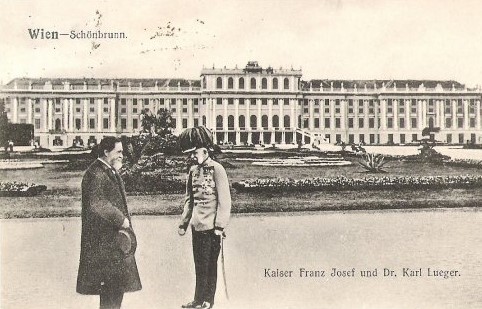
(A császár és Karl Lueger polgármester 1910-ben, Bécsben. Valószínűleg akkor ők voltak ketten a legnépszerűbb figurák ott. Hitler még a kanyarban sincs.)
Hamann kötete azért nélkülözhetetlen adalék a második világháborúhoz, mert rámutat egy nagyon fontos kontinuitásra a szétesőfélben lévő, forrongó Monarchia és a második világháború között. Mert azok az eszmék, amelyekkel Hitler felgyújtotta a világot, nem voltak újak: tulajdonképpen a császárváros általános közhangulatát másolták le. Hogy mást ne mondjak, Bécsben ekkoriban Karl Lueger volt a polgármester*, aki véresszájú antiszemita szólamokkal nyerte meg a nép szívét – Hitler valószínűleg tőle leste el, hogyan kell néptribunként az ujja köré csavarni a tömegeket. A parlamentben is hemzsegtek az agresszív taplók, akik gyakorlatilag ellehetetlenítették a demokratikus ügymenetet**. Minden nemzetiségnek (a cseheknek éppúgy, mint az olaszoknak) megvoltak a maguk radikálisai, ahogy természetesen a németeknek is. Mert – bár gyakran megfeledkezünk róla – nem csak a nem-németek gravitáltak kifelé az Osztrák-Magyar Monarchiából, hanem bizony a germán szívűek számottevő része is. Ők voltak azok, akik a Habsburgokat elaggott, idejétmúlt csontvázaknak tartották, akiket kriptába kéne már tenni, és helyette legszívesebben a Nagy-Német Birodalomhoz kötötték volna a szekerüket. Ilyen értelemben szegény Ferenc Jóska alaposan meg volt lőve: népei egymással fenekedtek, mindegyik személyes sértésnek vette, ha a másik valamilyen jogot kapott, legfeljebb abban értettek egyet, hogy a zsidókat agyon kéne ütni. Egy nálánál bölcsebb uralkodónak is beletört volna a bicskája a helyzetbe***. Hitler pedig ott ült a forrongás, az izgatott zsemzsegés közepén, és figyelt, tanult, jegyzetelt. Mindent, amit látott, beépítette formálódó világnézetébe. Elvetette a magot, és locsolgatni kezdte. Rusnya egy paréj nőtt ki belőle.
Pazar, tárgyszerű, részletező kötet. Ajánlom.
* Karl Lueger máig vitatott személyiség. Tagadhatatlanul minden idők egyik legkompetensebb polgármestere, gyakorlatilag ő csinált élhető világvárost Bécsből, ami ekkoriban a világ tíz legnagyobb városának egyike volt. Sokan vitatják azt is, hogy valóban antiszemita lett volna - vannak arra utaló jelek, hogy csak szavakkal ostorozta a zsidóságot, valójában remekül megfért velük. Azonban amikor beemelte a politikai közbeszédbe a legalpáribb biboldózást, tulajdonképpen legitimálta az antiszemitizmust a tömeg szemében - ezért pedig viselnie kell a felelősséget.
** Hitler le is vonta a következtetést a bécsi parlamentben látottakról: a demokrácia döntés- és életképtelen. Az, hogy hol a nemzetiségek, hol a németek blokkolni tudták a döntéshozatalt, az valóban jelezte, hogy az osztrák demokrácia egész egyszerűen rosszul van megtervezve – kár, hogy Hitler nem az akkori londoni parlament munkáját figyelte testközelből, akkor talán több értéket látott volna a demokrácia eszméjében.
*** Ilyen körülmények között persze kérdés, hogy a Monarchiát megmentette-e volna, ha idejében és kellő határozottsággal egy föderális szerkezetet hoznak létre a duális elrendezés helyett. Hisz Ferenc József éppenséggel bőségesen tett gesztusokat a cseheknek, a lengyeleknek, csak épp azzal szembesült, hogy 1.) azok radikálisai keveslik az apanázst 2.) a német radikálisok pedig csak megerősödtek abban, hogy Németország az igazi hazájuk, saját császáruk csak kiszolgáltatja őket a szláv veszedelemnek, ami kultúrájuk felszámolására törekszik. Ez a jelenség amúgy – hogy két szemben álló fél radikálisai szinte egymást hergelve, együttes erővel megakadályozzák az észszerű, múlhatatlanul szükséges reformokat – minden időkben a történelmi tragédiák melegágya.
Hamann az 1900-as évek legelejére visz minket, azokba az évekbe, amikor Adolf Hiter pelyhedző bajszú ifjoncként megérkezett Linzből Bécsbe, hogy szerencsét próbáljon. Sorsa általános sors volt az alkonyát élő Monarchiában, hisz akkoriban gyakorlatilag minden második fiatalember a dinamikusan fejlődő, izgalmas Bécsben kívánta megcsinálni a szerencséjét. Az se unikális, hogy Hitlernek ez nem sikerült: a Képzőművészeti Akadémiára nem vették fel, úgyhogy innentől meg kellett húzni a gatyamadzagot – gyanítható, hősünk bizonyos időszakokban koldulásból volt kénytelen fenntartani magát. Ha pedig munkája volt, az is csak a tisztes szegénységre volt elég: fillérekért árulta akvarelljeit a nem túl igényes polgároknak.
(A császár és Karl Lueger polgármester 1910-ben, Bécsben. Valószínűleg akkor ők voltak ketten a legnépszerűbb figurák ott. Hitler még a kanyarban sincs.)
Hamann kötete azért nélkülözhetetlen adalék a második világháborúhoz, mert rámutat egy nagyon fontos kontinuitásra a szétesőfélben lévő, forrongó Monarchia és a második világháború között. Mert azok az eszmék, amelyekkel Hitler felgyújtotta a világot, nem voltak újak: tulajdonképpen a császárváros általános közhangulatát másolták le. Hogy mást ne mondjak, Bécsben ekkoriban Karl Lueger volt a polgármester*, aki véresszájú antiszemita szólamokkal nyerte meg a nép szívét – Hitler valószínűleg tőle leste el, hogyan kell néptribunként az ujja köré csavarni a tömegeket. A parlamentben is hemzsegtek az agresszív taplók, akik gyakorlatilag ellehetetlenítették a demokratikus ügymenetet**. Minden nemzetiségnek (a cseheknek éppúgy, mint az olaszoknak) megvoltak a maguk radikálisai, ahogy természetesen a németeknek is. Mert – bár gyakran megfeledkezünk róla – nem csak a nem-németek gravitáltak kifelé az Osztrák-Magyar Monarchiából, hanem bizony a germán szívűek számottevő része is. Ők voltak azok, akik a Habsburgokat elaggott, idejétmúlt csontvázaknak tartották, akiket kriptába kéne már tenni, és helyette legszívesebben a Nagy-Német Birodalomhoz kötötték volna a szekerüket. Ilyen értelemben szegény Ferenc Jóska alaposan meg volt lőve: népei egymással fenekedtek, mindegyik személyes sértésnek vette, ha a másik valamilyen jogot kapott, legfeljebb abban értettek egyet, hogy a zsidókat agyon kéne ütni. Egy nálánál bölcsebb uralkodónak is beletört volna a bicskája a helyzetbe***. Hitler pedig ott ült a forrongás, az izgatott zsemzsegés közepén, és figyelt, tanult, jegyzetelt. Mindent, amit látott, beépítette formálódó világnézetébe. Elvetette a magot, és locsolgatni kezdte. Rusnya egy paréj nőtt ki belőle.
Pazar, tárgyszerű, részletező kötet. Ajánlom.
* Karl Lueger máig vitatott személyiség. Tagadhatatlanul minden idők egyik legkompetensebb polgármestere, gyakorlatilag ő csinált élhető világvárost Bécsből, ami ekkoriban a világ tíz legnagyobb városának egyike volt. Sokan vitatják azt is, hogy valóban antiszemita lett volna - vannak arra utaló jelek, hogy csak szavakkal ostorozta a zsidóságot, valójában remekül megfért velük. Azonban amikor beemelte a politikai közbeszédbe a legalpáribb biboldózást, tulajdonképpen legitimálta az antiszemitizmust a tömeg szemében - ezért pedig viselnie kell a felelősséget.
** Hitler le is vonta a következtetést a bécsi parlamentben látottakról: a demokrácia döntés- és életképtelen. Az, hogy hol a nemzetiségek, hol a németek blokkolni tudták a döntéshozatalt, az valóban jelezte, hogy az osztrák demokrácia egész egyszerűen rosszul van megtervezve – kár, hogy Hitler nem az akkori londoni parlament munkáját figyelte testközelből, akkor talán több értéket látott volna a demokrácia eszméjében.
*** Ilyen körülmények között persze kérdés, hogy a Monarchiát megmentette-e volna, ha idejében és kellő határozottsággal egy föderális szerkezetet hoznak létre a duális elrendezés helyett. Hisz Ferenc József éppenséggel bőségesen tett gesztusokat a cseheknek, a lengyeleknek, csak épp azzal szembesült, hogy 1.) azok radikálisai keveslik az apanázst 2.) a német radikálisok pedig csak megerősödtek abban, hogy Németország az igazi hazájuk, saját császáruk csak kiszolgáltatja őket a szláv veszedelemnek, ami kultúrájuk felszámolására törekszik. Ez a jelenség amúgy – hogy két szemben álló fél radikálisai szinte egymást hergelve, együttes erővel megakadályozzák az észszerű, múlhatatlanul szükséges reformokat – minden időkben a történelmi tragédiák melegágya.

April 7, 2022
"Hitler's Vienna: A Dictator's Apprenticeship" is a remarkable book by a seemingly unqualified author working with inadequate sources who manages to explain how Adolf Hitler developed his Nazi Ideology and political methodology during the time that he spent in Vienna between 1906 and 1913.
I say "unqualified" because Harman was neither a university professor nor a political historian. Her most important book prior to "Hitler's Vienna" was a biography of the beautiful and vivacious Empress Sissi, wife of Franz Joseph I. Hitler, of course, had nothing in common with Sissi. He was a member of the lumpenproletariat while he was in Vienna. Totally lacking in any social graces, he lived off public assistance and by occasionally sponging off his relatives. He possessed neither intelligence nor the drive to stick with any project. So vivid are her descriptions that Harmann, the one-time royal biographer, makes the reader believe that she was one of the lost young men living along with Hitler in the Men's Hostel (Männerwohnheim Meldemannstraße).
Harmann continually reminds the reader that she is handicapped by the shortage of accounts and testimonials of those who knew Hitler during the period. There are huge blank areas in the narrative. Too often Harmann finds that she must rely on single source for a particular incident. Her primary source is Hitler's autobiography "Mein Kampf" which is highly distorted. Accounts from friends fall into two categories. First there are laudatory works published during the 1930's to capitalize on Hitler's popularity. The second group originated in the 1940s when the authors felt compelled to event crimes and misdemeanours that Hitler did not actually commit.
To compensate for the lack of reliable reports from those who knew Hitler, Harmann resorts to speculation. Noting, Hitler attended many performances of Wagner , Harmann assets that one can assume that Hitler was also familiar with Richard Strauss. Because Hitler was a painter, there is good reason to believe that he was aware of Gustav Klimt.
Harmann's big thesis is that during his Viennese years, Hitler came to see the world through the prism of Wagner's Ring Cycle. He believed that it would be possible to found a heroic regime like that of Wotan and the Völsungs to rule a greater Germany. Hitler passionately hated the multi-racial and multi-cultural nature of the Austro-Hungarian empire. He was horrified by the parliament in which 233 Germans constituted a minority relative to 283 non-Germans ( i.e. 107 Czechs, 33 Ruthenians, 19 Slovenians, 19 Italians, 1 3Croats, and5 Romanians . He feared possibly with good reason that Germans would become a minority in the capital city of Vienna.
Harmann identifies and summarizes the ideas of those writers and politicians that Hitler would later take his ideas from. The prime political influence were Karl Lueger Mayor of Vienna 1897-1910 and Georg Schönerer leader of the nationalist Pan-German Party at the beginning of the 20th Century. Franz Stein and Karl Hermann Wolf also contributed ideas that later appeared in "Mein Kamp." The writers and pamphleteers that influenced Hitler were Guido von Lanz von Liebenfels, Hans Goldzier, Hans Hörbigger, Otto Weininger, and Alex Trebitsch.
In the final analysis there was virtually nothing in "Mein Kampf" that was original. It was simply a synthesis of the ideas and fantasies of the pan-German movement that dominated Viennese cultural and political life during Hitler's time in the city. Oddly enough Hitler did not seem to particularly dislike the Jews. He had a Jewish dealer and clients that he was on good terms with. If anything he hated the Czechs more who constituted 20% of the population of Vienna at the time and were not nearly as well assimilated into German culture as the cultured Jews that Hitler knew. Hitler did however feel that the pan-German movement had too many enemies (i.e. Czechs, Jews, Jesuits, Freemasons, capitalists, Socialists, Parliamentarians, etc.) needed to concentrate on only one . Hitler's decision to use the Jews as the prime scapegoat dated from the 1920s.
Hitler also acquired his leadership skills and ambition at a later date. Harmann's book presents Hitler in Vienna as a lost young man with absolutely no charisma slowly adopting the poisonous values of the city's pan-German movement. Harmann tells us a great deal about Hitler but leaves many questions unresolved. It is nonetheless a fabulous book for anyone interested in the popular culture of Vienna at the start of the 20th century.
I say "unqualified" because Harman was neither a university professor nor a political historian. Her most important book prior to "Hitler's Vienna" was a biography of the beautiful and vivacious Empress Sissi, wife of Franz Joseph I. Hitler, of course, had nothing in common with Sissi. He was a member of the lumpenproletariat while he was in Vienna. Totally lacking in any social graces, he lived off public assistance and by occasionally sponging off his relatives. He possessed neither intelligence nor the drive to stick with any project. So vivid are her descriptions that Harmann, the one-time royal biographer, makes the reader believe that she was one of the lost young men living along with Hitler in the Men's Hostel (Männerwohnheim Meldemannstraße).
Harmann continually reminds the reader that she is handicapped by the shortage of accounts and testimonials of those who knew Hitler during the period. There are huge blank areas in the narrative. Too often Harmann finds that she must rely on single source for a particular incident. Her primary source is Hitler's autobiography "Mein Kampf" which is highly distorted. Accounts from friends fall into two categories. First there are laudatory works published during the 1930's to capitalize on Hitler's popularity. The second group originated in the 1940s when the authors felt compelled to event crimes and misdemeanours that Hitler did not actually commit.
To compensate for the lack of reliable reports from those who knew Hitler, Harmann resorts to speculation. Noting, Hitler attended many performances of Wagner , Harmann assets that one can assume that Hitler was also familiar with Richard Strauss. Because Hitler was a painter, there is good reason to believe that he was aware of Gustav Klimt.
Harmann's big thesis is that during his Viennese years, Hitler came to see the world through the prism of Wagner's Ring Cycle. He believed that it would be possible to found a heroic regime like that of Wotan and the Völsungs to rule a greater Germany. Hitler passionately hated the multi-racial and multi-cultural nature of the Austro-Hungarian empire. He was horrified by the parliament in which 233 Germans constituted a minority relative to 283 non-Germans ( i.e. 107 Czechs, 33 Ruthenians, 19 Slovenians, 19 Italians, 1 3Croats, and5 Romanians . He feared possibly with good reason that Germans would become a minority in the capital city of Vienna.
Harmann identifies and summarizes the ideas of those writers and politicians that Hitler would later take his ideas from. The prime political influence were Karl Lueger Mayor of Vienna 1897-1910 and Georg Schönerer leader of the nationalist Pan-German Party at the beginning of the 20th Century. Franz Stein and Karl Hermann Wolf also contributed ideas that later appeared in "Mein Kamp." The writers and pamphleteers that influenced Hitler were Guido von Lanz von Liebenfels, Hans Goldzier, Hans Hörbigger, Otto Weininger, and Alex Trebitsch.
In the final analysis there was virtually nothing in "Mein Kampf" that was original. It was simply a synthesis of the ideas and fantasies of the pan-German movement that dominated Viennese cultural and political life during Hitler's time in the city. Oddly enough Hitler did not seem to particularly dislike the Jews. He had a Jewish dealer and clients that he was on good terms with. If anything he hated the Czechs more who constituted 20% of the population of Vienna at the time and were not nearly as well assimilated into German culture as the cultured Jews that Hitler knew. Hitler did however feel that the pan-German movement had too many enemies (i.e. Czechs, Jews, Jesuits, Freemasons, capitalists, Socialists, Parliamentarians, etc.) needed to concentrate on only one . Hitler's decision to use the Jews as the prime scapegoat dated from the 1920s.
Hitler also acquired his leadership skills and ambition at a later date. Harmann's book presents Hitler in Vienna as a lost young man with absolutely no charisma slowly adopting the poisonous values of the city's pan-German movement. Harmann tells us a great deal about Hitler but leaves many questions unresolved. It is nonetheless a fabulous book for anyone interested in the popular culture of Vienna at the start of the 20th century.

April 9, 2008
I saw on Amazon that the book also exists in English, "Hitler's Vienna, A Dictator's Apprenticeship".
I would recommend it for two reasons:
1) The in-depth analysis of Vienna at the time of Hitler's arrival and stay from 1908 to 1913. He originally moved there in the hope to be accepted at the Academy of Fine Arts, but he was refused twice, mainly because he had dropped out of school at the age of 16 (he was lazy) and, therefore, had not passed the exams (rather like the SAT, I think) a standard requirement for acceptance at the Academy.
2) Hitler's life against this backgrounds, indeed his apprenticeship in the prevailing political currents that he witnessed, that influenced him and on which he later expanded.
Even if one were not interested in Hitler, alone the portrayal of Vienna at the beginning of the last century would make the book worthwhile reading - it's gripping, sad, at times even funny and undoubtedly widens one's horizon and understanding of how one thing can lead to another.
Of course for those who also want to learn more about what made Hitler tick (and what ticks he had) - there is a lot of that here too!
I would recommend it for two reasons:
1) The in-depth analysis of Vienna at the time of Hitler's arrival and stay from 1908 to 1913. He originally moved there in the hope to be accepted at the Academy of Fine Arts, but he was refused twice, mainly because he had dropped out of school at the age of 16 (he was lazy) and, therefore, had not passed the exams (rather like the SAT, I think) a standard requirement for acceptance at the Academy.
2) Hitler's life against this backgrounds, indeed his apprenticeship in the prevailing political currents that he witnessed, that influenced him and on which he later expanded.
Even if one were not interested in Hitler, alone the portrayal of Vienna at the beginning of the last century would make the book worthwhile reading - it's gripping, sad, at times even funny and undoubtedly widens one's horizon and understanding of how one thing can lead to another.
Of course for those who also want to learn more about what made Hitler tick (and what ticks he had) - there is a lot of that here too!

June 6, 2012
This was a good, informative book about Hitler's birth, up and until the time he left Vienna to go to Munich; so it covers from 1889- ~1914. Brigitte Hamann definitely researched this book quite thoroughly, as you can see from her cited notes in the back of the book. What I liked about this book is that it dispelled a lot of rumors/myths about Hitler that have been circulating for years e.g. that he had Jewish ancestry, that he didn't get accepted to art school because of Jewish professors, and that he was gay, among others. The book is quite detailed with little facts about what influenced Hitler's thinking, philosophy, and politics, as well as the people who influenced him. So if you have a serious interest in Hitler I would highly recommend this book as it is a very focused look into his early years etc; but if you only have a passing interest in him, then I think you can skip this one.

September 10, 2018
Excellent blend of information, with resources from Hitler's youth (and his own writings), mixed with a thorough analysis of the politics, social, and cultural scene in Vienna during Hitler's years there. When combined, I feel that I came away with both a greater understanding of Hitler, and with an broad view of the forces at play at Vienna's fin de siecle. Timely reading both for American politics and, personally, as a run up to my first visit to Austria.
April 8, 2013
Excellent description of pre-war Vienna. Hamann's functionalist thesis destroys the internationalist approach. Mommsen writes an excellent foreword as well.

July 23, 2016
Beautiful and scholarly, a must read.
August 18, 2019
Together with Anton Joachimsthaler, Brigitte Hamann lays the groundwork of our knowledge of Hitler's formative years!
March 6, 2021
Hamann's work has no equal.

November 25, 2019
3.5 stars.
This book talks a lot about the political and social climate in Vienna during the years that Hitler was living there. It shows how he incorporated ideas of pan-Germanism and antisemitism into his political platform after WWI.
We also get a glimpse into Hitler's life and activities as a young man, and I must say that he sounds insufferable. He thought of himself as a great artist and orator. He'd pontificate for hours on political topics; one friend/roommate even took the opportunity to move out while Hitler was out of town because Hitler would keep him up until the wee hours of the morning with political lectures, and the guy just wanted to get some sleep! Hitler also refused to work. He had a small pension from his father's estate, but when that ran out he spent some time being homeless (living in shelters and hostels funded by Jews) rather than getting a job that would earn him a living. The only work he would do is painting watercolors and postcards.
I found this book to be very interesting, but I'm not sure it would have held my interest quite so much had I not been preparing to travel to Vienna. Part of my interest was learning about the history of Vienna, as well as Hitler.
This book talks a lot about the political and social climate in Vienna during the years that Hitler was living there. It shows how he incorporated ideas of pan-Germanism and antisemitism into his political platform after WWI.
We also get a glimpse into Hitler's life and activities as a young man, and I must say that he sounds insufferable. He thought of himself as a great artist and orator. He'd pontificate for hours on political topics; one friend/roommate even took the opportunity to move out while Hitler was out of town because Hitler would keep him up until the wee hours of the morning with political lectures, and the guy just wanted to get some sleep! Hitler also refused to work. He had a small pension from his father's estate, but when that ran out he spent some time being homeless (living in shelters and hostels funded by Jews) rather than getting a job that would earn him a living. The only work he would do is painting watercolors and postcards.
I found this book to be very interesting, but I'm not sure it would have held my interest quite so much had I not been preparing to travel to Vienna. Part of my interest was learning about the history of Vienna, as well as Hitler.
January 12, 2018
The title says it all. While the focus is on Hitler's five years (1908 - 1913) in Vienna, this includes a brief account of his childhood and adolescence. Ms. Hamann divides the remainder of the book between an account of Hitler's activities in Vienna and the forces - cultural, political and economic - in the Austro-Hungarian Dual Monarchy that were his "apprenticeship".
In closing the book, Ms. Hamman observes that, while living in Vienna, Hitler was "not particularly conspicuous", had "no special talent," was a "weak eccentric who avoided regular work" and was "a 'quarrelsome fellow' with a hot temper who always had to be right..." Nevertheless, in 1913 he took many things to Munich he learned in Vienna that he would use as Fuehrer. Among these were "the Shoenerians' 'Heil' greeting, the List disciples' swastika,...[and] Karl Ito's proposal to control the Gypsies by tattooing numbers on their...arms".
Most of this book is accessible to the general reader. However, those unfamiliar with the Dual Monarchy and its numerous regions and ethnicities will need some help from Wikipedia or another source.
In closing the book, Ms. Hamman observes that, while living in Vienna, Hitler was "not particularly conspicuous", had "no special talent," was a "weak eccentric who avoided regular work" and was "a 'quarrelsome fellow' with a hot temper who always had to be right..." Nevertheless, in 1913 he took many things to Munich he learned in Vienna that he would use as Fuehrer. Among these were "the Shoenerians' 'Heil' greeting, the List disciples' swastika,...[and] Karl Ito's proposal to control the Gypsies by tattooing numbers on their...arms".
Most of this book is accessible to the general reader. However, those unfamiliar with the Dual Monarchy and its numerous regions and ethnicities will need some help from Wikipedia or another source.

August 20, 2026
Faszination Hitler: Wie schaffte es ein obdachloser, arbeitsloser Schulabrecher innert wenigen Jahren, ein ganzes Volk hinter sich zu bringen? Hammans Buch zeigt was für ein Mensch der junge Hitler war. In erster Linie: seltsam. Er ist fasziniert von Wagner und altdeutschen Volksmythen, interessiert sich für Architektur und Malerei und hält seinem Jugendfreund stundenlange nächtliche Monologe über seine politischen Weltanschauungen. In einem scheinbar unstillbaren Wissensdurst liest er bis tief in die Nacht verschiedenste Bücher über Politik, Militär, Geschichte, Architektur und selbst Esoterik über Prophezeihungen eines zukünftigen „Auserwählten“ (mit dem er sich später selbst identifizierte). Dabei wird Hitler zeitlebens ein fotografisches Gedächtnis nachgesagt, so dass es in Kombination mit seinen Sonderinteressen aus heutiger Sicht beinahe so scheint als sei der junge Hitler Autist gewesen. Anzumerken ist auch, dass dem jungen Hitler vor dem ersten Weltkrieg kein Antisemitismus angehängt werden kann, hat er doch viele jüdische Freunde. Interessant ist zudem sein prüdes, von Angst geprägtes Verhältnis gegenüber Frauen. In dem durchaus frei lebenden Wien zu der Zeit sind keine Fraunbegeungen Hitlers bekannt, im Gegenteil rationalisiert er sein nichtexistentes Verhältnis mit christlich inspirierten Monologen über Keuschheit und Geistesgegenwärtigkeit. Schliesslich lebt der junge Hitler in einer selbst kreiierten Traumwelt, glaubt Opern von Wagner zu vollenden können, hegt Pläne für den Umbau von riesigen Gebäuden und ist sich der Liebe von einer Frau sicher, die ihn noch nie wahrgenommen hat. Dieser fehlende Realitätssinn führte beim späteren Hitler zu unzähligen Verbrechen. So konnte er bis zuletzt seine Niederlage nicht wirklich einsehen.
Auch wenn es teils so scheint, als ob der junge Hitler etwas „geniales“ an sich hat, muss man sich vergegenständigen, dass dies wohl erst im Rückblick seiner Karriere so scheint. Das wichtigste Kapitel in Hammans Buch ist dann auch das letzte, das aufzeigt, dass es kurz vor dem ersten Weltkrieg absolut nichts an Hitler gibt, das darauf hindeuten würde, dass er innert kürzester Zeit eine solche Karriere hinlegt. In der Realität war Hitler ein durchschnittlicher Sonderling. Wie auch seine Kollegen zu der Wiener und Münchner Zeit bestätigen, deutet nichts auf seinen späteren Aufstieg hin.
Nach dem ersten Weltkrieg mussten unzählige Bedingungen und Strukturen dazu geführt haben, dass dieser Sonderling einen solch steilen Aufstieg hinlegen konnte.
Auch wenn es teils so scheint, als ob der junge Hitler etwas „geniales“ an sich hat, muss man sich vergegenständigen, dass dies wohl erst im Rückblick seiner Karriere so scheint. Das wichtigste Kapitel in Hammans Buch ist dann auch das letzte, das aufzeigt, dass es kurz vor dem ersten Weltkrieg absolut nichts an Hitler gibt, das darauf hindeuten würde, dass er innert kürzester Zeit eine solche Karriere hinlegt. In der Realität war Hitler ein durchschnittlicher Sonderling. Wie auch seine Kollegen zu der Wiener und Münchner Zeit bestätigen, deutet nichts auf seinen späteren Aufstieg hin.
Nach dem ersten Weltkrieg mussten unzählige Bedingungen und Strukturen dazu geführt haben, dass dieser Sonderling einen solch steilen Aufstieg hinlegen konnte.

August 19, 2020
An exceptional book to understand what created the monster Adolf Hitler became. The fact that his best friend was Jewish at a time when he really had no other friends begs the questions of what made him hate them so much later. This delves into his the influences from his family life that shaped his personality and I began to realize that he was a psychotic from an early age. If it wasn't for world events combined with his mental state after being gassed and his natural tendency to look for a fight rather than let one come to him, I doubt he would have never become so loved and blindly followed. His anger from a young age consumed him which made him a social outcast and his artistic talents were not nearly enough for him to follow that path so I surmise that he would probably would have committed suicide or been imprisoned as a Mental Patient before he was 20 if not for the First World War.
November 21, 2023
A brilliantly researched portrait not just of a tyrant, but also of the political, artistic, social, and demographic forces that shaped him.
What pamphlets were circulating in Vienna during those formative years? What politicians did Hitler admire? What operas did he like? I don’t know if there exists any other source that is better researched than this book.
I was especially fascinated by the familial history at the early chapters, which described Hitler’s early domestic life.
To note, the author has cross checked against local registries, etc., and notes when sources are questionable.
I recommend this book to anyone interested in history (it is not too academic as some of the reviews suggest). To anyone visiting Vienna - a must read!
What pamphlets were circulating in Vienna during those formative years? What politicians did Hitler admire? What operas did he like? I don’t know if there exists any other source that is better researched than this book.
I was especially fascinated by the familial history at the early chapters, which described Hitler’s early domestic life.
To note, the author has cross checked against local registries, etc., and notes when sources are questionable.
I recommend this book to anyone interested in history (it is not too academic as some of the reviews suggest). To anyone visiting Vienna - a must read!
June 9, 2024
Endlessly fascinating. Not only for the early life of Adolf Hitler but for the incredible history of Old Austria, its customs and its various peoples . Just amazing information especially on the people who actually knew Hitler when he lived in a men’s home and the ideas of politicians that Hitler simply copied when he came to power in Germany . There’s so much amazing information in this book I feel like travelled to Vienna in the past . There’s so much false information about Hitler out there it’s a pleasure to read a book that’s legitimate and truthful .

February 26, 2024
An excellent piece of work on the early life of Hitler, there is a wealth of knowledge here that I had no idea of and I have been reading literature on Hitler for many years. The author highlights who she believes are Hitler's foremost influences during his years in Vienna and backs it up with a wealth of knowledge and examples from Hitler's speeches and writing. This is well worth a read if you want to fill in your knowledge of a rather understudied part of Hitler's life.

March 19, 2019
A bit on the academic side, but absolutely fascinating.

December 3, 2023
Read for my Austrian History course.
May 30, 2025
Anfangs sehr interessant, dann wird es zu kleinteilig und etwa ab der Mitte hat es mit Wien überhaupt nichts mehr zu tun 🤷🏼♀️
Es wird dann auch zu hypothetisch.
Schad.
Abgebrochen etwa bei Seite 350
Es wird dann auch zu hypothetisch.
Schad.
Abgebrochen etwa bei Seite 350

June 12, 2025
Not an easy read for me, but immensely valuable to me for a better understanding of Mein Kampf This author seemingly left no stone unturned.

July 8, 2022
The first thing I did after finishing “Hitler’s Vienna” by Brigitte Hamann was to google “Best Biographies of Adolf Hitler.”
That’s not because I found “Hitler’s Vienna” inadequate. Far from it. Ms. Hamann’s work is one of impressive scholarship.
Nor was it merely reflective of my particular interest, stemming from family history, in the Third Reich and particularly the experience of Jews in Vienna after the 1938 Anschluss. As intense as those interests are, they have never extended to a need to know the details of the Fuhrer’s life. The results of that life were more than enough.
No, what compels me to learn more about Hitler is the same astonishment at his subsequent career felt by everyone he knew during his Vienna years. Not one of them could have imagined that the penniless, would-be painter described by Brigitte Hamann would become Chancellor of Germany and, in amazingly short order, the country’s absolute dictator and an idol of millions. And his former colleagues at Vienna’s men’s hostel understood even less “why the same person who had once gotten along especially well with Jews was now all of a sudden supposed to be a leading German anti-Semite.”
Ms. Hamann’s book on the years the young Hitler spent in Vienna leaves one invoking Lucifer and fairly shouting the question of what, exactly, had happened. That is the question that will cause me to delve into other Hitler biographies in search of a better understanding of how the inept, no-account itinerant described by Ms. Hamann worked his way up to perpetrating the greatest cataclysm in human history.
January 14, 2013
Very good book, but more for academic than general readers. What I didn't like - the author spend too much time writing about turn of the century Viennese politicians, most of whom were minor. While I understood the point - to show the sources of certain of Hitler's techniques, I felt the author got bogged down to often on minutiae. There were annoying typos in the book, also - when a German book title was translated in to English, only the first word of the English translation was capitalized, and some of the spacing in the text was off, leading to word mash-ups. Sloppy proofreading.
That said, the rest of it was very good. It dispelled a great deal of Hitler myths, for example, he could not have caught syphilis from a Jewish prostitute, as is so often reported, since he had a negative Wasserman test in 1940, and often the author cites the basis for the myths. It seems that Hitler, upon coming to power, made an effort to erase as much as possible about the 1907-1913 period he spent in Vienna. Notwithstanding, the author diligently recreates as much as possible and we learn that Hitler had an aversion to working, harangued the few friends he had for hours on end, had seemingly friendly relations with Vienna's numerous Jews, was the beneficiary of Jewish philanthropy at men's shelters, and soup kitchens, earned a pittance as an artist drawing scenes to be used as inserts into picture frames, had an obsessive love of opera, and as far as can be determined, was completely asexual. Seemed like a weirdo by anybody's standards, now or then. The sections of the book dealing with the presence and influence of Jews and (surprisingly to me) Czechs in Vienna were revelatory. Also nice detail on Hitler's family background.
That said, the rest of it was very good. It dispelled a great deal of Hitler myths, for example, he could not have caught syphilis from a Jewish prostitute, as is so often reported, since he had a negative Wasserman test in 1940, and often the author cites the basis for the myths. It seems that Hitler, upon coming to power, made an effort to erase as much as possible about the 1907-1913 period he spent in Vienna. Notwithstanding, the author diligently recreates as much as possible and we learn that Hitler had an aversion to working, harangued the few friends he had for hours on end, had seemingly friendly relations with Vienna's numerous Jews, was the beneficiary of Jewish philanthropy at men's shelters, and soup kitchens, earned a pittance as an artist drawing scenes to be used as inserts into picture frames, had an obsessive love of opera, and as far as can be determined, was completely asexual. Seemed like a weirdo by anybody's standards, now or then. The sections of the book dealing with the presence and influence of Jews and (surprisingly to me) Czechs in Vienna were revelatory. Also nice detail on Hitler's family background.

February 16, 2009
I read this book when I studied in Vienna in Fall 2001. It describes the art, political, and religious movements in Vienna before World War II. By learning about Vienna, one begins to learn more about the early years of an aspiring Adolf Hitler. The book succeeds in humanizing Hitler, putting him in a context that I knew too well (the streets and Opera Houses of Vienna), and drawing some basic conclusions. Excellent read.

January 15, 2009
A surprisingly good book. I find myself recommending it often to folks interested in 20th century European history.

August 9, 2011
Soberbio, inmejorable.
October 25, 2011
wealth of footnotes, a german author, about a little known period of the tyrant's life. Looking forward to perusing

January 28, 2013
A great book. It helps you to understand a lot about crazy Adolf. Seriously!

November 18, 2014
Stunningly useful book for those who want to figure out where Hitler came from. Well written and a mine of information.
April 1, 2018
Одне з найбільш детальних досліджень життя Гітлера. Страшно уявити яка праця покладена на те, щоб зібрати всі ці документи і свідчення. Фактологічність книги зашкалює.
May 3, 2017
Loved this book. It is very detailed regarding the young Hitler. As with most history books it can be a bit boring at times.
Displaying 1 - 30 of 30 reviews