

What do you think?
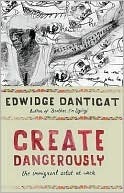
Create Dangerously: The Immigrant Artist at Work
"Create dangerously, for people who read dangerously. This is what I've always thought it meant to be a writer. Writing, knowing in part that no matter how trivial your words may seem, someday, somewhere, someone may risk his or her life to read them." — Create Dangerously
In this deeply personal book, the celebrated Haitian-American writer Edwidge Danticat reflects on art and exile, examining what it means to be an immigrant artist from a country in crisis. Inspired by Albert Camus' lecture, "Create Dangerously," and combining memoir and essay, Danticat tells the stories of artists, including herself, who create despite, or because of, the horrors that drove them from their homelands and that continue to haunt them. Danticat eulogizes an aunt who guarded her family's homestead in the Haitian countryside, a cousin who died of AIDS while living in Miami as an undocumented alien, and a renowned Haitian radio journalist whose political assassination shocked the world. Danticat writes about the Haitian novelists she first read as a girl at the Brooklyn Public Library, a woman mutilated in a machete attack who became a public witness against torture, and the work of Jean-Michel Basquiat and other artists of Haitian descent. Danticat also suggests that the aftermaths of natural disasters in Haiti and the United States reveal that the countries are not as different as many Americans might like to believe.
Create Dangerously is an eloquent and moving expression of Danticat's belief that immigrant artists are obliged to bear witness when their countries of origin are suffering from violence, oppression, poverty, and tragedy.
In this deeply personal book, the celebrated Haitian-American writer Edwidge Danticat reflects on art and exile, examining what it means to be an immigrant artist from a country in crisis. Inspired by Albert Camus' lecture, "Create Dangerously," and combining memoir and essay, Danticat tells the stories of artists, including herself, who create despite, or because of, the horrors that drove them from their homelands and that continue to haunt them. Danticat eulogizes an aunt who guarded her family's homestead in the Haitian countryside, a cousin who died of AIDS while living in Miami as an undocumented alien, and a renowned Haitian radio journalist whose political assassination shocked the world. Danticat writes about the Haitian novelists she first read as a girl at the Brooklyn Public Library, a woman mutilated in a machete attack who became a public witness against torture, and the work of Jean-Michel Basquiat and other artists of Haitian descent. Danticat also suggests that the aftermaths of natural disasters in Haiti and the United States reveal that the countries are not as different as many Americans might like to believe.
Create Dangerously is an eloquent and moving expression of Danticat's belief that immigrant artists are obliged to bear witness when their countries of origin are suffering from violence, oppression, poverty, and tragedy.
189 pages, ebook
First published July 22, 2010
About the author
Edwidge Danticat
134 books2,945 followersEdwidge Danticat is a Haitian American novelist and short story writer. Her first novel, Breath, Eyes, Memory, was published in 1994 and went on to become an Oprah's Book Club selection. Danticat has since written or edited several books and has been the recipient of many awards and honors. Her work has dealt with themes of national identity, mother-daughter relationships, and diasporic politics. In 2023, she was named the Wun Tsun Tam Mellon Professor of the Humanities in the department of African American and African Diaspora Studies at Columbia University.
Ratings & Reviews
Friends & Following
Create a free account to discover what your friends think of this book!
Community Reviews
Displaying 1 - 30 of 231 reviews

February 25, 2020

Edwidge Danticat's Create Dangerously: The Immigrant Artist at Work is an engaging collection of essays that takes its cue from Albert Camus' Create Dangerously. Decades earlier, Camus wrote about the challenges and responsibilities of the artist. Danticat takes a personalized approach to this challenge emphasizing Haitian artists, the widespread devastation of the 2010 earthquake centered near Port-au-Prince, voices of the Haitian diaspora as well as Danticat's own experiences moving back and forth between cultures since immigrating to the U.S. at age 12. She places herself in a position of privilege and security, a place that is not conspicuously dangerous but still demands that she bears witness.
"The immigrant artist shares with all other artists the desire to interpret and possibly remake his or her own world. So though we may not be creating as dangerously as our forebears—though we are not risking torture, beatings, execution, though exile does not threaten us into perpetual silence—still, while we are at work bodies are littering the streets somewhere…."
Danticat's debut novel, Breath, Eyes, Memory, (something I've been meaning to reread and review), emphasizes growing up between U.S. and Haitian culture. For me, it somehow echoes in the background of this collection. The writing of Breath, Eyes, Memory is more evocative (it is fiction) than the essay collection, but Creating Dangerously is engaging and offers Danticat's unique insights. 3.75 stars

June 9, 2015
After meeting Edwidge Danticat in March of this year, I decided that I wanted to read Create Dangerously: The Immigrant Artist at Work. (A title Danticat borrowed from Albert Camus as the title of her 2008 Toni Morrison Lecture delivered at Princeton University). A book of less than 200 pages, composed of 12 essays/chapters and a “postscript,” this book---published in 2010---is the ninth of Danticat’s published titles. It looks small and unassuming but---trust me---I am still meditating on its content, and will be for a while. Most of the pieces exist in other versions published in places like The Progressive, The Nation, and The New Yorker between the years of 2001 and 2011. One piece, entitled “I Am Not A Journalist”---I recognized as having provided some factual content in Danticat’s 2013 novel Claire of the Sea Light.
I first thought the book would be about her personal creative journey and processes, but the affect of reading these essays---almost as a whole cloth---casts a more dynamic net than that. In addition to bearing witness to Haiti’s tragedies, and ongoing crises, Danticat also shows us the roles that oral storytelling, filmmaking, radio, and theatre play in contemporary literacy. She also pays homage and introduces us to Haitian writers who have had “to create dangerously” such as Marie Vieux-Chauvet, Jacques Roumain, and Jan J. Dominique.
“Writing is nothing like dying in, for, and possibly with, your country.”
Some of the things these essays have begun to make me consider include (1) writing and creating as “disobedience” and “revolt against” multiple hungers and forms of suppression; (2) the idea of “people who read dangerously”---that is, people who read at great risk whether that risk might result in something physically brutal or even fatal; as well as readers who are at risk of endangering their current self-image and worldview; (3) reading and writing as acts of critical empathy and compassion that give us opportunities to listen and be heard, as well as draw parallels and recognize patterns in our human experience.
What would you consider and celebrate as “reading dangerously”?
Is there a writer whose works you have found yourself conversing with over time?
I first thought the book would be about her personal creative journey and processes, but the affect of reading these essays---almost as a whole cloth---casts a more dynamic net than that. In addition to bearing witness to Haiti’s tragedies, and ongoing crises, Danticat also shows us the roles that oral storytelling, filmmaking, radio, and theatre play in contemporary literacy. She also pays homage and introduces us to Haitian writers who have had “to create dangerously” such as Marie Vieux-Chauvet, Jacques Roumain, and Jan J. Dominique.
“Writing is nothing like dying in, for, and possibly with, your country.”
Some of the things these essays have begun to make me consider include (1) writing and creating as “disobedience” and “revolt against” multiple hungers and forms of suppression; (2) the idea of “people who read dangerously”---that is, people who read at great risk whether that risk might result in something physically brutal or even fatal; as well as readers who are at risk of endangering their current self-image and worldview; (3) reading and writing as acts of critical empathy and compassion that give us opportunities to listen and be heard, as well as draw parallels and recognize patterns in our human experience.
What would you consider and celebrate as “reading dangerously”?
Is there a writer whose works you have found yourself conversing with over time?

February 17, 2021
Master writer Edwidge Danticat has written a searing and gorgeously rendered series of personal vignettes and essays as part of the late great Toni Morrison's lecture series from Princeton University. Ms. Danticat writes, "we cannot afford to curse or avoid these exits and migrations, because they have earned us whatever type of advancement we have made" (Danticat 35).
Ms. Danticat writes about being an exile from her beloved Haiti, of writing "dangerously" to expose the truth, and brutal indignities that her community has faced throughout history and politically. She writes also about her loved ones who suffered so much at the hands of human ignorance, racism and natural disasters that seem to deem Haiti a cursed land.
But at the heart of this text is that writers of color have the responsibility to reassert and fight marginalization, so that the cycle and "fear of being misread, misseen, and misunderstood; of being presented out of context" (Danticat 145) somehow becomes better for everyone, and to show that as a society we should care, even just a little bit more than we want to.
Ms. Danticat writes about being an exile from her beloved Haiti, of writing "dangerously" to expose the truth, and brutal indignities that her community has faced throughout history and politically. She writes also about her loved ones who suffered so much at the hands of human ignorance, racism and natural disasters that seem to deem Haiti a cursed land.
But at the heart of this text is that writers of color have the responsibility to reassert and fight marginalization, so that the cycle and "fear of being misread, misseen, and misunderstood; of being presented out of context" (Danticat 145) somehow becomes better for everyone, and to show that as a society we should care, even just a little bit more than we want to.

March 29, 2025
Wow! Brilliant and engaging.
Edwidge Danticant generously takes us into her world and showcases what it means to create dangerously. I loved how she wrote cases that were so personal and very Haitian. Everything about this collection was heartbreaking, yet, heartwarming.
Edwidge Danticant generously takes us into her world and showcases what it means to create dangerously. I loved how she wrote cases that were so personal and very Haitian. Everything about this collection was heartbreaking, yet, heartwarming.

February 19, 2023
Quedé completamente aturdida, conmovida y tocada por estos ensayos. Me quedo con todas las ganas de seguir leyendo a Edwidge y a otras autoras haitianas. A leer más mujeres negras latinoamericanas.

October 20, 2011
Inept is the word that immediately comes to mind when trying to "review" this book. Ms. Danticat's words, halting yet fluid, have borne upon me the beginnings of an understanding of a nation and its beleaguered people. I have no mechanism with which to comprehend the physical, political, emotional and spiritual devastation so many have endured, but my mind is now open, reset and forever changed by her deft and daring creation.
So many of the questions she asked herself (and others) are questions that too many of us aren't asking ourselves (and others). And we should given the state of affairs in our own countries and those to which we are now indebted/intertwined. For instance, near the end of the Bicentennial chapter: "For is there anything more timely and timeless than a public battle to control one's destiny, a communal crusade for self-determination?"
No. There isn't.
And while I don't wish to divert any attention from Haiti's hopes and plights (of which I presently know too little), I'm invigorated by her thoughts about artists any- and everywhere creating dangerously, defiantly and fearlessly before, during and after times when our governing institutions "govern" with such blithe indifference.
Also, I love how she reveals the duality of being an immigrant artist throughout the book. As both Haitian and American I feel in so many ways that she's perfectly primed to see things about both countries that perhaps neither is capable of acknowledging. In the Another Country chapter in particular she dissects America (in the period immediately following Hurricane Katrina that is still just as relevant now) in such a way that I felt like I was the "amenning lady" waving her white hankie on the first pew in church:
"This is the America that continues to startle, the America of the needy and never-have-enoughs, the America of the undocumented, the unemployed and underemployed, the elderly, and the infirm ... Perhaps this America does have more in common with the developing world than with the one it inhabits."
Preach.
So many of the questions she asked herself (and others) are questions that too many of us aren't asking ourselves (and others). And we should given the state of affairs in our own countries and those to which we are now indebted/intertwined. For instance, near the end of the Bicentennial chapter: "For is there anything more timely and timeless than a public battle to control one's destiny, a communal crusade for self-determination?"
No. There isn't.
And while I don't wish to divert any attention from Haiti's hopes and plights (of which I presently know too little), I'm invigorated by her thoughts about artists any- and everywhere creating dangerously, defiantly and fearlessly before, during and after times when our governing institutions "govern" with such blithe indifference.
Also, I love how she reveals the duality of being an immigrant artist throughout the book. As both Haitian and American I feel in so many ways that she's perfectly primed to see things about both countries that perhaps neither is capable of acknowledging. In the Another Country chapter in particular she dissects America (in the period immediately following Hurricane Katrina that is still just as relevant now) in such a way that I felt like I was the "amenning lady" waving her white hankie on the first pew in church:
"This is the America that continues to startle, the America of the needy and never-have-enoughs, the America of the undocumented, the unemployed and underemployed, the elderly, and the infirm ... Perhaps this America does have more in common with the developing world than with the one it inhabits."
Preach.

April 10, 2013
At first I wasn't sure if this book would speak to me since I'm not an immigrant artist as Danticat describes. But the more I read the more I realized she was not just speaking of writing from a place of danger and displacement. She's talking about the danger of going deep into one's own truth and creating fearlessly from that place. Since that is exactly what I seek to do as a writer I found this book inspiring and challenging. It encourages me to approach my work again and again with diligence and purpose. I highly recommend it to any artist who hopes to do the same.

September 17, 2010
I am always a little leery when a favorite writer publishes a collection of essays relying heavily on previously published work. Oftentimes, I am deeply dissatisfied. The material doesn't hold together, and I find that the writer has done disappointingly little work to update the material or to excise repetitions among the essays. This was not the case as I read Edwidge Danticat's new book, Create Dangerously: The Immigrant Artist at Work. Danticat's collection is surprisingly fresh (almost every essay reflects on the impact of Haiti's cataclysmic January 12th earthquake), and each piece has been carefully recrafted around the unifying theme of the immigrant artist's privileges and responsibilities. With a consistently strong voice, recognizable as Danticat's in its firm but quiet insistence which is at once compelling in its directness and powerful in its subtlety, Danticat confronts and deconstructs a variety of social and cultural forces that would relegate a country, a people, a socially-constructed race or even herself as either an immigrant writer in the US or as an exiled writer outside of Haiti to the margins. In these essays, she writes forcefully from her position over a wide variety of topics—claiming places for Haitian artists alongside Sophocles, Emerson and Picasso; explicating the root causes of different legacies, despite many similarities, between contemporaneous revolutions in Haiti and the United States; and reemphasizing a missing plurality of voices from Haiti by both giving voice to those who have not been heard, as well as by asserting her right to speak only for herself.
November 3, 2022
Qué buena, qué bellas está escritas algunas reflexiones, me encantó conocer sobre Haití.
NOTA PERSONAL PARA MÍ MISMO: Debo leer más autores africanos, afrodescendientes loco, basta por un rato de leer autores blancos del primer mundo, muy canónicos y todo pero esta literatura es tanto o más interesante y por sobre todo uno empatiza más.

January 26, 2012
I loved this book because of how she address her experiences as being a Haitian/writer/immigrant and how one identity often feeds another. Her commentary in "The Other Side of the Water" on going home to bury a cousin who she barely knew despite them both living in America and in "Walk Straight" about visiting a great aunt depicts a universal experience of how our family shapes our lives and how you never realize how little time you have with family until they are gone. "Our Guernica" puts a face on the Haitian earthquake which destroyed the fragile existence of many of her countryman, in a way that is tragic and hopeful. But the essay that hit home for me was the title essay which starts off the book. It speaks about the craft of writing in a way that caused me to rethink how and why I put words to paper.
June 15, 2017
"And during this final conversation, I am even more certain that to create dangerously is also to create fearlessly, boldly embracing the public and private terrors that would silence us, then bravely moving forward even when it feels as thought we are chasing or being chased by ghosts... Creating fearlessly, like living fearlessly, even when a great tempest is upon you. Creating fearlessly even when cast lot bo dlo, across the seas. Creating fearlessly for people who see/watch/listen/read fearlessly. Writing fearlessly because, as my friend Junot Diaz has said, 'a writer is a writer because even when there is no hope, even when nothing you do shows any sign of promise, keep writing anyway.' This is perhaps also what it means to be a writer. Writing as thought nothing can or will ever stop you. Writing as though you full-heartedly, or foolheartedly, believe in acheiropoietos."

July 2, 2020
For several years there have been three writers who I considered my favorites, Sebastian Barry, Czeslaw Milosz and Anatole France. But in the last couple of years there are three young women who I now include in that group, Jesmyn Ward, Madeleine Thien and now Edwidge Danticat. I only discovered Danticat about 6 months ago when I read Krik! Krak! and I've been reading everything I can find of hers since. Each time I read one of her books I'm more and more impressed. This book of essays is absolutely amazing! I was going to pick out my favorite essays in the book but as I went through the titles I realized that one was just as good as another, but if I had to pick one I'll go with Walk Straight. It was magnificent and very personal to Danticat as were several of the others. Many of the essays were based around the cruel dictatorship of Duvalier and of the people who suffered under him. As difficult as the subject matter was in some of the essays Danticat's magnificent prose made them quite inspirational. An outstanding book!

November 27, 2022
Edwidge Danticat's Create Dangerously: The Immigrant Artist at Work is a collection of essays about being a Haitian author living in the U.S. Although Haiti is so close to the United States in terms of distance, culturally it is parsecs away. Few Americans can lay claim to having read a Haitian author.
I enjoyed these essays, despite the fact that untimely death plays such a large part in them, and am eager to read some of Danticat's fiction.
I enjoyed these essays, despite the fact that untimely death plays such a large part in them, and am eager to read some of Danticat's fiction.

May 2, 2024
Serie de ensayos donde la autora reflexiona sobre su experiencia como escritora migrante, el existir en medio de dos naciones y no ser considerada de ninguna, haitiana para los estadounidenses y viceversa.
Toma como punto de partida varios hechos históricos importantes de Haití y los sobrepone a su experiencia y a la de varios artistas que al igual que ella han sido marcados por un pasado genético geográfico.
Toma como punto de partida varios hechos históricos importantes de Haití y los sobrepone a su experiencia y a la de varios artistas que al igual que ella han sido marcados por un pasado genético geográfico.

May 16, 2022
Increíble ella… todo lo que se ha traducido al castellano es BRILLANTE! Cuentos, novela y ensayo, parece que la autora se mueve con maestría en todos los géneros.
MUY RECOMENDABLE
MUY RECOMENDABLE

February 14, 2023
Once again, I feel inadequate to “review” a work that is profound, moving, and crafted with great care. I felt the desire to read Danticat’s nonfiction after enjoying several of her novels, and there is indeed enough memoir material in these essays to help me better understand her as author. But I gained so much more than I bargained for! I will copy some passages— too long to quote here—for deeper reflection.

November 20, 2024
creation, whether art or writing, as an immigrant or being of immigrant experience is to serve as archive
March 11, 2020
Extraordinario conjunto de crónicas, que rozan el ensayo; hay un tópico crucial, un recuerdo o una noticia que despierta en una divagación que termina transformándose en un cuestionamiento al trabajo del arte, la escritura y el papel de quienes ejercen el oficio para interferir en la realidad. Desde sus raíces haitianas, Danticat reconstruye un pasado, un presente y un cuestionado futuro en torno a cómo puede ser percibida una nación, un pueblo, su gente y su cultura. Puede hacerse trabajosa su lectura, pero al terminarla se transforma en una revelación necesaria en tiempos que necesitamos re pensar todo a nuestro alrededor. Excelente lectura para preparar la votación del próximo 26 de abril y saber el porqué de la necesidad de un Apruebo mayoritario.

August 2, 2016
I did not intend to read this book of essays so fast. I started it, thinking I'd read a couple essays here and there, maybe one before bed, but alas, I was engrossed. Danticat is not a historian or even a editorialist, yet I learned so much about Haiti and what it means to be a Haitian immigrant in the 21st century from her book. I probably would not have been as interested as I ended up being had I not already read most of Danticat's fiction. For fans of her novels and stories, this book is nothing short of essential. I feel like I understand much better the place from which Danticat births her novels, and for that the novels move even closer to my heart.
These essays, which nearly all appeared elsewhere in a similar form but are so seamlessly strung together in this volume that most will not even know it, also have something to offer those of us who appreciate why artists work—especially in light of a country's great pain and suffering. I would certainly place it alongside Moments of Being (Virginia Woolf) and In Search of My Mother's Gardens (Alice Walker) as nonfiction treatises on writing and a writer's dedication to her craft.
It's truly shocking what great inhumanity the people of Haiti have experienced, but Danticat reminds us not to pity the survivors but feel linked to them, to respect their journey, and do our part to champion (and maybe even make) art/language/writing that dares to be dangerous. She certainly places herself not as an authority or expert, but someone else on her own journey, and I really appreciate that. For me, though, this book is an important reminder as a teacher, a poet and coach, as a Unitarian Buddhist, and a reader. Create dangerously. Read dangerously. Create spaces for both!
These essays, which nearly all appeared elsewhere in a similar form but are so seamlessly strung together in this volume that most will not even know it, also have something to offer those of us who appreciate why artists work—especially in light of a country's great pain and suffering. I would certainly place it alongside Moments of Being (Virginia Woolf) and In Search of My Mother's Gardens (Alice Walker) as nonfiction treatises on writing and a writer's dedication to her craft.
It's truly shocking what great inhumanity the people of Haiti have experienced, but Danticat reminds us not to pity the survivors but feel linked to them, to respect their journey, and do our part to champion (and maybe even make) art/language/writing that dares to be dangerous. She certainly places herself not as an authority or expert, but someone else on her own journey, and I really appreciate that. For me, though, this book is an important reminder as a teacher, a poet and coach, as a Unitarian Buddhist, and a reader. Create dangerously. Read dangerously. Create spaces for both!

November 23, 2010
I just started Danticat's new book, and I wanted to read aloud the first chapter through a loudspeaker in a van driving through the streets, like in the old-fashioned way politicians used to advertise their candidacies. I realize, though, that shouting it might not meet the spirit of her first chapter....but I think you get my point: everyone should read it. But, again, such a dictatorial mode would be antithetical to Danticat's message. And around and around I go....
The only problem with her book so far is that her literary references keep adding to my list of "to-reads"!
The only problem with her book so far is that her literary references keep adding to my list of "to-reads"!

February 27, 2016
This collection of essays is as delicate as it is powerful. Danticat has a sophisticated intelligence and a complete passion for her homeland. We do not have much in terms of glimpses into the troubled past and beautiful traditions of Haiti; Danticat's is a voice that crosses the water, that bridges the diasporic space between countries.

September 23, 2017
Completed reading Sept. 23, 2017 --
More thoughts to come.
_______________________________
Early impression, reading continues : Wed. Sept. 2017
: Currently Reading: Edwidge Danticat, Create Dangerously: the immigrant artist at work . (2010) The question that thrusts this book is "What can the artist do?" .What can Danticat do in Haiti, the country of her birth, when political strife, poverty, and natural disasters occur. How can Danticat do anything, when she hasn’t lived in the country since age 12. Each chapter is set in a troubled era in which she lived, or a historical event in Haiti she reconstructs via art in that time. For examples: Haiti's 2006 earthquake, DuValier era when tonton macoutes , terrorized tortured everyday Haitians in the countryside, farmers, families, herdes, anyone targeted based on flimsy rumors they were part of the resistance. Or the time Papa Doc Duvalier ordered assassination of two Haitian writers - Marcel Numa and Louis Drouin”. Duvalier labeled them “outsiders” and branded their relatives ‘traitors”, because the two traveled and workedin the U.S., out of economic necessity. On execution day, Papa Doc Duvalier shut down schools; then , he ordered all Haitians to witness a firing squad murder them in a public square. (Why don't I know this history?)
What can the artist do? Edwidge Danticat acknowledges her vulnerabilities, guilt, good intentions while at a loss about where to start because she's been "gone away". She is both insider (born there), and outsider, NYU and Brown trained, Oprah Book Club acclaim, etc. She is lives in material comforts while her grandmother Tante Ilyana resides on a mountainous hilltop. Ilyana guards the family cemetery plot, and insists on a home that requires a day of walking uphill to reach. I value how Danticat lacks pretensions, her insightful writing knife is not dull. I am foolish to to not read with vigilance.
For example, Edwidge Danticat describes a child rescued from earthquake rubble in plain language. Danticat’s writes in quiet prose, but then, she’ll close the sentence with a detail that guts me. For example: Danticat reports a shy Haitian child survived, but did not talk. She sees a ‘gash’ on the girl’s forehead. the concrete split her scalp open”. Before Danticat walks away, she adds the closing phrase: the gash is where school concrete fell on the 10 yr old’s head and split. her scalp open. Her honesty does not shield readers or allow the distance to pretend a happy endings awaits Haiti. Each time Instead, she pierces my reading, and reminds me not to be passive or asleep while I learn Haiti’s heartbreak (6,000 died?). Here’s a Haitian survivor, Alerte Berlance in the chapter “I Speak Out”. Duvalier’s country militiamen sliced Alerte’s tongue in half, hacked off her arm with a machete, then, tossed her into a mass grave to die. Danticat won’t allow an American primed on U.S. heroic myths. She won’t jump the Berlance’s recovery years, acknowledging only triumphant benchmarks -- speaking tours, a Phil Donahue Show talk show appearance. Danticat insists readers see the “the before” too. And “the during”. I infer her message: “Wake the f*ck up. Don’t consume natural disaster horrors as if Haitian suffering is your devastation porn, tourist!”
In the “I Am Not a Journalist” chapter, the author describes the 1994 course "History of Haitian Cinema" at Ramapo College (NJ), which she co-taught with Hollywood filmmaker Jonathan Demme and Haitian radio journalist and filmmaker Jean Dominique. She and the reader shift our perspective about why Cinema matters -- Dominique explains that in a country where illiteracy was around 51 %, Haitian films,painting, and the visual arts ARE the vehicle to disseminate then discuss political strategies to survive, and overthrow Father and Son DuValier governments. Radio and community theater is valuable as well for that reader. In this way words such as "resistance" do not sound as empty as when I use them at U.S. protests. Danticat writes in clear, straightforward prose. I'm learning about Haitian culture in its own right, and not just what happens to Haiti.
More thoughts to come.
_______________________________
Early impression, reading continues : Wed. Sept. 2017
: Currently Reading: Edwidge Danticat, Create Dangerously: the immigrant artist at work . (2010) The question that thrusts this book is "What can the artist do?" .What can Danticat do in Haiti, the country of her birth, when political strife, poverty, and natural disasters occur. How can Danticat do anything, when she hasn’t lived in the country since age 12. Each chapter is set in a troubled era in which she lived, or a historical event in Haiti she reconstructs via art in that time. For examples: Haiti's 2006 earthquake, DuValier era when tonton macoutes , terrorized tortured everyday Haitians in the countryside, farmers, families, herdes, anyone targeted based on flimsy rumors they were part of the resistance. Or the time Papa Doc Duvalier ordered assassination of two Haitian writers - Marcel Numa and Louis Drouin”. Duvalier labeled them “outsiders” and branded their relatives ‘traitors”, because the two traveled and workedin the U.S., out of economic necessity. On execution day, Papa Doc Duvalier shut down schools; then , he ordered all Haitians to witness a firing squad murder them in a public square. (Why don't I know this history?)
What can the artist do? Edwidge Danticat acknowledges her vulnerabilities, guilt, good intentions while at a loss about where to start because she's been "gone away". She is both insider (born there), and outsider, NYU and Brown trained, Oprah Book Club acclaim, etc. She is lives in material comforts while her grandmother Tante Ilyana resides on a mountainous hilltop. Ilyana guards the family cemetery plot, and insists on a home that requires a day of walking uphill to reach. I value how Danticat lacks pretensions, her insightful writing knife is not dull. I am foolish to to not read with vigilance.
For example, Edwidge Danticat describes a child rescued from earthquake rubble in plain language. Danticat’s writes in quiet prose, but then, she’ll close the sentence with a detail that guts me. For example: Danticat reports a shy Haitian child survived, but did not talk. She sees a ‘gash’ on the girl’s forehead. the concrete split her scalp open”. Before Danticat walks away, she adds the closing phrase: the gash is where school concrete fell on the 10 yr old’s head and split. her scalp open. Her honesty does not shield readers or allow the distance to pretend a happy endings awaits Haiti. Each time Instead, she pierces my reading, and reminds me not to be passive or asleep while I learn Haiti’s heartbreak (6,000 died?). Here’s a Haitian survivor, Alerte Berlance in the chapter “I Speak Out”. Duvalier’s country militiamen sliced Alerte’s tongue in half, hacked off her arm with a machete, then, tossed her into a mass grave to die. Danticat won’t allow an American primed on U.S. heroic myths. She won’t jump the Berlance’s recovery years, acknowledging only triumphant benchmarks -- speaking tours, a Phil Donahue Show talk show appearance. Danticat insists readers see the “the before” too. And “the during”. I infer her message: “Wake the f*ck up. Don’t consume natural disaster horrors as if Haitian suffering is your devastation porn, tourist!”
In the “I Am Not a Journalist” chapter, the author describes the 1994 course "History of Haitian Cinema" at Ramapo College (NJ), which she co-taught with Hollywood filmmaker Jonathan Demme and Haitian radio journalist and filmmaker Jean Dominique. She and the reader shift our perspective about why Cinema matters -- Dominique explains that in a country where illiteracy was around 51 %, Haitian films,painting, and the visual arts ARE the vehicle to disseminate then discuss political strategies to survive, and overthrow Father and Son DuValier governments. Radio and community theater is valuable as well for that reader. In this way words such as "resistance" do not sound as empty as when I use them at U.S. protests. Danticat writes in clear, straightforward prose. I'm learning about Haitian culture in its own right, and not just what happens to Haiti.
This entire review has been hidden because of spoilers.

March 24, 2023
In one chapter, Edwidge writes that many of us and much of her writing are vulnerable to a swift, unthinking protectiveness of Haiti's virtue after years of Haiti's portrayal as 'boat people', or the poorest nation in the Hemisphere, or practitioners of a barbaric religion, leading us to revolt against any negative portrayal or verbal slight against us, our culture and our land. I knew then that I couldn't put the book down.
I'm admittedly at risk of being too generous in my review. Having dedicated my studies to challenging international development schemes, contemporary economic theory, and international relations, this was my first foray into Haitian authorship and their insights to my country's hopes, scenes, and internal dialogues from the ground-up and separate from intellectual perjury and case studies. I feel Edwidge's envy and grief for a Haiti that's been lost after coup d’états and natural disasters, and for a land that I'll never meet, having grown up "lòt bò dlo" and given pause by the danger it presents. But, I mustn't overlook the value of her writing about much of the communalism, staidness, and the cautiously relentless wistfulness for a safer and prosperous nation that Haitians maintain-- and the writer's maintain when they conceive, publish and distribute literature of any fashion, even when doing so risks the lives of them and their loved ones.
I'm grateful for this book, despite its simplicity, and will likely read it again when I wish to send my mind back overseas.
I'm admittedly at risk of being too generous in my review. Having dedicated my studies to challenging international development schemes, contemporary economic theory, and international relations, this was my first foray into Haitian authorship and their insights to my country's hopes, scenes, and internal dialogues from the ground-up and separate from intellectual perjury and case studies. I feel Edwidge's envy and grief for a Haiti that's been lost after coup d’états and natural disasters, and for a land that I'll never meet, having grown up "lòt bò dlo" and given pause by the danger it presents. But, I mustn't overlook the value of her writing about much of the communalism, staidness, and the cautiously relentless wistfulness for a safer and prosperous nation that Haitians maintain-- and the writer's maintain when they conceive, publish and distribute literature of any fashion, even when doing so risks the lives of them and their loved ones.
I'm grateful for this book, despite its simplicity, and will likely read it again when I wish to send my mind back overseas.

January 11, 2025
"Los artistas migrantes dudamos mucho, sintiendo que por nosotros se ha sacrificado tanto, se han aplazado tantos sueños. Podría haber sido más sencillo, más seguro, haber seguido profesiones más útiles, como medicina, derecho o ingeniería, tal como querían nuestros padres. Cuando nuestros mundos se desmoronan literalmente, nos decimos que nuesttros mayores tenían razón con respecto a nuestras carreras pasivas de observadores distantes".
Un libro hermosísimo sobre el poder de crear a pesar de los totalitarismos y las dictaduras. La autora escribe sobre su historia familiar, siendo una inmigrante, y lo entreteje con la historia política, social y económica de su país, Haití. Además, menciona muchísimos artistas (pintores, escritores, periodistas, escultores) que me eran desconocidos y de los que tomo nota para buscar y leer (y eso que soy del Caribe).
De alguna forma, la autora busca cambiar una perspectiva sesgada sobre lo que son los haitianos y lo que es ese país dentro de lo que ofrece globalmente. Siempre se menciona que es el país más pobre de la zona y que viven en la miseria. Resulta que son una nación riquísima en cultura, en gastronomía e independiente desde hace siglos. Sin embargo, no ha logrado surgir debido a un montón de factores económicos y políticos.
Crear en peligro, crear aunque todo nos sea adverso, escribir lo que se observa, escribir desde el amor profundo hacia un país, crear y leer a pesar de todo.

July 16, 2021
4 stars for Create Dangerously. This book is a collection of essays from Haitian-American writer Edwidge Danticat. It is a little bit of a wonder that I stumbled upon this book a week after Haiti and the world woke up to the news of Jovenel Moïse’s assassination. Danticat, through her words and descriptions gives you a peep into life in Haiti and how the country has struggled to find its bearings after being subjected to a series of consecutive torturous dictatorial regimes and natural calamities.
Danticat, at the start of the book, implores you to create dangerously and cites the examples of Haitian thinkers, activists, poets, photographers, sculptors, journalists, filmmakers who all chose to create despite Papa Doc Duvalier’s rein of terror. Those who dared to openly dissent and call out Duvalier were publicly punished and made examples of, in order to dissuade other dissenters from rising against the dictator.
Danticat says “No matter how trivial your words may seem, someday, somewhere, someone may risk their life to read them. Therefore, create dangerously, for people who read dangerously.”
Danticat, at the start of the book, implores you to create dangerously and cites the examples of Haitian thinkers, activists, poets, photographers, sculptors, journalists, filmmakers who all chose to create despite Papa Doc Duvalier’s rein of terror. Those who dared to openly dissent and call out Duvalier were publicly punished and made examples of, in order to dissuade other dissenters from rising against the dictator.
Danticat says “No matter how trivial your words may seem, someday, somewhere, someone may risk their life to read them. Therefore, create dangerously, for people who read dangerously.”

May 30, 2019
"Perhaps this America does have more in common with the developing world than with the one it inhabits. For the poor and outcast everywhere dwell within their own country, where more often than not they must fend for themselves. That's why one can so easily become a refugee within one's own borders - because one's perceived usefulness and precarious citizenship are always in question, whether in Haiti or in that other America, the one where people have no flood insurance" (111).
It took me months to finish this book, not because the prose is dense or the content uninteresting, but rather because Danticat writes with such vulnerability, wisdom, and skill that as she is exploring her heartbreaking familial history and sharing her views of the world, it's difficult not to put the book down to spend some time mulling over her ideas. I will readily recommend this title to many and am trying to figure out how to add it to future sections of my narratives of immigration courses.
It took me months to finish this book, not because the prose is dense or the content uninteresting, but rather because Danticat writes with such vulnerability, wisdom, and skill that as she is exploring her heartbreaking familial history and sharing her views of the world, it's difficult not to put the book down to spend some time mulling over her ideas. I will readily recommend this title to many and am trying to figure out how to add it to future sections of my narratives of immigration courses.

April 14, 2025
Lo primero que leo de ella y hacia rato que no me topaba con una prosa tan conmovedora y atrevida, porque las palabras de estas páginas ahondan en las tragedias de Haití, el sino de un país extraviado en sí mismo, su historia desbordándose sepultando a ciudadanos y artistas.
Magistral, desgarrador y contemporáneo. Venezuela y Haití describen órbitas similares actualmente, una lectura que también se desprendió de esa estela.
Magistral, desgarrador y contemporáneo. Venezuela y Haití describen órbitas similares actualmente, una lectura que también se desprendió de esa estela.
June 28, 2022
Brutal acercamiento a la historia, cultura y sociedad haitiana a través de la mirada de artistas y escritoras que como migrantes resisten y existen entre dos orillas.
Mèsi anpil pou histwa sa yo ki nesesè pou nous kapab kontinye konprann Ayiti.
Mèsi anpil pou histwa sa yo ki nesesè pou nous kapab kontinye konprann Ayiti.

September 17, 2020
Awesome, incredibly well written.
Displaying 1 - 30 of 231 reviews