Jump to ratings and reviews
Rate this book

To Win The Winter Sky: The Air War Over The Ardennes 1944-45

Rate this book
As Allied and German armies fought on the ground in the Battle of the Bulge, an equally desperate battle raged in the skies overhead, as enemy air forces fought the weather and each other for supremacy.Acclaimed author Danny Parker completes the narrative begun in his highly successful Battle of the Bulge. He covers the important and previously unexplored air aspect of a famous land battle. Those who thought they were thoroughly familiar with Hitler's last offensive will find a wealth of new information here, including exclusive interviews with war-time airmen, over 100 rare photos, the unknown story of German MIAs, Luftwaffe jets and other secret weapons, losses in men and aircraft for both sides from government archives, aircraft performance comparisons, and the innovations in tactics and technology that made victory for one side possible and defeat for the other side inevitable.Through all the facts and figures, Danny Parker weaves a compelling narrative about the airmen on both sides in the last desperate days of World War II, about their conflicts with the enemy and among themselves as they stood on the brink of victory--and defeat. As the end of the war drew near, Allied leaders were divided between British and Americans, air and ground commanders, and advocates of strategic and tactical air operations. On the German side, Luftwaffe leaders Hermann Göring and Dietrich Peltz sought to obey every order to the bitter end, while Luftwaffe fighter commander Adolf Galland struggled to save his last reserves of young pilots from a final and futile slaughter.Danny S. Parker is a former research consultant to the Joint Chiefs of Staff on the Battle of the Bulge, and is the author of "Ten Percent Chance of The Last Operation of the German Airborne," and The Battle of the Bulge. He is highly regarded by veterans, historians, and active-duty military personnel.

528 pages, Hardcover

First published January 1, 1994

3 people are currently reading
57 people want to read

About the author

Danny S. Parker

10 books18 followers
Danny Parker is a life-long World War II historian with a strong focus on the Battle of the Bulge and it's major participants. He is a former research consultant the United States Joint Chiefs of Staff on the Battle of the Bulge. He has published numerous articles and books on the subject and has designed three simulation games on the Ardennes campaign. In addition to his study of World War II Mr. Parker is interested in Zen, low-energy housing and good coffee.

Ratings & Reviews

What do you think?
Rate this book

Friends & Following

Create a free account to discover what your friends think of this book!

Community Reviews

5 stars
12 (40%)
4 stars
9 (30%)
3 stars
9 (30%)
2 stars
0 (0%)
1 star
0 (0%)
Displaying 1 - 9 of 9 reviews
Profile Image for Marc.
231 reviews40 followers
December 30, 2022
Having read quite a few books on the Battle of the Bulge, the main concentration always seems to be on the American paratroops, tankers and/or infantry, along with their counterparts on the German side. The fighting in the air is usually mentioned as, "The weather was bad for several days, then it cleared and Allied airpower helped stem the German tide." Pretty simplistic view of things, so I was pleased to read this book and round out my knowledge of the Battle of the Bulge with what went on in the skies overhead.

The book's main focus is the combat operations of the 9th US Air Force and its opposition by the German Luftwaffe. Various units of the 8th US Air Force get some ink, some of which were attached to the 9th, but mostly because of the 8th's involvement in the aerial battles. The detail on both the American and German sides is really good, with plenty of personal anecdotes sprinkled in for flavor. The RAF's 2nd Tactical Air Force is also mentioned, but not in the same amount, mostly getting mention during the Luftwaffe's Operation Bodenplatte on New Year's Day 1945.

The book begins with combat operations and organization of the US and German forces prior to the German offensive and goes through the end of January 1945. There is some further bits of the story after that, but the main part covers about a six-week span starting in mid-December 1944. While the weather wasn't very good over the battlefield, there still was a pretty decent amount of flying being done, mostly by the Americans as they simply had more forces in action. Once the weather clears, the floodgates open and the Germans really begin to feel the full weight of American and British tactical airpower. Several of the personal anecdotes reference similarities to the earlier fighting over Normandy and the Falaise Pocket earlier in the year, so if you're familiar with those instances that will give you a good idea of the scale in this one.

I probably would have given this book five stars except for the editing. Quite a few typographical errors mar the text and the author has an annoying habit of using exclamation points when they don't really seem necessary. The flow of the narration could have been tightened up a bit as well as it jumps around a bit in places, and the reader can get confused about when things happened.

Plenty of excellent photos in this book, along with a few helpful maps and several charts showing comparative strengths of the forces involved and operational statistics. If you're looking for a view of the Battle of the Bulge from above the battlefield, this is definitely worth picking up.
Profile Image for Mike.
1,239 reviews176 followers
January 14, 2016
An NCO in a German parachute division insisted that his men fire away with their sidearms at Allied fighters strafing the town. But when the American planes returned, he quickly took cover in a cellar. ”When the shooting starts” one German officer related after the war, "the iron in their hearts turned to lead in their pants.” After reading this account of the air war before, during and just after the Ardennes battle, you begin to understand just how devastating and frightening the unrelenting attacks were. You might think there was little flying during the early part of the Battle of the Bulge and airpower only came out after the first week when the weather cleared. To Win The Winter Sky: The Air War Over The Ardennes, 1944 1945 will demonstrate this was not the case. There was a lot of flying from the start, usually in atrocious conditions. The book highlights the intense airwar, with almost 10,000 Allied planes opposed by around 1700 Luftwaffe aircraft. Just as the ground battle destroyed the cream of the armored Wehrmacht and SS formations, the Luftwaffe suffered destruction in the air. The Germans had plenty of airplanes but the loss of irreplaceable, experienced pilots was a mortal blow. So many Luftwaffe pilots were sent into battle with almost no training and little flying time in their aircraft. It was often like shooting clay pigeons for the experienced American, British and Polish fighter pilots.

Parker will take you through some history of the air war in Europe prior to the Ardennes campaign. This was an excellent part of the book, especially for anyone not familiar with the air war. Succinct and well-written. Some new things I found out in this book was the extent of flying by the Luftwaffe and the Allies, the extensive use of napalm (thought it was primarily used in the Pacific), and the successful use of the AR-234 Arado jet as a reconnaissance aircraft and a bomber. The book also has many excellent photos of the participants, the machines and the battlefields. If you want a more complete picture of the Ardennes battle, you need to have this book.

What I did not particularly like about the book is the failure to tell this story in a joint framework. There is very little of the interplay between the air and ground battles. Only when Panzer Lehr is trying to reinforce and rescue the 2nd Panzer Division, under relentless attack by British Typhoons, do you get an idea of the impact of air on a ground battle. Even then, Parker hardly mentions any Allied ground force in that particular part of the battlefield. For a guy who has written several books on the Battle of the Bulge and was a consultant to the US Joint Staff, I expected a better account.

There are several ways this could have been told better. He could have taken a mission-oriented approach, explaining the air superiority, deep air interdiction, armed reconnaissance, battlefield air interdiction, close air support, air resupply missions and how these supported or did not support the ground campaigns. He could have taken a campaign objective approach, looking at the various German and Allied ground and air formations and how they were supported/hindered/prevented on accomplishing their objectives over different phases of the battle. Instead, he takes a chronological, day-by-day recounting of the battle with few “big picture” overviews. Plenty of individual fighter and bomber actions, fights, losses, results but not conducive to an exciting narrative. His accounting of Operation Bodenplatte at the end of the Ardennes campaign provided a glimpse of how exciting a narrative could have been woven.

In the end I’ll give it 3 Stars but could have been much more.
Profile Image for Michael.
76 reviews23 followers
Read
August 13, 2016
I am at the point of this writing a couple of chapters into the book. Normally I do not comment or review before finishing a book. The author has taken what I believe to be an excellent approach in discussing this air campaign. He has provided a very balanced explanation of the context on both sides of the conflict in which the Ardennes air campaign was fought.

However, the publisher's editor has left numerous typos and grammatical errors within the text of the book. I hope this does not reflect negatively on the authors efforts. Normally I would ignore such errors except for this book seems to have more than the norm.

As I said above the author does an excellent job of describing the air war over the Bulge. Extremely detailed accounts of the day to day aerial meat grinder that was the Battle of the Bulge on the ground and in the air. For this reader there were many new discoveries or reminders of things forgotten. The descriptions of tension among top German brass is worth the read. By this time in the war Goring and Hitler were at odds with each other. Hitler actually treated Goring many times with total disdain in the last months of the war.

Many of the German pilots doing battle over the Bulge had less than ten or even five missions to their name when they were sent up against experienced allied air crew. All in all an excellent read. If this book remains in publication, in this readers opinion, it is essential that the publishers fix the grammatical errors and typos as this are abundant enough to be distraction.
Profile Image for KOMET.
1,262 reviews144 followers
May 6, 2012
A weighty, comprehensive book that sheds much light on an aspect of the Battle of the Bulge that was, hitherto, little remarked upon by historians.
Profile Image for Rich.
83 reviews46 followers
August 1, 2013
In December, 1944 and January, 1945 one of the great battles of World War II was fought in the skies over the Ardennes Forest of Germany, Belgium and Luxembourg. This battle is virtually unknown. Unlike the famous Battle of the Bulge, the air war overhead was almost completely one-sided--the Allied air forces won the campaign decisively. Moreover, the magnitude of this victory had a profound influence on the outcome of the ground battle below. For the U.S. and British air forces had not only menaced the German enemy on the battlefield, blasting their troops and tanks, but they also starved their armies by lancing their sources of supply. So decisive was the impact, that the outcome of the battle in the Ardennes was virtually predestined.
To Win the Winter Sky by Danny Parker is an immensely powerful work of detailed history. In fact, it is equal to or better than any other history of World War II I've read.

Parker starts with a brief examination of the Airmen who would play most important to the air battle of the Ardennes: the commander of the Luftwaffe, Reichsmarschall Hermann Goring; the commander of Allied Strategic Air Forces, Lt Gen Carl "Tooey" Spaatz; the Luftwaffe armaments minister, Albert Speer; the Commander of Eighth Air Force, Lt Gen Jimmy Doolittle; the Commander of Ninth Air Force, Maj Gen (later Lt Gen) Hoyt Vandenberg; the Marshal of the Royal Air Force, Air Arthur Harris (nicknamed "Butcher Harris"); and, most importantly, the Deputy Supreme Commander to SHAEF, first deputy to Gen Eisenhower, Sir Arthur Tedder. Parker then contextualizes the day-by-day progress of the 3rd Reich's Wacht-am-Rhein that later earned the nickname, the Battle of the Bulge to minute detail.

The audacious stories Parker teases out to his readers deliver some truly valuable nuggets. A couple of the most entriguing are:

- The disagreement between the American and British air strategy of bombing cities... largely Tedder and especially Harris championed this strategy while Spaatz disagreed with it vehemently (later, in the Pacific, Lemay would incorporate the RAF strategy). This meant Eisenhower had to provide tacit approval for attacking cities in the interest of building consensus within the unified strategic air effort. With the struggles between Monty and Bradley, Patton, and most every other American General of significance in the land effort, I do not envy the decisions Ike was forced to make in the interest of the coalition in the air effort.

- The rapid replanning of the whole of Eighth Air Force's missions on December 18th, changed from strategic attack upon the critical oil infrastructure to the bringing the whole of its 3,500-plane force against logistical support stations, communications systems, and airfields that were supporting the Reich's offensive.

- The details of how Spaatz's strategic air campaign, and Doolittle's Mighty Eighth Air Force's particular focused upon on the Reich's oil production prior to the Bulge caused a shortage of supplies at the outset. This effect proved decisive in the fact that German tanks literally ran out of gas following the breakout in the Ardennes with nothing to stop them between Luxembourg and Antwerp.

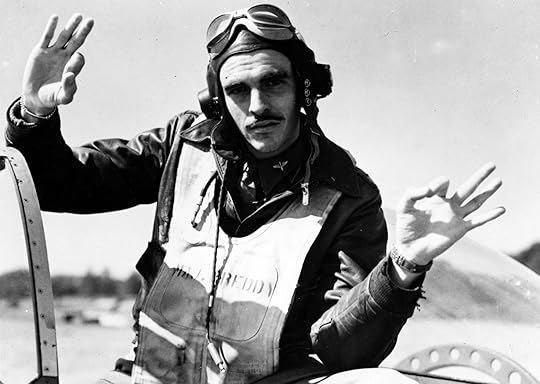
- The story of how a hung-over Maj George E. Preddy shot down six Me-109s in as many minutes in his stead "Cripe A'Mighty." This same man, who on D-Day flew 17 hours of air cover in a P-47 in the first 48 hours of the invasion. And finally, painfully, how one of the greatest American Aces of WWII lost his life to friendly anti-aircraft fire in the confusion that was the Bulge.
 Major George E. Preddy, Jr
Ultimately, Parker's work here is a classic for airpower strategists. It highlights the importance of air superiority, as well as strategic attack, to joint warfare. In a time when the air force has rarely strayed from a close air support mission in over a decade, there are many who are beginning to question the relevance of the independent air service that does more than only support the Army. If those who ignore history are doomed to repeat it, then Airmen and Soldiers alike would be bettered by not forgetting the decisiveness of airpower in this excellent annal of history.
The use of Allied air power against the German Ardennes Offensive was historic. Never before had air power blunted an enemy's surprise counteroffensive from the sky.
Profile Image for Dimitri.
1,008 reviews258 followers
December 22, 2023
"The weather was so bad over the Ardennes that Hitler timed his offensive to it and nothing took to the air until Christmas, when Bastogne was saved."

Bugle gospel, but not quite the truth, thanks to Parker's book. ***1/2

It can be a bit repetitive, with X group making Y sorties on the day the chapter deals with, but the interspersed testimonials in fine print are worth pausing for. In between, the overall picture is always connected to the familiar events on the ground.

While meteorology was the air force's Achilles heel, whatever window for flying opened was utilized to the max on both sides, either to protect the panzer columns from the Jabos or to provide high command with the bird-eye view of a rapidly evolving front. The Allies were fairly succesful in starving the attackers of petrol by peppering their supply lines, while the Lutwaffe ocassionally managed to bite the heavy bomber's offensive in the vicinity of its home bases with more success than the infamous decimation of Bodenplatte.


By the time the Bulge as in retreat, the winter sky felt like Normandy. Secure for all, safe for some.

Profile Image for Alan Carlson.
289 reviews4 followers
December 16, 2021
Refutes the usual picture of the air war component of the Battle of the Bulge (which is: 12/16-12/24 - fog and snow; 12/25 - 12/31 US bombs the heck out of the Germans while airdropping supplies to the 101st at Bastogne; 1/1/45 Luftwaffe attack goes badly), with a comprehensive review of the extensive actions taken by both sides whenever the weather permitted.

Loses one star for repetitive narration style, and no maps showing all the villages named in the narratives.
103 reviews
December 17, 2021
Worthwhile survey of the air battles surrounding the Battle of the Bulge. Suffers from a number of editorial/proofreading oversights. Obviously well researched. I was surprised at the number of aircrew lost and whose remains have never been discovered (at least at the time of the writing, 1994).
92 reviews2 followers
August 5, 2011
Realy Good book from beging to end.
Displaying 1 - 9 of 9 reviews

Can't find what you're looking for?

Get help and learn more about the design.