

What do you think?
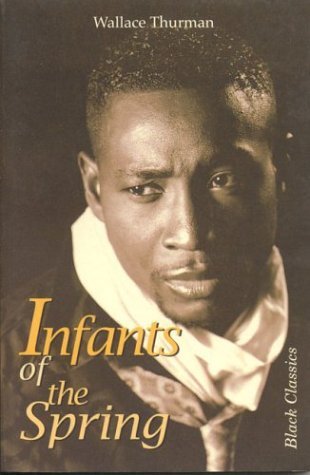
Infants of the Spring
It's 1920s Harlem, and man, the joint is jumpin'. Folks are coming and going and everything's copacetic as long as the gin keeps flowing. This is the scene Stephen Jorgenson dives into when he arrives from Canada for the first time. He is taken to "The Niggerati Manor, " an apartment building in Harlem inhabited by aspiring artists whose true talents lie in living, and where everything's black and white - with a lot of grayness in between. Counterbalancing Stephen's embrace of these folks is Raymond Taylor, a writer who is the only truly talented artist in the manor. Raymond's cynical take on the "new Negro artist" is the tightrope he walks between the love and hatred of himself and his people. Characters representing Langston Hughes, Zora Neale Hurston, and Alain Locke all appear, and part of the fun of this book is figuring out who's who.
240 pages, Paperback
First published January 1, 1932
About the author
Wallace Thurman
23 books90 followersWallace Henry Thurman (1902–1934) was an American novelist active during the Harlem Renaissance. He also wrote essays, worked as an editor, and was a publisher of short-lived newspapers and literary journals. He is best known for his novel The Blacker the Berry: A Novel of Negro Life (1929), which explores discrimination within the black community based on skin color, with lighter skin being more highly valued.
(from Wikipedia)
(from Wikipedia)
Ratings & Reviews
Friends & Following
Create a free account to discover what your friends think of this book!
Community Reviews
Displaying 1 - 30 of 48 reviews

January 7, 2022
Beloved, we join hands here to pray for gin. An aridity defiles us. Our innards thirst for the juice of juniper. Something must be done. The drought threatens to destroy us.
What a wonderful novel, a near forgotten jewel. Thurman imagines a boarding house for black bohemians in Depression-era Harlem. The satire is scathing and very few are spared. It recalled The Tenants of Moonbloom and I found it wonderful, the novel articulates perspectives that were undoubtedly taboo then and likely remain so now. Miscegenation and Marxism are amongst the myriad matters to be dragged across the coals. A prominent black academic holds a salon at the residence in effort to foment "race-wide" cultural discourse. The result is beyond hilarious. The legacies of DuBois and Garvey are upheld but appear to offer little promise in the frenetic metropolis. The novelist/protagonist believes in Dostoevsky and Gide but realizes that both pertain little to his specific racial situation.
The ending appeared disjointed as if a requisite number of arcs had to be terminated if the effort was to properly conclude.
4.4 stars
What a wonderful novel, a near forgotten jewel. Thurman imagines a boarding house for black bohemians in Depression-era Harlem. The satire is scathing and very few are spared. It recalled The Tenants of Moonbloom and I found it wonderful, the novel articulates perspectives that were undoubtedly taboo then and likely remain so now. Miscegenation and Marxism are amongst the myriad matters to be dragged across the coals. A prominent black academic holds a salon at the residence in effort to foment "race-wide" cultural discourse. The result is beyond hilarious. The legacies of DuBois and Garvey are upheld but appear to offer little promise in the frenetic metropolis. The novelist/protagonist believes in Dostoevsky and Gide but realizes that both pertain little to his specific racial situation.
The ending appeared disjointed as if a requisite number of arcs had to be terminated if the effort was to properly conclude.
4.4 stars
September 25, 2025
(Jesus Christ. I just wrote an apologia for men concerning the framework of Linda Bostrom and Karl Ove Paradox; I'm done with the longform for the moment. That said, I need to get these out of the way, so:)
This is tremendous. Better than the debut, it substantiates that Thurman was readied to be one of THE great writers of his and all time. Life, or death, had other plans. Right this damn shame by reading this, husbanded to you by the benevolent auspices of a white publisher, invariably under their 'Hey! Look! We Publish Black!' series. The name's of these fucking charity charades will vary, the agentive bullshit will not. Ignore it all and just smoke this whole thing in one sitting. Wallace deserved that much, and I daresay he likely would've sparked you up himself.
This is tremendous. Better than the debut, it substantiates that Thurman was readied to be one of THE great writers of his and all time. Life, or death, had other plans. Right this damn shame by reading this, husbanded to you by the benevolent auspices of a white publisher, invariably under their 'Hey! Look! We Publish Black!' series. The name's of these fucking charity charades will vary, the agentive bullshit will not. Ignore it all and just smoke this whole thing in one sitting. Wallace deserved that much, and I daresay he likely would've sparked you up himself.

September 8, 2012
You guys. You guys. This book.
There is so much to say about it, in much more articulate ways than I can after having read it only once. Thurman has constructed both a broad caricature, a satirical peephole into the Harlem Renaissance, and a manifesto of the unformed New Negro, in the guise of the angsty black intellectual, artistic youth.
Read this book.
There is so much to say about it, in much more articulate ways than I can after having read it only once. Thurman has constructed both a broad caricature, a satirical peephole into the Harlem Renaissance, and a manifesto of the unformed New Negro, in the guise of the angsty black intellectual, artistic youth.
Read this book.

March 17, 2018
I thoroughly enjoyed this satirical commentary of the Harlem Renaissance. I instantly connected with the timelessness of its characters and story. For instance, the residents of "Niggerati Manor," a small group of self-proclaimed artists, spoke more to me of youthful experimentation and search for identity than of fledgling pursuits of artistic creation. These same personalities would be as at home in the 70's (during my twenties) as today, though they walked the streets of Harlem. Especially intriguing was the psychology and dynamics of the friendship between Ray (the protagonist who embodies Thurman) and Stephen, from Denmark, who both approach race relations with the detachment of anthropologists until Stephen suddenly sours on the "Negro" but for Ray.
Those interested in Harlem literati, writers like Zora Neale Hurston and Langston Hughes, will be delighted with their cameo-like "appearances," though many less recognized artists are also depicted. In fact, I only discovered this book by Wallace Thurman when reading Langston Hughes' auto biography, The Big Sea. Hughes devotes a large portion of his story on a review of the main Harlem luminaries, including, of course, Wallace Thurman.
Those interested in Harlem literati, writers like Zora Neale Hurston and Langston Hughes, will be delighted with their cameo-like "appearances," though many less recognized artists are also depicted. In fact, I only discovered this book by Wallace Thurman when reading Langston Hughes' auto biography, The Big Sea. Hughes devotes a large portion of his story on a review of the main Harlem luminaries, including, of course, Wallace Thurman.

April 20, 2014
wallace thurman is raymond
zora neal hurston is sweetie
alain locke is dr. parkes
langston hughes is tony
little snapshot of life in "the manor" centered on raymond. not hugely ambitious in scope, the meeting of the minds takes place near the conclusion and only lasts a couple pages.
read if interested in harlem rennaisance...
zora neal hurston is sweetie
alain locke is dr. parkes
langston hughes is tony
little snapshot of life in "the manor" centered on raymond. not hugely ambitious in scope, the meeting of the minds takes place near the conclusion and only lasts a couple pages.
read if interested in harlem rennaisance...

March 7, 2023
3.5
In the third section of his autobiography 'The Big Sea', Langston Hughes mentions his contemporary Wallace Thurman in several pages. He makes reference to this work: "... the only novel by a Negro about that fantastic period when Harlem was in vogue. ... 'Infants of the Spring', a superb and bitter study of the bohemian fringe of Harlem's literary and artistic life, is a compelling book."
He also says a bit about Thurman himself: "He was a strangely brilliant black boy, who had read everything, and whose critical mind could find something wrong with everything he read. ... [He] wanted to be a great writer, but none of his own work ever made him happy."
'IOTS' - one of a few extant works by the author - was published in 1929. Thurman, who had an understandably troubled life mixed with bad health, died of tuberculosis 3 years later, at age 32. Judging from the way he presents himself (as Raymond Taylor) in 'IOTS', it seems Thurman was something of a force of nature: tempestuous, mercurial and quixotic; more akin in spirit to James Baldwin than the taciturn, enigmatic Hughes.
This novel of his can be a frustrating affair. Much of it is eloquent and sharply observed. But there's a balance problem; the narrative is somewhat marred by a certain lack of clarity (like an odd 'schizophrenia') as well as bouts of shakiness either in speech passages or characterizations. What's good here battles what's - well... 'closeted'.
The back of the Modern Library paperback of 'IOTS' (with the dazzling painting 'Black Belt' by Archibald Motley, Jr. on the cover) describes Thurman as a "bisexual alcoholic". However, according to Louise Thompson - to whom he was married for 6 months in 1928 - Thurman was gay and refused to admit it.
In the novel, Raymond certainly comes off gay. His interest in women reads as a search for a steady 'BFF'; his interest in men is self-consciously subservient to the '20s in Harlem. His primary fire echoes as Baldwin-esque:
The novel's main strength rests with its importance as a document of the Harlem Renaissance - a time of promise unfairly altered and squelched by the approaching Depression. Thurman's book isn't a no-longer-relevant roman à clef curio. It's a flawed but fascinating exploration of an era that still has things to teach us.
In the third section of his autobiography 'The Big Sea', Langston Hughes mentions his contemporary Wallace Thurman in several pages. He makes reference to this work: "... the only novel by a Negro about that fantastic period when Harlem was in vogue. ... 'Infants of the Spring', a superb and bitter study of the bohemian fringe of Harlem's literary and artistic life, is a compelling book."
He also says a bit about Thurman himself: "He was a strangely brilliant black boy, who had read everything, and whose critical mind could find something wrong with everything he read. ... [He] wanted to be a great writer, but none of his own work ever made him happy."
'IOTS' - one of a few extant works by the author - was published in 1929. Thurman, who had an understandably troubled life mixed with bad health, died of tuberculosis 3 years later, at age 32. Judging from the way he presents himself (as Raymond Taylor) in 'IOTS', it seems Thurman was something of a force of nature: tempestuous, mercurial and quixotic; more akin in spirit to James Baldwin than the taciturn, enigmatic Hughes.
This novel of his can be a frustrating affair. Much of it is eloquent and sharply observed. But there's a balance problem; the narrative is somewhat marred by a certain lack of clarity (like an odd 'schizophrenia') as well as bouts of shakiness either in speech passages or characterizations. What's good here battles what's - well... 'closeted'.
The back of the Modern Library paperback of 'IOTS' (with the dazzling painting 'Black Belt' by Archibald Motley, Jr. on the cover) describes Thurman as a "bisexual alcoholic". However, according to Louise Thompson - to whom he was married for 6 months in 1928 - Thurman was gay and refused to admit it.
In the novel, Raymond certainly comes off gay. His interest in women reads as a search for a steady 'BFF'; his interest in men is self-consciously subservient to the '20s in Harlem. His primary fire echoes as Baldwin-esque:
"Do you know, Steve, that I'm sick of both whites and blacks? I'm sick of discussing the Negro problem, of having it thrust at me from every conversational nook and cranny. I'm sick of whites who think I can't talk about anything else, and of Negroes who think I shouldn't talk about anything else. I refuse to wail and lament. My problem is a personal one, although I most certainly do not blind myself to what it means to be a Negro. I get it from all sides. I get it from the majority of whites who invade Harlem and who bend over backwards making themselves agreeable. I get it from whites downtown with whom I do business, and who for the most part are unconsciously patronizing. But I have a sense of humor. That's all that saves me from becoming like most of the Negroes I know. Things amuse me."Like the artists' commune depicted in Sherill Tippins' 'February House' (2016), 'IOTS' overflows with 'dorm-life' boisterousness. A bunch of creative types attempt (and struggle with) the bumpy camaraderie of unconventional kindred souls. All is (mostly) fizzy until all fizzles out.
The novel's main strength rests with its importance as a document of the Harlem Renaissance - a time of promise unfairly altered and squelched by the approaching Depression. Thurman's book isn't a no-longer-relevant roman à clef curio. It's a flawed but fascinating exploration of an era that still has things to teach us.

April 26, 2018
Infants of The Spring is a great, biting satire that gives stilted but accurate sketches of young artiste hopefuls in the midst of young adult angst during the Harlem Renaissance. None of the female characters are writers or painters, just "supporters" of artists (like Euphoria) or actresses like Aline (with the implication of being failures). What I absolutely hated was the treatment and sketches of women in the book, and I will not hand it to being "a product of its time." It had openly queer characters and a woman casually having an abortion, however, the demonization of a young rape victim and insinuating she was a liar made me absolutely livid. Portraying female characters this way was the choice of the author, and we can discuss why he made that choice and what that says about him, but I refuse to handwave his decisions as if he didn't have a choice in how he portrayed female artists of the Harlem Renaissance.

May 30, 2018
Interesting short novel inspired by the real-life group of Harlem artists to which the author belonged back in the 1920s. In some ways I feel I'm missing a lot here - the brief introduction of this edition gives some of the context, but the characters in Infants of the Spring are apparently based on other artists in the group, and I neither know enough about them or their work to pick up on the parallels and all the satirical references. (On the other hand, there are a few more people to add to my to-read list, which is never a bad thing.) Beyond all this missed specificity, however, is an often painfully incisive look at race - both through the friendship of Ray and Stephen, and through the different social reactions to this boarding house full of black artists. There's a sort of treacherous whirlpool of expectation, ambition, and prejudice which makes for genuinely compelling reading, and gives some insight as to what the author must have experienced himself.

November 10, 2022
Think of a literary The Real World: New York (Season 1, the OGs) but with a majority black cast of roommates. You've got drinking, drama and debauchery mixed with a dash of colorism, jealousy and hypocrisy.
I would love to know how Zora, Claude, Langston, Richard, George, Jessie and Alain reacted when they recognized themselves in this work. It's one thing to hear it from your friend but to read it and know others will too?!?! It's all jokes until you're the punchline. Every good satire is dripping with the truth of reality.
It's always troubled me that Wallace Thurman so closely resembled Raymond (obviously) but SPOILER ALERT died much like the character Paul. No, he didn't commit suicide but died penniless and alone taken by a disease attributed to his alcoholism. Just an observation.
I would love to know how Zora, Claude, Langston, Richard, George, Jessie and Alain reacted when they recognized themselves in this work. It's one thing to hear it from your friend but to read it and know others will too?!?! It's all jokes until you're the punchline. Every good satire is dripping with the truth of reality.
It's always troubled me that Wallace Thurman so closely resembled Raymond (obviously) but SPOILER ALERT died much like the character Paul. No, he didn't commit suicide but died penniless and alone taken by a disease attributed to his alcoholism. Just an observation.
This entire review has been hidden because of spoilers.

February 23, 2026
Probably more of a 4, but 5 for me as it had a lot of lines and insights that personally hit. This one made me think, a lot! And I enjoyed keeping a journal of thoughts and recording lines as I read. Ironic as I was supposed to read this in college for an English class and never did, but I think it found me again at the right time.

November 5, 2021
3.5 stars

December 28, 2024
3.5 stars. Langston Hughes was right about this guy!
April 24, 2025
It’s always nice when you read a masterpiece of a novel for a class.

October 24, 2019
J'en parle sur mon blog demain. Une lecture en mi-teinte, si le propos et le thème sont importants et s'il se dégage une profonde intelligence dans ce livre, reste que la forme fictionnelle a eu un impact important sur ma lecture. J'espère être plus claire dans ma chronique.

Read
April 21, 2015A powerful insider’s account (and critique) of the waning years of the Harlem Renaissance, Thurman spares no one as trains his razor sharp gaze upon the motivations of those hoping to be part of the cultural moment. Often hilarious but ultimately tragic, profound disillusionment seethes through every scene as Thurman searches desperately for any sign of artistic integrity among the self delusion and shattered dreams. — Minh Le
from The Best Books We Read In March: http://bookriot.com/2015/04/01/riot-r...
from The Best Books We Read In March: http://bookriot.com/2015/04/01/riot-r...
July 28, 2017
I enjoyed this book a lot. I think its artistic merit has been questioned, but I felt like I was witnessing the Harlem Renaissance through the eyes of these troubled and funny characters. It will make you laugh as well as feel for each character.

April 11, 2018
The manor comes to life through its well written, animated and largely uninhibited characters. This story is filled with fights, parties, breakdowns, and intellectual arguments all of which bring the heart of the Harlem Renaissance, and Harlem in general, to the forefront.
March 29, 2008
What an amazing book -- and to think that it was written at the end of the Harlem renaissance -- it is a history lesson, and can also be contemporary social commentary...

July 2, 2008
Author is controversial and troubled. Harlem Renaissance time period and author's facetious take on "artists." Not a great read at all.

October 22, 2008
This is a book I really wanted to read bc I hoped it could teach me something, but I just couldn't connect with the charactersand the authors voice.

January 2, 2011
A very intriguing tale that gives a not-so-often-seen glimpse into life during the Harlem Renaissance. Part social commentary, part novel, and so much more.

December 14, 2012
There's not much to say about this novel. It's a dead story with no hope insight for the characters.

September 14, 2014
An interesting and valuable perspective on the Harlem Renaissance, but not a particularly enjoyable read.

January 1, 2016
Amazing book that explores, what I deem to be, an adult angst of adult artists during the Harlem Renaissance. Very engaging and thought provoking.
Want to Read
May 17, 2018this book its worthy to reading
This entire review has been hidden because of spoilers.
August 27, 2024
A darker insight into the romanticized Harlem renaissance period. Raymond Taylor, our story's main character and modeled after Wallace Thurman, doesn't give af if you're black, white, asian, hispanic, hillbilly, cross-dresser, renaissance man, anime enthusiast, etc. He just wants to write his books and be viewed objectively as a creator of good literature.
We explore the dynamics of white minorities in predominately black spaces. Interracial relationships (from the perspective of African-Americans). We see proclaimed artists drinking an obscene amount of alcohol all the while making little progress in their professional domains. Thurman forces us to consider how we should really view the Harlem Renaissance and points the finger back at his professional counterparts to do something to make this period of Black expression more than just a reminiscent blimp in American history.
Ironically, Thurman died two years after writing this from alcohol abuse and Tuberculosis. I'm giving this 3 stars because I felt like most of the story was them just drinking and partying while Raymond bitched about people around him not working. It would have also been nice to know more about Raymond's work. I didn't come away with anything profound or have any significant feelings brought up in me.
We explore the dynamics of white minorities in predominately black spaces. Interracial relationships (from the perspective of African-Americans). We see proclaimed artists drinking an obscene amount of alcohol all the while making little progress in their professional domains. Thurman forces us to consider how we should really view the Harlem Renaissance and points the finger back at his professional counterparts to do something to make this period of Black expression more than just a reminiscent blimp in American history.
Ironically, Thurman died two years after writing this from alcohol abuse and Tuberculosis. I'm giving this 3 stars because I felt like most of the story was them just drinking and partying while Raymond bitched about people around him not working. It would have also been nice to know more about Raymond's work. I didn't come away with anything profound or have any significant feelings brought up in me.

September 16, 2025
One of Bowie’s 100; a satire about the Harlem Renaissance. The protagonist, Ray (Wallace Thurman), lives in Niggeratti Manor, an apartment house meant to nurture the art of the black tenants, disguised - Nora Zeale Hurston, Langston Hughes, Dorothy West and more. Some whites - Dr. Clarke holds a salon to bring the artists together to coalesce around a theme or vision. He lays out the idea that they should all go back to their African roots. This is roundly rejected by the black artists who just want to make art. These whites =Negrotarians. The salon is a no go.
In intro, there is the hypothesis that all of the characters are manifestations of one aspect of Ray’s (Thurman’s) personality.
Steven is a white Danish doctoral student who insinuates himself into Ray’s Harlem community. He is quickly disillusioned by layers and complexities of blacks and whites interrelating.
Tuft hunting - hangers on, social climbers
In intro, there is the hypothesis that all of the characters are manifestations of one aspect of Ray’s (Thurman’s) personality.
Steven is a white Danish doctoral student who insinuates himself into Ray’s Harlem community. He is quickly disillusioned by layers and complexities of blacks and whites interrelating.
Tuft hunting - hangers on, social climbers

November 20, 2020
"the skyscraper would soon crumple and fall, leaving the dominating white lights in full possession of the sky."
The truth is that I hate rushing books out the door just to meet university deadlines. The truth also is that I absolutely loved this book. The representation of the trauma of race and racism, the trauma of the colour line and its transcendence and finally, the Harlem Renaissance and/or its failure.The book feels like a web of stories that are all different and yet all of them end in failure.
The truth is that I hate rushing books out the door just to meet university deadlines. The truth also is that I absolutely loved this book. The representation of the trauma of race and racism, the trauma of the colour line and its transcendence and finally, the Harlem Renaissance and/or its failure.The book feels like a web of stories that are all different and yet all of them end in failure.
May 2, 2026
i absolutely LOVED THIS. so so interesting, especially with the presence of madness and mental illness within each of the characters, often going undiagnosed but definitely remaining a significant thematic point that punctuates the plot (with characters' wellbeing declining, both physically and emotionally as the story progresses). ALSO. THE USE OF MUSIC and music theory terms was so fascinating ESPECIALLY in the contrast of jazz/spirituals with classical music. OVERALL SO AMAZING 2389348958/10.
Displaying 1 - 30 of 48 reviews