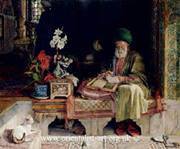
Disguised as a Persian dervish, Sir Richard Burton (1821-1890) set out to become the first Christian to penetrate the Muslim shrines of Medina and Mecca - a reckless stunt that would have resulted in his being executed if discovered. Endlessly observant, amused, boastful and engaging, Burton here describes his time in Cairo (including a memorable drinking contest with a ferocious Albanian mercenary captain), his crossing of the Red Sea in a crazily overloaded pilgrim boat and his arrival in the fabled Nejd. "Great Journeys" allows readers to travel both around the planet and back through the centuries - but also back into ideas and worlds frightening, ruthless and cruel in different ways from our own. Few reading experiences can begin to match that of engaging with writers who saw astounding great civilisations, walls of ice, violent and implacable jungles, deserts and mountains, multitudes of birds and flowers new to science. Reading these books is to see the world afresh, to rediscover a time when many cultures were quite strange to each other, where legends and stories were treated as facts and in which so much was still to be discovered.
Captain Sir Richard Francis Burton KCMG FRGS was a British geographer, explorer, translator, writer, soldier, orientalist, cartographer, ethnologist, spy, linguist, poet, fencer and diplomat. He was known for his travels and explorations within Asia, Africa and the Americas as well as his extraordinary knowledge of languages and cultures. According to one count, he spoke 29 European, Asian, and African languages.
Burton's best-known achievements include travelling in disguise to Mecca, an unexpurgated translation of One Thousand and One Nights (also commonly called The Arabian Nights in English after Andrew Lang's adaptation), bringing the Kama Sutra to publication in English, and journeying with John Hanning Speke as the first Europeans led by Africa's greatest explorer guide, Sidi Mubarak Bombay, utilizing route information by Indian and Omani merchants who traded in the region, to visit the Great Lakes of Africa in search of the source of the Nile. Burton extensively criticized colonial policies (to the detriment of his career) in his works and letters. He was a prolific and erudite author and wrote numerous books and scholarly articles about subjects including human behaviour, travel, falconry, fencing, sexual practices, and ethnography. A unique feature of his books is the copious footnotes and appendices containing remarkable observations and unexpurgated information.
He was a captain in the army of the East India Company serving in India (and later, briefly, in the Crimean War). Following this he was engaged by the Royal Geographical Society to explore the east coast of Africa and led an expedition guided by the locals and was the first European to see Lake Tanganyika. In later life he served as British consul in Fernando Po, Santos, Damascus and, finally, Trieste. He was a Fellow of the Royal Geographical Society and was awarded a knighthood (KCMG) in 1886.
An interesting little book but only an excerpt from a pilgrimage made by Sir Richard Burton an Englishman who disguised himself as a Persian on a pilgrimage to Mecca in the 1850s.
The prose is very descriptive. He travels from Egypt across the Red Sea. He describes his companions, an Albanian cutthroat and the precautions he takes not to be discovered. However, the book ends with his arrival at the first Holy site Al-Madinah the second holiest city in Islam located in Saudi Arabia.
"and this is the Arab's Kayf. The savouring of animal existence; the passive enjoyment of mere sense; the pleasant languor, the dreamy tranquility, the airy castle building, which in Asia stand in lieu of the vigourous, intensive, passionate life of europe. It is the result of a lively impressible, excitable nature and exquisite sensibility of nerve; it argues a facility for voluptuousness unknown in northern regions, where happiness is placed in the exertion of mental and physical powers...in the east, man wants but rest and shade....he is perfectly happy , smoking a pipe, or sipping a cup of coffee or drinking a glass of sherbet, but above all things deranging body and mind as little as possible, the troubles of conversations, the displeasures of memory and the vanity of thought beign the most unpleasant interruptions to his Kayf..."
I was really interested to find out how Burton managed to make it to Medina and Mecca but was left disappointed when the book ended right when he set sight of Medina. There was no description of the place which is what I was expecting. Also, some of his descriptions are a little lengthy and the constant flipping to the endnotes did bother me a little. The book should have been epic given the premise but it fell short to me unfortunately.
This is my first reading of a Sir RFB book, and I found the writing style quite wordy and complex. I seldom have an issue with over-description - more the better usually, but this felt - complex - maybe that isn't the right word.
Notwithstanding the writing style, the concept of this book is great - disguising oneself as a pilgrim and travelling into lands which bar entry on religious grounds.
The problem I have with this book (to clarify, this book is To the Holy Shrines a part of the Penguin Great journeys series, which is a series of excerpts from the book Personal Narrative of a Pilgrimage to Al-Madinah and Meccah published in 1855) is that the suggestion is we will learn of the journey to, and the earn a description of, the holy shrines (which would be Al-Madinah and Meccah). Unfortunately, not the case. The book ends on arrival at the first of the holy shrines, and we receive not a paragraph of description.
Again, let me be clear that this is a criticism of the selection of excerpts, not the original book, which I have not read, but would like to at some point.
There is a certain amount of amusement in the time spent in Egypt, and the events of the journey to Al-Madinah, but not enough for the disappointment of the final chapter.
In which the daring Sir Richard dons the robes of a Muslim pilgrim in order the join the haj and gain a sight of the shrines of Mecca and Medina. He was clearly quite a lad, mentioning his ability to get by firstly as a Persian and then an Indian traveller, and quite undaunted by the necessity to sojourn for long weeks in the dens of Cairo as he fell into character, and then the subsequent hazards of a journey across the Red Sea and into the Arabian interior.
This is all told in Boys' Own adventure style prose. It occasionally hits some rhapsodic heights, with descriptions of evening time in Cairo and the glimpse we get of his entry into Medina. But most of the account is taken up with stories of the buffoon-like behaviour of the fellows that he acquaints, few of whom have any of the merits one would associate with a gentleman and an Englishman. But the text is one of the ways that the folks back home learnt about what was going on in the bigger world. They could hardly have challenged in their prejudice that its was sorely in need of being made civilised.
It was good, but I probably would have fancied reading the unabridged version. Regardless, will buy this series where I find it for their delightful graphic design
Interesting but a little difficult to read partially because of the typically florid early 19th century style; also, the spellings of many words are much different than how we spell them today. For example: Bedouin is spelled “Badawin.” Each chapter has footnotes with the explanations at the back of the book. I found myself making use of them quite regularly – which unfortunately disturbs the flow of the narrative, a little bit. It does certainly provide a different view of the way that part of the world was, back then. Since this - like all the volumes in this series - is not a complete account of his journey to Mecca, it does leave the reader wanting a bit more, leaving him as it does in Al-Madinah. That being said, I’m not sure if I would be up to reading his entire account, even given my interest in early travel writings like this.
This entire review has been hidden because of spoilers.
One of the best and most widely travelled persons of the 19th century. His writing here is engaging and fun, and always with an observant and open-hearted eye for the cultures he experienced first hand.
I've had a near lifelong interest in Richard Francis Burton, but have read very little of his work. This was a good way to start back up again and remedy this. Highly recommended for anyone who likes to read travel writings from the past.
I liked this very interesting edited version of the travels of Richard Burton through Islamic countries during Victorian times. He was a very interesting and intelligent man and I would read other works by him.
Great writing, but dated now. Jarringly condescending attitudes to other nationalities and races. Despite that, I was very impressed by Burton's courage and resourcefulness.
Using a sample of extracts from Personal Narrative Of A Pilgrimage To Al-Madinah And Mecca by Richard Burton (no, not that Richard Burton, the Victorian explorer, spy and sexologist Sir Richard Francis Burton), To The Holy Shrines chronicles the author's time in Egypt in which he dons the robe of a Muslim pilgrim.
An OK read but, whether it was the style of writing (imagine a wordy Boy's Own prose) OR that I was expecting more of an adventure involving a journey to the Holy Shrines (instead of which I got more of an account of the buffoonish behaviour of the characters the author encountered) OR that it was merely an extract from a much longer book, the ending of this, the shorter version, rather uninspiring, alas, one that didn't particularly appeal to my taste.
Walaupun tak sukakan buku ini, ada satu perkara yang saya pelajari iaitu asal-usul nama 'Trafalgar'.
"Then came Trafalgar: would that Nelson had known the meaning of that name! it would have fixed a smile upon his dying lips!" so says the Rider through the Nubian Desert, giving us in a foot note the curious information that 'Trafalgar' is an Arabic word, which means the 'Cape of Laurels.' Trafalgar is nothing but a corruption of Tarf al-Gharb - the side or skirt of the West; it being the most occidental point then reached by Arab conquest.
Petikan di atas ini merujuk kepada Perang Trafalgar (Battle of Trafalgar) di antara British dan negara-negara bersekutu Perancis dan Sepanyol di Tanjung Trafalgar (Cape of Trafalgar), Sepanyol pada tahun 1805. Nama Tanjung Trafalgar diberi oleh orang-orang Arab apabila tempat ini berjaya ditawan; sebagai mercu kejayaan kemasukan Islam di Eropah Barat.
Pihak British menang di dalam Perang Trafalgar tersebut. Komander Horatio Nelson seterusnya mengabadikan pula nama ini di Trafalgar Square, London.
So far without a doubt my least favorite out of the "Great Journeys" series. 1,5 Stars. The writing style wasn't for me. It was very descriptive and lengthy which made it quite boring in my opinion. All the foot notes turned out to be pretty annoying too.
There also isn't much of a journey going on. We spend a lot of time in Egypt (pages 1-54), reading about his travel companions (pages 55-63), followed by a description of the boat and its passengers (pages 64-72), travel by ship (pages 73-75, arrival in Yambu (pages 74-80), description of an Arab Shaykh's traveling gown (pages 81-84). Followed by a giant gap in the story and than two pages of prayers and a view of the Holy City. Notes (pages 88-106) The End. Very disappointing and nothing in this excerpt makes me want to pick up the original text.
Burton casts his cynical glance over everything during his journey to Madinah and shows he has a wonderful eye for detail. The encounter with the Albanian bashi-bazouk stands out as the highlight of this short excerpt.