Jump to ratings and reviews
Rate this book

Lydia Cassatt Reading the Morning Paper

Rate this book
This richly imagined fiction entices us into the world of Mary Cassatt’s early Impressionist paintings. The story is told by Mary’s sister Lydia, as she poses for five of her sister’s most unusual paintings, which are reproduced in, and form the focal point of each chapter. Ill with Bright’s disease and conscious of her approaching death, Lydia contemplates her world with courageous openness, and asks important questions about love and art’s capacity to remember.

164 pages, Paperback

First published January 1, 2001

26 people are currently reading
3135 people want to read

About the author

Harriet Scott Chessman

8 books54 followers
Harriet Scott Chessman's acclaimed novels include The Beauty of Ordinary Things, Lydia Cassatt Reading the Morning Paper, Someone Not Really Her Mother, The Lost Sketchbook of Edgar Degas and Ohio Angels. Her fiction has been translated into eight languages, and featured in The New York Times, The San Francisco Chronicle, NPR’s All Things Considered, and Good Morning America.

She has also created the librettos for two operas, "My Lai" and "Sycorax."

Ratings & Reviews

What do you think?
Rate this book

Friends & Following

Create a free account to discover what your friends think of this book!

Community Reviews

5 stars
532 (23%)
4 stars
854 (38%)
3 stars
648 (28%)
2 stars
155 (6%)
1 star
52 (2%)
Displaying 1 - 30 of 262 reviews
Profile Image for Carol, She's so Novel ꧁꧂ .
966 reviews841 followers
December 15, 2021
4.5★

This is a lovely, gentle story about the relationship between sisters - in this case renowned Impressionist painter Mary (May) Cassatt & her ailing sister Lydia. They are with their parents in France - Lydia is slowly dying from Bright's Disease (now called nephritis) and May is in denial about her sister's impending demise. Instead she paints a series of five paintings, from one of my my favourite Cassatt works Woman Reading;


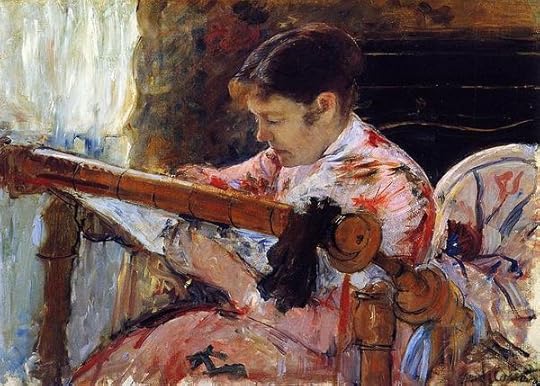
to the more intense Lydia at a Tapestry Frame;


I don't think I am projecting - you can see the pain in the set of Lydia's mouth in the latter painting.

This book also touched on other relationship's in the family and on May's close friendship with Edgar Degas.

This is a book that rewards a patient reader. My only quibble was the use of French phrases - but changed to English, even though the Cassatts were still speaking French together. A very minor quibble in a book to treasure - not the least because there are five quality plates of the "Lydia paintings."


https://wordpress.com/view/carolshess...
Profile Image for Annette.
963 reviews614 followers
March 30, 2022
Paris, 1878: Lydia Cassat is ill, dying of Bright’s disease. Thus, she has lots of time to think. At the same time, her sister, Mary Cassat, asks her to pose for another painting. While Lydia poses, again she has a lot of time to reminiscent about life. Her thoughts drift a lot to some places in the US. Even when they walk the Parisian streets up to Mary’s studio, Lydia drifts with her thoughts, intertwining the Parisian streets with the places in the US, and because of that the story feels very scattered.

It is a small book, only 162 pages long, the goal should be to pull a reader into this story from page 1. But on page 38 (end of chapter 1), the story continues to be all over the place.

With the presence of Degas in Chapter 2 the story gains the much needed guidance.

The premise of the story is very interesting, centered around five of Mary’s paintings of Lydia. However, the story doesn’t have a good flow. It is pretty choppy most of the time. I couldn’t get into this story.

P.S. Highly recommend a novel about Mary Cassatt: I Always Loved You by Robin Oliveira.
Profile Image for SarahC.
277 reviews27 followers
July 23, 2012
This is a beautiful and stirring novel and will likely be my favorite read of the summer.

"When Edgar visits, in the late morning, he looks hot and winded. As I break my pose [she was modeling for her sister Mary's painting], I can see his damp shirt beneath his summer coat. I feel a kind of humming inside me."

How can I not love this novel when I see that this author knows about that humming inside us all? This isn't a sexual scene at all, but sensuous instead. The man described isn't her lover, but rather her friend-- and there's an attraction deeper than even the humming.

This book is an example that it's not sexual detail that I need in a novel, but rather something that says "I understand how humans feel sometimes."

This fictional account is a story of the famous Mary Cassatt's sister Lydia, who posed for some of the glorious paintings created by Mary. Lydia's story centers around her terminal illness, but it isn't a story of a young woman dying. It is the story of a young woman living. I rarely read anything like it, and it is certainly a fine work that celebrates women's lives and their inner passion.
Profile Image for Negin.
779 reviews147 followers
April 26, 2020
The concept of this book appealed to me and I was so looking forward to reading it. I love Mary Cassatt’s art, impressionism, and reading about Paris during those years – with Degas, Renoir, and so on. This ended up being a monotonous read and I couldn’t get into it. The paintings in the book were pretty, but the story was missing something. It was boring.
Profile Image for Mela.
2,021 reviews269 followers
November 14, 2022
In "Sainsbury's Magazine" was written: "Tenderly written... a moving yet unsentimental account of the contrast between life's frailty and art's immortality, as well as a sensitive exploration of the bond between sisters". It was exactly so.

This book was beautiful and gripping at the heart. I feel that I can't describe it as it deserved.

There wasn't much plot or action. It was more like a diary or rather a record of flowing thoughts.

Characters of the book were real persons who lived in the second part of the XIX century, such as Mary Cassatt (an American painter, impressionist), her sister Lydia (a narrator of the book), Edgar Degas (a French artist). There was also a few times about May Alcott (sister of Louisa May Alcott). Though it isn't a typical novel you will learn a little about those times, those people, their lives, and dreams. Like if you peered behind the curtain. What you will see there is... really moving.

A deep relationship between two sisters, when one is very sick and both know that she soon or later will die. For both of them, it was a hard and painful truth. Lyddy was reviewing some points of her life. She asked herself what is love. She was trying to take what life remained for her. But it wasn't easy. How can one submit to the thought that one will never have what one longs for, that one's loved ones will live when one goes?

There is also about art, about what it is for people who are making it and for those who are seeing it, who are admiring it. About that art can bring sometimes a consolation.

When I think about this book I feel... How could I explain it? It is one of these books (at least for me) which could help when I will be in a similar situation as Lyddy. And the truth is that we all will be sooner or later. And Lyddy asked a few questions which forced me to stop and think about some aspects of life and emotions.

My quotes are too long. I have cited here only one. I wish it will show that this book isn't pessimistic after all.

Sometimes one can have a glimpse of the future, and, frightening as it is, it can have in it an element of consolation. Terrible, to imagine a world continuing beyond my own dissolving; yet what if I am a presence for May, and for others too, leaving a trace, like the swath of white light on the top of this embroidery frame? Maybe I should not be so afraid of vanishing, after all.

For this thought and for Lyddy's letter to her sister I will love this book forever.
Profile Image for Jaylia3.
752 reviews151 followers
May 13, 2014
This poignant little novel centered around Mary Cassatt’s life in 1880’s Paris covers much of the same ground as another book I read recently--I always Loved You by Robin Oliveira, a work of fiction which speculates about Cassatt’s relationship with Edgar Degas. Degas, the Cassatt family, and the Paris art scene are brought back to life in this book too, but here the story is told from the point of view of Mary’s beloved but terminally ill sister Lydia, who served as a model in some of Cassatt’s most beautiful paintings. Each of the five chapters uses one of the paintings Mary did of Lydia as its jumping off point, and (thank you publisher!) lovely color plates of the paintings are interspersed in the text.

As a narrator Lydia has wit, longings, and a probing intellect, but because of her illness she leads a circumscribed life very unlike her ambitious younger sister. She muses about the artistic process and her role in it, she’s fascinated by and drawn to Mary’s interpretations of her modeling poses, and when strong enough she takes readers with her around the sunny streets of Paris to rub elbows with the likes of Degas, Renoir, and Caillebotte. While Lydia Cassatt Reading the Morning Paper is a short novel it’s not slight. Ambitious themes are explored, including life, death, family love, driving passion, the place of art, and the possibility of immortality.
Profile Image for Maria Thomarey.
581 reviews68 followers
August 9, 2017
Readathon2017 23/26: ενα βιβλίο με εφτά λέξεις στον τίτλο
Ένα πολυ ενδιαφέρον βιβλιο . Το ειχε εκδόσει η Άγρα πριν καμια εικοσαριά θα χρονια . Τωρα μαλλον θα ειναι εξαντλημένο . Η ιστορια του βιβλίου στηρίζεται σε υπαρκτά -αν και νεκρά πλέον -πρόσωπα . Ειναι ενα μυθιστόρημα ιστορίας της τέχνης . Αλλα και μια πορεία προς το θάνατο . Προς το θάνατο αλλα ο προς τη λήθη .
Profile Image for Elizabeth (Alaska).
1,573 reviews554 followers
March 8, 2018
Physically, this is a lovely book. Each of five paintings that make up the five chapters are presented with a glossy photograph. As I was not in the least familiar with the artist Mary Cassatt, these photographs were indispensable. The pages are deckle-edged. I admit to not being a fan of deckle-edged editions because I find the pages hard to turn; but it makes a nice presentation and in this case I think is fitting.

Lydia Cassatt is the first person narrator and the model for each of the five paintings. She is also suffering from Bright's Disease, which is incurable. She knows she is dying and very much sooner than she and her sister would hope. She tires easily. One would not think that holding still for an hour or more at a time and for several hours in a day would be tiring. I think I could not do it and I am relatively healthy. And so, each sitting is precious.

I have quibbles with the writing. The novel takes place entirely in France, four of the five chapters in Paris. Chessman chose to sprinkle the text with French phrases. I saw no reason for this. It didn't seem quite right that these American sisters would sprinkle their conversations with French. My 50+- year ago high school French was enough to get most of it, but it was that it wasn't enough to get all of it that was annoying. The other thing that I missed understanding entirely is that some paragraphs were in italics. Were these excerpted from letters? They didn't seem any different to me than other paragraphs where Lydia Cassatt was thinking about the present, and in some cases, were memories. If it had all been memories in italics, that might have made sense, but they weren't.

Still, Chessman does well in creating the sadness of an impending death. She presents the close relationship of the sisters. Lydia Cassatt was just 45 years old when she died. What would it be like to know your time is so short? Can you look around you and see what life would be like after you're gone?

I have said before I know nothing about art and artists. What I liked especially about this was the creation of the paintings, their settings, how they came to be. It was the interaction between artist and her model that was, for me, the real story. That they were sisters and had a relationship beyond painting was also of interest. While I wouldn't want my reading days filled with the subject, I will look again for more of this type of fiction.
Profile Image for Kirsty.
2,794 reviews190 followers
April 2, 2023
I love novels about real-life art and artists, and thus Lydia Cassatt Reading the Morning Paper sounded utterly fantastic to me. Scott Chessman has plotted her story very carefully around that of the Cassatt sisters, and Mary's output of paintings. Lydia's voice is quiet yet authentic, and filled with such moments of beauty: 'I'm in love with all of this, this bright and foreign life', for instance. The imagery throughout is dreamily poetic.

I love the way in which Scott Chessman arranged the entire novel around five of Mary's paintings, and that these were produced in colour in each of the chapters. Lydia's illness, too, has been well captured, and is sensitively handled. The time period is detailed, and has clearly been very well researched. There is also an awful lot of depth to the novel. Lydia Cassatt Reading the Morning Paper is a thoroughly enjoyable and thought-provoking read, and I cannot wait to get my hands on the author's other work.
Profile Image for Laura.
7,133 reviews607 followers
October 8, 2017
A gift from TA, thank you so much dear friend!!

In this book, the author describes the world of Mary Cassatt's early impressionist paintings.

The narrator is Mary Cassatt's sister Lydia, as she poses for five of her sister's most unusual paintings:

1. Women Reading, Joslyn Art Museum. Omaha, Nebraska (cover of this book);

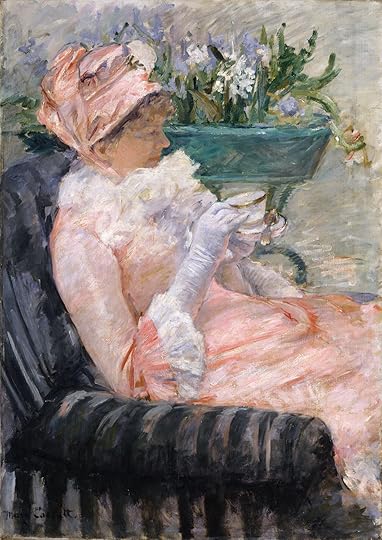
2. The Cup of Tea, The Metropolitan Museum of Art;

3. Lydia Crocheting in the Garden, The Metropolitan Museum of Art;

4. Woman and Child Driving, Philadelphia Museum of Art;

5. Lydia at a Tapestry Frame, Collection of the Flint Institute of Arts.


Lydia also describes their friendship with Edgar Degas and Berthe Morisot as well.

A little gem of literature, to not be missed for all fans of art fiction genre.
Author 8 books9 followers
Read
April 14, 2009
This is a lovely, meditative book written from the point of view of Mary Cassat's dying sister Lydia as she poses for several paintings over some years. It's quiet, but I found it quietly compelling. Does art make one immortal? Is that any consolation for death? The book also looks at Mary Cassat's unorthodox romantic relationship with Edgar Degas, and the choices she makes in order to remain an artist and a relatively independant woman. Finally, the relationship between the sisters is moving, one not examined enough in literature. Oh--and the paintings are reproduced in color in the book, which is lots of fun. I kept looking back at them again and again as I read, and seeing more because of the writing. Very cool.
Profile Image for Jane.
1,682 reviews238 followers
May 2, 2016
A perfectly exquisite little book: a novella of five chapters on five portraits of Lydia Cassatt, painted by her sister, the American impressionist, Mary Cassatt. Each consisted of Lydia's meditations on life, illness [Lydia suffered from Bright's Disease], death, and art; her thoughts and memories, interspersed with her descriptions of the modeling sessions for her sister. Also, Lydia attempts an interpretation of each of these five portraits: "Woman reading"; "Tea"; "The Garden"; "Driving"; "Lydia seated at her embroidery frame." Written in delicate, flowing prose in a stream-of-consciousness style, this opened for me the world of the Cassatt sisters, their family, and the Parisian art world of the 1880s. An added bonus was a color plate of each portrait.
Profile Image for Kelsey.
240 reviews31 followers
December 13, 2017
This has to be one of the most beautiful things I have ever read. Though it's a novella, it reads almost like poetry, with lines so detailed and imaginary, that I felt too it was summer, summer in Paris, and I had all day to do nothing. To sit and sew. To paint. To walk. To read.

I'm in such awe of this little book, that sadly, I don't have much else to say. There is nothing to say, and yet, I feel as though I could write fifty pages about it, and Chessman's use of language, imagery, feeling.

The short and short of it is, I highly recommend this to people who love poetic-like works, to people who want something light and airy, to people who appreciate art, all kinds.
Profile Image for Karyn.
231 reviews19 followers
August 26, 2025
I purchased this book, because it had beautiful Artsy cover and the title intrigued me.

Set in late 19th-century Paris, it offers glimpses into the art world of that era.

Based on the relationship between the American impressionist's painter Mary Cassatt and her sister, Lydia. It is a short quick read with few of the paintings done by Mary reproduced in the book.

This writing is like a reflection of life as Lydia views it, with her sister, and the people around her. It shows the bond between the sisters as they are growing up. The memories they have shared travelling around.

Although Lydia struggles with her illness, she is Mary’s (May) favorite model. May directs Lydia in various poses, in her studio and outside in the open. She tells her what to wear, what will look good on her etc. Lydia observes her sisters' sketches and paintings with deep thoughts. Her mother and sister, take utmost care of Lydia that she never faces any trouble while posing.

May has a close friend Degas, who often visits them to watch her painting. He is critical in his views. Lydia observes the intimacy between May and Degas when they are together but does not really say anything. Keeping her thoughts to herself.

The book feels like someone’s memory. They are aware of their short life, their wishes, and regrets.
The writing is very poetic and like a diary. Nothing rushed.
If you love art, then you can pick it up for all the descriptions and reproductions in it.


Profile Image for Debbie Robson.
Author 13 books179 followers
December 12, 2023
Lydia Cassatt Reading the Morning Paper by Harriet Scott Chessman is a gentle, reflective novel that would not suit every reader. Chessman has cleverly taken five paintings by the American Impressionist painter Mary Cassatt of her sister Lydia and weaved a story around these paintings, told from the point of view of Lydia. As she states in her introduction, “I have attempted to be as accurate as possible about the Cassatts’ lives yet this is definitely a work of fiction.”
I loved reading about the creation of a painting and then checking the painting reproduced in the book. We find out briefly that Lydia lost a young man she was keen on – killed presumably in the Civil War. We also find out what she thought of Edgar Degas, how she enjoys sitting for her sister and her worries about her sister after her own impending death. Highly recommended for those looking for a slower paced but beautifully written novel.
Profile Image for Melanie.
397 reviews38 followers
March 31, 2009
Mary Cassatt is one of my guiding angels. Her paintings of women writing letters, drinking tea, reading, and doing needlework illuminate a life I often imagine for myself - a life surrounded by quiet beauty and the leisure to appreciate it.

Harriet Scott Chessman, the author of Lydia Cassatt Reading the Morning Papers, has gone beyond the escapist dream by bringing the reader into the life of Lydia Cassatt, the frail older sister who posed for many of Mary Cassatt's best-known paintings. "I have thought, imagined, and dreamt my way into her world," says the author. The narrative wanders as Lydia poses, musing as she holds up a teacup for hours or reads a newspaper. Lydia remembers the young man she once loved, the images she saw through her dead brother's telescope, the great artists she has known (Degas, Pissarro, Renoir), and her mother's sense of betrayal when Mary sells portraits of family members.

"Who is going to care about such pictures as much as Mary's own family?" asks Mother Cassatt. Lydia understands the core of Mary's art - how she works for hours to capture the image, gesture, and illumination of one moment, how beloved and iconic these paintings will become.

Lydia does not always understand what Mary sees, and especially not what Mary see is her, but she cherishes the gift that her sister has given her by using her image as the public face of Mary's genius.

Mary Cassatt creates the five paintings that comprise the narrative after Lydia is diagnosed with Bright's disease, inevitably fatal in the nineteenth century. Lydia's disease, her helplessness and agony, often delays the progression of the paintings. It does not affect the bond between Lydia and her sister, whose love and care seem to bathe Lydia's suffering in the rosy, caressing light in the portraits. Even Degas, whose brusque and sarcastic manner often upsets Mary, seems to become a more caring, softer presence as Lydia's life ebbs.

Chessman portrays the details of Lydia's disease and decline in prose quite blunt. One does not have to imagine the pain or embarassment of these symptoms; the prose leaves little room for imagination. However, Lydia is neither diminished by her disease nor severed from her essence. She retains the ability to observe, analyze, and understand her sister's vision and her own joy to have been a part of Mary's art.

At the end of her life, Lydia's deepest imaginings buoy her: "To live in that world you made... that creamy world of no difficulty, no blood... a life like a shell curling in on itself, glistening and clean on the sand, rolled in salt water, rolled and rolled, spent and spending." This book allows the reader to bask in both worlds - the world illumined by the magic captor of light, and the world in which we observe the mundane details behind the illusion.

Chessman has written a seamless and welcome glimpse of these worlds. Don't miss it.
Profile Image for Patty.
2,693 reviews118 followers
November 30, 2009
One of the problems with purchasing fiction for a public library is reading all the reviews. Usually after I have done an order with about 50 titles I want to read at least 20 of those books. I am an omnivore - there are few areas of fiction that I won't try. So my to-read list could be seriously large.

However, my solution is to try to forget all those new titles and concentrate on those that made it to my reading list. I always hope that if a book is really good, it will come to my attention again.

This is one of those books. I am so glad it found me at last. Lydia Cassatt was the painter's, Mary Cassatt, sister. Apparently Lydia posed for her sister five times. Chessman takes these five paintings and, as she says "thought imagined and dreamt her way" into Lydia's world. This is a magnificent book. Chessman made me feel like I was there in Paris in the 1880's, like I had the privilege of speaking with Lydia or reading her diary.

This was a quiet little book, really special. I would highly recommend this to readers of Chevalier or Vreeland.
Profile Image for Tara.
Author 24 books618 followers
January 4, 2009
I find many books these days start off with great first chapters that have obviously been workshopped/edited to death, then the rest of the book never quite measures up. This is one book I found that started off slowly and roughly (it's a bit fragmented and the author seems to be trying to get in all the facts she researches), but the story slowly builds and the characters come to life and Chessman's views on life, mortality, illness, love, and art are delivered in simple but compelling prose. You'll never look at Cassatt's and Degas' paintings in the same way again.
Profile Image for CLM.
2,902 reviews204 followers
April 4, 2008
Nicely packaged but I would have enjoyed it more if a bit more substantial. It felt somewhat written for museum gift shops.
Profile Image for Ourania Topa.
172 reviews46 followers
September 5, 2020
Γραμμένο με γνώση και ευαισθησία, το μικρό αυτό βιβλίο αφορά τη ζωή των αμερικανίδων αδελφών CASSATT στο Παρίσι περί τα 1880. Η MARY CASSATT, ορκισμένη εργένισσα, ζωγράφος, αποφασισμένη να σταθεί με το σπαθί της στα πόδια της εντός του κύκλου των γάλλων ιμπρεσσιονιστών, αντιπροσωπεύει τη ΝΕΑ ΓΥΝΑΙΚΑ της ΜΟΝΤΕΡΝΑΣ ΕΠΟΧΗΣ. Η μεγαλύτερη αδελφή της, LYDIA, φτιαγμένη για οικογενειακή και ήσυχη ζωή στην εξοχή, κουβαλά ένα τραυματικό αισθηματικό παρελθόν (ο αγαπημένος της σκοτώθηκε στον αμερ��κάνικο πόλεμο) και αντιμετωπίζει ένα νοσηρότατο μέλλον (πάσχει από τη νόσο του Bright). Αυτή είναι τόσο η αφηγήτρια όσο και το μοντέλο των 5 πινάκων της αδελφής της, γύρω από τους οποίους οργανώνεται το κείμενο: η προγενέστερη ζωή της οικογένειας Cassatt στην Αμερική, η φιλία της Mary με τον Degas, οι περιστάσεις που στάθηκαν πηγή έμπνευσης για τα 5 εικαστικά και πώς αυτά ολοκληρώθηκαν, αλλά - κυρίως - τα συναισθήματα και οι στοχασμοί ενός ανθρώπου που νιώθει να φεύγει από τη ζωή χωρίς να αφήνει πίσω το σημάδι του. Άραγε αρκεί το γεγονός ότι εμπνέει την αδελφή της κα�� ποζάρει -με τόσο πόνο και κόπο- γι' αυτήν, να την κάνει να αισθανθεί πως κάτι άξιζε η φευγαλέα της παρουσία σε τούτον τον κόσμο;
3, 5 αστεράκια ευχαρίστως!

Υ.Γ. Διάβασα την ελληνική μετάφραση της Παλμύρας Ισμυρίδου (εκδ. Άγρα)
Profile Image for Pollapollina Books.
736 reviews68 followers
November 8, 2020
Con le immagini di cinque quadri della pittrice americana impressionista Mary Cassatt, l'autrice ci racconta una storia, narrata in prima persona dalla sorella dell'artista. Una storia di colori e pennellate nella Parigi di fine Ottocento, di ricordi di famiglia, di personaggi realmente esistiti, ma romanzati nei dialoghi e nei pensieri. Un libro ben costruito, lieve e profondo insieme, che racconta di amore, rimpianto, memoria e senso della vita, col profumo dei fiori a macchie di colori come sfondo.
Profile Image for Margaret.
229 reviews27 followers
January 28, 2018
This is a lovely little story, really a meditation on life and what it means to be alive... while dying. I "read" it as an audiobook and expect I'll read it again one day, with the referenced paintings in front of me. (I believe they are printed in the book.) It made me appreciate Mary Cassatt's paintings more than I had.
Profile Image for Ivan.
801 reviews15 followers
May 9, 2025
Really very lovely. I enjoyed being with these sisters as imagined by Chessman. The prose is evocative. "...how I wish to live, to enter the arbor, to swim into the kiss, to break my pose and walk into my own life." Superb.
Profile Image for Holli.
336 reviews28 followers
July 28, 2009
A lovely, meditative book about the relationship between Mary (painter) and Lydia (model) Cassatt. I read the book in one sitting, in the car on the way home from a very active and people-filled vacation with my husband and sons. Reading it was like a mini-retreat, a nice soothing transition back into my work-a-day life. Sort of a "Calgon, take me away" experience. The sister relationship reminded me of Jane and Cassandra Austen, and the references to drinking tea, crocheting, embroidery, flowers, letter writing and other feminine pasttimes and interests was very enjoyable.

The writing is very poetic and descriptive, and Chessman did an excellent job of describing Cassatt's paintings from the point of view of the sister/model--how she sees herself and longs to be the woman May has portrayed:

I see now that May's painting creates a kind of memory. Whether or not anyone ever knew me, she will offer a memory of me, for the world to claim. And I see something else: she pictures me as a woman who has had her wishes fulfilled. The day is luminous, the woman's dress a meadow, as she bends to her creation, on her own, desirous simply of what she already has. I yearn to be like this, to have the grace of such satisfaction p. 157.

Chessman also did a good job of weaving literature into the story. Lydia is an avid reader and the quotes from whatever she is reading at the time add to the meaning and mood of the novel. I love this passage:

. . . within this Cassatt Nation, my own small acre has treasures of books stashed everywhere, in the elbows of trees, beneath berry bushes, on benches by streams. My little house is composed of books: English and French novels, and books of poetry too, gold-edged. I, who am moderate in so much, who bend myself to family life, am most immoderate once I'm in my acre. I read for hours, with passion, ardently wishing the stone wall around me to hold, the little gate to feel the pressure of no hand, the latch to grow rusty. p. 8

I have always admired Mary Cassatt's work and I appreciate knowing more about her. I feel a library program brewing . . . something about Mary Cassatt and Edgar Degas. How ironic that an artist known for her portraits of mothers and children could not have both children and art in her own life. Her world forced her to choose between the two and she chose art.

Probably my favorite thing about this book is that even though it is told from the perspective of a dying woman, the book is about how to live. And how is it that we should live?

I yearn to be simply present in this day, filled for the moment with color and shape, my own hand urging the needle through the silk.
Profile Image for Sarah.
548 reviews34 followers
May 22, 2011
Another "still, small voice"...
What an exquisite, little book! Not only does it perfectly capture the atmosphere of Cassatt's paintings, it resonated with me on a personal level. The narrative is profoundly moving. The prose is fresh, crisp, bright and lovely. I can't wait to read more from this author.

I adore this book so much, I wish I'd written it.
Profile Image for Morning Glory.
513 reviews7 followers
June 29, 2025
Very beautiful, dreamy quality to the story of sisters, art, and sickness. 🩷 so fun to have May Alcott cameos and a lot of French too.
“Sickness holds no place there. All is rose and white and cream, the gorgeous and simple here and now, the shimmering surface of things.” 37
“Maybe it’s this talk of nunneries, but I feel a yearning for some sign-of grace, of a future life that holds more than darkened windows. Why should it be only Catholics who sr such signs, like the girl who had the visions at Lourdes? I would be grateful simply for a dove…” 102
“I’m not asking you to live with no feeling, May,” I begin, and at once I’m aware how my own life must look in her eyes, a desert, parched under a hot sun.” 103
Profile Image for Evelyn.
Author 1 book33 followers
October 27, 2018
This is a little book, but a pretty one. Each of the five chapters is centered around a painting by Mary Cassatt, where her sister Lydia is posing. Within each chapter is a color print of the painting in question. It's an easy read; I finished it in less than a day. I would recommend it to anyone interested in art, especially the impressionists of the late 1800s. Mary Cassatt is American, from the Philadelphia area, I think, but she moves to Paris to gain more fame for her impressionistic art. Some of her favorite subjects are women and children. I've always loved her work, but knew nothing about her. This little book is about the relationship between Lydia and Mary, two loving sisters, and why they complement each other so well. The prose is very lyrical and beautifully written in the first person from Lydia's viewpoint.
Profile Image for Dbvdb.
586 reviews
January 30, 2022
Told from the point of view of Mary Cassat's sister Lydia during the last months of her life - it's really more of a lament than a story. It's a work of fiction and I do question the reliability of what the characters do in the book which always bothers me.

I think this short book could have actually been shorter. In the Goodreads reviews I see that the paper book included prints of the paintings guided the story, so maybe that would have helped to know - nothing was said in the audio version. It was probably an interesting project for the author.

So - it was "okay". I can't strongly recommend it. The audiobook reader was the author which maybe wasn't the best choice in this case.
1,361 reviews7 followers
August 13, 2022
I have been aware of but only marginally interested in, Mary Cassatt’s works. This lovely, small book changes that. I want to know more. The bond between Mary and Lydia is so poignantly described as well as Mary’s commitment to her art. There are nice color plates to accompany each story with in depth discussion of the creation of each painting. The pain of losing a sibling is so strong throughout the whole book, so well rendered. My heart ached.
Profile Image for Jamie.
157 reviews10 followers
January 23, 2020
Easy, fast read. Maybe a bit overly sweet at times—the not uncommon portrayal of the perfection of the dying—but not distractingly so. There are worse crimes in life and literature. And as Lydia reminds May (Mary), “Je suis encore là,” and through her sister’s paintings she remains so still.
Displaying 1 - 30 of 262 reviews

Join the discussion

Can't find what you're looking for?

Get help and learn more about the design.