This book examines the long term economic growth that has raised the West's material living standards to levels undreamed of by counterparts in any previous time or place. The authors argue that this growth has been driven by technological revolutions that have periodically transformed the West's economic, social and political landscape over the last 10,000 years and allowed the West to become, until recently, the world's only dominant technological force.
Unique in the diversity of the analytical techniques used, the book begins with a discussion of the causes and consequences of economic growth and technological change. The authors argue that long term economic growth is largely driven by pervasive technologies now known as General Purpose (GPTs). They establish an alternative to the standard growth models that use an aggregate production function and then introduce the concept of GPTs, complete with a study of how these technologies have transformed the West since the Neolithic Agricultural Revolution. Early modern science is given more importance than in most other treatments anf the 19th century demographic revolution is studied with a combination of formal models of population dynamics and historical analysis.
The authors argue that once sustained growth was established in the West, formal models can shed much light on its subsequent behaviour. They build non-conventional, dynamic, non-stationary equilibrium models of GPT-driven growth that incorporate a range of phenomena that their historical studies show to be important but which are excluded from other GPT models in the interests of analytical tractability. The book concludes with a study of the policy implications that follow from their unique approach.
This book isn’t well-written. Its key ideas are not well-organized. Hundreds of pages could have been omitted with little loss of substance. It indulges in the sort of mathematical sophistry that plagues academic economics.
It does, however, stand as one of the best-available works in advancement of a thesis that I agree with: that technological progress is the single biggest contributing factor to sustained economic growth.
Of particular note is the book’s identification of 24 General-Purpose Technologies (GPTs) that the authors judge to have been most consequential in economic history. A brief survey of them can be found here.
What I find most interesting about this thesis isn’t its provocativeness, but how heavily reliant discussions of it in popular discourse and academic literature are on vague metaphor rather than taut logic in fleshing it out.
As far as I can tell, the belief that technological progress begets economic progress is widely held, but theoretically and empirically precise explanations as to how this is so are basically nonexistent: Talk of disruption suffuses the business press. Schumpeter’s gale of creative destruction is common parlance among policymakers and economists despite being conceptually hand-wavey and ill-defined. The neoclassical school (and this book) accounts for the continuous stream of innovations made possible by new technologies as teleologically peripheral spillovers rather than as part of a phenomenon central to the growth process. The volume at hand also defers to the conception of a Structuralist-Evolutionary paradigm to make sense of technological change, in effect conceding that something is happening but we don’t know what it is.
To the credit of Lipsey et al., they’re very clear in emphasizing the importance of how technical advance expands production possibilities, opening up new frontiers of economic activity that’d be impossible without certain technologies (think long distance travel without airplanes, consumer electronics without electricity, cloud computing without the Internet, etc.). This observation isn’t, however, wed to a convincing empirical schema for explaining growth.
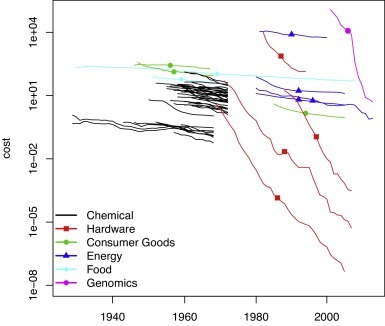
Of particular interest in this regard is the observation that technical advance appears to be associated with falling production costs (something the authors only address tangentially), an ostensible paradox in light of the fact that economic growth entails a rise in the sum of all prices. In terms of developing explanations for how technology contributes to growth, perhaps it behooves us to start with empirical observations first and work backwards toward theory that makes sense of them.
If declining costs truly are an empirical regularity associated with technical progress, how could falling production costs and prices possibly contribute to rising growth?
We might begin to resolve this paradox if we think of technological progress in a manner consistent with Brian Arthur’s notion of combinatorial evolution: technologies don’t sit still in isolation, they combine with other technologies to form new, more complex ones. This dovetails with Lipsey et al.’s account of expanded possibilities as spillovers because economic products in the modern world tend to be highly complex and composed of many intermediate component products (engines in cars, spark plugs in engines, CPUs in smartphones, silicon transistors in CPUs, etc.). Technologies, because they become cheap, become economically viable subcomponents of increasingly complex products.
This is all well and good, but it’s still in the realm of wishy-washy abstraction in terms of explaining an objectively measurable phenomenon like economic growth (to be clear, Arthur’s theory never aspired to). It also highlights the challenge of where to draw conceptual boundaries when theorizing about technology in an economic context, something the authors grapple with by pigeonholing their GPTs as organizations, processes, or products. If one is to truly understand how technology contributes to growth, one needs to establish a causal sequence that points from technology to growth, not merely conceptualize one’s intuitions. Based on the observation of declining costs, I offer the following that’ll take a bit of explanation to fully flesh out:
Technologies improve productivity. Productivity improvements lower unit costs. Lowered unit costs expand production possibilities. Expansion of production is growth.
How do technologies improve productivity and lower unit costs? Principally, by serving as new, labor and resource-saving capital goods (products used to produce other products).
How do lowered unit costs expand production possibilities? Principally, by serving as new, cheap intermediate goods (products used as components in final products) and new, cheap complementary goods (products that must be consumed with other products).
Thinking about technologies in the roles they serve as capital, intermediate, and complementary goods does two useful things: it ameliorates the aforementioned conceptual boundary problem, and it provides an unambiguous basis for empirical scrutiny. It achieves this because capital and intermediate goods are factors of production associated with measurable costs, complements are products associated with unambiguous prices, and factor and complement costs are both components of final output, the metric we’re trying to make sense of when we talk of growth.
So how, exactly, could declining factor and complement costs contribute to an increase in total output? I’m glad you asked, please allow me to explain…
Cost Evolution: From Cost-Prohibitive to Cost-Economic
If I could, I would go on holiday on the Moon.
If I could, I would rid my cells of deleterious gene variants.
If I could, I would play video games on a PC that renders frames at twice the resolution and frame rate of prevailing standards.
Given the current state of science and technology, the products I’d need to make these things happen are technically feasible. Nevertheless, many of them are out of my reach. The reason for this is quite simple: currently, they’re cost-prohibitive for me—they would cost me too much.
And why, exactly, are they cost-prohibitive? Because as of this writing they are very costly to produce.
And what, exactly, dictates how costly it is to produce something? Factor costs, or the costs of the labor, capital, and intermediate products needed to produce a final product.
If you have a look around the environment in which you read these words, one mathematical reality unites practically all of the products you’ll see in it (including the device on which you’re reading): the prices paid by their owners to acquire them were commensurate with the products’ production costs plus markups, and those production costs were equal to the sum of the costs of the factors that were employed in their production. This reality reflects the kind of economic transformation that production ultimately is: that of factors into products (just like multiplication!).
Seeing as how GDP is merely the sum of all prices for all final products in a given period, if for the sake of analytical tractability we assume a closed economy with no taxation, the following equivalence relations hold:
all factor costs = all production (unit) costs = all prices (i.e., output, Y, GDP) - all markups
With a little bit of algebra we can leap to:
all prices (output) = all factor costs + all markups
Another way of putting this is to say that aggregate output is commensurate with the sum of all factor costs (which themselves sum to aggregate production (unit) costs).
Where am I going with this?
Whether or not I’m going to be able to afford to go to the Moon, have my genes altered, or play video games at frame rates that give me an unfair advantage over my opponents ultimately depends on the factor costs associated with producing the relevant products. As a result of the relevant factors being too costly, these products are cost-prohibitive for me. Consequently, I (and many others like me) don’t contribute to demand for them, they aren’t widely produced, and they don’t contribute to growth. By virtue of merely desiring them, however, I do contribute to potential demand for them—demand that would exist if hypothetical products could be produced at costs that are within the realm of affordability to consumers.
It’s worth noting that this notion of potential demand is no mere arbitrary abstraction: if you subscribe to the output = income = final demand identity, then, seeing as how growth of output and income have continued unabated for hundreds of years, if untapped potential demand didn’t exist, growth would, by implication, cease. This cuts to the heart of what economic demand essentially is: the manifestation of human beings satisfying their needs and desires via production. Potential demand, therefore, is the stuff of unsatisfied needs and desires.
What, generally, accounts for absences of economic satisfaction? The cost-prohibitiveness of production. And what, generally, determines whether or not production is cost-prohibitive? The costs of the labor, capital, and intermediate products needed to produce a final product summing to a figure that consumers can afford. If new factors come along which can reduce these costs, this opens the door to the production and sale of new, previously cost-prohibitive products, contributing to growth.
Interestingly, while cost-prohibitive is a term that’s widely used in common parlance, as far as I know a perfectly symmetrical antonym for it doesn’t exist. Cost-effective or cost-efficient, you might chime in, but no, those ain’t gonna cut it for the task at hand.
I Googled “antonym of prohibitive” in hot pursuit of conceptual complementarity and, auspiciously, “economic” was among the terms returned. Pleasingly, I was reminded that economic is used adjectively to describe activities as being profitable or gainful. I say pleasingly because production and products are referred to as cost-prohibitive when their associated costs preclude profitable, gainful outcomes for producers and consumers, and using the term cost-economic to describe the opposite scenario is highly intuitive and totally sounds cool.
We’ve now made two key observations: that technical progress is associated with falling production costs and prices, and that the viability of complex economic activity is largely a function of cost summation. The insight we’ve been working toward based on these observations is that when costs decline, previously cost-prohibitive economic activity is rendered cost-economic. I dub this process cost evolution.
Some examples are illustrative:
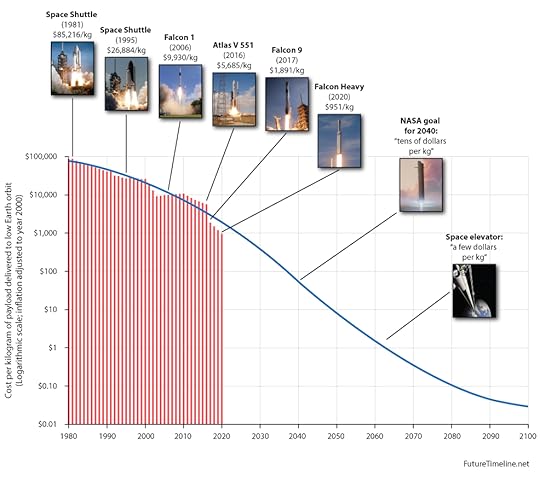
If I want to go to the Moon, I have to physically get there. If some firm is offering lunar vacation packages, their prices will, at a minimum, be equivalent to the cost of producing the vacation package, the sum of factor costs. In this case, some of these factor costs entail getting me off of the surface of Earth and onto the surface of the Moon. If it costs ten million dollars to do so, the package is going to cost me at least ten million dollars. This is cost-prohibitive. If it only costs a few thousand dollars, however, it will become much more cost-economic, leading to increased demand by me and others like me.
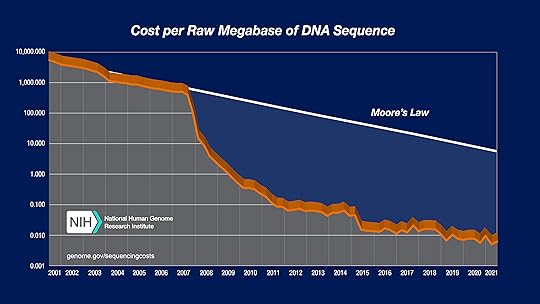
If 23andMe wants to sell kits whereby consumers send them a DNA sample and the company sequences and interprets their genome, part of the cost of such kits are the costs associated with gene sequencing. If it costs tens of millions of dollars to sequence a genome (as it did not long ago), such kits are going to be cost-prohibitive to consumers. If it only costs hundreds of dollars (as it does now), this activity is thereby rendered cost-economic. Consequently, with the advent of cheap personalized genomics, the economics of further spillovers which require use of the technology (like genetic medicine and gene editing) become viable and potential demand begins to be translated, via production, to real demand.
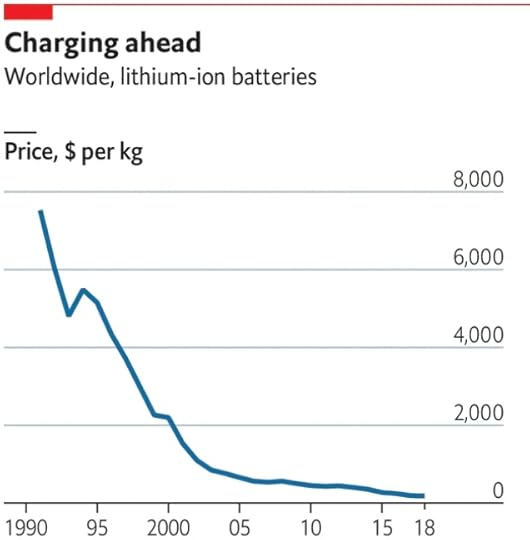
If you want a smartphone, you’re gonna have to bear the cost of the production of its battery. If that production costs $5,000, you’re probably not gonna want the smartphone anymore. If it costs tens or hundreds of dollars, however, you’re in business. The same is true of, say, electric cars: if their batteries cost more than the price of most luxury sedans, this doesn’t bode well for demand for them. With declining costs owed to technical innovation, however, they’re rendered viable substitutes for gas guzzlers.
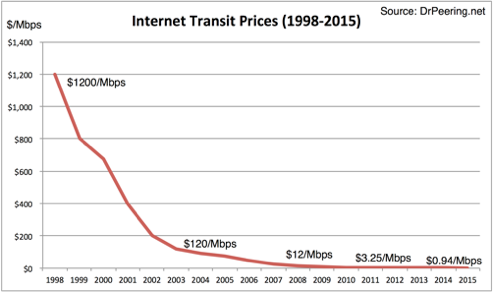
At this point I could easily show a figure depicting dramatic declines in computing costs and then drone on about the far-reaching economic implications of this, but bloody everyone already knows about Moore’s Law, so I’ll resort to an example pertaining to something even more fun: the Internet.
Cloud computing. Video streaming platforms. Media-rich social networking. Your favorite mobile app. The economics of all of these products depend on the existence of low cost, high bandwidth Internet. AWS is unlikely to have had much luck selling web storage and computing resources had bandwidth costs stagnated in the dial-up era. Netflix is unlikely to have had much success selling its subscriptions had the cost of ISP service hefty enough to deliver the bandwidth needed to stream HD video remained higher than the cost of a typical mortgage. With slow, expensive Internet, these products are cost-prohibitive for most consumers. With the advent of blazing fast, cheap Internet, however, they’re rendered cost-economic. Why? Because consumption of these products requires consumption of the Internet, and, consequently, if you can’t afford a certain amount of bandwidth, you can’t afford to do things that require that certain amount of bandwidth.
An important distinction must be made in the Internet’s case: much of its contribution to the economics of other products stems from its role as a complement product, not as a factor of production. Consumers buy Internet access, and they use that access while consuming other products. The same is true of (arguably) the most significant technology in economic history: electricity.
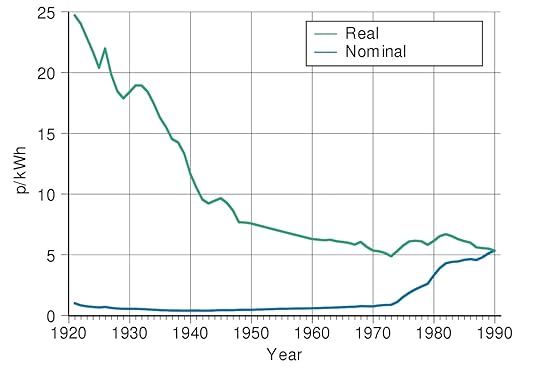
Were it not for an abundance of affordable, standardized, reliable electricity, most production and products in the contemporary world would be rendered cost-prohibitive. For households, staples of modern living like heating and cooling, lighting, refrigeration, appliances, and consumer electronics of all sorts most certainly wouldn’t have reached near-total market penetration had the cost of the electricity needed to use them remained an order of magnitude higher than contemporary rates.
Like the Internet, electricity’s importance as a complement product doesn’t detract from or compete with its importance as a factor of production (demand for it is greater among firms than households, apparently). Rather, it underscores how the economics of many products are dependent upon the economics of other products, illustrating the mind-boggling complexity (which comes from the Latin com- and plectere, meaning woven together) of modern economies as well as the conceptual unruliness of technology.
In conclusion, are we now positioned to make a conjecture as to how, ultimately, technologies contribute to economic growth? Yes: through the cost savings that they yield in their roles as factors of production and complementary goods. These savings render previously cost-prohibitive production and products cost-economic and thereby bridge the gap between demand and potential demand.