

What do you think?

When the Killing's Done
From the bestselling author of The Women comes an action- packed adventure about endangered animals and those who protect them.
Principally set on the wild and sparsely inhabited Channel Islands off the coast of Santa Barbara, T.C. Boyle's powerful new novel combines pulse-pounding adventure with a socially conscious, richly humane tale regarding the dominion we attempt to exert, for better or worse, over the natural world. Alma Boyd Takesue is a National Park Service biologist who is spearheading the efforts to save the island's endangered native creatures from invasive species like rats and feral pigs, which, in her view, must be eliminated. Her antagonist, Dave LaJoy, is a dreadlocked local businessman who, along with his lover, the folksinger Anise Reed, is fiercely opposed to the killing of any species whatsoever and will go to any lengths to subvert the plans of Alma and her colleagues.
Their confrontation plays out in a series of escalating scenes in which these characters violently confront one another, and tempt the awesome destructive power of nature itself. Boyle deepens his story by going back in time to relate the harrowing tale of Alma's grandmother Beverly, who was the sole survivor of a 1946 shipwreck in the channel, as well as the tragic story of Anise's mother, Rita, who in the late 1970s lived and worked on a sheep ranch on Santa Cruz Island. In dramatizing this collision between protectors of the environment and animal rights' activists, Boyle is, in his characteristic fashion, examining one of the essential questions of our Who has the right of possession of the land, the waters, the very lives of all the creatures who share this planet with us? When the Killing's Done will offer no transparent answers, but like The Tortilla Curtain , Boyle's classic take on illegal immigration, it will touch you deeply and put you in a position to decide.
Principally set on the wild and sparsely inhabited Channel Islands off the coast of Santa Barbara, T.C. Boyle's powerful new novel combines pulse-pounding adventure with a socially conscious, richly humane tale regarding the dominion we attempt to exert, for better or worse, over the natural world. Alma Boyd Takesue is a National Park Service biologist who is spearheading the efforts to save the island's endangered native creatures from invasive species like rats and feral pigs, which, in her view, must be eliminated. Her antagonist, Dave LaJoy, is a dreadlocked local businessman who, along with his lover, the folksinger Anise Reed, is fiercely opposed to the killing of any species whatsoever and will go to any lengths to subvert the plans of Alma and her colleagues.
Their confrontation plays out in a series of escalating scenes in which these characters violently confront one another, and tempt the awesome destructive power of nature itself. Boyle deepens his story by going back in time to relate the harrowing tale of Alma's grandmother Beverly, who was the sole survivor of a 1946 shipwreck in the channel, as well as the tragic story of Anise's mother, Rita, who in the late 1970s lived and worked on a sheep ranch on Santa Cruz Island. In dramatizing this collision between protectors of the environment and animal rights' activists, Boyle is, in his characteristic fashion, examining one of the essential questions of our Who has the right of possession of the land, the waters, the very lives of all the creatures who share this planet with us? When the Killing's Done will offer no transparent answers, but like The Tortilla Curtain , Boyle's classic take on illegal immigration, it will touch you deeply and put you in a position to decide.
369 pages, Hardcover
First published February 22, 2011
About the author
T. Coraghessan Boyle
209 books3,123 followersT. Coraghessan Boyle (also known as T.C. Boyle, is a U.S. novelist and short story writer. Since the late 1970s, he has published eighteen novels and twleve collections of short stories. He won the PEN/Faulkner award in 1988 for his third novel, World's End, which recounts 300 years in upstate New York. He is married with three children. Boyle has been a
Professor of English at the University of Southern California since 1978, when he founded the school's undergraduate creative writing program.
He grew up in the small town on the Hudson Valley that he regularly fictionalizes as Peterskill (as in widely anthologized short story Greasy Lake). Boyle changed his middle name when he was 17 and exclusively used Coraghessan for much of his career, but now also goes by T.C. Boyle.
Professor of English at the University of Southern California since 1978, when he founded the school's undergraduate creative writing program.
He grew up in the small town on the Hudson Valley that he regularly fictionalizes as Peterskill (as in widely anthologized short story Greasy Lake). Boyle changed his middle name when he was 17 and exclusively used Coraghessan for much of his career, but now also goes by T.C. Boyle.
Ratings & Reviews
Friends & Following
Create a free account to discover what your friends think of this book!
Community Reviews
Displaying 1 - 30 of 910 reviews

August 14, 2011
The Channel Islands off the California coast, near Ventura, are home to many species of flora and fauna that are either rare or nonexistent elsewhere. Serial invasion by intent or accident having placed many of these species at risk of extinction, the National Park Service wants to restore natural biota to the islands. In order to accomplish this goal, it will be necessary to remove the exotics. In this case that means rats and wild pigs. So what is an ecologist to do? It may be a laudable goal to restore the islands to their natural state, but if the only way of accomplishing this end means having to slaughter hundreds, thousands of unwanted rats and pigs, is that an acceptable cost? Preservation, extermination, invasion, resistance, doing the right thing, defining what that right thing is, appreciating the bio diversity of some of the Channel islands and surviving the depredations of human interactions all feature large in TC Boyle’s latest novel When the Killing’s Done.
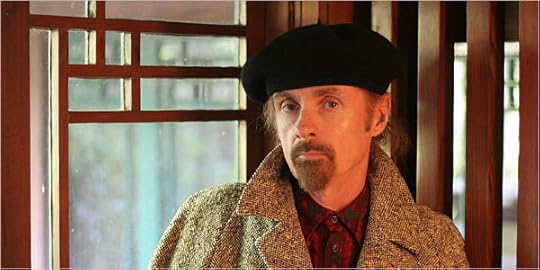
T.C. Boyle - image from NY Times
Alma Boyd Takesue is the NPS official in charge of the project. She is a dedicated ecologist, with a big-picture view and has been making the rounds speaking wherever and whenever she can to explain and promote the NPS program. Her nemesis is Dave LaJoy, wealthy from the success of a chain of stores, and possessed of lots and lots of free time. He believes that the killing of animals, whatever the higher purpose, is wrong. LaJoy dogs Alma at her speaking engagements, and plans more direct actions to see that her island efforts fail. Theirs is the central conflict in the story.
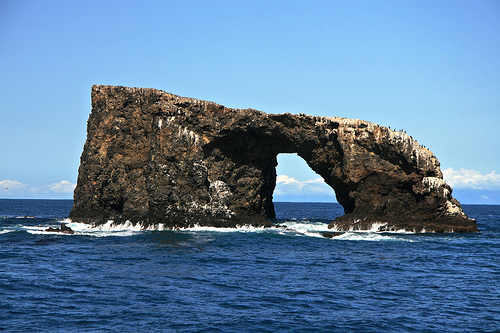
Anacapa
Boyle takes us back in time to see the islands in various stages, with water transportation coming in for rough seas as a way of viewing history. The connection between invasions is nowhere clearer than in the case of the first shipwreck resident Boyle offers. Beverly Boyd drags herself from a potential aqueous end onto Anacapa after her ship is destroyed in a storm. When Boyle gets around to telling of an earlier wreck, one that brought the four-footed, bedraggled invader, Rattus rattus, one cannot but think of Bev. There is also overt mention that some of the greatest damage had been done to native life by species introduced by people, species like sheep and pigs. And there are more shipwrecks to come, but I won't spoil by telling when or how.
Parallel to telling the tale of the islands is the history of two main matrilineal families. We get a significant look at the personal history of the Boyds, from the time when pregnant Bev loses both her husband and brother-in-law in a stormy sea. Next comes her daughter, Katherine, Kat, married to a man her mother does not accept, who has keeping-her-husband-alive troubles of her own. And finally Kat’s daughter, Alma, who keeps the traditional relationship losing streak going. Alongside this we see the somewhat smaller timeline of Rita Reed. An erstwhile musician, she leaves her abusive husband, daughter in tow, to take a job cooking for sheep-farmers on Santa Cruz. As an adult, her daughter, Anise, takes on with the decidedly human-hostile LaJoy. One wonders here if Boyle is trying to rid the place of fathers as well as rats. Are any fathers capable of both raising children and surviving? I am not familiar enough with Boyle’s oeuvre to know if this is thematically persistent in his novels, but it certainly stood out for me here. Although Boyle says that his were good parents, one must wonder if there is something about their relationship that has crept into his view of the durability of marriage. His parents did suffer from substance issues. Maybe that colored his view.
The ironically named Dave LaJoy is a cartoon. I am not certain this was Boyle’s full intent. He does give LaJoy some humanity on occasion. The guy really does have issues with people killing animals. But he is such an over-the-top jerk that it is very difficult to see past his anger management (does not take his Xanax) issues, and general misanthropy to gain much sympathy for his outlook. Attempts to humanize him pall in comparison to the very vivid images presenting him as an arrogant, irresponsible, socially challenged bully. Boyle tries to offer a smaller image of misguided eco-friendlies. A group of uneducated, if well-meaning sorts are shown trying to encourage a baby seal back into the water when it had been out of the water on purpose, trying to get some sun. While Boyle does not overtly take sides in the debate presented, it is pretty clear that he sided with folks who have their science right.
There are swimmers in the water one might hook if trawling for a bit of foreboding. A flying fish that zooms into one boat presages the entrance of the entire sea. A fisherman who had netted a young Great White, when asked where the larger ones reside, says "off the islands." This struck me as the equivalent, in scary movies, of the ingénue insisting on looking in the forbidden room, or the child turning back towards the monster to retrieve her teddy bear. Would you feel comforted were you about to sail into such waters? Dave LaJoy, having suffered some setbacks, flirts with a mysterious blonde just before heading out on a dangerous mission. Could she have been a siren?
Boyle wades a bit into fantasy waters. Anacapa Island is infested with rats. Their voracious, omnivorous appetite has made life particularly difficult for truly native fauna. But are the rats on the island really people who had been changed, a la Circe? A fairy tale offers that suggestion and one might presume that Boyle fishes these waters as a way of giving us second thoughts about the National Park Service plan to remove the species from the island with extreme prejudice. Although not considered candidates for removal, ravens, which are presented in quite dark terms, are offered a bit of humanity.
Will the islands be restored? Will invasive species be removed? Will any fathers survive or stick around to raise their children?
I liked the book. It told an interesting story, and offered a wealth of information that was news to me about the Channels. But I was not blown away. I did not get that tingle one gets on putting a top-notch book down, that you can’t wait to pick it up and see where it is going next. Still, that said, it is a worthwhile read.
I thought the title overstated a bit. There is plenty of killing, to be sure, but killing implies intent and not all the deaths here are intentional, unless, I suppose, one considers nature and/or fate to be killers.
T.C. Boyle was raised in a working class environment in northern Westchester county. He found his way to California, like so many other invasive species, and has settled in quite nicely. It is not known whether he displaced any natives. Given the quality of the work he produces, this seems like an instance in which it is probably best to just leave the newcomer alone.
It would be great if GR allowed half stars, as I would have liked to move this up to 3.5.
PS - Here is a trailer for the book.


T.C. Boyle - image from NY Times
Alma Boyd Takesue is the NPS official in charge of the project. She is a dedicated ecologist, with a big-picture view and has been making the rounds speaking wherever and whenever she can to explain and promote the NPS program. Her nemesis is Dave LaJoy, wealthy from the success of a chain of stores, and possessed of lots and lots of free time. He believes that the killing of animals, whatever the higher purpose, is wrong. LaJoy dogs Alma at her speaking engagements, and plans more direct actions to see that her island efforts fail. Theirs is the central conflict in the story.
Anacapa
Boyle takes us back in time to see the islands in various stages, with water transportation coming in for rough seas as a way of viewing history. The connection between invasions is nowhere clearer than in the case of the first shipwreck resident Boyle offers. Beverly Boyd drags herself from a potential aqueous end onto Anacapa after her ship is destroyed in a storm. When Boyle gets around to telling of an earlier wreck, one that brought the four-footed, bedraggled invader, Rattus rattus, one cannot but think of Bev. There is also overt mention that some of the greatest damage had been done to native life by species introduced by people, species like sheep and pigs. And there are more shipwrecks to come, but I won't spoil by telling when or how.
Parallel to telling the tale of the islands is the history of two main matrilineal families. We get a significant look at the personal history of the Boyds, from the time when pregnant Bev loses both her husband and brother-in-law in a stormy sea. Next comes her daughter, Katherine, Kat, married to a man her mother does not accept, who has keeping-her-husband-alive troubles of her own. And finally Kat’s daughter, Alma, who keeps the traditional relationship losing streak going. Alongside this we see the somewhat smaller timeline of Rita Reed. An erstwhile musician, she leaves her abusive husband, daughter in tow, to take a job cooking for sheep-farmers on Santa Cruz. As an adult, her daughter, Anise, takes on with the decidedly human-hostile LaJoy. One wonders here if Boyle is trying to rid the place of fathers as well as rats. Are any fathers capable of both raising children and surviving? I am not familiar enough with Boyle’s oeuvre to know if this is thematically persistent in his novels, but it certainly stood out for me here. Although Boyle says that his were good parents, one must wonder if there is something about their relationship that has crept into his view of the durability of marriage. His parents did suffer from substance issues. Maybe that colored his view.
The ironically named Dave LaJoy is a cartoon. I am not certain this was Boyle’s full intent. He does give LaJoy some humanity on occasion. The guy really does have issues with people killing animals. But he is such an over-the-top jerk that it is very difficult to see past his anger management (does not take his Xanax) issues, and general misanthropy to gain much sympathy for his outlook. Attempts to humanize him pall in comparison to the very vivid images presenting him as an arrogant, irresponsible, socially challenged bully. Boyle tries to offer a smaller image of misguided eco-friendlies. A group of uneducated, if well-meaning sorts are shown trying to encourage a baby seal back into the water when it had been out of the water on purpose, trying to get some sun. While Boyle does not overtly take sides in the debate presented, it is pretty clear that he sided with folks who have their science right.
There are swimmers in the water one might hook if trawling for a bit of foreboding. A flying fish that zooms into one boat presages the entrance of the entire sea. A fisherman who had netted a young Great White, when asked where the larger ones reside, says "off the islands." This struck me as the equivalent, in scary movies, of the ingénue insisting on looking in the forbidden room, or the child turning back towards the monster to retrieve her teddy bear. Would you feel comforted were you about to sail into such waters? Dave LaJoy, having suffered some setbacks, flirts with a mysterious blonde just before heading out on a dangerous mission. Could she have been a siren?
Boyle wades a bit into fantasy waters. Anacapa Island is infested with rats. Their voracious, omnivorous appetite has made life particularly difficult for truly native fauna. But are the rats on the island really people who had been changed, a la Circe? A fairy tale offers that suggestion and one might presume that Boyle fishes these waters as a way of giving us second thoughts about the National Park Service plan to remove the species from the island with extreme prejudice. Although not considered candidates for removal, ravens, which are presented in quite dark terms, are offered a bit of humanity.
Francisco said they were the souls of Indians, las almas de los Indios, come back from the dead to plague the white men who displaced themA woman left by Padres in the 1830s was reputed to have two ravens for pets.
Will the islands be restored? Will invasive species be removed? Will any fathers survive or stick around to raise their children?
I liked the book. It told an interesting story, and offered a wealth of information that was news to me about the Channels. But I was not blown away. I did not get that tingle one gets on putting a top-notch book down, that you can’t wait to pick it up and see where it is going next. Still, that said, it is a worthwhile read.
I thought the title overstated a bit. There is plenty of killing, to be sure, but killing implies intent and not all the deaths here are intentional, unless, I suppose, one considers nature and/or fate to be killers.
T.C. Boyle was raised in a working class environment in northern Westchester county. He found his way to California, like so many other invasive species, and has settled in quite nicely. It is not known whether he displaced any natives. Given the quality of the work he produces, this seems like an instance in which it is probably best to just leave the newcomer alone.
It would be great if GR allowed half stars, as I would have liked to move this up to 3.5.
PS - Here is a trailer for the book.
This entire review has been hidden because of spoilers.

November 4, 2014
“Sometimes, when she's out here alone, she can feel the pulse of something bigger, as if all things animate were beating in unison, a glory and a connection that sweeps her out of herself, out of her consciousness, so that nothing has a name, not in Latin, not in English, not in any known language.”
The best parasites, viruses, or bacterias all infect their host, multiply, and wait for opportunities to leave offspring on another passing ship. The reason they are considered successful is that they don’t kill their host. Sometimes there are accidents, a host may have been too weak to start with, but that just falls under the Darwin assertion of survival of the fittest. (Herbert Spencer coined the phrase after reading Darwin’s book and it was incorporated into later editions of On the Origins of Species.) The invader by killing the weak have actually made the species stronger.
Ebola for example is such a raw, undisciplined child running amuck. If it were left to continue running unchecked it would decimate the world population of humans by some say 25% which would be catastrophic or 90% which would be significantly more than catastrophic (the projected average is 50%). Bad for humans, but maybe not so bad for the Earth. Humans have been an alarmingly successful/unsuccessful parasite. We are in the midst of maybe our greatest legacy the mass extinction of...well...everything else.
“Unlike past mass extinctions, caused by events like asteroid strikes, volcanic eruptions, and natural climate shifts, the current crisis is almost entirely caused by us — humans. In fact, 99 percent of currently threatened species are at risk from human activities, primarily those driving habitat loss, introduction of exotic species, and global warming.”
When will the killing be done?
Will the host kill us before we kill the host?
Not to worry, the Australian scientist Professor Frank Fenner, who helped to wipe out small pox, ”predicts humans will probably be extinct within 100 years, because of overpopulation, environmental destruction and climate change.
We might be the last ones standing, but then won’t it make sense that Mother Nature will turn her significant firepower on us?
Bad boys, bad boys whatcha going to do? Whatcha going to do when they come for you?
Alma Takesue is an environmentalist trying to stem the tide of human influence on the naturally occurring balance of power that exists in a world without human interference. Most of the time she fails, but this time on the Channel Islands off the coast of Santa Barbara, California she has court backed control to return the islands to the way they once were. There are several parts to the plan, each rather aggressive, and if there is a hiccup with any part of it millions of dollars will have been wasted. They will start by poisoning the rats. Then hunters will sweep the islands systematically killing all the feral pigs. They must capture and release the Golden Eagles in a different part of the country and reintroduce the Bald Eagle. They have been breeding a specific endangered species of fox “native” (depends on where you begin the timeline) to the islands in captivity and will release them when the ecosystem has been returned to a fox conducive environment.
Not everyone is thrilled with the process of returning the islands to a “pristine” condition. Dave LaJoy, owner of a successful chain of electronic stores, is an animal rights activist. He doesn’t see Alma as an environmental savior, but as a Pig Killer. With his dreadlocks and his over-the-top passion for this recently acquired crusade. ( I think of him as a recently reformed smoker who complains the loudest about coming in contact with second hand smoke.) I kept thinking to myself that somehow my Carl Hiaasen books were on the shelf too close to my T. C. Boyle books. Dave must have built a raft out of a piece of endpaper and paddled his way into this story.
To complicate this testy relationship Alma and Dave also went on one date. It was an aborted date, but nevertheless it was officially a date. Everyone has had one of those dates right? The one that you will deny ever happened for the rest of your days.
As Alma launches her killing spree, Dave tries his best to circumvent her game plan. He cuts wires. He strews B-12 for the rats to eat to help counteract the poison. He sprays obscene words on her car. In a moment of inspiration he captures raccoons and releases them on the island, introducing yet another invasive species for Alma to eventually have to deal with. I was never sure throughout the course of the book whether Dave’s heart was really in the right place or if his ongoing battle was really more about winning.
The interesting thing for me about this book is that T.C. Boyle really muddies the waters on what the right thing is to do. Short of eliminating humans, which would allow every other species to return to a naturally balanced state, the work of environmentalists can seem fruitless. They can slow the inevitability, but they can not turn back the clock or keep the clock from ticking forward. I had never really thought of Animal Rights people and environmentalist being on opposite sides of a conflict, so that was eye opening for me as well. Boyle provided other back stories that for me really didn’t work which is why I dropped a typical four star book down to three.
Boyle is so snarky. I have caught up with him several times over the years. Once in Oakland at a signing he noticed I did not have his first book. He pointed out a gentleman that did have a copy and that if I hurried I could maybe knock him in the head and make off with it. I do believe I saw the gleam of a potential story in his head with me as the willing victim to provide him with realistic details. Most recently he came to Watermark Books in Wichita, Kansas which is only about two and half hours from me. I had to go because there was a good chance he would never get this close to me again. I also had to see it to believe it! Boyle in one of the reddest of the red states in the Union. He starts off by saying “I’m going to talk about my book for a few minutes and then we can get naked and really get this party going.”
***Crickets.***
I’m not sure what the book promoter at Watermark had told people, but she did manage to get a good crowd. She had asked me if I could come early and be a greeter for Boyle, but I had a conflict and was lucky to make the event at all. I would have warned him that this was not going to be his normal crowd. A joke that would make the audience chuckle in most other places would not be successful here. Regardless, after they dimmed the lights a bit, I was able to relax and enjoy listening to him be jovial, hip, and still be, at 62 years of age, one of the strangest most fascinating human beings I’ve ever met.
The best parasites, viruses, or bacterias all infect their host, multiply, and wait for opportunities to leave offspring on another passing ship. The reason they are considered successful is that they don’t kill their host. Sometimes there are accidents, a host may have been too weak to start with, but that just falls under the Darwin assertion of survival of the fittest. (Herbert Spencer coined the phrase after reading Darwin’s book and it was incorporated into later editions of On the Origins of Species.) The invader by killing the weak have actually made the species stronger.
Ebola for example is such a raw, undisciplined child running amuck. If it were left to continue running unchecked it would decimate the world population of humans by some say 25% which would be catastrophic or 90% which would be significantly more than catastrophic (the projected average is 50%). Bad for humans, but maybe not so bad for the Earth. Humans have been an alarmingly successful/unsuccessful parasite. We are in the midst of maybe our greatest legacy the mass extinction of...well...everything else.
“Unlike past mass extinctions, caused by events like asteroid strikes, volcanic eruptions, and natural climate shifts, the current crisis is almost entirely caused by us — humans. In fact, 99 percent of currently threatened species are at risk from human activities, primarily those driving habitat loss, introduction of exotic species, and global warming.”
When will the killing be done?
Will the host kill us before we kill the host?
Not to worry, the Australian scientist Professor Frank Fenner, who helped to wipe out small pox, ”predicts humans will probably be extinct within 100 years, because of overpopulation, environmental destruction and climate change.
We might be the last ones standing, but then won’t it make sense that Mother Nature will turn her significant firepower on us?
Bad boys, bad boys whatcha going to do? Whatcha going to do when they come for you?
Alma Takesue is an environmentalist trying to stem the tide of human influence on the naturally occurring balance of power that exists in a world without human interference. Most of the time she fails, but this time on the Channel Islands off the coast of Santa Barbara, California she has court backed control to return the islands to the way they once were. There are several parts to the plan, each rather aggressive, and if there is a hiccup with any part of it millions of dollars will have been wasted. They will start by poisoning the rats. Then hunters will sweep the islands systematically killing all the feral pigs. They must capture and release the Golden Eagles in a different part of the country and reintroduce the Bald Eagle. They have been breeding a specific endangered species of fox “native” (depends on where you begin the timeline) to the islands in captivity and will release them when the ecosystem has been returned to a fox conducive environment.
Not everyone is thrilled with the process of returning the islands to a “pristine” condition. Dave LaJoy, owner of a successful chain of electronic stores, is an animal rights activist. He doesn’t see Alma as an environmental savior, but as a Pig Killer. With his dreadlocks and his over-the-top passion for this recently acquired crusade. ( I think of him as a recently reformed smoker who complains the loudest about coming in contact with second hand smoke.) I kept thinking to myself that somehow my Carl Hiaasen books were on the shelf too close to my T. C. Boyle books. Dave must have built a raft out of a piece of endpaper and paddled his way into this story.
To complicate this testy relationship Alma and Dave also went on one date. It was an aborted date, but nevertheless it was officially a date. Everyone has had one of those dates right? The one that you will deny ever happened for the rest of your days.
As Alma launches her killing spree, Dave tries his best to circumvent her game plan. He cuts wires. He strews B-12 for the rats to eat to help counteract the poison. He sprays obscene words on her car. In a moment of inspiration he captures raccoons and releases them on the island, introducing yet another invasive species for Alma to eventually have to deal with. I was never sure throughout the course of the book whether Dave’s heart was really in the right place or if his ongoing battle was really more about winning.
The interesting thing for me about this book is that T.C. Boyle really muddies the waters on what the right thing is to do. Short of eliminating humans, which would allow every other species to return to a naturally balanced state, the work of environmentalists can seem fruitless. They can slow the inevitability, but they can not turn back the clock or keep the clock from ticking forward. I had never really thought of Animal Rights people and environmentalist being on opposite sides of a conflict, so that was eye opening for me as well. Boyle provided other back stories that for me really didn’t work which is why I dropped a typical four star book down to three.
Boyle is so snarky. I have caught up with him several times over the years. Once in Oakland at a signing he noticed I did not have his first book. He pointed out a gentleman that did have a copy and that if I hurried I could maybe knock him in the head and make off with it. I do believe I saw the gleam of a potential story in his head with me as the willing victim to provide him with realistic details. Most recently he came to Watermark Books in Wichita, Kansas which is only about two and half hours from me. I had to go because there was a good chance he would never get this close to me again. I also had to see it to believe it! Boyle in one of the reddest of the red states in the Union. He starts off by saying “I’m going to talk about my book for a few minutes and then we can get naked and really get this party going.”
***Crickets.***
I’m not sure what the book promoter at Watermark had told people, but she did manage to get a good crowd. She had asked me if I could come early and be a greeter for Boyle, but I had a conflict and was lucky to make the event at all. I would have warned him that this was not going to be his normal crowd. A joke that would make the audience chuckle in most other places would not be successful here. Regardless, after they dimmed the lights a bit, I was able to relax and enjoy listening to him be jovial, hip, and still be, at 62 years of age, one of the strangest most fascinating human beings I’ve ever met.

February 16, 2024
I listened to the audio version of this novel, which is based around the idea of a conflict between ecologists and animal rights activists over the elimination of non-native wildlife living on California’s Channel Islands. In the novel, the islands were used for sheep and pig farming in the 19th and 20th centuries, with the animals going wild after the farms were abandoned. The US National Park Service decides to kill off the feral livestock to restore the native ecosystem.
I’m sometimes wary of novels focused on political issues, as they often end up as the literary equivalent of desk-thumping. However this one grabbed my attention because of a similar issue that arose in the Western Isles of Scotland at the turn of the century. A government body, at that time called Scottish Natural Heritage, decided to exterminate hedgehogs from the islands, as they ate the eggs of ground nesting birds. Hedgehogs are of course native to the British mainland, but it seems they were introduced to the islands as a means of controlling slugs. They are however, a much loved animal in the UK, and SNH’s plans ran into a storm of protest. Eventually a compromise was reached under which the hedgehogs were trapped alive and then removed to the mainland.
Our two main characters are ecologist Amy Boyd Takesue, and Dave LaJoy, the leader of an animal rights group. The author doesn’t really leave much doubt as to which side he supports, but he doesn’t say so specifically until very near the end. To be honest I would rather he had not done so. One thing he does very well though, is to present both sides of the argument. Both characters are people who are absolutely convinced they are right, and who consequently loathe each other. The chapters tend to alternate between the perspectives of Amy and Dave, and thus we get both points of view. There are also a number of backstories, linking various of the characters to the history of the islands. Some people might not like that structure, but I don’t mind it. There was one section that puzzled me, where some new characters are briefly introduced and then disappear from the novel, without, as far as I could tell, having any impact on the rest of the story. I listen to audiobooks while driving and wondered whether I missed some connection at that point.
A bit of a diversion from my normal reading matter, but a worthwhile one.
I’m sometimes wary of novels focused on political issues, as they often end up as the literary equivalent of desk-thumping. However this one grabbed my attention because of a similar issue that arose in the Western Isles of Scotland at the turn of the century. A government body, at that time called Scottish Natural Heritage, decided to exterminate hedgehogs from the islands, as they ate the eggs of ground nesting birds. Hedgehogs are of course native to the British mainland, but it seems they were introduced to the islands as a means of controlling slugs. They are however, a much loved animal in the UK, and SNH’s plans ran into a storm of protest. Eventually a compromise was reached under which the hedgehogs were trapped alive and then removed to the mainland.
Our two main characters are ecologist Amy Boyd Takesue, and Dave LaJoy, the leader of an animal rights group. The author doesn’t really leave much doubt as to which side he supports, but he doesn’t say so specifically until very near the end. To be honest I would rather he had not done so. One thing he does very well though, is to present both sides of the argument. Both characters are people who are absolutely convinced they are right, and who consequently loathe each other. The chapters tend to alternate between the perspectives of Amy and Dave, and thus we get both points of view. There are also a number of backstories, linking various of the characters to the history of the islands. Some people might not like that structure, but I don’t mind it. There was one section that puzzled me, where some new characters are briefly introduced and then disappear from the novel, without, as far as I could tell, having any impact on the rest of the story. I listen to audiobooks while driving and wondered whether I missed some connection at that point.
A bit of a diversion from my normal reading matter, but a worthwhile one.

October 6, 2013
A story built around the very real attempts to reestablish indigenous species on the Channel Islands off the coast of southern California. The problem is you have to kill invasive species like rats, rabbits, pigs and some birds to do this.
Enter a fictitious PETA-like animal rights group opposed to all killing of animals. The plot revolves around two couples with opposing environmental viewpoints. All four are vegetarians. One couple is rabidly opposed to the killing of any animals, and the other couple is park service employees; one a public relations person and one a scientist involved in implementing the restoration plan.
We get mini-biographies of three of them that explain how their life experience shaped their ecological thinking. In the three-some we have a Japanese American female biologist; a male anti-authoritarian type and a female musician.
This is a good read containing enough scientific detail that it can be called faction. The author is writing about his own neck of the woods as he was a Professor of English at the University of Southern California at the time and he still lives near Santa Barbara.
Like another work of his, The Women, about the women in Frank Lloyd Wright's life, the author uses straightforward writing with a mixed chronological approach, jumping back and forth in time. Boyle (b. 1948) has published about 20 popular novels and a dozen collections of short stories. I enjoy his (generally) straightforward writing and I also liked his collection of short stories, Wild Child.
Here are links to my reviews of a couple of other books by T. Coraghessan Boyle:
The Women
Wild Child and Other Stories
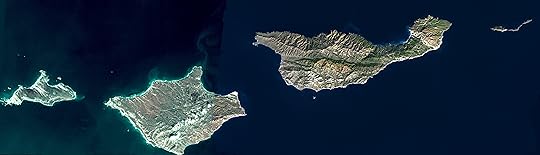
Top photo of the Channel Islands from earthobservatory.nasa.gov
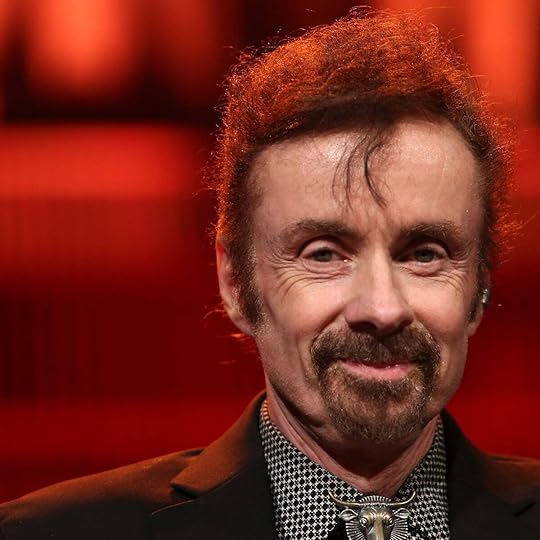
The author from theguardian.com.uk
Enter a fictitious PETA-like animal rights group opposed to all killing of animals. The plot revolves around two couples with opposing environmental viewpoints. All four are vegetarians. One couple is rabidly opposed to the killing of any animals, and the other couple is park service employees; one a public relations person and one a scientist involved in implementing the restoration plan.
We get mini-biographies of three of them that explain how their life experience shaped their ecological thinking. In the three-some we have a Japanese American female biologist; a male anti-authoritarian type and a female musician.
This is a good read containing enough scientific detail that it can be called faction. The author is writing about his own neck of the woods as he was a Professor of English at the University of Southern California at the time and he still lives near Santa Barbara.
Like another work of his, The Women, about the women in Frank Lloyd Wright's life, the author uses straightforward writing with a mixed chronological approach, jumping back and forth in time. Boyle (b. 1948) has published about 20 popular novels and a dozen collections of short stories. I enjoy his (generally) straightforward writing and I also liked his collection of short stories, Wild Child.
Here are links to my reviews of a couple of other books by T. Coraghessan Boyle:
The Women
Wild Child and Other Stories
Top photo of the Channel Islands from earthobservatory.nasa.gov
The author from theguardian.com.uk

September 25, 2025
i enjoyed this novel. it felt pretty tongue in cheek throughout, tho also touched on alot of serious issues, and grappled with the complexity of human impacts on nonhuman lives and communities, whatever the human intent.
🐦 🐧 🦭 🐀 🐁 🐷 🐑 🦝 🐟
🌊🪨 it was a huge story with many parts that fit - some more immediately/seamlessly, others like jigsaw pieces 🧩🙂
🌊🪨 it was a big meander throughout, but an interesting and enjoyable one 😁
🌊🪨 it could've been alot shorter, with alot less detail in places, but then it wouldn't have been what it was, and what i enjoyed it as 🙂😉
🌊🪨 i liked the layers of hypocrisy and/or incompetence wrt human impacts on natural environments and species. both the conservationists and the animal rights group, enacting awful things on the creatures they're claiming to have concerns for 😬😆🙈 i think this was in large part the point of the novel.
🌊🪨 there were so many threads to the backdrop tapestry upon which the overt plot was enacted, and also integrally woven into it - racism, sexism, power and politics, relationships, families, generations, class, poverty, mental health...
🌊🪨 the character portraits were very good - each distinct, human, flawed 😁
🌟 🌟 🌟 🌟
accessed as a library audiobook, well read by Anthony Heald 🙂
tho i needed to slow the reading speed down to 80% for it to be comfortable/easy for me to follow. especially when listening when tired (which was/is most of the time 😴).
🐦 🐧 🦭 🐀 🐁 🐷 🐑 🦝 🐟
🌊🪨 it was a huge story with many parts that fit - some more immediately/seamlessly, others like jigsaw pieces 🧩🙂
🌊🪨 it was a big meander throughout, but an interesting and enjoyable one 😁
🌊🪨 it could've been alot shorter, with alot less detail in places, but then it wouldn't have been what it was, and what i enjoyed it as 🙂😉
🌊🪨 i liked the layers of hypocrisy and/or incompetence wrt human impacts on natural environments and species. both the conservationists and the animal rights group, enacting awful things on the creatures they're claiming to have concerns for 😬😆🙈 i think this was in large part the point of the novel.
🌊🪨 there were so many threads to the backdrop tapestry upon which the overt plot was enacted, and also integrally woven into it - racism, sexism, power and politics, relationships, families, generations, class, poverty, mental health...
🌊🪨 the character portraits were very good - each distinct, human, flawed 😁
🌟 🌟 🌟 🌟
accessed as a library audiobook, well read by Anthony Heald 🙂
tho i needed to slow the reading speed down to 80% for it to be comfortable/easy for me to follow. especially when listening when tired (which was/is most of the time 😴).

May 28, 2011
I love TC Boyle, and he writes enough that I can pick from among his novels based on the appeal of their subject matter. This was fascinating, a book about the Channel Islands off the coast of Santa Barbara, Anacapa and Santa Cruz. They've always been just a couple of big rocks to me-- but not after reading this book. Forever after, they'll be the location of this novel, which charts the ideological battle for possession of these bioscapes--on the one side, science and ecology represented by Alma Takasue, a Park Service biologist, implementing the Park Service plan to restore ecological balance on the islands by eradication of foreign species (a policy currently being pursued, the 'killing' of the title) and on the other side, animal rights advocacy, represented by Dave LaJoy, one of TC Boyle's classic, larger-than-life fanatical visionaries, joining the cast of such other over-the-top egomaniacs as Kinsey (The Inner Circle), Kellogg (The Road to Wellville) and Frank Lloyd Wright (The Women). There's nothing Boyle loves as much as a visionary, how he loves to chart the damage that ensues when such energy and vision fuels a not-terrifically self-aware human being. Of course, man is the most invasive of invasive species--and LaJoy is paradoxically more aware of this than Takasue. A wonderful read, a lasting effect on the reader. Nice job.
March 28, 2011
Kind of a disappointing three stars here as I'm a long-time fan of Boyle's and the first 40 pages of this are so utterly amazing, I was ready for that the entire story, but alas, it wasn't to be. The first 40 pages is as good as it gets though, but unfortunately the story jumps into the near present and switches back and forth between characters on opposite sides of the fence regarding the de-population of the Channel Islands of rats, pigs and other animals killing off the natural habitat. One character wants to rid the islands of these animals, the other sees it as murder and fights to stop it. Neither are all that likable and particularly the pro-animal guy is just a little too one-dimensional for a TC Boyle book. Boyle also goes off on a few off shoots that really have no place in the book regarding short side stories of the Islands...I don't know. I just found it a bit underwhelming after such a promising, riveting start and considering this is a writer I hold in very high esteem.

January 15, 2015
Ich mag TC Boyles Stärken in der Themenvielfalt seiner Romane - sowohl historische als auch moderne Geschichten werden sehr variantenreich in der Breite und in der Tiefe gut recherchiert erzählt.
Im vorliegenden Roman werden äußerst spannende Positionen zum Themenkomplex Artenschutz gegen Tierschutz aufgegriffen: Sollen endemische Arten vor eingeschleppten animalischen Invasoren durch Töten und Jagen geschützt werden oder sollen auf die naive Art alle Tiere gerettet werden, egal was die überlebenden Rassen durch Überbevölkerung bei allen anderen Arten anrichten? Das ist hier nämlich die Kernfrage in der sich zwei Gruppen von Naturliebhabern in brennendem, unversöhnlichem Hass völlig fanatisch gegenüberstehen. Vorhang auf für die erste Fraktion: Die studierte Biologin Dr. Alma Boyd Takesue von der einen Fraktion und ihre Gruppe der Artenschützer, die auf einer abgelegenen Inselgruppe vor Santa Barbara, die von Menschenhand eingeschleppten Ratten vergiften und angesiedelten Schweine jagen lässt, damit nicht 100 indigene bedrohte Vogelarten, Füchse und andere Kleintiere von den beiden Spezies ausgerottet werden. In der anderen Ecke dieses Kampfes: Der Tierschützer Dave LaJoy und seine Studentenfreunde, die jedes Tier retten wollen, sich permanent als moralisch überlegen empfinden und in ihrer manchmal auch sehr kurzsichtigen Wut, ohne strategisch nachzudenken, Almas Kampf um ein ökologisches Gleichgewicht und Artenschutz auf den Inseln mit allen Mitteln und teilweise mit atemberaubenden Dilettantismus sabotieren.
Mich erinnert der Fanatismus der Tierschützergruppe in Boyles Roman an einige militante Veganer in meiner Umgebung, die jemanden, der ein bis drei Bioschweine jährlich aus der regionalen Nachbarschaft ehrlich umbringt und komplett verspeist, als Mörder beschimpfen, aber gar nicht reflektieren, dass ihre veganen Brotaufstriche, strotzend vor Palmöl, wie Nusscreme etc. und ihre Milch- bzw. Fleischersatzprodukte aus Soja genau wie in vorliegender Geschichte hunderte Arten in Asien oder woanders ausrotten. Ich war in Borneo Indonesien auf solchen Plantagen und dort ist genau dasselbe wie in vorliegendem Roman passiert. Ansässige Orang Utans, Kleintiere, Vögel etc. werden durch die riesigen Monokulturplantagen stark dezimiert, die Ratten schlüpften in diese Nische und erledigten den Rest der bedrohten Arten. Um der Rattenplage Herr zu werden, hat man dort Giftschlangen ausgesetzt, die die heimischen Plantagenarbeiter töteten, deshalb arbeitet man jetzt mit ausländischen Hilfskräften …..
Der derzeit so moderne Veganismus hat sich bedauerlicherweise von einem ernährungstechnisch bewussten Lebensstil zu einer teilweise fanatischen Religion und Industrieproduktion entwickelt, die genau das zerstören, was sie eigentlich bekämpfen wollten. Dabei will ich ja gar nicht sagen, dass nicht jeder öfter gedankenlose, nicht nachhaltige Aktivitäten setzt oder seine Handlungen nicht in ihrer Komplexität bis zur letzten Konsequenz durchdenkt, aber sich selbst moralisch für überlegen zu halten, weil man nur verkürzt auf das Tier schaut, das unmittelbar stirbt, nicht nachzudenken und das durch eigene Verantwortung verursachte Artensterben als Kollateralschaden abzutun, ist wie Pontius Pilatus Art sich seine Hände in Unschuld zu waschen, auf die anderen mit dem Finger zu zeigen und Mörder, Mörder zu rufen.
Dieses Buch thematisiert genau mit den Argumenten beider Gruppen, dass der Mensch gerade in seiner Überbevölkerung das für die Natur gefährlichste Raubtier ist, und egal was er tut, müssen Tiere sterben. Insofern liefert der Roman hier genügend Diskussionsgrundlage und Material zum Nachdenken.
Aber auch Alma und ihre Artenschützer kommen überhaupt nicht strahlend bei der Story weg. Sie verwaltet wie ein Vernichtungslagerkommandant ohne Gefühlsregung und Gnade sehr pragmatisch den Massenmord an den unerwünschten eingeschleppten Arten und versucht gleich Sisyphos auf den Inseln den Urzustand der Flora und Fauna wiederherzustellen. Können und dürfen Wissenschaftler in errechneten Populationsmodellen gottgleich in die Natur eingreifen und irgendwelche menschlichen Einflüsse durch Töten von Tieren wieder auf den Stand von vor 200 Jahren zurücksetzen? Kann man überhaupt alle Einflussfaktoren der Natur auch auf so einer kleinen Inselgruppe identifizieren, einbeziehen, kontrollieren und steuern? Auch das sind durchaus spannende, schlüssige Argumente der Gegenseite, die sich der Leser während der Lektüre zwangsläufig durch den Kopf gehen lassen muss.
„Ich weiß nicht, warum wir alles töten müssen“, sagte Alicia so leise, dass Alma sie kaum hören konnte, und betrachtete ihre Fingernägel, die zweifarbig lackiert waren, in Aquamarin und Brombeer. Kein Blickkontakt. Blickkontakt wäre konfrontativ gewesen, durchsetzungsfähig, und Alicia war alles andere als das, mehr Gefäß als Inhalt. „Was wäre, wenn wir die Welt sich selbst überlassen würden wie damals, bevor es uns gab – als Gott sie gemacht hat? Wäre das nicht einfacher.“
Das Töten erledigt Alma nicht mal selbst – da macht sie sich nicht die Hände schmutzig - sondern eine ausländische, australische Jägerschaft, die ganz offensichtlich mit Freude ihrer Arbeit des Dahinmetzelns nachgeht. Auch hier orte ich eine Analogie zu der Position der eingefleischten Karnivoren, die ihr Fleisch aus Massentierhaltung von anderen geschlachtet, aus dem Supermarkt beziehen und oft den Wert eines Lebens gar nicht ermessen können bzw. wollen. Mit der Zeit empfindet Alma zudem sichtlich Genugtuung bei der Qualitätssicherung und Überprüfung der Schlachtung vor Ort und bei mir dreht sich als Leserin, die vom Verstand her den Artenschützern Recht gibt, ob dieser Lust am Töten der Magen um.
Beide sowohl Dave als auch Alma werden dann auch noch in ihren eigenen unumstößlichen Ansichten korrumpiert, ein grandioser Side-Kick Boyles. Bei Dave müssen zwei Waschbären, die den geheiligten Rasen seines schmucken Hauses zerstören, weg. Wohin wenn nicht töten? Natürlich auf die Inselgruppe. Eine weitere neue Rasse, die die indigenen Tierarten umbringt, wird ins abgeschottete Ökosystem eingespeist und es werden noch einige folgen. Alma weicht von ihren Grundsätzen ab, als sie schwanger wird und ihr Kind trotz Überbevölkerung unbedingt haben will.
Die Story steuert wie ein Krieg zwischen einer Nationalarmee und einer verbittert kämpfenden Guerilla gepflastert mit überraschenden Wendungen rasant auf ein Finale zu, das ich sinngemäß mit Jeff Goldblums Aussage in Jurassic Park kommentieren möchte: „Die Natur findet immer noch einen anderen Weg.“ :-)
Boyle kann zwar wunderbar erzählen und mit Sprache umgehen, er ist ein Meister der Fabulierkunst, aber auch seine typischen Schwächen offenbaren sich schon zu Beginn des Romans: die oft unnötige epische Breite und Redundanzen. Bereits auf Seite 50 kommt eine Geschichte doppelt vor: erstens als Zusammenfassung und anschließend im Detail. Das macht die Erzählung unnötig zäh. Ist das notwendig? Auch ein paar Hintergrundstories aus der Vergangenheit sind meiner Meinung nach etwas zu weit ausgeholt, anderseits fehlen im Gegenwartsplot bei einigen Zeitsprüngen die Übergänge, hier wäre tatsächlich mehr Text und Inhalt vonnöten. Diese angeführten Kritikpunkte sind für mich jedoch Jammern auf hohem Niveau.
Fazit: Sehr gute, moderne Geschichte, über die man noch lange diskutieren und nachdenken kann. Absolut lesenswert!
Im vorliegenden Roman werden äußerst spannende Positionen zum Themenkomplex Artenschutz gegen Tierschutz aufgegriffen: Sollen endemische Arten vor eingeschleppten animalischen Invasoren durch Töten und Jagen geschützt werden oder sollen auf die naive Art alle Tiere gerettet werden, egal was die überlebenden Rassen durch Überbevölkerung bei allen anderen Arten anrichten? Das ist hier nämlich die Kernfrage in der sich zwei Gruppen von Naturliebhabern in brennendem, unversöhnlichem Hass völlig fanatisch gegenüberstehen. Vorhang auf für die erste Fraktion: Die studierte Biologin Dr. Alma Boyd Takesue von der einen Fraktion und ihre Gruppe der Artenschützer, die auf einer abgelegenen Inselgruppe vor Santa Barbara, die von Menschenhand eingeschleppten Ratten vergiften und angesiedelten Schweine jagen lässt, damit nicht 100 indigene bedrohte Vogelarten, Füchse und andere Kleintiere von den beiden Spezies ausgerottet werden. In der anderen Ecke dieses Kampfes: Der Tierschützer Dave LaJoy und seine Studentenfreunde, die jedes Tier retten wollen, sich permanent als moralisch überlegen empfinden und in ihrer manchmal auch sehr kurzsichtigen Wut, ohne strategisch nachzudenken, Almas Kampf um ein ökologisches Gleichgewicht und Artenschutz auf den Inseln mit allen Mitteln und teilweise mit atemberaubenden Dilettantismus sabotieren.
Mich erinnert der Fanatismus der Tierschützergruppe in Boyles Roman an einige militante Veganer in meiner Umgebung, die jemanden, der ein bis drei Bioschweine jährlich aus der regionalen Nachbarschaft ehrlich umbringt und komplett verspeist, als Mörder beschimpfen, aber gar nicht reflektieren, dass ihre veganen Brotaufstriche, strotzend vor Palmöl, wie Nusscreme etc. und ihre Milch- bzw. Fleischersatzprodukte aus Soja genau wie in vorliegender Geschichte hunderte Arten in Asien oder woanders ausrotten. Ich war in Borneo Indonesien auf solchen Plantagen und dort ist genau dasselbe wie in vorliegendem Roman passiert. Ansässige Orang Utans, Kleintiere, Vögel etc. werden durch die riesigen Monokulturplantagen stark dezimiert, die Ratten schlüpften in diese Nische und erledigten den Rest der bedrohten Arten. Um der Rattenplage Herr zu werden, hat man dort Giftschlangen ausgesetzt, die die heimischen Plantagenarbeiter töteten, deshalb arbeitet man jetzt mit ausländischen Hilfskräften …..
Der derzeit so moderne Veganismus hat sich bedauerlicherweise von einem ernährungstechnisch bewussten Lebensstil zu einer teilweise fanatischen Religion und Industrieproduktion entwickelt, die genau das zerstören, was sie eigentlich bekämpfen wollten. Dabei will ich ja gar nicht sagen, dass nicht jeder öfter gedankenlose, nicht nachhaltige Aktivitäten setzt oder seine Handlungen nicht in ihrer Komplexität bis zur letzten Konsequenz durchdenkt, aber sich selbst moralisch für überlegen zu halten, weil man nur verkürzt auf das Tier schaut, das unmittelbar stirbt, nicht nachzudenken und das durch eigene Verantwortung verursachte Artensterben als Kollateralschaden abzutun, ist wie Pontius Pilatus Art sich seine Hände in Unschuld zu waschen, auf die anderen mit dem Finger zu zeigen und Mörder, Mörder zu rufen.
Dieses Buch thematisiert genau mit den Argumenten beider Gruppen, dass der Mensch gerade in seiner Überbevölkerung das für die Natur gefährlichste Raubtier ist, und egal was er tut, müssen Tiere sterben. Insofern liefert der Roman hier genügend Diskussionsgrundlage und Material zum Nachdenken.
Aber auch Alma und ihre Artenschützer kommen überhaupt nicht strahlend bei der Story weg. Sie verwaltet wie ein Vernichtungslagerkommandant ohne Gefühlsregung und Gnade sehr pragmatisch den Massenmord an den unerwünschten eingeschleppten Arten und versucht gleich Sisyphos auf den Inseln den Urzustand der Flora und Fauna wiederherzustellen. Können und dürfen Wissenschaftler in errechneten Populationsmodellen gottgleich in die Natur eingreifen und irgendwelche menschlichen Einflüsse durch Töten von Tieren wieder auf den Stand von vor 200 Jahren zurücksetzen? Kann man überhaupt alle Einflussfaktoren der Natur auch auf so einer kleinen Inselgruppe identifizieren, einbeziehen, kontrollieren und steuern? Auch das sind durchaus spannende, schlüssige Argumente der Gegenseite, die sich der Leser während der Lektüre zwangsläufig durch den Kopf gehen lassen muss.
„Ich weiß nicht, warum wir alles töten müssen“, sagte Alicia so leise, dass Alma sie kaum hören konnte, und betrachtete ihre Fingernägel, die zweifarbig lackiert waren, in Aquamarin und Brombeer. Kein Blickkontakt. Blickkontakt wäre konfrontativ gewesen, durchsetzungsfähig, und Alicia war alles andere als das, mehr Gefäß als Inhalt. „Was wäre, wenn wir die Welt sich selbst überlassen würden wie damals, bevor es uns gab – als Gott sie gemacht hat? Wäre das nicht einfacher.“
Das Töten erledigt Alma nicht mal selbst – da macht sie sich nicht die Hände schmutzig - sondern eine ausländische, australische Jägerschaft, die ganz offensichtlich mit Freude ihrer Arbeit des Dahinmetzelns nachgeht. Auch hier orte ich eine Analogie zu der Position der eingefleischten Karnivoren, die ihr Fleisch aus Massentierhaltung von anderen geschlachtet, aus dem Supermarkt beziehen und oft den Wert eines Lebens gar nicht ermessen können bzw. wollen. Mit der Zeit empfindet Alma zudem sichtlich Genugtuung bei der Qualitätssicherung und Überprüfung der Schlachtung vor Ort und bei mir dreht sich als Leserin, die vom Verstand her den Artenschützern Recht gibt, ob dieser Lust am Töten der Magen um.
Beide sowohl Dave als auch Alma werden dann auch noch in ihren eigenen unumstößlichen Ansichten korrumpiert, ein grandioser Side-Kick Boyles. Bei Dave müssen zwei Waschbären, die den geheiligten Rasen seines schmucken Hauses zerstören, weg. Wohin wenn nicht töten? Natürlich auf die Inselgruppe. Eine weitere neue Rasse, die die indigenen Tierarten umbringt, wird ins abgeschottete Ökosystem eingespeist und es werden noch einige folgen. Alma weicht von ihren Grundsätzen ab, als sie schwanger wird und ihr Kind trotz Überbevölkerung unbedingt haben will.
Die Story steuert wie ein Krieg zwischen einer Nationalarmee und einer verbittert kämpfenden Guerilla gepflastert mit überraschenden Wendungen rasant auf ein Finale zu, das ich sinngemäß mit Jeff Goldblums Aussage in Jurassic Park kommentieren möchte: „Die Natur findet immer noch einen anderen Weg.“ :-)
Boyle kann zwar wunderbar erzählen und mit Sprache umgehen, er ist ein Meister der Fabulierkunst, aber auch seine typischen Schwächen offenbaren sich schon zu Beginn des Romans: die oft unnötige epische Breite und Redundanzen. Bereits auf Seite 50 kommt eine Geschichte doppelt vor: erstens als Zusammenfassung und anschließend im Detail. Das macht die Erzählung unnötig zäh. Ist das notwendig? Auch ein paar Hintergrundstories aus der Vergangenheit sind meiner Meinung nach etwas zu weit ausgeholt, anderseits fehlen im Gegenwartsplot bei einigen Zeitsprüngen die Übergänge, hier wäre tatsächlich mehr Text und Inhalt vonnöten. Diese angeführten Kritikpunkte sind für mich jedoch Jammern auf hohem Niveau.
Fazit: Sehr gute, moderne Geschichte, über die man noch lange diskutieren und nachdenken kann. Absolut lesenswert!

March 25, 2026
T.C. Boyle is one of my favorite authors and during the past 20 years or so I have read many of his novels as well as a few volumes of his wonderful short stories. When the Killing's Done is in my opinion one of his best. With its themes of animal rights and invasive species, it really left me with a lot to think about. The story's main protagonist is Alma Boyd Takesue, a biologist who works for the National Park Service and is in charge of trying to remove invasive species from two of the Channel Islands off the coast of Santa Barbara, California. But then there is her antagonist and nemesis, Dave LaJoy, a really obnoxious local businessperson who founded the animal rights organization, "For the Protection of Animals" (FPA) and who is opposed to any killing of animals including the rats and feral pigs targeted by Alma and the Park Service. LaJoy goes to great lengths to sabotage Alma by trying to stop the poisoning of the rats on Anacapa Island and by trying to show the slaughter of the feral pigs on Santa Cruz Island to gain support of the public. But is he able to sway people's opinions and stop the killing? Or will his efforts lead to tragedy?
I have always found Boyle's prose to be descriptive and very eloquent. He often uses words that I have to look up but this only adds to my education and enjoyment of his stories. He is also great at character development and this novel was exceptional in providing back stories on the characters and how their histories overlapped with the history of the Channel Islands. The novel starts out telling the story of Alma's grandmother who was shipwrecked on Anacapa Island shortly after World War II when the boat her husband was piloting was capsized in the channel. Then later in the novel he tells of Alma's father, a Japanese American who meets with tragedy as he is diving for sea urchins near Santa Cruz Island. Then there was LaJoy's girlfriend, Anise and her mother who worked for years on Santa Cruz as a cook for the sheep farmers there. The novel was overall very beautifully written and the ending was very poignant.
As usual, Boyle provides a lot of history in his novels and educates the reader on places and things that would otherwise be overlooked by most. I definitely learned a lot about the Islands and it definitely made me think about the ethical questions of killing species to try to reestablish an environment to its original state. Another high recommendation for this one!
Boyle also wrote another novel called San Miguel about another of the Channel Islands and the families who lived there in isolation to raise sheep. I read that one a few years ago and would also recommend it and I'll be looking forward to reading more of Boyle's works that I have missed.
I have always found Boyle's prose to be descriptive and very eloquent. He often uses words that I have to look up but this only adds to my education and enjoyment of his stories. He is also great at character development and this novel was exceptional in providing back stories on the characters and how their histories overlapped with the history of the Channel Islands. The novel starts out telling the story of Alma's grandmother who was shipwrecked on Anacapa Island shortly after World War II when the boat her husband was piloting was capsized in the channel. Then later in the novel he tells of Alma's father, a Japanese American who meets with tragedy as he is diving for sea urchins near Santa Cruz Island. Then there was LaJoy's girlfriend, Anise and her mother who worked for years on Santa Cruz as a cook for the sheep farmers there. The novel was overall very beautifully written and the ending was very poignant.
As usual, Boyle provides a lot of history in his novels and educates the reader on places and things that would otherwise be overlooked by most. I definitely learned a lot about the Islands and it definitely made me think about the ethical questions of killing species to try to reestablish an environment to its original state. Another high recommendation for this one!
Boyle also wrote another novel called San Miguel about another of the Channel Islands and the families who lived there in isolation to raise sheep. I read that one a few years ago and would also recommend it and I'll be looking forward to reading more of Boyle's works that I have missed.

May 12, 2021
3.5 stars
A few days ago, I read an article in The Guardian on the devastation that European hedgehogs are wreaking upon the ecological balance in much of New Zealand. Apparently, the little guys (and gals) were brought over a while back by Brits who wanted to be reminded of their homeland. Bad decision. Now, the New Zealand government is trying to figure out how to get rid of the hedgehogs—that is, how to kill them efficiently without being utterly inhumane.
I read that article by chance the day after I had finished T. C. Boyle’s When the Killing’s Done, a novel centered on a controversy similar to the one facing New Zealanders: the killing of invasive animals on two of the Channel Islands off the California coast—rats on one, feral hogs on the other. The central figures at odds with each other are Alma Takesue, who works for the National Park Service and is charge of the eradication, and Dave Lajoy, a passionate if not crazed animal rights advocate who is determined to stop Alma and the Park Service. Tension builds as the novel proceeds, with Dave’s efforts becoming more disruptive and threatening—and dangerous. Along the way, the family histories of Dave and Alma get filled in, along with the histories of the islands, making for a full and satisfying novel, one that eventually gains speed and races along toward a final confrontation.
This is the second Boyle novel I’ve read, and I’ve seen in both a fine storyteller whose narratives crackle with tension while at the same time meticulously building a large and convincing fictional world often based on historical fact.
A few days ago, I read an article in The Guardian on the devastation that European hedgehogs are wreaking upon the ecological balance in much of New Zealand. Apparently, the little guys (and gals) were brought over a while back by Brits who wanted to be reminded of their homeland. Bad decision. Now, the New Zealand government is trying to figure out how to get rid of the hedgehogs—that is, how to kill them efficiently without being utterly inhumane.
I read that article by chance the day after I had finished T. C. Boyle’s When the Killing’s Done, a novel centered on a controversy similar to the one facing New Zealanders: the killing of invasive animals on two of the Channel Islands off the California coast—rats on one, feral hogs on the other. The central figures at odds with each other are Alma Takesue, who works for the National Park Service and is charge of the eradication, and Dave Lajoy, a passionate if not crazed animal rights advocate who is determined to stop Alma and the Park Service. Tension builds as the novel proceeds, with Dave’s efforts becoming more disruptive and threatening—and dangerous. Along the way, the family histories of Dave and Alma get filled in, along with the histories of the islands, making for a full and satisfying novel, one that eventually gains speed and races along toward a final confrontation.
This is the second Boyle novel I’ve read, and I’ve seen in both a fine storyteller whose narratives crackle with tension while at the same time meticulously building a large and convincing fictional world often based on historical fact.

December 31, 2012
There is such good writing on environmental issues these days -- from Jonathan Franzen to Barbara Kingsolver, Margaret Atwood and Carl Hiaasen -- that the bar is set very high for would-be contenders. Boyle, however, vaults effortlessly over it with this bleak and beautiful novel.
The story is so simple, but then so much great writing usually is: set on the Channel Islands off California, specifically Anacapa and Santa Cruz (San Miguel features in Boyle's next novel), Boyle focuses on two main characters representing diametric views. Dave Lajoy is all for nature red in tooth and claw; Alma Taksue is for high-brow park management and conservation.
The two clash over an ambitious plan to restore the ecological balance of the islands. In a series of flashbacks to different periods in the islands' history, Boyle underlines the arrogance and shortsightedness of both points of view.
He really gets under the skin of his characters, is quite savage about their weaknesses and pettiness, but still manages to convey moments of grace and tenderness when they have a dim glimpse of their true place in the world ... usually at their wits end, and/or confronted with death and destruction. (This makes for a large quotient of gallows humour; the novel is bitingly funny, but the laughter that is evoked from the reader is always uncomfortable and complicit).
Boyle's description of the islands is some of the finest nature writing I have ever read; the reader really gets to understand the mercurial temperament of the islands. And the sense of yearning for understanding and belonging that drives the characters is conveyed with impeccable nuance.
Dave Lajoy has to rank as one of Boyle's greatest anti-heroes to date. I got the sense that Boyle got really fired up by this story, and had a huge amount of fun writing about these characters. The novel reads effortlessly, building incrementally to quite an unexpected, but inevitable, ending.
The story is so simple, but then so much great writing usually is: set on the Channel Islands off California, specifically Anacapa and Santa Cruz (San Miguel features in Boyle's next novel), Boyle focuses on two main characters representing diametric views. Dave Lajoy is all for nature red in tooth and claw; Alma Taksue is for high-brow park management and conservation.
The two clash over an ambitious plan to restore the ecological balance of the islands. In a series of flashbacks to different periods in the islands' history, Boyle underlines the arrogance and shortsightedness of both points of view.
He really gets under the skin of his characters, is quite savage about their weaknesses and pettiness, but still manages to convey moments of grace and tenderness when they have a dim glimpse of their true place in the world ... usually at their wits end, and/or confronted with death and destruction. (This makes for a large quotient of gallows humour; the novel is bitingly funny, but the laughter that is evoked from the reader is always uncomfortable and complicit).
Boyle's description of the islands is some of the finest nature writing I have ever read; the reader really gets to understand the mercurial temperament of the islands. And the sense of yearning for understanding and belonging that drives the characters is conveyed with impeccable nuance.
Dave Lajoy has to rank as one of Boyle's greatest anti-heroes to date. I got the sense that Boyle got really fired up by this story, and had a huge amount of fun writing about these characters. The novel reads effortlessly, building incrementally to quite an unexpected, but inevitable, ending.

March 4, 2011
I jumped this book ahead of all my other library books when it came in, but was it worth it? Written in classic Boyle style (fans of his will know what I mean), it is filled with frenetic, run-on inner monolgoues, characters who rarely exhibit kindness to themselves or others, and all the environmentalists are kind of stupid. Also everyone drinks a lot, even the pregnant chic. No one writes drunk as well as T.C. Boyle.
One of the main themes usually running through his work is that nature is in trouble, we are the ones f*cking it up, and the people who try to help out are pretty dimwitted, in it for their own ends, and are mainly screwing the animals over with their efforts. Case in point - crazy activist Dave is somehow okay with trapping raccoons to keep them from tearing up his lawn and then releasing them in a closed island ecosystem like it's some episode of Born Free. Really? You don't think that maybe the raccoons would prefer not to be trapped, traumatized, and then left in some weird place they've never been before?
There is an interseting environmental interplay between the two sides, biologist Alma Boyd Takesue (her name is easy to remember because she's referred to as Alma Boyd Takesue several times in the book), who wants to kill the invasive rats on the island and Dave LaJoy, who does not. There's a section from Alma's perspective about how the rats are killing the foxes and it's all man's fault because they rode over on ships and you start thinking, "Rats! They're awful! Why shouldn't they be exterminated?" and then Dave starts talking and it’s all about rats being perfect little creatures & what right do we have anyway and that makes you think, “Poor little guys.” So there are clearly no easy answers about dealing with invasive species, which is a problem you didn’t even know you had to worry about all that much.
My issue with this book is that everything happens so fast – there is going to be a big showdown between LaJoy & Takesue over the rats and then all of a sudden four months have passed & the rats are all dead & it’s on to exterminating pigs. Someone’s pregnant, then she’s almost due, then she has a nine-week old. I could’ve done without the many flashbacks to character’s pasts and famous boats sinking (a diversion that could've been interesting but isn't fleshed out enough) just to get more info on what’s happening to everybody in real time. Also, Tim is a jerk.
One of the main themes usually running through his work is that nature is in trouble, we are the ones f*cking it up, and the people who try to help out are pretty dimwitted, in it for their own ends, and are mainly screwing the animals over with their efforts. Case in point - crazy activist Dave is somehow okay with trapping raccoons to keep them from tearing up his lawn and then releasing them in a closed island ecosystem like it's some episode of Born Free. Really? You don't think that maybe the raccoons would prefer not to be trapped, traumatized, and then left in some weird place they've never been before?
There is an interseting environmental interplay between the two sides, biologist Alma Boyd Takesue (her name is easy to remember because she's referred to as Alma Boyd Takesue several times in the book), who wants to kill the invasive rats on the island and Dave LaJoy, who does not. There's a section from Alma's perspective about how the rats are killing the foxes and it's all man's fault because they rode over on ships and you start thinking, "Rats! They're awful! Why shouldn't they be exterminated?" and then Dave starts talking and it’s all about rats being perfect little creatures & what right do we have anyway and that makes you think, “Poor little guys.” So there are clearly no easy answers about dealing with invasive species, which is a problem you didn’t even know you had to worry about all that much.
My issue with this book is that everything happens so fast – there is going to be a big showdown between LaJoy & Takesue over the rats and then all of a sudden four months have passed & the rats are all dead & it’s on to exterminating pigs. Someone’s pregnant, then she’s almost due, then she has a nine-week old. I could’ve done without the many flashbacks to character’s pasts and famous boats sinking (a diversion that could've been interesting but isn't fleshed out enough) just to get more info on what’s happening to everybody in real time. Also, Tim is a jerk.
This entire review has been hidden because of spoilers.

July 25, 2011
It’s always a delight to see an environmental conscience creeping into fiction. This novel (one of my favorites of recent years) reminded me most of Jonathan Franzen’s Freedom; in both books the central character is a committed conservationist worried about pollution, invasive species, and overpopulation - but still displaying hypocritical lapses.
When the Killing’s Done focuses on the invasive species on Anacapa and Santa Cruz, two of the North Channel Islands off the coast of California near Santa Barbara. Boyle’s protagonist, Dr. Alma Boyd Takesue, works for the National Park Service as director of information resources and plans two successful eradications: black rats from Anacapa, and wild pigs from Santa Cruz.
Of course it’s not quite as simple as that; there are in fact two separate environmental groups involved, with different interpretations of what “conservation” must mean. On the one hand we have the National Park Service and Nature Conservancy, who recognize that some species (rats, pigs, snakes, eagles) must be culled or relocated to allow sensitive prey populations (foxes, seabirds) to recover. On the other hand are the hippy activists of tiny grassroots group For the Protection of Animals, who protest continuously outside Alma’s office and plan guerrilla missions on the islands themselves to save the targeted species. They will do anything to stop the killing.
Boyle raises important questions about human responsibility towards nature. Do we leave well enough alone, or are we compelled to do something to fix the messes we have made? What has to die so that other species can live, and how do we know we are making the right choices? Are humans just another species of animal, or do we have special rights as well as obligations?
The novel is not just thought-provoking but also hugely entertaining, with shipwrecks, an island castaway, Wild West-style ranching, an unplanned pregnancy, and some nutcases who are uncomfortably like real, flawed human beings. (Plus there’s a terrific ending.)
When the Killing’s Done focuses on the invasive species on Anacapa and Santa Cruz, two of the North Channel Islands off the coast of California near Santa Barbara. Boyle’s protagonist, Dr. Alma Boyd Takesue, works for the National Park Service as director of information resources and plans two successful eradications: black rats from Anacapa, and wild pigs from Santa Cruz.
Of course it’s not quite as simple as that; there are in fact two separate environmental groups involved, with different interpretations of what “conservation” must mean. On the one hand we have the National Park Service and Nature Conservancy, who recognize that some species (rats, pigs, snakes, eagles) must be culled or relocated to allow sensitive prey populations (foxes, seabirds) to recover. On the other hand are the hippy activists of tiny grassroots group For the Protection of Animals, who protest continuously outside Alma’s office and plan guerrilla missions on the islands themselves to save the targeted species. They will do anything to stop the killing.
Boyle raises important questions about human responsibility towards nature. Do we leave well enough alone, or are we compelled to do something to fix the messes we have made? What has to die so that other species can live, and how do we know we are making the right choices? Are humans just another species of animal, or do we have special rights as well as obligations?
The novel is not just thought-provoking but also hugely entertaining, with shipwrecks, an island castaway, Wild West-style ranching, an unplanned pregnancy, and some nutcases who are uncomfortably like real, flawed human beings. (Plus there’s a terrific ending.)

July 15, 2011
The novel is about the struggle of man and his environment - of one day (19th century) introducing non-native animals to an environment and totally obliterating species that didn't know how to cope, and years later (21st century) trying to undo the damage this introduction did by killing the non-native creatures and re-introducing the native animals that weren't wiped out.
This is the main story of the book with the real life events of the extermination of rats from Anacapa island and afterwards the extermination of pigs from Santa Cruz island (both islands are off the coast of California). Alma Boyd Takesue is the environmental scientist who takes on this challenge and is our heroine, while Dave LaJoy is the antagonist, a self proclaimed eco-warrior attempting to stop and sabotage any attempts at wiping out any animals no matter what. To this end he pickets Takesue's campaign to wipe out the rats and when that fails, he does everything he can, going further than before, to stop the extermination of the pigs.
I've been a huge fan of T C Boyle's writing for years now and strongly recommend his short story collections After the Plague, Tooth and Claw, and last year's Wild Child, as incredible examples of the short story medium and Boyle's own mastery of writing. That said, I've never been able to finish one of his novels before "When the Killing's Done". Not sure why that is but one reason I'm sure of that made me finish this book was the story and the writing.
Boyle does a marvellous job of pacing an interesting story and turning it into a thriller. The pages fly by with events unfolding at a furious pace, the spaces between chapters sometimes signalling a shift of several years and Boyle often jumps backwards and forwards in time to give the reader background to a situation, sometimes going back to the 19th century then the 20th, then the present day. The impression is of a whizz-bang tour of the history of the region and coupled with Boyle's indeible prose makes for a compelling read.
The characters of Alma Takesue and Dave LaJoy are also fascinating. It's clear who the reader is supposed to side with and who Boyle himself favours but we nonetheless get a vivid portrait of two obsessive individuals who feel they are doing the right thing. Alma, for all her surety as a scientist and rigid world view, is challenged by events in the book that happen in her personal life and we see her grow realistically as a character. Dave is a more fascinating character just because he's so extreme in defending animals that it blinds him to human beings and drives him to do ridiculous and dangerous things. As the reader spends more time with him we get to see the various sides of his character and the contradictions of his life, work, and goals.
This is the best novel of 2011 so far. An original novel featuring events and themes relevant to us today filled with characters and a level of writing that showcases a master writer at the top of his game. Utterly engrossing, memorable, and hugely enjoyable, I loved this book and am more convinced than ever at T C Boyle's abilities, it's a shame he's not as popular in the UK as he is stateside. If you're a fiction fan looking for an exciting, contemporary read, "When the Killing's Done" is for you.
This is the main story of the book with the real life events of the extermination of rats from Anacapa island and afterwards the extermination of pigs from Santa Cruz island (both islands are off the coast of California). Alma Boyd Takesue is the environmental scientist who takes on this challenge and is our heroine, while Dave LaJoy is the antagonist, a self proclaimed eco-warrior attempting to stop and sabotage any attempts at wiping out any animals no matter what. To this end he pickets Takesue's campaign to wipe out the rats and when that fails, he does everything he can, going further than before, to stop the extermination of the pigs.
I've been a huge fan of T C Boyle's writing for years now and strongly recommend his short story collections After the Plague, Tooth and Claw, and last year's Wild Child, as incredible examples of the short story medium and Boyle's own mastery of writing. That said, I've never been able to finish one of his novels before "When the Killing's Done". Not sure why that is but one reason I'm sure of that made me finish this book was the story and the writing.
Boyle does a marvellous job of pacing an interesting story and turning it into a thriller. The pages fly by with events unfolding at a furious pace, the spaces between chapters sometimes signalling a shift of several years and Boyle often jumps backwards and forwards in time to give the reader background to a situation, sometimes going back to the 19th century then the 20th, then the present day. The impression is of a whizz-bang tour of the history of the region and coupled with Boyle's indeible prose makes for a compelling read.
The characters of Alma Takesue and Dave LaJoy are also fascinating. It's clear who the reader is supposed to side with and who Boyle himself favours but we nonetheless get a vivid portrait of two obsessive individuals who feel they are doing the right thing. Alma, for all her surety as a scientist and rigid world view, is challenged by events in the book that happen in her personal life and we see her grow realistically as a character. Dave is a more fascinating character just because he's so extreme in defending animals that it blinds him to human beings and drives him to do ridiculous and dangerous things. As the reader spends more time with him we get to see the various sides of his character and the contradictions of his life, work, and goals.
This is the best novel of 2011 so far. An original novel featuring events and themes relevant to us today filled with characters and a level of writing that showcases a master writer at the top of his game. Utterly engrossing, memorable, and hugely enjoyable, I loved this book and am more convinced than ever at T C Boyle's abilities, it's a shame he's not as popular in the UK as he is stateside. If you're a fiction fan looking for an exciting, contemporary read, "When the Killing's Done" is for you.

November 16, 2021
An interesting, thought provoking, engaging, novel mainly set on the sparsely inhibited Channel Islands off the coast of Santa Barbara, California, dramatising the conflict between environment protectors and animal rights activists. The time period appears to be around 2000 to 2010. There are a number of interesting characters, dramatic events and sub plots. There is historical information provided including the efforts of three characters in the 1970s who ran a sheep breeding business on Santa Cruz Island.
Alma Takesue, an environmentalist, is trying to return the islands to the way they once were, without rats and feral pigs. The environmentalists have been breeding a native fox and will release the foxes back onto Santa Cruz Island once they have eradicated the rats and pigs.
Dave LaJoy, with a successful electronic retail chain of shops, is an animal rights activist. He organises protests, viewing people like Alma as a pig killer.
T. C. Boyle fans should find this novel to be a rewarding reading experience.
This book was first published in 2011.
Alma Takesue, an environmentalist, is trying to return the islands to the way they once were, without rats and feral pigs. The environmentalists have been breeding a native fox and will release the foxes back onto Santa Cruz Island once they have eradicated the rats and pigs.
Dave LaJoy, with a successful electronic retail chain of shops, is an animal rights activist. He organises protests, viewing people like Alma as a pig killer.
T. C. Boyle fans should find this novel to be a rewarding reading experience.
This book was first published in 2011.

February 19, 2011
"When the Killing’s Done" is a story about two kinds of environmental crusaders. On one side, there is Alma Boyd Takesue, Ph.D, a National
Park Service biologist. She’s got “self control. And drive. And smarts,” and she’s the face of a plan to restore the ecosystem of California’s Northern Channel Islands — “The Galapagos of America.”
Alma wouldn’t be alive if not for the islands — they’re what saved her grandmother from drowning at sea when she was shipwrecked in 1946 — and she approaches the project of eradicating invasive species and fostering endangered ones with the zeal of an evangelizing public servant. For Alma, it’s not enough to eliminate the rats and pigs that are driving the islands’ unique species to extinction. She has to get the public and the media to embrace those plans too.
On the other side is the dreadlocked David LaJoy, a zealot of another sort altogether. LaJoy's also eager to capture the public’s attention, but as an animal rights fanatic, his real sympathies are with the rats and pigs headed for certain death at the hands of the Park Service. For David, killing animals for any reason crosses an absolute moral line — “no matter how loose-jointed he might get,” he reminds himself, “that’s what he has to remember: save the animals.”
To that end, he’s not above haranguing Alma or trespassing on Parks property to sabotage the agency’s plans for the land. David spends a good part of the novel either trying to dodge the Coast Guard and Parks Service or defend himself in court.
It can be hard to balance the ethical and moral questions of environmental activism with the subtle psychological demands of compelling fiction. “Because it is so vast, amorphous, controversial, and abstract, the environment defies personification, that essential strategy of fiction, and few have found ways to dramatize environmental issues,” Diane Johnson writes in her review of the novel for the latest issue of The New York Review of Books.
Boyle gets around the difficulty of dramatizing environmental issues by dramatizing the environmentalists themselves. To drive home the tension between their positions, he draws out the similarities between Alma and her nemesis David. Alma and her biologist boyfriend Tim Sickafoose are vegetarians, and so are David and his girlfriend Anise Reed. They all live in the Santa Barbara area, they all drive white Priuses, and they all grapple with the quandaries of consumption while listening to the same hippie folksinger — and the similarities don’t end there. Like Alma, David’s girlfriend Anise has matrilineal ties to the islands: Her mother worked as a cook on an island sheep ranch in the 1970s.
Though their philosophies on what’s best for the natural world around them clash perfectly, Boyle makes it clear that both the Alma/Tim and David/Anise camps are equally motivated by a mix of childhood sympathies, inclinations of personality, and adult life politics. Our approach to moral questions about the environment, Boyle seems to suggest, is as complicated as the environment itself.
This is a book full of action and plot twists, but the ambiguity of the answers Alma and David are looking for is what makes "When the Killing’s Done" truly gripping. David follows his conscience, but he loses perspective and gets lost in the execution of his plans. Alma might be on the right side of the law, but who really has the authority to rule on which animals have a right to live and die?
http://www.thetakeaway.org/blogs/take...
Park Service biologist. She’s got “self control. And drive. And smarts,” and she’s the face of a plan to restore the ecosystem of California’s Northern Channel Islands — “The Galapagos of America.”
Alma wouldn’t be alive if not for the islands — they’re what saved her grandmother from drowning at sea when she was shipwrecked in 1946 — and she approaches the project of eradicating invasive species and fostering endangered ones with the zeal of an evangelizing public servant. For Alma, it’s not enough to eliminate the rats and pigs that are driving the islands’ unique species to extinction. She has to get the public and the media to embrace those plans too.
On the other side is the dreadlocked David LaJoy, a zealot of another sort altogether. LaJoy's also eager to capture the public’s attention, but as an animal rights fanatic, his real sympathies are with the rats and pigs headed for certain death at the hands of the Park Service. For David, killing animals for any reason crosses an absolute moral line — “no matter how loose-jointed he might get,” he reminds himself, “that’s what he has to remember: save the animals.”
To that end, he’s not above haranguing Alma or trespassing on Parks property to sabotage the agency’s plans for the land. David spends a good part of the novel either trying to dodge the Coast Guard and Parks Service or defend himself in court.
It can be hard to balance the ethical and moral questions of environmental activism with the subtle psychological demands of compelling fiction. “Because it is so vast, amorphous, controversial, and abstract, the environment defies personification, that essential strategy of fiction, and few have found ways to dramatize environmental issues,” Diane Johnson writes in her review of the novel for the latest issue of The New York Review of Books.
Boyle gets around the difficulty of dramatizing environmental issues by dramatizing the environmentalists themselves. To drive home the tension between their positions, he draws out the similarities between Alma and her nemesis David. Alma and her biologist boyfriend Tim Sickafoose are vegetarians, and so are David and his girlfriend Anise Reed. They all live in the Santa Barbara area, they all drive white Priuses, and they all grapple with the quandaries of consumption while listening to the same hippie folksinger — and the similarities don’t end there. Like Alma, David’s girlfriend Anise has matrilineal ties to the islands: Her mother worked as a cook on an island sheep ranch in the 1970s.
Though their philosophies on what’s best for the natural world around them clash perfectly, Boyle makes it clear that both the Alma/Tim and David/Anise camps are equally motivated by a mix of childhood sympathies, inclinations of personality, and adult life politics. Our approach to moral questions about the environment, Boyle seems to suggest, is as complicated as the environment itself.
This is a book full of action and plot twists, but the ambiguity of the answers Alma and David are looking for is what makes "When the Killing’s Done" truly gripping. David follows his conscience, but he loses perspective and gets lost in the execution of his plans. Alma might be on the right side of the law, but who really has the authority to rule on which animals have a right to live and die?
http://www.thetakeaway.org/blogs/take...

October 4, 2011
This is the book that led me to finding Goodreads. I was doing a search on the title and "vegan" because I was surprised (and disappointed, to be honest) that Dave LaJoy, the character who founded and ran the fictional For the Protection of Animals, was not one. The first time this is revealed, he is complaining bitterly about how his eggs are prepared. Later, there is a scene that acknowledges that this presents an inconsistency:
So where am I going with this? It just surprises me that Anise appears to be the one and only vegan in the entire novel. Even the other activists who associate with Dave LaJoy seem to be on the dairy, eggs, and fish train. I understand that Boyle was making a statement about hypocrisy, but must they all be hypocrites? In my experience, you will find more vegans than non-vegans represented in such groups. (In the spirit of full disclosure, I will reveal that I am a vegan, so this makes me more sensitive about such issues.)
Boyle is one of my favorite authors, and I still liked this novel enough to give it three stars (but he is usually a four/five-star author for me). Although he often claims not to write polemics, but rather throw out situations and allow the readers to make up their minds, it seemed clear to me that his sympathies lie with Alma Boyd Takesue, the biologist with the National Park Service whose plans to eradicate non-indigenous species in the islands off the coast of California pit her against Dave LaJoy. She is the rational one whose motives are based on science, and he is the irrational extremist whose methods only underscore his afore-mentioned hypocrisy. In certain respects, this novel will remind readers of The Tortilla Curtain and, especially, A Friend of the Earth. The latter got into the realm of eco-terrorism, with a main character every bit as extreme as Dave LaJoy. (I wonder if Boyle is aware that there are vegans who believe in non-violent vegan education. He needs to read some Gary Francione!)
That was the day he gave up meat, cold turkey, and where did that expression come from? Of course, he still needed protein, especially since he was lifting at the gym, and so he continued to incorporate eggs and dairy in his diet, though he knew all about the battery hens in the egg-laying factories, how they're fed the remains of the male chicks, which are otherwise useless to the industry, how they're subjected to forced molting (that is, they're periodically denied food for six to ten days and then brought back on diet as a way of forcing ovulation), and how after a year they're played out and sent to slaughter. Anise is on him all the time about it--not to mention his cardiologist--but eggs are his one concession to the system, to cruelty. He means to change. He wants to change. Anise is a vegan and he's moving that way, he is, but it's hard, because through all his bachelor days from his divorce on up to the present, it's been eggs that sustained him.Later still, we learn that eggs are not his "one concession," as he eats fish. Anise chides him with "If you're going to commit to vegetarianism, you can't go halfway, Dave." So Boyle himself clearly knows the difference. And yet the character Alma Boyd Takesue is identified as a vegetarian, and she turns out to be a pescetarian.
So where am I going with this? It just surprises me that Anise appears to be the one and only vegan in the entire novel. Even the other activists who associate with Dave LaJoy seem to be on the dairy, eggs, and fish train. I understand that Boyle was making a statement about hypocrisy, but must they all be hypocrites? In my experience, you will find more vegans than non-vegans represented in such groups. (In the spirit of full disclosure, I will reveal that I am a vegan, so this makes me more sensitive about such issues.)
Boyle is one of my favorite authors, and I still liked this novel enough to give it three stars (but he is usually a four/five-star author for me). Although he often claims not to write polemics, but rather throw out situations and allow the readers to make up their minds, it seemed clear to me that his sympathies lie with Alma Boyd Takesue, the biologist with the National Park Service whose plans to eradicate non-indigenous species in the islands off the coast of California pit her against Dave LaJoy. She is the rational one whose motives are based on science, and he is the irrational extremist whose methods only underscore his afore-mentioned hypocrisy. In certain respects, this novel will remind readers of The Tortilla Curtain and, especially, A Friend of the Earth. The latter got into the realm of eco-terrorism, with a main character every bit as extreme as Dave LaJoy. (I wonder if Boyle is aware that there are vegans who believe in non-violent vegan education. He needs to read some Gary Francione!)

June 8, 2018
It took me forever to finish this book. Actually, it's one of my few remaining books on CD, so after it was sitting on my desk for over two years (half-listened) I finally got around to playing it in my car (which is just old enough to still have a CD player - funny to think that soon those will be like cassette players).
When the Killing's Done is a story about environmental activists and hipsters and scientists that plays out in California, specifically around the Channel Islands. The plot mostly revolves around a rich businessman who's taken up radical activism on behalf of animal rights, which manifests as protesting and obstructing efforts to kill rats and feral pigs and other invasive species that biologists are trying to eliminate from the islands. He's actually an egomaniac asshole, however, as demonstrated on his one and only date with the protagonist of the story, in which he proves to be a hot-tempered jackass of the first order. So it's no surprise when he takes his crusade against her animal control efforts personally and the naive college kids who follow him on his misbegotten quest fare poorly.
This is a very literary novel, however, so the prose is layered thickly and artistically over a fairly mundane story about critters and marine biology and California wildlife. There is some personal drama, as we get family histories of several of the characters, all illustrated in depth but none of them actually that interesting.
T.C. Boyle is apparently a popular author with certain types of literary aficionados, but while this story was somewhat interesting, it didn't really engage me (as evidenced by the fact that it took me a couple of years to get around to finishing it). Boyle does do an excellent job of describing Anacapa Island, and fleshing out all his flawed people who animate the drama and conflict over how to deal with creatures great and small who might or might not belong on it. Not sure I would read another one of his novels if I were looking for a page-turner, though.
When the Killing's Done is a story about environmental activists and hipsters and scientists that plays out in California, specifically around the Channel Islands. The plot mostly revolves around a rich businessman who's taken up radical activism on behalf of animal rights, which manifests as protesting and obstructing efforts to kill rats and feral pigs and other invasive species that biologists are trying to eliminate from the islands. He's actually an egomaniac asshole, however, as demonstrated on his one and only date with the protagonist of the story, in which he proves to be a hot-tempered jackass of the first order. So it's no surprise when he takes his crusade against her animal control efforts personally and the naive college kids who follow him on his misbegotten quest fare poorly.
This is a very literary novel, however, so the prose is layered thickly and artistically over a fairly mundane story about critters and marine biology and California wildlife. There is some personal drama, as we get family histories of several of the characters, all illustrated in depth but none of them actually that interesting.
T.C. Boyle is apparently a popular author with certain types of literary aficionados, but while this story was somewhat interesting, it didn't really engage me (as evidenced by the fact that it took me a couple of years to get around to finishing it). Boyle does do an excellent job of describing Anacapa Island, and fleshing out all his flawed people who animate the drama and conflict over how to deal with creatures great and small who might or might not belong on it. Not sure I would read another one of his novels if I were looking for a page-turner, though.

September 13, 2012
Terrible! It surprises me how much I sincerely dislike this book because I am a vegetarian and supporter of sustainable living and the preservation of all species on this planet.
His writing style irritates the heck out of me, with his overuse of commas and his run-on sentences. Rar! This book includes too many side stories. What does a random couple dying have anything to do with the plot?
As satisfying as it was to have LaJoy die in the end, it seemed entirely too convenient. And his epiphany seconds before his death? Yeah, okay, that's believable (being facetious here).
I don't know what else to say, except to include an example of the awfulness that is When the Killing's Done:
"He's walking now, striding along in his business-as-usual gait, forty-two years old and as fit as the gym and Dr. Reiser's Lotensin and blood thinners can make him, ignoring the cars lined up at the light with their wipers clapping and the exhaust coiling out of their tailpipes in the last petrochemical gasp of the black stuff pooled up under layers of shale in Saudi Arabia and Nigeria and Venezuela, the death of the earth, the death of everything, smelling crushed worm, rotting leaf and the wet acidic failure of the newspaper stuck to the sidewalk where the Mexicans tossed them short of house stoops and store-fronts in the grim desperate hour before dawn."
THIS IS ONE SENTENCE! SERIOUSLY?!? HOW IN THE HELL DID THIS GET PUBLISHED?!!?!?!
His writing style irritates the heck out of me, with his overuse of commas and his run-on sentences. Rar! This book includes too many side stories. What does a random couple dying have anything to do with the plot?
As satisfying as it was to have LaJoy die in the end, it seemed entirely too convenient. And his epiphany seconds before his death? Yeah, okay, that's believable (being facetious here).
I don't know what else to say, except to include an example of the awfulness that is When the Killing's Done:
"He's walking now, striding along in his business-as-usual gait, forty-two years old and as fit as the gym and Dr. Reiser's Lotensin and blood thinners can make him, ignoring the cars lined up at the light with their wipers clapping and the exhaust coiling out of their tailpipes in the last petrochemical gasp of the black stuff pooled up under layers of shale in Saudi Arabia and Nigeria and Venezuela, the death of the earth, the death of everything, smelling crushed worm, rotting leaf and the wet acidic failure of the newspaper stuck to the sidewalk where the Mexicans tossed them short of house stoops and store-fronts in the grim desperate hour before dawn."
THIS IS ONE SENTENCE! SERIOUSLY?!? HOW IN THE HELL DID THIS GET PUBLISHED?!!?!?!
This entire review has been hidden because of spoilers.

September 6, 2014
Highly enjoyable book. This is the 4th book by Boyle that I have read and he just is one writer that I can keep coming back to. Reminds me of some of the similar issues we read about in The Tortilla Curtain, but Boyle just seems to be able to get into all of his characters and point out the flaws, the issues and even the similarities between adversaries. Each chapter is about 20 pages long, and there is not a ton of quick reading dialogue, but his prose and the dialogue that he uses is powerful and he really seems to have the characters voice in all the dialogue.
If you are not into fluff novels, and enjoy a really well-written thought provoking writer then TC Boyle is your man, and this is another fine effort.
If you are not into fluff novels, and enjoy a really well-written thought provoking writer then TC Boyle is your man, and this is another fine effort.

September 12, 2019
A quick read with a strong beginning, lots of conflict between interesting characters, and not much of an ending.

August 31, 2013
So I really liked The Women (Boyle's book about FLW's life and loves) and thought it might be interesting to read Boyle's take on environmentalism and our (speaking for humanity at large) responsibility towards other creatures.
Unfortunately, I found this novel to be at best boring, at worst preachy, and overall just fairly uninteresting. I get that Boyle was trying to say something profound about the ways that people a)affect the natural order and the world and b)should make efforts to ameliorate our damage and c)there are shades of grey and dispute over what is the best course of action. Clearly he nods towards the argument that attempts to "fix" or "repair" our effects are unnecessary and may not work, however in the end Alma is the heroine and the argument stands that we should try to return things to their natural order.
This was written in the same vein as Carl Hiassen's work (the only two of which I have read are Hoot and Lucky You). I maintain that Hoot was the best of the lot (including this book), but maybe that is just because I am less critical of a YA book.
Way too much of the novel was contrived and melodramatic. Alma should not (and there was no need for her to) have dated Dave. This did not add complexity or depth to either of their characters or relationship, it was simply another scene in which Boyle could present Dave as an obnoxious overbearing jerk (and again, why couldn't he be at least partially sympathetic? When, in life, do we ever encounter characters that are so clearly black and white? So clearly good or evil?). Similarly, it was unnecessary for all of Alma's ancestors to be single moms (and therefore for her to become a single mom). I was also not for a moment deceived: as soon as she puked the first time it was clear she had to be pregnant. Alma should not have run into Anise et al at the Micah Stroud concert; the SAME GIRL WHO ASKED ABOUT MUDSLIDES should not have been the one to fall to her death in a mudslide. So many plot pieces were just too convenient for plausibility or even good entertainment.
The text was also over-written. Instead of being descriptive, I found it to be just boring: "he gets to his feet, digs out his plastic water bottle for a long hissing squeeze of filtered water from the reverse-osmosis tank he installed in the kitchen at home, aqua vita, then tucks it away and starts back up the trail." Perfect example of my often (unfortunately probably overused) criticism of masturbatory writing. Sentences such as the above are not written for the pleasure of the reader; they are solely for the author's own amusement and delight. Along these lines, I was also annoyed by the chapter titles. I wanted to just send Boyle an email already to congratulate him for being able to look up the Latin names in his biology textbook.
Finally (and I will admit to being still over-sensitive after reading Greer last week), the male/female relationships were so unbelievably stereotypical and offensively chauvinistic. Alma is unable to contradict LaJoy on their date because he "was the expert here. He was the one paying--this was a date, a dinner date--and she had to defer to him." and Anise (like all women) can "sulk and brood for days on end over some imagined slight or a thing so inconsequential--what somebody said to her at work, the color of the dress she knew she shouldn't have bought--as to make him question her sanity" What the fuck? Really? Clearly sulking and brooding is not a solely female characteristic and most women have more important things to worry about than the color of an unwanted dress.
Overall there was nothing poignant and no astute observations. The characters were flat and uninteresting and the whole thing resolved itself too neatly. The best point Boyle makes is that chaos will win out and that people cannot control or repair nature (and that maybe we should just respectfully leave it alone as best we can: "how much better would it be if nobody ever came out here and the islands could exist in the way they always had. Or should have."); unfortunately the blatantly contrived and forced text undermines this concept.
Unfortunately, I found this novel to be at best boring, at worst preachy, and overall just fairly uninteresting. I get that Boyle was trying to say something profound about the ways that people a)affect the natural order and the world and b)should make efforts to ameliorate our damage and c)there are shades of grey and dispute over what is the best course of action. Clearly he nods towards the argument that attempts to "fix" or "repair" our effects are unnecessary and may not work, however in the end Alma is the heroine and the argument stands that we should try to return things to their natural order.
This was written in the same vein as Carl Hiassen's work (the only two of which I have read are Hoot and Lucky You). I maintain that Hoot was the best of the lot (including this book), but maybe that is just because I am less critical of a YA book.
Way too much of the novel was contrived and melodramatic. Alma should not (and there was no need for her to) have dated Dave. This did not add complexity or depth to either of their characters or relationship, it was simply another scene in which Boyle could present Dave as an obnoxious overbearing jerk (and again, why couldn't he be at least partially sympathetic? When, in life, do we ever encounter characters that are so clearly black and white? So clearly good or evil?). Similarly, it was unnecessary for all of Alma's ancestors to be single moms (and therefore for her to become a single mom). I was also not for a moment deceived: as soon as she puked the first time it was clear she had to be pregnant. Alma should not have run into Anise et al at the Micah Stroud concert; the SAME GIRL WHO ASKED ABOUT MUDSLIDES should not have been the one to fall to her death in a mudslide. So many plot pieces were just too convenient for plausibility or even good entertainment.
The text was also over-written. Instead of being descriptive, I found it to be just boring: "he gets to his feet, digs out his plastic water bottle for a long hissing squeeze of filtered water from the reverse-osmosis tank he installed in the kitchen at home, aqua vita, then tucks it away and starts back up the trail." Perfect example of my often (unfortunately probably overused) criticism of masturbatory writing. Sentences such as the above are not written for the pleasure of the reader; they are solely for the author's own amusement and delight. Along these lines, I was also annoyed by the chapter titles. I wanted to just send Boyle an email already to congratulate him for being able to look up the Latin names in his biology textbook.
Finally (and I will admit to being still over-sensitive after reading Greer last week), the male/female relationships were so unbelievably stereotypical and offensively chauvinistic. Alma is unable to contradict LaJoy on their date because he "was the expert here. He was the one paying--this was a date, a dinner date--and she had to defer to him." and Anise (like all women) can "sulk and brood for days on end over some imagined slight or a thing so inconsequential--what somebody said to her at work, the color of the dress she knew she shouldn't have bought--as to make him question her sanity" What the fuck? Really? Clearly sulking and brooding is not a solely female characteristic and most women have more important things to worry about than the color of an unwanted dress.
Overall there was nothing poignant and no astute observations. The characters were flat and uninteresting and the whole thing resolved itself too neatly. The best point Boyle makes is that chaos will win out and that people cannot control or repair nature (and that maybe we should just respectfully leave it alone as best we can: "how much better would it be if nobody ever came out here and the islands could exist in the way they always had. Or should have."); unfortunately the blatantly contrived and forced text undermines this concept.

September 3, 2011
Few novelists possess the chutzpah (or the talent, for that matter) to write coherent novels on a wide variety of disparate subjects and themes, with little trepidation of alienating his/her fanbase. Consider TC Boyle's body of work, which avoids pigeon-holing into a particular genre; he's written about topics as varied as turn-of-the-century health spas/sanatoria, the sexual dalliances of Frank Lloyd Wright, the explosion of migrant day-laborers in Los Angeles, free-love communes, and so forth. Not a common theme to be found in any of these works, really, but Boyle tackles each with alacrity and enthusiasm, so much so that the reader can't help but be infected by that enthusiasm as well, and finds himself getting engrossed in a topic that had (up until then) barely registered a radar-blip of recognition or interest. Boyle writes about what he's passionate about (which may well be just about everything) and passes on that enthusiasm to the reader, no matter how arcane the topic.
In "When the Killing's Done" (Boyle's 14th novel) , the author turns his attention to the Channel Islands in California (off the coast of Santa Barbara) and focuses on the battle between the National Park Service, who wishes to eradicate the non-indigenous rat and pig populations on Anacapa and Santa Cruz Islands (which are upsetting the evolutionary eco-balance of these islands), and a PETA-esque animal-rights group vehemently opposed to said eradication. The battle is taut and tense, with far-reaching implications; depending on your viewpoint, it's a battle with few winners: Do you let the rats and pigs alone and let them throw off the fragile balance of a closed eco-system, or do you "play God" and kill off a whole species so that others may live? And what makes a fox or a rare bird more deserving to live than a rat or a pig? Boyle provides no ready answers or heavy-handed morality to solve this dilemma; he instead lets his very well-fleshed-out protagonists do battle and allows the reader to make the judgement call. (Well, Boyle may not be completely neutral: his leader of the animal-rights activists is one step below Snidely Whiplash on the despicable scale (the guy's so comedically obnoxious you can almost see him twiddling his handlebar moustache as he plots deeds to thwart the National Park Service). His apposite, Alma Boyd Takesue (the Talking Head/lead biologist for the NPS) is given a little more even-handed treatment, although she, too, is fraught with imperfection. (Her character is exhaustively explored, almost excessively so, with a two-generation-long back-story that could be considered overkill).
Boyle's m.o. has always strayed toward verbosity; this novel, like many of his others, is almost TOO detailed. I find this technique of his totally to my liking (though I can certainly see how others might find his style a little overwrought.) If anything, Boyle's emphasis on detail is crucial for accessibility to all these disparate topics. Not everyone's going to cozy up to a novel about Island Biodiversity, but Boyle's story-telling emphasis on details makes even the most mundane topic one of supreme interest for everyone.
In "When the Killing's Done" (Boyle's 14th novel) , the author turns his attention to the Channel Islands in California (off the coast of Santa Barbara) and focuses on the battle between the National Park Service, who wishes to eradicate the non-indigenous rat and pig populations on Anacapa and Santa Cruz Islands (which are upsetting the evolutionary eco-balance of these islands), and a PETA-esque animal-rights group vehemently opposed to said eradication. The battle is taut and tense, with far-reaching implications; depending on your viewpoint, it's a battle with few winners: Do you let the rats and pigs alone and let them throw off the fragile balance of a closed eco-system, or do you "play God" and kill off a whole species so that others may live? And what makes a fox or a rare bird more deserving to live than a rat or a pig? Boyle provides no ready answers or heavy-handed morality to solve this dilemma; he instead lets his very well-fleshed-out protagonists do battle and allows the reader to make the judgement call. (Well, Boyle may not be completely neutral: his leader of the animal-rights activists is one step below Snidely Whiplash on the despicable scale (the guy's so comedically obnoxious you can almost see him twiddling his handlebar moustache as he plots deeds to thwart the National Park Service). His apposite, Alma Boyd Takesue (the Talking Head/lead biologist for the NPS) is given a little more even-handed treatment, although she, too, is fraught with imperfection. (Her character is exhaustively explored, almost excessively so, with a two-generation-long back-story that could be considered overkill).
Boyle's m.o. has always strayed toward verbosity; this novel, like many of his others, is almost TOO detailed. I find this technique of his totally to my liking (though I can certainly see how others might find his style a little overwrought.) If anything, Boyle's emphasis on detail is crucial for accessibility to all these disparate topics. Not everyone's going to cozy up to a novel about Island Biodiversity, but Boyle's story-telling emphasis on details makes even the most mundane topic one of supreme interest for everyone.

February 14, 2025
I just finished this and sit here caught in its grip not having words to describe it. T.C. Boyle is spot on about so many things. Thankful to get back to his writing. I’ve read that he believes book should be fun and entertaining, not “formal and academic”. I learned so much about the Channel Islands, boating, environment, National Parks and on and on, from this book. It had me thinking and left me thinking much more than a class on ethics or environmental essays or even a visit to the Channel Islands National Park. I also read Boyle says he does not write fiction to dictate moral codes or tell people what to think. “It’s not the place of the author to lead the reader by the nose (or any other body part for that matter)”. He doesn’t here but oh, how easy it would be to do that. I found myself on no sides, empathizing for all sides. The conflicts, the dilemmas… all with good intentions.
As my friend wrote, he “gets deeply into the heads of his characters” that for me, brings his detailed description of events so real, I felt I experienced them, from running over a squirrel, wrapping dog shit in “neat little plastic bags”, to doing an at-home pregnancy test and many others in between.
And then there’s the landscape and seascape:
“As the boat slows and they cruise into the dock, the sun cutting through what’s left of the mist in great rectilinear columns, the cliffs rearing, birds squawking, everyone seems to come alive.” Yes, I was there and now grateful for the experience.
As my friend wrote, he “gets deeply into the heads of his characters” that for me, brings his detailed description of events so real, I felt I experienced them, from running over a squirrel, wrapping dog shit in “neat little plastic bags”, to doing an at-home pregnancy test and many others in between.
And then there’s the landscape and seascape:
“As the boat slows and they cruise into the dock, the sun cutting through what’s left of the mist in great rectilinear columns, the cliffs rearing, birds squawking, everyone seems to come alive.” Yes, I was there and now grateful for the experience.

January 21, 2025
TC Boyle did not craft one book based on an uninhabited tiny island off the coast of California, he wrote two.
When the Killing’s Done was published 12 months before San Miguel, which is based on the western-most of the desolate North Channel islands. It centres around the two eastern islands Anacapa and Santa Cruz.
The theme is different too and it is a fascinating one. The novel centres around a ferocious battle between a conservationist Alma Boyd Takesure and two environmentalists over plans to save native species from ones introduced over the years by man: rats and pigs.
It is one of the best novels I have read about green issues, which poses important questions about important questions which are at the heart of a dispute which escalates of control.
I found it thought-provoking and quietly challenging as well as an exhilarating read.
And Boyle’s writing skills, his mastery of plot and pace are very much to the fore. The first chapter, an extraordinary account of a shipwreck is breathless and brilliant. Superb novel from a maestro of the craft.
When the Killing’s Done was published 12 months before San Miguel, which is based on the western-most of the desolate North Channel islands. It centres around the two eastern islands Anacapa and Santa Cruz.
The theme is different too and it is a fascinating one. The novel centres around a ferocious battle between a conservationist Alma Boyd Takesure and two environmentalists over plans to save native species from ones introduced over the years by man: rats and pigs.
It is one of the best novels I have read about green issues, which poses important questions about important questions which are at the heart of a dispute which escalates of control.
I found it thought-provoking and quietly challenging as well as an exhilarating read.
And Boyle’s writing skills, his mastery of plot and pace are very much to the fore. The first chapter, an extraordinary account of a shipwreck is breathless and brilliant. Superb novel from a maestro of the craft.

November 11, 2012
When I pick up a novel by Boyle, I can always be assured that:
a-I will not be bored.
b-I will learn a few things about a given subject, and probably (certainly) a few new words, too.
c-The characters will be complex human beings, often very flawed but not aware of it, or in denial of it, or working hard to convince themselves otherwise with self-deluding and convoluted feats of reasoning and justification.
WTKD scores on all three counts. The environmental and historical situation of the Channel Islands provides a detail-rich backdrop for the clash and conflict of our dear protagonists as they delude themselves and each other. As usual, Boyle gets us into their skulls. And stomachs- I actually felt kind of queasy after so many choppy, gut-heaving boat trips back and forth.
Sure, the LaJoy character is sometimes too much; he could have been sketched out a bit more lightly but let's face it, some people have no sense of subtlety (we all know a few!) and Dave LaJoy must be one of them. And, incidentally, while Dave is eternally pissed-off, misguided and on the offensive -so 'unlikable' - check out how Boyle manages the the very balanced - and 'likable' -Tim Sickafoose !
Finally: SHAME ON BLOOMSBURY PRESS FOR THE ENDLESS TYPOS AND FONT GLITCHES in this KINDLE edition!! An insult to author and readers alike.
a-I will not be bored.
b-I will learn a few things about a given subject, and probably (certainly) a few new words, too.
c-The characters will be complex human beings, often very flawed but not aware of it, or in denial of it, or working hard to convince themselves otherwise with self-deluding and convoluted feats of reasoning and justification.
WTKD scores on all three counts. The environmental and historical situation of the Channel Islands provides a detail-rich backdrop for the clash and conflict of our dear protagonists as they delude themselves and each other. As usual, Boyle gets us into their skulls. And stomachs- I actually felt kind of queasy after so many choppy, gut-heaving boat trips back and forth.
Sure, the LaJoy character is sometimes too much; he could have been sketched out a bit more lightly but let's face it, some people have no sense of subtlety (we all know a few!) and Dave LaJoy must be one of them. And, incidentally, while Dave is eternally pissed-off, misguided and on the offensive -so 'unlikable' - check out how Boyle manages the the very balanced - and 'likable' -Tim Sickafoose !
Finally: SHAME ON BLOOMSBURY PRESS FOR THE ENDLESS TYPOS AND FONT GLITCHES in this KINDLE edition!! An insult to author and readers alike.

August 16, 2014
I really enjoy TC Boyle in general. I had a hard time with rating this book. It's uncomfortable, and it it probably supposed to be. None of the characters are that likeable, the avid animal lover is a jerk and refuses to see gray areas of life. The environmentalist park official is not really likeable either. Actually nobody is, almost nobody in the book is likeable.
Perhaps that's the point. The damage our species has done to this particular land is difficult to parse out from the changes that might have occurred by chance due to a strong storm or random event. Do we get to decide that the non-native species that were introduced have less a right to life than the original species?
Taking a hard line on this topic is doomed to failure, there is always a good argument against your view, it's simply not black and white while the characters Boyle creates are. So uncomfortable to read but likely because it needs to be.
Perhaps that's the point. The damage our species has done to this particular land is difficult to parse out from the changes that might have occurred by chance due to a strong storm or random event. Do we get to decide that the non-native species that were introduced have less a right to life than the original species?
Taking a hard line on this topic is doomed to failure, there is always a good argument against your view, it's simply not black and white while the characters Boyle creates are. So uncomfortable to read but likely because it needs to be.

April 2, 2011
Not sure how to rate this book. First TC Boyle book I've read and I'm not sure if he's for me. I'll need to try another of his to know for sure. Also, I listened to this one and the readers voice bugged me. Unfair but true and that colored it for me.
I liked the story, the characters, the setting and the back stories through generations, but it was too much. Too much context and detail that I felt bogged down at times and just wanted to get through it. That happened less as the book progressed but it still left me a little annoyed. He's no doubt a talented writer but I need to find another novel and read not listen to see if I'm up for his work more than this once.
Oh, I liked the character development although the two leads are pretty archetypal and a little predictable.
I liked the story, the characters, the setting and the back stories through generations, but it was too much. Too much context and detail that I felt bogged down at times and just wanted to get through it. That happened less as the book progressed but it still left me a little annoyed. He's no doubt a talented writer but I need to find another novel and read not listen to see if I'm up for his work more than this once.
Oh, I liked the character development although the two leads are pretty archetypal and a little predictable.
March 14, 2024
The question this book is asking is whether human intervention on nature can ever be undone. And if there is one point in time of natural development where we can start off of.
Alma Takesue is PR spokesperson for National Park Service and firm believer that returning the Santa Barbara Islands to their "natural state" is the right thing to do to restore balance in the ecosystem. If that means killing off invasive species, that does not change that it's the right thing to do. She also has the science thing going for her.
Dave LaJoy, business and yacht owner, misantrophe and somewhat recent animal rights acitivist firmly stands against this approach and advocates for the animals of Santa Barbara Islands without any human intervention. Form the beginning it is made clear that he shies away from nothing to save the animals. However, things turn to the absurd, when he starts Throughout the book, his motivations feel unconsolidated and directed more towards "besting" NPS's plans rather than saving animals from harm.
T.C. Boyle excels at writing both main characters ambivalent, flawed, more or less unlikeable at times. With that he manages to put the beginning question in the center and as the finale of the book rather than readers rooting for one site because of likeability. I also really enjoyed the many parallel and shifting timelines which in most parts were cohesive enough for the main story line. Only for one fatal boat accident near the end of the book there is no apparent connection to any of the character's backstories. I wonder, if T.C. Boyle just had too much fun to let people die on the Santa Barbara canal. Remember folks, yachting is dangerous!
Really funny for me was the discussion of food consumption for both characters. Both of them have strong motivations to become vegan due to different reasons (you can guess who does it because of animal suffering and who because auf climate change) but fail to do so. Escpecially LaJoy's favor for eggs was hilarious to me.
The book lacks when it comes to relationship development. While the other relationships stay stagnant, only the romantic/sexual relationship between Alma and Tim Sickafoose changes throughout the book. For me, it did not add much to the story, it felt stilted and the emotional accountability and stability it gives Alma (which she does not tire to emphazise) did not come across. Therefore, the great conflict of falls flat.
I also wonder whether it was necessary to give voice to Dave LaJoys sexism in such an extensive fashion. I understand it adds to him being a misantrophe. However, it would have been a worthwhile challenge to make this and his attitude towards women clear without them being constantly reduced to either how hot or dumb or both they are.
Alma Takesue is PR spokesperson for National Park Service and firm believer that returning the Santa Barbara Islands to their "natural state" is the right thing to do to restore balance in the ecosystem. If that means killing off invasive species, that does not change that it's the right thing to do. She also has the science thing going for her.
Dave LaJoy, business and yacht owner, misantrophe and somewhat recent animal rights acitivist firmly stands against this approach and advocates for the animals of Santa Barbara Islands without any human intervention. Form the beginning it is made clear that he shies away from nothing to save the animals. However, things turn to the absurd, when he starts Throughout the book, his motivations feel unconsolidated and directed more towards "besting" NPS's plans rather than saving animals from harm.
T.C. Boyle excels at writing both main characters ambivalent, flawed, more or less unlikeable at times. With that he manages to put the beginning question in the center and as the finale of the book rather than readers rooting for one site because of likeability. I also really enjoyed the many parallel and shifting timelines which in most parts were cohesive enough for the main story line. Only for one fatal boat accident near the end of the book there is no apparent connection to any of the character's backstories. I wonder, if T.C. Boyle just had too much fun to let people die on the Santa Barbara canal. Remember folks, yachting is dangerous!
Really funny for me was the discussion of food consumption for both characters. Both of them have strong motivations to become vegan due to different reasons (you can guess who does it because of animal suffering and who because auf climate change) but fail to do so. Escpecially LaJoy's favor for eggs was hilarious to me.
The book lacks when it comes to relationship development. While the other relationships stay stagnant, only the romantic/sexual relationship between Alma and Tim Sickafoose changes throughout the book. For me, it did not add much to the story, it felt stilted and the emotional accountability and stability it gives Alma (which she does not tire to emphazise) did not come across. Therefore, the great conflict of falls flat.
I also wonder whether it was necessary to give voice to Dave LaJoys sexism in such an extensive fashion. I understand it adds to him being a misantrophe. However, it would have been a worthwhile challenge to make this and his attitude towards women clear without them being constantly reduced to either how hot or dumb or both they are.

May 9, 2017
Dies war mein erstes Buch von T.C. Boyle. Seine sprachliche Fähigkeiten haben mich begeistert. Insbesondere seine ironischen Formulierungen, wenn er dem Leser Einblicke in die Gefühlswelt seiner Hauptpersonen gewährt, sind echt köstlich. Teilweise hatte ich so ein leichtes Dauergrinsen auf dem Lippen beim Lesen.
Das Buch behandelt die Problematik, welche Kettenreaktionen der Eingriff des Menschen in die Natur für andere Spezies mit sich bringt. Dabei geht es nicht nur um die durch einen Schiffbruch an Land gespülten Ratten auf einer kleinen Inselgruppe im Pazifik vor der Küste Los Angeles, die sich negativ auf die Population der Vögel auswirkte. Es werden auch andere Eingriffe thematisiert und letztlich befasst sich das Buch mit der Frage, in wie weit der Mensch nach der Fehlentwicklung die alte Ordnung wieder herzustellen soll.
Na klar, sagen bestimmt die Meisten, Ratten sind ekelhaft, Vögel nicht, also ist das Töten der Ratten gerechtfertigt. Aber Boyle lässt hier eine fanatische Tierschutzgruppe dagegen auftreten, die das Abschlachten der Ratten oder später der Wildschweine als barbarisch anprangert. Er bleibt bei seiner Darstellung halbwegs neutral zwischen den beiden Gruppen und führt dagegen auch die Widersprüche der beiden Parteien auf, wenn sie im privaten Bereiche sich konträr zu ihrer zur Schau gestellten Meinung verhalten. Tierschutz ist gut, aber wenn die Waschbären meinen Rasen umgraben, geht es dann doch zu weit. Abschließend kommt man aber zur Erkenntnis, dass jedes Eingreifen in die Natur, um Fehlentwickung rückgängig zu machen, auch schon wieder ein Eingriff ist, der wieder eine neue Reaktion hervorruft. Sollen wir daher die Natur nicht einfach sich selbst überlassen und nicht alles verschlimmbessern? Diese Frage muss sich jeder Leser selbst beantworten.
Von mir aus hätte sich das Buch noch intensiver mit der Frage auseinandersetzen können. Da war mir der Streit zwischen den beiden Hauptpersonen Dave und Alma, sowie die Beziehungsprobleme zwischen Alma und Tim dann eigentlich nur Nebenschauplätze, die zu viel Raum einnahmen. Daher gibt es einen Stern Abzug. Es gibt aber auf jeden Fall eine Leseempfehlung und bei mir die Gewissheit, dass das nicht das letzte Boyle-Buch war, das ich gelesen habe.
Das Buch behandelt die Problematik, welche Kettenreaktionen der Eingriff des Menschen in die Natur für andere Spezies mit sich bringt. Dabei geht es nicht nur um die durch einen Schiffbruch an Land gespülten Ratten auf einer kleinen Inselgruppe im Pazifik vor der Küste Los Angeles, die sich negativ auf die Population der Vögel auswirkte. Es werden auch andere Eingriffe thematisiert und letztlich befasst sich das Buch mit der Frage, in wie weit der Mensch nach der Fehlentwicklung die alte Ordnung wieder herzustellen soll.
Na klar, sagen bestimmt die Meisten, Ratten sind ekelhaft, Vögel nicht, also ist das Töten der Ratten gerechtfertigt. Aber Boyle lässt hier eine fanatische Tierschutzgruppe dagegen auftreten, die das Abschlachten der Ratten oder später der Wildschweine als barbarisch anprangert. Er bleibt bei seiner Darstellung halbwegs neutral zwischen den beiden Gruppen und führt dagegen auch die Widersprüche der beiden Parteien auf, wenn sie im privaten Bereiche sich konträr zu ihrer zur Schau gestellten Meinung verhalten. Tierschutz ist gut, aber wenn die Waschbären meinen Rasen umgraben, geht es dann doch zu weit. Abschließend kommt man aber zur Erkenntnis, dass jedes Eingreifen in die Natur, um Fehlentwickung rückgängig zu machen, auch schon wieder ein Eingriff ist, der wieder eine neue Reaktion hervorruft. Sollen wir daher die Natur nicht einfach sich selbst überlassen und nicht alles verschlimmbessern? Diese Frage muss sich jeder Leser selbst beantworten.
Von mir aus hätte sich das Buch noch intensiver mit der Frage auseinandersetzen können. Da war mir der Streit zwischen den beiden Hauptpersonen Dave und Alma, sowie die Beziehungsprobleme zwischen Alma und Tim dann eigentlich nur Nebenschauplätze, die zu viel Raum einnahmen. Daher gibt es einen Stern Abzug. Es gibt aber auf jeden Fall eine Leseempfehlung und bei mir die Gewissheit, dass das nicht das letzte Boyle-Buch war, das ich gelesen habe.
Displaying 1 - 30 of 910 reviews