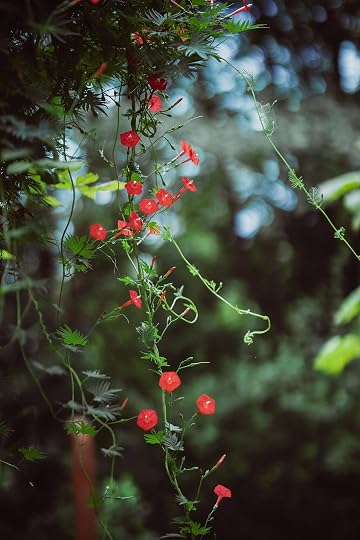
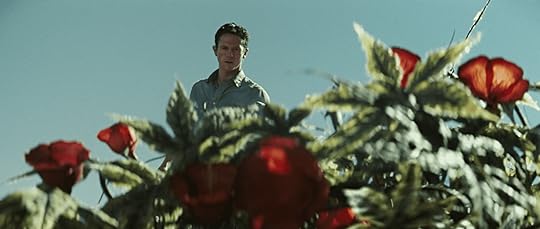
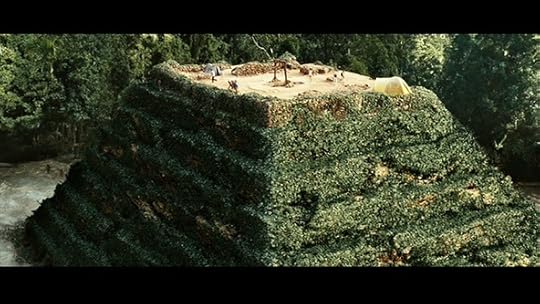
“The vines covered everything but the path and the tent’s orange fabric. In some places, they grew thinly enough that Eric could glimpse the soil underneath – rockier than he would’ve expected, dry, almost desertlike – but in others, they seemed to fold back upon themselves, piling layer upon layer, forming waist-high mounds, tangled knoll-like profusions of green. And everywhere, hanging like bells from the vines, were those brilliant bloodred flowers…”
- Scott Smith, The Ruins
I’ve always had this conception that the horror genre, be it books or movies, are meant to be scary. So that’s how I’ve judged various entries in the field. Did this [book or movie] scare me? Mostly, the answer is no. Real life itself is so terrifying that fictional fears really don’t do anything for me. After all, no monster springing from an author’s imagination is quite so terrifying as my student debt load.
While reading Scott Smith’s The Ruins, it occurred to me that my concept of horror is wrong, or at least strikingly narrow. That I was grading horror on the wrong scale. To be successful, horror doesn’t need to scare you. At least not in the BOO! sense of the word. It should also horrify you. Yes, I recognize this should be self-evident, that legions of youngsters flocking to Eli Roth's torture-porn oeuvre knew this intuitively. What can I say? I'm old, and I'm starting to recognize all the things I don't get. Anyway, The Ruins isn't frightening, but it is horrific. Almost from the start it filled me with dread, creating a weird tension as I longed to read on and hesitated to read on.
The setup is rather standard. Young people, ostensibly good looking, find themselves in a wee bit of trouble. Things get bad before they get worse. The setting, of course, is paradise, because there’s nothing like inverting the joy of being young, attractive, and in Mexico with the unspeakable terror of being hunted by something inexplicable and perhaps supernatural.
Jeff and Amy are med students. Eric and Stacy are not med students. Stacy and Amy are friends. All four are enjoying some time on the beach, getting drunk and lolling in the sun. They meet Mathias, a German tourist who is looking for his brother. They also meet some Greeks, one of whom they nickname Pablo. Mathias suggests they go meet his brother at some Mayan ruins. He has a crude map and a general notion about what they might find. For some reason, Jeff, Amy, Eric, Stacy, and the functional alcoholic, non-English speaking Pablo all find this a good idea.
It does not, in fact, turn out to be a good idea. The six get stranded on the ruins for reasons that I will not explain further, at the risk of spoiling plot points.
Smith is like the Salinger of the modern suspense novel scene. He has written two books. This is the second, A Simple Plan was the first. Both are excellent. Both were bestsellers. Both were made into movies. One of those movies had Billy Bob Thornton in it. That movie is not the one based on The Ruins, because there is no place for Billy Bob Thornton among young, attractive vacationers getting themselves into a situation. Unless, I suppose, Billy Bob is the situation. A Simple Plan came out in 1993. The Ruins followed (at the speed of George R.R. Martin) in 2006. He hasn’t published anything since. I haven’t been able to figure out why.
This is a shame. Because Smith does quality work.
The Ruins is an absolutely fantastic book that I can’t say much about. The writing is superb. Smith knows how to modulate his prose so that it is at times evocative, at times descriptive, and at other times unobtrusive, as the story barrels forward. At the start, the characters sort of blend together. But that changes as Smith draws them in firm, bold strokes, revealing personalities and back stories in an effectively poignant way. I cared for these stranded people. Even Pablo. Well, maybe not Pablo.
This is a battle for survival. The characters are put through a desperate wringer that lasts 369 pages in my trade paperback edition. Smith grounds things so well in reality that I readily accepted the gradual ratcheting of the horror elements.
There are passages in The Ruins that are among the most brutal and graphic things I have ever read. And I say this as a person who makes it a point (on occasion) to discover what is out there in the world of brutal and graphic. Yet the gruesomeness is not gratuitous. It perfectly complements the tale that Smith has set out to tell.
When the heat of summer starts to break, when I walk down the grocery aisle and say to myself, I should get some soup, when the leaves overhead turn orange and yellow and red, and fall to the sidewalk where they brown and crumble underfoot, and when the beer I drink comes spiced in pumpkin, that is my window for reading horror. Since I only read this kind of novel during the Autumn/Halloween season, I don’t claim to be an expert.
I also recognize that horror, like religion and politics, creates wildly divergent reactions in people. If you look at the Amazon reviews, there are as many 1 star ratings as 5 star ratings. I can understand that. If you don’t accept the central conceit, then all is lost. Setting that aside, I still contend that Smith’s literary skills are objectively first class. He excels at scene-setting, characterizations, dialogue, and creating tension.
In my humble opinion – again, the opinion of a man who reads two or three horror novels a year, at best – this is a classic. It does not have the bleak, thematic brilliance of Stephen King’s Pet Sematary, which I hold to be the greatest of all works of horror. But it comes close. This is a novel that got inside me, insidiously. It is vivid and horrifying and ultimately unforgettable. Even on the bookshelf, I can feel the book watching me, daring me to reread it.