Jump to ratings and reviews
Rate this book

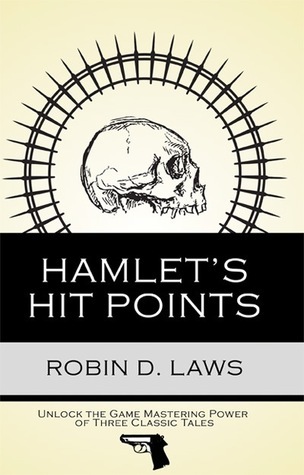
Hamlet's Hit Points

Rate this book
See Your Stories Like Never Before Hamlet's Hit Points presents a toolkit that helps make storytelling in any RPG easier and more fun by classifying story beats and letting you track their ups and downs from hope to fear and back. Armed with these tools, you'll be equipped to lay compelling track for an emotional roller-coaster that will keep everyone at your game table involved, excited, riveted. In these pages, you'll find definitions of nine critical story beats. You'll read about the relationships between those beats. You'll also find complete analyses of three stories you know already-- Hamlet , Casablanca , and Dr. No --to show you how the system works. Written with roleplayers in mind, Hamlet's Hit Points is an indispensable tool for understanding stories, in games and everywhere else.

196 pages, Perfect Paperback

First published August 5, 2010

131 people are currently reading
643 people want to read

About the author

Robin D. Laws

146 books196 followers
Writer and game designer Robin D. Laws brought you such roleplaying games as Ashen Stars, The Esoterrorists, The Dying Earth, Heroquest and Feng Shui. He is the author of seven novels, most recently The Worldwound Gambit from Paizo. For Robin's much-praised works of gaming history and analysis, see Hamlet's Hit Points, Robin's Laws of Game Mastering and 40 Years of Gen Con.

Ratings & Reviews

What do you think?
Rate this book

Friends & Following

Create a free account to discover what your friends think of this book!

Community Reviews

5 stars
75 (22%)
4 stars
146 (43%)
3 stars
88 (26%)
2 stars
21 (6%)
1 star
7 (2%)
Displaying 1 - 30 of 50 reviews
Profile Image for S. Ben.
48 reviews5 followers
August 12, 2011
This book has a very narrow audience: RPG referees who want their games to have compelling dramatic flow. For us, it is excellent. The secondary audiences might be people who want to *understand* the dramatic flow of their favorite movies and books, and those who are writing screenplays and books; it seems like it would be good for those people as well, but I can't say for sure.
Profile Image for Jason.
352 reviews5 followers
November 12, 2016
I went back and forth on the value of this book to me as a reader, an RPG player, and a GM. I was very excited to get it since it is so highly spoken of by people I respect. Once it was in my hands, I was disappointed to find that it contained what seemed to me so little actionable insight. But once I finished the first section on Hamlet, I turned back to the first page and read everything again.

This is one of those books that gives you proportionally what you put into it. The more you give yourself to the book and to its basic premise, the more you can draw from it, and the more you can let it spark your imagination and the possibilities to be had during play.

My disappointment with the book has mostly to do with the final section on Casablanca. This section makes the fewest connections to gameplay, choosing to focus mostly on the movie itself and its movements. This is not a fair criticism in part because Laws's point of the book is above all to teach readers how to break a movie or story down into its beats. Once his readers get an eye for story and its movements, they will naturally be able to bring those elements into their gameplay. Likewise, the ending section, which in reviews I read declared to be the greatest portion of the book, merely focuses on how to do a beat breakdown instead of how to apply that knowledge to your game.

I think that my reaction to the book has to do with my reading it in 2016 instead of 2010 when it was originally published. A lot has changed in the game world in the 7 years since Laws was writing this book. Fiasco had only just been published. Apocalypse World had not yet made its mark. The world of storygaming has opened up since then and a lot of gamers are approaching their RPGs as storymaking (to use Laws's word) devices first and foremost.

Regardless of the book's limitations, it is still useful, insightful, well-written, and well-presented. No matter where you are in your storymaking games, there is something here to make your play better.
Profile Image for John.
Author 4 books28 followers
August 31, 2014
A fascinating look at story design - written with an eye toward tabletop RPGs, but suitable for anyone interested in story structure. Laws' contention is that good stories are built on beats that alternate between hope (getting the protagonist closer to an emotional / tangible revelation) and fear (taking the protagonist further from the same). He documents this by diagramming HAMLET, DR. NO, and CASABLANCA using his invented iconography.

It's not a perfect system: I quibble with a few of his classifications of scenes in Hamlet, for instance. And there are notable errors in editing that render some of the diagrams and discussions hard to follow. But those aside, it's an eye-opening exercise.

Recommended for gamers and writers.
Profile Image for Colin.
Author 5 books141 followers
November 2, 2020
Interesting analysis of literary "beats" and applications for RPG narratives

So, I've heard nothing but good things about thus book by Robin Laws on literary beats and how to apply the concept for RPG gaming narratives. Laws analyses Hamlet, Dr. No, and Casablanca in terms of "beats." I probably read this at the wrong time - right now I'm all should old school ( OSR) emergent narrative (where there is no story but that which emerges organically from the procedures of the mechanics of the game). Very much the wrong time for this book for me, but I can see how this thinking would really benefit GMs who are trying to tell stories with their games. I'll probably need to read it a few more times to fully absorb it all, but Laws lives up to his reputation for genius. Really good stuff.
Profile Image for Lara.
114 reviews1 follower
March 30, 2025
Really thorough and a great jumping off point for learning how to plot stories in general. I really enjoy Robin Laws' books for learning how to be a DM. It has 3 very lengthy and detailed plotting write-ups - Hamlet, Casablanca and Dr. No. This is more of a reference book than something you read from start to finish, although you definitely could. I'm sure I'll be revisiting this book many times in the future. Recommended!
Profile Image for Johnny.
Author 10 books144 followers
June 10, 2016
In one sense, Hamlet’s Hit Points is a clever title. The use of the gaming term, “hit points,” lets one know that this book about game mastering a role-playing game involves gaming and the reference to Hamlet suggests that it involves learning from literature in terms of improving one’s role-playing campaigns. In another sense, Hamlet’s Hit Points is a misleading title. I fully expected to see characters from Hamlet, Dr. No, and Casablanca in sample statistics for one or two existing systems with some explanation from experienced game designer (and novelist) Robin Laws about how he did it. When I bought the book, I was already curious if he tried to create the statistics and skills for a character in the same way I used to write them for some of the Giants in the Earth-type columns I wrote for Dragon magazine (I was the publisher; they probably felt like they had to put me in the magazine.).

So, the disappointment with Hamlet’s Hit Points is that there is no “crunchiness” with regard to creating game information. The good news is that the book is replete with beat-by-beat descriptions (complete with iconic diagrams) for the three famous stories mentioned above. We wade through “up” beats, “down” beats, and “neutral” beats that either build the story dramatically (dramatic) or move the story toward the conclusion (procedural). Using Laws’ methodology (equally useful in writing classes and screenwriting workshops), one can readily see how dramatic tension is built, characterization is strengthened, and how story can be transformed for the game narrative. Why does it have to be transformed? In plays, films, and novels, the storyteller controls what the characters do and say. In role-playing games, the players are the characters and they OFTEN don’t do what you expect them to do. [I guess this happens in writing as well. Dorothy Sayers used to say that she never “converted” Lord Peter Wimsey to Christianity, even though she was quite devout, because she said that he would never do that.) As a result, Laws reminds the readers that he prefers the term “storymaker” to “storyteller,” even though he regrets coining a neologism (Footnote 2 from Loc. 101).

Now, even though I was disappointed with the lack of crunchiness, I’m not saying that I regret buying the eBook. There is some solid advice for gamemasters (although, for me, the practical insights were mostly revealed in the discussion of Dr. No, as much as I enjoyed the literary and dramatic insights for the play and the other movie. What do I mean? One of the beats is when Bond arrives at the airport and the viewers see that he is being observed. Well, there is a point-of-view (POV) problem in the game. No one knows they are being watched unless someone makes an Awareness check and the GM says, “You feel like you might be under surveillance.” Laws notes that the division between audience and character knowledge “…is the engine of Hitchcockian suspense.” (Loc 1551). He goes on to indicate that in “…a gaming context it’s often more effective for the characters to be aware that they’re being watched…” (Loc 1554) and “…even more effective if an obstacle prevents them from immediately catching and identifying their watchers.” (Loc 1555)

Later, he identifies the scene where one of the watchers to which Bond is oblivious shoots at him and the bullet hits a passing car. Laws suggests that this might be a result of a saving roll or even the expenditure of a narrative resource (karma chit?) to cancel out a hit (Loc 1816). Laws also waxes eloquently (and quite rightly, I believe) about the overt sexism in the early Bond films which doesn’t quite fit modern sensibilities.

Speaking of terrific insights, I had watched Casablanca several times before I noticed that the early command to round up suspects balances the famous line about rounding up the usual suspects at the end (Loc 3011). And, in terms of practical observations, Laws talks about the importance of foils and supporting characters while dealing with the colorful and sometimes comic characters in this great film.

At the conclusion, Laws explains how to find and diagram the beats of a narrative, how to use them to analyze your sessions and campaigns (Loc 4330), and how to use “pipe,” his term for the pipeline which is exposition—telling the audience (or your characters) what they need to know. He cautions against putting too many pipe beats in a sequence (Loc 4425). In spite of my disparagement in the opening paragraph, I’m glad I purchased this insightful book. I just wish it had contained a little more useful material in the midst of the dramatic analysis.
Profile Image for Benjamin.
1,429 reviews24 followers
Read
February 16, 2016
Robin D. Laws is a game designer and author who I like a lot; he's also a cineaste and a cook. Which all adds up to: this is a guy who is serious about his enjoyment.

I finally got around to reading this book (borrowed from an improvisor friend and fellow nerd -- what a capacious Venn diagram that is), which is all about "a system for analyzing stories tuned to the needs of roleplaying gamers."

(Laws gives that summary in the section wonderfully titled "How to Pretend You’ve Read This Book.")

In other words, it's a system for analyzing the beats of scenes that modulate (or not) our emotional states, mostly along a hope/fear axis, and mostly around the protagonist's dramatic and procedural aims.

(Or, in other, other words: this feels like a dry-run for Laws's game Hillfolk, which revolves around beats between characters and how they get resolved either positively or negatively. As such, the pair demonstrate how nonfiction/analysis can lead to creative work, and vice versa.)

Laws nicely lays out a bunch of types of beats, starting with the primary beats for him:
procedural (revolving around characters’ external goals),
dramatic (relating to their internal needs).

He then adds a number of interesting, less common beats:
commentary,
anticipation,
gratification,
bringdown,
pipe,
question,
reveal.

(I'm writing them all down so I have a place where I can reference them easily.)

What’s really interesting about this to me is that Laws goes on to identify the beat by both its type and its emotional modulation: a character successfully achieves a procedural goal? The audience is lifted up emotionally on the wings of hope. A character fails to get another character to respect him/her? The audience is brought down into the realm of disappointment and fear.

While these primary beats can swing either way, some of the secondary beat types have a built-in directionality for Laws: gratification is always good, a bringdown is always bad. Laws also notes that some beats might not touch us emotionally at all: a lecture may lay some pipe (i.e., give us some information) but neither excite us with the promise of fun or depress us with the threats to come.

It’s a very interesting system, one which I plan to use to analyze a few stories later. But most of the book is given over to examining three different stories in beat-by-beat detail--Hamlet, Dr. No, and Casablanca. And that's a lot of detail, which sometimes might feel like a slog.

In fact, I was probably most engaged, after learning the general outlines of the system, when I wanted to argue over certain details with Laws. For instance, Laws argues that there’s a sequence where one of the secondary villains in Dr. No becomes a protagonist. And yet, that feels a little loosey-goosey. Why does that person become the protagonist? Simply because he’s the only person we recognize for this sequence and he’s entering a place that is (to us) unknown and scary. It would seem to me to be easier to argue that this reveal is set up as a down arrow for our main protagonist, Bond: we see the lair of Dr. No not as a threat to the secondary villain--who we have no reason to attach to emotionally--but as an eventual threat to Bond.

There are a number of times in the book where I felt like that, which probably shows how engaging and interesting this beat-by-beat, hope-vs-fear system of analysis is. Let's see how it holds up and/or what it can tell us about some other stories.
Profile Image for Chris Duval.
138 reviews2 followers
December 10, 2015
This is a formal analysis of the character interactions in the play, 'Hamlet,' and the two movies, 'Doctor No' and 'Casablanca.' It is pitched to gamers, particularly to GMs wishing to improve their role-playing. The idea is that the formal analysis, which includes a diagramming technique, can be applied to PC and NPC interactions, giving clues on when to change the emotional direction and thus add to player enjoyment. Action and dialog are broken up into 'beats,' which are classified by function and emotional impact. For dramatic dialog, the terms 'petitioner' and 'granter' are used. The author credits Michael Shurtleff, "Audition," an acting text, and the film editor Walter Murch, as relayed by Michael Ondaatje, "The Conversations." I found the application of the techniques gave valuable insights, though I think it important to be familiar with at least 'Hamlet' and 'Casablanca.'

The diagrams supplement the text. From time to time they contradict it, and this subtracts from the book's overall worth.

Non-gamers: GM means game master, and is a generic term that cuts across table-top role playing games (RPGs). The GM has primary, but not exclusive, responsibility for narrative setting and development and derivatively for player fun. PC = player character: one acted by a player in an RPG. NPC = non-player character: one acted by the GM in an RPG.
Profile Image for Jerry.
Author 10 books27 followers
August 17, 2020
My disappointment with the book stems from its under delivery in two ways. On the obvious level, we don’t find out how many hit points Hamlet has, neither literally nor metaphorically. That is, how does analyzing Hamlet (or Dr. No, or Casablanca) help GMs in a roleplaying game where such things as hit points or other player resources describing their character exist? The concept of “their character” is rarely touched on.

The second is that while this book has been on my to-read list for a long time, I finally picked it up because I’d read Laws’s article in the first Interactive Fantasy, when it was named Inter•Action. In it, he writes that “…games that win acclaim today for their adherence to criteria from other narrative forms may eventually come to be regarded as dated and naïve,” and ends the article by writing “Perhaps before we figure out which criteria to apply to [the interactive art of RPGs], we should attempt to figure out how to observe it at all.”

So I was hoping to see how he had solved that problem, and how he was going to contrast the act of seeing a film or play with the act of playing a game.

But there’s practically none of that here; instead, it’s a near beat-for-beat, literally, analysis of one play and two movies, with very little attempt to relate it to roleplaying games, as if the fit were so tight it needs no discussion.

Even that could have been interesting if there’d been some discussion of what changed his mind.

So it was my expectations going into reading this book that led to my finding it merely okay. But I’m not sure I’d have found it much better had I gone into it blind. Laws presents a complex system for analyzing movies (and by inference, game sessions) “beat by beat”. Hamlet has 43 pages of beats, Dr. No 60 pages of beats, and Casablanca 50 pages of beats. The descriptions of each beat are small: there are a lot of beats to analyze. It’s very Gygaxian, both in the amount of record-keeping and the sense that the author doesn’t actually use the system as described for his own games.

You’re supposed to be analyzing your own games in the same way, beat by beat, and also, maybe, player by player within each beat.

The two main beats are “procedural” beats, that is, movement toward a goal where something is in jeopardy, and “dramatic beats”, which are similar but involve interaction with someone the character has an emotional investment in. The goal is some sort of internal change, and some sort of concession is often desired.

There are a lot of other beats that are rarer in roleplaying games. He doesn’t say why, but I’d guess that they are extraordinarily likely to end in a failed narrative. Hiding critical information until the big reveal, in a roleplaying game, is more likely to result in the players completely forgetting the hidden information than in them gaining insight into what had seemed like an aside.

In his analysis of Hamlet, he assumes that three of the characters are player characters: Hamlet, Horatio, and Ophelia. He has a short discussion of their role in the narrative, and talks about how the GM might assign the Horatio role, that of confidant to Hamlet, to a particular kind of player, which is already going kind of off-topic. He has the GM assigning roles to players, instead of players choosing to design their characters.

Similarly, and immediately following, he seems to be making the assumption that the game of Hamlet would have had to follow the same outcomes if Shakespeare had designed a game instead of written a play. To talk to the ghost, he writes, Horatio’s player might have to make a Religion roll, or an Occult roll, but either way the ghost isn’t going to talk to Horatio, it’s only going to talk to Hamlet. This makes the unwarranted assumption that if it happened that way in the play, it has to happen that way as a game. But if looked at as a game, there’s no real reason not to simply assume that the reason the ghost talks to Hamlet is that Horatio’s player failed the roll and Hamlet’s player did not fail, or didn’t need to roll because it was his father. Nor is there any reason to assume that Horatio’s player couldn’t have come up with some innovative means of talking to the ghost outside of a roll.

The mention of Horatio’s player’s potential die roll was mostly an aside, but it’s an important one because, without it, you could sort of assume that the outcomes of each beat were the result of player choice and the game’s success mechanism; with it, the default assumption changes to one of storytelling rather than playing a game.

He also has a tendency to treat scenes that are necessary solely because of the form of the play/film the same as scenes that might play out in a game. Hamlet’s soliloquy, for example, is there because the audience is not the player, and must be informed of the player’s thoughts. There is no narrative reason for it in a game, where the player already knows it and is already voicing their concerns to the other players.

Throughout the book, there are what would be sidebars in a larger format; one that struck me was on point-of-view limitations, and how, in a game, information would have to come to the players in different ways. These limitations come partially from attempting a beat-by-beat translation of a play/film into a game session. The sidebar is necessary because that’s the method the book is about, but it also highlights the limitations of the method. In a sense, this book confirms Laws’s earlier suspicion that applying the analysis of film to games is extraordinarily naïve.

This is further highlighted in Act II, Scene I, when Hamlet’s somewhat complicated plot to get Claudius to attend the play starts to succeed because Rosencrantz and Guildenstern mention the play to Claudius.


In a game, POV limitations would mean that players would learn of their victory only when someone—perhaps Rosencrantz and/or Guildenstern—came back to report that the king has chosen to attend.


In a game, though, that scene probably wouldn’t even exist; the players might lay the foundation, but eventually one or more of them would have to either convince Claudius to attend or discern whether or not they’ve managed to convince Claudius through their proxies. Player characters are able to, and likely to, take action, and in ways that authors often forbid their characters from doing so as to maintain suspense or merely keep the movie from ending before the allotted time is up.

The advantage of roleplaying games is that player characters can interact with the world in a way that viewers cannot yet do. Thus, for example, the reveal of Claudius’s plot against Hamlet can happen in any number of ways as the players interact with the world, querying it to improve their existing knowledge and poking it to reveal unsuspected information.

Throughout this analysis, the issue of agency—that player characters are involved—seems lost.

This is especially visible in the treatment of Ophelia as a player character. She is, in Laws’s telling, constantly the object of player character attacks and is in a mostly subordinate role delivering the results of those attacks to where the player characters want them to go, such as furthering the deception of Hamlet’s madness or as someone for Hamlet to spar with to acquire information.

There is useful information for GMs in the book, and in the analyses, such as having the ghost up the ante once Hamlet discovers that his mother was probably aware of the murder, by asking Hamlet not to seek revenge against her but to redeem her. But for the most part the useful advice is hidden by the complexity of the analysis.


If we don’t either hope or fear for the character, we don’t care what’s going on, and the game is lost.


There’s no actual discussion of what this means. It might have provided a jumping off point for the importance of balancing between being a killer GM or a pushover (Monty Haul) GM, or some other useful insight, but instead it goes back into beat maps and oscillations.

There are two basic assertions. First, that too much seriousness or too much lightheartedness are not as satisfying as a mix, and that strings of successes are not as satisfying as failure followed by a success. But while he occasionally mentions that, for example, Dr. No has “a sequence of five downbeats—more than you see in Hamlet” what this means is left undiscussed.

Further, whether a particular beat ends as an upbeat or a downbeat tends not to be about whether it’s satisfying or unsatisfying in practice; at one point, it’s about who comes out more powerful at the end of the transaction, at another, Casablanca 10, the description implies a “gratification” upbeat and the arrow points down.

The advice, other than to interleave beats, tends not to hinge on the direction of the arrows and in fact the breaking down of beats tends to divert his attention away from actual advice. His summary of Hamlet starts out useful but then gets tangled in the weeds of beat progression rather than what we might learn from Shakespeare’s choices to increase tension or loosen it at various points.

The book has inspired me to watch Casablanca (yet) again; Laws clearly loves both Casablanca and Dr. No as inspirational for roleplaying game sessions and as movies in themselves.
Profile Image for Mario.
Author 2 books6 followers
February 15, 2017
After a recommendation by Pablo Hidalgo, I started reading this incredible book about dissecting stories into beats, in order to better comprehend the rhythm and variance of the hope/fear cycle that allows us to bond with the story.

It does so by using three examples of great storytelling: Shakespeare's Hamlet, as the title suggests; Terence Young's Dr. No film, and Michael Curtiz' masterpiece, Casablanca. Robin Laws explains every beat of the works in order to point the procedural or dramatic relevance of each, how does it affect the story in an upwards, downwards or lateral movement, and what kind of importance to the plot do they have.

Not only this book helped me understand Hamlet in a completely different way, but it also should serve as a starting point to analyze other works of art, and in turn, apply the lessons of cadence and balance in your own RPG sessions.

Highest recommendation possible!!!
Profile Image for Igor.
10 reviews3 followers
June 13, 2014
With a heavy heart I give this useful book only three stars. The described framework for analyzing the flow of the mood by dividing them into atomic beats of different flavors is briliant and helps stay aware of the balance of the story a GM (or a writer - the system is universal) is cooking. It is, however, delivered in an excruciatingly boring package. Only with a lot of effort I was able to plow through a beat after beat after beat of three different works, gradually losing focus and being constantly tempted to skip entire pages. This should have been a lengthy blog post or perhaps a series of smaller ones. In its current form, the book is as engaging as a drawn-out and dull lecture would be.
Profile Image for Sean.
90 reviews13 followers
October 13, 2012
An interesting method to improve storytelling by identifying ways to share narrative dramatic information in a way that assists in creating a satisfying pace in storytelling.

A short system of definitions is introduced, and then seen executed as the beats of Hamlet, Dr. No, and Casablanca are examined. Just these sections alone is enough to provide new perspective on these works.

The system seems useful, but perhaps the book is misleading as a RPG text. The idea comes from the author's blog originally, and that makes sense. This book is an interesting idea but lacks a robust structure. It feels like a suggestion of guidance, not actually a new tool.
Profile Image for Michael Burnam-Fink.
1,702 reviews301 followers
July 11, 2012
In this book, Laws introduces a way of analyzing texts as a series of 'beats', mostly procedural or dramatic, which serve either to increase or resolve tension and danger for the protagonists. While this is supposedly a guide for GMing, the advice is rather scanty: alternate upbeats and downbeats, procedural and dramatic moments, and follow a long slide of downs with a triumphant up. The majority of the book (80%+) is a very detailed beat by beat summary of Hamlet, Dr No, and Casablanca.
Profile Image for Roland Volz.
45 reviews7 followers
October 24, 2010
Analysing visual media to see how they work seems like the dry stuff you might do in a humanities class. But by picking three well-known (or at least easy-to-find) examples and using ordinary conversational language, Robin Laws makes transparent the dynamics of a good story. Thought-provoking yet light, this was an excellent read.
Profile Image for Brian Rogers.
836 reviews8 followers
April 7, 2016
This is just bloody wonderful. It's hard to really describe past the actual description, but many of the thing in here drove me to make Mech and Matrimony, my Jane Austen meets Giant Robots RPG and one of the top 5 gaming experiences in my life, as the mechanics were drawn directly from his observations on emotional beats. It's a great book for anyone who takes their GMing seriously.
Profile Image for Emmanuel Greene.
25 reviews
February 15, 2017
Very interesting book! The advice on mixing up the types of story beats will definitely be useful in running an RPG game (assuming I can remember to do so while also keeping track of everything else involved in running the game). Also, it was fun to watch "Dr. No" again while reading along. Very insightful commentary!
Profile Image for Patrick.
228 reviews3 followers
May 5, 2014
Setting this one back on the shelf until I have more time. This is a serious bit of literary analysis and deeper than my casual reading time allows right now. I will return to this after things calm down a bit and I have the time for serious reading.
Profile Image for James.
12 reviews6 followers
February 25, 2013
I love frameworks, and this books gives an interesting one for mapping the up and down beats of stories.
124 reviews2 followers
December 19, 2018
I've never read anything like this book. Its content would not be amiss in a university course on story and plot analysis, but it's also peppered with applications to improvisational role playing games from the gamemaster point of view.

The basic idea of the book is that effective stories mostly consist of beats of drama or emotional power, and action or physical power. When our heroes get a win, that inspires hope; when they lose ground, that inspires fear. Great moments often involve hope and fear simultaneously. There are other sorts of beats too, dealing mostly with the setup and payoff of informational mysteries, and the setting of emotional atmosphere. But that pretty much covers it!

To prove that you can get a lot of mileage out of this scheme, the centerpiece of the book is its three blow by blow dissections of classic narratives in their entirety: Hamlet; Dr No, the first James Bond film; and Casablanca. You can draw many fascinating lessons from these breakdowns, especially if you are very familiar with the source material. They tend to break up stretches of down beats with up beats fairly quickly. The down beats outnumber the up beats, mirroring the tension of drama. Moments of power often cut ambiguously.

For the budding gamemaster, there are many interesting lessons about balancing challenge with victory for players. Sometimes just relieving tension is appropriate. You can organize your adventure into beats and branches with different payoffs, then rearrange them to suit the rhythm of the season. Some storytelling techniques are unavailable in RPGs, because everything in the story happens on stage. And some are unique to RPGs, such as the ability to play off your intimate knowledge of the audience.

Now that I've read this book, I should have enough to analyze my own favorite works, and to create my own well paced role playing adventures. If you want those superpowers, or you just want to wallow in the greatness of the analyzed narratives, this book is for you.
Profile Image for Mark.
532 reviews11 followers
April 4, 2025
A book for RPGers--mostly game runners--that does a close analysis of the "beats" in Hamlet, Casablanca, and Doctor No. A beat, as used here, is a dramatic unit of somewhat arbitrary length (but short: Casablanca has around 175.)

I read this after re-watching the works described, which meant the floor for my enjoyment started pretty high; even when the observations on a beat are straightforward it still has the relaxed appeal of reading the recap of a show you've enjoyed. Mixed into this are tie-ins as to how something might work in RPG terms (Hamlet fails a Perception roll and thinks it's Claudius, not Polonius, behind the curtain, with disastrous consequences), or advice on what not to do (like have your party taken prisoner.) There are also observations about the craftwork: Bond is allowed fail while still generally protecting his competence; Rick's long run of "wins" at the start of Casablanca establishes a level of detached control he has, but one that we start rooting against.

The general bit of RPG advice that emerges is a point about pacing. None of these works has a huge run of beats that resolve in the same direction. Hamlet (and the audience) have lots of wins before he meets his doomed fate, Bond is omnicompetent and cool but frequently stymied. This need for variety is probably intuitive to anyone who runs games. You feel players haven't had a win in a while, you make sure they get one; they've breezed past all the obstacles, you throw them a challenge. But the details help make explicit options that I think I would have used only accidentally: The challenge doesn't need to be a tough encounter, simply playing an NPC as more of a jerk can give the players what Laws would call a dramatic loss even if they get the clue out of them and move the plot forward.
154 reviews
August 18, 2018
The book describes a system to analyse the emotional ups and downs of a story, and then demonstrates how to use that system on Hamlet, Casablanca, and Dr No. The title references pen & paper roleplaying games, and there is advice on how to use the system to better track and manage the emotions of players in a game you are running or participating in.

The system and advice can apply to any story or game, and overall the concept seems solid. However, I would have preferred more examples and discussion of how it could be used within a gaming context. The examples were chosen to show primarily dramatic, procedural and mixed stories (Casablanca, Dr No and Hamlet respectively), but I one less example and more discussion of how to use the system during a live roleplaying game or when designing a game would have been more valuable.

Laws writes enjoyable and precise summaries of the action in his examples, and it's pleasant to read through the book, but by the end I'm not really sure what the selling points of his system are. In short, it offers good food for thought, but feels like more of an appetizer than a main course.
Profile Image for Mark Austin.
601 reviews5 followers
September 6, 2019
A fascinating look at how story beats work in almost all narrative media, with some explanation of how they might apply to RPGs. After an initial breakdown of what a beat is (change towards hope or fear for protagonists), the author proceeds to discuss the major and minor types of beat in a summary fashion before breaking down Hamlet, Dr. No (the first Bond movie), and Casablanca into individual beats with commentary on each along with occasional applications to games. He finishes with a quick summary and recommendations.

In all, I learned quite a bit about narrative structure, some about running and designing narrative games, and a lot about the specific structures of the play and pair of movies he details. A fair number of beat arrows (indicating the type of beat and whether it was up or down) were incorrect, necessitating a double take of the associated text to determine if it was correct; a minor but not-infrequent event.

Either way, still worth a read for anyone into games, narrative structure, or both.
Profile Image for Morgan McGuire.
Author 7 books22 followers
June 16, 2020
There's about 20 pages of advice on structuring the emotional pacing of games here, and they're good pages. The rest is applying a slight variation on traditional literary analysis techniques to three works. That's well done and informative, but isn't directly applicable to games--I seriously question whether the exact beat structure of Hamlet should be copied for a tabletop campaign, and how one could even accomplish that without railroading the players if it was desired. This is a beautiful analysis, but doesn't deliver what the book promises. I'd much rather see transcripts of gaming sessions, in three different game rulesets, that are augmented with the analysis and how the game master responded to player actions. That would be actionable as game mastering advice. As written, this tells me how to make a movie or book, with the benefit of editing and hindsight, but not how to run a game.
Profile Image for Travis.
2,856 reviews48 followers
August 4, 2018
I understand what the author was trying to do here, and I applaud his efforts. However, I found this whole scheme to be needlessly complex, and overly subjective. I realize the whole point of the exercise is to give game masters the ability to gauge their audience's reactions, and produce a script of sorts that will provide the best playing experience, but I'm just not feeling it.
This method may work for some, but I can't see it being used as a general purpose tool for any sort of large numbers, because it just doesn't fit the ease of use most folks have come to associate with gaming tools. Add to that the fact that it's so subjective, and I just can't see it being useful to more than a handful of folks. Of course, your mileage may vary, but to be perfectly honest, I found the whole concept to be mindnumbingly boring.
Profile Image for David Montgomery.
283 reviews24 followers
December 28, 2019
An intriguing way of analyzing stories by breaking them down into different kinds of "beats," of which the most important are "procedural" beats (where protagonists try to accomplish some task) and "dramatic" beats (where characters seek emotional concessions from each other). After outlining his model, Laws spends most of the book putting it into practice by analyzing three stories for their beats: "Hamlet," "Dr. No" and "Casablanca." Laws, a prominent designer of tabletop roleplaying games, offers this analysis as a way for gamers to improve their roleplaying (and would later write a new game, "Hillfolk," based around the principles in this book), but most of the book would be helpful for anyone hoping to understand ideas of drama and narrative construction. Not a life-changing read, but an intriguing one.
Profile Image for Chris.
129 reviews1 follower
January 8, 2023
I felt this was a book that fizzled. The idea of using beats to analyze a story/play/film was interesting, and I learned about pacing for my own RPGs. And also my own work. But once I had read the example of Hamlet, broken down beat by beat, I didn't feel further in depth analysis added anything more.

And it couldn't decide if it was talking about - story - or table top role playing games. Which though related are different things. One person doesn't have full control of the emotional bears, or direction - foreshadowing and pipeline with payoffs don't always happen in games.

This would be a stronger book either as a story analysis text OR an guide to dramatic beats in RPGs... But in the end falls in the middle and misses.
Profile Image for Vanessa.
349 reviews10 followers
June 26, 2024
I was expecting more advice for GMing from this. 80% of the book was dull beat-by-beat analysis of works that I didn’t find particularly relevant to tabletop gaming. It didn’t help that I’ve never seen Dr No and barely remember Casablanca, but it felt like I was reading an essay from a film studies class instead of anything gaming-related.

I ended up skimming the latter two analyses and only reading the rare sidebars about GMing, which did contain some useful insights, if not enough to warrant the length of the book. The primary message could have been covered in a much shorter work: mix up and down beats in your campaign to achieve a rewarding tension between hope and fear for your players.
Profile Image for Ryan.
133 reviews4 followers
February 16, 2020
First of all, if you like literary analysis and also play ttrpgs, this is a must-buy. Laws is very good at scene-by-scene analysis, and chooses a few excellent examples that vary from emotional melodrama to pure procedure.

I do wish that there was more commentary and advice for GMs. There's some there, maybe a page or so for every ten pages of the literary analysis. I just thought the book was so well done that I wish there was more, I would have happily read another hundred pages on the same topic.

I'll check out more books by the author as they articulate this concept better than any other book I've read so far.
Profile Image for Deanne Townshend.
94 reviews
June 8, 2020
It's always difficult to review books that teach something practical vs narrative, but I learned a lot from Laws' book about storymaking structure, pacing, and emotional response.

I'm sure it would have been more helpful if I was more familiar with the three pieces studied (Hamlet, Dr. No, and Casablanca). Likewise, the entire book was slightly dated in reference and the new wave of gaming over the last decade to higher levels of development vs action.

Still, the primary teachings and practical use remain extremely useful as a DM/GM, and I'm excited to try these in my campaign.
Displaying 1 - 30 of 50 reviews

Can't find what you're looking for?

Get help and learn more about the design.