Jump to ratings and reviews
Rate this book

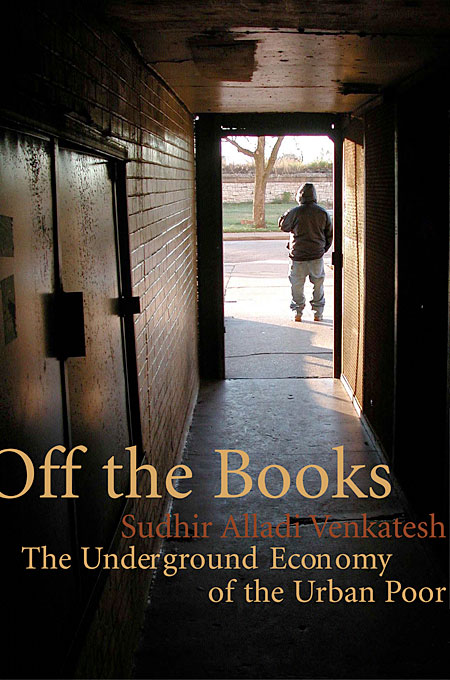
Off the Books: The Underground Economy of the Urban Poor

Rate this book
In this revelatory book, Sudhir Venkatesh takes us into Maquis Park, a poor black neighborhood on Chicago’s Southside, to explore the desperate, dangerous, and remarkable ways in which a community survives. We find there an entire world of unregulated, unreported, and untaxed work, a system of living off the books that is daily life in the ghetto. From women who clean houses and prepare lunches for the local hospital to small-scale entrepreneurs like the mechanic who works in an alley; from the preacher who provides mediation services to the salon owner who rents her store out for gambling parties; and from street vendors hawking socks and incense to the drug dealing and extortion of the local gang, we come to see how these activities form the backbone of the ghetto economy.

What emerges are the innumerable ways that these men and women, immersed in their shadowy economic pursuits, are connected to and reliant upon one another. The underground economy, as Venkatesh’s subtle storytelling reveals, functions as an intricate web, and in the strength of its strands lie the fates of many Maquis Park residents. The result is a dramatic narrative of individuals at work, and a rich portrait of a community. But while excavating the efforts of men and women to generate a basic livelihood for themselves and their families, Off the Books offers a devastating critique of the entrenched poverty that we so often ignore in America, and reveals how the underground economy is an inevitable response to the ghetto’s appalling isolation from the rest of the country.

426 pages, Hardcover

First published October 16, 2006

59 people are currently reading
2088 people want to read

About the author

Sudhir Venkatesh

10 books251 followers
Sudhir Alladi Venkatesh is William B. Ransford Professor of Sociology, and the Committee on Global Thought, at Columbia University in the City of New York.

His most recent book is Gang Leader for a Day (Penguin Press), which received a Best Book award from The Economist, and is currently being translated into Chinese, Korean, Japanese, German, Italian, Polish, French and Portuguese. His previous work, Off the Books: The Underground Economy of the Urban Poor (Harvard University Press, 2006) about illegal economies in Chicago, received a Best Book Award from Slate.com (2006) as well as the C. Wright Mills Award (2007). His first book, American Project: The Rise and Fall of a Modern Ghetto (2000) explored life in Chicago public housing.

Venkatesh’ editorial writings have appeared in The New York Times, the Chicago Tribune, and the Washington Post. He writes for Slate.com, and his stories have appeared in This American Life, WIRED, and on National Public Radio. His next book, under contract with Penguin Press, will focus on the role of black market economies—from sex work and drug trafficking to day care and entertainment—in the revitalization of New York since 1999.

Venkatesh is completing an ethnographic study of policing in the Department of Justice, where he served as a Senior Research Advisor from 2010-2011.

Venkatesh’s first documentary film, Dislocation, followed families as they relocated from condemned public housing developments. The documentary aired on PBS in 2005. He directed and produced a three-part award winning documentary on the history of public housing for public radio. And, he recently completed At the Top of My Voice, a documentary film on a scholar and artist who return to the ex-Soviet republic of Georgia to promote democracy and safeguard human rights.

Venkatesh received his Ph.D. in Sociology from the University of Chicago. He was a Junior Fellow at the Society of Fellows, Harvard University from 1996-1999, and an NSF CAREER award recipient in 2000. He holds a visiting appointment in Columbia University’s Law School and he is a voting member of the Institute for Research in African-American Studies.

Ratings & Reviews

What do you think?
Rate this book

Friends & Following

Create a free account to discover what your friends think of this book!

Community Reviews

5 stars
190 (22%)
4 stars
320 (38%)
3 stars
239 (28%)
2 stars
65 (7%)
1 star
16 (1%)
Displaying 1 - 30 of 90 reviews
Profile Image for Lobstergirl.
1,921 reviews1,435 followers
October 18, 2011
I'll never look at a ghetto the same way again. Much of what sociologist Venkatesh found during his deep immersion into one of Chicago's south side neighborhoods isn't surprising; what did surprise me was the degree of symbiosis among the various players in the underground economy. Street hustlers - often homeless - might hawk merchandise, but also be employed by store owners to hand out flyers, or even to sleep in the store at night as security. A store owner might provide a ready bathroom to the hustlers who are doing him favors so that they don't have to defecate in a park, or just a place to store their belongings. Ministers will help broker short term jobs for the underemployed, but will get a cut in exchange for the "job placement." And the constant presence of people on the streets, out in public places, is due to the lack of private spaces: people who have stable places to live, whether they own or rent, often provide a place to sleep for a constant stream of relatives and friends down on their luck, so privacy inside the home is in very short supply.

A street hustler named Carla told him:

You're going to think this is funny. But if you're poor, you need jail. You really do. That's where I disappear to. The food is good and it's better in the winter; the people are okay to you, except for the guards that try to get up in your kootchie. And you get some peace. I mean, you have to know when to go! You can't go right after [check day] when everyone's in there because they're drunk. No. You go middle of the week, slow time, get a few days, get rested, get warm. See, everyone around here does that. That's why we know the cops so well; we see them all the time. They're like our landlords.


The hustlers often prefer jail to shelters because jail doesn't kick them out at 6 a.m. And jail attendants sometimes look out for the hustlers. One said, "It's not official policy, but we don't stick these homeless people who...just need a night to rest. We don't put them in with the rapists, or even burglars...I guess I got a lot of feeling for these people. They work their tail off, they get arrested, and I know they do things wrong, but they are just desperate, they just need to survive."

It's not an uplifting read, and Venkatesh's writing style is wordy and repetitive. His favorite word is myriad.
Profile Image for Eric.
70 reviews44 followers
November 6, 2012
I'm not really sure why so many Goodreaders were expecting a Harvard University Press' publication of a qualitative study of illicit economies to be targeted for the reading level of The da Vinci Code... Let's be clear, this is the publication of a multi-year survey by an academic on an academic press.

And it's an incredibly important study. Most scholarly output on the urban poor draws either from statistical estimates of activity or on political polemics disguised as original research. This is a frustrating book in that the intricate networks of interdependence defy simple solutions. The ideological solutions from either end of the American spectrum, developed for the self-congratulation of their adherents, don't address the issues that actually perpetuate the cycles of poverty.

Some have criticized the writing as being overly redundant and this is a fair criticism, particularly the penultimate chapter "Our Gang" which seemed to succumb to repeating the same points over and over. If Venkatesh didn't have sufficient material for a whole chapter, he should have dispersed his material on the gang (more precisely, the community's attempts to mediate the conflicts created by the gang) throughout the other chapters or expanded its scope to include more information on the official policing of the neighborhood.

However, that doesn't change the fact that this is the best book I've read this year. I've learned more about poverty, Chicago, and even my neighbors, from this volume than I have in all my reading to date.
Profile Image for Colleen.
741 reviews15 followers
April 15, 2009
The topic is important (urban poverty) and the book is informative. The degree to which police are complicit in the underground economy by their simple refusal to interact more with poor communities was an eye opener. But the book was too long, mostly due to unnecessary wordiness and repetition of arguments--it should have been about 3/4 or even 1/2 as long as it is. He seems like a good academic writer but doesn't make the transition to a wider audience very well--it definitely could have used better editing.
Profile Image for James.
301 reviews73 followers
February 17, 2009
Probably the best account I've seen of life in the slums.

The author tells interesting stories about how welfare mothers "manage the household".
Getting a few dollars here, there, and anywhere to pay the bills.

Every adult who lives in the home is expected to contribute,
either money, a car, services, something.
Even grandparents have explicit mandatory contributions.

One woman kicked her grandfather out of the home six times for up to a month because he was not putting in his share.

The author repeats the words family members use to refer to each other,
bitch, n****r, and other expletives are used to refer to grandparents or granddaughters.
A gritty look at the poor underbelly of Amerika.

One thing that surprised me was the fact that the ministers are as predatory as anyone else in the community.

They help find work for people and demand 10% of the wage in return.
To prevent people from not paying them for long term work,
they shuffle the workers around.

A person might work a week or two at one place then be replaced by someone else. They in turn move on to another job.
Even if a worker thinks they might have a long term position,
the worry that the employer may move, lose his job, or divorce,
keeps them in line.

Preachers may tell people to forgive others,
but when it comes to their 10%, they never forget or forgive.

Like their white brethren, they are also sexual predators.

The author is from India, so the people don't look at him as either white or black.
So he is given a more intimate view of the subjects lives than someone who is identified as being either one of us or one of them.


Profile Image for Mike Morita.
5 reviews
October 8, 2007
Freakonomics is a huge bestseller, the successful collaboration of an economist and a journalist (Levitt & Dubner). This book screams for such a collaboration.

Off the Books: The Underground Economy of the Urban Poor is authored by an economist and colleague of the better known Levitt, and explores similar "real-world" economics that the public is now familiar with. The author entered Chicago's tough area and, after gaining the trust of the locals, began to observe the interrelated economic activities therein.

This book is fascinating, both the author's experience and his observations are stories worthy of retelling, but the writing style dooms the content. It is obvious that the author writes mostly journal articles. The dry, factual retelling lacks flow and keeps the reader at arms length as an observer rather than a participant in the action.

If you are comfortable with an academic style, this book is quite interesting, and I would recommend it. If you want to be engrossed & entertained, however, reread Freakonomics.
Profile Image for Anya Weber.
101 reviews1 follower
November 3, 2008
I'll admit that I only read about the first half of this book. It's a fascinating topic: the underground, unreported, illegal commerce that goes on in the inner city. And Venkatesh definitely knows his subject; he spent about a decade getting to know this one Chicago ghetto community, and I completely trust his stats and judgments about how people there make ends meet.

Unfortunately, Venkatesh's writing style is a bit pompous at times, and he throws in scholarly terminology when it's not really needed. He also paraphrases himself and others in an irritating way, rather than reporting speech directly. I'm sure that sometimes he does this to preserve the anonymity of his subjects, but it feels a bit stiff.

I kept comparing this book to Mitchell Duneier's vastly more lovable "Sidewalk," which is about homeless people in NYC who support themselves by selling books and magazines (illegally) on the sidewalk. I loved that book, and was completely fascinated all the way through, so I'd recommend that one over "Off the Books" for a good layperson's guide to inner city economies.
Profile Image for Emily.
Author 6 books32 followers
June 3, 2009
Off the Books is still a book for the lay reader but it is clearly a deep dive into the economics and sociology of the urban ghetto. The book explores how various actors in the ghetto economy work with each other from people just trying to get by to prostitutes, pimps, street preachers, homeless, local business owners, itinerant hustlers, and gang members selling crack on local sidewalks.

On the good side, it is peppered throughout with very specific examples and excerpts of interviews and conversations with local residents. This makes the book an extremely interesting read for the large bulk of it, since it is much easier to identify with the ghetto ecosystem from the point of view of people instead of numbers and tables. On the bad side, the book does occasionally veer into the gutter of academic talk where it rambles for a while. Some of these sections are skimmable but some are not so occasionally the book bogs down.

All in all, a very good, interesting read. Not a particularly fast read, but a very interesting read nonetheless.
Profile Image for Kate.
650 reviews151 followers
November 20, 2012
Living in and around Chicago for almost my entire life, I was particularly interested in what Venkatesh had to say about the inner city experience here. He did not disappoint. Venkatesh uncovers a world that is barely visible in the evening news reports of murder, drugs and meyhem in neighborhoods like Garfield Park and Englewood. I now completely understand why people living in these communities are so hesitant to implicate the murderers in their midst. I understand now how clergy became entangled in the edges of crime, and when and how the gangs became more violent. This is a book about under the table economics, yes. But it is also a book about a community's survival in a world where its members are most unwelcome. Economics is just one strand in a web of community relationships, inadequate policing, addictions, violence and compromised social services. The final chapter ties together all of the actors whose livings were described in earlier chapters. It is a brilliant piece of academic writing. Remarkable work.
Profile Image for Steve.
89 reviews5 followers
October 3, 2007
While Off the Books can be a little dry at times, it was still an interesting look into daily life for the urban poor on Chicago's South Side. Some of it was what I was expecting (pimps, hos, drugs, and gangs) but a lot of it was news to me (a homeless guy with a thriving auto repair practice).

What was particularly interesting was that the book covered events from the late nineties up until 2004, so a lot of what was discussed is fairly recent history.

Venkatesh has a tendency to hammer a point home so hard that it becomes redundant, but for the most part I found his commentary both insightful and enlightening. Just be prepared for some sections to drag on.

READ IT IF: you like sociology and you are comfortable with academic non-fiction.

SKIP IT IF: you need a "juicy" story to drive the book forward and keep your interest; most of this book is about things (situations, neighborhoods, and politics) and not stories ("oh no he didn't!").
Profile Image for Madeleine.
5 reviews4 followers
December 23, 2008
One of the best books on poverty I've ever read. Venkatesh spends over a year in a small (several blocks) section of south Chicago learning about the complicated "underground economy"--how drug dealers make their money, how single mothers negotiate with those drug dealers for economic assistance in exchange for allowing them to sell drugs on a certain corner, etc. If you've ever wondered how people survive on $203/mo (the amount of welfare given to a single adult, for example, in Minnesota), read this!
1 review
December 12, 2014
Venkatesh has masterfully produced what is both effective and persuasive in his work “Off the Books: The Underground Economy of the Urban Poor.” It is effective in that he captures the essence of a plighted people and place, and persuasive because some kind of personal change will be experienced in the range of time before the book is read to after it is finished. He shows that there is good, there is bad, and there is ugly existing in Maquis Park, just like every other neighborhood across the United States. In this way, Venkatesh indicate a contradiction throughout the book, which is how this Chicago neighborhood is both its own separate entity unlike any other, as well as a place not much different than certain areas of urban poor and that mirrors those in existence across the nation. Without any available opposition, the argument is that he has accomplished what he intended: an insightful overview and persuasive analyzed study of an impoverished Chicago underground neighborhood that operates by its own rules and yields its own particular series of events.

The book takes place in Maquis Park, a Southside neighborhood of Chicago which is predominantly black and impoverished. Over a span of years, the author compiles what he learns from community members, including some examined history and experiences as he interacts with the population he is studying. These accounts are personal, they are real, and they are raw—a snippet of obscene language will serve as a reminder. These stories elicit authentic attitude and feelings from within the characters. The reader remembers that these are factual people, and in effect, the reader should have an emotional response or at least some kind of empathy. The author is careful to not sugarcoat nor exaggerate his findings, which proves the interpersonal collected data to be as accurate as possible given the circumstances. As you read, you undergo smooth transitions between the present moment and past happenings, which work to purposefully link a connection of the past to the present and future. The personal stories start and end with a gang leader, Big Cat, and symbolize the fate of a Maquis Park member. This could also be the fate of someone else, or it could be a wake-up call to reevaluate and adjust life choices. This is not to say that everyone who lives in Maquis Park is unhappy in their current situations. Some do fine and are content, but others struggle day after day. Big Cat, although gang affiliated, wanted to support the community by giving back. This was somehow part of the gang code and a vision he had to improve life in Maquis Park. Unfortunately, Big Cat’s decisions ultimately led to his own fatality: gang related conflict took his life. One of the social stratification problems that is explored is how this cycle cannot break and, so, consequently repeats itself. Through unexplainable chances or constructive decisions, or rather the combination of the two, a select number of Maquis Park’s members pull themselves out of the ghetto into a new life which exists away from the previous. But those who are not as fortunate stay entrenched in the location and all it provides, creating this place that is entirely deprived and relatively homogeneous.

Venkatesh effectively transports us to a Midwestern world of the urban poor. He presents to us many individuals who lead unique lives, but which are all united by ties to the underground economy where the neighborhood’s isolation causes its industry to go unregulated, untaxed, and undocumented. Some have no choice but to participate in unofficial transactions, but others choose to profit through it, weigh the potential benefits with risks, and assume the danger of being caught. Certain candidates who are in terribly worse off situations actually hope for police intervention to take them to refuge. The example the author gives is the homeless who are especially disadvantaged and would rather spend a few nights in jail so that they will receive rest versus dealing with a rule that forces them out of shelters in the morning to search for employment. Well-known in the community is Pastor Wilkins, a pastor, leader, and supporter; as is Leroy, an auto shop entrepreneur who accepts payments of used electronics in exchange for his services. For survival, the underground economy depends upon the life source of its people, or the strength of ties that the community hold with one another, and the author uses Jesse Jefferson’s words to explain. These read: “Our business is never just about making money, it’s about community relations at the same time” (143). One person’s transaction has a ripple effect that will inevitably touch many others who are connected through a web, knowingly or unknowingly. The author demonstrates just how integrated all parts of the community are through the examination of Big Cat’s gang. I myself, on the topic of gangs, immediately think up a definition which includes a group far separate from and unrelated to the community, but the author defeats this type of thought with his own evidence and findings that prove this to be incorrect. It is learned that the gang members are just as much part of the community as everyone else! Big Cat is even included in the agreed upon meetings that are carried out toward the end of the book before his death.

Venkatesh always gives us at least two sides to every point, analysis, story, or encounter. By doing so, he persuades the reader to break his or her own biases in favor of adopting a fresh outlook on the subject at hand. There is the pastor who helps mediate conflict, but who also charges the mediated for his time and position of power. And there is Big Cat—head rank of a gang—who frequently participates in unlawful doings, yet, in addition to, takes care of his community by donating funds to various programs and orders his subordinates to safely watch children who hang out in the parks. One can certainly appreciate Venkatesh’s objectiveness, a key element in writing a piece such as his. He does not take us into this hush world to prove its existence of right or wrong, just as he does not claim its innocence nor deny the evident corruption. An essential part of the author’s success in the study stems from an advantage he has, his background, which labels him as neither friend nor foe. He is the perfect observer, a neutral character in a game known as the underground. He is not feared, just as he is not revered, except when it comes to his provision of mediation. Racially he does not blend in as an African American, however, neither does he stand out as a Caucasian. Thus, he as the impeccable viewer is able to collect his data without problem.

The author exposes us to an inside world which most of us are not familiar with or may hold prejudice against. After finishing the book, I felt I was divided or on much more of a middle ground between seeing this place with both an angelic and a devilish composition. In the beginning, he starts with a clear separation for the sides of activity—licit and illicit. He argues that even though licit exchanges may be breaking the law, they are logical and not heinous. A trade of services such as childcare for homemade food helps care for a child and feed someone who is hungry—there is no danger and no one is harmed. He contrasts this to the illicit side, where many experience disturbance and are harmed as a result. Prostitutes illegally earn money to survive, but, in doing so, are physically assaulted and run the high risk of imprisonment. Homeless groups in other cities who are caught loitering may be in trouble with the police, but the homeless in Maquis Park are seen as a vulnerable source of cheap labor, such that many small business owners use them to sleep in their shops as low-cost security or work part time as discounted employees. Even though its legality is missing, still again this trade off benefits both the struggling homeless population as well as the community’s needy business owners. The author beautifully reveals symbiotic relationships one after another in a quest to highlight the interconnectedness that drives people through their difficulties to the side of victory. The legality that is missing affects the entire community and almost everyone is a part of it in one way or another. One might reason pastors would be immune to what is known as the “shady world”, but they are just as much active in it as anyone without a religious title. They may even have more relations with shady members, since most of them believe in counseling all people and, as a result, regularly interact with gang members. Those like Pastor Wilkins who allow funerals for slain gang members usually receive monetary contribution as a thanks for their offered service. There is one main street of shops where Venkatesh learns that over seventy-percent of workers are informally employed, which would include the previously mentioned homeless working as employees. People, he says, do not want “real” work since they are comfortable being locked into the community with the social support of these personal networks they are provided with. Again, even though it is not legal, more money can be made if payment forms alternate to other goods. Like Leroy receives electronics, he can sell them for higher prices to someone and increase his profits so that he can continue to run his auto business. Sometimes in kind services are supplemented if someone cannot pay back the money which they were lent, and if this is done, the person avoids ruining a relationship by not paying anything at all. There is more cleverness than one might imagine when it comes to being part of the underground and making money. Venkatesh becomes familiar enough to learn that street hustlers have to negotiate public space with others before they execute their moneymaking talents and strategies, while gang members collect “street taxes” from shop owners and others who they can intimidate and extort money from.

The people of the underground continue to function as they have for so long. They do want change, but they must first victor over steep adversity in order to attain it. They have lived disadvantaged in such a system for long enough that it has become a default way of life, what children grow into, and what adults wish to escape but mostly do not seem to. Venkatesh briefly mentions the feminization of poverty in the ghetto, but I feel does not analyze it as deeply as other major aspects. This book’s central topic is not feminization specifically, though I would have liked to have read more about it; his accounts seem to focus almost entirely on adult men and not on youth and not majorly on women. After giving accounts, he offers solutions to the black struggle he observes. He suggests government subsidy form that would spur business growth in the area. He tells of the Fish Tank analogy for life in the ghetto that teaches no matter who you are, you are relying on someone else. Unfortunately, blacks are the least likely to acquire loans, while other ethnic minorities are more likely. This is just one disadvantage that calls for government subsidy. As for government intervention, that is critically needed as well. Although police are a legal authority, their presence when required is missing in the ghetto, which is why Venkatesh tells us that other prominent community figures substitute themselves by stepping into that role. Pastor Wilkins works in close relation to Big Cat, the Black Kings gang leader, not because he respects gang life, but since he knows that the police are unable to be effective in stopping it. Communal activities like such demonstrate that strong collective action is the community’s strongest weapon against hardship, and we only know this because of Venkatesh’s well-done gathering of insight.

When I first obtained my copy and discovered the book’s total length, I assumed surely that there would be heavy repetition within its many pages, enough to create craziness while I read. And to be honest, there was repetition that evoked boredom as I struggled to finish one of the middle chapters. I understand repetition is needed to get a point across and to heavily support it, but it sometimes generated tiredness and slowed down my pace as I read. It made me want to get through the book quicker and speed up the process. Yet, it felt like I was not getting anywhere, like there was even more to read than before. It was as if I had been sucked into a form of book limbo where movement did not occur as usual, and I’ll admit—that felt strange. That put me off the middle of the book since I had lost momentum. It was a steady start, a weak middle, and a sturdy end for me and my interest level, like an inverted bell curve. Maybe it was all psychological, because there were only a small number of chapters but they were expansive in size. However, by the end of the book, I was surprised to find it more enjoyable than I had originally anticipated. As a whole, this book does exactly what you want it to. It does not aimlessly give countless personal accounts like one may blindly prepare for, it instead correctly uses firsthand information to augment support for its arguments. It stays on focus and then brings in the scholarly analysis when necessary. It also awakens one, if he or she is not already awoken, to the world of social stratification. The people who live in Maquis Park do not immigrate there, they are born into it without a choice or desire. For those who wish to move out to go on and have a better life, most cannot afford to and so they do not exit from the community. As a reader, the book has certainly made me grateful for what I have been born into and fortunate to have. It brings an awareness to this sense of injustice and people who are forced to live unfair lives: kids of prostitutes, kids whose fathers are incarcerated, kids at schools that do not have adequate resources, kids who do not receive the attention and role models they deserve and look for each in the form of gang life. Besides a variety of countless other cases, there are women who prostitute themselves to support their dependents and men who deal drugs so that they can eat. Many will argue that they need to get real jobs and abide by the law, but those who make that argument have no true comprehension of what discrimination these people face. It seems obvious enough that it should not be said, but the ghetto is—as we have learned—a place unlike most that subsists on its own set of means. If one should learn anything from this book it is an understanding that neighborhoods similar to Maquis Park exist the only way that they know—through undying methods and techniques of the shady world. If we are to mend these depleted neighborhoods in restoration, we will not be successful simply by halting these affairs. Arresting drug dealers here and there does not stop the drugs from finding their way into the hands of the people, basically, because this responsive approach fails and there will always be other drug dealers to carry on the task. Instead of being reactive we must be proactive with regards to fighting such a battle, and this means implementing policy that targets the root of the problem, not just the effects. Like pulling a weed from a garden, it cannot be picked from the top or it will continue growing. It is more difficult, but it must be extracted completely from the root.

In regards to audience appreciation: I would recommend this to my Sociology friends, but not my regular friends. This is specific subject matter with great depth of research and discovery. It illustrates what is problematic, and it certainly is not uplifting, though it may generate inspiration. Lovers or members of sociology and its realm, I think most of all, would appreciate this work for its quality, regardless of minor personal disfavors.
Profile Image for Amanda Bivens.
229 reviews3 followers
January 3, 2017
I began this book with great excitement. The first few chapters were engrossing. However by the time I made my way to the chapter on gang contribution, I felt the information was becoming circular. No new insight was gained because everything had been laid out in pieces within previous chapters. I did thoroughly enjoy the part about pastoral contributions to the underground economy and overall found the work to be fascinating and refreshingly unsentimental.
Profile Image for Dawn Nichols.
100 reviews4 followers
March 8, 2023
This is a very well-written book explaining some of Venkatesh’s most interesting research. He tells a rare story in a more academic yet accessible way. If you are interested in this topic and not necessarily expecting a popular science style one finds in more common bestsellers, then this is a great book for you. It’s detailed and fascinating.
Profile Image for Vincenzo Rascionato.
57 reviews
June 14, 2021
Interesting book on how the underground economy works based on a 1st person account. Great examples of how a neighborhood actually works. Sometimes the writing got repetitive but overall a solid read.
8 reviews31 followers
December 25, 2021
Read this for a class in college and enjoyed it for the most part. I agree that the writing could've been cut down in half, but it was an overall eye-opening read about how these communities utilize their own economy outside of the societal norm.
Profile Image for Ashleigh Summerlin Ochoa .
2 reviews4 followers
March 1, 2017
Not very well written, redundant, and overly detailed. Then again, it is the authors thesis and culmination of years of research, so I shouldn't be so harsh
15 reviews
June 1, 2023
Reading style is extremely dry. It was a pain to read despite the fantastic topic. I didn't finish it mostly because of this reason.
30 reviews2 followers
December 1, 2024
Learned a lot, but the content was dry and repetitive.
Profile Image for Misha.
35 reviews7 followers
March 26, 2013
I'll try not to repeat what the other reviewers have already said and
just express my opinion on the book.

It is sad but all too true that the poor seldom speak for
themselves. And even though they may live a few blocks away, it
requires a prolonged ethnographic study like Venkatesh's to get
the picture of their daily lives and economic relations.

And the picture he paints is indeed fascinating. Sterile academic
words like "gang activity" or "narcotics" that Venkatesh uses contrast
with the stark reality and the daily struggle that the urban
downtrodden have to lead. This is probably the single most important
reason to read this book. The book provides a comprehensive survey to
the twisted economic and social life of the "shady world": there is a
chapter on "soccer moms", on business people on street hustlers, the
preachers and on the street gangs. However, the main feel that I got
for Marquis Park is that of a place of crushing poverty and
despair. The anecdotes and live situations are bizarre yet possess
their own underlying logic: a gang leader as a person to turn to to
mediate conflicts; a garage owner paying his mechanics with used radio
equipment instead of cash; a church leader "placing" his parishioners
into the homes of the affluent, getting a cut of their wages and then
"rotating" them to make sure they do not lose their dependence on him;
the small business owners fostering relationships with each other
through small loans to secure against tough economic circumstance; the
same business owners are afraid to operate outside the ghetto because
the operating environment is so insecure and the relationships inside
the community provide the meager support in case of hard times. It is
breathtaking how the residents of Marquis Park completely gave up on
the safety net of the modern state and, as in primitive societies,
rely on their children to provide care and support in their old age.

The author's sympathy towards his subjects shows often in the book and
make it a far more pleasurable read. However, this comes with a lot
of effort on the reader's part. Venkatesh writing style is circular
and repetitive. The book starts from the death of the gang leader and
ends with it. This would be a nice narrative device if it were not for
mind-numbing continuous retreading over the same thoughts, ideas and
facts. And it is not that Venkatesh repeats himself word-for-word but
he just goes over the same territory and re-references or re-stresses
or reiterates ad nauseam. At some point I started treating the books
as a primary source --- a witness account rather than a synthetic
scholarly work. Another major complaint is the scatterbrain treatment
of the material. With all the repetition, some of the important
economic background and the history of the formation of the ghetto is
tucked in somewhere in the middle of the book. For example, the ghetto
got so poor because most of the blue color jobs that the ghetto
residents used to be able to get were shipped overseas. This fact is
mentioned offhandedly in the introduction of one of the middle
chapters.

Another major annoyance is the lack of numbers and statistics in the
book. How difficult was it to state what the number of people in
Marquis Park was? How many of them actually migrate out of it? It
seems that there is a constant outflow of people. What is their
average income? How does it compare to the other American inner
cities? What are the economic dynamics of it? They have become poorer
in the last twenty years, but by how much? The author claims there is
no adequate policing. How many policemen are there per resident? How
does it compare to other parts of the city? The author claims there is
overcrowding. How many square feet are there per resident? and so on.
At last it would not have hurt this book to provide some sort of an
idea of what is required to better the lot of the residents of Marquis
Park.
12 reviews
June 27, 2016
Off the books is an engaging account of life in and around the underground economy in an American ghetto. The author, Sociologist Sudhir Venkatesh , spent a large amount of time in the Chicago Southside neighborhood of Marquis Park, establishing relationships with residents and
observing their daily life. This provided him with the ability to write a fly on the wall account of the web of exchange in the neighborhood that is occurring outside of the formal economy.

The ghetto presents a range of opportunities for off the books work. Drug dealing and prostitution are obvious underworld activities, but the book details the surprising breadth of ways people hustle to make a dollar or two. One man has a niche doing minor car repairs in
alleyways while another shines shoes and helps squatters find a place to stay for a fee. A Homeless man might be payed a few dollars to watch a store a night, while for a fee the local preacher may mediate your dispute. The neighborhood is severely lacking in opportunities for traditional employment so the underground economy is an tied to residents doing what they can to just get by.

The books consist of chapters focusing on differing aspects on the underground economy: the household, entrepreneurship, street hustlers, preachers, the local gang.These chapters are anchored by a cast of recurring residents like James Arleander the homeless mechanic who does car repairs in alleyways and Marlene Matteson, the president of the local block club.

While the books is very local in the focus, Marquis park is tied back to larger scale economic and political trends. One example of this is a very interesting discussion on how the entrenched poverty of neighborhoods like marquis park was in part an unintended consequence of the successes of civil rights movement. Similarly there the chapter on the local preachers provided a short political history of Chicago and the role preachers played in the movement leading to the election of the city’s first black mayor Harold Washington.

I picked up this book wanting get a better understanding of the kind of urban poverty fictionalized in
television shows like The Wire. Marquis Park is a real place, populated by real people, who have to struggle in numerous ways just to get by. The book is in Chicago rather than a fictionalized Baltimore,
but it is a very recognizable neighborhood. In terms of increasing your understanding this goes further than something like The Corner: A Year in the Life of an Inner-City Neighbourhood
as into the larges scale forces that helped to create and sustain the ghetto.

For any prospective readers I recommend that you go into this book with realistic expectations of what you are about to read. This was written by a Columbia University Academic and published by the Harvard University Press. This book is not a page turner. While the material covered is quite interesting, there are a number of quite slow moving sections. Similarly the author has a habit of repeating some passages almost verbatim which would most likely have been cleaned up if the book was written with a popular audience in mind. The author does write clearly and there is no academic jargon so this book should be accessible provided you have a little bit of perseverance.
Profile Image for Marigny777.
17 reviews5 followers
July 6, 2010
I have a particular rule that applies to managing my bibliophilia, which is that any book I leave in a Macy's fitting room while trying on new pants to replace the ones that I tore that day on the way to work, is not a book that I need to replace in order to say that I have finished it.

I will admit this is a rule set more by recent precedent than by any codified regulation as such.

Off the Books is not a book that anyone needs to finish without utterly compelling reasons such as survival, significant monetary reward, or the militant enforcement of a stroller ban in your neighborhod thus allowing you not only to get to brunch without having to constantly dodge the ever increasing presence of SUVs-as-strollers on sidewalks, but to also enjoy said brunch without the screaming contents of said SUVs-as strollers, and the overly indulgent, equally winey, spineless, biped putrefaction that feels the need to loose their ear shattering brood on the rest of a reproductively temperate and peaceful brunch enjoying society.

If you think the above paragraph was somewhat verbose and could have benefited from a reading of the Elements of Style, imagine 300+ pages of this run away repetitive nonsense and you have an accurate stylistic synopsis of Venkatesh's "Off the Books". Just take words/phrases "open air car mechanic", "home made soul food", "drug sales", "prostitution", "gypsy cab", "pastor/minister/preacher", "ola's hair salon", and "storefront/storefront backroom", mention them several hundred times in akward paraphrased dialog portions, include some loose glue language and you have Venkatesh's epic work of tedium.


Profile Image for Susan Robertson.
274 reviews
February 9, 2014
I highly recommend this book to those interested in a understanding the dynamics of the life among the urban poor. Folks that navigate this economy are faced with situations and decisions that those of secure in our middle class lives can't begin to comprehend. The book explains the critical role that the storefront preachers play in the community. Moms in poor communities want the same thing as Moms everywhere--good schools, a safe community, and better life for their children. Unfortunately, the American Dream, as we know it, is nearly impossible for these folks to achieve. Much of the economy is "off the books" and very unstable. I was impressed with the tenacity, perseverance and generosity of spirit of the people described in this book. We are so quick to judge others without fully understanding what they face on a daily basis. This book offers a window into a world ignored by many in our country. It seeks to describe not prescribe--the solutions to these problems will have to be found elsewhere.
24 reviews4 followers
December 16, 2007
This book takes you inside an urban neighborhood in Chicago's southside as the author explores how various people make money to get by. As the reader quickly discovers, nearly everyone is involved in an underground economy, from the woman who sells soul-food from the back of her kitchen and doesn't report the revenues, to the street hustlers and gang members. More interesting, everyone's activities are inexplicably intertwined in a profound and intricate way and it becomes near impossible to differentiate the line between the mere illegal by law (not reporting revenues or paying taxes) and the illicit/immoral (prostitution, extortion).
Most depressing, you realize that in these poor communities, the underground economy is really the primary (and at times - the only) economy available for people to participate it.
Interesting subject but the book really seemed to drag on and might have been better captured in a single essay.
Profile Image for John.
504 reviews12 followers
January 21, 2009
This serves as the smart companion to Venkatesh's other work, Gang Leader for a Day . Not to say the other book wasn't smart, but it was more dedicated to character studies and had a little more action. This book gives you more depth to the economic and social background to the parts of Chicago in Gang Leader. Many of the same character types show up in both works. This one goes deeper into the reasons behind community interactions and examines the research about poor inner city communities. Each chapter focuses on the different actors in the underground economy: women who provide additional means through their homes, entrepreneurs on the street, hustlers who provide support to local businesses, preachers who serve as mediators, and the gangs who influence the entire community.
Profile Image for Vasil Kolev.
1,139 reviews198 followers
September 5, 2010
The book explains the internal dealings of a poor black community in Chicago, showing the webs of connections between the residents. The different kinds people that inhabit and influence the society are well describer - residents, clergy, gangs, homeless people, activists.

There's no recipe for how to solve anything, it's just plain history and direct observations of the people and their interactions. The insight the book provides is useful for initial understanding of the culture of these gettos, but doesn't dig in the (more interesting for me) issues like reasons for the overall poverty and the exact economic flows.
(which are pretty hard to find our, even for Venkatesh)

All in all a good read, although the language is a bit slow and winding (unlike his last book, "Gang leader for a day", but not as bad as the "American projects...")
Profile Image for David Gross.
Author 10 books134 followers
June 12, 2007
Venkatesh stumbled on the underground economy of a poor neighborhood in Chicago and “saw a world open in front of me whose significance I couldn’t have imagined. The innumerable economic exchanges that took place every hour, every day, no longer seemed random or happenstance. There was a vast structure in place, a set of rules that defined who traded with whom, who could work on a street corner or park bench, and what prices could be set and what revenue could be earned. There were codes in place for settling disputes and adjudicating conflicts, unwritten standards that tried to ensure that haggling did not get out of hand…” He brought an academic eye to this economy (and an investigative style not afraid of getting its fingers dirty) and shares what he observed.
12 reviews2 followers
December 24, 2007
Not for the faint of heart - or those bored by statistics - this book is a gripping peek inside a struggling community that the vast majority of us will never experience or comprehend. Venkatesh allows us to come as close as print will let us. Venkatesh's casual treatment of the harder aspects of life in maquis park only mirrors their own casual treatment. But the picture that emerges is of a life that is far more vibrant than one would anticipate. However, that life sows the seeds of its own persistence - since it is so hard to make a living, it is inconceivable that one might leave it for a better existence, because if that other opportunity doesn't pan out, it will be very hard to build one's own situation back to its original capacity.

I loved this book and highly recommend it.
8 reviews2 followers
October 20, 2008
After completing his doctorate at the University of Chicago, Venkatesh wrote this book in an effort to describe his experiences with the Urban poor in the South Side of Chicago. While insightful, the organization of the book leaves much to be desired. The messages he takes from his experiences are simple and powerful, but are often over explained leaving the last half of each chapter and especially the last half of the book repetitive and dull.
I would still recommend this book to people who are also exposed to the urban poor as it can help the reader categorize her own experiences and more adeptly recognize those cultural barriers that are easy to overlook.
Displaying 1 - 30 of 90 reviews

Can't find what you're looking for?

Get help and learn more about the design.