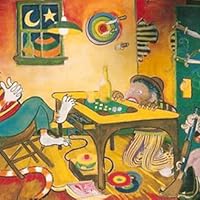
A tuba player surfs the web from a cyst on his hand. A town of spilled peaches fields its own game show. A mosquito fogger finds an unlikely friend. The stories in Mike Young's debut collection Look! Look! Feathers tap into the surreal and sad, the absurd and ragged dreams scratching at the edge of the American heart. Punks drive auctioned police cars, and necklaces of bluebird bones are sold from a roadside van. In these tales of the Pacific Northwest, Young finds magic burrowed under the moss of ordinary life.
I'm not sure how Mike Young got so good already. I mean, dude is pretty young but his stories and poems that pop up here and there and everywhere are always so full of vibrant color, stunning language, and an engaging brand of funny wisdom that seems to bubble out of their small town, sorta white trashy settings and characters. Also--I had a new sensation reading these stories. It was this: You can spot a great sentence writer pretty quickly, but Mike somehow takes his killer sentences and builds them into paragraphs that detonate like bombs. You might wanna stop and say to the nearest person: Hey, listen to this sentence, but then you're like, Wait, there's another. And another. Fuck it--just read this whole paragraph. I've also been reading the new collected Barry Hannah lately and I have to say (DARE to say), Mike Young is almost as good as Barry Hannah. Yeah, I said it. Just you wait and see.
There is a lot to be said about these twelve stories, but in short, Look! Look! Feathers is an impressive first collection and Mike Young is a gifted new storyteller. Young's narrative voice is like that of an entire community of unique personalities, each presenting its own history with a special hospitality and confidence that draws you in instantaneously and stays with you long after the tale has been told. Some stories are more interesting and vivacious than others, but they all possess an essence of great character that gives them their strength. Favorites of mine included "Burk's Nub," "Susan White and the Summer of the Game Show," "What The Fuck Is An Electrolyte?", and "Restart? Restore?"
“The World Doesn’t Smell Like You,” from Mike Young’s story collection LOOK! LOOK! FEATHERS, is a quest narrative about these high school dumbasses who need to know whether the rumor’s true that their gym teacher, Coach Schiel, has only got one ball.
It’s one of the L!L!F stories I got to read an early draft of, it’s the story I got to publish in Keyhole 10, and when in a certain mood, it’s my favorite story in the collection. Other favorites are “Susan White,” “Snow You Know,” “The Same Heart,” and “Burk’s Nub,” the latter a band-nerd companion to “The World” that underscores each high school clique’s unique potential for cruelty.
And the pack of guys in “The World” is a clique, but not one tied to a sport, art, activity, or a love for much of anything. They’re instead united by a philosophy of self-serving people-trampling hedonism—or what would be hedonism if they were better at figuring out what felt good—and gruff Coach Schiel is their prophet. “You don’t learn to shake a man’s hand, how to grip,” Schiel speechifies, “I guarantee you’ll wake up one night and he’ll be pissing in your hair.” Or, as the narrator puts it, “Buzz the world. Do not let the world buzz you.”
Schiel begins to lose his edge, though, when a pep rally horse accident leaves the Home Ec teacher permanently deaf and Schiel kinda to blame. When Schiel, weeks later, takes uncharacteristic sympathy on Fat Burk, one of the boys flips and attacks Burk to counteract Schiel’s undue kindness. The scuffle that ensues leaves two boys unconscious and Schiel’s job on the chopping block.
The manic playfulness of the prose and plot dizzies a little on first read (see above, where I had the privilege of skimming by a pep rally horse accident), a dare to the reader—I’m not waiting for you—from a narrator who occasionally must express his discomfort with relating his testicular tale to the sort of people who might be more concerned with the “narrative scheme or whatever” than with how hella hot Kristy Saiz looked when mad and sweaty.
One of the story’s only still moments comes from the school principal. “I’ve been speculating a sort of anti-video game,” he tells Schiel. “In lieu of your typical prostitutes, pistol whipping, etcetera, what I’d like to see invented is a game in which the player controls a desert. The sensitive ecosystem of a desert. The slow, imminent sand.” At this school, that kind of quiet sparseness could only exist as fantasy.
In the story’s final pages, the boys pay Schiel a visit in his home. “For a dude with one ball, he had a pretty sweet pad,” we’re told before the narrator checks himself and qualifies the compliment: “Sweet enough, I mean.” Schiel gets them drunk, administers doorstopper cunnilingus lessons, and takes them to the bridge to toss a broken recliner in the river, where they revel together and bond over inflicting themselves on nature. But there is still, of course, the matter of the ball. The boys’ need to know trumps their respect for grizzled Schiel’s dignity, as it must if they don’t want to wake with somebody pissing in their hair.
It’ll surprise few Giant regulars that the grad school friendlies that most stirred in me a “Damn, I better step up my game,” competition are Mike and his ex-roomie, Rachel Glaser. Mike’s stories, poems, and songs, taken together, form an America that doesn’t know that its beating heart is the hungry cluttered small towns of the Pacific Northwest. It’s the fiction, though, that for me does the most at once: Language, character, plot, place, inventory, experiment, emotion, and ambition are inextricable from each other in this book. Look! Look! Feathers does the old things and the new things. We can have it all, and should.
When I read an early draft of “The World…” Mike shared that the story was a challenging write for him—and one he felt ambivalent about—because these central dicks are of a kind Mike can’t stand in real life. But they’re dicks who have been granted the dignity of very close attention—they hurt, they confer over plastic tacos, they’re largely shunned by their classmates, they tear each other down, they each privately long for a cruel girl way out of their league, and at the end, each boy gets his own “where are they now” sentence that reminds us how few cards each of these guys held to begin with. Maybe the thing that most gets our empathy machines humming for the unnamed narrator is that he has been loaned the author’s own powers of articulation. And when we talk about a writer’s generosity for characters (a phrase that sounds to some a little too Glimmer Train for comfort), that’s what we mean: The author offers the guy enough space to try and sway, enough rope to hang.
Seriously, this guy is the Barry Hannah of a new generation, but (im)possibly more jaded, fragmented, jostled, boozey, druggy, and electrified...Yep. These stories are good, even I-read-them-eating-a-can-of-peaches-in-a-parking-lot good! In fact, they're great! I seriously hope Mike Young writes a novel, and I hope that when he does the energy of these stories remain with the same face-punch splatter through the brain. Is it even possible for this guy to get any better? Anything is possible, so they say, and I can only hope that the saying holds true.
Mike Young’s short stories live in the bizarre corners of our world, just past the surface of what we see in passing, but recognizable all the same. Suburban jocks idolize their washed-up, half-insane coach. Residents of shitty apartments and motel kitchenettes drink, fight and talk about all the great plans they have. Everyone is lonely in their own special way, and everyone likes to think that their voice is unlike anyone else’s. Problem is, several stories in, sometimes those voices bleed together.
And maybe that’s the point — we’re all so different in all the same ways.
It’s not that I flat out don’t like his style — no, sometimes fragmented thinking suits the story just fine — but the style sometimes came at the expense of clarity. At times, all those details smooshed into one and I had trouble discerning who said what, and where. Again, this could be because of the time frame in which I read the book. All I’m saying is, I didn’t fall in love.
But fair play to Mike Young for being different, for carrying that indie-kid literary bag. His characters don’t sit around and yammer about the intellectual merits of their problems, and they don’t whine. Their problems simply are. Here is the situation now, here is how they deal. Occasionally they may recognize that they’ve made some poor choices, but man, there’s still a glimmer of something new around the corner.
All apologies to Fresno, but driving the 350 miles between L.A. and San Francisco, the scenery unspools in little more than a piss and a half of endless, bleached nothing. Leaving the Bay Area and heading toward Southern Oregon, the Interstate rises out of the Central Valley and winds left of center. During these next 350 miles, pretty much the same piss and a half, the trees, the elevation, the entire character changes. In this corridor, Red Bluff to Yreka to Talent, the weeds and speed give way to off-ramp drags of greasy spoons and grizzled beards, canned greens and un-ironic curios, potholes and slush. Here, where most pull over just long enough to fill up and flush out, Mike Young takes up residence.
Describing Look! Look! Feathers, Young has said the stories are about people “trying to try,” but make no mistake, this isn’t participation-ribbon or up-by-your-bootstraps trying; in these dozen stories, Young exposes character after character who are trying to trust. Trusting themselves, trusting adulthood, trusting the internet, trusting the people they just might love, all while suspecting the very suckiest, that with both sides predisposed to fuck things up, maybe the best they can do is try. These are the same twitching, fragile moments Jim Shepard engulfs in avalanche and flood and Young dares them au natural, in high school gyms and tribal casinos and Pollard Flats. And if you’ve never stopped for the restroom in Pollard Flats, let me be the first to tell you, that mannequin in the tub will haunt you way longer than any old rockslide...Read the rest at the site
I am exactly halfway through this collection of stories, but I had to come here and gush about it because I am in love. Mike Young is a a force. These stories are everything it is to be a person in America, growing up, or staying the same, or just living, but blue-collar-smart, like if Barry Hannah fell into the brainhole of a Freaks & Geeks freak (or geek). It's like when someone lets you in on a revelation that you didn't know you knew, and you're like "Holy shit! I knew that. But holy shit!"
pretty brilliant first book of short stories, most set in califa north of the Sacramento river. most are pretty raw, deal with losers making very bad decisions, and ordinary folks trying to play a fucked up game with fucked up rules not of their making.
Amazing that he's able to incorporate pop culture and entirely avoid kitsch. Enough has been said about his strong voice. More importantly, these stories explore human emotion as technology has tampered with it. Mosquito Fog is in my top three contemporary short stories.
Someone in comments said she was giving this 5 stars because she loved how gross it is. I am not finishing it and giving it one star because I do not love how gross it is.
Mike Young’s fiction collection contains twelve stories, told predominately in a hyper-conversational prose style, reminiscent of Barry Hannah and Steve Almond, chronicling the lives of marginal, everyday folks. Some of these characters live in neighborhoods you might drive around instead of through. Some you’d give wide berth to at a convenience store. Some you know and some you’re glad you don’t. Some of them are us when we think no one is looking. Many of the characters are, you might say, extra-normal. Normal on a bad day. Normal screwed over. Normal on a tear. Normal heartbreakingly trying to stay that way, like Eureka in “Snow You Know and Snow You Don’t,” addressing her unborn child:
Maybe you’ll want dreadlocks. Maybe you’ll be in the newspaper for basketball. You might learn to snowboard or like hotdogs….Boys’ll tease you but their voices will break. If you want to play the clarinet, we’ll get you one. Might be from the pawnshop. We’ll need to talk about the money stuff, what people call “situations,” but I’ll make Dan Mac lay that out. Nothing’s fair. Your fingers’ll callus, even when you’re reading about red nails in the magazines.
Whether Mr. Young intended them to or not, these gritty and often hyperbolic stories remind us of things easily forgotten, good and bad. But they aren’t overly nostalgic, like a lot of fiction being written and published and fawned over these days. That said, reading these stories can be a lot like reminiscing. The smells, sounds and sights of Teendom and Tweendom are recreated here with breathtaking accuracy. Mr. Young wallows in the muddy details of adolescence, and, as we read, so do we.
From “Burk’s Nub”: Burk plays tuba, usually tries to hide behind it, but you can’t miss him. His thighs are Christmas hams. People call him Jabba the Hut….He wears only two or three stretched and torn t-shirts….Sometimes he wears his P.E. shirt, which is pathetic. But when you don’t have the money for a lousy Metallica t-shirt, what do you do?
Young pays tribute to his literary forbearers, too—not by pastiche, but by homage and a nose-tweaking kind of allusion. He visits the sacred ruins, pays his respects, and kicks over the altar on his way out.
My favorite stories in the collection, like the surreal title story, seem to be a visit to a vividly revitalized Raymond Carver Country. Mr. Young left up the “tacky apartment buildings,” but the people who inhabit them are quirkier, more cankerous, grittier and grimier, and more alive, really. (It’s worth noting that both Carver and Young are from the Pacific Northwest.)
And, with their staccato rhythms and bizzarro subject matter, I couldn’t help making comparisons to Padgett Powell when reading stories like “Misquito Fog” and “Restart? Restore?”
The language in this collection is exciting and unexpected and the characters are vividly drawn. You can see them clear as day. It’s obvious they are loved and respected by their creator, warts (or “nubs”) and all.