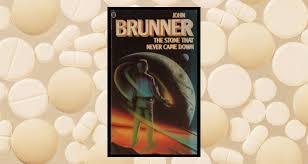
BOOK CLUB EDITION Book is in Near Fine condition. Boards are clean, not bumped. Not remaindered. Dust Jacket is in Near Fine condition. Not chipped or crinkled. Not price clipped. Book is covered by Mylar Brodart. All-ways well boxed, All-ways fast service. Thanks.
John Brunner was born in Preston Crowmarsh, near Wallingford in Oxfordshire, and went to school at St Andrew's Prep School, Pangbourne, then to Cheltenham College. He wrote his first novel, Galactic Storm, at 17, and published it under the pen-name Gill Hunt, but he did not start writing full-time until 1958. He served as an officer in the Royal Air Force from 1953 to 1955, and married Marjorie Rosamond Sauer on 12 July 1958
At the beginning of his writing career Brunner wrote conventional space opera pulp science fiction. Brunner later began to experiment with the novel form. His 1968 novel "Stand on Zanzibar" exploits the fragmented organizational style John Dos Passos invented for his USA trilogy, but updates it in terms of the theory of media popularised by Marshall McLuhan.
"The Jagged Orbit" (1969) is set in a United States dominated by weapons proliferation and interracial violence, and has 100 numbered chapters varying in length from a single syllable to several pages in length. "The Sheep Look Up" (1972) depicts ecological catastrophe in America. Brunner is credited with coining the term "worm" and predicting the emergence of computer viruses in his 1975 novel "The Shockwave Rider", in which he used the term to describe software which reproduces itself across a computer network. Together with "Stand on Zanzibar", these novels have been called the "Club of Rome Quartet", named after the Club of Rome whose 1972 report The Limits to Growth warned of the dire effects of overpopulation.
Brunner's pen names include K. H. Brunner, Gill Hunt, John Loxmith, Trevor Staines, Ellis Quick, Henry Crosstrees Jr., and Keith Woodcott. In addition to his fiction, Brunner wrote poetry and many unpaid articles in a variety of publications, particularly fanzines, but also 13 letters to the New Scientist and an article about the educational relevance of science fiction in Physics Education. Brunner was an active member of the organisation Campaign for Nuclear Disarmament and wrote the words to "The H-Bomb's Thunder", which was sung on the Aldermaston Marches.
Brunner had an uneasy relationship with British new wave writers, who often considered him too American in his settings and themes. He attempted to shift to a more mainstream readership in the early 1980s, without success. Before his death, most of his books had fallen out of print. Brunner accused publishers of a conspiracy against him, although he was difficult to deal with (his wife had handled his publishing relations before she died).[2]
Brunner's health began to decline in the 1980s and worsened with the death of his wife in 1986. He remarried, to Li Yi Tan, on 27 September 1991. He died of a heart attack in Glasgow on 25 August 1995, while attending the World Science Fiction Convention there
aka K H Brunner, Henry Crosstrees Jr, Gill Hunt (with Dennis Hughes and E C Tubb), John Loxmith, Trevor Staines, Keith Woodcott
Winner of the ESFS Awards in 1980 as "Best Author" and 1n 1984 as "Novelist"..
Name: Brunner, John Kilian Houston, Birthplace: Preston Crowmarsh, Oxfordshire, England, UK, (24 September 1934 - 25 August 1995).
Alternate Names: K. Houston Brunner, Kilian Houston Brunner, Henry Crosstrees, Jr., Gill Hunt, John Loxmith, Ellis Quick, Trevor Staines,Keith Woodcott.
John Brunner postulates a world on the brink of war where fanatical ""godheads"" prowl the streets and every man's hand is raised against his neighbor. Disaster looms until a motley underground discovers and disseminates a deus ex machina drug that compels the perception of complexity; the result is expanded minds and peace on earth. Credible characters, suspenseful plotting.
John Brunner's 1973 novel, The Stone That Never Came Down, is set in a near-future, blighted London during the Christmas season, where temperatures are subzero and the entire city groans under layers of ice and snow. Governmental incompetence, massive unemployment, restricted city services, and skyrocketing inflation leave huge swaths of the population, especially children, malnourished and famished.
This crushing downward spiral has given birth to The Campaign Against Moral Pollution (headed, of course, by a wealthy matron and backed by political power). There are also many religious fanatics known as the Godheads who roam the streets and break into homes, demanding alms with threats of broken bones and shattered windows for anyone who dares not comply. Brunner is keen to observe the way a focus on morals, especially anything revolving around sexuality, can become a substitute for addressing dire economic and social ills.
Brunner introduces a number of men and women who are suffering in various ways in this devastated, frozen metropolis, most notably Malcolm Fry. Malcolm has been unemployed for six months, the consequence of objecting to the views expressed by a representative of The Campaign Against Moral Pollution at the school where he taught history. A shame, since his students loved him. An even greater shame that his wife had enough of his unemployment (Malcolm has been blacklisted as part of the Campaign's purification program) and left with their two young children.
All this has left Malcolm deeply depressed, leading him to visit a pub where he meets a stranger who gives him a capsule to ease his pain. Thinking he couldn't feel any worse, Malcolm swallows the drug. Now, back home the following morning with his girlfriend Ruth, he begins to experience some of its effects. Quite remarkably, Malcolm feels euphoric and possesses an incredible memory for events and details long forgotten, along with an exceptional ability to analyze information. Added to this, as unbelievable as it might seem, Malcolm eventually recognizes that the principal change he has undergone is a dramatic increase in empathy and understanding of others.
Unlike Brunner's Stand on Zanzibar and The Sheep Look Down, this is a short novel (200 pages) that can be read in a day or two. Events move apace. The various narratives develop and intertwine, leading to the heart of the tale: a conversation Malcolm and Ruth have with a doctor and the two principal scientists at the research institute responsible for developing this powerful drug that permanently alters human nature. Oh yes, VC appears capable of transforming humanity itself, eliminating such traits as fanaticism, aggression, prejudice, and the desire to dominate. Since the world has sunk to such a dismally low level of ignorance and violence, the group concludes in their despair that VC would be an improvement. Their decision, however, proves moot. They soon discover that VC has already been released into the population, spreading through casual contact and blood transfusions.
Brunner pushes us to confront important philosophical questions. What would be lost if we no longer possessed the capacity for aggression and other seemingly negative tendencies? Are such traits separable from courage, ambition, passion, and individuality? And if such transformations in human nature could be made, who would get to decide? Would you be satisfied if you were excluded from the decision-making process?
It is now 2026. With our own culture awash in drugs that alter mood, perception, and behavior, the questions posed by Brunner's novel feel more relevant than ever: if we could permanently change human nature, should we?
The Stone That Never Came Down was serialized in Ted White's Amazing Stories magazine's October and December issues in 1973, then published in hardback by Doubleday and the SF book club before DAW released a mass market edition in 1975 with a Kelly Freas cover. (That lady sure looks worried, doesn't she?) Brunner had written a couple of immensely popular, very long, and rather bleak books (Stand on Zanzibar and The Sheep Look Up), and this one was a short and cheerful read in comparison. It's set in a time of overpopulation and pollution and unemployment and economic and political crisis with world war looming and religious fanatics running roughshod over everyone, but Brunner posits a happy-making drug that calms everybody down and solves all their problems. It's a kind of choppy narrative as he jumps from character to character to show how their lives have changed, but once you get used to it it's a pretty smooth read. Everybody deserves a happy ending once in a while.
Cute and fun, which is probably why the New Worlds critics gave Brunner such a kicking; that and the prose, which is, at best, fuctional - my how he loves an adverb! All that aside it's a nice slice of wishful thinking and a lovely escape from the shitstorm of current affairs. Brunner's reading of the way that late capitalism might progress is actually pretty astute but his solution, well, it's a beautiful dream that I didn't mind buying into for 200 pages. Now give me some post-apocalyptic bleakness and I can get back to biting my nails and worrying about EVERYTHING!
review of John Brunner's The Stone that Never Came Down by tENTATIVELY, a cONVENIENCE - October 28, 2018
I've been singing critical praises of John Brunner ever since I discovered him a few years back & every time I read another bk by him it's a pleasure. Here's the epigraph to "BOOK ONE Ascent":
Dissidentes Christianorum antistites cum plebe discissa in palatium intromuissos, monetbat civilus, ut descordiis consopitis, quisque nullo vetante, religioni suae serviret intrepidus. Quod agebat ideo obstinate ut dissensiones augents licentia, non timeret unanimantem postea plebem, nullas infestas hominibus bestias, ut sunt sibi ferales plerique Christianorum expertus.
"—Ammianus Marcellinus: Res Gestae" - p 1
"Ammianus Marcellinus (born c. 330, died c. 391 – 400) was a Roman soldier and historian who wrote the penultimate major historical account surviving from antiquity (preceding Procopius). His work, known as the Res Gestae, chronicled in Latin the history of Rome from the accession of the Emperor Nerva in 96 to the death of Valens at the Battle of Adrianople in 378, although only the sections covering the period 353–378 survive." - https://en.wikipedia.org/wiki/Ammianu...
I didn't have much luck producing a coherent translation with online means so here's a bad approximation:
"The leaders of the Christians, with his people was divided up in the king's house: the dissident intromuissos, as per civil law, was executed, there was no opposition, otherwise they were allowed to serve their own religious feelings in an unsurpassed way. The license of which he had allowed so tenaciously that they will increase; they are causing the divisions, there is no fear of a united Christianity later on among the people, & no sense that they trouble the men, the wild beasts, that they are in disagreement with the majority of the Christians.
"—Ammianus Marcellinus: Achievements"
I took so many liberties w/ that that it's probably dramatically wrong. Latin scholars, feel free to add a corrective comment! The time & place seem dystopic. What is going on?:
"It was dreadfully cold in here. Filtered by the dervishes of the snow, a street-lamp beam lanced between the curtains and showed him his breath clouding before his face. The time-switch which had brought the radio to life also controlled an electric fan-heater, but the middle-element was broken and anyhow the power was usually browned out nowadays. If only he could afford to turn on the central heating . . ." - p 4
Then again, this could be a time from my life. There're confrontations w/ Christian bullies running amok. One of the protagonists won't give the bullies any money unless they can answer a question:
""You can have this if you name a weapon of modern wat that wasn't invented and first used by a Christian country!" - p 10
""Can't answer, hm? Not surprising! The whole lot is yours, from the hand-grenade to the hydrogen bomb! So stop wasting my time. I have to go to work. And it wouldn't do you any harm to work for a change, instead of sponging off the rest of us who do!"" - p 11
Needless to say, this, ahem, didn't go over too well. &, yeah, there's racism too:
"These days it was a common habit to pass over a black kid who talked back to teachers, and slap on his record a ribber stamp saying INEDUCABLE. And half of them were glad to be out of school, but furious at being out of work as well." - p 18
The action's taking place in England, where Brunner lived, but one of the characters is an American evangelist who's being recruited by an English Chrsitian crusader who he's dubious about joining forces w/:
"["]You join her in her New Year's Crusade, and you'll be on the map for good and all. It would make you—well it would make you the Billy Graham of the nineteen-eighties!"" - p 20
I don't know how many people remember Billy Graham these days. He only died on February 21, 2018, so it wasn't that long ago, but I think he was far beyond his prime by then. During the Vietnam War he was possibly the most public Christian apologist for the US invasion & continued oppression of the Vietnamese people — not that he put it that way, of course. I was raised in a conservative Christian family & when I was about 15, maybe in late 1968, my sister, later a missionary, took me to a Billy Graham Crusade at the Baltimore Civic Center — a place that held thousands of people. It was the closest thing to a nazi rally that I ever 'hope' to attend. One of the main things I remember about it was the showing of a movie about a teenager whose life becomes extremely degraded as a result of 'straying from the path.' It was very much in the spirit of the hyper-conservative TV show "Dragnet" in which doom & gloom & guilt were slathered on like leprous hog fat on a piece of nice clean white bread. I was horrified by Graham's obviously unscrupulous crowd manipulation. As such, Brunner really nails it w/ his reference here. This bk was published in 1973 when the war was still ongoing & Brunner was an anti-war activist so I'm sure he was fully aware of Graham's significance. Brunner was no fool when it came to his own country's future either as is demonstrated by shades of Brexit in the following:
"—Can it really be on the cards that we'll see a military coup in Italy, like the Greek one? And that a junta of generals would try to pull them out of the Common Market?" - p 30
"—And I said, "Do you really think there's no hope for us at all?" And he looked at me for a bit, with that odd quizzical expression, and then he produced that little phial of capsules, tiny little yellow things no bigger than rice-grains, and said, "This may be the answer. I hope it is." And I said . . . God, I must have been drunk by then! I said, "If that's the case, I'd like some." And he said, "Okay, here you are. You deserve it more than most people." And like a crazy fool I took it!"" - pp 30-31
Now, I've ridiculed the 2011 SF film called "Limitless" about drugs making someone smarter. My point has been that humans seem to want everything to be as easy as popping a pill. Alas, if you want to be smart, you might actually have to work at it & you might not get much respect for it either. Brunner's story might seem to be a precursor to "Limitless" &, to a small extent, it is — but it's much more nuanced.
"["]Living aimal tissue is ideal. Which is why we call it 'viral coefficient'."
""You mean it breeds?" Sawyer cried. "You mean it's infectious?"
""Not infectious!" Randolph snapped. "Cold air, sunlight, even dilution in plain water will inactivate it almost at once. But . . . Well, without being infectious, it may possibly be contagious.["]" - p 51
That's an interesting distinction, eh?!
"Strictly, a contagious disease is one transmitted by physical contact, whereas an infectious one is transmitted via microorganisms in the air or water. In practice there is little or no difference in meaning between contagious and infectious when applied to disease or its spread." - contagious | Definition of contagious in English by Oxford Dictionaries - https://en.oxforddictionaries.com/def...
As you may've noticed by now, in an avoidance of spoiling the plot for you I've dropped hints w/o providing full coherence. As such, my review is somewhat akin to the note left by a dead central character. "These passages, however, were islands of clarity in a muddle of jargon, parasyntaxis, and abominable straining after pointless puns." (p 47)
"Chest Cee! 'Sdense! Corpo di barragio! you spoof of visibility ina freakfog, of mixed sex xases among goats, hill cat and plain mousey, Bugamy Bob and his old Shanvocht! The Blackfriars treacle plaster outrage be liddled! Therewith was released in that kingsrick of Humidia a poisoning volume of cloud barrage indeed. Yet all they who heard or redelivered are now with that family of bards and Vergobretas himself and the crowd of Caraculacticors as much no more as be they not yet now or had they then notever been."*
"Malcolm took the sheet of paper he was offered, glanced at it, and passed it to Ruth. Having read it more slowly, she exclaimed, "Why. it's like something out of Finnegans Wake!"
""Right! Professor, Dr. Post did leave a record of his experience—at any rate, as complete a record as he thought would be necessary, knowing that with total recall he could later compile as detailed an analysis as anyone might wish for. And here it is. Not a farrago of rubbish, but the result of trying to condense scores of different levels of experience—real and vicarious—into the narrowest possible compass. Language isn't designed to carry that kind of load, Not ordinary language, anyhow."" - pp 85-86
*Finnegans Wake p 48, Viking Press, February 1975 paperback edition
"We had done some French and Latin at school but I knew virtually no German or Italian and it was clear that Joyce exploited both of these languages continually. I would take a dictionary and work through a chapter, looking up any word I thought suited the language in question. I soon learned that the most cryptic elements were often pure English. Grotesque orthography was often repeated verbatim in the Oxford English Dictionary. I suspected that Joyce was delbierately revivifying many archaic snd dialectical usages. Partridge's Dictionary of Slang and Unconventional English and the Oxford Dictionary of English Proverbs provided numerous identifications of items in FW or of words very close to Joyce's." - p 29, The Finnegans Wake Experience - Roland McHugh
""Urea stimulates activity in the nervous system," Malcolm said. "Loss of power to excrete it as allantoin has been compared to adding a permanent pep-pill to our diet."" - p 142, The Stone that Never Came Down
"Muscle loss, osteoporosis, and vascular disease are common in subjects with reduced renal function. Despite intensive research of the underlying risk factors and mechanisms driving these phenotypes, we still lack effective treatment strategies for this underserved patient group. Thus, new approaches are needed to identify effective treatments. We believe that nephrologists could learn much from biomimicry; i.e., studies of nature’s models to solve complicated physiological problems and then imitate these fascinating solutions to develop novel interventions. The hibernating bear (Ursidae) should be of specific interest to the nephrologist as they ingest no food or water for months, remaining anuric and immobile, only to awaken with low blood urea nitrogen levels, healthy lean body mass, strong bones, and without evidence for thrombotic complications. Identifying the mechanisms by which bears prevent the development of azotemia, sarcopenia, osteoporosis, and atherosclerosis despite being inactive and anuric could lead to novel interventions for both prevention and treatment of patients with chronic kidney disease."
[..]
"This unique ability of bears to recycle urea during hibernation is not present in other hibernating mammals, such as the Columbian ground squirrel or the hedgehog."
- "Hibernating bears (Ursidae): metabolic magicians of definite interest for the nephrologist" - PeterStenvinkel, Alkesh H.Jani, Richard J.Johnson - https://www.sciencedirect.com/science...
""How people delude themselves," Malcolm muttered. "Sooner or later all the finest ideals of mankind have led to overreaction. Christianity became the official religion of the Roman Empire and was perverted into a justification for slavery. The proud slogan of the French Revolution was inscribed over the guillotine. The oppressed victims of the tsars proceede to treat their former rulers with even greater brutality."
Clever ideas and well written. I doubted the book to start with but it picks up well and I greatly enjoyed it in the end. An introspective on war and the human condition. Also my first ever John Brunner book but will not be the last.
This is a novel written in 1973, and has always been a favorite of mine, and this is probably the third or fourth time that I have read this fine book. Although the tale is set primarily in England, it describes a dystopia in which poverty, inflation, unemployment, and disillusionment are rampant around the world, and WW III seems just around the corner. And, to make matters worse, members of a right-wing political/religious group, The Campaign Against Moral Pollution (Godheads), are armed with crosses which they use as weapons to demand alms and obedience from anyone they can shake down. However, the entire world might change dramatically for the better if a mysterious new drug known as VC is allowed to to spread throughout mankind. There don't appear to be any negative side effects, and the drug drastically increases the individual's natural empathy, and grants total and complete access to one's memory. After being infected, a person's natural filters and prejudices are dismantled, and one is truly free to experience what it means to be human for the rest of their life. The novel describes how this change effects numerous individuals, and ends at kind of a 'dawning of a new age for mankind'. The characters are not that carefully delineated, but the storyline is so compelling that this can be overlooked. And, I think the book authentically demonstrates that the political and social status quo would be violently opposed to anything of this nature since their power lies in fear and divisiveness. I would recommend this book to anyone who understands that some of the best science fiction is more about adventurous storytelling than excellent writing
Although I am a big fan of John Brunner, none of his other works have quite come up to the level of "The Sheep Look Up" or "Stand on Zanzibar." I enjoyed the setting of this novel in Europe, and the idea that was raised in the story about a specie being aware of its own evolution, but didn't find the characters particularly engaging, though some were all too accurate in their depiction of contemporary political figures.
A morality tale, but an entertaining one. On the brink of WWIII, can a new virus save humanity? Rather sweet and 70s that the only thing he thought wouldn't be affected was partying and recreational drug use.
Drill down into the root causes of today’s political dysfunction, and you’ll find the problem—unsurprisingly—in the human mind. In the United States, and no doubt throughout the world, untold millions of people are in the thrall of irrationality. They indulge in magical thinking and conspiracy theories, simply refusing to face facts. But what if it were possible to “cure” them with a pill? To sweep away the cobwebs in their minds with a simple, non-toxic, long-lasting drug—a cure for irrational thinking? It’s a nice fantasy, isn’t it? And British science fiction author John Brunner spun out an engaging story about it half a century ago in The Stone That Never Came Down.
AN UNINTENTIONAL ALTERNATE HISTORY OF EUROPE IN THE 1970S Brunner’s novel was set in his own time, and it reflects the preoccupations of the age (or at least his own concerns). He imagines Britain in the grip of religious extremism, with a multimillion-member movement called the Campaign Against Moral Pollution terrorizing the public with bands of roving “godhead” thugs. Meanwhile, a neo-Fascist movement is on the verge of capturing the Italian government—and war seems imminent between the Italians on the one hand and the Germans and French on the other. A war that will inevitably turn nuclear.
Now, Brunner himself may have feared such prospects, but in no way does it reflect the reality either in Britain or on the Continent in the 1970s. So, it’s probably best for a reader today to view The Stone That Never Came Down as alternate history, and let Brunner’s fantasies stand. And once you do that, you’ll need to swallow his imagined cure for irrational thinking, too..
A COCKAMAMIE STORY, BUT IT’S ENTERTAINING Somehow, Brunner manages to cram an army’s worth of characters and half a dozen subplots into barely more than two hundred pages. Unless you manage to retain the names of all the characters in active memory, you might find yourself turning back the pages from time to time. There’s a lot going on here. But this is the gist of it . . .
WORLD WAR III THREATENS World War III is on the horizon, even though those principally responsible for pushing the world to the brink seem to be entirely unaware of it. Nor is the news media conscious of the danger. But a handful of exceptionally far-sighted people in Britain know perfectly well what’s going on. That’s because they have, wittingly or not, swallowed a pill or inhaled an aerosol that affects the mind. It’s a cure for irrational thinking, so they entertain no false hopes that the world will sidestep a nuclear holocaust unless something drastic happens.
SCIENTISTS BLUNDER INTO A CURE FOR IRRATIONAL THINKING The first among that handful of people are the scientists at the Gull-Grant Research Institute. They’re the ones whose efforts in the lab have led to the development of VC, a psychoactive drug of unknown properties. It’s what soon proves to be a cure for irrational thinking—among other things. It also radically heightens the senses and makes people smarter.
COMBATING THE TWIN THREATS OF RELIGIOUS EXTREMISM AND NUCLEAR WAR All over London, godheads are running rampant. Walking about in gangs, they extort bribes from homeowners under threat of breaking all their windows or even setting fire to their homes. The police do nothing. But there is one honest detective at the Met. And he joins with the scientists in a desperate campaign to infect everyone with VC who in a position to affect the course of events. The drug proves remarkably easy to spread and soon finds itself in key places throughout Europe. You can guess what happens next.
ABOUT THE AUTHOR John Brunner (1934-95) wrote scores of science fiction novels, more than a dozen collections of short stories, and many other works in a career from 1951 to his untimely death in 1995. He won the Hugo Award in 1969 for Stand on Zanzibar, his novel about overpopulation. The British Science Fiction Association gave him its top award the same year. Brunner was born and educated in Oxfordshire. Twice married, he died of a heart attack at the age of sixty in Glasgow, Scotland, while attending the World Science Fiction Convention.
In a 1980s world where fundamental Christian beliefs (both racist and misogynist) are enforced by roaming mendicants known as godheads, Malcolm Fry wakes up after a big night out. Gradually he becomes aware that his every sense is heightened and he can assimilate data into logical conclusions at lightning speed. He rashly took a drug called VC at his local pub in England, and one of its designers has now been murdered. Malcolm falls into a deep sleep lasting three days and wakes to the realization that his neighbour Billy and his new girlfriend Ruth have sat by him the whole time, reluctant to inform authorities for many reasons. A casual blood donation has now released VC into the wild and recipients are now prone to revelations of their own. Armed with a list of those exposed to VC, Malcolm must build an army to distribute it and hopefully prevent World War 3! Surprisingly readable tale from John Brunner after although some of the references are a bit dated. The anti-war, anti-racism theme is refreshing. Worth a look.
In the far future of the 1980s the world has gone to pot. Hyper-inflation, massive unemployment, rampant crime, severe government corruption, and a rise in religious fundamentalism. At this time a group of scientists are working on the drug from the movie "Limitless" which will enhance human consciousness. The experimental drug escapes from the lab into the general public and soon a group of newly smart people are trying to figure out how to stop World War III.
This book is based on a common scientifiction trope of the time, that we are going to destroy ourselves if we don't change our evil ways, and if we would all just learn to get along we would enter into a future utopia. And if it takes some people to force this change on everyone else then that's alright because they mean well. Most of Brunner's works deal with the collapse of human society, this is just a different approach to the subject. Entertaining in a dated sort of way.
A solid SF effort from Brunner. This is only my second book from him, but I shall b reading more. This story describes a near future, might as well be now, where the world is on the brink of war. There are massive labor strikes around Europe, religious violence from a group of moral protectors, and confrontations between the countries of Europe. A man receives a drug from a scientist and starts feeling very different. The scientist is then murdered. This drug has the power to give the user a clearer conscience, health, reflexes, and a near photographic memory. A group of the people who were accidentally infected by the drug, which is more like a virus, take it upon themselves to stop the world from coming to war and stopping the religious brigade who stands to profit from these conflicts.
This is an early entry in the "Flowers for Algernon" mold of stories about chemicals that make humans smarter by activating more of their brains. I loved it when I first read it in the early 1970s, and I still enjoyed the plot and ideas behind it. Perhaps because I've read so much exceptional literature since my early 20s, I was bothered by the two-dimensional characters and somewhat stiff writing style this time. John Brunner was indeed a visionary, however, and it is somewhat dismaying to see that his description of a messed-up society on the brink of nuclear war and ecological disaster still sounds exactly like our current situation. If only a viral outbreak of super-intelligence could fix it in time!
Great story. The UK is suffering from Government Austerity and has become dominated by far right Christian groups who will kill anyone who is not white, Christian, heterosexual, and married to the person they are having sex with, whilst demanding tithes from everyone not in their group. The police side with the violent Christians so they act with impunity. Landlords are causing homelessness by evicting residents. WWIII is about to kick off, unusually started by an internal dispute within the EEC (the predecessor to the EU, not the Russia-dominated organisation). A research institute, about to be closed down, creates a biological culture (a virus?) that helps people become more empathetic whilst not letting them forget anything.
REM: "The Stone That Never Came Down" by John Brunner
(Original Review, 1980-09-12)
The classic tests on this subject were done something like 25 years ago, and became sufficiently well known that by the late 60's they were turning up (in cut-down versions with animal subjects) in high school science fairs. The test was fairly simple: a sensor was rigged to detect Rapid Eye Movements (characteristic of the deepest (fourth) level of sleep and generally simultaneous with dreams) and attached to various devices to wake up the sleeper whenever REM began.
The DAW edition of this book touts “John Brunner’s novel of the fever-pitched fight against the end of the world will remind readers of Nineteen Eighty Four and A Clockwork Orange — but with a special difference.”
That special difference is that the baddies are religious Christians and the answer is empathy-giving drugs.
Brunner’s characters seem to argue that the reason we’re headed to Armageddon is religious extremism. He even blames nukes and mustard gas on Christians.
To me, it was just too ham-fisted, unoriginal, and tiresome for me to take seriously, making me lose interest about halfway through.
Europe in the early part of the 21st century is in the same shape as things are now under tRump's regime. The elites/1%-ers are the haves and everyone else is the have-nots. Homelessness and unemployment is rampant. The "Godheads," faux Christians, are the bullies of society, extorting "tithes" and gay-bashing (and burning). But three professors in a lab have come up with a replicating virus that, when ingested, is contagious and causes an awakening of conscience. A bit naive and contrived; not Brunner's best work.
Because James Alan Gardner, in Vigilant, acknowledged a debt to it, and also recommended it, and rec'd all Brunner. What I've read of Brunner I've admired, too.
Topical despite being fifty years old. By focusing on human nature, hypocrisy, and willful ignorance Brunner creates a gripping portrait of humanity on the edge. What constitutes the current precipice has changed —less fear of WWIII, more of climate disaster— but the people driving towards the cliff are ever so very familiar. And the proposed cure just as likely to work.
A really good book about the mistake often made by people in trusting clergy unquestionably, during this short book the subject is explored with detail that I shall not go into now. There's a new drug and WW3. It is all about to happen no wonder Dick calls the author an inspiration. This is true sci-fi I would recommend this book to anyone.
Brisk, with a fairly diverse cast and many moving parts, a kind of viral empathy heist to prevent the end of the world. It’s interesting to read if only for how many more cynical takes I think a scareder author might pursue. I bought it for the cover on the DAW edition (wild blonde hair!!), but was pleasantly surprised to find it a highly digestible quick what-if reader.
This entire review has been hidden because of spoilers.
My fifth Brunner novel. I'm sorry to say this one was awful. Very boring, very dated, too many characters that aren't fleshed out so I kept losing track of who they were. I read half hoping it would improve but it did not. A drug that cures societal problems. A naive 1970's pipe dream. No pun intended.
Due to the poor editing and plenty of printing errors only four stars; otherwise it could have been five!
Great story, i hope there will be a revival of John Brunners books. And really scary when you think this book is from the seventies, but it could play today.
Boring, hard to read and slow. Maybe the founding idea for the movie Limitless and the idea of taking pharmaceuticals to improve humanity, which is an awesome premise, but it falls flat for me.
This entire review has been hidden because of spoilers.