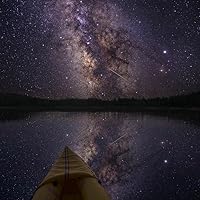
From the author of Astrophysics for People in a Hurry and the host of A Spacetime Odyssey,a memoir about growing up and a young man's budding scientific curiosity.This is the absorbing story of Neil deGrasse Tyson's lifelong fascination with the night sky, a restless wonder that began some thirty years ago on the roof of his Bronx apartment building and eventually led him to become the director of the Hayden Planetarium. A unique chronicle of a young man who at one time was both nerd and jock, Tyson's memoir could well inspire other similarly curious youngsters to pursue their dreams.Like many athletic kids he played baseball, won medals in track and swimming, and was captain of his high school wrestling team. But at the same time he was setting up a telescope on winter nights, taking an advanced astronomy course at the Hayden Planetarium, and spending a summer vacation at an astronomy camp in the Mojave Desert.Eventually, his scientific curiosity prevailed, and he went on to graduate in physics from Harvard and to earn a Ph.D. in astrophysics from Columbia. There followed postdoctoral research at Princeton. In 1996, he became the director of the Hayden Planetarium, where some twenty-five years earlier he had been awed by the spectacular vista in the sky theater.Tyson pays tribute to the key teachers and mentors who recognized his precocious interests and abilities, and helped him succeed. He intersperses personal reminiscences with thoughts on scientific literacy, careful science vs. media hype, the possibility that a meteor could someday hit the Earth, dealing with society's racial stereotypes, what science can and cannot say about the existence of God, and many other interesting insights about science, society, and the nature of the universe.Now available in paperback with a new preface and other additions, this engaging memoir will enlighten and inspire an appreciation of astronomy and the wonders of our universe.
Neil deGrasse Tyson was born and raised in New York City where he was educated in the public schools clear through his graduation from the Bronx High School of Science. Tyson went on to earn his BA in Physics from Harvard and his PhD in Astrophysics from Columbia.
In 2001, Tyson was appointed by President Bush to serve on a twelve-member commission that studied the Future of the U.S. Aerospace Industry. The final report was published in 2002 and contained recommendations (for Congress and for the major agencies of the government) that would promote a thriving future of transportation, space exploration, and national security.
In 2004, Tyson was once again appointed by President Bush to serve on a nine-member commission on the Implementation of the United States Space Exploration Policy, dubbed the “Moon, Mars, and Beyond” commission. This group navigated a path by which the new space vision can become a successful part of the American agenda. And in 2006, the head of NASA appointed Tyson to serve on its prestigious Advisory Council, which guides NASA through its perennial need to fit ambitious visions into restricted budgets.
In addition to dozens of professional publications, Dr. Tyson has written, and continues to write for the public. From 1995 to 2005, Tyson was a monthly essayist for Natural History magazine under the title Universe. And among Tyson’s fifteen books is his memoir The Sky is Not the Limit: Adventures of an Urban Astrophysicist; and Origins: Fourteen Billion Years of Cosmic Evolution, co-written with Donald Goldsmith. Origins is the companion book to the PBS NOVA four-part mini-series Origins, in which Tyson served as on-camera host. The program premiered in September 2004.
Two of Tyson’s other books are the playful and informative Death By Black Hole and Other Cosmic Quandaries, which was a New York Times bestseller, and The Pluto Files: The Rise and Fall of America’s Favorite Planet, chronicling his experience at the center of the controversy over Pluto’s planetary status. The PBS NOVA documentary The Pluto Files, based on the book, premiered in March 2010.
In February 2012, Tyson released his tenth book, containing every thought he has ever had on the past, present, and future of space exploration: Space Chronicles: Facing the Ultimate Frontier.
For five seasons, beginning in the fall of 2006, Tyson appeared as the on-camera host of PBS NOVA’s spinoff program NOVA ScienceNOW, which is an accessible look at the frontier of all the science that shapes the understanding of our place in the universe.
During the summer of 2009 Tyson identified a cadre of professional standup comedians to assist his effort in bringing science to commercial radio with the NSF-funded pilot program StarTalk. Now also a popular Podcast, for three years it enjoyed a limited-run Television Series on the National Geographic Channel. StarTalk combines celebrity guests with informative yet playful banter. The target audience is all those people who never thought they would, or could, like science. In its first year on television and in three successive seasons, it was nominated for a Best Informational Programming Emmy.
Tyson is the recipient of twenty-one honorary doctorates and the NASA Distinguished Public Service Medal, the highest award given by NASA to a non-government citizen. His contributions to the public appreciation of the cosmos have been recognized by the International Astronomical Union in their official naming of asteroid “13123 Tyson.” And by zoologists, with the naming of Indirani Tysoni, a native species of leaping frog in India. On the lighter side, Tyson was voted “Sexiest Astrophysicist Alive” by People Magazine in 2000.
More recently, Tyson published Astrophysics for People In A Hurry in 2017, which was a domestic and international bestseller. This adorably readable book is an introduction to all that you’ve read and heard about that’s making news in the universe—consummated, in one plac
“Beyond the judgment of others, rising high above the sky, lies the power of ambition.” ~NdGT
One part memoir and three parts astrophysical awesomeness. Tyson recounts his journey from a star-struck Bronx adolescent (with a telescope) to one of the world’s most prominent and recognizable scientists. Along the way he shares his insights and opinions on topics as diverse as public education, NASA, race relations, 9/11, Stephen Hawking, dark matter, neckties, and male strippers.
Did you know..?
* A solar eclipse can never occur on Easter. * An alien from Venus would be called a “Venereal.” * A day on Jupiter is only ten hours long. * Pluto is smaller than seven moons in our solar system, including ours. * A can of Diet Pepsi floats, a can of regular Pepsi sinks.
“...there is no shame in not knowing. The problem arises when irrational thought and attendant behavior fill the vacuum left by ignorance.” (pg 38)
A young, good looking black astrophysicist. And an older white woman who writes books and book reviews.
Answer: both of us wanted to be astronomers since we were kneee-high to a toy telescope. And that's where my astral career ended. Tyson, however, took his lifelong love of the stars from the Starlight Apartments in the Bronx (poetic irony, yes?) first to a Ph.D. in physics and then to a career as college professor, Director of the Hayden Planetarlum, commenter extraordinaire on the PBS Nova series, and even to the extent of dissing Pluto. The last charge, levelled by Sheldon on tv's "The Big Bang Theory," is denied by Tyson, who really is a peaceable, good natured guy.
I thoroughlty enjoyed this book, a brief autobiography of a man I've admired for years. I learned that his sense of humor revealed on Nova is very real, and very funny, as when he says,
“Unlike what you may be told in other sectors of life, when observing the universe, size does matter, which often leads to polite ‘telescope envy’ at gatherings of amateur astronomers.”
THE SKY IS NOT THE LIMIT is written to appeal to adults and juveniles, too. He never tires of exhorting young people to lift their head, gaze at the sky and set no limits. This is advice we should all take to heart.
"The Sky Is Not the Limit" is an autobiography of Neil deGrasse Tyson, one of my few favorite astrophysicists alive. It reveals what happened during his childhood that lead him to get absorbed into astrophysics when he was just nine, the age of which many people have no clues to their future. It also vividly describes his passion when he got involved in astronomical events and a trip to West Africa to see solar eclipse with many famous people, including Neil Armstrong, the first human to set footprint on the surface of the Moon. Interesting activities like answering scientific questions and sharing his knowledge of the greatness of universe in various events and even on the planes awards him pleasure emotionally. The stories of his later work as a member of the Bush's Aerospace Commission, the racism he encountered during his everyday and academic life, his relationship with the cosmos, the possibility of how the world will end, and the controversial relationship between science and religions are also crammed into this informative autobiography. After finishing reading it, we not only indirectly experience Neil's life, but also are able to expend our knowledge of science.
I love every moment while reading this book. It's highly recommended.
In the end, I will leave you with the last paragraph, which Neil spectacularly expressed his feeling through this book.
"I owe Earth (and the universe) much more than this. For my entire omnivorous life I have eaten of its flora and feasted on its fauna. Countless plants and animals have sacrificed their lives and unwillingly donated their energy content to my sustenance. The least I can do is donate my body back to this third rock from the Sun. I want to be buried, just like in the old days, where I decompose by the action of microorganisms, and I am dined upon by any form of creeping animal or root system that sees fit to do so. I would become their food, just as they had been food for me. I will have recycled back to the universe at least some of the energy that I have taken from it. And in so doing, at the conclusion of my scientific adventures, I will have come closer to the heavens than to Earth."
The Sky Is Not the Limit: Adventures of an Urban Astrophysicist by Neil deGrasse Tyson
“The Sky Is Not the Limit” is the entertaining biography of astrophysicist Neil De Grasse Tyson. Best-selling author and science icon Neil deGrasse Tyson takes the reader on a journey through his eyes, which is to say the cosmos and many interesting insights of his life. This uplifting 203-page book includes the following seven chapters: 1. Night Vision, 2. Space, the Final Frontier, 3. Scientific Adventures, 4. Dark Matters, 5. Romancing the Cosmos, 6. The End of the World, and 7. God and the Astronomers.
Positives: 1. Great science writing. Informative, interesting, accessible and fun to read. 2. The fascinating life of Neil deGrasse Tyson (NDT), makes for a great biography. “In these pages, I share what I believe to be amusing and playful moments of my life in the cosmos.” 3. The book has excellent flow. The pages read themselves. 4. NDT’s charm is found throughout the book. He shares his interest in the universe and his life as a black man in America. 5. The impact of good teachers on students. “A student's academic life experience can be constructed from much more than what happens in a classroom. Good teachers know this. The best teachers make sure it happens, and measure their own success as educators not by how many students earned As in their class but by the testimony of whose lives they enriched.” 6. Not afraid to provide constructive criticism. “So we have created, and willingly support, an educational system that honors the highest grades in class and on exams, but these same perfect grades bear little or no predictive value for those who will actually express the talent that shapes our contemporary culture.” 7. NDT shares his favorite courses. “My favorite between them, and my favorite of them all was simply titled Astronomy Roundtable, which covered the physics and the mathematics of relativity, black holes, quasars, and the big bang.” 8. NDT’s philosophy is top notch. “Actually, there is no shame in not knowing. The problem arises when irrational thought and attendant behavior fill the vacuum left by ignorance.” 9. Shares perspectives on interesting topics like the defense of humanity. “we must colonize space in as many places as possible, which will proportionally reduce the chance of our annihilation from a collision between Earth and a comet or asteroid—we would then no longer have all our eggs in one basket, as it were.” 10. The impact of 911 on NDT. “The fires created a furnace hot enough to render molten the steel cores of the World Trade Center towers. Before my apartment received professional cleaning, I collected a vial's worth to keep as a kind of reliquary—in remembrance of a tragic portal through which we had all passed.” 11. Social criticism. “At the risk of sounding like a curmudgeon, allow me to say that one of society's greatest ills is the astonishing breadth and depth of its scientific (and mathematical) illiteracy.” 12. In defense of the scientific method. “Initial uncertainty is a natural element of the scientific method, yet the scientific method is, without question, the most powerful and successful path ever devised to understand the physical world.” 13. So why did Pluto get demoted? Find out. 14. Fun tidbits. So what about the metric system? “Last I checked, only four countries are left in the world that do not officially sanction the metric system in their general population: Liberia, Myanmar, South Yemen, and the United States of America.” 15. Fascinating look at being black in America. “At no place along that timeline could I recall a black person (who is neither an entertainer nor an athlete) being interviewed as an expert on something that had nothing whatever to do with being black.” “I can summarize my life's path by noting the following: in the perception of society, my athletic talents are genetic; I am a likely mugger-rapist; my academic failures are expected; and my academic successes are attributed to others.” 16. Math and physics. “Equations are not ideas unto themselves. They are just the symbols that represent ideas.” 17. The end of the world. “The complete list of corpses may sound familiar: black holes, neutron stars (pulsars), white dwarfs, and even brown dwarfs are each a dead end on the evolutionary tree of stars.” 18. Religion versus science, always a fascinating topic. “The claims of science rely on experimental verification, while the claims of religions rely on faith.” “I have yet to see a successful prediction about the physical world that was inferred or extrapolated from the information content of any religious document. Indeed, I can make an even stronger statement. Whenever people have used religious documents to make accurate predictions about our base knowledge of the physical world, they have been famously wrong.” 19. A photo insert.
Negatives: 1. Very little supplementary visual material on the substance of the narrative. 2. No links to notes. 3. No formal bibliography.
In summary, icons that are genuinely passionate about their work always impress me. NDT loves being an astrophysicist and his engaging words flow beautifully throughout. A fascinating life in a fascinating career, a biography worth reading. I recommend it! Further recommendations: “Origins: Fourteen Billion Years of Cosmic Evolution”, “Welcome to the Universe: An Astrophysical Tour” and “Astrophysics for People in a Hurry by Neil deGrasse Tyson, “Cosmos” Carl Sagan, “The Big Picture” Sean Carroll, “A Universe From Nothing” by Lawrence Krauss, “The Grand Design” by Stephen Hawking, “The Elegant Universe” by Brian Greene, and “Wonders of the Solar System” and “Wonders of the Universe” by Brian Cox.
I loved this biography of Tyson. I'm a long term fan of Cosmos the Sagan then Tyson updated version, and it was very interesting reading about Neil's path to the stars and about his meeting with Carl Sagan. Lot's of good stories about science and about being black in America.
I wanted to like this because I like Neil Degrasse Tyson. But it turns out that I like the cool, smart, yet approachable Neil of 2015 way more than I like the vaguely condescending People Magazine's Sexiest Astrophysicist Neil of 2004. I don't know who the intended audience was for this memoir and I'm not quite sure he did either. There was a push for NASA funding alongside bemoaning funding going to the arts in school. There were sections that just meandered and I actually flipped past them, which I hardly ever do. I ended up giving up on the book.
Five wonderful stars for an inspirational, thought provoking, informative and fun read. Somehow, I used to think of memoirs and autobiographies to be dull and boring, specially if one is written by a nerdy astrophysicist, like what interesting could happen in the life of a geek, but I was wrong. Neil is not only a brilliant scientist but a hilarious writer and an amazing educator too with some interesting life stories. He is a staunch advocate of funding new space exploration programs and making serious efforts to find an alternate home for homo sapiens because he believes this one is going to hit by an asteroid soon. I really enjoyed reading his humorous and witty style of writing and the way he talks about critical social issues like racism and systemic prejudice against his community in American society. A real fighter His life stories intertwined with his childhood passion of learning what is out there in the sky is engrossing for anyone who is interested in the subject or just loves science. PS, I don’t approve his efforts to demote Pluto as a planet, otherwise he is cool
This guy is one of my personal heroes. A black dude from the Bronx who went to earn a Ph.D in Astrophysics. This guy rocks. Neil DeGrasse Tyson is the director of the Hayden Planetarium at the Museum of Natural History in NYC, and he has become a minor celebrity in the world of science.
Not so much because of the color of his skin, but for the story of how a kid in a NYC apartment fell in love with the study of deep space physics and phenomena. This book is very breezy and fun. The few times he gets into complex analyses of astronomy his prose style allows just about anyone to understand his point of view.
I also like this book because he feels (as I do) that American society is far too scientifically illiterate, and there needs to be more mainstream scientists of color who inspire and reach back into disadvantaged communities.
How does a young black kid from the Bronx become a world-famous astrophysicist, Director of the Hayden Planetarium and the second coming of Carl Sagan? The Sky is Not the Limit is Neil deGrasse Tyson’s semi-autobiographical account of how he came to be seduced by the study of the night sky, one that doubles as a light work of popular science, promoting informed, critical thinking and asserting that yeah, science is cool. Subtitled Adventures of an Urban Astrophysicist, Tyson’s memoir reveals that anyone can take joy from studying the stars, even if their view of the sky is washed out from city lights and their ambitions discounted by everyone they meet. The biography-turned-essay collection is Tyson’s most effective attempt so far to convert his gift for communicating science in public lectures into written form. Though his being seduced by heavenly bodies takes center stage, one essay ("Dark Matters") sees Tyson make a rare comment on race. Although he received support from his parents and guidance from remarkable individuals like Carl Sagan and Isaac Asimov, Tyson had to overcome the obstacle for race: at every step along the way of his education people questioned his choice of occupations, from patronizing whites doubting his intelligence ("Why don't you just play basketball?") to patronizing blacks who thought astrophysics was too white and that an intelligent black man should be helping the race by being a social activist instead. He persevered, however, and eventually became a celebrity scientist, the first black man (to his knowledge) to be interviewed on television and asked for his professional opinion on something outside of race or civil rights. The Sky is not the Limit covers astrophysics, math, skepticism, telescope stargazing as a first date (not successful), and September 11th, 2001. Those looking for an entertaining science read should find this attractive.
Related:
Dr. Tyson hosts a weekly podcast called "StarTalk Radio", which is ridiculously awesome. He always hosts with a comedian, includes interviews, and fields questions from listeners about science and popular culture. The last show featured an interview...Buzz Aldrin, one of the first two men on the moon. Tyson has also spoke with Dr. Ruth (that "Dr. Ruth") and frequently features authors like Mary Roach and Neil Chaikin
Hopefully, likely, someday there will be a comprehensive biography of astrophysicist Neil deGrasse Tyson. No rush though. With several published works, and many videos and audio recordings available for free online, the in-process life of Dr. Tyson is quite accessible. And for those of us who want the equivalent of an extended personal conversation, there is The Sky Is Not the Limit. Published in 2004, this book is far from comprehensive. Still, it is a wonderful survey of the life of the man People Magazine hypothesized to be the Sexiest Astrophysicist Alive.
I was hoping for a memoir that focused mainly on relating life events. However, The Sky Is Not the Limit spends a great deal of ink engaging in scientific discussion. In such cases, a briefly recounted memory serves as a springboard to academic discourse. All the material is valuable, but the selling point of memoir is undercut somewhat as a result. A minor criticism, but this book wants for a greater abundance of revealing anecdotes.
At any rate, Dr. Tyson's exciting and candid voice comes through loud and clear. The anecdotes he does share run the gamut from triumph, to tragedy, with humor and surprise included. In terms of offering both vivid personal history and profound reflection, the sections on 9/11 and racism are absorbing. Tyson provides some of his most insightful and bittersweet assessments when recounting his memory of the Apollo 11 moonlanding.
For fans of Neil deGrasse Tyson, this book is of course a must read. For those shopping for a proper introduction to Tyson's scientific knowledge, and his entertaining and accessible style of sharing it, consider trying Death by Black Holeor the more recent Space Chronicles.
Quotes from Neil deGrasse Tyson that I found inspiring:
"I want every generation of stargazers - whether they sit atop a tenement roof or an Appalachian mountain - to have a polished lens with which to see the universe and reach for their own star."
"A student's academic life experience can be constructed from much more than what happens in the classroom. Good teachers know this. The best teaches make sure it happens."
"Unlike what you might be told in other sectors of life, when observing the universe, size does matter, which often leads to polite 'telescope envy' at gatherings of amateur astronomers." Love the sense of humor!
About one of his fondly remembered professors, the late Professor Gerard deVaucouleurs who instilled an uncommon sense of patience, precision and scientific fortitude: "No idea too big to tackle. Like the Stradivarius violin, I fear that his kind will never again be made."
Quotes that inspired Neil deGrasse Tyson:
"Enter to grow in wisdom" "Exit to Serve Better Thy Country and Thy kind." - Harvard
"Hold fast to dreams For if dreams die Life is a broken-winged bird That cannot fly" - Langston Hughes
The biography is very humorous, at times humble and several 'pat your self on the back' moments (well deserved) and feels as if he is talking to you instead of trying to lecture. Easy read that is very knowledgeable and enjoyable!
I thoroughly enjoyed this. There's not a wasted moment in this book, it's full of interesting recollections, and opinions that each end on solid points while flowing nicely to the next sections. The last few books I read meandered throughout, and I often found myself wondering where they were going, so it was a relief to read this and never feel lost. These were at times funny, harrowing, and at times beautiful and profound. His 9/11 recollection was probably the most vivid I've come across, possibly because it was seen through the point of view, all-together a physicist, father, and one who was so close to the incident. My only nitpick is the final chapter on religion because it was somewhat wishy-washy, which is fine, if he just said, "I feel wishy-washy about theological matters." It was the only section where I couldn't tell what his point of view was. Otherwise excellent book.
Neil DeGrasse Tyson is possibly the coolest astrophysicist to have ever lived. Unfortunately this means that I have no idea what his research is about (since even this autobiography of sorts breezes through his grad school years) but that I do know he's one of the great modern popularizers of science. The Sky is Not the Limit shed light both on his astrophysical and personal life and gives more detail beyond his Daily Show persona.
From beginnings, including going up to the roof with a telescope and occasionally having the police called to investigate the person with the long, thin object on the top of a NYC building roof, to his continuing themes of Pluto and inaccuracy in movies (sorry "Gravity" folks, this was a thing years before he pointed out every inaccuracy), Tyson tells stories with his usual charm and humor. Really, if it's any hint to other scientists out there, adopting more of Tyson's wonder at the universe and making it obvious to others is a great way to start doing some outreach.
Other, less run of the mill topics included Tyson's experience during the 9/11 attack on New York, including evacuating with his daughter. Also, a chapter about his experiences as black man in modern America were particularly interesting, especially since the discussion occurred at a conference for African American physicists (who had all very similar experiences with the police and shopping mall cops--interesting too in light of the Henry Lewis Gates, Jr.'s run in with local cops not too many years ago). The experiences of both being an astrophysicist (which of course I am interested in as I am working on a PhD in a subfield of astrophysics) and being an underrepresented minority (also applicable) were interesting as both an insight into how scientists think but also how they develop.
One thing missing that I very much wanted to hear about was Tyson's graduate school experiences. He alludes to issues at his first institution as a reason for finishing his master's there and taking some time off, and I was very curious to learn more about it. I'm not trying to pry, but my very new position as a graduate student has made me curious about others' experiences. NDT has been a scientific role model for me for years, so I was hoping to glean some advice about how to get that PhD without going nuts.
Still, the range and interesting nature of Neil deGrasse Tyson's observations throughout his life and career were fascinating, and it's well worth the read especially for non-scientists, because more than a few times Tyson is spot on about how the minds of us scientists work.
Very entertaining memoir, but a bit dated since it was written in 2004. Would love to know more about the past 10 years, and sad illness caused us to miss deGrasse Tyson speak here in Madison. Main point that will stay with me in this book it nurturing the natural passions of our children. He was 9 when he set his sights on the stars, and his parents supported and encouraged him every step of the way. Second point, the important of science projects and critical thinking as part of childhood. As a lawyer mom I am always challenging the kids on arguments and assumptions, but not the natural scientist I vow to pull out some of those kid science project books I've bought. Well worth the read. deGrasse Tyson is funny, infinitely smart, and makes the bold comments we need to make about valuing, not belittling, scientific and math literacy. Thank you!
Neil De Grasse Tyson is an astrophysicist, he's the director of the Hayden Planetarium, and he's black – a combination making for a unique viewpoint. The book is mostly autobiography with a good helping of space science. Tyson's kind of a larger-than-life figure, and the same energy he brings to his interviews permeates this fun – and often funny – book. He never hesitates to detail his accomplishments,which is great, as he's done some amazing things. He doesn't downplay how much the media seems to love him (which is also great - I wish reporters would call working scientists more often), but he also mentions things like his drawer full of hate mail from third graders about his stance on Pluto's planetary status.
3.5 stars. An episodic look back on Tyson's career up to 2004, interspersed with a lot of scientific information. I was expecting a more cohesive, singular narrative of his past based on the description, but this book was more anecdotal than not. Some parts of Tyson's experience are really powerful and unique, and I was especially moved when he recalled being in NYC during 9/11 and reflected on his experiences as a black man and astrophysicist in America. However, in other places he can be rather condescending towards others, especially if they don't have as deep an understanding of astrophysics as he does, which could be a little off-putting to me as a reader. All in all an interesting read, though a bit of a mixed bag due to the considerations noted above.
It tells the somewhat inspiring story of Neil deGrasse Tyson. He focuses especially on his way through High-School and College, as well as the troubles he faced due to his skincolor. He also offers his thoughts on several subjects, such as religion, 9/11 and the media It is written with a certain kind of dry wit which I enjoyed quite alot. However, he judges certain groups of people pretty harshly within the book, so if that kind of stuff isn't your cup of tea, you best avoid this book.
Makes me wish I'd taken some college-level math so I'd have a better understanding of the universe and how it works. But it's not necessary to know any math to read the book. It's quite a good portrayal of a regular guy who became one of the most prominent astrophysicists of our time, and who just happens to be black, breaking the mold on stereotypes. Plus, it's witty and elegant.
A fun, readable memoir that intersperses stories of Neil deGrasse Tyson's life with his reflections on the importance of scientific thinking, the misrepresentation of science in media, and the importance of his being a highly visible Black astrophysicist.
This would be a great book to give to a teen who's interested in science. It doesn't go deeply into any math, but does inspire the reader to go out and learn more.
Fun book by Neil deGrasse Tyson, the astrophysicist of the title. It's not quite an autobiography, more of him just musing about his life and how he sees the world with fun digressions into things like peoples' reactions to math equations and the end of the world.
It's not too big on hard dates which for my purposes is a little difficult--it feels like his 14th year lasted forever! But I really liked the personal stories he told about that time. It's comforting to read about a kid who was not perfect but really excited about learning and intelligent when he's surrounded by people inspired to support him in that.
An interesting and informative read. For most of the book I wondered why the author made very little of the fact that he's a man of color. I thought that certainly must have been a factor in his life. And, sure enough, later in the book he devotes a chapter about how his color did play a roll for him. He is certainly an amazing and accomplished man, irrelevant of his skin color. And a good writer, too.
I thought I was getting an autobiography of Neil deGrasse Tyson. He did include a few personal stories, but he spent a lot of time explaining cosmic stuff. I think he can't help himself. Also, I got the feeling that some of the chapters were recycling of speeches he had made. You'd think his life would be so full that he could write a whole book about himself. Or more likely, when he is talking about th cosmos, he IS talking about himself, as I have heard him say that all of us are made with the stuff of the universe. I mostly skipped the chapter that detailed ways the universe could kill us all at once.
I love Mr. Tyson and it’s tempting to rate any of his books high because of the the the magic of the subject and his friendly approach.
This book is not different, though more of an autobiography than the rest of his books, it’s still fascinating, at points even more than usual because it’s nice to read about his passion sometimes more than reading complicated physics.
At times I’ve found some of his approaches a bit arrogant and surprisingly ditching others, usually for their poor understanding of astrophysics. What’s up with that?
I literally devoured this book. Not only it resonates with a proper example of good parenting (let’s face it, not every parent encourages their offspring to pursue their dreams when the term “astrophysicist” hits the table), but also the struggles and obstacles Neil faced to build his outstanding career to date. The passion in which he speaks about his love for astrophysics is inspiring, so much it leaves you to consider if you’re actually pursuing your dreams or fooling yourself under such belief. 100% recommended
It was interesting to see how Tyson got to be where he is and the challenges he faced. Not as good as his other books, but still interesting. He really is a great writer and speaker, and knows how to bring the very complicated subject of astrophysics down to everyone's level. If you enjoyed this, I highly recommend his Death by Black Hole.
Neil deGrasse Tyson tells us what it was like growing up as a kid in the city with an early passion for astronomy. He got to do some really cool stuff at an early age. And it's sort of all to do with the Hayden Planetarium, which he's now director of.
I found it very interesting, and it might just get you interested in astrophysics!
Tyson is a classy guy with a great story. It is well worth reading. With that said, it took me months and months to finish the book. I'd read a chapter and not read another one for weeks. There is nothing wrong with the book or the story. Tyson came from humble beginnings. He's brilliant, and he worked hard. He's a family man, happily married with kids. This just doesn't make for page-turning excitement. I highly recommend the book, but you will be able to put it down.
I've seen quite a few of Dr. Tyson's lectures and interviews on the web, so I thought I might like reading some of his work, and a memoir seemed like an easy first step. I enjoyed this book. It's mostly autobiography, of course, but there's also a bit of cosmology, media criticism, social criticism, and some thoughts on education and religion. It is, for the most part, a light and entertaining read. And, having read it, I'm certainly likely to give some of his other books a try.