It Has To Be This Way 2, by M. Anthony Penwill is published by Matt’s Gallery to accompany Lindsay Seers’ exhibition of the same title. The book is one element of the installation. Each element has arisen in relation to the total work, and all are mutually co-dependent. The second exhibition is co-comitioned by Mead Gallery, University of Warwick and National Gallery of Denmark. The book has been published in 15,000 copies and has been free for visitors throughout the exhibition.
From a tangle of manuscripts, research notes and a fateful box of photographs, Lindsay Seers tries to make sense of her step-sister's strange and desperate variant of Tarot in which photographs become a means of divination.
The structure of the novella, It Has To Be This Way by M. Anthony Penwill, draws from the archives of both the artist and her sister, Christine. The book is written through a process in which a narrative is founded on a selection of photographs. The archives from which the photographs were taken are constituted by the sisters' shared research from 1996–1999 on Queen Christina of Sweden (1626–1689). Inevitably, given their source, they reflect the life of Christine. M. Anthony Penwill has acted as an editor for this project and is the author of the resulting publication.
-Desciption from Matt's Gallery for the book "It has to be this way" which accompanied the exhibition of the same name.
DNF. An impulse purchase, and very cheap, so no regrets - but no rating, as I stopped barely 25% in, and I think it was more the wrong book or wrong time, than a bad book.
It’s an intriguing concept: a book that unravels a messy family, based on letters, a character’s research notes, postcards, videos, transcriptions of conversations, and photos. Photos that were actually exhibited in The National Gallery of Denmark and a couple of British galleries in 2011, and for which the book was written. I don't know if the photos really belong together, or if the whole thing is a fiction within a fiction.
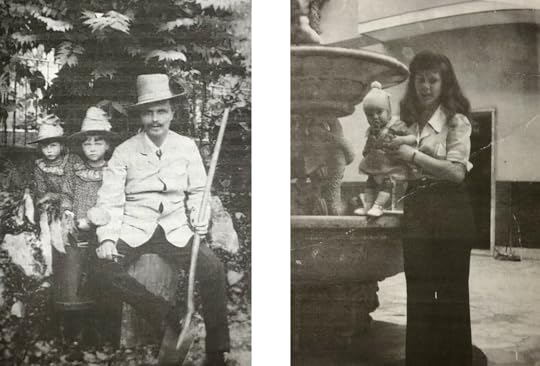
Image: Normal family photos?
There’s diamond smuggling; a suspicious accident; estrangements; a dodgy anonymous boyfriend; adult children who feel abandoned; memory loss; death; historical research; codes and ciphers; gender-fluidity; trips to Sweden, Finland, Ghana, and Rome; mistaken identity, and alchemy.
It’s presented as a collation of sources, with commentary, footnotes, and the photos. Some of the characters are referred to only by an initial. It’s all rather confusing, but potentially interesting to solve.
Most of the photos are purportedly taken by one of the main characters, Lindsay, many featuring her or her androgynous stepsister, Chris, who looked so like her, people often confused them.
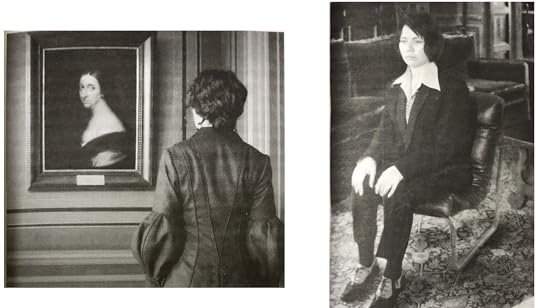
Image: Identity: who am I?
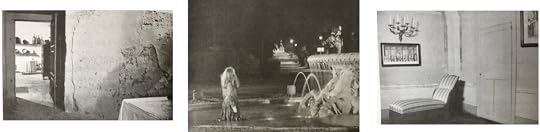
The black and white photos throughout the book seem to have little in common, and while some are enticingly odd, others are more like normal family snaps. And yet I just couldn’t get into it. It had an increasingly unsavoury feel. For the right reader in the right mood, it might be very good.
Image: Intriguing, disturbing, or what?
Photos, memories, reality
Photos are often used to piece together a narrative and kindle memories. But in this, everyone’s motives and memories are suspect, and one can’t be sure whether it’s Chris or Lindsay in many of the images. Even Lindsay isn’t always certain.
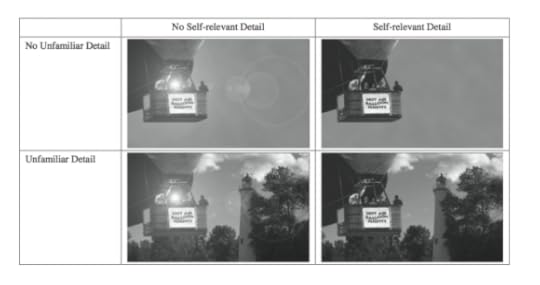
There’s a lot of real-world research, some of it contentious, into memory retrieval and implantation. Smells can be strong triggers, but often vague, whereas a photo is more specific and definitive. Except that PhotoShop exists. If you see a picture of you, as a child, in a hot air balloon, the chances are you’ll believe and expand on that “memory”, even if you’ve never been in a balloon! See CogBlog for details.
Image: Factors that affect the effectiveness of fake photos in implanting in memory (Source)
These days, it’s not just photos: deepfake videos can make it look and sound as if someone is saying something they never did. It’s one thing to resurrect Carrie Fisher for yet another Star Wars film, but in a different league when used for revenge porn, fake news, fraud, or to stir up political controversy and hatred.
And then there's False memory syndrome. It's an easy response for abusers to throw at victims when there is no corroborating evidence, although it’s not a recognised psychiatric phenomenon. Nevertheless, while one should always start by listening to victims, if it is possible to implant harmless memories, one can’t rule out the possibility of imagined abuse in some cases.
How can we ever know what is true if we can’t be sure of our own memories?
I totally agree with the review of the person below, I have very similar feelings. This book is tricky and disturbing. It makes your brain work over it for the whole days, every next chapter gives a shake (especially the notes of S). But the greatest thing about it is - it actually happens. That's life. It can be that way. And this is shocking, because makes you travel to the whole new dimension of life - some misty, weird and scary magical parts that still do exist in your brain. And you'll discover that there is no bigger and more complicated phrase to define than "Queen Christina".
"It has to be this way" may very well have changed my life. In ways it is a journey that started on a hot day in June when I stepped into the National Gallery of Denmark. The exhibit there was in many ways overwhelming but, as is the case with all the elements of this story, it isn't primarily the story that captures me but the way it is presented. Always a twist or a turn or something mind numbing or weird. It is definetly worth reading/visiting and has made an impact on me.