Rifts is a multi-genre role-playing game that captures the elements of magic and the supernatural along with science fiction and high technology. It spans countless dimensions making anything and everything possible. Players are limited only by their imaginations! Rifts is a complete, role-playing game that can stand alone or be combined with characters and elements from the entire Palladium Megaverse. Players can easily bring in characters from Heroes Unlimited, Robotech, Nightbane, RECON, Mystic China, The Palladium Fantasy RPG, or any of Palladium's RPGs.
Kevin Siembieda (born April 2, 1956) is an American artist, writer, designer, and publisher of role-playing games, as well as being the founder and president of Palladium Books.
Palladium Books, founded in southeast Michigan, claims to be the first to implement a role-playing system intended to work for all genres and to introduce the perfect-bound trade paperback format to the RPG industry.
Some of the role-playing games Siembieda helped produce include Teenage Mutant Ninja Turtles & Other Strangeness (1985), Robotech RPG (1986), After The Bomb (1986), and Rifts (1990).
Siembieda is also an artist, best known for occasionally illustrating Palladium Books' products. In 1978, he started the now-defunct Megaton Publications in Detroit, publishing a digest style title called A+ Plus and several other titles. He also contributed art and cartography to several early Judges Guild products (for both their Traveller and Dungeons & Dragons lines).
While the Rifts game system is not my favorite Role-playing system to us I love their source books. Always filled with great art and well written they are a nice goto source for new ideas, plots, characters and locations for any game. Recommended
I absolutely love Rifts. And I have since I was 13 years old. It's the post-post-apocalypse and you can roll up a Wizard, a Psychic, a Cyborg, a Dragon, a Juicer (chemically augmented super-soldier type), a Crazy (brain implants), a Scientist, a Vagabond, a Wilderness Explorer, a cyberpunkesque City Rat, a Doctor, or you can pilot a suit of Power Armor or Mech.
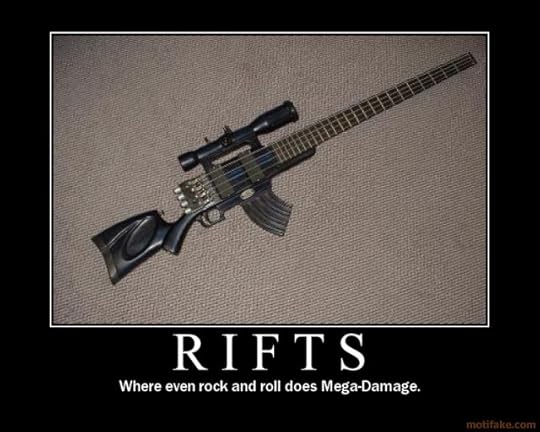
Well, I had to open this review with a motivational poster since I have yet to have done that with a book and I found this poster as I was looking for a picture of the cover to upload to Goodreads. Well, there were other ones, but the cool one which said 'Live in Russia – why play post-apocalyptic fantasy games', wasn't working.
That is an interesting thing though because we seem to love our post-apocalyptic wastelands, and while I would not necessarily say that Russia meets the criteria, Somalia certainly does. However the difference between living in Somalia and playing a post-apocalyptic roleplaying game is that the chances of you (as opposed to your character) walking out of it alive afterwards are much higher. Further, it does cost money, and requires extensive training, to be able to survive in Somalia, and if all the training that you need to survive a post-apocalyptic wasteland is to roll dice and draw upon your imagination, then I know what I would rather do.
Oh, and there is another thing about this particular post-apocalyptic wasteland and that the fantasy element. When the civilised world wiped itself out in a nuclear world it opened up a number of rifts to other worlds, and the inhabitants of these worlds came swarming through, bringing their magic with them, to completely alter the makeup of the Earth (sounds a little like Defiance). So, while you and run around in a full suit of body armour and blow away others with your energy weapons, there is always a chance that some mage will simply shut you down with a well placed lightning bolt.
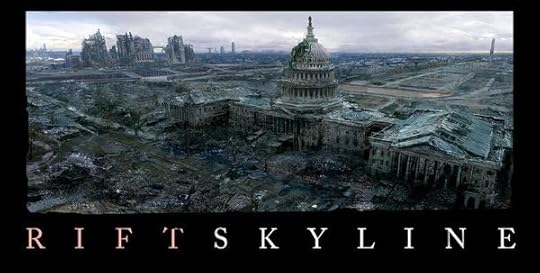
Time for another picture:
I never actually got around to playing Rifts, though my friend did buy it and lend it to me. I guess one of the main reasons really comes down to how easy it is to develop a game. Okay, I tend to put in way too much detail when I created my adventures, as if I was attempting to sell them as well as play them. I guess I like writing though and I also like detail. Okay, I have published some of my adventures up on the internet (though that website has long since gone), but not in the sense where I have made money from them.
The other thing that I baulked at was mega-damage. To me it just simply didn't work. Okay, granted, if you are hit full pelt in the chest with an energy weapon you are going to die, but I felt that having two levels of damage was simply annoying, and also made the game incredibly lethal. Basically, with the amount of time taken to create a character, to have them them blown away because they forgot to put their power armour on is a bit silly (though that is probably also a sign of a very bad GM).
When this book came out, my friends and I were playing the Robotech RPG from Palladium books. I picked up a copy of Rifts on day one, and instantly was drawn into the detailed world that Kevin and company had created. The mix of science fiction and fantasy was like nothing seen before, and the Palladium game engine, even with as much as people complain about it, was the perfect vehicle upon which to convey the story.
The world setting is amazing. Detailed in all the right places, and left completely vague in, again, all the right places. Ripe for players to add their own stories and create their own legends in the ever-growing world of Rifts Earth.
To this day, I prefer the Palladium game engine over all of the others I have played. And I've played a lot of them, believe you me! Is it perfect? No. Absolutely not. But then, neither is any other game engine.
What I love about the Palladium system is that it is completely geared, in my opinion, to story telling. Yes, there is a lot of randomness to the die rolls (not enough if you ask some), but the whole point of any RPG is to tell a story. The story of the players' characters. And any GM worth their dice won't let a bad roll, or an odd bit of extranious rule get in teh way of the story!
So, if the idea of a super-tech world being overrun by demons, monsters, aliens, and magic has any appeal to you at all, then you should absolutely give Rifts a good, long look. You owe it to yourself. Because even after 20+ years, the story and setting are amazing, and the engine is running strong.
I picked this up when I was 12 years old, not long after its initial release, and it opened up an entire world to me. For that, I will forever be grateful to Kevin. I recall years of imaginative exploration and excitement; late nights curled in a blanket with a dim light, feasting on the countless ideas, characters, and stories. For me, Rifts will forever be associated with child-like exploration.
The game has its detractors, but because it's the one that I began with, I can hardly find much fault with it.
Just finished reading this one again the other day. This is a rpg, so understand that. The system is awful but I have many fond memories of playing this game with friends, and soon will do so again. Rpgs are like fashion and music, they return to become new again. The thing about this book is the fluff and the limited art that makes it come alive. Such a wonderous setting and an apt playground to craft amazing stories you will always remember. Great stuff!
A total nostalgia read for me, this is the tabletop role-playing game I got super into in middle school/high school. It's a great, over-the-top setting, a postapocalyptic Earth overstuffed with dragons and magic and robots and sinister monsters popping out of "rifts." The "human-first" totalitarian Coalition State offers good conflict, even if they're an obvious Nazi analogue, and the little sketches of a ruined United States are humming with imagination and energy.
I rarely played the game--it was hard getting a party together--and reading back, I'm not sure how I played the game at all, as there are so many rules and numbers and exceptions to remember, all scattered throughout the book. (I also remember combat taking forever when we did play, as we mostly just emptied full rifle clips into whatever bad guy we were facing.)
As a rulebook, "Rifts" is disorganized and leaves much to be desired, but as a nostalgic peek into a ruined world, it's still fun.
About 11 years ago I finally decided to try Rifts, and I ended up with the Ultimate Edition. While I loved the setting (I already knew something about it) I felt overwhelmed with all the "stuff": so many weapons, powers, spells, how could I manage all this information? I had never been afraid of heavy games, but somehow I thought Rifts might be too crunchy for me. Not having ever played the game, this time I ended up with a copy of the Standard Edition, and it seems to have made all the difference for me. It is one hell of a book, with plenty of player options, but for some reason, it felt more manageable. I might still never play the game, as it is probably difficult to find a group interested in playing a campaign, and I do not think it makes a lot of sense to put all the effort this game needs/deserves. However, I have purchased a fair amount of supplements to (hopefully) keep myself interested in the setting for a while.
Good game, fun world, played it a lot in the early 2000's. Like anything there are a few things about the Rifts universe I'd change and we often did in house rules. I, being an avid shooter, had started to write a supplemental weapons manual for home use for this Rifts system. I felt game weapons lacked logic in their design. Before I finished I became embroiled in the APOCalypse 2500 project and simply folded my weapons ideas into my game universe. This is not to say that APOCalypse 2500 is derivative of Rifts, as it is not. The writing of the weapons manual simply spurred me on to do what I'd been thinking about for years.
This is my 1st review of a roll playing game. Many might disagree with me but there Rifts Palladium series as one of my favorites. And I might be just nostalgia but I really enjoy it. It is a little rules heavy but it has a good mix of options on how to play character. If you've ever imagined fighting a dragon with a mech, this is your game
This book is the core rulebook for a role-playing game, so it's not a straightforward, cover-to-cover read. Based on my experience playing the game, I would offer the following: The world created by Kevin Siembieda is a fascinating, near endless one (as the many supplements show), full of inventive weapons and worlds - derivative on occasion, but still interesting - and perfect for adventures. The downside is an overly complex combat system, involving, for instance, three different levels of damage. And character options, while fascinating and myriad, can become overwhelming. But a solid game that is almost more enjoyable to imagine than to play.
This was an RPG I played as a teenager and followed into my 20s, going back and opening it up was like revisiting the past. What RPGs are based on is creating worlds that stories can be evolved within and the Rifts world does throw everything together in a post-apocalyptic world where technology and magic and dimensional beings all reside together. I really enjoyed using it to spark my imagination.
Did not like this game at all. It gets 2 stars instead of one from me for trying to blend everything under the sun into one game, but it is that 'toss everything into the pot and see what happens' mentality that I thought failed here.
I was always marginally aware of Rifts, since it's the crown jewel of the Palladium line, which I've used despite its bulky system, but I never actually investigated the setting of the core book. It's pretty interesting.