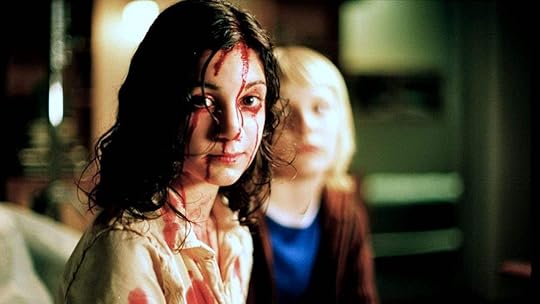
Audiences can't get enough of fang fiction. "Twilight," "True Blood," "Being Human," "The Vampire Diaries," "Buffy the Vampire Slayer," "Blade," "Underworld," and the novels of Anne Rice and Darren Shan--against this glut of bloodsuckers, it takes an incredible film to make a name for itself. Directed by Tomas Alfredson and adapted for the screen by John Ajvide Lindqvist, The Swedish film "L't den r?tte komma in" (2008), known to American audiences as "Let the Right One In," is the most exciting, subversive, and original horror production since the genre's best-known works of the 1970s. Like "Twilight," "Let the Right One In" is a love story between a human and a vampire--but that is where the resemblance ends. Set in a snowy, surburban housing estate in 1980s Stockholm, the film combines supernatural elements with social realism. It features Oskar, a lonely, bullied child, and Eli, the girl next door. "Oskar, I'm not a girl," she tells him, and she's not kidding--she's a vampire. The two forge an intense relationship that is at once innocent and disturbing. Two outsiders against the world, one of these outsiders is, essentially, a serial killer. What does Eli want from Oskar? Simple companionship, or something else? While startlingly original, "Let the Right One In" could not have existed without the near century of vampire cinema that preceded it. Anne Billson reviews this history and the film's inheritence of (and new twists on) such classics as "Nosferatu" (1979) and "Dracula" (1931). She discusses the genre's early fliration with social realism in films such as "Martin" (1977) and "Near Dark" (1987), along with its adaptation of mythology to the modern world, and she examines the changing relationship between vampires and humans, the role of the vampire's assistant, and the enduring figure of vampires in popular culture.
ANNE BILLSON is a film critic, novelist, photographer, style icon, wicked spinster, evil feminist, and international cat-sitter who has lived in London, Tokyo, Paris and Croydon, and now lives in Belgium. She likes frites, beer and chocolate.
Her books include SUCKERS (an upwardly mobile vampire novel), STIFF LIPS (a Notting Hill ghost story), THE EX (a supernatural detective story) and THE COMING THING (Rosemary's Baby meets Bridget Jones) as well as several works of non-fiction, including BILLSON FILM DATABASE, BREAST MAN: A CONVERSATION WITH RUSS MEYER, and monographs on the films THE THING and LET THE RIGHT ONE IN.
Her latest book is CATS ON FILM, the definitive work of feline film scholarship.
She sometimes writes about film for the Guardian, and is currently working on a screenplay and a sequel to her vampire novel, SUCKERS. She has three blogs: multiglom.com (the Billson Blog), catsonfilm.net (a blog about cats in the cinema), and lempiredeslumieres.com (photographs of Belgian beer, bars and sunsets).
Let the Right One In is 1) a great horror novel; 2) a great movie; and 3) a great American remake - this last one sound like a contradiction in terms to some of you purists but I think both the movies are excellent.
Anne Billson wrote a very smart book about Buffy the Vampire Slayer so she is clearly a bit obsessed by vampires but that's okay, so long as she doesn't take it too far. Writing books is a good way to get it out of your system.
She uses this movie to summarise the whole history of vampires in the movies and how they morphed from being tall creepy old guys (Bela Lugosi, Christopher Lee) to teen pinups (Robert Pattison, James Marsters).
But I say bah humbug to the lot of them. For me, there is only Eli, saddest vampire of them all.
A man commits a gruesome murder for someone else. What are his motives and reasons for this act? A child is the target of a group of bullies and dreams of murderous revenge. What ties these two characters together? That is the mystery of Let The Right One In.
I picked up this book because of the comparison of this Swedish author to Stephen King on the back of the book jacket; had I read further, I would have noted that the next blurb proclaimed it to be about vampires. Ever since Twilight (ugh), I just can't seem to shake the vampire grip on my subconscious neck. Although I am itching to get away from vampires, I read this novel anyway given the stellar reviews it's received (as both a book and a movie). Good character development, a captivating mystery, and a desire for the redemption of the vampire genre spurred me on to began reading. I really enjoyed it until about midway when it got a little too freaky for me (sorry, no spoilers from this gal, you'll have to read it for yourself). Also, the characters in this book have few redeeming qualities, so it was hard for me to care about what happened to them. Even the bullied child creeped me out with his thirst for murderous revenge. The central vampire in this book, Eli, is not anyone you will lust after or envy. This vamp is truly alien and drinks blood without apologies. If you are sick of sparkly vampires, love triangles and synthetic blood you'll appreciate Let The Right One In.
Very well written but a bit too dark for me. Very few redeeming characters and even the victims are difficult to empathize with. However, I can't help but be drawn into the prison of the life that is Eli's and wonder how and what has made her this way...
Interestingly, others who have reviewed this book have confused it with the novel Let the Right One In. This is a short book explores the themes of the film adaptation. I enjoyed this. It was an easy read and the author has a good knowledge and understanding of the genre.
This critical review of the horror film Let the Right One In offers insights into how the film situates itself in relation to the broader vampire film genre, both as it is forged in movies and on TV. This task it does very well, although often to such an extent that the focus shifts from a work predominantly about this film to something more broadly about vampire films in general; that is, it sometimes talks about other films for a considerable time and only briefly relates this back to the film at hand. The book also does a very good job of engaging how the movie's cinematic form - the shots, editing, music, sound, sets - relates to the story and its meaning. All this it does well. Two ways in which the book comes up short relate are its adequately developing a thesis, and its ignoring the perspective a particularly relevant critical theory that might bring light to bear on the film. Regarding the first, the author states early on that the film draws upon "social realism," but then fails to sufficiently follow up on developing this thesis, at least explicitly; the book rarely mentions the term after its introduction, and doesn't explore all parameters of the definition it provides in the first few pages. I would have liked to have heard more about this idea, as it seems the central focus of the author's perspective on the film. Secondly, given the focus of the film on its two outcast protagonists, one of whom is a "girl" born as a boy, and the other one who doesn't seem to care about such labels, the book's side-stepping any insights queer cinema theory may provide to interpreting the film is puzzling. Clearly there's fruit to bear here, but this critical theory is neither mentioned nor explored, even thought its pertinence to the film seems clear and begs consideration. Again, the book's strengths are its close read of how the film's artistry relates to the story and its meaning, and its consideration (sometimes at too much length) of the film's relation to the broader vampire genre. In sum, readers will get something out of this book, even if some pertinent ideas are underdeveloped or unexplored.
An excellent overview of the film that elucidates its extraordinary and lasting power, as well as examining it as an adaptation of the Lindqvist novel as well as against the background of the (sub)genre of vampire movies. Billson's encyclopaedic knowledge of film in general -- and vampire films in particular -- offers a rich background for the often minute examination of this extraordinary film. Her careful observation brings out details half-glimpsed or even forgotten, sparking a desire to watch it again even if you've just seen it recently. The technical expertise is evident as Billson breaks down scenes and even shots with insight and persuasiveness. These Devil's Advocate volumes are thin in size but the best -- like this one -- are chock full of value.
After re-watching both movie adaptations of Let the Right One In (and getting about two-thirds of the way through the audiobook so far), it was fun to read some long-form non-fiction about it. I haven't thought about these films all that deeply in the more-than-a-decade since I first saw them, but I remember how much the original Swedish version affected me at the time. Anne Billson offers some interesting insight, which I don't always agree with, but perhaps the most significant point she makes is how this film supports many different interpretations. Recommended if you want to chew more on this now-classic vampire movie.
This isn't the novel that the film is based on. It reads like a cross between a scholarly paper and a fanzine. If you are a film lover and you're obsessed with vampires you might dig this book. It provides an plot summary and compares it to other vampire novels, films, and TV shows. I have read or watched many of the comparative works mentioned so, I was able to hang in there. Book is written smartly and moves along at a brisk clip.
This entire review has been hidden because of spoilers.
Another dissapointment.... I thought I'd be daring and read a random vampire book and... well idk why I did that. I think the story is solid. The concept is interesting.
However, I don't think it's an engaging story. I was at 66% and had no interest in continuing the book. I only did so bc I'm mentally ill and it physically hurts to dnf books. I'd say don't read the book, just watch the movie but i haven't seen the movie so it might also be "meh"
Anne Billson wrote the excellent BFI essay on 'The Thing', so it's no surprise that this short book on 'Let the Right One In' is also thoughtful and appreciative of the film's achievements. Bonus points for connecting each short, thematic chapter on the film to the history of vampires in cinema in general.
This is a very good book for anyone who loved the movie and is in search of more, especially more vampire content. This was rather useful for the writing of my third-year thesis on Let The Right One In.
Pretty good book, really slow but good build up. I was a quarter into the book, before I even knew what it was about! I won't spoil it, but great finish.
This is a study of the critically acclaimed movie, and will primarily appeal to those who are passionate fans of it.
Billson is obviously intrigued by the movie, and adopts a two-pronged approach (no pun intended!) in her analysis.
This consists of meticulously recounting the scenes from the movie, while simultaneously adding her own comments. I actually felt it was quite similar to the experience you get from watching director's commentary on a DVD.
Billson has a keen eye for the language of movies - like when she notes the use of the colour red throughout the movie. However, it's also an approach that lends itself to a somewhat superficial, very visually orientated analysis.
Perhaps in order to remedy this, Billson organizes her observations in overarching themes like "The Vampire's Lifestyle" and "The Vampire's Arrival".
In this approach Billson compares and contrasts "Let the Right One In" to the many other vampire-movies that have been made. She has a vast knowledge of the horror-genre, and you'll certainly come away a lot wiser on pivotal vampire movies.
The main problem with this approach is that "Let the Right One In" is anything but a typical vampire movie and has almost nothing in common with movies like "Twilight" and "Blade". Billson is the first to recognize this, but yet she still insists on understanding it within this framework.
I can't help but feel that perhaps it would have been more rewarding to compare "Let the Right One In" to movies from different genres, or perhaps by analyzing on how it juxtaposes opposites (innocence vs callousness, reality vs the fantastical, human being vs monster) in order to create a complex, ambiguous and fascinating story.
As it is, I feel it's too seldom that Billson’s analysis scratches more than just the surface, which is a shame. Still, I would recommend her guide to fans of the movie, as there's certain to be some new perspectives or tidbits of knowledge, you didn't know.
In addition to the criticism above, there are a few minor issues, which I felt could have been easily avoided.
Billson has a firm grasp on the movie, but she doesn't seem to have the same insight into the novel. This means that on occasions she is oblivious to issues that are quite plainly stated in the novel. (She also frequently misspells the name of the author, John Ajvide Lindquist).
Throughout the guide she uses screenshots from the movie to illustrate key-scenes. This is a good idea, but unfortunately the quality of the photos is very poor - they're grainy, grey-scale and about the size of a matchbox - and so, they add very little to her analysis.
Finally, potential readers should be aware, that the guide is chock-a-block with spoilers from vampire movies.
Given Billson’s approach, this is hard to avoid, but I was genuinely dismayed to see her reveal the ending to the short story Lindquist wrote as an epilogue to his novel.
This short story is called "Let the Old Dreams Die" and is part of an identically named anthology of short stories from Lindquist:
So: if you wish to find out for yourself how the story of Oscar and Eli ends, make sure you DO NOT READ p. 105 of Billson’s guide!
Since Interview with a Vampire, this is maybe the best vampire book I've ever read! It's nothing like Twilight. This is real, raw and what a blood sucker should be. I don't think I've been this freaked out since Salem's Lot by King. They kill, plain and simple. It is very dark, but for gripes sake its about a vampire that kills. This is a well-written book that flows easily really becoming fast past about 30% in and this is where everything begins to unravel. Really there are more twist and turns in this and so much surprise. The characters are well-drawn and this is hard when your telling multiple perspectives. I understood something in each of them, felt sympathy, well except for one a little too dark. That one I just wanted dead, which means he was drawn especially well.
Trina said I'd like it even though I've seen both movie versions and wasn't really interested. I took her advice and really liked it. Great characters, interesting take on the vamp genre - it was a quick and interesting read.
I saw the movie first and thought it was unique. I found out the movie made from a book so I got the book to read. once u get past the forgein names it is a really good book.