Georges Prosper Remi (22 May 1907 – 3 March 1983), better known by the pen name Hergé, was a Belgian comics writer and artist. His best known and most substantial work is The Adventures of Tintin comic book series, which he wrote and illustrated from 1929 until his death in 1983, leaving the twenty-fourth Tintin adventure Tintin and Alph-Art unfinished. His work remains a strong influence on comics, particularly in Europe.
"Hergé" is the pseudonym of George Remí, making a game with the initials of his name inverted. Throughout the evolution of his star character, Tintin, we can see the progress of this author: from the first titles marked by the ultraconservative doctrine of the director of the newspaper Le Petit Vingtième, to the breaking of conventions embodied from The Blue Lotus , as well as the evolution of the society of his time. The research carried out by Hergé to historically contextualize his Adventures, as well as his implicit social criticism, have made Tintin a masterpiece of the 20th century.
The reference for any tintinophile is an adventure in the land of the Soviets! We find there not only the first journalistic adventures of Tintin and his four-legged companion, Snowy but also all the ingredients of the hero's future adventures already found here: the hero's inscription in his time and in the face of the contradictions of his time, endless stunts, misunderstandings, "evil villains" ... Here we are touching the essence of Tintin's character. Consequently, the whole is more extended than another album in the series, but impossible to get bored with over the pages; the actions are linked via situations found with pleasure in many volumes. I want this old-fashioned Tintin more! Of course, it may put off the still-rough drawing and the decision to keep the black and white, but this, on the contrary, drives the desire to discover the origins of Tintin's character again and again. A book to collect!
Despite suffering from a lack of any cohesive plot, poor art (compared to later entries) and political naiveté, Tintin in the land of the Soviets is still a worthwhile read for Tintin completists.
Even so, it’s not a book I would ever recommend to first time Tintin readers. It is worlds away from the genius of later entries. I would suggest reading it along with a companion work like Tintin: Herge and His Creation, which explains the troubled publication history and the influences prevalent in the author’s life at the time.
What we have here is a young artist only discovering his craft, and with no clear direction in which to steer it yet.
There are some bright moments that foreshadow the great things ahead, and the hokey situation comedy even makes for one or two smiles, even though it is clearly more suited to a Roadrunner cartoon than a Tintin story.
I love the Tintin books, but I can hardly give this more than three stars, since that would diminish the significance of the true five star entries.
Written in 1929 this Tintin adventure gives us a glimpse into the recent Bolshevik revolution in Russia. As such it is a very important document that will be enjoyed by those who are interested in the history of modern Russia and the geopolitical 'quake' that was the result of the end of the Romanov dynasty. Powerful and thought provoking.
اولین جلد از کمیکهای تنتن، یعنی «تنتن و میلو: فرار از شوروی»، فقط یه داستان ماجراجویانه درباره یه خبرنگار جوون نیست؛ بلکه یه جور بازتاب نگاه غرب به شوروی اون زمانه. هرژه، خالق تنتن، توی این داستان، تصویر خیلی اغراقشده، ترسناک و زشتی از شوروی نشون میده؛ جوری که انگار اونجا یه دنیای تاریک، سرد، بیاخلاق و خطرناکه. ولی این زشتی فقط توی ظاهر اون سرزمین نیست. اگه با تکیه بر مفاهیمی که اومبرتو اکو توی کتاب تاریخ زشتی مطرح میکنه به این جلد نگاه کنیم، میفهمیم این زشتی یه کارکرد سیاسی و فرهنگی داره: تبدیل شوروی به «دیگری». این «دیگری» توی کتاب «تاریخ زشتی» خیلی مفهوم مهمی هستش و منم بهش علاقه زیادی دارم ، ارجاع زیادی هم بهش میدم. از نظر اکو، زشتی فقط این نیست که یه چیز یا آدم، نامتقارن، معیوب یا نازیبا باشه؛ زشتی خیلی وقتها به اون چیزهایی اطلاق میشه که ما ازشون میترسیم یا درکشون نمیکنیم. زشت، کسیه که با ما فرق داره، فرهنگش متفاوته، یا حتی تهدیدی برای نظم ماست. حالا اینجاست که مفهوم «دیگریسازی» مطرح میشه: ما خودمون رو درست، خوب، زیبا، و بااخلاق میدونیم و در مقابل، یه «دیگری» میسازیم که زشت، منحرف، ترسناک یا خشنه؛ و به این ترتیب خودمون رو بالاتر میبریم و جدا میکنیم. توی این کمیک، اون دیگری، مردم و نظام کمونیستی شورویان.
تو داستان، تقریبا همهچیز شوروی زشته. مردمش یا ترسیده و غمگینان، یا بیاحساس و دغلباز. خیابونها گلآلودن، خونهها ویرونن، معماریها شبیه زندانه. نظام حاکم، خشن و بیرحمه و مردم هم یا قربانیان یا بخشی از اون سیستم سرکوب. در مقابل، تنتن یه پسر متمدن، زرنگ، خوشتیپ و اخلاقمداره و سگش میلو، نماد غربِ روشن و آزاده. این تقابل قشنگ میشه دوگانه آشنای «ما/آنها» یا «خوب/بد»، ولی با شکل بصریِ زیبا/زشت.
*مهم مهم مهم: ولی چیزی که ماجرا رو مهمتر میکنه اینه که این تصویر زشت، فقط برای خندیدن یا سرگرمی ساخته نشده. پشت این ظاهر ساده، یه پیام جدی هست که میگه «شوروی جای ترسناکیه؛ ازش دوری کن!» زشتی اینجا یه جور هشدار سیاسیه. هرژه، شاید آگاهانه یا ناآگاهانه، داره از تصویرسازی زشتی استفاده میکنه تا ترس و نفرت نسبت به شوروی رو توی ذهن مخاطب که اغلب کودک و نوجوانه بکاره. پس میشه نتیجه گرفت «تنتن در شوروی» فقط یه قصه کمیک کودکانه نیست. یه روایت تصویریه که از زشتی به عنوان یه ابزار سیاسی و ایدئولوژیک استفاده میکنه. تصویریه از جهانی سیاه که باید با دنیای روشن غرب مقایسه بشه. و این همون چیزیه که اکو دربارهش میگه: زشتی، وقتی به «دیگری» نسبت داده میشه، فقط یه برداشت شخصی نیست؛ یه سازوکار فرهنگیه برای طرد، برای مرز کشیدن، برای برتری دادن به خودمون. ____________________________ خیلی دلم میخواد بهش ۵ ستاره بدم، چون مجموعه رو هدیه گرفتم. ولی خب آخه آقای هرژه خودتم اعتراف کردی گند زدی دیگه . الان ۳ من اندازه همون ۵ عه
It can be an odd experience to look at the early work of an author (and artist) who later proves to be innovative and masterful. The work here is sou rough, the plotting so silly, and the characters unrecognizable to fans of the later series.
But then, no artist emerges into the world fully formed, and even Moebius had his awkward stage. In this fisrt story, Tintin himself is less the clever, charming figure of the later books. Much like Mickey Mouse in Steamboat Willie, the character starts off as an unpleasant prankster eager to fight anyone he meets.
The story, itself is very goofy and cartoony, full of pratfalls, one-liners, fights, and spectacular crashes. Guns and bombs are not frightening things, but tools of slapstick.
The book also has none of the painstaking research which marked Herge's later work. His depiction of Russia is simple propaganda with the Soviets as overblown villains. There is no attempt to look at any real cultural differences.
However, there are some glimmers of possibility here. The clean lines and motive sense of gesture is present, and the influence of American cartoonists like McCay and McManus are very clear. But anyone looking for a genuine Tintin story is not going to get one, here. The only reason to read this volume is for completeness' sake, for those who are curious to see the sketchy, awkward beginnings of a series that became a worldwide phenomenon.
3.5 stars Originally written in French, I read the English version.
I have seen the movie and heard a lot about the comics but never read one. And I think if you haven't read Tintin, this book is a perfect way to start, it being an introduction to Tintin, his dog snowy and their adventure!!
Being the first book in the series I was lucky enough to get the beautiful colored edition which added to the pleasure of reading this.
One thing hit me squarely after finishing this is how it portrays communism as an evil force and Russians as the balant villains. Well, this was first published in 1930, right around when Russian revolution had taken place and formation of Soviet of Russia was on it's initial stages. So maybe this is a general idea of what people around the world felt of what is happening in Russia. This part has to be read with a grain of salt.
What I most enjoyed in this book was the thoughts of Snowy and the conversations that Tintin has with Snowy. For me snowy was the most fun to read and I actually had some laugh out loud moments on reading Snowy's thoughts.
یک. یکی از حسرتهای زندگی امروز من اینه که تو دوران کودکی فرصت این رو نداشتم که تنتن بخونم! وقتی میشنوم یکی به این اشاره میکنه که تو کودکی/نوجوونیش تنتن خونده یه جورایی بهش حسودیم میشه. وقتی فهمیدم خواهر بزرگترم هم تو بچگیش تنتن خونده و بعد سرنوشت اون کتاب/کتابهایی که خونده، بعد از چند سال و تو دوران بچگی من نامشخصه و اون کتابها میتونستند به دست من برسند و نرسیدند، حسرتم واقعاً عمیقتر شد. راستش رو اگه بخواید، تنتن نخوندن توی کودکی چیزی نبود که به تنهایی برام مهم باشه! انگار اون مدل تجربهی دوران کودکی/نوجوونی که توش میشه تنتن خوند مسئلهی جدیتر منه، و وقتی فهمیدم تو همون خونه و فقط چند سال قبلتر تنتن خونده میشده و تنتن خوندن خیلی هم دور از دسترس نبوده ناراحتیم بیشتر هم شد.
دو. من و همسرم [احتمالاً مثل خیلی دیگه از زوجها] راجع به بچهدار شدن فکر و صحبت میکنیم. طبیعتاً من به عنوان یه کتابخون (اگه بتونم خودمو کتابخون به حساب بیارم) یکی از دغدغههای جدیم اینه که چه کتابهایی رو میتونم توی کودکی و نوجوونی فرزند/فرزندانم بهشون پیشنهاد کنم. تنتن همیشه یکی از گزینهها بوده که راستش همیشه برام سوال بوده (و هنوز هم تا حدی هست) که آیا به درد امروز هم میخوره یا نه! پس تصمیم گرفتم خودم بخونمشون تا هم شاید کمی از حسرت کودکیم کمرنگ بشه و هم شاید بتونم به لیست کتابهای «برای فرزندم» چند تا پیشنهادی اضافه کنم.
سه. پریشب چند دقیقهای پایین گیشا منتظر همسرم بودم. مثل همیشه راهم باز شد به کتابفروشی هوپا. یه دوری زدم و تنتن به چشمم خورد. میدونستم جلد اول از جلدهای مناقشهانگیز تنتنه، اما دوست داشتم از اول شروع به خوندنش کنم، و این شد که جلد اول رو خریدم، همون شب که خستگی اجازه نداد، اما شب بعدش نشستم و تقریباً توی یک نشست کتاب رو خوندم و تماشا کردم.
چهار. خوندن اولین تنتن در کل تجربهی بدی نبود. مطمئنم که دوست دارم ادامهش بدم، و احتمالاً این کار رو خواهم کرد؛ چرا که شنیدم تنتنهای بعدی راه خودشون رو پیدا کردن، و از جلد اول که زیادی ایدئولوژیزده، در خدمت پروپاگاندای ضدکمونیسم و گلدرشته و روند داستانیش کمی بیش از حد غیرمنطقیه فاصله گرفتهن. به نظر میاد که حتی خود هرژه، خالق تنتنها، هم بعداً چندان در مقام دفاع از این جلد تنتن نبوده! پس جلو بریم و سعی کنیم روند خوندن تنتن رو در اوقات فراغت ادامه بدیم تا شاید اگه توی کودکی/نوجوونی، پسر/دخترم داشت تنتن میخوند بدونم چی به چیه! (تلاشهای احتمالاً مذبوحانهی یک پدر برای همراهی با نسل بعدی؛ حتی پیش از اینکه نسل بعدی وارد این دنیا شده باشن!)
پنج. با وجود همهی ضعفهاش، از داستان پرنقص گرفته تا نگاه بسیار یکطرفهی سیاسی، خوندن این کتاب تجربهی بدی نبود، شاید چون به چیزی فراتر از خود کتاب وصل میشد. اگه قصدتون آشنایی با مجموعهی تنتنه، همونطور که گفتم، باید بدونید که جلدهای بعدی پختهتر، متعادلتر و از نظر گرافیکی و روایی جذابترن، اما اگه دنبال یک دید تاریخی و ریشهای هستید و دوست دارید روند بالغ شدن تنتن رو ببینید، این جلد نقطهی شروع مناسبیه — البته احتمالاً لازمه که از زمینههای زمانهش کمی آگاه باشیم.
Primer y relativamente desconocido álbum de Tintín. Comenzó a publicarse por entregas (como todas las demás aventuras) en enero de 1929, finalizándose en mayo de 1930 y viendo la luz ese mismo año como álbum completo.
La obra fue un encargo a Hergé de Norbert Wallez, sacerdote y director del diario belga “Le Vingtième Siècle”, y se incluiría en el suplemento infantil, como clara propaganda anticomunista. Lo cierto es que es poco más que eso, acompañada además de un dibujo bastante rudimentario, en blanco y negro, que está muy lejos de la estética de los álbumes posteriores. El autor lo calificó posteriormente como una transgresión de juventud y se opuso a su reedición hasta los años 1969 (en una edición limitada) y 1973, y supongo que esto es por lo que hoy podemos leerlo sin ninguna modificación, ya que los posteriores sí fueron revisados en sucesivas ediciones.
Así, partimos hacia Moscú con Tintín, el burguesito asqueroso, y su fiel Milú (que no deja Bélgica nada convencido, ya que ha escuchado que en Rusia hay muchas pulgas, e incluso ratas brr). Pero la labor periodística se verá amenazada por los servicios secretos, que no pueden permitir que se cuente lo que está pasando allí. La historia (¡Por la perilla de Lenin!) es poco más que una sucesión de persecuciones, atentados, torturas y peleas, y como aventura carece de interés, aunque desde luego como curiosidad no tiene precio.
از نظر گرافیکی، هنوز پخته نشده بود که چیز طبیعیای هست چون اولین قسمتاش بود. از نظر داستانی هم به قدرتِ بقیه قسمتها نبود ولی باز هم جذاب و جالب بود. فرار کردناش از موقعیتها گاهی تخیلی میشد و مثل قسمتهای دیگه هوشمندانه نبود.
تمام قصه این بود که میره شوروی و هی بدبیاری میاره و ازشون فرار میکنه و ازاخر برمیگرده به شهرش.
از نظر محتوایی هم صرفن نظام کمونیستی رو بد جلوه داده بود و به نشون دادن وضعِ بدِ مردم شوروی اکتفا کرده بود.
I was thrilled to discover this illustrated book at the Internet Archive. While I grew up reading Tintin (and the Asterix and Obelix series), I never could find this first adventure of Tintin that was originally published in 1929 to 1930. Tintin and Snowy are more crudely drawn in this anti-communist satire. Although ridiculous with all that transpires in the Soviet Union and rife with errors, Herge's trademark humor still lives on in the boy reporter and his faithful dog companion. While traveling to the Moscow to report on its conditions, Tintin's train is blown up. He is pursued by OGPU agents, is continually arrested and escaping, and infiltrates the Red Army while being exposed to Soviet propaganda and hardships. I gave it 4 stars, because of how strongly and fondly my childhood memories were revived and for making me laugh out loud.
اولین کتاب از سری تن تن که نقاشی بسیار ضعیفی داره اولين بار که کتاب رو خوندم بچه بودم ، نه مي دونستم کومونيست چيه نه کاپيتاليسم امروز که کتاب رو خوندم فقط به ي چيز فکر مي کردم عجب پروپاگاندايي
دقیقا همون چیزی بود که شنیده بودم... ریسیسم، تلقین عمیق عقاید سیاسی و خشونت علیه حیوونا... ادامه میدم چون میگن از جلد سوم به بعد خوب میشه و همینطور چون تصویرسازیهاش رو دوست دارم🤌🏻
A lookalike-cousin-prick masquerading in Russia as the real Tintin!
Didn't know a so much loved character was so badly presented in its debut!...and that its launch was part of an ugly propaganda!
Tintin in the Land of Soviets appeared first in the The Little Twentieth, a children's supplement of a conservative and fascist Belgium-based newspaper, The Twentieth Century, for which Herge (Georges Reni) worked as an illustrator. In the disguise of reporting current affairs to the young readers through Tintin the reporter, the newspaper's editor, Norbert Wallez's main agenda was to propagate the anti-communist and right-oriented sentiments, which were strongly prevalent during 1930s in the Europe, among children. Also, here Herge simply regurgitated several parts in Joseph Douillet's Moscow Unmasked without much fact-checking, unlike his future works which were much acclaimed for the detailing and the amount of research.
Tintin was one of the biggest chunks of my childhood. I had all 24 books, which my mother graciously and patiently purchased for me, one by one, sometimes multiple volumes at a time, because I couldn’t help myself. I have individual memories associated with each of them. It’s hard not to, when you reread a series so many times. One of the mass appeals of Tintin for me was the fact that I could go absolutely anywhere in the world with him – the sea, the air, Europe, Asia, North and South America, and even the moon. I have read the series as a whole no fewer than 50 times, with the vast majority of that number being in Persian, but a few in English as well. It’s been at least 13 or 14 years since I’ve done a proper run through, and I think I’m ready to embark on the journey again. Let’s see what memories are pulled out of the vault, if any. Throughout it, I will be using Michael Farr’s Tintin: The Complete Companion. There is something so joyful in being able to read a work deeper, when that work is emotionally charged and holds an important place in your heart.
As Farr mentions, the perfectionist tendencies of Hergé and his attention to detail were key aspects of the longevity of Tintin. “By devising a character who would appeal to children as much as grown-ups, though for often quite different reasons, Hergé struck gold… In fact the appeal has proved much wider: from children first learning to read to aged Tintinophiles… The child will be gripped by the excitement of Tintin, the comedy, even farce. The adult will additionally find political satire and parody, puns and prescience. The most dedicated Tintinologist, as he or she may be called, may have read the stories any number of times and still discover something new: they bear repeated rereading. The adventures, like their hero, are inexhaustible.” Amen.
We begin with Tintin prowling around in Soviet Russia, on a mission to report for his newspaper, Le Petit Vingtième. This first volume is decidedly less spectacular than the ones that follow, in both story and art. There are far too many setbacks for Tintin for it to feel like a smooth adventure, and you can clearly tell that Hergé has not found his feet with the drawings. Farr puts it perfectly: “Most notably the very first Tintin adventures lack a pre-planned scenario, instead a high degree of last minute improvisation propels the action from one scene to the next.” Published in 1929, this first book draws heavily on Moscou sans voiles (Moscow Unveiled), a book written by Joseph Douillet and detailing the daily lives of people in Soviet Russia and the doings of the Bolsheviks. The highlights of this book are lifted from Douillet’s book: an election episode, in which the communist party remains in power with the use of guns by officials to intimidate the “voting public”, and a tour of the “Potemkin factories, where industrial activity is simulated by burning straw” for the benefit of “gullible British trade unionists”. The latter image has remained with me for years – honestly. The commissar is pointing to the smoking chimney stacks behind him, saying: “Contrary to the tales put out by the bourgeois nations, our factories work to full capacity!” Meanwhile, the British delegates look on, murmuring “Beautiful” or “Very nice”, while smoking pipes and wearing tweed jackets.
The next few panels show what is really going on – the factory setups are cardboard (I am assuming a convincing painting of the outer views), a stack of hay is being burned for each “chimney”, and the noise coming from the factories is man-made, but it’s a person deliberately banging some pieces of metal to make the whole act convincing.
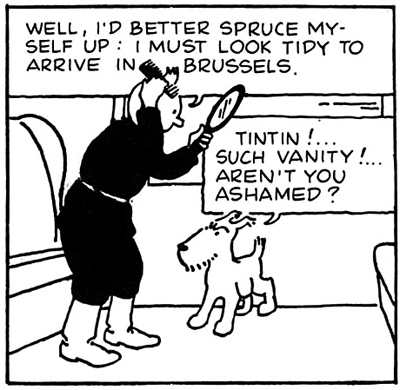
Hergé was not the biggest fan of this volume, and only allowed for it to be included in collections of Tintin books in 1973. Later Tintin books come to showcase meticulous research and accuracy (the agenda and colonialist paradigms, however, as we will see with the second volume, does not necessarily always go away). Either way, it, like most other Tintin books, remains a rich source of historical facts, details, propaganda, and imagery. A nice depiction of Brussels’ Gare du Nord station ends our first adventure.
The unforgettable Tintin and Snowy were created by Herge with the first adventure of the Tintin in Tintin in the Land of the Soviets. The creativeness of this comic series is quite admirable, as we have come to know. But this is the first in the series, so we have to excuse and overlook inherent flaws a first work may have. We know that the series produced some great stories later on and introduced many unforgettable characters.
For a start, we have only Tintin and Snowy in this adventure, and they are sent to Moscow to report on the Bolshevik government. The story colourfully portrays Tintin's adventures there and the mishaps and perils he faces. However, there is no proper plot; and the story is thematically naive. The adventures felt all over the place. It was more of an effort to comically mock the Bolshevik government.
All in all, not a good one in the series, but it is alright for a first.
Tintin was one of the comic book heroes of my childhood. I'm going to read my way through the series again as I listen to a radio program about him, and his creator, Hergé. It begins with Tintin in the Land of the Soviets which I never read as a kid. The story had been published in a magazine, and then a book form when Hergé was just starting out as a comic book author, but later on he really didn't want this one republished, and it wasn't until he had passed away that it was.
I can see why. This is a terrible mess of a book. The art is not as good as it would in later books, most of the characters are of the cardboard kind, and the plot, if there is actually something you could call a plot in it, is disjointed, and ridiculous. It works on the cliffhanger model, so Tintin, and his faithful dog Snowy, constantly get into dangerous situations. Tintin is blown up (more then once), he is shot at (more than once), he crashes a plane, a train hits him, he faces a firing squad, he ends up in torture chamber, and he gets very, very drunk. Yes, this is the Tintin book where our hero actually gets a hangover for the first and last time in the series. And poor Snowy hardly gets anything to eat all the way through this adventure, a fact which he reminds the reader of quite frequently.
Unlike many of the later books Snowy has a voice in this book, and he works here as the comic relief of this duo. To be honest, he is the best thing about this book because he is often funny. I don't think this book would be bearable without him. It's that bad. Still, it is still interesting from an historical point of view. Hergé was just starting to form this series at the time it was published, and it is going to evolve into something more interesting as we get further into it. It might have become better if Hergé had, as he did with other stories, redrawn, and edited it for the book format, but as it stands, it is really not a good book.
3 étoiles. La première fois que j'ai lu ce livre, j'ai été dégoûté. « Evidemment, Hergé a énormément progressé tout au long de sa carrière. Les illustrations ici sont presque ridiculement grossières, et le texte n'est pas beaucoup mieux », ai-je dit. Apparemment, « je m'ennuyais tellement que j'ai failli abandonner à mi-chemin », et je suis parti avec l'impression que « franchement, ça ne valait vraiment pas la peine d'être lu. »
La deuxième fois que je l'ai lu, c'était pour pratiquer la lecture à voix haute avec mon jeune frère. Cette fois, j'ai été plus amusé par les parties irréalistes. Les évasions et les aventures sont presque ridicules, et les Soviétiques étaient drôlement allemands au lieu de russes !
Cependant, j'ai beaucoup apprécié le dialogue, c'est délicieusement français. <3 Et il y avait pas mal d'humour… Les remarques sarcastiques de Milou, notamment, et l'avion de Tintin qui part a reculons… En fait, même si ce n'est pas aussi bon que les autres livres, et même si Tintin ne ressemble pas beaucoup à Tintin dans les derniers tomes—définitivement pas si génial!—c'est un bon début de série, et j’aime voir le talent comique révolutionnaire d'Hergé prendre son envol!
Contient de l’alcool, jurons, de la violence et des vols. Tintin joue aux fantômes.
*** ENGLISH TRANSLATION *** 3 stars. The first time I read this book, I was disgusted. “Obviously, Hergé has progressed enormously throughout his career. The illustrations here are almost ridiculously crude, and the text isn't much better,” I said. Apparently, “I was so bored I almost gave up halfway through,” and left feeling like, “Honestly, this really wasn't worth reading.”
The second time I read it was to practice reading aloud with my younger brother. This time I was more amused by the unrealistic parts. The escapes and adventures are almost ridiculous, and the Soviets were funny Germans instead of Russians!
However, I really enjoyed the dialogue, it's deliciously French. <3 And there was a lot of humour… Milou’s [Snowy’s] sarcastic remarks, in particular, and Tintin’s plane going backwards... In fact, even if it's not as good as the other books, and even if Tintin doesn't look much like Tintin in the later volumes—definitely not so great!—it's a good start to the series, and I love seeing Hergé's revolutionary comic talent take flight!
Contains alcohol, profanity, violence and theft. Tintin plays ghosts.
«Тентен у країні Сов’єтів» — цінний насамперед своїм потужним та відвертим посилом, що викривав злочини совєцької влади проти свого народу.
По суті Ерже один з перших, не без допомоги юного Тентена у далекому 1929 році розповів Європі про Голодомор і злочини чєкістів. Саме тому, мальований репортер з Брюсселю персона нон грата у володіннях Кремля. З тих же причин і в Україні донедавна мало хто чув про пригоди Тентена, на яких зростала Європа протягом ХХ століття. За часів совєтської окупації України будь-які згадки про Тентена були під суворою забороною, та й комікси як жанр в «країні Сов’єтів» були негласно заборонені.
Якщо брати до уваги художній та мистецький аспект і враховуючи поважний вік мальопису, історія подана максимально просто і зрозуміло, найбільше схожа на популярні в ті часи шаржі та карикатури, що мали не надто складний малюнок, а в сюжеті переважав сарказм та висміювання. Ерже в «країні Сов’єтів» тільки пізнає та намацує своє ремесло, тому «Тентен у країні Сов’єтів» не найкращий вибір для ознайомлення з творчістю автора, раджу звернути увагу на той же «Tintin: Herge and His Creation» що вважається однією з найвдаліших робіт автора. Тож три зірочки за мальопис і одна зірочка за сміливість автора, що в далекому 1929 році не побоявся писати правду.
We got the Asterix set a few years ago, and had been thinking about getting the Tintin one as well. Imagine how we lunged and grabbed it when we saw it sitting in Crossword a few days ago! Tintin was first published in 1929 in Le Petite Vingtième, a Catholic far-right newspaper that Hergé worked for. Incidentally, Tintin also begins life in print as a journalist working for the same publication.
Hergé wanted to set the first book in the US but the editor wanted him to write a propaganda piece against the USSR. And here we are! Tintin in the Land of the Soviets is weird. It's nowhere near as good as Hergé's other works in terms of drawing, story-telling, or even characters. Tintin and Snowy are the only two people with consistent talking parts, and this basically ends up with Tintin talking to himself and explaining his actions. It gets a little annoying beyond a point.
The book was pretty racist. That's expected with Tintin, but I can't believe how absolutely weirdly racist it was. At one point, the supposed Russians were speaking in German. The torturers supposed to be torturing Tintin for a confession were ... wait for it ... Chinese!!! CHINESE! This is so bloody random!
The book is quite obviously a propaganda piece against USSR. It's well done in it's intent but no pleasure to read about for modern audiences. The research is pretty abysmal and I am even surprised that this became a hit enough for Hergé to actually decide to hone his skills and do a much better job with the later books.
Not a great start to the series, but I know it gets better!
I started reading Tintin comic books in Athens in the mid-1970s. I used them to better learn how to read in Modern Greek, since the stories were not only interesting to a child-like mind, but also it was in lower case letters unlike many Greek comics which are written in all caps. In this way, I was able to better pronounce the words, too, with the proper accent marks and learn more vocabulary which I noted in small pocket notebooks that I carried around. Currently, I'm reading some Tintins in English, because I bought the complete hardback set for over a hundred dollars for my grandchildren to enjoy. But, alas they are not taking to Tintin as I did, since social media and Disney malarkey on TV have spoiled their capacity for non-standard aesthetics, possibly forever.
It's interesting to see how the Belgians viewed what was happening in Nazi Germany and the Soviet Union during the mid to late 1930s.
Re - read this today and i gotta say i still like it , ofcourse having been first published during the 1930s the book has it's fair share of problem like the whole Soviet propaganda and being focussed more on a goofy take on adventures of tintin rather than the later days mystery / detective style . To be fair the Comic hasn't aged well at all and yet , there's something about Tintin that i really like ,the adventure of Tintin is especially fun as no matter how many tough corners Tintin found himself in , the Duo of Tintin and Snowy always found a way out only to be trapped in another . Granted there's not much in terms of art and sure in this day and age this kind of story won't capture one's imagination but thinking the story to be one set in 30s and still finding it amusing is a Achievement well worth recognition , ergo 4 stars
Divertido cómic con el que las aventuras de Tintín dieron comienzo. El estilo de Hergé se empieza a construir en esta primera aventura en Rusia, donde vemos a un intrépido reportero pelear y huir de los rusos del partido comunista, que aquí es pintado como un régimen totalitario y cruel con los pobres. A parte de la crítica política, que en los inicios de Hergé venía delimitada por la corriente política que seguían los periódicos donde publicaba, asistimos a una divertida aventura donde los gags de Tintín y Milú son lo más reseñable.