

What do you think?

Alfred Schnittke
This biography of the Russian composer Alfred Schnittke (b.1934) presents a fascinating portrait of a man whose musical output is inextricably linked to the strictures of life in the former Soviet Union. For most of his adult life in Russia Schnittke's music was powerfully shaped by the frustrations of the Soviet period and he reacted strongly against the ideology of the era. His symphonies lie arguably at the end of the Germanic symphonic tradition, yet each represents a new concept of the genre for the twentieth century. His works reveal the influence of Shostakovich among others, but remain strongly original. Each of his compositions can be understood primarily to offer a unique synthesis of many different influences and styles.
The author gives a detailed discussion of Schnittke's music and theories, arguing that the various stylistic elements in his works - his polystylism - may be perceived as part of a new, more universal language.
The author gives a detailed discussion of Schnittke's music and theories, arguing that the various stylistic elements in his works - his polystylism - may be perceived as part of a new, more universal language.
240 pages, Paperback
First published September 25, 1996
Ratings & Reviews
Friends & Following
Create a free account to discover what your friends think of this book!
Community Reviews
Displaying 1 - 5 of 5 reviews

January 6, 2024
I found this a pretty good primer on the music and life of Alfred Schnittke. The book was included in Phaidon's 20th Century Composers series, published in the 1990s and now discontinued. These are accessible and attractively presented introductions, with a stylish layout that has stood the test of time, and plenty of illustrations to lighten the text. At the back of the book is a useful list of works, suggestions for further reading, a selective discography and a relatively fine-grained index. Exactly what you would expect from this type of book. Predictably, detailed discussions of individual works are not to be be found. Caveat: the book was published in 1996, two years for the composer's death. As a result the list of works is not complete (the Ninth Symphony, amongst others is not included). Also the discography is somewhat outdated (although the bulk of recordings still in the catalogue of the BIS and Chandos labels was recorded before the publication date).
Beyond the biographical narrative, I am interested in better understanding the artistic ethos of a composer and the fundamental driving forces behind his work. This is where Alexander Ivashkin delivers, up to a point. Ivashkin was an intimate of the composer and well acquainted with the social and professional conditions in which Schnittke worked. All this is particularly relevant given the very particular setting of post-war Soviet totalitarianism and Schnittke's distinctive hybrid Germanic-Slavic background. As a performing artist, Ivashkin had a good understanding of Schnittke's working methods both in and out of the concert hall. (A potential drawback of this close relationship between biographer and subject is the lack of distance. Ivashkin is certainly not impartial. He could be accused of a certain amount of idolatry.)
Ivashkin is able to make a concise but relatively convincing case for the marked stylistic shifts in the composer's output: from the early experiments with serialism, through fractured polystylism and a more compact, almost classically argumentative style, to the rigour of the late works. Schnittke's music resonates with a strong extra-musical meaning. It also suggests depth and a spiritual quality. Ivashkin argues that Schnittke was first and foremost driven by a dramaturgical instinct that breaks the bounds of any attempt to squeeze the music into a sonic architecture that reflects a strictly formal logic. Extrapolating from what Ivashkin writes, I hypothesise that Schnittke sought to tap into what the Islamic scholar Henri Corbin has called the 'imaginal world', a 'middle world' that exists between the material and spiritual realms and where spiritual truths are revealed through archetypes and symbols. Ivashkin: "A composer, in Schnittke's opinion, should be a medium and a sensor whose task is to remember what he hears - namely music, from 'somewhere else' - and whose mind acts only as a translator. Music comes from a kind of 'divine' rather than 'human' realm."
One doesn't have to buy into this esoteric-religious frame to sense the pertinence of the assertion that a kind of symbolic grammar is encoded in this music, which has emerged from a deep fusion of Central European and Russian musical traditions, an abiding interest in myth and early Christian culture, and a great sensitivity to the grand sweep of history and shifting human affairs.
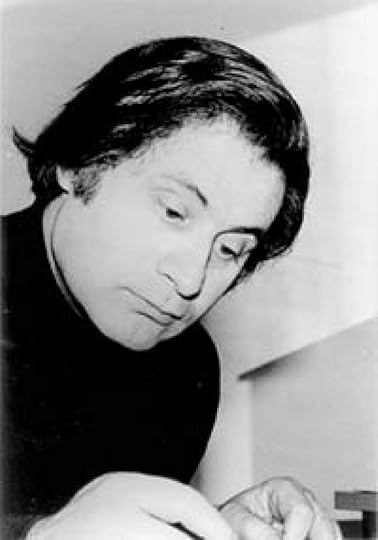
Alfred Schnittke in the 1970s. Source of image: unknown.
Beyond the biographical narrative, I am interested in better understanding the artistic ethos of a composer and the fundamental driving forces behind his work. This is where Alexander Ivashkin delivers, up to a point. Ivashkin was an intimate of the composer and well acquainted with the social and professional conditions in which Schnittke worked. All this is particularly relevant given the very particular setting of post-war Soviet totalitarianism and Schnittke's distinctive hybrid Germanic-Slavic background. As a performing artist, Ivashkin had a good understanding of Schnittke's working methods both in and out of the concert hall. (A potential drawback of this close relationship between biographer and subject is the lack of distance. Ivashkin is certainly not impartial. He could be accused of a certain amount of idolatry.)
Ivashkin is able to make a concise but relatively convincing case for the marked stylistic shifts in the composer's output: from the early experiments with serialism, through fractured polystylism and a more compact, almost classically argumentative style, to the rigour of the late works. Schnittke's music resonates with a strong extra-musical meaning. It also suggests depth and a spiritual quality. Ivashkin argues that Schnittke was first and foremost driven by a dramaturgical instinct that breaks the bounds of any attempt to squeeze the music into a sonic architecture that reflects a strictly formal logic. Extrapolating from what Ivashkin writes, I hypothesise that Schnittke sought to tap into what the Islamic scholar Henri Corbin has called the 'imaginal world', a 'middle world' that exists between the material and spiritual realms and where spiritual truths are revealed through archetypes and symbols. Ivashkin: "A composer, in Schnittke's opinion, should be a medium and a sensor whose task is to remember what he hears - namely music, from 'somewhere else' - and whose mind acts only as a translator. Music comes from a kind of 'divine' rather than 'human' realm."
One doesn't have to buy into this esoteric-religious frame to sense the pertinence of the assertion that a kind of symbolic grammar is encoded in this music, which has emerged from a deep fusion of Central European and Russian musical traditions, an abiding interest in myth and early Christian culture, and a great sensitivity to the grand sweep of history and shifting human affairs.
Alfred Schnittke in the 1970s. Source of image: unknown.
August 7, 2007
This entry in Phaidon Press' biographies of 20th century composers describes the life and work of Alfred Schnittke, the great Russian postmodernist, and is written by noted Russian cellist and friend of the composer Alexander Ivashkin. The work was published in 1996, two years before Schnittke's death. However, because Schnittke's last years were fraught with ill health, there is a general supposition that his career had ended. How surprised Ivashkin must have been to see a final bust of activity from the composer's pen shortly after the book's appearance.
As with all of Phaidon Press' biographies, the focus here is on the life and surroundings of the composer. Ivashkin describes in detail the composer's youth in Engels and Vienna, his tribulations in the Moscow Conservatory, and his marriage and family life. His pieces are often mention in connection to the events that inspired them, such as the death of his mother that led to his Piano Quintet. Unfortunately, there is very little in the way of analysis of his works. What few scores are shown in the book are given only to spice up the text with illustrations, they are not used by Ivashkin to point out the important innovations of Schnittke's music.
Beyond this lightweight nature, the book is fraught with other problems. There is a lot of repetition, many events are presented out of chronological order (for example, a chapter on the 1970s going back to the 1960s), and much tighter editing was necessary. There is even an error with typesetting where a sentence somehow disappears between pages 141 and 142. Becuase the work was rather obnoxious in these regards, I wouldn't recommend it except to hardcore fans of Schnittke who want to read as much as possible about him, or to people who just want to know the general outline of his life without knowing how his pieces work.
As with all of Phaidon Press' biographies, the focus here is on the life and surroundings of the composer. Ivashkin describes in detail the composer's youth in Engels and Vienna, his tribulations in the Moscow Conservatory, and his marriage and family life. His pieces are often mention in connection to the events that inspired them, such as the death of his mother that led to his Piano Quintet. Unfortunately, there is very little in the way of analysis of his works. What few scores are shown in the book are given only to spice up the text with illustrations, they are not used by Ivashkin to point out the important innovations of Schnittke's music.
Beyond this lightweight nature, the book is fraught with other problems. There is a lot of repetition, many events are presented out of chronological order (for example, a chapter on the 1970s going back to the 1960s), and much tighter editing was necessary. There is even an error with typesetting where a sentence somehow disappears between pages 141 and 142. Becuase the work was rather obnoxious in these regards, I wouldn't recommend it except to hardcore fans of Schnittke who want to read as much as possible about him, or to people who just want to know the general outline of his life without knowing how his pieces work.

October 4, 2012
The book was good; it gave a good, comprehensive view on Schnittke's life until 1996. My favorite part was actually the score excerpts included in the book, these were really cool.
The biggest issue (and the only thing keeping this review from being a 5-star) is that there are many blatant typos or editing issues. There was one instance where the word "furious" was spelled "fur ious" but the worst were two occasions where lines were repeated in their entirety, and on occasion where an entire line (or more) was missing. There may have been more that I missed.
The biggest issue (and the only thing keeping this review from being a 5-star) is that there are many blatant typos or editing issues. There was one instance where the word "furious" was spelled "fur ious" but the worst were two occasions where lines were repeated in their entirety, and on occasion where an entire line (or more) was missing. There may have been more that I missed.

September 2, 2012
This is a biography of Schnittke, that's why I don't expect any of his music analysed in the book. This often comes up, when people write reviews about the work. In my oppinion it's simply unfair to expect that from a biography.
Exciting read, even the storytelling is a bit sloppy. 5 stars because Schnittke's is Schnittke, but the biography project was maybe a bit too big bite for the author after all. Very much enjoyable though!
Exciting read, even the storytelling is a bit sloppy. 5 stars because Schnittke's is Schnittke, but the biography project was maybe a bit too big bite for the author after all. Very much enjoyable though!

May 29, 2009
Very dry yet fawning bio of Schnittke, written by a Russian composer for whom English is a second language. If you need some trivia on this bomb ass composer, it's worth a quickie read.
Displaying 1 - 5 of 5 reviews