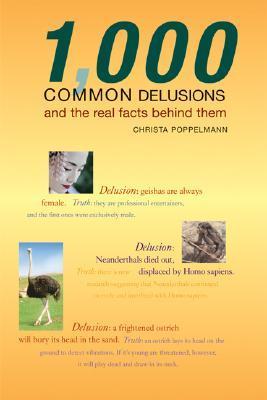
Certain "facts" are accepted as absolute truths. But are they indeed so? 1,000 Common Delusions debunks these persistent myths. From the stories of the ancient world to religion and sports, here are the real facts about common fallacies that have long been assumed to be true. Organized by theme -- history and politics, natural sciences and technology, society and everyday life, Earth and the universe, and others -- here are some
Delusion. Stone Age humans lived in caves. Truth. They lived in huts and tents. The caves, decorated with hunting scenes and animal pictures, were used for ritual ceremonies. Delusion. Geishas are always female. Truth. They are professional entertainers, and the first ones were exclusively male. Delusion. Marie-Antoinette told her subjects to eat cake. Truth. When Marie-Antoinette was still a child, a fictional princess in a story said, "If they have no bread, let them eat brioches." Later this was attributed to Marie-Antoinette. Delusion. A frightened ostrich will bury its head in the sand. Truth. An ostrich lays its head on the ground to detect vibrations. If its young are threatened, however, it will play dead and draw in its neck. Delusion. The Hundred Years War lasted 100 years. Truth. The clash between France and England actually lasted 114 years, from 1339 till 1453. Delusion. Bagpipes were invented in Scotland. Truth. They were introduced into the British Isles by Caesar's legionnaires and originated in Asia Minor. The myth-shattering truths in this intriguing book will shock, surprise and amuse readers. Fully indexed, it is a welcome resource -- and sure to be the final arbiter in many disagreements.
Some fascinating stuff here from all walks of life - history, culture, science, the arts....
Some it is stuff that is pretty common knowledge ex. "Dirt is unhealthy" (nope, helps the body build up resistance to bacteria and germs) to more huh moments like " Jesus said he was the Son of God" (he said God was his father, referred to himself a "The Son of Man".
Perfect bathroom book that you can pick up and read a few snippets and then put back down.
Interesting read for those of you that like this stuff.
I've been working on this for about three weeks. It's not that complicated, certainly not difficult reading, but it's the sort of thing that you can't really read in long stints. There was a lot of interesting stuff in the book in short paragraphs.
That's the good news. The bad news is that I found at least a couple of either completely wrong or vaguely not-quite-right pieces of information (e.g., Jesus grew up in Nazareth, not Bethlehem, according to the gospels; this was basically a typo, but one that should have been caught). Once you've had that experience, it tends to color the way you look at the rest of the details. So I can't honestly recommend the book in terms of research, but for a trivia nut, it would be interesting.
I really love this kind of thing. It's obvious that I pretty much had no choice in the little matter of becoming a librarian!
Not too bad and I learned some new things, but it could have used some editing and some fact checking. Several of the disproving statements have been further disproven either since the writing of this book or beyond the author's knowledge/research. I read a lot of trivia books, and I'm always more willing to believe one that cites research rather than just stating "facts." When you're trying to disprove delusions, tell me why your true statement counteracts my previously held beliefs. She has no stated research, and while most of her statements have been verified in other works I've read, others seem like they'd be more believable with some support.
I read through most of this in preparation for taking it to my classroom as a study hall read (in case you don't have work to do...).
Interesting, but although the review claims it's extensively indexed, each entry doesn't have a citation, so it's hard to know (just based on reading the text) where the info is coming from. And since it's only briefly explained, I'm sometimes still skeptical of the explanation provided.
The word "delusions" wildly overstates what the author covers in this book. What she does here is correct MISCONCEPTIONS, pretty succinctly, starting with misconceptions about the Stone Age and moving on up through the centuries. A lot of intriguing information. I have to say the book would have been easier to read in a clearer ink and a different typeface.
You would be surprised what you hold as common knowledge/ historical truth is in fact not at all what you were lead to believe and often times very different. Great little read