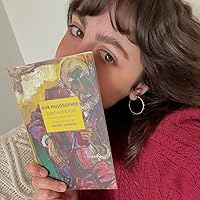
Magical powers inhabit the land to which Malfred Signal retires- freed at last of her responsibilities to a dying mother and the generations of young ladies who have learned perfect drawing techniques in her classes. Her first night in the idyllic island retreat that is to be her new home is one of terror: a storm is raging, an intruder pounding on her door, and calls the police, the priest and the doctor over her still-unconnected telephone bring no result. This is the state of siege, painted in pigments of dark and light, the brush dipped in themes of selfhood and loneliness, of death and its counterpart, the need to survive, to live.
The fate befalling the young woman who wanted "to be a poet" has been well documented. Desperately unhappy because of family tragedies and finding herself trapped in the wrong vocation (as a schoolteacher) her only escape appeared to be in submission to society's judgement of her as abnormal. She spent four and a half years out of eight years, incarcerated in mental hospitals. The story of her almost miraculous survival of the horrors and brutalising treatment in unenlightened institutions has become well known. She continued to write throughout her troubled years, and her first book (The Lagoon and Other Stories) won a prestigious literary prize, thus convincing her doctors not to carry out a planned lobotomy.
She returned to society, but not the one which had labelled her a misfit. She sought the support and company of fellow writers and set out single-mindedly and courageously to achieve her goal of being a writer. She wrote her first novel (Owls Do Cry) while staying with her mentor Frank Sargeson, and then left New Zealand, not to return for seven years.
3.5/5⭐️ Cracked open the mind of an old woman and we descend together as she loses her grasp around reality and the gates of a life painted on a canvas. I enjoyed a lot of its reflective and lyrical prose, however, it does slow down a bit and loses its intrigue towards the final parts. Nonetheless, personally, i loved the entirety of it and found much of what people critique incredibly necessary. It is all done intentionally and preserved the realism of Malfred’s character. I will likely come back to my annotations for my future personal inflections
Janet Frame was a very special discovery for me. I had found her novel A State of Siege (1966) at some book sale, and it had been sitting on my shelves for years until I watched a film based on Frame’s three-volume autobiography. I figured that if I didn’t read it now, I never would, and it turned out happily that the novel appealed to me more than the film (although I love to watch the director Jane Campion at work). A State of Siege is an internalized novel, mostly in third person, but sometimes, especially as the novel proceeds, in the first person, that also becomes increasingly surreal/unhinged. Repetition is used to great effect. A far more accessible cousin to Marguerite Young. A 4.5.
I feel ashamed at not being able to deal with this; as I understand it, it's a day in the mind of a woman developing dementia and I tried hard for thirty-odd pages. But even if it is I who am revealed to be unworthy, rather than the book, I'm sticking to my plan of seeing my days out reading what I want to. Sorry Janet Frame.
PS: It pissed me off to discover that the word 'ruminate' has been hijacked by psychotherapists and is considered to be a bad habit. I consider otherwise, it's an important word, it describes something that is necessary to do, and it should be given back to its normal English usage. However, that said, it crossed my mind more than once in my endeavour to read this book, that the character needed to stop ruminating. Please, please, please stop that!
Janet frame completion project going well so far. Michael king‘s enormous frame biography has become my north star as i plod through her oeuvre. this is the ‘waiheke novel’ (she lived there briefly). the usual interiority, detailed accounts of spells of rumination that work so well in Faces but really torture you in the Edge of the Alphabet make up the bulk of this brief novel. probs a hard sell if you not a framehead
Janet Frame is an author of incredible talent. Her poetic prose is lyrical, especially her journeys into the inner recesses' of the human mind. In "State of Siege", she takes the reader on a journey into the mental workings of a retired school teacher as the retiree falls into the depths of dementia. No, it is not a light hearted trip but one filled with questions and recriminations of a life led by a fellow human being. There is no pain but their is confusion and beauty and introspection, as our heroine copes with her circumstances and her past. I have said it before and it holds true for this book, "No one does madness like Janet Frame." At times, the reader will get lost in the authors prose poetry style, but as you pick your way patiently through the detritus of another person's past, you will appreciate the lushness and the emotion that Frame gives to the written word. As an aside, I find it fascinating, the New Zealander's love of their own country. This definitely comes through in this book, as we are treated to Frame's homage to her homeland, especially the South Island. Never jingoistic, but just a fierce love for the land itself. I wonder why this is so. Perhaps the newness of the nation for the English colonists, perhaps a "small man's complex", perhaps just the inherent beauty of the land itself, I don't know, but it is a phenomenon that is interesting, at least to me. None the less, a very good read, perhaps not for everyone, I will always enjoy Janet Frame's trips through the human psyche.
There was much here that reminded me of the works of both Clarice Lispector and Jon Fosse, though in a more tangled, less permeating manner. There is no doubt that Frame is a talented writer and has a very singular vision of the world (almost certainly due to her own biography and struggles with mental illness) but it is this singularity that to my mind - and I do not speak to this work's ability to affect in general, only its ability to affect myself - reduces the enjoyability of this book and the impression that it makes upon the reader. There were passages here that left me starkly impressed by the quality of message, of metaphor, and of blending of vocabulary, and these passages were not all too rare but still shone brightly out from the prose that lay between them. Frame's idea and narrative are conceptually very compelling and serve as an overwhelming exploration and meditation on grief, art, nature, light, lost love, family, the 'propriety' of womanhood, and individuality. The nightmarish series of events that make up the majority of the book - all taking place over the course of a singular, impossibly long night - serve as a useful foundation upon which Frame's protagonist can retreat within herself, to what Frame calls 'the room two inches behind the eyes', and consider her life, what she has done with it versus what she wishes to have done (and what has caused her to uproot herself in order to move to an island community), her perceptions of her family and the binding which a family enacts upon a person. Our protagonist - Malfred Signal, a woman whose shadow I can sense the author lingering closely within - lusts desperately for some enlightening view hidden behind the chronology of her life and its people, as well as the people of her country in a more general sense (this mingles with some excellent yet subtle discussions over national identity, community and separation - wilful or otherwise - from such community), and this desire is something I can in a sense relate to and I am sure is relatable for other readers. Yet, Signal finds herself so wholly burdened by her prior years and flaws and duties that she cannot find the view she seeks, whether or not it even it exists, and the battering of the external world - embodied in a very real storm, and a dubiously real intruder - upon her door drives her fully over the precipice of her life and into the blackness of death. Frame however finds herself entangled in the lurching brain of her protagonist and the work's messaging and often loses the poignancy that some of the novel's passages clearly possess. I would also criticise the ending, though not for its obvious nature, with which I have no trouble, but its bluntness. Frame has spent great amounts of the book leading us down wandering and violently twisting paths only to suddenly present us her conclusion over a handful of lines. I would have liked to have seen greater care given to this particular aspect of the novel. I have not been dissuaded from exploring Frame's other works and have taken pleasure in discovering another writer, yet feel frustrated at a work whose quality could not be wholly freed from its own writhings.
My long overdue introduction to this New Zealand stalwart. The book did not disappoint. It is a thrilling and expansive exposition on the nature of neurotic feelings and the crowded senses of living.
A retired school teacher leaves her home in the South Island and moves to the tropical north. She has bought a section and house on an island in the Hauraki gulf. While she has expectations and good reasons for making the change, she ultimately finds that the world she’s dived into has a penchant for knocking and a desire to invade her space.
An expert thriller and inner exploration of the mind. I was lucky enough to finish this book in a place where crashing waves mimicked the words off the page.
A bleak and thought-provoking novel on the perception (or deception) of self. I both deeply pitied and disliked Malfred. It took a turn for the slightly too strange for me in Part 3, and I found myself struggling to follow the ideas. I see some people describe this book as Malfred's descent into dementia, but I don't personally agree; I see her as Frame's vehicle for her ideas about memory and ego.
I cannot probably recall another time when I had read a novel where a moment's uncertainty, a moment's mischance, a moment of madness defines the working process of a novel in such a convincing manner. Indeed the novels of the great New Zealand writer Janet Frame are quite unlike any that have been written in the last century. Just picture to yourself this: a retired art teacher escaping the dominating presence of her family comes to a quiet and secluded tropical island hoping at last to be alone with nature and solitude; but her first night on this island turns to a parable of insecurity and madness as in that stormy night an intruder pounds ceaselessly and inexplicably on her door. The tragic denouement at the end does not serve the ease the atmosphere in this tense narrative where both memory and echoes of the past serve to portray the workings of the human mind in times of utter duress. Indeed the entire thought process in the novel is that stormy night and the madness of the intrusion into the privies of a lonely soul that only sought a solitude and oneness with nature. That one incident serves as the cogwheel around which the narrative twists and turns in time and the past life to portray the workings of a tender and lonely soul, and also the workings of the artistic process. Besides being a riveting narrative it is also a wonderful portrait of an individual and a family, as well as a mesmerizing exploration of artistic temper.
Picking up this book felt like a burden; understanding its meaning even more so. Frame uses layers of metaphor to convey ideas which, while poetically presented, distract from the concepts which much simpler prose could have achieved. Why use the word ‘mind’ when ‘the room two inches behind the eyes’ can be used instead?
It is perhaps the most complex book I have ever read, and I am still unsure if I have a strong enough grasp of literary technique to understand it.
Despite its challenges, it is an incredibly enriching read and effective in leaving the reader with a curious albeit eerie feeling about the roles that cumulative trauma have on our developed psyche in old age.
In many ways I felt Malfred was childlike, both psychologically with a strong ego-centricity and independence yet to be formed, and socially with expressed self-consciousness of social norms, without a strong sense-of-self. I find it interesting that her breakdown occurred at the very inflection point of her final attempt at self-discovery. The reader is left to wonder whether the novel is a polemic of the road from self-absorption to self-destruction.
This entire review has been hidden because of spoilers.
DNF p. 91. I wasn’t going to count this since I didn’t finish it, but decided I would since it is clearly well written and also seems like a work worth engaging with. It is a book about Dread, not dread of anything in particular although age and isolation feed the beast as it slinks around preying on the consciousness of vulnerable people. I found it creepy and interesting, just not interesting enough. I kept wanting someone to turn on the lights—as the main character Malfred exhorts the darkness to do in her first night in a new house, in a new town, on a small New Zealand island. I really wanted some kind soul to bring her tea and cake. Hopefully, I will find something else by Janet Frame that will sit better with me.
I wanted to give this one 4.5 stars for the under climatic ending. This, I think, was Janet Frame’s version of a thriller. For the most part it works. We feel what the main character Malfred feels and get the sense of what she is thinking. Anyone who has read Janet Frame knows she goes by no rules, so the ending could be anything. I was happy with the book and story overall just a little disappointed with the ending.
I was retiring to live on my own in a place with a lovely view of the sea and paint. As does the protagonist. Now I’m having second thoughts … Sometimes she writes like a tsunami of words that detail the details - dense and intense. and and and now and then it’s inspired. Poetic. Metaphorically explosive.
Good intro essay by Chris Kraus but read it after the book.
This started well enough with evidence of the author's wonderful writing---but soon descended into a rambling monologue that made me wonder about the sanity of the character. I found it hard to continue reading. 4/10
It’s comforting to know that I never have to write a novel because anything I might have to say has already been said and beautifully by Janet Frame. This is one of her lesser known works, perhaps due to its being rather quiet and awfully…awfully bleak. It’s a very well crafted book.
I actually really loved this book. I think it will go down as a literary classic. Not really like anything I’ve ever read. Beautiful illustrative writing of the NZ landscape. Janet Frame also had a tumultuous life and deserves recognition!
Really 3.5; this just isn't my thing, and I fear Frame in general won't be my thing. Depictions of 'madness' don't really work for me, I'm more of a depressive type. But I'll persevere, maybe? I don't know.
What a great relief to of finally finished this book. The sense of loneliness and desperation building into madness & fear was unnerving. It has even soured the idea of a holiday in N.Z.
Janet Frame knows how to take a reader on a journey, even if that journey is compressed into one harrowing stormy night within Malfred Signal's mind, the "room two inches behind the eyes."
I did enjoy this book and its kind of slow descent into is this person a bit mad, but the ending was a bit like ‘what?’ and felt a bit underwhelming. still well written but
This entire review has been hidden because of spoilers.
Frame’s writing is beautiful and managed to keep me going till the end, but much like the protagonist, I found myself wishing the night was over ‘help help! Save me! Get me out of this book!’