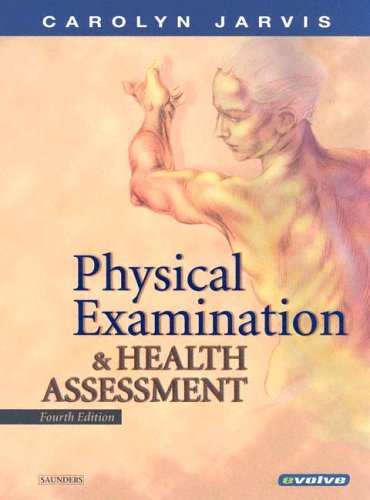
Physical Examination and Health Assessment provides all the information necessary to conduct a holistic health assessment across the life span. The physical examination unit is organized by body system, pedagogically and clinically the most logical and efficient way to learn and perform health assessment. Each chapter has five major sections: (1) Structure and Function (A&P); (2) Subjective Data (history); (3) Objective Data (skills, expected findings, and common variations for healthy people and selected abnormal findings); (4) Abnormal Findings (illustrations of related disorders and conditions in atlas format); and (5) Application and Documentation (sample charting, clinical case studies, nursing diagnoses, and critical thinking questions tied to the Saunders video series).
Where have I been all semester? Reading this book and completing creative writing assignments for the class that assigned it, so it's only fair that I include it in my Goodreads book goal.
Warning: Do not read this book if you are not a health care provider. The pictures of abnormalities will seriously distress you, and for heaven's sake, keep it away from your family and children. However, a possible exception for any hypochondriacs in your life--the pictures should reassure them that whatever oddness they have is quite normal. Except that I diagnosed myself with skin cancer, a bulging vertebral disc, as well as at least twenty other conditions while reading this, so maybe that isn't a very good idea.
Seriously, I cannot stress enough the potential for harm. A co-student and good friend was doing homework when her fiance innocently glanced over to see what she was doing. Unfortunately, it was the section on "Male Genitourinary System," leading to an incredulous, "what the hell?," couch-vaulting reaction, thus leading her to laugh so hard she spilled soda on the floor, prompting the dog to start licking soda and getting sticky paw prints all over.
This was assigned reading in a BSN-level class and as such, was a seriously inappropriate text. This is provider level material, focusing strictly on diagnositic provider or specialist-level assessments. It does walk providers through both a subjective and objective assessment of each body system, and a sidebar lists diagnosis--usually medical, again, not nursing--that might be signified by the finding.
Unfortunately, some assessments seem quite outdated to modern practice. I understand including the information, as it is impossible to update "the basics" of medicine (trying to reform medical curriculum is a Herculean task--just ask anyone trying to mandate a communication or end-of-life class for doctors). Kidney percussion? Lung percussion? Finding the diaphragmatic excursion? Yeah, not stuff you will ever see in any town that has an x-ray machine. The sophistication of modern diagnostics makes those skills irrelevant, and quite possibly bridging on malpractice, at least in America, land of the lawyer. Palpating the spleen or for an abdominal aortic aneurysm? Probably not recommended without first running some blood or imaging tests, which this text does not cover. Then there's the vaginal exams and inguinal hernia checks--all NP level material and a clear "not in my practice" guideline.
Still, the material itself is explained well. It's divided by systems (oh, how medical of them) and each chapter begins with a short biology review and follows with pictures of the step-by-step systems assessment. At the end of each chapter were a number of the aforementioned pictures depicting abnormal conditions. Internet supplements were available but completely ignored. The first three chapters stress development of a comfortable setting and communication skills, which was a nice inclusion.
Two star rating for enjoyment, three and a half for content.
This textbook saved me throughout Nursing school. You learn so much from it, I swear. You saw many common illnesses, diseases, conditions…it helps you recognize them as there are numerous pictures. It is very interesting. I’m pretty sure it’s not just because I find anything medical fascinating, the book is well written to keep your interest and provide you with as much knowledge as possible. As a first year nursing student you will be providing a lot of assessments (and throughout your career as a nurse) so this book is essential.
Perhaps I'm biased as I had the great fortune of having Professor Jarvis as my health assessment instructor during nursing school, but I think the book is fabulous. The pictures and descriptions are great, as well as the sidebars with additional information. Out of all of my nursing textbooks it was honestly one of the most helpful and easiest to understand. Some of the skills may not be frequently used, but are GOOD skills to have. I have seen anesthesiologists and surgeons do quick lung percussions amongst other things that are 'lost skills' now due to reliance on machinery and technology. And no, not ALL facilities have immediate or easy access to X-rays or other technology. Even if not all the things done are necessarily within scope of practice for RN's it is still VERY important to know how assessments are done, and what to look for when performing them in order to fully assist a physician or NP. Even after 2 years of nursing, I will still occasionally refer back to this book and have never even considered getting rid of it as I have with some other nursing texts. It has been very helpful for me.
This is a great book, puts all the nursing things together, examination and putting together the whole nursing "thing". I enjoy this course and wish it had started earlier. This is a lifetime book and one I actually LIKE to read. :)