Antiochus Wilson is completely and utterly bored with his life, until he receives the call that changes everything. When the voice on the other end of the line promises him excitement, wealth, and happiness, he is more than a little intrigued.
Arriving at a hastily scrawled address, Wilson discovers a mysterious and exclusive organization that offers its clients whole new lives . . . for a price. The organization arranges for a client's demise or disappearance and outfits each with a new body in which to begin again. But there's no turning back, and no room for second-guessing. When Wilson begins to question his new circumstances and pushes some very well-established boundaries a bit too far for the organization's comfort, his second chance may just be his last.
Seconds (1962) is a pseudo-science fiction novel that, for this reader, seems in some respects to echo Heinlein’s 1961 novel I Will Fear No Evil in that both novels posit the ultra-wealthy escaping death (I Will Fear No Evil) or boredom and aging (Seconds) by the advent of plastic surgery. Seconds also became a motion picture starring Rock Hudson.
Seconds is a sparsely written novel with few characters and little in the way of descriptions. Wilson is a successful banker and family man, who is offered a chance by an acquaintance to leave his boring drab existence and wife and start something new with a new face and new body. He has no idea how it works or much about the secret organization that masterminds this – after all, what is the first rule of Fight Club – you never talk about it. He is whisked through offices and other buildings in back ways in a sort of cloak and dagger manner and offered a chance to go through with the program. He awakes on a plane to Los Angeles with a new face and a new identity (an artist, of course), a servant in a new home to guide him through his new life, and people who appear to recognize him in his new face, greeting him like a new friend.
The question then becomes what it will take for Wilson to adjust to his new life and whether he will blow this new chance at a new paradise or make it work. You wonder why he could not just continue with his old succcessful life and what his uncouth need is to learn all the details about who he is now, how this works, and what became of his old life.
It is a perfectly-structured meditation on the meaning of life and what it means to be in heaven, hell, or purgatory. It is also a question of what makes an individual and what makes someone who is hell-bent on just going along with the program and whatever the puppetmasters want you to do.
After all, what would you do if given another chance at life? Would you be more successful, happier, more content? Or would ennui still eat at you and strip the flesh off your rotting bones?
I saw the great John Frankenheimer movie of this novel in the 1960s and then went out and got the book. It is an excellent thriller about a middle-aged man who gets to be "reborn" as someone who looks like Rock Hudson and who is an artist in Malibu with no obligations to nobody. Perfect? Well... Tonight I saw the movie again...
In 1964, David Ely produced a novel of existential despair that also manages to be a satire on the consumer-targeted managerial capitalism that was at the core of the American dream before the dissent of the mid-1960s took hold.
Almost ten years earlier (1955 (novel) and 1956 (film)), in 'The Man in the Gray Flannel Suit', the demands of corporate life were presented as sets of conflict between personal expression, family duty and corporate compliance and resolved in favour of the 'natural' confluence of the last two.
Critique was never far below the surface. J K Galbraith's 'The Affluent Society' did so in grand policy terms but many men chafed under obligations that seemed to be as collectively imposed as anything that the Soviets may have offered even if none dared say it in those terms.
It is quite important to the story in 'Seconds' that 'Wilson' (the protagonist) has raised a family and is alienated from it as it is alienated from him. The sacrifices of work and loss of free expression (there is to be irony in the new social role assigned to him by the corporation) have turned to dust.
'Wilson' thinks he wants freedom but he what he really wanted was the belonging and meaning promised at the beginning of his life. Family and corporate duty are no longer aligned - in fact, everything has turned to dust.
The novel is a morality tale. It is about what happens when a new capitalist enterprise offers the opportunity to escape obligation and how the 'contract' proves to be one with the devil as a new obligation emerges to a different 'Stepford' type of pseudo-individualist conformity.
It is quite slow-moving and Ely is not a lively writer. At first, this troubled me. I was going to mark it down but, as it progressed, I realised that the style fitted with an atmosphere of greyness and mounting despair as the protagonist gets sucked into this paranoid fantasy.
In 1966, it was made into a film (of course, this is no guarantee of literary quality, often the reverse) which tells us something about the mood of the time. Another capitalist enterprise (the cinema industry) was already feeling the shift of mood that was to become the 'sixties'.
This is certainly not a happy book. There is no visceral or cosmic horror. It is psychological horror, a fantasy at core (no such corporation as the one described could exist and survive in the real world) but it feels real at times. It is on the very edge of the territory staked out by Ligotti.
There is one note of realism, a core element in the story. The corporation is running to stand still and is in financial difficulty because it has sold something it cannot deliver. It is a peculiar form of Ponzi scheme. It is also consciously set up to be a fulfilment of uncertain wishes.
Capitalism is, in fact, depicted as rational in its determination to continue with its misjudgements. It is a machine that eats people. In opening up a market for a packaged 'freedom', the corporation enslaves and much much worse in order to meet its entrepreneurial mission and survive.
A very dark book - not perhaps a masterpiece of world literature but well worth reading (if you are not already depressed). It is an insight into the frustrations emerging in the early 1960s as post-war conformity started to move the war generation towards their inevitable mid-life crisis.
For those who want a solid and moving audio version of the book, I can recommend the reading of Edward French which starts (in six separate chapters) at https://youtu.be/Ymt3DDzgA10 His YouTube Channel, incidentally, is an excellent source for readings of weird and horror fiction.
This dark, comedic suspense thriller was chosen as the final part in John Frankenheimer's "Paranoia" trilogy of movies. Imagine a cross-over episode of The Beverly Hillbillies, The Man from U. N. C. L. E. and The Prisoner with Laugh-In montages. Imagine Milburn Drysdale walking into the Tailor/Dry Cleaners that is a front for U. N. C. L. E. HQ and being treated like Patrick MacGoohan's character in The Prisoner and later being invited to the "Parties" on Laugh-In.
The book is what you get if Kurt Vonnegut, Ian Fleming and Philip K. Dick smoked pot and dropped LSD hits at the same party and went off to discuss literature together. There are three kinds of weird: weird, really weird and Seconds.
A very solid read, extremely well written and deftly executed. I'm perplexed by the low aggregate rating.
I have seen the movie a few times (before having read the book) and it is also very good. There did seem (to me) a feeling of the film version being a bit dated, very California 60s.
Somehow this was not as prominent (at least not to me) in the novel. Though I knew where things were headed, the author was expert at creating an atmosphere of anxious menace and doom.
A measurement of intervals of time: one sixtieth of a minute A second helping of food at a meal Inferior goods As a verb: agreeing with something or someone
All of these meanings have resonance with the storyline of “Seconds”. However, for me, this story was less about ‘seconds’ and more about ‘firsts’ — to wit, can you be a second if you were really never a first?
A very successful long-married middle aged banker is finding himself bored with his life and his marriage when he gets a phone call from his old Harvard roommate Charlie (whom he thought had died the previous year in a quite bizarre ‘fall’ into an active volcano). Charlie explains to his friend, thereafter referred to as Mr. Wilson, that his demise had been expertly engineered to look like a tragic accident by a secret organization that, for a steep fee, was able miraculously to grant qualifying candidates a chance at a completely new life — one unencumbered by all former responsibilities of family and profession. A second chance to make those unrealized dreams come true — a rebirth, but one in which the ‘newborn’ skips past all the struggles, dips and challenges of growing up, and is instead ‘born’ anew with an already actualized identity, a new surgically reconstructed countenance, and a ‘past’ with all the requisite phony certificates to authenticate the second life. So a stand-in for the first iteration of Wilson is staged to present as tragically deceased from a sudden heart attack in a midtown hotel, while the second iteration of Wilson in hiding undergoes some months of grueling surgery and physical training to ultimately land in a cushy and enviable setup on the beaches of Malibu, in a fabulous home with a full time servant, along with an art studio fitted out by the company in order that the second Wilson can realize his dream of living the life of the wildly successful ‘painter’, one with a plethora of glowing (and completely counterfeit) reviews of his many art exhibits. The only problem is that Wilson, who apparently hadn’t held a paintbrush since maybe 6th grade, was an inept artist without any more idea of how to construct a life for himself as a second on his own terms than he did when he was a first.
A non-entity doesn’t suddenly morph into an entity, or add nothing to nothing and you still wind up with … nothing.
Artiste Wilson becomes more and more discombobulated by his new life, by the realization that he is being watched (the butler is a company spy), by his neighbors who all seem to be ‘rebirthers’ and quite desperate in their libertine pursuits, and by the realization that he was hardly a blip on the radar screen of his former family’s lives — not thought of with fondness, or disdain even — just not thought of at all. So it’s no surprise that Wilson winds up back at the secret company compound, waiting his turn to become one of the cadaver stand-in for new recruit rebirthers. There, as an agitated Wilson is finally realizing he’s not getting a third chance at existence, one has to ask: was Wilson ever really alive?
It’s a well-written albeit fantastic story with a Swiss cheese degree of plot holes, but I think especially in the context of the ‘60s (when the book was written), it does reflect the zeitgeist of challenging cultural norms & expectations and questioning prevailing cultural values. But for me the most interesting part of the book was when Wilson visited his daughter & wife, and realized he had been dead to them well before the company faked his death in that hotel room.
A measurement of intervals of time: one sixtieth of a minute A second helping of food at a meal Inferior goods As a verb: agreeing with something or someone
All of these meanings have resonance with the storyline of “Seconds”. However, for me, this story was less about ‘seconds’ and more about ‘firsts’ — to wit, can you be a second if you were really never a first?
A very successful long-married middle aged banker is finding himself bored with his life and his marriage when he gets a phone call from his old Harvard roommate Charlie (whom he thought had died the previous year in a quite bizarre ‘fall’ into an active volcano). Charlie explains to his friend, thereafter referred to as Mr. Wilson, that his demise had been expertly engineered to look like a tragic accident by a secret organization that, for a steep fee, was able miraculously to grant qualifying candidates a chance at a completely new life — one unencumbered by all former responsibilities of family and profession. A second chance to make those unrealized dreams come true — a rebirth, but one in which the ‘newborn’ skips past all the struggles, dips and challenges of growing up, and is instead ‘born’ anew with an already actualized identity, a new surgically reconstructed countenance, and a ‘past’ with all the requisite phony certificates to authenticate the second life. So a stand-in for the first iteration of Wilson is staged to present as tragically deceased from a sudden heart attack in a midtown hotel, while the second iteration of Wilson in hiding undergoes some months of grueling surgery and physical training to ultimately land in a cushy and enviable setup on the beaches of Malibu, in a fabulous home with a full time servant, along with an art studio fitted out by the company in order that the second Wilson can realize his dream of living the life of the wildly successful ‘painter’, one with a plethora of glowing (and completely counterfeit) reviews of his many art exhibits. The only problem is that Wilson, who apparently hadn’t held a paintbrush since maybe 6th grade, was an inept artist without any more idea of how to construct a life for himself as a second on his own terms than he did when he was a first.
A non-entity doesn’t suddenly morph into an entity, or add nothing to nothing and you still wind up with … nothing.
Artiste Wilson becomes more and more discombobulated by his new life, by the realization that he is being watched (the butler is a company spy), by his neighbors who all seem to be ‘rebirthers’ and quite desperate in their libertine pursuits, and by the realization that he was hardly a blip on the radar screen of his former family’s lives — not thought of with fondness, or disdain even — just not thought of at all. So it’s no surprise that Wilson winds up back at the secret company compound, waiting his turn to become one of the cadaver stand-in for new recruit rebirthers. There, as an agitated Wilson is finally realizing he’s not getting a third chance at existence, one has to ask: was Wilson ever really alive?
It’s a well-written albeit fantastic story with a Swiss cheese degree of plot holes, but I think especially in the context of the ‘60s (when the book was written), it does reflect the zeitgeist of challenging cultural norms & expectations and questioning prevailing cultural values. But for me the most interesting part of the book was when Wilson visited his daughter & wife, and realized he had been dead to them well before the company faked his death in that hotel room.
There's an old proverb: The grass is always greener on the other side (of the fence).
It is usually meant in an ironic way, meaning that the grass is not actually greener on the other side at all; it merely appears so from our fixed position.
This is essentially what the novel seems to ask: What if we could go over that fence, with the "small" provision, that once we have grossed it we could never turn back?
It also proposes an answer . . . and the answer, as may be expected, is far from a pleasant one.
All in all, a well-written and fantastic novel (and perhaps an even better film), which made me contemplate upon my own desires of wanting to be someone that perhaps I am not at all so suited to be.
I read this because I wanted more of the subtle menace of the excellent John Frankenheimer film version, starring Rock Hudson in a career-defining role. I was not disappointed. The dialogue might seem a little stilted, but this perfectly captures the promise and disillusionment of the 1960s, and of middle class American life in general. A paranoid classic.
I liked the finale of the Mad Men TV very much, but SECONDS would have worked too!
Always wanted to read this because I loved the movie. I was not disappointed. The only thing that was a letdown was the ending. I thought the movie, with Rock Hudson as the "reborn" man, had a more terrifying climax. In that sense, it was an improvement over the novel's ending. All things considered, though, I recommend this story highly. It will haunt you.
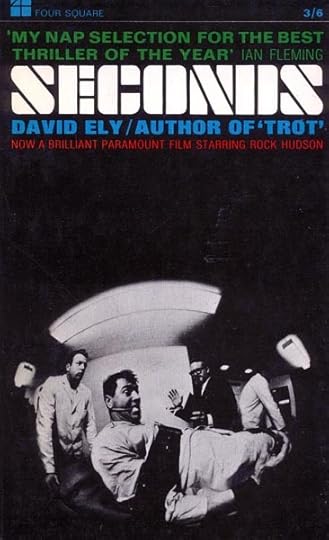
This is one of my all time favourite films so I thought I would try the novel on kindle. It was interesting, quite similar to the film but also enjoyable. The cover wasn't the film tie in version here but a godawful matrix 'inspired' effort.
A strong storyline that accomplishes a rare synchrony of deep meaning and superficial gratification. The writing style is sharp, precise and never convoluted or pretentious unlike most literary works these days.
DNF at page 101 because I am finding it just too much of a trial to read. Apparently it is a cult classic novel, I guess that in the early 1960's it would have been a really exciting, sci-fi, thriller-ish adventure. I might even have enjoyed it if I encountered it in the 70's or 80's but here and now it is dull to boring, predictable and so inherently unlikely that I can't read more than half a page at a time.
I am halfway through this book and the ending is so completely predictable (at least in broad terms), that I am not even going to bother reading the last few pages. The process of getting there is so very detached from any event or emotion, other than a slight creepiness, that the reading is not worthwhile. The process of reading is so utterly boring that I can't bear it.
Well written, with Wilson as a protagonist who would probably be good in film but is fairly pointless in prose, I respect that this book might have been innovative in it's time. Calling it sci-fi, is, I think, a little misleading. Sure that level of plastic surgery and forensic organisation would have been a bit ahead of the times, but I do still think it is more thriller than sci-fi.
Also, the initial flaw that I could just not get past from the beginning and which coloured the rest of the reading for me: Would anyone, ever, go ahead with something so dramatic and so expensive without having any idea what the process or the results would be; where they were going or what they would be doing? If Wilson were a criminal who had to do it to escape the gallows, ok, I could buy that. But the way it is laid out.... ok, I get that was meant to be part of the creepiness, but lets face it, it is just ridiculous.
I could cope with the ridiculous, I have before, but add in complete emotional detachment, no actual events or storyline and you lost me. It could have been a bit interesting if Wilson actually tried to make it as an artist, but no. The model was just there for yet another highly silly sex scene (yes, I know, the 60's got it) and the conclusion to this 'second life' was entirely predictable.
“Look at it this way. You’re living a dream. All those longings you had back in the old days—well, they’ve come true now. You’ve got what almost every middle-aged man in America would like to have. Freedom. Real freedom. You can do any damned thing you want to. You’ve got financial security, you’ve got no responsibilities, and you’ve got no reason at all to feel guilty about what you’ve done. The company’s taken care of everything. Right?”
Terrifying.
A middle aged man in a dead end boring life takes a chance and ends up with a company that'll fake his death, give him plastic surgery, and set him up with a new identity where he can live out his dreams of youth, or will he?
Is it really a second chance if it's all been planned out for you in advance? Can you turn your back on your wife and daughter and pretend they don't exist?
A dark, satirical, thought provoking read. Had me hooked from start to end. Not quite as powerful as such classics as 1984 and Farenheit 451 but definitely worth a read in my opinion. Keen to watch the movie.
Es war ein seltsames Lesen. Nennen wir den Protagonisten "Wilson" - denn so heißt er etwas später. Doch bon Vorne. Wilson wird von einem Freund angerufen, der erst einige zuvor gestorben ist. Dieser Freund erzählt ihm, dass er nicht wirklich tot sei, sondern es nur vortäuschte. Blieb aber über vieles andere eher kryptisch. Eines Tages erhielt Wilson einen Zettel mit einer Adresse. Er folgt den Anweisungen, ohne wirklich zu wissen was los ist. Er gelangt über mehrere Etappen in "die Firma", dort wird er reingelgt, bezirst, und vor vollendete Tatsachen gestellt.
Er erwacht mit einem neuen Gesicht und neuer Identität. Doch Wilson, der eigentlich Bankier ist und eine Frau und eine Tochter hatte, war plötzlich Maler und inmitten Kaliforniens einquartiert. Das alles hatte seinen Preis.
Das Buch ist aus dem Jahr 1963 und ziemlich fortschrittlich. All diese Schönheitsoperationen und dem Ideal der modernen Welt. Ein wenig seltsam, skurril und doch recht interessant. Aber Wilson selbst, der nur irgendwie dort landete, war mir etwas komisch. Auf der einen Seite weist das Buch interessante Aspekte auf und es liest sich recht schnell, doch andererseits war es auch echt verstörend.
There’s undoubtedly something here, but I don’t think it quite hits as hard as it should. Maybe if I weren’t already familiar with European existentialist literature I’d find this more gripping. As it stands, this feels a little undercooked, like a short story stretched out to barely novel length. The main idea here - identity and one’s sense of self, and how that relates to modernity and capitalism - is interesting, but this is caught between being a straight thriller novel and being something more philosophical. Personally I would have preferred the Robin Cook thriller approach since the novel always seems about to veer that way.
M’ha agradat l’idea inicial, però desprès m’he encallat en el ritme i el camí, i m’he ensopit.
Desprès del llibre, hem vist el film (1966) Els grans noms (director, música, títols) feien presagiar una pel·lícula superior, però ens ha decebut. Filmada a base d’excentricitats (bruscos moviments de càmera, primers plans exagerats, distorsions, etc...), l’únic que ens ha provocat és mareig. Respecte la novel·la, afegeix seqüencies desastroses, com la del raïm. Només vam gaudir dels actors, encapçalats per Rock Hudson.