Alan Moorehead was a sensational Australian writer of the XX century. His works are usually considered to be generalized history for the masses, as he writes them more like a writer, not a historian. As Thornton McCarmish puts it, "for most professional historians, Moorehead was a mere popularizer. Nevertheless, there was a sly art to these narratives and a distinctive aesthetic to which ordinary readers responded in huge numbers." Alan Moorehead had always wanted to be, primarily, a writer, not a historian. To that, he had always shared his passions regarding journalism with his wife, as he became one of the most widely recognized ones in Europe.
Gallipoli is one of the most outstanding works by Moorehead, which made the author be put in a special literary category by Sunday Times. Furthermore, it was critically acclaimed both by critics and the campaign participants. Moreover, the book significantly increased the author's reputation at the time. At the end of 1954, he had visited Gallipoli and found out for himself that the Gallipoli campaign of 1915-1916 could be turned into a great book, filled with action and human sacrifice, which he was very good at delivering .
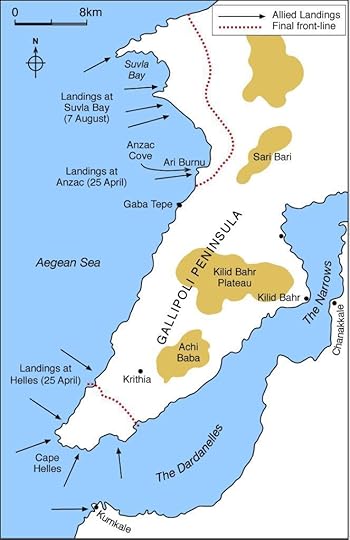
In the book, Alan Moorehead describes the Gallipoli campaign, which was carried out by the Allied troops against the Ottoman and the German Empires from February 19th, 1915, to January 9th, 1916. It describes the moves which both sides took and provides a good chronology, yet the book's focus is not as much to provide the reader with the information about the events, but rather to provide the reader with the feeling of what the soldiers on the battlefield lived through. Throughout the book's entirety, the reader might notice how Moorehead describes almost every single stone on the battlefield. One might even forget that he is reading a historical book, as Moorehead dives in into "Tolstoy-like" descriptions of the war: "grass vanished from the ground, and in place of green crops there were now wide areas covered with the fading purple flowers of the wild thyme, the dried-up sticks of asphodel, an occasional dusty pink oleander, a green fig or a pomegranate with its little flame-coloured blossom on the fruit." The author's graph mania can also be seen in how he overcomplicates some of the descriptions, making them long and beautiful rather than short and on point. For example, when Alan Moorehead describes the fleeing of the allied soldiers from the ship Swiftsure, he establishes that they "did not wait to pack their belongings; baggage, bedding, tinned preserves and an assortment of wines were dumped in a trawler and ferried across in a matter of minutes." Such a passage could have easily been shortened by stating that the soldiers did not pack their belongings without making the reader endure through unnecessary prose.
One of the author's central theses is that the Gallipoli campaign was forgotten. Throughout the book, he is trying to show that despite the Gallipoli mission being a battle destined to be lost by the allies, the act of bravery carried out by the allies shall always be remembered . With such theses, he reveals to the reader direct thinking behind the campaign, covering not only Winston Churchill, whom he considers to be the main person to take the blame for the disaster of Gallipoli , but the entirety of the Allied commanding, which did not do much to support the success of Gallipoli. Moorehead also shows that the landings were a horrifying mess, as Turks were defending their position bravely, while the Allied forces seemed to be lost entirely and inexperienced, as the commanders most certainly were relying on morale . Furthermore, he also touches on the fleet's role during the campaign, as he shows that even one submarine could have done significant damage. For instance, because of the dangers of a submarine attack, HMS Queen Elizabeth, the most powerful ship on the allied side during the campaign, was taken away .
A significant focus of Moorehead's book, as it was already stated, is on the life of soldiers. He provides insights into their lives using soldiers' diaries, memoirs, and even poetry, through which the struggles could be better understood. The author also describes the horrors of everyday lives, as the disease, flies, hunger, and dehydration were endangering people's lives. For example, some people were forced to drink seawater . The shortage of military supplies also came with such horrors, which resulted in some attacks being almost suicidal bayonet charges . Nonetheless, one might notice that some of the descriptions might seem fabricated. For instance, when he describes the problem of flies that the soldiers experienced, he states that "no tin of food could be opened without it being covered instantly with a thick layer of writhing insects." Although it is understandable that such a description was provided to make the reader feel the number of flies, it is unnecessary to overestimate the actual situation. One more overcomplication could be found in the author's description of the diseases that men experienced during the campaign, most notably dysentery. In his book, Moorehead states that "every man was infected by it." This information can be doubted by other researchers, such as Peter Hart, who suggested that dysentery caused a "heavy toll on the Allied soldiers." To that, Alan Moorehead sometimes falsifies the facts by assuming that some of the historical personalities he mentions seemed to predict the future. For example, when he mentions the Russian Emperor Nikolai II, he states that he knew "the revolution and his own death were not far off." Nevertheless, in reality, the emperor could have had no idea about the revolution in 1915, as the Russian Empire was doing well militarily. His death, especially, could have been seen in no way because the liberal-bourgeoise revolution was leading among the people's beliefs. When it finally occurred in 1917, it was not until the Civil War broke out when the emperor and his family were killed in inevitable circumstances, so there is hardly any chance he understood that his revolution and death were close. Thus, in the book, Alan Moorehead tries to perfect his writing by partially providing false facts, which may lead some people reading to confusion.
Another confusing moment in the book is that the French letters, seen in some chapters, do not have a translation . Considering this book was published in 1956, this might have led some people to misinterpretation or anxiety, as it takes time to use the dictionary, especially when translating entire paragraphs.
One more consideration that might be taken from the book is the sources Alan Moorehead used. Firstly, it is necessary to understand that despite the book being critically acclaimed, with Winston Churchill himself praising it, the book can be considered outdated now. The bibliography Moorehead provides consists primarily of ANZAC sources, which can be understood due to the author being Australian. Furthermore, nearly all these sources are first-person narratives of what was happening, as there was barely any scholarly research during that time, which might lead to confusing and unofficial information getting into the book. Moorehead himself describes the reliability of the sources as "confirmed by other people," which is a vague justification.
The conclusion that Alan Moorehead provides at the end of the study states that the operation in Gallipoli was a mistake from the beginning. He traces throughout the book that soldiers on the Allied side were providing their offense while being inexperienced, while the Turks clearly understood their territory, which helped them in defense. Furthermore, in Moorehead's opinion, the Dardanelles fleet attack was a wrong decision . Another argument that Moorehead gives to support his position is that the fighting was throwing one group against another until the other side was exhausted . Finally, in Moorehead's opinion, the motivation was high on both sides, as the Allied soldiers deemed adventure, while the Turks wanted their first major victory . Nevertheless, Gallipoli was almost forgotten by the allies; as Moorehead notices, they have concentrated more on the Western Front, which partially led to the loss of Gallipoli.
To conclude, Alan Moorehead's book is an interesting research that compels both the elements of fiction and non-fiction. The materials he uses in the research are valid for the time, yet they are unhelpful for scholars today. Thus, the main reading contingent shall be considered people who want to understand history in a general way: Moorehead provides a detailed and interesting description of events without requiring the knowledge of any other material. The statement he makes, in conclusion, is that the heroes of Gallipoli shall always be remembered, as despite the operation being a mistake, they have endured and fought bravely. Furthermore, the book primarily focuses on the ANZAC troops, yet it remains unbiased until the very end, as Moorehead treats both sides with the same respect. Nonetheless, Moorehead's book has many discussions that do not relate to the topic, as well as it has many descriptions which only complicate the narrative. Thus, the book might serve greatly to a regular reader if he is interested in either history or English, as the author not only details the historical events but also uses good machinations with the English language to describe them. Lastly, the book reads very easily, except for the part with no translation of French, which might lead one towards a better understanding of the Gallipoli campaign, World War I itself, and the horrors and successes that people endure at wars.