In 1937, Adam Nicolson’s father answered a newspaper ad—“Uninhabited islands for sale. Outer Hebrides, 600 acres . . . Puffins and seals. Apply . . . ”.
In this radiant and powerful book, Adam describes, and relives, his love affair with this enchantingly beautiful property, which he inherited when he was twenty-one. As the islands grew to become the most important thing in his life, they began to offer him more than escape, giving him “sea room”—a sailing term Nicolson uses to mean “the sense of enlargement that island life can give you.”
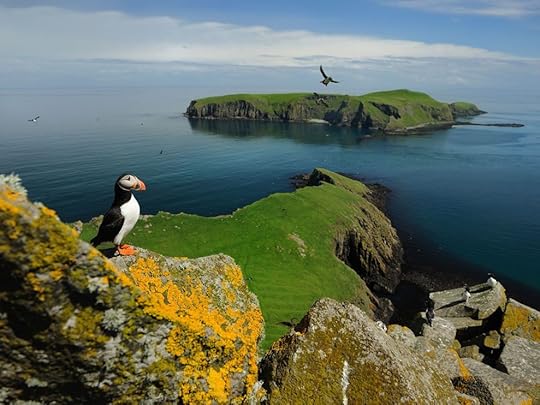
The Shiants—the name means holy or enchanted islands—lie east of the Isle of Lewis in a treacherous sea once known as the “stream of blue men,” after the legendary water spirits who menaced sailors there. Crowned with five-hundred-foot cliffs of black basalt and surrounded by tidal rips, teeming in the summer with thousands of sea birds, they are wild, dangerous, and dramatic—with a long, haunting past. For millennia the Shiants were a haven for those seeking solitude—an eighth-century hermit, the twentieth-century novelist Compton Mackenzie—but their rich, sometimes violent history of human habitation includes much more. Since the Stone Age, families have dwelled on the islands and sailors have perished on their shores. The landscape is soaked in centuries-old tales of restless ghosts and ancient treasure, cradling the heritage of a once productive world of farmers and fishermen.
In passionate, keenly precise prose, Nicolson evokes the paradoxes of island life: cut off from the mainland yet intricately bound to it, austere yet fertile, unforgiving yet bewitchingly beautiful.
Sea Room does more than celebrate and praise this extraordinary place. It shares with us the greatest gift an island can bestow: a deep, revelatory engagement with the natural world.
Adam Nicolson writes a celebrated column for The Sunday Telegraph. His books include Sissinghurst, God’s Secretaries, When God Spoke English, Wetland, Life in the Somerset Levels, Perch Hill, Restoration, and the acclaimed Gentry. He is winner of the Somerset Maugham Award and the British Topography Prize and lives on a farm in Sussex.
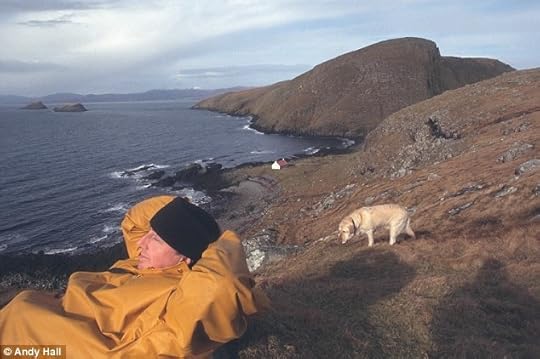
This was a surprising pleasure to read by the author of “Why Homer Matters”. I readily enjoyed its core as a sustained poetic reverie during his extended stays on a trio of remote islands in the Hebrides off northwest Scotland, the Shiants. These he received as an early inheritance from his father at age 18. Though only 500 acres of cliffs, meadows, and hardy vegetation devoid of trees, the islands are also a major nesting site of many seabirds, including puffins, skuas, gannets, kittiwakes, and geese. For a number of years Nicholson was content to visit alone during summers via a sailboat trip from a Harris Island port 5 miles across the treacherous tidal channel called the Minch. He retreated to a 19th-century two-room rock homestead without electricity and mediated on the vistas and on the violence of waves meeting cliffs. We experience him pursuing amateur naturalist observations in his explorations, reaping treasures and indelible visions.
For example, I love his contrasting experience of puffins and the cormorant-like shags: Ludicrous and loveable puffins! Their sociability is as stiff and predictable as an evening in Edwardian London. Gestures of deference are required of any newcomer, and a little accepting dance of acceptability is made by those already settled with cigars around the fender. …the are more capable of looking embarrassed than any bird I have seen. So polite is this world, in fact, that most of its members seem struck dumb by their sense of propriety.
…If puffins and gannets are from different worlds, the shags are from another universe. Nothing can really prepare you for the reality of the shag experience. It is an all-power meeting with an extraordinary, ancient, corrupt, imperial, angry, dirty, green-eyed, yellow-gaped, oil-skinned, iridescent, rancid, rock-hole glory that is Phalacrocorax aristotlelis. They are scandal and poetry, chaos and individual rage, archaic, ancient beyond any sense of ancientness that other birds might convey. …There’s a fluster of rage, resentment, and clumsiness as the big, black webbed feet stomp around the sticky, white, guanoed mayhem of kelp stalks and wrack branches that is its nest, in the back of which, creeping for the shadows, you see the couple of young, half-formed embryonic creatures, shag chicks, rat-birds, serpentine, leathery, hideous.
Nicholson has a facility of slipping about the timescales as his perception of the here and now reveals how small we are in the life of this realm. For example, the oldest fossils of shags are pegged at 60 million years, which was not long after the dinosaurs met their cataclysmic extinction and ichthyosaurs still swam the seas. Eventually the strange architecture of headlands of soaring dolomite columns sets him to pursuing knowledge of the geological history of the islands and shares his delights in how the frozen conformation is rendered into dynamic flux of magma flows and foldings in the minds of geologists who visit him there. The mysteries of old foundations and walls on his tours of his land sets him to dwelling on the human communities who dwelled like him back into in the mists of historical time and the vast pre-historical periods. Nicholson give up his precious isolation to invite some archeologists to come do some digs, and their discoveries at Stone Age, Iron Age, and Medieval sites helps him with a more informed imagining of what life was like there.
The middens (i.e. garbage piles) dug up at different sites on the Shiants reveal evidence of times of famine, as indicated by concentrations of limpet shells, a meal of last resort. Some modeling of available land resources for gardening versus grazing of sheep and cattle suggests that only a handful of families could ever be sustained on the island and that overpopulation with occupation by as few as 40 humans could tip the balance toward disaster and starvation. I got the same sense of human adaptability and risks of life on the edge from Jared Diamond’s inquiries into the Viking settlement of Greenland for three centuries in his “Collapse: How Societies Choose to Fail or Succeed.”
A particularly old artefact pulled off the bottom of the sea off the Shiants is a Bronze Age necklace or armband known as a torc, which is elegant in the simplicity of twisted and fluted dual bands. He imagines it cast into the sea as a tribute to the unknown forces at the edge of the known world. Nicholson also tracks references to a visit of a prominent Roman to a resident in the Shiants Other records indicate mystics hung out there, including early Christians. The Vikings in their sojourns gifted their names to many headland and inlets. The Hebrideans harbored a large population of Catholics, much oppressed over long time periods. Nicholson finds in his house a Medieval gravestone with a carved cross within a circle being used as a hearthstone by the later house builder. But the cross was hidden on flip side, suggesting resolute defiance of persecution. Over the centuries, political rebels sometimes hid out on the Shiants, as apparently did pirates. Murderous clans vied for territory in the Hebrides, occasionally wiping out a whole family. Gaelic names of various geographical sites on the island appear to reflect historical events of tragedy and mystery later blown up in oral tradition to mythical or miraculous proportions. The name Shiants means hallowed or blessed from one angle, haunted from another. Consistent with that he finds in history excursions much evidence of priests and reclusive saints who found spiritual refuge on remote Hebridean outposts like this, as well as records of myths about magical or evil presences. Despite these extremes, the archeological evidence points to residence in the Shiants mostly by ordinary farmers for many generations into the 16th century.
By the 17th century, feudal lords and aristocratic landowners cleared off most of their peasant tenants from many properties in the Hebrides and used their estates for summer leisure activities. Island like the Shiants changed from being places that were “empty and difficult for the Hebrideans” into sites that “became beautiful and empty for outsiders.” One exception was one landowner of the Campbell clan who resided on the Shiants with his family in the 1860s, commuting as needed to Harris or the mainland by boat and receiving suitors to his fair daughters by boat. Through most the 18th and 19th centuries, the Shiants largely became a site for temporary sheep grazing and fishing stations. Nicholson kept the tradition of his father and predecessors of allowing sheep herders access to grazing on the island. In a particularly fun section, he details his participation with the shepherds in the fascinating and exhausting work of driving the sheep form many a rough spot to a beach and loading them on a barge to move them from one island to another.
One reason Nicholson’s account of this rocky place on the Atlantic appeals to me is because I feel the northeast coast of Maine where I live is like its mirror image, split from the British islands by ancient shifts of the tectonic plates. I am especially fond of hiking high cliffs facing the stormy sea, and I marvel at the endurance of fishermen and admire a man a few miles down the peninsula who tends a flock of sheep. Not so long ago, sheep were similarly transported to small uninhabited islands for grazing. We have one island offshore of my town where puffins thrive, though nothing like the hundreds of thousands that nest in the Shiants. We have a lot of eagles and ospreys, yet I had to go north into New Brunswick to experience soaring gannets and their plummeting and deep dives into the sea for mackerel. Nicholson’s account of sea eagles, collosal and majestic, nesting on the Shiants in earlier centuries and signs of their return in recent years was uplifting for me.
At times it can seem he is making mountains out of molehills, at others on the trail of wisdom expressed in the Leonard Cohen line, “We are so small between the stars, so large against the sky.” In the following example I find a useful outlook, while others may see purple patch:
Islands are made larger, paradoxically, by the scale of the sea that surrounds them. the element which might reduce them. … has the opposite effect. The sea elevates a few acres into something that could never be if hidden in the mass of the mainland. The sea makes islands significant …they are not-sea within the sea, standing against the sea’s chaos and massive power, but framed by it, enlightened by it. In that way every island is an assertion in an ocean of denials, the one positive gesture against an almost overwhelming bleakness. …The state of siege and an island, in short, is life set against death, a life defined by the death that surrounds it.
This combination of lyrical immersion in an austere but rich environment, explorations of a special ecology, and speculation on human affinities for remote island life conforms a subgenre of non-fiction I admire which could be called “Biography of Place.” Among the couple of dozen books I voted for on the Listopia list for this category, are two I loved by Tim Robinson which are the most similar in scope and style to this one (“Connemara” and “The Stones of Arran”). I look forward to reading Nicholson’s recent book on sea birds, as well as his book on Homer.
A disclaimer: I bought this book in a tiny bookstore/post office while on a trip to the Isle of Skye off the Northwest coast of Scotland, and read the first few chapters while sitting on a log at the edge of the tiny harbor in Port Righ just before sunset. So I might be a little biased as to its quality or significance.
If you've never had a chance to travel to the outer islands off the coast of Scotland, then you should most definitely read this book. It does for the Hebrides what Frances Mayes' books have done for Tuscany - only it includes a lot less people and a lot more sheep, puffins and seals.
There is something undeniably haunting about the Scottish isles. The extremes of weather and situation that exist there make life an endless struggle, and as Nicolson notes in his book many of the islands are now uninhabited for that very reason. The book spends quite a bit of time on the history of the islands and the various groups of people and animals who have attempted to sustain life there (Nicolson is a historian so he's in his element here). Yet, to me, the book's best moments are found in the descriptions of the islands themselves and their wild austerity. If you ever do have the chance to visit the islands off the coast of Scotland, you'll see what Nicolson means when he discusses the fascination and repulsion they generate. They're so breathtakingly beautiful that you feel you must experience life among them, but they offer little softness or respite to those who make the attempt.
This is a great book to read while traveling - and take my word for it, if you ever actually visit the islands you should most definitely take this along and read it while in the background fishermen shout to each other in Gaelic as they dock their boats for the night.
What happens when an aristocrat inherits a beautiful, severe, historic and largely uninhabited Hebridean island? Best case scenario: this book. Nicolson clearly loves and cares for the Shiants, as is reflected here, but his work is marred by his feud with the local Scots who quarrel with an Englishman's sole ownership of the isles (a right and proper complaint, as Nicholson himself notes, as is their complaint against sole ownership of land), but also and more grievously by his egotism and casual but deeply ingrained sexism. The water is masculine, the land feminine? All boating is a man's world; all domestication, a woman's? Rubbish. This reeks of personal history, poorly thought out assumptions and badly read history, which is all the more startling given Nicolson's own wonderful readings of archaeology within this book. Instead, his sexism seems to reflect his own domestic quarrels with his first wife and second, as well as with the women who have either lived on the island or who have refused to travel there.
But what is good about Sea Room? It is passionate and resourceful, enlivening even the dullest moments of archaeological history with a thrilling and deeply imagined vision of the lives of the Shiant islanders throughout the isles' existence. Nicolson tells three stories, essentially: the frame narrative is one of his commissioning and use of a small, Viking-era personal boat from a local craftsman to get to and from the isles. The second stories is of his commissioning of an archaeological study of the isles: this makes up the bulk of the text, although Nicolson frames it as a deep history of the isles instead of the result of his commissioned study. And the third narrative running through the text is one of Nicolson's ownership of the isles: his relationship with his son, who inherited the island, with his father, who gave the isles to him, with the neighbours who think it unjust that he owns them, and with the local stewards / sheep herders whom he works with to house sheep on the island.
Together, these strands of passion make up a richly imagined, albeit marred vision of a place in the world that would otherwise go largely unnoticed, and that is a prize worth the effort. No question. What should be questioned is why such a beautiful task can only be accomplished by an aristocrat with a personal history of wealth and connections, and whose primary relationship to the island -- as much as he hides it from himself and from this book -- is pecuniary: his money pays for it, pays for the studies, pays for the boat, pays for the stewards services... all revolve around Nicholson's social privilege and inherited capital, which is indelibly tied to the patriarchal structures of wealth and patronizing visions of others. And that is a shame, because this kind of beautiful imagination is common property to all, as should be the land that is brought to life through history in this fashion.
Ah, what a fine book this is. Reading it is like spending time with a new friend. Nicholson has a sharp and curious mind and a generous spirit. You may not think you can be much interested in a group of three little islands in the Outer Hebrides - the Shiants - their climate, wildlife, prehistory, geology, archeology, socio-economics, agriculture, shepherding, folk literature, the sea currents around them, and the host of other topics covered in this book, but Nicholson draws you in. Soon you are immersed in whatever there is to be known about what amounts to less than a square mile of rock, cliffs, beach, and meadow.
The book is organized around the turn of the year, beginning with Nicholson's first journey to the islands in his own boat in the spring, and ending with the first gusty wet weather of autumn, as he sits at the window in a two-room cottage writing. Into this annual cycle he interweaves story upon story, often speculative, of how the islands came to be, how they came to be what they are, and the people over thousands of years who have lived here.
As the year passes, Nicholson sketches in the broad sweep of recorded history from St. Columba to the present, noting the several hands through which the islands have passed, including his father's and his own. A team of archeologists identifies the remains of Iron and Bronze Age settlements and spends a summer uncovering a long abandoned farmstead. The discovery of a buried cobblestone with an ancient inscription sends him on one of many attempts to unravel mysteries that he uncovers.
The book is based on considerable research, and Nicholson pieces together a previously unwritten history of the islands with references drawn from many old documents and interviews with historians and other experts. He helpfully illustrates his text with many photographs, drawings, and maps.
This book is for anyone who feels the magical pull of islands. You will not regard them quite the same way again.
I found this book inconsistent, some sections were really interesting but some diversions simply failed to hold my interest. I did find the initial self-justification a bit irritating because this is ultimately a "rich man owns islands" book and whilst there is a lot of excellent prose and diversions into the local history there was always little "socialist" voice in my head saying "He just traveled up from London for the summer". Whilst I appreciate the whole "authentic" sailing boat thing I rather think the locals are using highly powered metal skiffs and ribs to eek a living from the sea and land - but it's all so romantic.
Adam Nicholson is a very good writer, some truly lovely prose but I didn't warm to the author.
Author Adam Nicolson's father bought the Shiant Isles (a group of three small islands off the coast of the isle of Lewis, in the Outer Hebrides of Scotland) in like, the 1940s. The Nicolsons are English, but Adam's father regularly went up there to camp and bond with the islands, and passed that onto his son when he handed him the title to the islands upon reaching adulthood.
This book is a blend of the history of the Shiant Isles since the Neolithic era with the author's own experience of the islands and what they mean to him and his family. At times the writing is lovely and evocative, but I came away with such a bad taste in my mouth, for a couple of reasons.
(1) First - how annoying is it that this guy just bought a bunch of islands and now he's a wealthy landowner. An English landowner of islands historically owned by the local Scottish community. Hmm. Sounds familiar. Oh, by the way, the author also happens to be a Baron. Unrelated to the islands. Hard not to hate him on principle.
(2) The cringey misogyny. I think Adam Nicolson got a little caught up in talking about the history of the islands and forgot that he's writing this book in 2001 and he can't sell his daughters for 30 sheep. He goes on about how the islands are not a place for women, they're just too crude and masculine and unfeminine (he literally describes the islands as "unfeminine." Bro they are ISLANDS. They don't have a penis, I swear. You can check).
Direct quote: "I don't mind this crudity. It is quite unfeminine... Women don't like it much.... This is not a female place. Of course, for centuries it must have been as much woman's as man's country, but the islands' modern isolation has masculinised them, as though they have become part of the sea, which is the male domain."
It's so jarring to hear something like that written unsarcastically in the modern world, and for good reason. Like, I forgot all women are exactly the same and they're all delicate blossoms who are better off in dainty glass greenhouses than the big unprotected scary islands. According to Nicolson, only men can camp! Only men like islands. Only men are allowed on the sea. Rules are rules. (If this is not a "female place" I have to wonder what he thinks is a female place. The kitchen?).
This is made worse by the fact that he talks - repeatedly - about how he's giving the islands to his son when he's 21 as his father did before him. And how he expects his son will give it to his son, and to his son, and so forth.
Funny how he doesn't mention anything about his daughters (who are BARELY referred to, by the way - and only as "my wife stayed home with the girls"). No islands for you, girls. Grab your ladles and remember your place!
Let me tell you, if my dad had owned some islands that were a beloved and meaningful place to him and he just handed them to my brother, I would erupt. (Especially because, as it happens, I love camping and my brother is an indoor boy. Crazy how gender doesn't actually determine your entire personality, isn't it?)
Loved this: Adam Nicolson inherited the Shiant Islands in the Hebrides from his father Nigel Nicolson at the age of 21, bought at the behest of Nigel's mother Vita Sackville-West. The islands had long been uninhabited, although there is a usable house there, and life there is pretty primitive (rats, no toilets). This is not quite what you imagine the holiday home of a Bloomsberry to be, in other words. Adam Nicolson is sensitive to all the possible accusations of being a posh English landowner with a plaything, meets them all head on, and provides here what must be a definitive history of the islands, every aspect of them. Fantastic.
Amanda Brookfield's Reviews > Sea Room: An Island Life in the Hebrides
Sea Room by Adam Nicolson Sea Room: An Island Life in the Hebrides by Adam Nicolson 25327464 Amanda Brookfield's review Jul 24, 14 · edit 5 of 5 stars Read from June 30 to July 24, 2014
This is not my usual type of read. Memoirs-style descriptions of remote Scottish islands, the Shiants, populated by puffins,rats and, sometimes sheep, which have to be transported to and from the mainland by boat....nope, not my bag at all. But a friend recommended it to me. A good friend, one of those whose tastes you can trust absolutely.
I was out of my comfort zone a lot of the time. It meant I had to concentrate, a bit like when one is trying a new - and scary - type of food. This was made easy however by Adam Nicolson's mesmeric and powerful narrative style. He writes like a poet, with an extraordinary eye for ordinary detail and a lyrical, natural turn of phrase that draws you in.
I like books that tell stories. In the case of An Island Life the 'story' operates on two levels. First there is the fascinating history of the islands themselves, which Nicolson tracks back over the centuries, deploying the skills of a forensic scientist as well as a poet in the process. Then there is the account of what the islands have meant to his own family, legal owners for a hundred years. Bequeathed to him by his father when he was twenty one, Adam Nicolson is fast approaching the same milestone with his own son. It is a poignant tradition, plainly not about the handing on of an 'asset' so much as granting the next generation privileged access - the opportunity to connect with and learn from a small, beautiful and truly wild part of the world.
I could not envisage managing the journey, let alone the harsh existence on the Shiants islands myself, but thanks to Adam Nicolson I feel I have been there anyway. But that's what a good book does: takes you somewhere other, and then brings you safely home.
Finally finished, hurray. It's such a shame, this could and should be a fascinating book, with the biology, history and geography of the Islands woven together and affecting each other, but the authors ego - and it's a BIG one - keeps getting in the way. The frequent casual sexism is also jarring, especially in a modern book; how can geographical features be "masculine" or "feminine"? I probably will recommend it to people travelling that way, because of the information contained, but with the caveat that it can be extremely irritating, and to read something else at the same time so you can get through it.
This concerned a subject - the author describing the isolated Hebridean Shaint Islands, and those who have lived on it - about which I would've professed an interest. In the end though it made for a slightly over-long read, slightly over-dwelling on aspects of less interest to me, slightly over-doing the romanticism and (like I have felt of the likes of Robert Macfarlane) leaving me somehow both envious of them and irritated in a 'it's alright for you, nipping to your wild paradise to write poetically about it whilst normal people have to earn a proper living' manner.
Nicholson writes well, and tries very hard to be fair and complete and thorough. Had I read this at a more leisurely pace, in snatches rather than cover-to-cover in a few days, I may well have got more enjoyment from it. As it happened, it just came over a little repetitive in places - there is only so much one can say about a limited geographical area, and perhaps as a consequence I found the historical detail a bit much overall. There were plenty of bits that were witty and interesting and stimulated further interest, but there was a lot in between that wasn't so compelling. I didn't feel completely satisfied either with the balance of all of the discussions of tenants and landowners, and farmers and fishermen, the social history of it all.
Nicolson's book is a well-researched and heartfelt homage to the Shiants, three tiny islands in the Outer Hebrides that were purchased in 1937 by his father. He reconstructs the history of the islands using the few artifacts found there, with a particular focus on the lives of the various tenant farmers and shepherds who occupied them over the centuries. My favorite parts of the book, however, are his poetic descriptions of the flora, fauna and geology of the Shiants. I read the first half of the book while visiting Lewis and Harris this past spring, the hazy outlines of the islands visible from the house where I stayed; reading the second half in my suburban home outside Boston brought me right back to the desolate and captivating beauty of the Hebridean landscape.
There were places where I really liked this book, and they were in some of Adam's descriptions of the islands and the peoples. His love of the Shiants is clear. However, I was thrown off a little by his conversational style. Two lines into a story about someone or something and Adam would veer off into an aside that sometimes felt longer than the story itself. It made the narrative a little choppy. I found my attention wandering a little throughout and I am not sure if I was in the mood to read this book when I began it. Unfortunately for me and the book, I was reading from a library loan so I could not afford to put it to one side a return to it when I felt like it.
Author Adam Nicolson has been the only writer I've contacted to say how much I loved his book. I didn't expect an answer in return, but he is a lovely, humble man and we had a short bit of back and forth. This book is about a small, uninhabited island off Scotland that the author inherited. His account is rich with information: the island's ecology, weather, ancient history, sporadic inhabitants, etc. A wonderful book for the armchair traveler, about a very isolated and rather bleakly romantic locale.
Adam Nicolson is totally in love with the Shiants and that makes some of his writing very beautiful. For the most part, I really enjoyed learning about the islands, their human history and archaeology, the birds and beasts that inhabit them and the surrounding seas. I began finding his love affair with the islands tedious towards the end though. I hate saying that but really, by two thirds of the way through, I'd learned as much as I could ever want to about the Shiants. The website is great though. I love the description of the house and the list of provisions.
Memorable book! Among the best I've ever read. Engagingly written and endlessly fascinating. Learning the Shiants had evidence of homes as early as 1000 led me to learn more about sea travel in the North Atlantic in the 800s and 900s and that led to learning the difference between Vikings and Norse and that led to an interest in Viking ships/boats...and so it goes. Loved his connection to this bit of land he owned and his desire to learn more about all its inhabitants over time. So happy I read this book.
I appreciate the love the author has for the islands and that he is paying his respect to the people living on the islands before him, but I can't agree with him on his thoughts on his right to owning them. I did have a lovely time reading the book, but it was a bit tiresome to read about the islands not being suitable for women just because there isn't electricity, running water or a loo. It says more about the author's view on women than anything else in my opinion.
Funny fact for me is that I have met one of the archeologists mentioned in the book. The only thing I remember is that she is called Mary and that she told me about the Hebrides. "You must go there", she said. By chance I ordered this book to read in preparation for my trip this year to the Hebrides... I couldn't believe it when I understood that the Mary I met in Björkö (Birka) Midsummer's eve in 1991 was the same person that was visiting the Shiants.
Having read lots of non-fiction this year where the setting has been an island I was looking forward to reading about a real person who owned islands - the Shiant islands near Lewis. The cover really drew me in. On the whole I enjoyed it but I really wanted more about the person and his interaction with the islands. However there was a lot of history which was quite dense so I did a fair bit of skimming. I was interested in the nature and descriptions of the landscape. I’m going to pass it to a friend who will be interested in the history parts.
This was a beautifully written biography of a place, not quite like any I have read before. Entirely devoted to three Scottish islands known as the Shiants (“one definite, softened syllable, ‘the Shant Isles’, like a sea shanty but with the ‘y’ trimmed away”), they are an archipelago of three islands in the Hebrides, about 550 acres in size, about four miles off the coast of Lewis, located in a body of water called the Minch, their names Garbh Eilean, Eilean an Tighe, and Eilean Mhuire. The author intended in the book to immerse himself in the islands in an attempt to tell their whole story “in as many dimensions as possible: geologically, spiritually, botanically, historically, culturally, aesthetically, ornithologically, etymologically, emotionally, politically, socially, archaeologically, and personally.”
Right away in a very early paragraph you can tell the author loves these islands, lands “with black cliffs five hundred feet tall dropping into a cold, dark, peppermint sea, with seals lounging at their feet, the lobsters picking their way between the boulders and kelp and thousands upon thousands of sea birds wheeling above the rocks.” Again and again he describes the feel of being on the islands any time of day or night, all year long, of being in the waters around them, climbing the rocks, being among the wildlife and the sheep, of spending time with the locals who have made either a living there fishing and shepherding or with scientists have studied the island’s geology, biology, and archaeology, all described with a novelist’s eye and amply illustrated with photographs and maps.
Geology fairly early on is very well discussed, with the author noting that the Shiants are the “most northerly extension of the British volcanic landscape” and the “most northerly example” of columnar dolerite, the author vividly describing the geological origins of these and other rocks in the Shiants, what they look like, and the sometimes deadly dangers of climbing them. The columnar rocks were fascinating, as from time to time entire columns collapse into the sea as the base of each column gets eaten away by the ocean, as “the columns of which the islands are made are scarcely more bound to each other than pencils in a box and once the base has gone, knocked out by a winter storm, there is nothing to withstand the force of gravity.” Said to be similar in some ways to a glacier calving, where the splits occur “the remaining edges are as sharp as knives,” while the “bare unlichened stone smells of iron or even blood, because blood smells of iron too.”
Though not getting a lot into botany per se, Nicolson never failed to note the surprising number of flowers that bloom in the archipelago, noting early in the book for instance that in summer “the grass on the cliff-tops is thick with flowers: bog asphodel and bog pimpernel; branched orchids, the stars of tormentil and milkwort,” with other plants including wild thyme, purple knapweed, hart’s tongue ferns, forget-me-nots, meadowsweet, yellow flags, and watermint. Of all the natural history subjects covered in the book this was probably the one he spent the least amount of time on, though he was far from “plant blind” and always noted wildflowers and other plants wherever they occurred (and not just through dull listings but describing what they looked like and sometimes what they meant to him or in the past to the previous inhabitants).
Birds more than any other wildlife were described again and again in truly well written prose, everything from snipe (“fluting at night over their territories” in the marsh) to short-eared owls (cruising “low over the rushes for the voles that are its only prey”) to white-tailed sea eagles (with a “leonine presence,” “the only truly imperial creature in the British Isles”), to ravens (which gleefully harass the eagles playing “like Messerschmitts around” them). Most of the all the seabirds are well discussed, as the Shiants are “one of the great bird places in the world,” boasting between 15,000-18,000 guillemots, 8,000 to 11,000 razorbills, between 4,000 and 6,000 fulmars, about 2000 kittiwakes, about 1500 shags, a few hundred gulls of various species, 26 great skuas, and 240,000 puffins (“about one in eight of the British total and two per cent of all the puffins in the world”). The seabirds are especially well detailed, the author vividly portraying what they look and sound like, what is it is like to see them in such dense numbers in the breeding season (and perhaps not see them at all outside of that season), of how they subdivide the various ecological niches around the island, with for instance noting how gulls and kittiwakes dabble at the surface while puffins dive to depths of 30 to 40 feet, while the guillemots plunge “much deeper, often to a hundred and fifty feet, and going much further afield.” My favorite descriptions were of the shags, as nothing “can prepare you for the reality of the shag experience. It is an all-power meeting with an extraordinary, ancient, corrupt, imperial, angry, dirty, green-eyed, yellow-gaped, oil-skinned, iridescent, rancid, rock-hole glory that is Phalacrocorax aristotelis,” a creature that lives in a “stinking slum,” which if one approaches, “hawks and spits at you, its gizzard shaking in anger and fear, its whole head prodding and prodding towards you, like an angry finger.”
Additionally, it was interesting to read accounts of when the birds used to be trapped and eaten (or the eggs collected and eaten), with the author reproducing a chart compiled by Cambridge zoologist HB Cott in the early 1950s in which he rated the various how the eggs of the various seabird species tasted when scrambled, which ranged from “very good” for the lesser black-backed gull and kittiwake to “unpleasant” and “off” for the shag.
Rather late in the book he delved into a subject that is around the edges the entire time one reads this work, scurrying in the walls of the single house still fit for human occupation on the island (in that it has walls and a roof), of the sounds heard at night as he slept next to the fire, evidence of their nocturnal excursions obvious the next day; rats. Possibly as many as three thousand rats call the Shiants home. No one knows how they got there originally or how long they have been there, but it was interesting that they weren’t “the rats you find at home in the barn or the sewer,” the brown rat (Rattus norvegicus), but instead now a rare rat in the UK, the ship, black, or plague rat (Rattus rattus). One might have thought they would have denuded the islands of their numerous seabirds, but Nicolson went to offer theories as to why there may actually be some sort of equilibrium between nesting birds and the rats.
I really liked how the author made the waters around the islands come alive, describing them as dynamic places with almost a personality, of how the water, far from being a static thing, moved and pulsed in response to the winds, tides, currents, and often most of all the undersea topography, of how the water could be very unpleasant for instance where it was squeezed between islands in narrow channels, perhaps further agitated as it was “forced to run over a knotted and fractured sea-bed.” He learned to be wary of the many underwater rocks around the Shiants, that though dangerous became familiar to him like an “ill-tempered dog,” mindful of some rocks that looked “black and bitter, the knobbled spine of a half-submerged creature.” It wasn’t just the author who saw creatures and animate beings in the often chaotic waters around the islands, as the “Sound of Shiant is also known as the Sruth na Fear Gorm, the Stream of the Blue Men, or more exactly the Blue-green Men,” as the “adjective in Gaelic describes that dark half-colour which is the colour of deep sea water at the foot of a black cliff” but also that according to folklore and tall tales, describes the Blue-Green Men, who “are strange, dripping, semi-human creatures who come aboard and sit alongside you in the sternsheets, sing a verse or two of a complex sign and, if you are unable to continue in the same metre and with the same rhyme, sink your boat and drown your crew.”
Though the islands, uninhabited for well over a century, are regarded as wild, remote, and nearly wilderness, Nicolson never lets the reader forget this is very much a human landscape. Much of that history is told through accounts of personal triumph and more often tragedy, either recorded at the time or what he can be discerned from what archaeologists and he himself found on the island showing the lives of inhabitants from before the Middle Ages all the way up into the 20th century, everything from a very rare and valuable golden torc to a “hermit’s pillow stone, the medieval brooch, the decorated craggenware, the stone stools, the scrimshawed plate, the kelp irons, the boat nails from the house roof,” to a fragment of a lovingly crafted wooden toy boat, each item vividly described, often illustrated with photographs or sketches, each one opening up to a reader a lost history, one very rarely written down or with any named individuals attached to it.
Again and again in the book, Nicolson shares his thoughts on what islands mean to the human spirit and day-to-day life and how this changed through time for the inhabitants and visitors of the Shiants. Over the centuries the islands went from being rich places, able to provide a living to their inhabitants and part of the wider world around them, the inhabitants benefitting from the local markets as much as they benefitted from them, of the islanders being part of local churches or clan conflicts or even rarely larger tides of history, that “to be on the Shiants was to have the benefits of good soils, the riches of the birds and fish…[i]t was not to be deprived of anything the mainland could offer…a sea room with sea room, a place enlarged by its circumstances, not confined by them” to eventually with the coming of modernity in the eighteenth century being felt even by the those who loved the place as a realm that was cut off and just too isolated for people to remain, a place that was forgotten and unneeded. When the islands emptied, they became seen as awful places for a time as illustrated by the views of Robinson Crusoe, the author writing the Shiants were seen, just as Crusoe viewed islands, “in some ways a prison, a symbol of…suffering, divorced from the company of men.”
Still later the islands after they emptied of families who had lived increasingly hard lives (even facing at times starvation) they began again to be seen as wonderful places, such as viewed by authors as Jean-Jacques Rousseau (not specifically writing about the Shiants), as places where the solitary self could flower, a place where “dreamy-eyed travelers from the south were coming to see…as a vision of earthly beauty” (or derisively by authors such as DH Lawrence who according to Nicolson islands are “not so much islands as I-lands, where the inflated self smothers and obliterates all other forms of life”), a decidedly modern and romantic view.
Either because of his love for history and to immerse himself in the islands, or perhaps conscious of his own at times romanization of the Shiants, Nicolson notes that one, in appreciating the island’s modern, wild, isolated nature, should never forget the human cost behind such a thing. The author described at length what life was like on the Shiants for centuries, of how at one point there were originally five family farms located there, but with the changing markets due to globalization, demands of distant landlords that the inhabitants couldn’t meet and also produce enough food to eat, and perhaps the desire of the island’s owners to squeeze more money from the islands, profiting much less from resident farmers and shepherds and much more from seasonal kelpers and shepherds, the islands began to die by the 1720s. Instead of being rich places or at least decent places to live the Shiants became at the very least a place where “[i]nsularity was now a symptom of backwardness and isolation a kind of failure” to at worst “a kind of hell,” the islanders either left of their own accord because they couldn’t make a living there or were (somewhat less likely in the case of the Shiants) forced out. Nicolson wrote that because of the “continuing resonance of the Clearances” that there are those who strongly hold beliefs that the empty, uninhabited lands of Scotland “are an insult to society,” with some even going so far as to call for an end to private land ownership, a subject the author address again and again towards the end of the book, of hard feelings about how “southerners with southern money came to entertain themselves in a romantic and deserted island,” islands that once had families and where people fished and collected seaweed and took care of sheep and were born and died. I think Nicolson tried to walk a razor’s edge between noting that the islands were once very much homes to people for centuries, places abandoned either under the duress of poverty and starvation or the greed of distant landlords, while at the same time loving, treasuring, and working hard to preserve their modern beauty of windswept wildflowers, dark sea cliffs, wheeling, screeching seabirds, and Viking-era ruins.
The author’s own views of the islands, what the idea of islands mean to him, as owner of the islands (having inherited them from his father and not long after he published the book said he would hand them off to his son), were that being on the islands excited him, that the island’s “wonderful sea room, the surge of freedom which a moated island provides” enlarged him, a feeling that he carried with him even when far from the Shiants. Again and again Nicolson came back to what the islands meant to him. Far from finding this boring or self-indulgent, I enjoyed reading this as it was an exploration in a sense of what the Shiants meant to previous generations and what islands in general mean to people who love them.
I received a copy of Adam Nicolson's Sea Room: An Island Life (2001) for Christmas. Sea Room is a non-fiction account of a series of three remote Scottish islands - collectively known as the Shiants, found five miles away from the larger island of Lewis and Harris - which the author was given by his father on the occasion of his 21st birthday. I settled down with Sea Room during the third lockdown, wishing more than anything that I still had the freedom to travel, and to explore places as uninhabited as the Shiants.
Interestingly, Sea Room provides the first instance in which anyone has written at length about the islands. Early on, Nicolson pronounces that this book forms 'an attempt to tell the whole story, as I now understand it, of a tiny place in as many dimensions as possible: geologically, spiritually, botanically, historically, culturally, aesthetically, ornithologically, etymologically, emotionally, politically, socially, archaeologically and personally.' Suffice to say, he has not left much out, and the history which he provides feels thorough and complex.<
In his introduction, Nicolson writes at length about the perception others have of the Shiants. He comments: 'The rest of the world thinks there is nothing much to them. Even on a map of the Hebrides the tip of your little finger would blot them out, and if their five hundred and fifty acres of grass and rock were buried deep in the mainland of Scotland as some unconsidered slice of moor on which a few sheep grazed, no one would ever have noticed them... [But] they stand out high and undoubtable...with black cliffs five hundred feet tall chopping into a cold, dark, peppermint sea, with seals lounging at their feet...'.
These islands offered only a single rustic bothy for accommodation, without either heating or water. The last permanent inhabitants of the Shiants left in 1901, the way of life no longer sustainable. He looks into how the very small community would have lived upon the islands; how they would have relied on a diet of fish and seabirds, and how difficult it was to grow fresh food. There is a focus upon migratory patterns of both birds and humans, and a real emphasis upon the anthropological.
The Shiants have made an enormous impression upon Nicolson: 'I have felt at times, and perhaps this is a kind of delirium, no gap between me and the place. I have absorbed it and been absorbed by it, as if I have had no distance apart from it. I have been shaped by those island times, and find it difficult now to achieve any kind of distance from them.' He writes beautifully about the islands, commenting: 'The sea makes islands significant. They are defined by it, both wedded to it and implacably set against it, both a creation and a rejection of the element which makes them what they are.'
There is a lovely, circular feel to the Shiants. Nicolson's father, Nigel - the son of Vita Sackville-West - purchased the islands for £1,400 during the 1930s, from novelist Compton Mackenzie, no less, and was adamant that they would form Nicolson's 21st birthday present. The author writes that he is going to be passing the islands onto his own son, a teenager at the time of writing.
Sea Room was a wonderful diversion from the world, and whilst I did not love it as much as Nicolson's focused account The Seabird's Cry, I still got an awful lot out of it. Sea Roomis a love letter to a place and space which many have not encountered before. It is a thoughtful, almost meditative account of what a place can mean, and its precise and lyrical prose is a real joy to escape with.
The tagline on the book sums it up. One man, three islands and half a million puffins. Imagine this – as you draw close across the sea from the Outer Hebrides to the Shiant Islands which have been mystically rising out of the mist for several hours now – you see a cloud of bees coming and going from a hive – or so it seems – backwards and forwards – a constant swirling swarm. And then beside you on the waves a fat little black and white bird with a multi-coloured beak stuffed with tiny fish suddenly becomes aware of your approach and tries to take off but is so un-aerodynamic that it can’t make it off the surface, its little stubby wings flapping, its spade-like bright orange feet trailing, it slaps face first into first one wave and then the next and then thinks ‘blow this for a game of soldiers’ and dives instead, deep under, and you wait but it doesn’t appear again. And ahead of you the sound increases like a thousand pairs of rubber washing up gloves being flapped together, or someone riffling through the pages of a book, over and over again, and then you realise that the bees are thousands of birds. Puffins, razorbills, guillemots. And the sound of their cries become deafening. And all around you birds dive and black and white ghosts flit through the green under your boat between the pulsing mauve and pink translucent jellyfish. This book is wonderful. But not nearly as wonderful as the Shiant islands themselves. Get thyself there. Or failing that, if you’re interested in the lives of remote communities, birdlife, or the sea, read this book.
To me, "Sea Room" by Adam Nicholson is "Zen and the Art of Motorcycle Maintenance" meets "The Source", that is, it's a meditation on the current state and on the history of a particular place as revealed in objects found there and stories passed down through generations. The author is the father of the current owner of the Shiants, a group of three small islands located just east of the Outer Hebrides of Scotland in the middle of a troublesome but bountiful sleeve of ocean known as The Minch. The islands are wildly beautiful, uninhabited, and are a birder's paradise. One might expect that they'd always been like that. That could not be farther from the truth.
The reality is that they were inhabited from neolithic times up until just maybe two hundred years ago and were part of a complex web of culture and commerce that linked all the islands with Great Britain, Ireland, and Scandinavia and places beyond.
The author poses several questions: Who lived there? Why? How? Why did they leave? As he proposes answers, some based on archaeology, some on historical research, some on old stories, some on observations of the realities of tide and weather and the habits of fishes, birds, and marine mammals, he takes us through a year of seasons in the islands.
I thought it was beautifully, colorfully written with equal doses of sadness and humor laid on a foundation of deep love for those islands and their wildlife, and respect for the people who lived and worked on them.
Goodreads just reminded me that I started reading this book 90 days ago and I am, unbelievably, still reading it. I thought this was a good point, therefore, to write a review. I was excited to find this book and read the beginning because it resonated so much with me, living as I do on a tiny, wild island. The author compares the Shiants to Greek islands, in fact. In places, I think this is beautifully written and very interesting. In other places I am frustrated as the author speculates over and over about things he merely imagines may be true about the islands. But I haven't finished it yet.
Just a lovely and interesting book about three small islands west of Scotland--their wildlife, their geography and geology, their history. A beautiful book about an isolated place that ranges through archeology, natural history, human history, literature and family memory. Read it slowly, savor it.
An evocative if rather stodgy exploration of three small islands in the Minch, between Skye and Harris. There's a bit of history, archaeology, nature and local legend, wrapped up with the islands' owner's reflections. I could only take it in small doses and bailed after 130 pages. The uncaptioned photos were an irritation.
Painful. The writing moves at the speed of a lethargic snail and contains far more detail about tidal waters than I ever wanted to read about outside of Reeds Almanac.
This book will not appeal to everyone. What one gets out of it will depend entirely on what one expects. I found both good parts and bad; some excellent, some encumbered, and some quite boring. But the book has a place and it has a story to tell. It captures factual information about a remote and basically severe place, of extremes that most people will never encounter—and therein lies its primary value: affording opportunity to expand awareness—albeit indirectly—where otherwise there would be none. One can hardly come away empty-handed.
Throughout this text is a singular tale of direct and very intimate connection with these remote islands that speaks of much more than mere ownership. It speaks of an intense and lasting bond with place, of a reverence that transcends words.
Quotes:
“The bird teeters, like most of the auks, on the borders of flightlessness. You see a puffin taking off from the sea, and it is a desperate business, a grinding attempt to get airborne, to get up the speed at which those those wing-fins will work. [. . .] Once going, a puffin can fly fast, up to sixty miles an hour, but then the landing can be difficult, less a controlled jump jet settling into place than a managed crash, after which there is a lot of head-shaking and shoulder ruffling by which coherence is re-established and dignity restored.”
“ . . . that sense of robustness, of a marvellously mature and adult approach to risk, with all the elasticity of response that it implies, is, I think, one of the reasons that the spectacle of the summer birds is so stimulating. This life-phenomenon is not sweet, in the way that puffins are often portrayed. Nor is it heroically violent, in the way that nature is often seen. It is a wonderfully sober, serious and ingenious response to the problems and challenges of a sea and island life.”
“I know three things about eagles. Their eyes, in whose retinas the rods and cones are packed many times more tightly than our own, have a resolution eight times better than ours. They live in a world of visual intensity whose nature we cannot, quite literally, even dream of. It is said that an eagle can see a shrew twitch in the grass from three thousand feet above it. And, thirdly, if our eyes occupied the same proportion of our skull as the eagle’s eyes do of his, they would be the size of oranges.”
“If it is true to say that you can’t remember time, only the places in which time occurred, then I think you could say that the bulk of these enormous [four-feet-thick blackhouse] walls is a type of time sponge, deeply absorbent of the moment passing, sucking up lives as they happened, holding events as if in a vast memory bank. Standing in the house after the archaeologists had left, and listening to the lark still singing above me, I could feel that these stones, and by extension these islands, continue to hold the memories of the life that was lived in them a quarter of a millennium ago.”
“Drops of rain hang on the blades of grass sprouting from their walls [abandoned buildings on Eilean an Tighe]. One of them is flooded. Rushes and flag irises grow inside its single room like a salad in a bowl.”
“The time I have had on the Shiants is coming to an end. I know the islands now more than I have ever known them, more in a way than anyone has ever known them, and as I sit here in the house I have a feeling, for a moment, of completeness and gratitude. My love affair with these islands is reaching its full term.”
Die Shiantinseln sind eine Inselgruppe der Äußeren Hebriden, die zwischen der Isle of Harris und dem schottischen Festland liegen. Sie bestehen aus drei größeren Inseln und zahlreichen Skerries. Insgesamt haben sie nur eine Fläche von nur 2,3 Quadratkilometern. Sie waren bis zu Beginn des 20. Jahrhunderts bewohnt und befinden sich in Privatbesitz.
In den 1930er Jahren gehörten die Inseln dem schottischen Schriftsteller Compton Mackenzie. Der verkaufte sie an einen Pferdezüchter von der Isle of Skye, aber nachdem der seine Pläne aufgeben musste, verkaufte er sie an den Vater des Autors. Der schenkte sie seinem Sohn Adam an seinem 21. Geburtstag und Adam Nicolson wird das ebenso tun. Oder vielleicht hat er es schon getan, denn die Ausgabe, die ich gelesen habe, stammt von 2009.
Adam Nicolson beginnt mit der ersten Fahrt, die er allein zu den Inseln unternimmt. Auch wenn die Überfahrt nur kurz ist, ist sie doch gefährlich. Vielleicht ist das auch der Grund, warum die Klippen der Shiants, die mindestens genau so schön wie die auf Staffa sind, von nur wenigen Menschen besucht werden. Dem Autor ist es ganz recht, denn er schätzt die Ruhe auf seinen Inseln.
Das Leben ist spartanisch, es gibt kein fließendes Wasser oder Strom und auch keine Toilette in seiner Hütte. Vielleicht ist das der Grund, warum die Frauen der Familie Nicolson und auch die von Compton Mackenzie nur einmal auf der Insel waren. Aber damit entgeht ihnen die Schönheit, von der der Autor immer wieder schwärmt. Genauso schwärmt er von ihrer Ruhe und auch der Einsamkeit, auch wenn die ihm manchmal zu viel werden. So empfindet er fast so etwas wie Trauer, wenn die Gänse die Insel verlassen.
Auch wenn er sich für einen rationalen Menschen hält, gibt er doch zu, dass auf den Inseln die Grenzen zwischen den Welten sehr dünn sind. Nicht nur Adam Nicolson, sondern auch andere Besucher hatten schon Erlebnisse, die sie sich nicht erklären konnten. Aber vielleicht war es auch nur ihr Unterbewusstsein, dass diesen Gedanken bestätigt sehen wollte.
Man merkt, wie sehr Adam Nicolson seine Inseln liebt. Er erzählt in seinem Buch von der Gegenwart, aber auch von der Vergangenheit nicht nur der Shiants, sondern auch ihrer Menschen. Die leben zwar alle auf Lewis und Harris, trotzdem gehören sie zu ihrem Lebensraum und damit auch zum Autor.