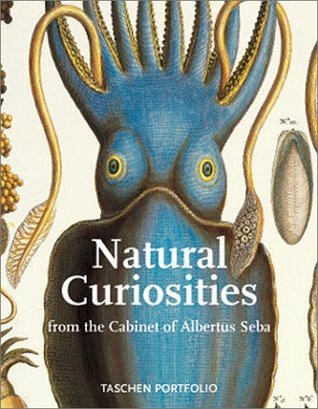
Albertus Seba's Cabinet of Natural Curiosities is one of the 18th century's gratest natural history achievements. This book consists of 14 color plates from the Tashen Portfolio. Each color plate depicting meticulously drawn animals from the collection of naturalist Albertus Seba (1665-1736).
The reverse of each page lists what animals are pictured in that particular page.
Albertus Seba was a Dutch pharmacist, zoologist and collector.
Born in East-Frisia, Seba moved to Amsterdam as an apprentice and opened around 1700 a pharmacy near the harbour. Seba asked sailors and ship surgeons to bring exotic plants and animal products he could use for preparing drugs. Seba also started to collect snakes, birds, insects, shells and lizards in his house. From 1711 he delivered drugs to the Russian court in Saint Petersburg and sometimes accepted fresh ginger as payment. Seba promoted his collection with the head-physician to the tsar, Robert Arskine, and early 1716 Peter the Great bought the complete collection. Seven months later seventeen trunks arrived in Russia. With Seba as an intermediate, Frederik Ruysch, a famous botanist, again sold his collection to the tsar. A special building was designed, and from 1728 till 1830 both collections were exposed in the Kunstkammer. With the acquisition of the two collections, the Russian Academy of Sciences had two modern, very well-documented collections at its disposal. View of the Kunstkammer across the Neva.
In October 1728 Seba had become a Fellow of the Royal Society. In 1735 Linnaeus visited him twice.
In 1734 Seba had published a Thesaurus of animal specimens with beautiful engravings. The full name of the Thesaurus is, with a dual Latin–Dutch title, Locupletissimi rerum naturalium thesauri accurata descriptio — Naaukeurige beschryving van het schatryke kabinet der voornaamste seldzaamheden der natuur (Accurate description of the very rich thesaurus of the principal and rarest natural objects). The last two of the four volumes were published after his death (1759 and 1765). Today, the original 446-plate volume is on permanent exhibit at the Koninklijke Bibliotheek in The Hague, Netherlands. Recently, a complete example of the Thesaurus sold for US $460,000 at an auction. In 2001, Taschen Books published a reprint of the Thesaurus, with a second printing in 2006.
In 1752, several years after his death, Seba's second collection went on auction in Amsterdam. The Petersburg Academy hastened to try and buy several objects.
Amazing catalog of natural items removed from their environments for the purpose of collection in the 19th century. While that hobby has fallen out of fashion, I can't help but love the illustrations of the collections - for the wonder they must once have presented as well as for their artistic merit.