Sozaboy describes the fortunes of a young naive recruit in the Nigerian Civil War: from the first proud days of recruitment to the disillusionment, confusion and horror that follows. The author's use of 'rotten English'—a mixture of Nigerian pidgin English, broken English and idiomatic English—makes this a unique and powerful novel.
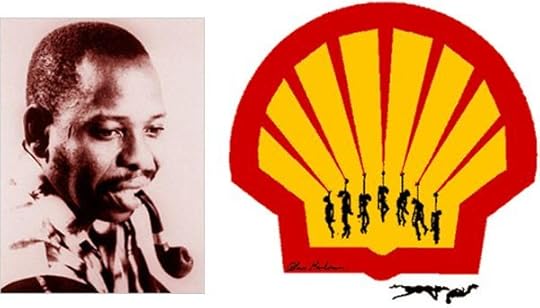
Kenule "Ken" Beeson Saro Wiwa was a Nigerian writer, television producer, environmental activist, and winner of the Right Livelihood Award and the Goldman Environmental Prize. Saro-Wiwa was a member of the Ogoni people, an ethnic minority in Nigeria whose homeland, Ogoniland, in the Niger Delta has been targeted for crude oil extraction since the 1950s and which has suffered extreme environmental damage from decades of indiscriminate petroleum waste dumping. Initially as spokesperson, and then as President, of the Movement for the Survival of the Ogoni People (MOSOP), Saro-Wiwa led a nonviolent campaign against environmental degradation of the land and waters of Ogoniland by the operations of the multinational petroleum industry, especially the Royal Dutch Shell company. He was also an outspoken critic of the Nigerian government, which he viewed as reluctant to enforce environmental regulations on the foreign petroleum companies operating in the area. At the peak of his non-violent campaign, Saro-Wiwa was arrested, hastily tried by a special military tribunal, and hanged in 1995 by the military government of General Sani Abacha, all on charges widely viewed as entirely politically motivated and completely unfounded. His execution provoked international outrage and resulted in Nigeria's suspension from the Commonwealth of Nations for over three years.
A me sozalettore, il racconto in prima persona di Mene evoca un fiume di coscienza, più che un flusso: ho per caso trovato un novello Ulysses nel continente nero? Ma il sozalettore può sentire anche odore di romanzo picaresco. E avere l'impressione che anche Mark Twain sia passato per queste pagine. Epperò, questo libro si potrebbe recepire come una storia d'amore: Mene va a fare il soldato e diventa sozaboy per amore della sua Agnes che ha più tette che anima.
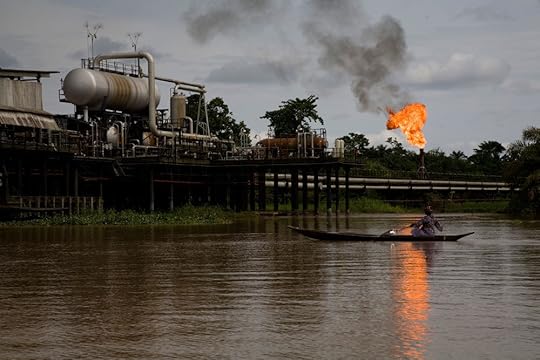
Le luci dell’impianto Agip viste da Akala-Olu, Nigeria.
O lo si potrebbe raccontare come un forrestgump che va alla guerra: perché questo sozaboy che diventa sozasoldato ricorda molto quell'altro Forrest Gump.
Ma si potrebbe anche raccontarlo come un Cidrolin che con un mazzo di fiori blu fugge dal suburbio e sale sul metro per andarsi a fare un'essenza di finocchio - d'altra parte il casino non suona mica la campana.
Sarà per questa porta aperta verso il mondo del grande Queneau, che mi esercito in questi goffi esercizi di stile?
Sfruttamento ambientale.
Invece Ken Saro-Wiwa racconta alla sua maniera, quella che ho già apprezzato nei suoi racconti, ed è la maniera migliore.
Una maniera che diverte tanto tanto mentre fa pensare e riflettere veramente veramente il sozalettore. Cosa che non è affatto una 'sorpresazione' perché da queste parti del sozamondo altri hanno scritto così prima e dopo (come si dice nell'ottima nota critica finale, Achebe e Kouroma solo per citare due perle).
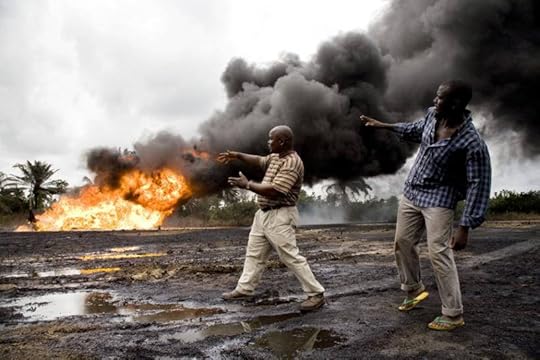
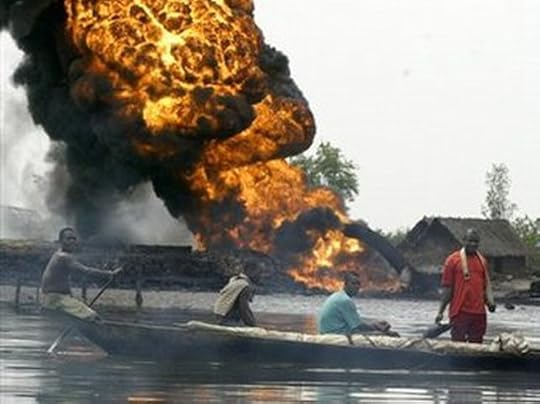
Disastro ambientale.
E, nonostante il diluvio d’ironia su ogni pagina, quando il sozaboy arriva nei campi per i rifugiati-spazzatura, la scrittura vibra come il cuore del presente sozalettore. Credetemi, sinceramente vostro.
I’m fond of reading Nigerian Literature. Chinua Achebe, Chimamanda Ngozi Adichie, Ben Okri, Helon Habila are amongst my favorite authors… and now, I include Ken Saro-Wiwa. Perhaps it’s the nostalgia of having grown up in Lagos (as an infant to the end of my teens) that echoes the setting in the back of my mind while I read these authors’ literary works. Whether it’s the traditions of the ethnic peoples, the woes and struggles of daily life under oppression (by brutal military dictatorships), corruption, black magic, the civil war (Biafra) or even colonialism, Nigeria can offer a story on any of these fronts. And these authors don’t shy away from revealing these truths through the medium of the written word.
Ken Saro-wiwa’s novel 'Sozaboy', however, encompasses all these facets of Nigeria into one compact story. In about 180 pages, Saro-wiwa’s protagonist, Sozaboy (Nigerian Pidgin English meaning soldier-boy) experiences first hand the confusion and chaos that took place when the eastern states of Nigeria declared secession in 1967, under the banner of Biafra.
Sozaboy is dreaming of manhood, which in his village, is associated with marriage and starting a family, having a job and having status. He begins to plan his future to pursue both his dreams and the woman he meets (and falls in love with at a brothel), all the while hearing stories from an ex-soldier in his village about how he had fought Hitler in Burma. The solider’s stories parallel the hard choices Sozaboy will have to make when the war arrives to his village.
Sozaboy is more a follower of the big events happening around him, being thrown from one unexpected situation to another. Yet in no way is this ‘fate-driven’ character detracting, since this is the reality of war to a person who’s world exists of one village and a nearby trading town. Sozaboy looses his mother and wife after joining the army and later begins a futile search for them. When he eventually runs into the displaced villagers, he’s seen as a ghost because everyone thinks him dead. And since the Nigerian culture is rich in its roots with spiritual beliefs and the dread of black magic, this situation makes for an enlightening exchange between characters.
A novel in rotten English… Saro-wiwa’s own words. He devised a consistent and logical non-standard variety of English and termed it rotten English, which is an amalgamation of Standard Nigerian English, Nigerian Pidgin English, broken English and idiomatic English. A brilliantly conceived concept that puts this story on a whole different plain of literature.
Most of the ‘rotten English’ was accessible to me and I required the use of the 3 page glossary for only about 20% of the novel. It would be likely, however, that other readers unfamiliar with Pidgin English and/or broken English might struggle with the book. But the effort is well worth it and once the reader reads a few pages, he/she will develop a feel for the language and its unusual grammatical structure. It’s a rewarding experience to ‘hear’ (at times verbatim) the Nigerian Pidgin dialect as well.
A Silenced Talent
Sadly enough, like many great talents, Ken Saro-wiwa was taken from this Earth before his time. In 1995, he was executed by the Nigerian military by hanging for his outspoken criticism of the military authority and the military dictator General Sani Abacha, who was a ruthless leader and one of the most corrupt men in the world.
I believe this novel serves as a reminder of the oppression and fear that militaries can instill into generations of a people. And the horrors they can inflict to their civilian population.
” E mi dico, dentro di me, che, oh mio Dio, la guerra è proprio una gran brutta cosa. La guerra è bere piscio e morire, e quell’uniforme che ci danno da portare serve soltanto a ingannarci. E chiunque pensa che quell’uniforme sia tanto bella è un fesso che non sa cosa vuol dire buono o cattivo o non proprio buono o proprio tanto brutto.”
Impiccato per uso improprio di parole!
Chi era Ken Saro-Wiwa? Un delinquente letterario? Fin da piccolo affinò l'arte di maneggiare le parole. Niente lo fermava e dimostrò abilità inaudite con la lingua del sangue: la lingua Kana, dialetto del suo popolo, il popolo Ogoni. Ma non dimenticava la lingua del popolo: il pidgin, frullato verbale, zona di confine degli idiomi e delle culture. E poi la lingua matrigna dominatrice: l'inglese imparato sui libri.
Così Ken Saro-Wiwa cresceva e come un giocoliere, giorno dopo giorno, faceva acrobazie con le parole. Un gioco, un passatempo. Man mano, però, che s'inoltra nell’universo dei vocaboli scopre il potere del linguaggio e diventa professore. Finchè un giorno scopre che non gli basta insegnare ma sente la necessità di usare le parole per descrivere il mondo africano: che impudente!!
E allora, non solo comincia a scrivere racconti e romanzi ma - addirittura- scrive e produce la prima e più seguita sit-com africana («Basi and Company») e riesce a comunicare con il popolo.
Le parole però, si sa, sono ribelli a volte scappano e non solo tradiscono il pensiero ma si mettono a lottare.
Ma saranno le parole scritte in Sozaboy, pubblicato nel 1985, a condannarlo?
Oppure saranno le parole urlate che scendono nelle piazze e che si schierano con il (suo) popolo Ogoni e che reclamano giustizia per i soprusi subiti da parte delle multinazionali petrolifere?
Qualcuno ha deciso; altri hanno avvallato; altri ancora hanno offerto le mani come strumenti di morte.
Il 10 novembre 1995 Ken Saro-Wiwa viene impiccato con modalità raccapriccianti:
” Fecero male il nodo scorsoio del cappio e per ben quattro volte hanno dovuto lanciare il corpo di Ken oltre la botola. Il cappio non gli spezzava il collo ma lo strozzava semplicemente, allora lo ritiravano su. E lui – è scritto, lo ha testimoniato un poliziotto – ripeteva: «Ma perché mi fate questo? Com’è possibile?» Quattro volte. Alla quinta il nodo ha funzionato. E Ken è morto.”
Un’esecuzione che ha smosso coscienze internazionali tanto da rinviare a giudizio come diretta responsabile di questa morte una delle più grandi compagnie petrolifere mondiali: il nome “Shell” non vi dice niente?
Proprio dieci anni prima fu pubblicato Sozaboy un impasto, un amalgama di linguaggi che si sprigiona a partire dal titolo. Soza, infatti, è forma alterata di soldier . Non è “pidgin” ma qualcosa che va al di là è lingua del popolo dove le parole si ripetono dopo essere masticate nella bocca di un adolescente.
Meme, protagonista, del romanzo ha quindici anni e come tutti suoi coetanei vive con passione sia il tempestoso richiamo ormonale sia la propensione alla fantasia. L’immagine di un futuro radioso a cui tende e cerca di costruirsi imparando a fare l’autista degli autobus e sposando la bella Agnes con quella razza di tette. Quello che è peculiare rispetto agli adolescenti di altri paesi è il ritrovarsi in un contesto di guerra. L’ingenuità con cui vive Meme è comica. In questo libro si ride salvo poi sentire un senso di colpa per la consapevolezza della tragedia che nasconde. La guerra che Meme si trova a combattere è la guerra civile del Biafra. Il ragazzo non capirà mai le ragioni di quel conflitto. L’idea di essere valoroso, lo scintillio del fucile saranno un’inevitabile attrazione. Sicuramente è un romanzo di formazione nella definizione classica in cui le esperienze narrate trasformano la coscienza del protagonista. Già dall’incipit (Il NUMBERO UNO) lo starter è impostato sull’innocenza di chi non sa, non conosce la brutalità:
” Comunque, all’inizio, tutti erano contenti a Dukana. Tutti i nove villaggi danzavano e mangiavano un sacco di mais con le pere snocciolando racconti sotto la luna. Perché il lavoro dei campi era finito e l’igname stava crescendo proprio bene. E perché il vecchio governo cattivo era morto ed era arrivato un nuovo governo, un governo di sozasoldati e di polizia. Tutti dicevano che sarebbe andato tutto bene a Dukana poiché c’era un nuovo governo.”
Poi, un giorno arriva la paura e, giorno dopo giorno, Meme si convince di dover fare il soldato e il suo nome diventa “Sozaboy”…
” Prima di questa storia, non sapevo mica cosa voleva dire morire. Tutta la mia vita era fatta soltanto di dolci sogni. Ma ora, proprio da questo momento, non vedo mica più la vita come la vedevo prima: la vedo piena zeppa di cattiveria. E so che la mia vita deve, all’improvviso, cambiare.”
I was really curious to read this book after have seen Black Gold. The movie doesn't talk about Ken Saro-Wiwa, but it deals with one of the most tragic problems of Nigeria: multinational oil companies that exploited the land without worrying about the inhabitants' health or the environment. Ken Saro-Wiwa has been killed in 1995 for his pacific fight against these oil corporations and because of the corruption of his government. At the presentation of Black Gold they talked a lot about Saro-Wiwa and other intellectuals that have been killed without a trial. Sozaboy doesn't deal with the oil corporations, but about the Nigerian civil war. Oh well, also the civil war started because of the oil seen that Biafra wanted independence from Nigeria because all the oil was in their part of land and they didn't want to share this richness with the rest of the country. I was however curious to read something by this author and about Nigeria.
This is a very powerful story, one of those that will surely stay with me for a long time. It talks about the Nigerian civil war (1967-1970); about uselessness of war, corruption (not only on high levels, but also in the army or among people who are starving and betray to obtain something), about superstition and black magic who was very strong in those places, but also about the wickedness of people who think only about their own profits don't worrying about others. Mene, also called Sozaboy (soldier boy), lives with his mother in a small village in Nigeria. He is a driver's apprentice, naive and is a good and a warm-hearted person. He seems ignorant, but he is only a very simple person. He is similar to Forrest Gump: seems silly, but says a lot of correct and right things though in a very childlike way. One day he falls in love and the girl agrees to marry him only if he will become a soldier, so she is sure that he is strong enough to protect her. Mene doesn't know what a war is and how it works. He thinks that wearing a uniform makes him handsome and strong, that having a gun is cool; soldiers go around singing and it seems they have a good time together. He doesn't listen to his mother's advices and joins the army after have married his beloved Agnes. Soon he starts to understand what a war is, though he doesn't understand who the enemy is and why he has to kill. Everything is confused and a lot of things that he doesn't understand happen: . Mene talks to the reader. His narration has a fast pace, as if he has the urge to tell the reader what he has experienced while being still puzzled about men's behavior. Also his way of talking changes while going on with the story. I've read the Italian translation so I'm sure I have lost the broken English and pidgin language in which the book is written and surely add a touch of originality and peculiarity to it.
Saro Wiva è -era, è stato giustiziato - un famosissimo personaggio pubblico nigeriano (autore per la radio e la tv, scrittore, saggista, anche reporter) che ha pagato con la vita la sua attività politica a favore degli abitanti del delta del Niger. Una nota doverosa per ricordare anche l'uomo che ha scritto questo bellissimo libro. All'inizio l'ho trovato quasi irritante, perché ci si ritrova praticamente nella testa del protagonista, Meme, un ragazzetto abitante di Dukana, fantastico villaggio africano. E Meme si esprime come un sempliciotto, con considerazioni anche sciocche. Poi, mi sono affezionata a Meme, ed ho capito la chiave di lettura. Il flusso continuo di pensieri - semplici - del povero Meme che si ritrova coinvolto suo malgrado nella guerra come soldato (sozaboy) è la visione "dal di dentro" di chi ha preso coscienza poco a poco della stupidità del combattere. Meme mostra il re nudo, l'insensatezza di guerre combattute per avidità e smania di potere. Quando lui ha un solo pensiero in testa: tornare da sua moglie, Agnes dalle fantastiche tette come due calabasse!
Comunque, all'inizio, tutti erano contenti a Dukana.
Il romanzo dI Ken Saro-Wiwa è ambientato nella regione subsahariana dell'Africa, la Nigeria. Anche se, in realtà, Sozaboy potrebbe essere ambientato in qualsiasi altra nazione africana dilaniata da una guerra civile o contagiata dalla corruzione di un governo instabile. La narrazione avviene attraverso la tecnica del flusso di coscienza e l'utilizzo di un linguaggio descritto dall'autore come Rotten english ossia un amalgama di pidgin nigeriano, inglese sgrammaticato, e buon inglese, con punte idiomatiche. Che, tra l'altro, mi sembra lo strumento perfetto per la cronaca in prima persona di Mene: apprendista guidatore di pulmini e aspirante -anzi, direi quasi forzatamente- sozasoldato. Il protagonista assiste all'involuzione del suo Paese con la caduta del governo buono e l'inizio della guerra civile nigeriana: facilmente riconducibile al devastante conflitto tra Nigeria e Biafra che terminò nel 1970 portandosi appresso numerosissime vittime. Per quanto la scrittura possa sembrare allegra, in alcuni punti raggiunge picchi di estremo dolore: Mene scoprirà con orrore l'aberrazione umana e si accorgerà che non esiste una fazione giusta oppure una sbagliata, perché entrambe hanno portato all'annientamento della sua patria e della sua gente.
Il romanzo riesce nell'intento di dare voce a un popolo attraverso la lucida interpretazione della storia di un uomo che scopre la follia e conosce la desolazione umana provocata dalla guerra. Il testamento dello scrittore e attivista Ken Saro-Wiwa impiccato dopo un processo farsa -eseguito con il coinvolgimento di una “certa”multinazionale- è un ottimo libro, una vera e propria arma pacifica.
La vera prigione ( K. Saro-Wiwa)
Non è il tetto che perde Non sono nemmeno le zanzare che ronzano Nella umida, misera cella. Non è il rumore metallico della chiave Mentre il secondino ti chiude dentro. Non sono le meschine razioni Insufficienti per uomo o bestia Neanche il nulla del giorno Che sprofonda nel vuoto della notte Non è Non è Non è. Sono le bugie che ti hanno martellato Le orecchie per un'intera generazione E' il poliziotto che corre all'impazzata in un raptus omicida Mentre esegue a sangue freddo ordini sanguinari In cambio di un misero pasto al giorno. Il magistrato che scrive sul suo libro La punizione, lei lo sa, è ingiusta La decrepitezza morale L'inettitudine mentale Che concede alla dittatura una falsa legittimazione La vigliaccheria travestita da obbedienza In agguato nelle nostre anime denigrate È la paura di calzoni inumiditi Non osiamo eliminare la nostra urina E' questo E' questo E' questo Amico mio, è questo che trasforma il nostro mondo libero
Ken Saro-Wiwa was executed in 1995 after a show trial by Abacha's military government. Saro-Wiwa was a well-known activist against the environmental degradation of the Niger Delta owing to the oil industry's extraction of oil with no care or consideration for the local ecology. As an Oboni tribe member, who live in and around the Niger Delta, Saro-Wiwa felt it necessary to actively protest the company's actions (primarily Shell) and the government's complicity in this environmental devastation. I was only 15 at the time, but I remember signing petitions to try to get our governments to put pressure on the Nigerian military junta for a fair trial. Although there was international pressure, in the end Saro-Wiwa was still executed.
Sozaboy, was written more than a decade before these events unfolded, and the story of novel is based on the Biafran war which was in the late 1960s. The story shows very clearly the author's political conscience in his discussion on the tragedy and futility of war from the eyes of a local youth. Sozaboy, the name the character calls himself in the story, is drawn into the war by the glamour of soldiering (though really having no sense of what soldiering means besides wearing a uniform, marching with a gun and singing songs with your mates while you march) and pressures from his rural community about the honour of being a soldier. What the war is about and who is meant to fight whom and for how long is unclear to all members of the community(or if there are those in the know they are not sharing). Out of love for his new wife who wants a strong man to protect her he joins the army, much to his mother's distress. Once he joins up though, and having gone through some training, Sozaboy quickly learns what the deal is... war is war and there is nothing or no one the army is not willing to sacrifice for its cause(which Sozaboy never asks about or learns).
What makes this book so wonderful is the voice of Sozaboy. A young man with ambitions but little opportunities, who is taken advantage of at almost every turn, but has an unfailingly gentle nature, he is what makes the horror of the story endurable for the reader. Saro-Wiwa made the contentious decision to write the novel in what he calls 'rotten english, a mixture of Nigerian pidgin english, broken english and occasional flashes of good, even idiomatic English'. This constricted language, which uses a smaller vocabulary in creative ways, is born of lack of a proper english education (something which Sozaboy often laments and always hopes to redress) and opportunity. As Saro-Wiwa points out is it "disordered and disorderly" adding a depth and vibrancy to Sozaboy's experience. There will be some readers, I expect, who will find it too disruptive, that it will impede their enjoyment of the novel. I was not one of those people, though I will admit that it took me awhile longer than usual to read through this relatively short novel.
Sozaboy is a story about a young African boy that tells his story in horrible broken English. This is a well-written story that has a mix of adventure, and a large amount of emotion spread through the story. This story starts out with Sozaboy telling his life story in his village. As the story unfolds there is a very important scene in the book when Sozaboy goes into one of his favorite bars and sees a very beautiful girl. This girl he decides, will be his wife. He walks up to her fairly timid and starts talking to her bit she reveals that if she will marry it will be to no one but a soldier. For a while after the army starts drafting and Sozaboy takes this as a perfect opportunity to join and then marry the beautiful girl in the bar. But soon things change from a wonderful experience to a scary and mixed up chain of events. These events consist of when Sozaboy and his friends were hanging out one of the decided to go to a highly ranked officer and steals his alcohol. This leads to his friend being killed and then a retaliation of the officer being killed as well. There are many different themes in this book. One of the most important ones though is the choice of right and wrong. This is because through these large amount of conflicts and situations Sozaboy had to reach deep with in him self and decide how to react and whether it was in fact right or wrong. Also I would say that love is a definitely a theme due to Sozaboy’s wife and leaving the army for them. I personally liked this story. It was a very appealing story line but did get confusing sometimes due to the language used and having to constantly flip back to the index to translate. I also would recommend this book to someone that is a very avid reader and likes conflicts such as war and conflicts in Africa.
se si contestualizza questo libro, si legge la prefazione di saviano, si scopre che è stato ken saro-wiwa a darci per primi l’immagine dei bambini del biafra con le pance piene di aria, allora si vedrà che questo è un libro importantissimo e bello, anche nel suo “rotten english”, molto difficile da rendere in italiano, infatti invece di creare disordine si legge piuttosto agilmente. N.B glossario alla fine.
This book is written in what the author called "Rotten English". ;In addition to a moving story. Fictional about the Nigerian Civil War in the 1960s following the life of Soza boy (soldier boy) the main character who fought for Biafra and was captured prisoner.
The story is based on the real events in Saro-Wiwa's homeland of Nigeria; Soza Boy is a member of a small tribe and signs up to fight for his own country. There is a contrast between his naive belief and the reality of the war, his small village and the city. What really turned him into being a soldier was that he met a girl he really liked; however she responded with an answer that she would only marry soldiers. Soon enough he recruited to the army during the Nigerian civil war (1967-1970).
His days were going perfectly fine and carefree until he found himself trapped in where the enemies were located. That occurred after his friend whom didn't intentionally mean to kill the officer after a fight because of his friend who stole alcohol. As luck would have it, he escaped from the enemies territory and continued to find his family members.
Regardless of the story, I think that Sozaboy is a believable character because his character suits the African individuals whom were naive and uneducated back then. What I really liked about this story is that it shows how people still began a war and fought without a reason they could possible come up with. There were such meaningless wars.
I found this book interesting because it was written in such language that you won't be seeing in books, today. Personally, It was a complex book to me especially with the rotten english that kicked in. Nonetheless, it's still a good book to read because you can see how people foolishly begin wars when it could've been solved without any killing. Besides from that, if you like challenging books with another way of speaking English, this book is the one you should read.
Sentence diagrammers beware! Written in “rotten English,” a dialect invented by Saro Wiwa himself (complete with it’s own grammatical and syntactical rules – dependent clauses can function as complete sentences, etc.) which incorporates “Nigerian Pidgin English, Broken English, and Idiomatic English,” it may take several pages to get into the flow of the language, but I implore you to do so. Sozaboy is the quintessential African War story, as well as the greatest anti-war novel I’ve ever read. Its also, very strangely, the closest thing to James Joyce’s A Portrait of the Artist as a Young Man I’ve found (heady company, I know, but that’s how much I love this novel!). Our narrator is a young soldier conscripted against his will into an unnamed civil war which he doesn’t understand, and which has taken everything from him and promises nothing in return. We follow him as he descends helplessly into the surreal horrors of this terrifying war, charting his psychological development along the way, and are, like him, left far wiser for it – a terrible sort of wisdom, yes – but a necessary one. It is a grotesque and tragic odyssey which this novel takes us on, but one that we must undertake if we want to understand the first thing about the wars that are raging around us. This is must read for anyone interested in contemporary Africa, or 3rd world conflicts.
Influential aside: Thank Sozaboy for the current spate of African Child Soldier Literature - The Beasts of No Nation, in particular, is a direct descendant of this seminal work.
Historical aside: Ken Saro-Wiwa, an Ongoni tribesman who himself worked as a civilian administrator during the Biafran / Nigerian Civil War, was hanged by Sani Abacha’s regime in 1995 for anti-governmental activism, including protests against Shell Oil’s involvement in the Niger Delta – a conflict which rages on.
Also includes one of the best first lines ever: “Although, everybody in Dukana was happy at first.”
Sample of rotten English: “All the nine villages were dancing and were eating plenty maize with pear and knacking tory (gossiping – there’s a glossary) under the moon. Because the work on the farm have finished and the yams were growing well well. And because the old, bad government have dead, and the new government of soza and police have come.
I loved this book! The "rotten English" (as the author calls it) was really lyrical and made the story more poignant. The way he used language really interpreted the story, the protagonist's state of mind, the emotions well. It caused me to think harder about what he was saying and thus to better identify with his feelings, including confusion about the war and its meaning (or lack thereof). I will reread this book many times, I'm sure.
The book was very challenging at the beginning due to the language used. It is mostly about the trauma a war causes and the false lifestyle it portrays from those outside the force. Sozaboy is experiencing heartbreak after chosing to join the force and in the end misses his mother and wife. He is way too deep in a catastrophic life by the time he sees things differently.
È difficile incontrare libri come Sozaboy. Per il ragazzo soldato, Ken Saro-Wiwa ha inventato un linguaggio del tutto nuovo, un rotten English che mescola il pidgin e la tradizione orale nigeriana con passaggi repentini di registro, assolutamente “pirotecnici”, come li definisce Itala Vivan nella bella Nota critica finale. Il risultato è il sorprendente racconto della brutalità della guerra narrato attraverso le parole di Meme (Sozaboy), un ragazzino impacciato, ingenuo e inesperto che proverà sulla propria pelle le sofferenze di una guerra senza senso. L’innocenza di Meme stride di fronte alla bestialità dell’essere umano.
“La guerra è la guerra e può succedere di tutto”: è il potente mantra che lega tutta la narrazione. E’ la guerra del Biafra, la guerra civile nigeriana che dal 1967 al 1970 decimò per fame e malattie da 1 a 3 milioni di nigeriani (con accuse di genocidio dell’etnia Igbo). Ken Saro-Wiwa non specifica mai il contesto storico in cui il racconto è calato e, forse, proprio per questo, Sozaboy acquista una valenza universale, di condanna della bestialità della guerra. Di tutte le guerre.
L’entusiasmo iniziale: “Erano dei ragazzini, proprio come me, tutti con fucile e uniforme. E quell'uniforme che mi piace così tanto. Quando vedo come stanno tutti marciando, e cantano e si pavoneggiano, io mi sento felice. Ma quando vedo tutte le uniformi che brillano e sono così belle da vedere, non riesco a dirvi come mi sento. Immediatamente capisco che questo fare il soldato è una cosa meravigliosa. Con il fucile, l'uniforme e il canto.”
La disillusione: “Perché dentro quel bosco era pieno di cadaveri. E tutti quei cadaveri mandavano un fetore, ma un fetore. Proprio molto aspro. E quando io li vedo, chiedo sempre a me stesso, ogni volta, è questo il bambino che quando la mamma l’ha partorito erano tutti così felici e ballavano e bevevano perché avevano tirato fuori un altro essere umano in questo mondo?"
La foresta malvagia: “(…) questo campo è in realtà un vero e proprio letamaio umano e tutta quella gente che ora chiamano rifugiati ormai è gente che hanno gettato via come immondizia. Non servono più a niente. Non posseggono più nulla, in questo mondo. Neanche il cibo più comune da mangiare. E tutto quello che hanno devono elemosinarlo prima di poterlo avere. Tutti i bambini hanno la pancia grande grande, come una donna incinta. E se tu vedessi le gambe e gli occhi. Sembra qualcosa che di solito vedi in un film o dentro la foresta malvagia degli incubi”.
Ma la guerra è la guerra.
Proprio come suggeriva Orsodimondo nella sua recensione, il racconto di Sozaboy non è tanto un flusso di coscienza quanto un fiume, in piena, incalzante, veloce, travolgente da cui, alla fine, se ne esce un po’ tutti sozalettori.
I always remember when Ken Saro-Wiwa was in the news. This was a great book, written in dialect, which enhances and makes personal the horrors the narrator experiences.
read for class. pretty good antiwar novel, though i am not very well equipped to make that assessment. linguistically very very very interesting. this is because it is written in “rotten english”, a mix of english, pidgin english, yorubo, and igbo. as said in the authors note, “the language is disordered and disorderly”. very immersive and moving. loved discussing it in class.
War is senseless. War takes, and takes, and takes and gives nothing in return.
This is my first pidgin novel, and while for the most part, Mene’s antics and way of thinking cracked me up, it couldn’t take my mind off how horrific war is. The worst part of it is Mene’s ignorance about it all.
Who was he fighting? What was he fighting for? Why was he fighting? He was told about an enemy but who is the enemy? Nobody knows. I feel like Manmuswhak is the embodiment of how the enemy is just a nebulous idea, constantly shifting to justify unnecessary violence.
He tries his all to survive because he must not die until he sees his loved ones.
Eventually, all his toil and perseverance is futile, his Mama and Agnes with JJC had been dead a long time again.
This was my first intro to Ken Saro-Wiwa as well and i’ll be reading more of his books. I have become strongly anti-war.
War benefits no one and it should be repudiated in all forms it can dare to take in our modern world.
This entire review has been hidden because of spoilers.
Mene is a boy from the village of Dukana, Nigeria. Apprentice drive, he lives with his mom. The civil war approaches. He met in the nearby town a pretty girl, Agnes, "Agnes with JJC" (you'll have to read the book to understand! ) Born in Dukana, and having lived in Lagos. Of course, he wants to marry her. To please Agnes with JJC , he will wear a uniform, singing military songs, and like Zaza, the soza (soldier) who went to Burma (Myanmar) a long time ago to hunt "Hitla" and since, is admired throughout the village, he will become a soza too. But "war is war" : he will be enrolled by the "enemy" (the rebels). Then he wants to find his mother and his beautiful wife, Agnes with JJC.
In a nutshell the story of Mene, "Sozaboy" , told by himself, ie with a limited vocabulary, a "local" English, and, which gives the full power to the story, without specifying time or place, like most uneducated children of African villages would. In a word, the style is naive in the extreme. Of course one easily guesses it takes place during the Biafra civil war, but in the end it doesn't matter. This could be any conflict on the continent.
For those who went to villages in West Africa, the story is even more touching: I could recognize the simplistic logic of the poor farmers, and some social aspects of the villages: the belief in the magic, the importance given to rumors, the weight of tradition etc.. And then I also recognized a kind of "insensitivity" that I would not be able so much to describe: Of course when Mene suffers, he wants to escape, but there is no emotional description of deaths or horrors of the civil war, as if he didn't realize the importance of suffering. Sozaboy is tossed from one place to another, depending on the circumstances, without realizing what happens to him or understanding the global context. This behavior is fairly typical, again, among the least educated villagers (in the sense "who have not gone to school"). And of course, as the story masterfully shows, they are also the most vulnerable toward all kinds of excesses: they are either placed on the side of the oppressors or oppressed by the circumstances, the good will of the authorities or a powerful men, all corrupted. But there is no Manichaeism at ll: Mene would be incapable of such thoughts. Besides the "Dukana people" can be terribly cruel.
To summary, the story is wonderful, incredibly powerful.
Int the novel Sozaboy, the main character life is told. The reader is told what he does for a living and how he came to get it, about how he spends his past time and about his life in his village. The story develops further with Sozaboy meeting a girl in his favorite bar. He finds her attractive and wants to marry her. She says she will only marry a soldier. After a few days the army enlists all the young men. Sozaboy has a great time there till his friend steals alcohol from a superior officer. His friend gets beaten up, after which Sozaboys friend gets the officer killed. During the fight in which the officer dies, Sozaboy survives and finds himself in enemy territory. He escapes and goes looking for his mother and wive for the rest of the book till when he finds out whats happened to them.
Sozaboy is discribed as a young man but that's mostly what you know about him. He seems to be naive and determined, which make him a fairly believable character because this goes along with the theme of people not being educated in Africa. One of the themes in this book is the false glories of war. In the beginning of the novel, being a soldier is described as a great achievement but towards the end of the novel, the character realizes that war which you don't know the purpose to and where only misery and death is made, isn;t waoth fighting for.
The book teaches what it was like to be in Nigeria during the civil war. It shows the meaningless slaughter that the armies of both sides were engaged in. The soldiers didn't even know who was the enemy or what they were fighting for. This is shown in numerous parts of the novel as Sozaboy is in the army and the book is very successful in relaying that message.
I liked the book, as it shows what happens when peoples greed causes untold turmoil. I'd recommend it to anyone wishing to see the result of conflict anywhere, so that these petty wars are not repeated in the future.
Sozaboy is a book written by Ken Saro-Wiwa. The setting of the novel is an African Country which he does not mention though it is obviously Nigeria.It tells a tale of a soldier who joins the war but does not know nor understand what he is fighting for, which i find is just ignorant and dumb. The narrator of the story is a naive apprentice driver who ends up in the prisoner of war camps. He witnesses the destruction that had finally became 'disillusioned', he walked away from all of it, but then only to discover that he has lost those whom are dearest to him.
The language of the book is written is actually a form of speaking in Nigeria. It a beautiful mixture of corrupt english words which were translated from the African language and also occasional bursts of idiomatic English, which was extremely different for ME to understand, and i just ended up getting frustrated. It took me about 20 pages to get into the flow, and honestly, i almost gave up on it. I constantly had to look back at the glossary, just to make sure i was understanding it correctly.
The story is based on the real events in Ken Saro-Wiwa's homeland of Nigeria. It was a very moving story, brought to a climax by a rather disturbing piece of 'realism' that dramatically captures the mindset of a soldier that is returning home.
Ken Saro-Wiwa was executed by the Nigerian authorities in November 1995 (after the British government refused to publish this novel) because they felt threatened by the intelligent and creative piece of work, such as this. Therefore this may be one of the most politically important books that you read in your life; but you should also enjoy it, don't bother if you are not into this kind of book though, because it will only bore you before it gets any better, but do if you are open-minded enough. I highly recommend it, for people whom are patient
This entire review has been hidden because of spoilers.
Written in 1985 but set nearly a decade earlier during the Nigerian civil war, this story, told in pidkin, tells of a young soldier named Mene. He has very little formal education and manages to support himself and his mother as an apprentice driver. When the war begins, he is seduced into joining the army by a young woman named Agnes, the sight of soldiers in uniform, the guns they carry, the power they wield over civilians even in positions of leadership, and the other benefits of being a soldier like having plenty of food to eat. Soldiering turns out to be nothing like “Sozaboy” thought it would be, partly because he doesn’t know who he’s fighting or why. It doesn’t take long for him to understand the meaning of the phrase, “war is war.” The part played by religion, the way it is wielded by the characters is disturbing yet common among those who profess to be Christian—attributing things to God or the Bible that do not belong. I cannot say that I liked the story, partly because the language was as difficult to read and fully understand as badly written student essays. And I cannot say that I liked Mene as he seemed to be incapable of making a good decision. 3
Saro-Wiwa subtitles this book, "A novel in Rotten English." I admit that I found it really difficult to navigate the mixture of "pidgin English, broken English, and idiomatic English" at first. However, as you continue to read, the rhythm becomes familiar and you almost forget that what you are written is not what we know as Standard English.
Sozaboy, as he calls himself, firmly believes that becoming a soldier will make him a man. As civil war breaks out in Nigeria, he defies his mother's wishes and enlists in order to impress his beautiful wife. Sozaboy quickly realizes that war life is not as glamorous as he once thought. The struggles that he endures are heart-wrenching, but his determination to be reunited with his family is hopeful and harrowing. I highly recommend this book, but be prepared to spend some time working through the language at first. It is worth it in the end!
A lovely, brief, and wrenching short story - kind of like the life of the author, Ken Saro-Wiwa, who was executed in 1995 on trumped up charges under the Abacha regime. Sozaboy is a the account of a young man who joins the army during the Biafran War in 1967 Nigeria. The author calls it “a novel written in rotten English”. I have only scratched the surface of Nigerian English but the register of this novel is rich and evocative. I enjoyed it helele.
La guerra vista dal basso in tutta la sua inspiegabile cattiveria ed ingiustizia. Un linguaggio volutamente sgangherato e geniale ci porta a fianco del protagonista , ci fa sperare soffrire ridere con lui . Finito il libro si ha la certezza di non dimenticarlo. Mai.
A highly entertaining and haunting account of one mans personal experience of the insanity of war, told in wonderful, inventive language that gives the story even more life.