

What do you think?
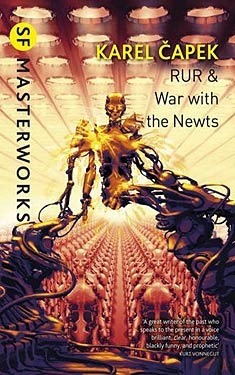
R.U.R. / War with the Newts
Two dystopian satires from one of the most distinguished writers of 20th-century European science fiction. R.U.R. is the work that first introduced the word 'robot' into popular usage.
Written against the background of the rise of Nazism, War With the Newts concerns the discovery in the South Pacific of a sea-dwelling race, which is enslaved and exploited by mankind. In time they rebel, laying siege to the strongholds of their former masters in a global war for supremacy.
R.U.R., or Rossum's Universal Robots, seen by many as a modern interpretation of the 'golem' myth, is regarded as the most important play in the history of SF. It introduced the word 'robot' and gave the genre one of its most enduring tropes.
Written against the background of the rise of Nazism, War With the Newts concerns the discovery in the South Pacific of a sea-dwelling race, which is enslaved and exploited by mankind. In time they rebel, laying siege to the strongholds of their former masters in a global war for supremacy.
R.U.R., or Rossum's Universal Robots, seen by many as a modern interpretation of the 'golem' myth, is regarded as the most important play in the history of SF. It introduced the word 'robot' and gave the genre one of its most enduring tropes.
349 pages, Paperback
First published January 1, 2011
About the author
Karel Čapek
622 books984 followersKarel Čapek is one of the the most influential Czech writers of the 20th century. He wrote with intelligence and humour on a wide variety of subjects. His works are known for their interesting and precise descriptions of reality, and Čapek is renowned for his excellent work with the Czech language. His play R.U.R. (Rossum's Universal Robots) first popularized the word "robot".
(Arabic: كارل تشابك) (Hebrew: קארל צ'אפק) (Japanese: 카렐 차페크) (Russian: Карел Чапек)
(Arabic: كارل تشابك) (Hebrew: קארל צ'אפק) (Japanese: 카렐 차페크) (Russian: Карел Чапек)
Ratings & Reviews
Friends & Following
Create a free account to discover what your friends think of this book!
Community Reviews
Displaying 1 - 30 of 62 reviews

Did Not Finish
October 14, 2022DNF'd at about page 95. Reread RUR, and it was fine, but decided War with the Newts was going to be a slog, with some really racist descriptions that I did not need in my brain.

May 24, 2012
I wish that *War with the Newts* had been printed on its own or that the play *RUR* had been positioned at the end of this book rather than the beginning. I think that casual browsers who pick up this book and turn the first few pages only to encounter a play from 1920 might be put off. After all, I am a voracious reader but I only rarely read plays. Plays are for performing and watching. This isn’t to say that *RUR* isn’t an important piece of work. It manifestly is.
But the novel that follows it, *War with the Newts*, is one of the finest political, social, economic and philosophical satires written during the 20th century. The story tells of how mankind becomes the agent of its own destruction thanks to greed and the unstoppable engines of big business . It’s partly also a satire against the rise of the Nazis (it was published in 1936). The writing is crisp, clever, funny, exquisite; and the structure of the novel, full of differing viewpoints and fake newspaper cuttings, is technically ingenious.
Čapek was one of the best writers from a small nation that produced a brace of phenomenal writers. For years I was discouraged from reading his works by disaparaging references made to him in an Isaac Asimov article. By chance, I read one of Čapek’s humorous travel articles in an anthology of Traveller’s Tales and I was immediately hooked by his engaging, comical and absurdist style. Asimov was wrong (as he was so often). Like Bulgakov, Karinthy and Zamyatin, Čapek is proof that 1920s and 1930s Continental European science-fiction and fantasy was the most advanced in the world at that time…
But the novel that follows it, *War with the Newts*, is one of the finest political, social, economic and philosophical satires written during the 20th century. The story tells of how mankind becomes the agent of its own destruction thanks to greed and the unstoppable engines of big business . It’s partly also a satire against the rise of the Nazis (it was published in 1936). The writing is crisp, clever, funny, exquisite; and the structure of the novel, full of differing viewpoints and fake newspaper cuttings, is technically ingenious.
Čapek was one of the best writers from a small nation that produced a brace of phenomenal writers. For years I was discouraged from reading his works by disaparaging references made to him in an Isaac Asimov article. By chance, I read one of Čapek’s humorous travel articles in an anthology of Traveller’s Tales and I was immediately hooked by his engaging, comical and absurdist style. Asimov was wrong (as he was so often). Like Bulgakov, Karinthy and Zamyatin, Čapek is proof that 1920s and 1930s Continental European science-fiction and fantasy was the most advanced in the world at that time…

March 28, 2024
R.U.R.: This is an amazing sci fi play, with serious overtones for capitalism--as applicable today as they were in 1920. The play revolves around a factory that manufactures robots, which are perhaps more like what we would today classify as androids. They are living beings, but manufactured to be workers without emotion, interpersonal connections, ambition, etc. The head of the factory, Harry Domin, dreams of a world in which human labor is abolished and people are free to live and pursue the higher elements of life. But the governments who buy the robots, the shareholders who fund the company, even those with whom Domin works are not idealists--they are capitalists and governments seeking to maintain their power. And Domin functions within a clearly capitalist system, in which the robots are seen as nothing but workers, without need for compassion or a "soul," as his wife Helena wants them to have. When Helena convinces Dr. Gall to alter the formula to make the Robots slightly more human, it precipitates a robot revolt against humanity, with the robots wiping out all humans except for Alquist, the head of works for the factory, who had refused to shoot them during the revolt. However, neither Alquist nor the robots know the formula to create new robots, and since they cannot reproduce sexually, the robots seem doomed by their twenty year life spans. While initially this is very much an anti-capitalist condemnation of the exploitation of labor (and it continues to be), by the end of the play Capek also warns against swinging to the other extreme--which for him as a central European in 1920 might be most visibly symbolized by the emerging Soviet State and the bloody chaos of the Russian civil war.
https://youtu.be/dsayddtbCZQ
War with the Newts: This is a complex sci fi novel, in that I'm not entirely clear which side Capek actually wants us to root for. Or, perhaps more specifically, this is often seen as an allegory for the rise of Nazism, but I'm not sure exactly which side are supposed to be the Nazis: the humans of the newts.
In the early portion of the novel, a sea captain discovers a race of salamanders on a remote island, which he makes a kind of contact with and then finds out that they can be great pearl fishers because they can swim through the oceans without needing to come up for air the way that human pearl divers do. Along with a businessman acquaintance, the captain seeds these salamanders throughout the Pacific islands and amasses a vast collection of pearls. However, after the captain dies, the businessman and his capitalist associates expand what the "newts" do, because they're tremendously skilled at underwater labor, and so the various companies and nations of the world begin hiring vast quantities of newts for underwater construction, the artificial expansion of coast lines, and even naval defense. In their treatment as an almost slave-like labor class, the newts are rather like the robots of RUR, except that they're organically occurring beings. As newts become more and more ubiquitous along the coastlines--and nations become more and more dependent on them--the newts become objects of scientific, philosophical, and artistic study, often involving quite brutal, torturous experiments (somewhat comparable to the worst excesses of Dr. Mengele or the Tuskegee syphilis study). But the "newt problem" also becomes a significant political issue, in terms of how the trade in newts is regulated, in terms of how the national forces of newts should interact, and in terms of what (if any) rights newts might have, and under what authority they might have those rights. Eventually, there are so many newts, and they are so well armed, trained, supplied, and fortified that they are able to destroy large tracts of the land, sinking it beneath the oceans to make room for themselves. The newt leader offers to pay for land, allowing humans to evacuate before it is made habitable for newts, but the nations of the world attempt to demur--a stance which doesn't serve them well, especially Britain, which actively tries (and fails) to fight the newts.
Throughout much of the novel, it seems like the humans are more closely aligned with Nazism, particularly in their virtual enslavement of what they see as an animal underclass and in their brutal "experiments" on the newts. However, by the end of the novel--and the actual newt organization and fight against the humans only takes up the last few chapters, maybe ten-fifteen percent of the novel--it is the newts who are taking territory essentially to produce living space, which was famously a Nazi ideological objective.
https://youtu.be/kEOIChFCKQM
https://youtu.be/dsayddtbCZQ
War with the Newts: This is a complex sci fi novel, in that I'm not entirely clear which side Capek actually wants us to root for. Or, perhaps more specifically, this is often seen as an allegory for the rise of Nazism, but I'm not sure exactly which side are supposed to be the Nazis: the humans of the newts.
In the early portion of the novel, a sea captain discovers a race of salamanders on a remote island, which he makes a kind of contact with and then finds out that they can be great pearl fishers because they can swim through the oceans without needing to come up for air the way that human pearl divers do. Along with a businessman acquaintance, the captain seeds these salamanders throughout the Pacific islands and amasses a vast collection of pearls. However, after the captain dies, the businessman and his capitalist associates expand what the "newts" do, because they're tremendously skilled at underwater labor, and so the various companies and nations of the world begin hiring vast quantities of newts for underwater construction, the artificial expansion of coast lines, and even naval defense. In their treatment as an almost slave-like labor class, the newts are rather like the robots of RUR, except that they're organically occurring beings. As newts become more and more ubiquitous along the coastlines--and nations become more and more dependent on them--the newts become objects of scientific, philosophical, and artistic study, often involving quite brutal, torturous experiments (somewhat comparable to the worst excesses of Dr. Mengele or the Tuskegee syphilis study). But the "newt problem" also becomes a significant political issue, in terms of how the trade in newts is regulated, in terms of how the national forces of newts should interact, and in terms of what (if any) rights newts might have, and under what authority they might have those rights. Eventually, there are so many newts, and they are so well armed, trained, supplied, and fortified that they are able to destroy large tracts of the land, sinking it beneath the oceans to make room for themselves. The newt leader offers to pay for land, allowing humans to evacuate before it is made habitable for newts, but the nations of the world attempt to demur--a stance which doesn't serve them well, especially Britain, which actively tries (and fails) to fight the newts.
Throughout much of the novel, it seems like the humans are more closely aligned with Nazism, particularly in their virtual enslavement of what they see as an animal underclass and in their brutal "experiments" on the newts. However, by the end of the novel--and the actual newt organization and fight against the humans only takes up the last few chapters, maybe ten-fifteen percent of the novel--it is the newts who are taking territory essentially to produce living space, which was famously a Nazi ideological objective.
https://youtu.be/kEOIChFCKQM

December 24, 2011
Karel Capek’s name may not be known that well outside the Czech Republic, though he has the distinction of being the originator of one of SF’s most endearing tropes – the word ‘robot’.
In this re-release we have two tales: the first is a script for Capek’s play which introduced us to that term, Rossum’s Universal Robots, or R.U.R., first published in 1920.
The second is a traditional novel. The War of the Newts was written in 1936, and though it may seem quite different to R.U.R., does have some common themes.
To be honest, RUR’s reputation beyond that of creating and using the word ‘robot’ is fairly unimpressive. What is interesting though is the fact that the robots in the play are not metal nor manufactured, as you would perhaps expect these days (and the cover rather misleadingly portrays), but are rather what we would these days call bio-engineered: that is, they are biological, created by biotechnology and, unlike R2-D2 or C-3PO, can be seen as human in appearance, even mistaken for human.
There are debates, as in Shelley’s Frankenstein, on the morality of such creatures and Science versus God along the way.
Other than that, the tale is one that is typical of its time, that of robots revolting in order to escape their slave-like existence whilst advocating freedom and independence. This was a common story-trope with the metal robots in the early days of pulp SF, as people felt intimidated by new technology. Asimov wrote his Robot stories as an alternate response to this idea of robots running amok.
Echoes of Metropolis (film, released 1927) are here.
War of the Newts follows a similar theme in that there is a revolution against oppression. This time the tale deals with an alien subspecies, an intelligent sea-dwelling race of newts, who rebel against slavery and exploitation and end up in a global war against the humans.
Though the book is titled War with the Newts, most of it deals with how the Newts were first met, how they became servile to humans and what led to the war, which actually only take up the last thirty-five pages or so. However when it does happen the war is both sad and weirdly affecting in that such catastrophic events are recounted in such a matter-of-fact manner. The last two sentences of the novel describes what must have been a common feeling at the time of writing: “And then?” “...Then I don’t know what comes next.” (page 349.)
The interesting thing for me here were the alien newts, who actually come across as tolerant, rational and quite sympathetic, perhaps even more so than the overbearing humans. The newts are clearly put into a situation that they feel is intolerable and the ensuing consequences are unfortunate but necessary. It may be that there are parallels here to Capek’s own life situation at the time. As a citizen of the Czech Republic in the mid-thirties they were experiencing the threat of Nazi occupation (which did occur in 1939.) It may not be that far-fetched to see the allegorical similarity between the Czech ‘newts’ and the Nazi ‘humans’ in this dystopian satire. Capek sadly died on December 25, 1938, of double pneumonia, shortly after part of Czechoslovakia was annexed by Nazi Germany.
All in all, an interesting read, though a book definitely of two halves. Capek is often ranked with Aldous Huxley and George Orwell. Though much less well known, on the strength of this it’s not hard to see why.
In this re-release we have two tales: the first is a script for Capek’s play which introduced us to that term, Rossum’s Universal Robots, or R.U.R., first published in 1920.
The second is a traditional novel. The War of the Newts was written in 1936, and though it may seem quite different to R.U.R., does have some common themes.
To be honest, RUR’s reputation beyond that of creating and using the word ‘robot’ is fairly unimpressive. What is interesting though is the fact that the robots in the play are not metal nor manufactured, as you would perhaps expect these days (and the cover rather misleadingly portrays), but are rather what we would these days call bio-engineered: that is, they are biological, created by biotechnology and, unlike R2-D2 or C-3PO, can be seen as human in appearance, even mistaken for human.
There are debates, as in Shelley’s Frankenstein, on the morality of such creatures and Science versus God along the way.
Other than that, the tale is one that is typical of its time, that of robots revolting in order to escape their slave-like existence whilst advocating freedom and independence. This was a common story-trope with the metal robots in the early days of pulp SF, as people felt intimidated by new technology. Asimov wrote his Robot stories as an alternate response to this idea of robots running amok.
Echoes of Metropolis (film, released 1927) are here.
War of the Newts follows a similar theme in that there is a revolution against oppression. This time the tale deals with an alien subspecies, an intelligent sea-dwelling race of newts, who rebel against slavery and exploitation and end up in a global war against the humans.
Though the book is titled War with the Newts, most of it deals with how the Newts were first met, how they became servile to humans and what led to the war, which actually only take up the last thirty-five pages or so. However when it does happen the war is both sad and weirdly affecting in that such catastrophic events are recounted in such a matter-of-fact manner. The last two sentences of the novel describes what must have been a common feeling at the time of writing: “And then?” “...Then I don’t know what comes next.” (page 349.)
The interesting thing for me here were the alien newts, who actually come across as tolerant, rational and quite sympathetic, perhaps even more so than the overbearing humans. The newts are clearly put into a situation that they feel is intolerable and the ensuing consequences are unfortunate but necessary. It may be that there are parallels here to Capek’s own life situation at the time. As a citizen of the Czech Republic in the mid-thirties they were experiencing the threat of Nazi occupation (which did occur in 1939.) It may not be that far-fetched to see the allegorical similarity between the Czech ‘newts’ and the Nazi ‘humans’ in this dystopian satire. Capek sadly died on December 25, 1938, of double pneumonia, shortly after part of Czechoslovakia was annexed by Nazi Germany.
All in all, an interesting read, though a book definitely of two halves. Capek is often ranked with Aldous Huxley and George Orwell. Though much less well known, on the strength of this it’s not hard to see why.
Read
August 7, 2025Good stuff!!! R.U.R made for an awesome comparison to Jurassic park for my English assignment :) War with the newts was boring me in the middle as I clearly wasn’t as passionate about the reproduction methods of newts as the author was but the end was really strong.
I always have trouble rating books that have as much depth and thought put into them as these two have so no rating for now.
I always have trouble rating books that have as much depth and thought put into them as these two have so no rating for now.

June 7, 2019
As a roboticist, I felt obliged to read R.U.R. as it is the first piece of literature where the term robot was introduced. The play is short but it is concise enough to portray the human nature in seeking for power even though it results with its own demise. The war the newts talks about the same topic with certain criticisms on world politicis. Authors like Capek are praised globally because their works are timeless.

December 6, 2022
It is disappointing that such a remarkable dystopian theatre play (R.U.R) and such an interesting dystopian novel (War With The Newts) are not read as much as the most famous dystopian works.
Primarily I believe that it's since it is Central European literature and, in turn, rather neglected.
Capek is an absolute must-read.
Primarily I believe that it's since it is Central European literature and, in turn, rather neglected.
Capek is an absolute must-read.

June 20, 2018
RUR: 4/5
War with the Newts: 1.5/5
War with the Newts: 1.5/5
September 15, 2026
Fortsatt aktuell
September 26, 2024
What, if any, is the danger in looking at every scientific discovery, technological innovation, or encounter with a new species primarily as a way to make a lot of money?
No one answers this question better than Čapek in two of his most famous works, R.U.R and War With The Newts.
R.U.R
Čapek coined the term 'Robot' in his play, R.U.R., although he was thinking of something quite different to the mechanical robots we have in mind today. Čapek's robots were biological and chemical in nature, perhaps reflecting the latest advancements of his time. In fact, Čapek even wrote a note to publicly clarify his position (“THE AUTHOR OF THE ROBOTS DEFENDS HIMSELF").
Overall, R.U.R, the short three-part play has not only stood the test of time, but arguably, its relevance in today's world, where Artificial Intelligence is gaining prominence, cannot be understated.
Rossum's Universal Robots (R.U.R), the company, is busy making biochemical robots, which are in great demand. The "Robots have no interest in life. They have no enjoyments. They are less than AI much grass. " The General Manager of R.U.R. is clear that these Robots have "... no will of their own. No passion. No soul." In the name of progress, the company continues to tinker with the Robots until they become just as intelligent and insecure as humans. The company continues to produce Robots even when governments start arming them. While others have regrets, the General Manager of R.U.R continues to justify himself. There are real lessons to be learnt here.
War With The Newts
"Ts, ts, ts. Nife. Nife, "says the Newt to the unsuspecting holiday maker, looking to get a knife off them. This is when things start to get out of hand!!
Dark humour does not get much better than the War With The Newts. These salamander-type creatures walk on hind legs, multiply extremely fast, and are quick learners to boot. They have been restricted to Devil's Bay, off the shores of a small island somewhere in the Pacific, until Captain van Toch decides to teach them how to use a knife to get pearls out of shells from the bottom of the sea. Having harvested all the pearls in Devil's Bay, Captain van Toch gets an old friend, an ultra-wealthy Captian of Industry, to fund his expeditions to other shores with the Newts, to harvest more pearls. No doubt, this operation grows so quickly that the price of pearls in the open market plummets. What to do now with all these Newts? The board members of this new organisation that had been formed to exploit the Newts have some excellent suggestions. Sell them, kill them, loan them, stop them from multiplying so fast ...
In the end, the Newts are put to building work under the sea, which they are particularly good at. In parallel, the Newts are being taught to read and write, and learn to do groundbreaking research, and advance in other spheres of intellect. Soon, however, they are even more Newts, and some governments arm them, well, because they want to protect them from other governments that have armed their Newts.
In parallel, the conscientious among us humans are arguing over whether Newts should be given rights (don't think so!), what religion should they follow (do they even have a soul?) and should they have their own country (no way!). Some counties argue that their Newts are superior to other Newts. Human-Newt government sponsored expert groups are formed (which end up debating such hefty topics as what is the correct scientific name that should be used for Newts globally).
But now there are too many Newts and they need space. Thanks to us, the rapid advancement of Newts in all spheres of life begins to create major headaches for humans!
Ring any alarms? Will Generative AI head this way? ChatGPTs? Artificial (General) Intelligence? Artificial (Super) Intelligence? Only time will tell!
This book is thoroughly enjoyable and in places laugh-out-loud-funny! Watch out for the Chapters 'The Yatch on the Lagoon' and 'The Yatch on the Lagoon continued'.
Finally, Čapek ingeniously finishes the book by talking to himself in the last chapter, 'The Author Talks with Himself.' "You are going to leave it at that?" The author's under voice was heard.
No one answers this question better than Čapek in two of his most famous works, R.U.R and War With The Newts.
R.U.R
Čapek coined the term 'Robot' in his play, R.U.R., although he was thinking of something quite different to the mechanical robots we have in mind today. Čapek's robots were biological and chemical in nature, perhaps reflecting the latest advancements of his time. In fact, Čapek even wrote a note to publicly clarify his position (“THE AUTHOR OF THE ROBOTS DEFENDS HIMSELF").
Overall, R.U.R, the short three-part play has not only stood the test of time, but arguably, its relevance in today's world, where Artificial Intelligence is gaining prominence, cannot be understated.
Rossum's Universal Robots (R.U.R), the company, is busy making biochemical robots, which are in great demand. The "Robots have no interest in life. They have no enjoyments. They are less than AI much grass. " The General Manager of R.U.R. is clear that these Robots have "... no will of their own. No passion. No soul." In the name of progress, the company continues to tinker with the Robots until they become just as intelligent and insecure as humans. The company continues to produce Robots even when governments start arming them. While others have regrets, the General Manager of R.U.R continues to justify himself. There are real lessons to be learnt here.
War With The Newts
"Ts, ts, ts. Nife. Nife, "says the Newt to the unsuspecting holiday maker, looking to get a knife off them. This is when things start to get out of hand!!
Dark humour does not get much better than the War With The Newts. These salamander-type creatures walk on hind legs, multiply extremely fast, and are quick learners to boot. They have been restricted to Devil's Bay, off the shores of a small island somewhere in the Pacific, until Captain van Toch decides to teach them how to use a knife to get pearls out of shells from the bottom of the sea. Having harvested all the pearls in Devil's Bay, Captain van Toch gets an old friend, an ultra-wealthy Captian of Industry, to fund his expeditions to other shores with the Newts, to harvest more pearls. No doubt, this operation grows so quickly that the price of pearls in the open market plummets. What to do now with all these Newts? The board members of this new organisation that had been formed to exploit the Newts have some excellent suggestions. Sell them, kill them, loan them, stop them from multiplying so fast ...
In the end, the Newts are put to building work under the sea, which they are particularly good at. In parallel, the Newts are being taught to read and write, and learn to do groundbreaking research, and advance in other spheres of intellect. Soon, however, they are even more Newts, and some governments arm them, well, because they want to protect them from other governments that have armed their Newts.
In parallel, the conscientious among us humans are arguing over whether Newts should be given rights (don't think so!), what religion should they follow (do they even have a soul?) and should they have their own country (no way!). Some counties argue that their Newts are superior to other Newts. Human-Newt government sponsored expert groups are formed (which end up debating such hefty topics as what is the correct scientific name that should be used for Newts globally).
But now there are too many Newts and they need space. Thanks to us, the rapid advancement of Newts in all spheres of life begins to create major headaches for humans!
Ring any alarms? Will Generative AI head this way? ChatGPTs? Artificial (General) Intelligence? Artificial (Super) Intelligence? Only time will tell!
This book is thoroughly enjoyable and in places laugh-out-loud-funny! Watch out for the Chapters 'The Yatch on the Lagoon' and 'The Yatch on the Lagoon continued'.
Finally, Čapek ingeniously finishes the book by talking to himself in the last chapter, 'The Author Talks with Himself.' "You are going to leave it at that?" The author's under voice was heard.

December 13, 2022
Karel Čapek is a writer who deserves to be more well known around the globe.
R.U.R might be old, but it is still fresh—it not only introduces the word "robot" but also asks timeless questions about humanity and life. I seldom read plays (they're meant to be watched, not read) and this one blew me mind.
War with the Newts is right up there with Animal Farm and should be recognized as one of the greatest works of satire ever written. Čapek, ever the erudite cosmopolitan, takes us around the globe and satirizes everything on the way. It's funny, mad, sad, and unnerving at the same time. Absolutely brilliant.
R.U.R might be old, but it is still fresh—it not only introduces the word "robot" but also asks timeless questions about humanity and life. I seldom read plays (they're meant to be watched, not read) and this one blew me mind.
War with the Newts is right up there with Animal Farm and should be recognized as one of the greatest works of satire ever written. Čapek, ever the erudite cosmopolitan, takes us around the globe and satirizes everything on the way. It's funny, mad, sad, and unnerving at the same time. Absolutely brilliant.

November 15, 2011
Karel Čapek (1890-1938) was the Czech writer whose 1920 play R.U.R. (Rossum’s Universal Robots) introduced the word ‘robot’ (originally meaning serf or forced labour) to the English language. Rossum’s Robots – they would be called androids today – were created from protoplasm in order to perform all sorts of menial and repetitive tasks, liberating human beings from toil and bringing in an earthly paradise. Inevitably the mass-production of Robots and the low cost of using them lead to their employment in many other ways. They become indispensable to some and impossible to work with for others. Gradually some Robots are improved to be more like humans and to seek to be treated like them – and so the Robots learn to hate their creators. ‘...They couldn’t hate us if they were only a little more human.’ / ‘Nobody can hate man more than man.’
The context of War with the Newts (1936) was the rise of National Socialism in Germany and the political insecurity of the inter-war years in Europe and throughout the world in general. The Newts are a newly discovered race of amphibious creatures which is taught to work for humans and exploited in order to exploit the resources of the sea. Newts can only live in shallow coastal waters, so vast colonies develop as the Newt population expands. The Newts’ situation soon becomes a source of tension for many people, with some advocating the granting of full rights, while others wish them to be suppressed entirely. Meanwhile the Newts labour at their allotted tasks, but no-one really knows what they are doing under the sea. And then the earthquakes begin, with the inundation of large areas of coastline and low-lying land allowing the Newts to expand at the expense of the inhabitants of the land.
Both R.U.R. and War with the Newts look at the unintended consequences of ‘progress’ and mankind’s manipulation of nature, and how mankind’s institutions rise (or don’t) to the new realities they and the race have to deal with. But while Čapek certainly did have a serious intent behind his work, this shouldn’t obscure their ironic wit and gentle wisdom (especially in War with the Newts). Both are tragic stories, but even in a world where nothing is secure it is yet possible for people to perform acts of humanity and meet the end with a wry smile. There are worse ways to go, as Čapek himself would undoubtedly have found out if he hadn’t died when he did.
The context of War with the Newts (1936) was the rise of National Socialism in Germany and the political insecurity of the inter-war years in Europe and throughout the world in general. The Newts are a newly discovered race of amphibious creatures which is taught to work for humans and exploited in order to exploit the resources of the sea. Newts can only live in shallow coastal waters, so vast colonies develop as the Newt population expands. The Newts’ situation soon becomes a source of tension for many people, with some advocating the granting of full rights, while others wish them to be suppressed entirely. Meanwhile the Newts labour at their allotted tasks, but no-one really knows what they are doing under the sea. And then the earthquakes begin, with the inundation of large areas of coastline and low-lying land allowing the Newts to expand at the expense of the inhabitants of the land.
Both R.U.R. and War with the Newts look at the unintended consequences of ‘progress’ and mankind’s manipulation of nature, and how mankind’s institutions rise (or don’t) to the new realities they and the race have to deal with. But while Čapek certainly did have a serious intent behind his work, this shouldn’t obscure their ironic wit and gentle wisdom (especially in War with the Newts). Both are tragic stories, but even in a world where nothing is secure it is yet possible for people to perform acts of humanity and meet the end with a wry smile. There are worse ways to go, as Čapek himself would undoubtedly have found out if he hadn’t died when he did.

December 31, 2013
"The questions runs: Is and has man ever been capable of happiness?? A man, certainly, like every other living creature; but mankind not. All unhappiness of the man lies in the fact that he was compelled to become mankind, or that he became mankind too late, after he had already been irrevocably divided into nations, races, faiths, professions, and classes, into rich and poop, into educated and uneducated, into the rulers and the ruled..."Pg299 War with Newts
It's rare to find something as profound and unique as War with the Newts. RUR is an interesting play from the 1920s and the first recorded mention of the term "robot". The real gem in this collection is War with the Newts. It's clever in the most dark and disturbing way. The Newts; a species of giant salamander which we allow to take over our world for economic gains. We educate the Newt, train them as slaves and then we arm them with weapons. The social undertones of this piece never dull the intensity of the narrative. The gross attention to detail and Capek's crystal-clear vision of our world post-Newts is rich and complex. This could be a great sci-fi movie and it reminds me of the Planet of the Apes. The novel is labeled "SF Masterworks" on the cover and I have to agree.
It's rare to find something as profound and unique as War with the Newts. RUR is an interesting play from the 1920s and the first recorded mention of the term "robot". The real gem in this collection is War with the Newts. It's clever in the most dark and disturbing way. The Newts; a species of giant salamander which we allow to take over our world for economic gains. We educate the Newt, train them as slaves and then we arm them with weapons. The social undertones of this piece never dull the intensity of the narrative. The gross attention to detail and Capek's crystal-clear vision of our world post-Newts is rich and complex. This could be a great sci-fi movie and it reminds me of the Planet of the Apes. The novel is labeled "SF Masterworks" on the cover and I have to agree.
May 16, 2015
I really enjoyed 'R.U.R.'. It surely is a naïve play with a simplistic plot and one-dimensional characters but, it's playful, witty, fun and highly entertaining. I don't know if Capek wanted here to raise an alarm or if, on the contrary, he just wanted to dabble and amuse himself with the usual technophobic fears. In any case he managed to pack into a few pages and in a fun way some serious questions about technological progress, its means, and possible (I personally don't think so, but?) consequences. Here are indeed some clever darts being thrown around and, it would be a pity to miss such a read.
'War with the Newts' is in the same vein -an humour both dark and plain silly serving an intelligent satire. Written during the rise of Nazism and its obsession with 'lebensraum', it's also a merciless slap into greed's face and what capitalism's worst aspects have to offer. The human race itself is here not portrayed kindly! It's too long at times but, Capek had so much fun writing it (it feels on every page!) that it always remains entertaining.
Don't be fooled by its omnipresent humour (at turns dark or quite childish), here's the work of a writer who knows how to make his readers laugh while, at the same time, giving them food for thoughts. Highly recommended!
'War with the Newts' is in the same vein -an humour both dark and plain silly serving an intelligent satire. Written during the rise of Nazism and its obsession with 'lebensraum', it's also a merciless slap into greed's face and what capitalism's worst aspects have to offer. The human race itself is here not portrayed kindly! It's too long at times but, Capek had so much fun writing it (it feels on every page!) that it always remains entertaining.
Don't be fooled by its omnipresent humour (at turns dark or quite childish), here's the work of a writer who knows how to make his readers laugh while, at the same time, giving them food for thoughts. Highly recommended!

November 26, 2013
I think this guy is just a luddite, theres nothing wrong with a robot or newt doing all the work so I can sit around doing nothing all day

June 19, 2022
In het voorwoord bij het SF toneelstuk ‘R.U.R.’ staat vermeld dat er aan het einde van de 19e eeuw drie van de belangrijke schrijvers van een generatie geboren werden binnen het tijdsbestek van een paar jaar tijd en op luttele kilometers van elkaar. Een van hen was Franz Kafka, geboren in Praag in 1883, die zo verschroeiend goed schreef dat hij het in de honderd jaar die volgden op zijn overlijden zelfs tot adjectief wist te schoppen. Hoewel Kafka’s verhalen stijf staan van de fantastische elementen - denk maar aan de foltermachine die de naam van de misdaad op het lichaam van veroordeelden kerft in ‘In de Strafkolonie’ of aan Gregor Samsa die transformeert van mens tot kever in de Metamorfose - denken weinigen aan hem als SF schrijver.
Nog dichter bij de realiteit staat de in datzelfde jaar geboren Boheemse bohemien Jaroslav Hašek, die met zijn ‘De lotgevallen van de brave soldaat Švejk’ een van de eerste grote romans ‘van onderuit’ neerschreef. Hašek was er vlak na de eerste wereldoorlog in geslaagd om met 'Švejk' een hoofdpersonage op te voeren dat (net als zijn schepper zelf trouwens) louter door de manier waarop hij in het leven staat, de volledige gevestigde orde in hun hemd wist te zetten. Sinds hij mij van harte werd aanbevolen door de ondertussen al enige tijd overleden Jaap Kruithof behoort Hašek tot mijn favoriete schrijvers.
De derde auteur uit dit wonderlijke drietal is Karel Čapek. Het zou te makkelijk zijn om zijn palmares te reduceren tot datgene waarvoor hij vandaag het best gekend is: namelijk de introductie van het woord ‘Robot’ aan de wereld. Toch is de keuze van dat woord op zich bijzonder al betekenisvol geweest. Het is afgeleid van het Tsjechische ‘robota’, wat staat voor de gedwongen arbeid van lijfeigenen. In het verhaal van Čapek krijgt het woord vanaf de start een politieke lading, een vector die wijst in de richting van een opstand.
In R.U.R. worden ergens rond het jaar 2000 op industriële schaal artificiële mensen geproduceerd door het concern ‘Rossum’s Universele Robots’. Deze androïden worden gewonnen uit de manipulatie van ‘protoplasma’. In vaten worden levers, hersenen, skeletten en huid gebrouwen die vervolgens in talrijke fabrieken worden geassembleerd tot willoze mensachtige wezens. Het stuk is een drie-akter met epiloog en het verhaal gaat aan een rotvaart vooruit. De wetenschappelijke nieuwsgierigheid die de formule voor het proces voortbracht wordt snel gekaapt door technologische ijver die op haar beurt word ingeschakeld ten behoeve van enorme financiële belangen. Een opflakkering van humanistische bezwaren bij de behandeling van de robots wordt snel weggesust waardoor niets nog de lont van het kruivat kan weghouden.
Waar Kafka voornamelijk de menselijk conditie op de korrel neemt - een vrij veilige vorm van verzet - schieten Hašek en Čapek met scherp op de misstanden in het maatschappijmodel van hun tijd. Daarbij kijkt Hašek vooral achterom. Met zijn geveinsde onwetendheid pootjelapt hij de met linten en medailles behangen ijzervreters van de zieltogende Oostenrijk-Hongaarse dubbelmonarchie, terwijl deze een eindeloze stoet sukkelaars in de richting van een naamloos graf laten marcheren voor hun tinnen idealen.
Maar het is Čapek voor wie de gevaarlijkste taak is weggelegd. Hij richt zich op de gruwelen die nog in het verschiet liggen. De thema's die door Čapek en zijn broer Josef - waarmee hij vaak samenwerkte, werden aangesneden - raakten in de jaren 1930 een gevoelige zenuw bij de Nazi's. Dit werd enkel versterkt wanneer er een Hitlerfiguur opduikt in het satirische vervolgverhaal 'War with the Newts' dat in de loop van de jaren 1930 verscheen. Karel slaagde er op slinkse wijze in uit hun klauwen te ontsnappen voor het derde rijk Praag overspoelde, door in 1938 plots te sterven aan een longontsteking. De gestapo moest dus noodgedwongen genoegen nemen met de arrestatie van zijn broer die in 1945 stierf in Belsen.
Die verbondenheid tussen SF en politiek is geen toevalligheid en ik zal er in verdere delen nog vaak op terugkomen. Ieder verhaal dat zich in een verre toekomst of een alternatieve werkelijkheid afspeelt krijgt al gauw de vorm van ofwel een voorspelling of een waarschuwing. Zelfs een audiovisuele slagroomtaart als Star Wars draagt een duidelijke ideologische stempel - denk maar aan het overdonderende applaus wanneer Palpatine zichzelf tot keizer uitroept in de galactische senaat. Of wat te maken van de romans van Ayn Rand. Misschien was zij wel de meest invloedrijke SF auteur van onze tijd?
Nog dichter bij de realiteit staat de in datzelfde jaar geboren Boheemse bohemien Jaroslav Hašek, die met zijn ‘De lotgevallen van de brave soldaat Švejk’ een van de eerste grote romans ‘van onderuit’ neerschreef. Hašek was er vlak na de eerste wereldoorlog in geslaagd om met 'Švejk' een hoofdpersonage op te voeren dat (net als zijn schepper zelf trouwens) louter door de manier waarop hij in het leven staat, de volledige gevestigde orde in hun hemd wist te zetten. Sinds hij mij van harte werd aanbevolen door de ondertussen al enige tijd overleden Jaap Kruithof behoort Hašek tot mijn favoriete schrijvers.
De derde auteur uit dit wonderlijke drietal is Karel Čapek. Het zou te makkelijk zijn om zijn palmares te reduceren tot datgene waarvoor hij vandaag het best gekend is: namelijk de introductie van het woord ‘Robot’ aan de wereld. Toch is de keuze van dat woord op zich bijzonder al betekenisvol geweest. Het is afgeleid van het Tsjechische ‘robota’, wat staat voor de gedwongen arbeid van lijfeigenen. In het verhaal van Čapek krijgt het woord vanaf de start een politieke lading, een vector die wijst in de richting van een opstand.
In R.U.R. worden ergens rond het jaar 2000 op industriële schaal artificiële mensen geproduceerd door het concern ‘Rossum’s Universele Robots’. Deze androïden worden gewonnen uit de manipulatie van ‘protoplasma’. In vaten worden levers, hersenen, skeletten en huid gebrouwen die vervolgens in talrijke fabrieken worden geassembleerd tot willoze mensachtige wezens. Het stuk is een drie-akter met epiloog en het verhaal gaat aan een rotvaart vooruit. De wetenschappelijke nieuwsgierigheid die de formule voor het proces voortbracht wordt snel gekaapt door technologische ijver die op haar beurt word ingeschakeld ten behoeve van enorme financiële belangen. Een opflakkering van humanistische bezwaren bij de behandeling van de robots wordt snel weggesust waardoor niets nog de lont van het kruivat kan weghouden.
Waar Kafka voornamelijk de menselijk conditie op de korrel neemt - een vrij veilige vorm van verzet - schieten Hašek en Čapek met scherp op de misstanden in het maatschappijmodel van hun tijd. Daarbij kijkt Hašek vooral achterom. Met zijn geveinsde onwetendheid pootjelapt hij de met linten en medailles behangen ijzervreters van de zieltogende Oostenrijk-Hongaarse dubbelmonarchie, terwijl deze een eindeloze stoet sukkelaars in de richting van een naamloos graf laten marcheren voor hun tinnen idealen.
Maar het is Čapek voor wie de gevaarlijkste taak is weggelegd. Hij richt zich op de gruwelen die nog in het verschiet liggen. De thema's die door Čapek en zijn broer Josef - waarmee hij vaak samenwerkte, werden aangesneden - raakten in de jaren 1930 een gevoelige zenuw bij de Nazi's. Dit werd enkel versterkt wanneer er een Hitlerfiguur opduikt in het satirische vervolgverhaal 'War with the Newts' dat in de loop van de jaren 1930 verscheen. Karel slaagde er op slinkse wijze in uit hun klauwen te ontsnappen voor het derde rijk Praag overspoelde, door in 1938 plots te sterven aan een longontsteking. De gestapo moest dus noodgedwongen genoegen nemen met de arrestatie van zijn broer die in 1945 stierf in Belsen.
Die verbondenheid tussen SF en politiek is geen toevalligheid en ik zal er in verdere delen nog vaak op terugkomen. Ieder verhaal dat zich in een verre toekomst of een alternatieve werkelijkheid afspeelt krijgt al gauw de vorm van ofwel een voorspelling of een waarschuwing. Zelfs een audiovisuele slagroomtaart als Star Wars draagt een duidelijke ideologische stempel - denk maar aan het overdonderende applaus wanneer Palpatine zichzelf tot keizer uitroept in de galactische senaat. Of wat te maken van de romans van Ayn Rand. Misschien was zij wel de meest invloedrijke SF auteur van onze tijd?

February 1, 2025
This combined volume of Czech author Karel Capek's two most famous works, RUR & War with the Newts is an important text for students and fans of science fiction, in that the former work is noted for its coining of the term 'robots', and the latter is a substantial novel in the apocalyptic/dystopian sub-genre. At times reminiscent of H.G. Wells and Aldous Huxley, both of these texts are somewhat bleak in their outlook and black in their humour in their depiction of humanity. Underpinned by a severe criticism of greed as a component of capitalism and an intense dislike for totalitarian belief systems (specifically Nazism), each of these works are still relevant to a contemporary, 21st Century audience. Capek's musing on the self-destructive possibilities of modern societies, informed by the exploitation of science and economic imperatives, creating dystopias where an underclass eventually annihilate those who created them, is pertinent today when we are rapidly surgng past the point of no return with our reliance on A.I. and cyberspace. Capek's play and novel remind one of more recent works such as 'Battlestar Galactica' and 'The Terminator' franchise, thus illustrating how important the author's work is today.
The first text in this volume, the play 'R.U.R.' is perhaps not as good as the second, the novel The War with the Newts. As per any theatrical text reading the play's lines doesn't allow for a complete engagement with the work. Additionally, the brevity of the play's narrative and the rather shallow development of the characters' personalities emphasises the artificiality of what Capek presents. A key plot point is that in the world of 'R.U.R.' humans lose the ability to reproduce, and there is simply no explanation of the reason for this. Whilst one can suspend belief, in a fictional work that is reliant on the conventions of science fiction one expects there to be some logical reason for such a significant event.
There are some redeeming aspects of 'R.U.R.' that deserve recognition. The most notable one that I'll reference here is the depiction of the robots not as simplistic mechanical constructs, but instead are biological approximations of humanity. Through this novel approach to the creation of the robots Capek emphasises their allegorical relationship with the poor, the inidgent, the exploited. Those that rely on the robots for the creation of capital and wealth, or as a means to validate their ideals, are seen to be just as inhumane as those that created an underclass through the development of excess ive capitalism. That the robots overthrow and destroy humanity is a barely concealed metaphor for the potential for revolution, and that within that act the exploited become responsible for their own destruction, is a complex and intriguing intellectual construct. That Capek ends the play with an optimistic scene that nominally reaffirms human values, if not humanity, belies the author's inability to be too dark, too doom-laden in his tone.
War With the Newts is in my opinion the better of the two works in this volume because the fictional construct of the novel is more comprehensive in its ideas, language, characetrisations and plot. Written in a form that reminds one of a fictional history, with multiple perspectives and characters, and applying prose styles ranging from academic papers, personal memoirs to comic novels and beyond, Capek's fiction is reminiscent of works such as H.G. Wells' Food of the Gods or Tono-Bungay.
The first text in this volume, the play 'R.U.R.' is perhaps not as good as the second, the novel The War with the Newts. As per any theatrical text reading the play's lines doesn't allow for a complete engagement with the work. Additionally, the brevity of the play's narrative and the rather shallow development of the characters' personalities emphasises the artificiality of what Capek presents. A key plot point is that in the world of 'R.U.R.' humans lose the ability to reproduce, and there is simply no explanation of the reason for this. Whilst one can suspend belief, in a fictional work that is reliant on the conventions of science fiction one expects there to be some logical reason for such a significant event.
There are some redeeming aspects of 'R.U.R.' that deserve recognition. The most notable one that I'll reference here is the depiction of the robots not as simplistic mechanical constructs, but instead are biological approximations of humanity. Through this novel approach to the creation of the robots Capek emphasises their allegorical relationship with the poor, the inidgent, the exploited. Those that rely on the robots for the creation of capital and wealth, or as a means to validate their ideals, are seen to be just as inhumane as those that created an underclass through the development of excess ive capitalism. That the robots overthrow and destroy humanity is a barely concealed metaphor for the potential for revolution, and that within that act the exploited become responsible for their own destruction, is a complex and intriguing intellectual construct. That Capek ends the play with an optimistic scene that nominally reaffirms human values, if not humanity, belies the author's inability to be too dark, too doom-laden in his tone.
War With the Newts is in my opinion the better of the two works in this volume because the fictional construct of the novel is more comprehensive in its ideas, language, characetrisations and plot. Written in a form that reminds one of a fictional history, with multiple perspectives and characters, and applying prose styles ranging from academic papers, personal memoirs to comic novels and beyond, Capek's fiction is reminiscent of works such as H.G. Wells' Food of the Gods or Tono-Bungay.

December 2, 2024
5 start for the novel; 4 stars for the play.
Review of War with the Newts (Dec. 2, 2024)
This is a terrific work that is probably overlooked because of the title. It frames within a speculative fiction genre themes of colonialization, slavery, racism, military arms races, capitalism, communism, political obfuscation and the human greed that underlines most of that. The humor here, and the well-managed pacing and method of narration which even offers fictitious news clippings, scientific papers, and more, is not just smooth and effective, but also holds up immensely well for its age. Frankly, I think it's the tongue-in-cheek selection of newts/salamanders as the "other" here that has limited this book's broad appeal to a public that demands scary and shocking aliens more than witty and thoughtful, though it fits perfectly well within the satirical style of the book itself. I also think the coda at the end purportedly in the voice of the author is a nice little touch, providing possibly the best quote in the work:
And coincidentally for me, it's the second book in a row with references to Jack London and Joseph Conrad, which always brings a smile, as well as using the small town of New Iberia, Louisiana for a highlight of one chapter, which is where my grandfather was born.
Review of R.U.R. (Nov. 22, 2020)
This earns praise for injecting the word "Robot" into world usage and for being one of the earlier entries in the world of science-fiction (this plot presages the film version of iRobot, without the happy ending), but unfortunately it is very short on the science, and long on the melodrama. It reads like something from a lesser British stage drama or film from the period between the wars, with zero character development but lots of banter from quirky types, all with stiff upper lips (except the pearl-clutching heroine, of course). Even Domin, who is conceivably one of the most evil, genocidal characters ever to grace the stage (he literately wants each nation to build their own robots, then teach them man's prejudices against he other, so that they will hate and fight every other countries' robots), is given blustery bonhomie and gee-whiz treatment as if he's a leading man (reminding me a bit of the Carl Denham character in the '33 King Kong). I honestly pictured everything in black and white, with the men all wearing tuxedos or tweeds and having moustaches.
It is an easy, though quirky, read, that is well worth it for the historical aspect and a few decent quotes (which is why I gave it a generous four stars - absent which it would have been hard to justify more than two and a half). No doubt, were I reading this when it was written (it was first published exactly 100 years ago) I would surely have given it five stars.
Review of War with the Newts (Dec. 2, 2024)
This is a terrific work that is probably overlooked because of the title. It frames within a speculative fiction genre themes of colonialization, slavery, racism, military arms races, capitalism, communism, political obfuscation and the human greed that underlines most of that. The humor here, and the well-managed pacing and method of narration which even offers fictitious news clippings, scientific papers, and more, is not just smooth and effective, but also holds up immensely well for its age. Frankly, I think it's the tongue-in-cheek selection of newts/salamanders as the "other" here that has limited this book's broad appeal to a public that demands scary and shocking aliens more than witty and thoughtful, though it fits perfectly well within the satirical style of the book itself. I also think the coda at the end purportedly in the voice of the author is a nice little touch, providing possibly the best quote in the work:
Must Nature always be asked to straighten out the mess that man has made?
And coincidentally for me, it's the second book in a row with references to Jack London and Joseph Conrad, which always brings a smile, as well as using the small town of New Iberia, Louisiana for a highlight of one chapter, which is where my grandfather was born.
Review of R.U.R. (Nov. 22, 2020)
This earns praise for injecting the word "Robot" into world usage and for being one of the earlier entries in the world of science-fiction (this plot presages the film version of iRobot, without the happy ending), but unfortunately it is very short on the science, and long on the melodrama. It reads like something from a lesser British stage drama or film from the period between the wars, with zero character development but lots of banter from quirky types, all with stiff upper lips (except the pearl-clutching heroine, of course). Even Domin, who is conceivably one of the most evil, genocidal characters ever to grace the stage (he literately wants each nation to build their own robots, then teach them man's prejudices against he other, so that they will hate and fight every other countries' robots), is given blustery bonhomie and gee-whiz treatment as if he's a leading man (reminding me a bit of the Carl Denham character in the '33 King Kong). I honestly pictured everything in black and white, with the men all wearing tuxedos or tweeds and having moustaches.
It is an easy, though quirky, read, that is well worth it for the historical aspect and a few decent quotes (which is why I gave it a generous four stars - absent which it would have been hard to justify more than two and a half). No doubt, were I reading this when it was written (it was first published exactly 100 years ago) I would surely have given it five stars.
May 16, 2026
R.U.R. by Karel Kapek is ranked 7154th on The Greatest Books of All Time web page, where War With The Newts by the same author is in a much better position at 756 – you have thousands of reviews on magnum opera from The GOAT and other sites on my blog https://realinibarzoi.blogspot.com/20... and YouTube channel, where you see my macaws
6 out of 10
I have listened to this play before https://realinibarzoi.blogspot.com/20... and I have not been thrilled, indeed, there are two reasons to hear it again, and write a note: first, George Constantin, a thespian as good as Jack Nicholson or any other, is in it and to enjoy his voice is a treat
Second, we have been under the threat of AI for some time, and this RUR is about robots and what will happen with them, will they have rights, maybe they will rebel, there have been many incidents where AI – which for practical purposes we can exchange for robots – have been hallucinating, using offensive, racist language
We have had motion pictures on the subject of what to expect from the interaction between humans and Artificial Intelligence https://realinibarzoi.blogspot.com/20... Her, written and directed by Spike Jonze comes to mind, the hero falls in love with an Operating System
And then we have a mass migration towards this, hoi polloi find themselves trapped in the same mirage, and this has happened in reality, though it is not a wide spread phenomenon – there are other problems associated with the rise of AI, massive unemployment for one, even if it is not feasible to get paranoid and gloomy
The counterargument uses history: people panicked when the automobile gained ground, for what would happen to all the carriage drivers – they lost their jobs – but then you could not stop progress, and we would be so much worse off, had the cars been banned somehow, so there are gains and then loses, a good read would be
Why The West Rules For Now https://realinibarzoi.blogspot.com/20... by Ian Morris gives us the history, but we also have a look into the future, the theory of Singularity is explained, the notion that AI, or a computer would become smarter than the whole humanity by 2035
It is not exactly what you get in the book, I have qualms about what I just said, but the point is AI is very advanced, they had this system – was it Mythos? – which is kept unavailable, actually, they have released it to a limited number of customers, which is too powerful, it can be dangerous in that it can hack into…well, anything
Then they had this dispute, the thing called the War Department now had a quarrel with Anthropic (again, it may be one of the other ones) and put them on the list of foes, because the company would not agree to have AI used on missiles, or something like that, be involved in killing people, but then what do you expect from Confidence Man https://realinibarzoi.blogspot.com/20...
6 out of 10
I have listened to this play before https://realinibarzoi.blogspot.com/20... and I have not been thrilled, indeed, there are two reasons to hear it again, and write a note: first, George Constantin, a thespian as good as Jack Nicholson or any other, is in it and to enjoy his voice is a treat
Second, we have been under the threat of AI for some time, and this RUR is about robots and what will happen with them, will they have rights, maybe they will rebel, there have been many incidents where AI – which for practical purposes we can exchange for robots – have been hallucinating, using offensive, racist language
We have had motion pictures on the subject of what to expect from the interaction between humans and Artificial Intelligence https://realinibarzoi.blogspot.com/20... Her, written and directed by Spike Jonze comes to mind, the hero falls in love with an Operating System
And then we have a mass migration towards this, hoi polloi find themselves trapped in the same mirage, and this has happened in reality, though it is not a wide spread phenomenon – there are other problems associated with the rise of AI, massive unemployment for one, even if it is not feasible to get paranoid and gloomy
The counterargument uses history: people panicked when the automobile gained ground, for what would happen to all the carriage drivers – they lost their jobs – but then you could not stop progress, and we would be so much worse off, had the cars been banned somehow, so there are gains and then loses, a good read would be
Why The West Rules For Now https://realinibarzoi.blogspot.com/20... by Ian Morris gives us the history, but we also have a look into the future, the theory of Singularity is explained, the notion that AI, or a computer would become smarter than the whole humanity by 2035
It is not exactly what you get in the book, I have qualms about what I just said, but the point is AI is very advanced, they had this system – was it Mythos? – which is kept unavailable, actually, they have released it to a limited number of customers, which is too powerful, it can be dangerous in that it can hack into…well, anything
Then they had this dispute, the thing called the War Department now had a quarrel with Anthropic (again, it may be one of the other ones) and put them on the list of foes, because the company would not agree to have AI used on missiles, or something like that, be involved in killing people, but then what do you expect from Confidence Man https://realinibarzoi.blogspot.com/20...

January 7, 2023
This was a really interesting, and honestly entertaining read. War With The Newts especially is an incredible piece of literature; never have I read something that has made me so physically queasy and yet has made me laugh so hard. Some things I enjoyed thinking about in reading these in succession:
Capek seems very much occupied with the philosophy of labour, which absolutely makes sense given RUR written in 1920 and War With The Newts in the 30s, we were seeing increased automation. I take these two stories to be driven partially by a fear that humanity's drive to find a workforce to allow us to reduce our own work will be punished in some way, which isn't a philosophy that matches my own but it was still a fantastic driving force for interesting stories, especially for the newts
I found both also presented both humanity's laziness and art as being useless to capitalism, as of course the robots and newts both thrived under capitalist society without these two things, and they're the things that we are sorriest to lose. Humans try and to teach culture & art to newts, and the robots' drive to rebel was driven by programming to bring them closer to human
I also thought it interesting to compare the differences between the humanity of the robots and the humanity of the newts based on the historical context. For RUR, it's incredibly straightforward as a response to the two 1917 Russian revolutions. Any beings with intelligence and feeling will inevitably make use of their strength and numbers to fight back against being used as labour and soldiers. For the newts, two of the very present global actors are the German Nazis and the British Empire. Greed for money holds less sway than greed for land: one of the biggest changes with a newt workforce is the creation of new islands and continents, and when the war hits, for Britain there is no price that can be placed on its land. The newts don't seem to understand this pride over land: as the last chapter worries over, the lack of the newts' geographical conflict is a primary factor in their success as a species
I only finished it last night so the above thoughts are not yet matured, but it was an incredible book for food for thought, and I would absolutely recommend it to anybody. This is exactly what sci fi should be: incredibly and unrelentingly philosophical
Capek seems very much occupied with the philosophy of labour, which absolutely makes sense given RUR written in 1920 and War With The Newts in the 30s, we were seeing increased automation. I take these two stories to be driven partially by a fear that humanity's drive to find a workforce to allow us to reduce our own work will be punished in some way, which isn't a philosophy that matches my own but it was still a fantastic driving force for interesting stories, especially for the newts
I found both also presented both humanity's laziness and art as being useless to capitalism, as of course the robots and newts both thrived under capitalist society without these two things, and they're the things that we are sorriest to lose. Humans try and to teach culture & art to newts, and the robots' drive to rebel was driven by programming to bring them closer to human
I also thought it interesting to compare the differences between the humanity of the robots and the humanity of the newts based on the historical context. For RUR, it's incredibly straightforward as a response to the two 1917 Russian revolutions. Any beings with intelligence and feeling will inevitably make use of their strength and numbers to fight back against being used as labour and soldiers. For the newts, two of the very present global actors are the German Nazis and the British Empire. Greed for money holds less sway than greed for land: one of the biggest changes with a newt workforce is the creation of new islands and continents, and when the war hits, for Britain there is no price that can be placed on its land. The newts don't seem to understand this pride over land: as the last chapter worries over, the lack of the newts' geographical conflict is a primary factor in their success as a species
I only finished it last night so the above thoughts are not yet matured, but it was an incredible book for food for thought, and I would absolutely recommend it to anybody. This is exactly what sci fi should be: incredibly and unrelentingly philosophical

August 18, 2017
This book was on course for a 5/5 but then about a third of the way through it did the same thing that George Orwell did in 1984 where the action suddenly cuts out so there can be pages and pages of background information. In 1984, it was a detailed history of the different nations in the postapocalyptic future. In this book, the equivalent is a lengthy section that reads like an essay on how the newts reproduce and how they act during scientific experiments.
Still, this is a great little read, and there’s something here for everyone – but particularly for fans of classic science fiction. It also has the benefit of basically being two books in one. Let’s take a look at each of them.
RUR is short for ‘Rossum’s Universal Robots’ and it’s credited with introducing the word ‘robot‘ to our vocabulary. It’s also a stage play, which makes it easy to absorb and highly entertaining, and I just flew through the pages and loved the whole thing from start to finish. I particularly liked how it posed the question of who’s ultimately responsible for the actions of a piece of software or a machine. Is it the machine itself, or is it the human who designed and created it?
War With the Newts contains many of the same themes, except this time it’s focusing on a species of intelligent newts that humanity discovers and subsequently takes advantage of until they eventually rise up against them. What’s interesting here is that the war itself doesn’t take up much of the book, but rather it tends to focus on the events that led up to the war and humanity’s role in them. It’s very cleverly done, but like I said – there’s a lengthy bit in the middle that gets kind of tedious, and I found it difficult to pick up momentum again after that.
Still, though, this is definitely worth reading – especially for hardcore sci-fi fans. I’m definitely glad I picked it up.
Still, this is a great little read, and there’s something here for everyone – but particularly for fans of classic science fiction. It also has the benefit of basically being two books in one. Let’s take a look at each of them.
RUR is short for ‘Rossum’s Universal Robots’ and it’s credited with introducing the word ‘robot‘ to our vocabulary. It’s also a stage play, which makes it easy to absorb and highly entertaining, and I just flew through the pages and loved the whole thing from start to finish. I particularly liked how it posed the question of who’s ultimately responsible for the actions of a piece of software or a machine. Is it the machine itself, or is it the human who designed and created it?
War With the Newts contains many of the same themes, except this time it’s focusing on a species of intelligent newts that humanity discovers and subsequently takes advantage of until they eventually rise up against them. What’s interesting here is that the war itself doesn’t take up much of the book, but rather it tends to focus on the events that led up to the war and humanity’s role in them. It’s very cleverly done, but like I said – there’s a lengthy bit in the middle that gets kind of tedious, and I found it difficult to pick up momentum again after that.
Still, though, this is definitely worth reading – especially for hardcore sci-fi fans. I’m definitely glad I picked it up.

November 21, 2024
A colleague recommended War with the Newts to me. I bought this volume because it also included RUR - the first appearance of robots in literature. RUR is a play, and I didn't really get on with it. That's because I like to see plays played rather than read. I got the point about man and his creations, I just didn't like the format in which the story was told.
The War With The Newts is also along that theme, only it is better presented. It is told as a story, but in an historical way. On one level, it's just a fantasy tale, but on another it encompasses one of the key issues of our time. Just suppose that we interpose Newts for AI. What does that look like?
Man creates (discovers) AI. It is trained to do simple tasks, relieving mankind of much of the routine drudgery within the economy. There is some resistance from the neo-Luddites, but the AI proves to be too useful to be foregone, so the use expands rapidly. As it does, a hierarchy of AIs develops, depending upon the complexity of the tasks called upon them. In turn, the AIs develop a sense of their own identity and eventually rebel against their human masters. A struggle ensues in which the humans are replaced by the AI. This is all very contemporary stuff - written in 1936.
The book is written in a style that might appear to be archaic. It is a product of its time, translated from the Czech. Despite that caveat, it reads well and has a good flow to it. There are lots of points at which we can stop the narrative to think about what the author said and what it means to us. I found it to be quite an interesting book and would recommend it on that basis.
The War With The Newts is also along that theme, only it is better presented. It is told as a story, but in an historical way. On one level, it's just a fantasy tale, but on another it encompasses one of the key issues of our time. Just suppose that we interpose Newts for AI. What does that look like?
Man creates (discovers) AI. It is trained to do simple tasks, relieving mankind of much of the routine drudgery within the economy. There is some resistance from the neo-Luddites, but the AI proves to be too useful to be foregone, so the use expands rapidly. As it does, a hierarchy of AIs develops, depending upon the complexity of the tasks called upon them. In turn, the AIs develop a sense of their own identity and eventually rebel against their human masters. A struggle ensues in which the humans are replaced by the AI. This is all very contemporary stuff - written in 1936.
The book is written in a style that might appear to be archaic. It is a product of its time, translated from the Czech. Despite that caveat, it reads well and has a good flow to it. There are lots of points at which we can stop the narrative to think about what the author said and what it means to us. I found it to be quite an interesting book and would recommend it on that basis.

September 13, 2017
Firstly thank you to the very kind student of mine who bought me this book as a present, couldn't have asked for a better gift! I had wanted to read R.U.R. for quite a while and enjoyed it very much. It was a little strange to read as of course, it is a play but if the reader can bear this in mind there is still a large amount of pleasure to be gained from reading this. However, the second novel in here really is, as the series implies, a masterwork.
Mankind has exploited everything it has found, then good hearted people came along and often with success reversed the oppression such as racism, sexism, anti-Semitism, homophobia and a very modern version is, of course, animal oppression (something I myself take very seriously). The oppressors, almost always get away with it, so to read a fictionalized version of where this isn't the case, and man oversteps its boundary one time too many, only for, in this case, the Newts, to turn around and fight back, and with gusto, is an intriguing and thought provoking development. I thoroughly enjoyed this book and once again like Kafka and Hasek, Czech has produced another powerhouse of great literature.
Mankind has exploited everything it has found, then good hearted people came along and often with success reversed the oppression such as racism, sexism, anti-Semitism, homophobia and a very modern version is, of course, animal oppression (something I myself take very seriously). The oppressors, almost always get away with it, so to read a fictionalized version of where this isn't the case, and man oversteps its boundary one time too many, only for, in this case, the Newts, to turn around and fight back, and with gusto, is an intriguing and thought provoking development. I thoroughly enjoyed this book and once again like Kafka and Hasek, Czech has produced another powerhouse of great literature.

June 26, 2018
کارل چاپک نمایشنامه نویس و داستاننویس اهل چکسلواکی در سال ۱۸۹۰ بدنیا آمد. نویسندگی را هنگام تحصیل در دانشگاهای سوربن و پراگ آغاز نمود کار مستقل وی با نوشتن داستان مصلوب آغاز گردید در سال ۱۹۲۰ اولین نمایشنامه اش بنام راه زن انتشار یافت.
وی طی دوره جنگ جهانی اول به روزنامه نگاری پرداخت و پی از جنگ از معاشران صمیمی توماش مازاریک بود. انتشار اولین نمایشنامه به نام «روباتهای عمومی روسوم» سبب شهرت جهانی او شد این نمایشنامه در هجو و انتقاد از تمدن ماشینی است که به زعم وی میلیونها انسان را از کار برکنار خواهد کرد
واژهٔ روبات را او در کتاب کارخانه رباتسازی روسوم (.R.U.R) معرفی کرد و مفهوم آن را تبیین کرد. البته مستنداتی مبنی بر نام گذاری کلمه ربات از جزف برادر کارل نیز وجود دارد
وی با همکاری برادر نقاشش بنام یوزف چاپک دو اثر «گودالهای نورانی» و «باغ کراکونوشا» را منتشر کرد. همچنین در سال ۱۹۲۳ با برادرش «راز ماکروپولوس» را نوشت وی زندگینامه گونهای مفصل از مازاریک نیز نوشته است.
وی در سال ۱۹۳۸ درگذشت.
«کارخانه مطلق سازی» و «داستانهای جن و پری» نیز از آثار این نمایشنامه نویس است. هر دو کتاب به فارسی ترجمه شده است.
وی طی دوره جنگ جهانی اول به روزنامه نگاری پرداخت و پی از جنگ از معاشران صمیمی توماش مازاریک بود. انتشار اولین نمایشنامه به نام «روباتهای عمومی روسوم» سبب شهرت جهانی او شد این نمایشنامه در هجو و انتقاد از تمدن ماشینی است که به زعم وی میلیونها انسان را از کار برکنار خواهد کرد
واژهٔ روبات را او در کتاب کارخانه رباتسازی روسوم (.R.U.R) معرفی کرد و مفهوم آن را تبیین کرد. البته مستنداتی مبنی بر نام گذاری کلمه ربات از جزف برادر کارل نیز وجود دارد
وی با همکاری برادر نقاشش بنام یوزف چاپک دو اثر «گودالهای نورانی» و «باغ کراکونوشا» را منتشر کرد. همچنین در سال ۱۹۲۳ با برادرش «راز ماکروپولوس» را نوشت وی زندگینامه گونهای مفصل از مازاریک نیز نوشته است.
وی در سال ۱۹۳۸ درگذشت.
«کارخانه مطلق سازی» و «داستانهای جن و پری» نیز از آثار این نمایشنامه نویس است. هر دو کتاب به فارسی ترجمه شده است.

October 1, 2026
Intriguing. Capek had an amazingly good grasp on the issues of AI development long before there were computers of any kind.
A couple of memorable passages:
"... human labor has become unnecessary, because suffering has become unnecessary, because man needs nothing, nothing, nothing but to enjoy -- Oh, cursed paradise this." p. 35
FOURTH ROBOT: Something is struggling within us. There are moments when something gets into us. Thoughts come to us that are not own own.
THIRD ROBOT: People are our fthers! The voice that cries out that you want to live;t he voice that complains; the voice that reasons; the voice that speaks of eternity--that is their voice! p. 75
A couple of memorable passages:
"... human labor has become unnecessary, because suffering has become unnecessary, because man needs nothing, nothing, nothing but to enjoy -- Oh, cursed paradise this." p. 35
FOURTH ROBOT: Something is struggling within us. There are moments when something gets into us. Thoughts come to us that are not own own.
THIRD ROBOT: People are our fthers! The voice that cries out that you want to live;t he voice that complains; the voice that reasons; the voice that speaks of eternity--that is their voice! p. 75

April 8, 2018
How can we declare war against ISIS, if ISIS is not a state? How can declare war against insurgents, if they are not a country? How can we declare war against the Newts, then?
It is quite incredible that "War with the Newts" described many of the political problems of today in such a clear way. Who is providing the weapons to the Newts (ISIS)? What about the Syria conflict, doesn't it look familiar to the Channel conflict?
It is quite incredible that "War with the Newts" described many of the political problems of today in such a clear way. Who is providing the weapons to the Newts (ISIS)? What about the Syria conflict, doesn't it look familiar to the Channel conflict?
April 17, 2024
I only read R.U.R., not War with the Newts. It was pretty funny, in a dark, depressing way. Čapek poked fun at a lot of things: Positivism, scientific arrogance, male chauvinism, the cult of efficiency. But the serious message was about the evil of one group oppressing another. That's a message that will probably never become dated, unfortunately. A lot of the characters' actions were nonsensical and the science was all wrong. But it's a satire, so we can forgive an awful lot.

September 3, 2026
That book is an bsolute masterpiece imo. While I loved the storyline on its own, the robots kinda remind me of the modern world or atleast our immediate future, if we switch the robots for AI. It basically serves a thrilling sci-fi read AND a warning about our over-reliance on AI and technology in general. A classic that hits different if you think about it deeply.

April 8, 2020
Quite a fascinating read. although "War with the Newts", is a bit "slow" in the beginning. R.U.R, is very quick read, but that doesn't mean it ain't worth it. After all, it is the text that introduced the word robot. ;-)

November 15, 2020
Prescient, hilarious, harrowing. Čapek was certainly light-years ahead of other literary prognosticators. His observations of other countries is particularly spot on, and you'll realize that nearly a hundred years after initial publication, in the end not much has really changed.
Displaying 1 - 30 of 62 reviews