

What do you think?

Shakespeare
Like Burgess's early novel, Nothing Like the Sun: A Story of Shakespeare's Love-Life, this equally delightful factual treatment of what we know of the Bard combines Burgess's stimulating erudition and his well-informed imagination. The result is at once a speculative biography, a theatrical history, and a re-creation of the Elizabethan age. Whether a vivid retracing of the evolution Elizabethan theater, a bravura reconstruction of the first performance of Hamlet, an infiltration of the intricacies of the court of the Virgin Queen, or an elegy on the era's end with the distrastrous Essex Rebellion, Burgess -- author of the classic A Clockwork Orange -- sets the stage for England's most glorious time and turns the spotlight on the figure of William Shakespeare. "Animated by affection and an understanding of the creative imagination that only a creative writer can bring to bear."—Atlantic Monthly "A smooth-flowing narrative, often enlivened by Anthony Burgess's Joycean appetite for linguistic fantasy."—Economist "Bright, racy...knowledgeable and humorous, alternately sensible and quirky."—Terry Eagleton, Commonweal "Burgess's wonderfully well-stocked mind and essentially wayward spirits are just right for summoning up an apparition of the Bard...."—Daily Telegraph
256 pages, Paperback
First published January 1, 1970
About the author
Anthony Burgess
361 books4,459 followersLibrarian Note: There is more than one author in the Goodreads database with this name.
Seriocomic novels of noted British writer and critic Anthony Burgess, pen name of John Burgess Wilson, include the futuristic classic A Clockwork Orange (1962).
He composed also a librettos, poems, plays, screens, and essays and traveled, broadcast, translated, linguist and educationalist. He lived for long periods in southeastern Asia, the United States of America, and Europe along Mediterranean Sea as well as England. His fiction embraces the Malayan trilogy ( The Long Day Wanes ) on the dying days of empire in the east. The Enderby quartet concerns a poet and his muse. Nothing like the Sun re-creates love life of William Shakespeare. He explores the nature of evil with Earthly Powers , a panoramic saga of the 20th century. He published studies of James Joyce, Ernest Miller Hemingway, Shakespeare, and David Herbert Lawrence. He produced the treatises Language Made Plain and A Mouthful of Air . His journalism proliferated in several languages. He translated and adapted Cyrano de Bergerac , Oedipus the King , and Carmen for the stage. He scripted Jesus of Nazareth and Moses the Lawgiver for the screen. He invented the prehistoric language, spoken in Quest for Fire . He composed the Sinfoni Melayu , the Symphony (No. 3) in C , and the opera Blooms of Dublin .
Seriocomic novels of noted British writer and critic Anthony Burgess, pen name of John Burgess Wilson, include the futuristic classic A Clockwork Orange (1962).
He composed also a librettos, poems, plays, screens, and essays and traveled, broadcast, translated, linguist and educationalist. He lived for long periods in southeastern Asia, the United States of America, and Europe along Mediterranean Sea as well as England. His fiction embraces the Malayan trilogy ( The Long Day Wanes ) on the dying days of empire in the east. The Enderby quartet concerns a poet and his muse. Nothing like the Sun re-creates love life of William Shakespeare. He explores the nature of evil with Earthly Powers , a panoramic saga of the 20th century. He published studies of James Joyce, Ernest Miller Hemingway, Shakespeare, and David Herbert Lawrence. He produced the treatises Language Made Plain and A Mouthful of Air . His journalism proliferated in several languages. He translated and adapted Cyrano de Bergerac , Oedipus the King , and Carmen for the stage. He scripted Jesus of Nazareth and Moses the Lawgiver for the screen. He invented the prehistoric language, spoken in Quest for Fire . He composed the Sinfoni Melayu , the Symphony (No. 3) in C , and the opera Blooms of Dublin .
Ratings & Reviews
Friends & Following
Create a free account to discover what your friends think of this book!
Community Reviews
Displaying 1 - 30 of 37 reviews

April 23, 2016
So after yesterday’s post it seems only fair to reveal what my hidden quotes were. Everything in bold is a Shakespeare quote. I did say they were hidden. Perhaps even in plain sight! (Don't hate me when you read the first one)
(1)“There’s Rosemary. That’s for remembrance.”

It’s the 400th anniversary since Shakespeare’s death! I just had to post something Shakespeare related on this day of all days. I mean can you blame me? Shakespeare’s just awesome. Also to liven things up a bit, I’ve discretely layered my review with Shakespeare phrases. Can you spot any? Some are obvious, but I don’t think you’ll find them all. There are thirteen in total.
So here goes.
This is the most unscholarly scholarly book I’ve ever read. It’s witty, supremely entertaining, and no less informative than a standard biography. It’s also quite concise; there’s no waffle:(2) brevity is the soul of wit. (3)It’s the best of both worlds really. I really enjoyed this, and I learnt a great deal about the Bard in the process. (4)It’s the be-all and the end-all of Shakespeare biographies really. In (5)one fell swoop Burgess provides a great level of detail about Shakespeare’s background; it provides a great level of detail about the man himself and the time in which he wrote. Burgess isn’t bias; he just provides as much information as possible. He starts from the beginning, from Shakespeare’s (6)flaming youth, (7)to his death bed where he breathed his last.
The chapters are organised for easy reference. It really is a good little book. In case you didn’t know, Anthony Burgess is the author of the famous A Clockwork Orange. So there’s going to be some skill in the writing. I tend to find biographies dry and boring; however, this was almost uplifting in places. (8)And that’s the naked truth.
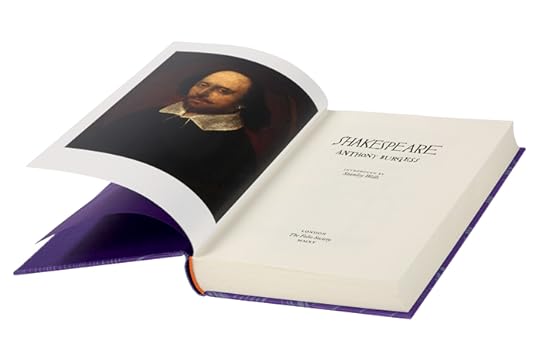
My edition is the beautiful folio society one. The only way I could justify buying more of these lovely, and expensive, books was if they were university related, so I was very pleased to find this. Even if I’m no longer studying Shakespeare! (9)There's the rub.But who cares? Despite finishing with this a university, I think I will always be studying Shakespeare. Shakespeare’s verses are (10) as swift as a shadow, and his plays are (11)such stuff as dreams are made on. His writing, his legacy, is everlasting. (12)In my heart of heartsI can tell you that there will never be a day when Shakespeare’s words aren’t relevant to the world. All people have to do is open their ears and hear them. (13)That’s the short and the long of it.
How many did you spot?
(1)“There’s Rosemary. That’s for remembrance.”
It’s the 400th anniversary since Shakespeare’s death! I just had to post something Shakespeare related on this day of all days. I mean can you blame me? Shakespeare’s just awesome. Also to liven things up a bit, I’ve discretely layered my review with Shakespeare phrases. Can you spot any? Some are obvious, but I don’t think you’ll find them all. There are thirteen in total.
So here goes.
This is the most unscholarly scholarly book I’ve ever read. It’s witty, supremely entertaining, and no less informative than a standard biography. It’s also quite concise; there’s no waffle:(2) brevity is the soul of wit. (3)It’s the best of both worlds really. I really enjoyed this, and I learnt a great deal about the Bard in the process. (4)It’s the be-all and the end-all of Shakespeare biographies really. In (5)one fell swoop Burgess provides a great level of detail about Shakespeare’s background; it provides a great level of detail about the man himself and the time in which he wrote. Burgess isn’t bias; he just provides as much information as possible. He starts from the beginning, from Shakespeare’s (6)flaming youth, (7)to his death bed where he breathed his last.
The chapters are organised for easy reference. It really is a good little book. In case you didn’t know, Anthony Burgess is the author of the famous A Clockwork Orange. So there’s going to be some skill in the writing. I tend to find biographies dry and boring; however, this was almost uplifting in places. (8)And that’s the naked truth.
My edition is the beautiful folio society one. The only way I could justify buying more of these lovely, and expensive, books was if they were university related, so I was very pleased to find this. Even if I’m no longer studying Shakespeare! (9)There's the rub.But who cares? Despite finishing with this a university, I think I will always be studying Shakespeare. Shakespeare’s verses are (10) as swift as a shadow, and his plays are (11)such stuff as dreams are made on. His writing, his legacy, is everlasting. (12)In my heart of heartsI can tell you that there will never be a day when Shakespeare’s words aren’t relevant to the world. All people have to do is open their ears and hear them. (13)That’s the short and the long of it.
How many did you spot?

December 11, 2023
An enjoyable if dated entry from my favorite genre of speculative fiction, Shakespeare biography. The documented facts of Will's life would scarcely fill ten pages (though I hasten to add that even this scant record would still point any serious person directly to the Stratford actor and not some grand conspiracy), so even the most scrupulous biographers must be willing to pad out their work with contextual detail, inference, educated guessing, and some plain assumption. Burgess is by his own admission not especially scrupulous, though he does showcase an impressive understanding of the Elizabethan/Jacobean world and the types of people who populated it—even if I could have stood slightly fewer pages about the Earl of Essex, personally. I found Burgess most interesting when elucidating the networks of kin, neighbors, business associates, literary rivals, and courtly connections Shakespeare was enmeshed in, which often get glossed over in narratives of the lone genius appearing to the world in a meteoric flash. In general Burgess is on the side of a human rather than a godlike Shakespeare, which always earns some points from me. His verve for language and novelistic imagination also make this quite a bit more engaging than many comparable texts.
Burgess is much less convincing when he tries his hand at psychoanalyzing the playwright, and—though he should know better as a fiction writer himself—he can't resist the urge to pick and choose details from the plays to read autobiographically. (He’s especially enamored with the idea, apparently Joyce's, that Will's wife Anne slept with his brother Richard.) A boy's club attitude towards all women not named Elizabeth I and a casuistic refusal to engage—as even the most conservative Shakespeareans do these days—with the possibility of Will's bisexuality are hard to look past as well.
All depictions of Shakespeare will ultimately reflect the times and the personality which conceive them, and Burgess' Shakespeare—witty, hard-working, unglamorous, depressive, anxious about money and rank, a little bit leering, with more or less the attitudes and hangups of a mid-20th-century English literary type—strikes me mostly as a portrait of Burgess himself. "To see [Shakespeare's] face we need only to look in a mirror," he asserts in his final paragraph. Well, at least he acknowledges it.
Burgess is much less convincing when he tries his hand at psychoanalyzing the playwright, and—though he should know better as a fiction writer himself—he can't resist the urge to pick and choose details from the plays to read autobiographically. (He’s especially enamored with the idea, apparently Joyce's, that Will's wife Anne slept with his brother Richard.) A boy's club attitude towards all women not named Elizabeth I and a casuistic refusal to engage—as even the most conservative Shakespeareans do these days—with the possibility of Will's bisexuality are hard to look past as well.
All depictions of Shakespeare will ultimately reflect the times and the personality which conceive them, and Burgess' Shakespeare—witty, hard-working, unglamorous, depressive, anxious about money and rank, a little bit leering, with more or less the attitudes and hangups of a mid-20th-century English literary type—strikes me mostly as a portrait of Burgess himself. "To see [Shakespeare's] face we need only to look in a mirror," he asserts in his final paragraph. Well, at least he acknowledges it.

March 11, 2023
Following his well-developed inclinations and inspired by the example of his subject, author Burgess presents here an impressionistic biography of the poet/playwright filled with erudite word play. This most certainly is not a scholarly biography but rather an attempt to get at the spirit of Shakespeare, his colleagues and competitors, and his times.

February 18, 2008
Perhaps the most distinctive and pleasing element of Burgess' book lies not in its ability to inform by dissecting the "raw facts" of history, but rather in its reflection of one accomplished writer's speculative musings on the great--yet altogether elusive--details of the life of one of his literary heroes. In this playful biographical study, the author pieces together the scant surviving historical accounts of the life of The Bard and acknowledges them as the thin and inadequate skeleton that they are for framing the life behind the greatest playwright of all time. Then he effusively fills in the gaps with his own informed guesses and imaginative theories. The Shakespeare that Burgess portrays is one who may or may not have been real, but who commodiously satisfies the personal questions that plain history leaves disappointingly unanswered.
The extent to which Burgess' guesses often digresses into the realm of fantasy and grandiose myth will inevitably elicit a cringe or two from the reader; however, the book is altogether an enjoyable read and does an excellent job of placing Shakespeare and his works in a historical context that fans of his plays and poems might not otherwise consider. Personally, I couldn't put it down. The book certainly enabled me to see some of my favorite plays in a new light and instilled me with an eagerness to read or reread several of his works.
The extent to which Burgess' guesses often digresses into the realm of fantasy and grandiose myth will inevitably elicit a cringe or two from the reader; however, the book is altogether an enjoyable read and does an excellent job of placing Shakespeare and his works in a historical context that fans of his plays and poems might not otherwise consider. Personally, I couldn't put it down. The book certainly enabled me to see some of my favorite plays in a new light and instilled me with an eagerness to read or reread several of his works.

December 19, 2019
Not the most reliable biography of Will floating around out there, but Burgess is fully upfront whenever he is indulging in a flight of fancy or making a bold speculation. The few hard facts that we have about Shakespeare don’t make for a very riveting read, so I immensely enjoyed following Burgess into the realm of imagination in order to conjure up vivid depiction of Shakespeare’s London, his cranky contemporaries, and of course the mysterious man himself.
August 1, 2023
En teoría terminé de leer este libro. Ahora, si me preguntan por la vida de Shakespeare no tengo ni idea porque entre tantos personajes que presenta esta biografía, anécdotas, temas de rima y otras cosas, todo se volvió una masa revuelta de nombres y hechos que no puedo conectar para armar la biografía del bardo.
Rescató algunas frases bellas, al final si había algo de encantador en este libro.
Sonará cringe, pero el párrafo final creo que es muy bonito “No tiene porque afligirnos no disponer de un retrato satisfactorio de Shakespeare. Para ver su cara nos basta con mirar a un espejo. El es cualquiera de nosotros, personar corrientes y sufrientes, impulsadas por ambiciones modestas, preocupadas por el dinero, víctimas del deseo, demasiado mortales…”
Rescató algunas frases bellas, al final si había algo de encantador en este libro.
Sonará cringe, pero el párrafo final creo que es muy bonito “No tiene porque afligirnos no disponer de un retrato satisfactorio de Shakespeare. Para ver su cara nos basta con mirar a un espejo. El es cualquiera de nosotros, personar corrientes y sufrientes, impulsadas por ambiciones modestas, preocupadas por el dinero, víctimas del deseo, demasiado mortales…”

June 11, 2020
Groundbreaking narrative of Shakespeare’s life, a lively and immediate look at Elizabethan London and the world of Shakespeare and his fellow players and writers.

December 4, 2021
Yra lietuviškas leidimas "Siluetų" serijoje (1990 m., leidykla "Vyturys"). Įdomi, profesionaliai parašyta biografinė knyga.

August 25, 2017
Written by a fine writer in his own write, this book imagines Shakesepeare as he could be intuitively imagined through the eyes of a novelist. There are multiple technical observations. Chiefly among them, I was very interested in Burgess’s take on Shakespeare’s predecessor’s and contemporaries. The Earl of Surrey’s innovation in 1557 was key to the development of Elizabethan drama. The book was a translation of Virgil and written “in blank verse, a form Surrey devised in order to meet the rhymeless challenge of Virgil’s hexameters. It is, of course, profitless to speculate what might have happened to Elizabethan drama (or the Miltonic epic, for that matter) if Surry had not tried to find a suitable verse-medium for rendering Latin epic poetry.” (34) If not for Surrey, would there have been Shakespeare? It is an interesting question. In Richard III, Shakespeare finds another innovation, “an approach to the three-dimensional drama, in which men are not always what they seem. For the first time, in Clarence’s dream speech, the unconscious mind is netted and landed.” (99) Philosophically, Burgess has a number of observations as well. “Hamlet is really about the impact on a Montaigne-like man of the harsh world of power and intrigue. The tragedy of the prince derives from his having to act, and to base that action on a premise which a Montaigne-like man is bound to find uncomfortable.” (106) “That Falstaff should be one of the great lovable characters of all literature is—to those who equate lovability with moral excellence—an eternal mystery. But to those who see no virtue in war, government propaganda, sour puritanism, hard work, pedantry, Rechabitism, and who cherish fallen humanity when it reveals itself in roguery and wit, then there is no mystery. The Falstaffian spirit is a great sustainer of civilization. It disappears when the state is too powerful and when people worry too much about their souls.” (149)
The book overall is organized simply, and easy to read. Burgess shares his guesses and his opinions freely. It is a lively biography, and an imagined one based in reason underpinning intuition. It is very, very good.
See my other reviews here!
The book overall is organized simply, and easy to read. Burgess shares his guesses and his opinions freely. It is a lively biography, and an imagined one based in reason underpinning intuition. It is very, very good.
See my other reviews here!

June 10, 2018
I am not sure was I prepared to read this work by Anthony Burgess about Shakespeare. I get that a lot of it was a speculation and fiction written about Shakespeare. It was an interesting piece of work, however it took me forever to read it. Some places were intriguing, had a lot of historical facts which amazed me and I felt that they were useful. Yet, in some cases the speculation of facts was too long and complicated to understand.

July 3, 2012
Who better to tell the life of Shakespeare than the author of A Clockwork Orange (where he invented a sort of Russian/Shakespearean dialect amongst his fictional world of chaos). Unlike other biographies of Shakespeare, this one doesn't run on too long, finishing just a little north of 200 pages. And Burgess glides you along the read with ease and humor. He's also not afraid to voice his opinion regarding specific plays from the Bard (he hates Pericles and Winter's Tale), and he never lets you forget that this biography of an old writer is told by a writer himself, who feels connected to Shakespeare, even if only because they share the same profession and love of writing. He talks a lot about the other writers that lived around Shakespeare's time (Ben Jonson, Christopher Marlowe, etc.) and while these parts can feel a little dull, they do help put the time period and political events into perspective. Burgess is humorous in explaining his own specific theories about Shakespeare's life, as he is always quick to remind the reader that he has no way of proving that this happened. It feels like you're having a one on one chat with Burgess, learning about Shakespeare from him, and then hearing what his opinion is on the manner.

March 6, 2016
A joyous, intellectual read. Wasn't Burgess a genius? Truly a remarkable man. In truth, Burgess' Shakespeare has very little of factual novelty to offer my generation; all of his knowledge and intuition have formed part of the basis of the latest generation of Shakespeare biographers and writers, not to mention those like Robert Nye's The Late Mr. Shakespeare.
Nevertheless, the way that Burgess writes makes this book easily worthwhile. Taking just the facts that we know about the Bard (or, knew, in 1976), he strings a story of Shakespeare's life that is full of reasonable assumptions and some more fantastic but equally beautiful surprises. A vivid and enjoyable read.
Nevertheless, the way that Burgess writes makes this book easily worthwhile. Taking just the facts that we know about the Bard (or, knew, in 1976), he strings a story of Shakespeare's life that is full of reasonable assumptions and some more fantastic but equally beautiful surprises. A vivid and enjoyable read.
August 5, 2020
Shakespeare's penmanship has made his figure bigger than life to a point where it is hard to imagine him ever being human like us. With Shakespeare Anthony Burgess manages to bring down the great playwright to the realm from which he originated from, displaying the layers of imperfect humanity within him. Here he is unfaithful, gets easily heartbroken, has glimpses of vanity, is careful with his money and never forgets a loan. Admiration of the poet's talent also seeps through the pages, but instead of it taking central stage (à la Mark Twain’s Joan of Arc), the praise is displayed more subtly. Burgess also understands the importance of context, paying a significant amount of his writing to detailed descriptions of Elisabethan era England and the events that directly influenced the bard and his writing. Granted, those people who are looking for a more traditional biography might come out dissapointed. The scarce amount of information regarding Shakespeare during his lifetime leaves Burgess no choice but to sometimes infer (albeit logically) as to what might have happened. On the other hand, this frees Burgess to tackle his ‘biography’ as a work of fiction, which is evident in his loose and playful style, which is a welcome addition to the overall enjoynment of the book.
I picked this book at random and I am in no form a Shakespeare scholar, my knowledge of his complete oeuvre could best be described as ‘basic’ or ‘highly aware’. As mentioned, Burgess does not shy away from providing the smallest of details, with myriads of names and contextual bits sometimes being the reason as to why I was losing my interest.
I picked this book at random and I am in no form a Shakespeare scholar, my knowledge of his complete oeuvre could best be described as ‘basic’ or ‘highly aware’. As mentioned, Burgess does not shy away from providing the smallest of details, with myriads of names and contextual bits sometimes being the reason as to why I was losing my interest.

June 21, 2025
I gre up near Stratford and went there often when young, either to walk along the river or once in a boat on the Avon with Mum andDad but not so expertly navigated inthe wake of a larger engined craft. And the pilgrimage to see the tomb in the church. Then there werethe school play events to see the great plays, Caesar, Romeo and Juliet (with Judy Dench), Wars ofthe Roses and myfavourite Richard III. Great actors too likeScofield and Robson, and a young Jonathan Pryce on a motorbike. Burgess's work certainly brings out hislove of the Warwickshire lad whose claim to authorship rings down the ages. Controversy continues but I am a fan of Will and have enjoyed AB's take on his and his times.

March 28, 2020
Šių laikų aktualijoms įdomus faktas. Elžbietos, Šekspyro Anglija, 1590-ieji ir maras. Mirdavo net?:) 30 žmonių per dieną, o teatrai buvo uždaryti du metus..
Knyga labai smulkmeniška, toks jausmas kad apie Šekspyrą jau viskas parašyta, tad autorius stengės išknisti 3-os kartos pusbrolius ar kitus ne tokius reikšmingus faktus. Norėjau pažinti Šekspyrą. Nepažinau.
Knyga labai smulkmeniška, toks jausmas kad apie Šekspyrą jau viskas parašyta, tad autorius stengės išknisti 3-os kartos pusbrolius ar kitus ne tokius reikšmingus faktus. Norėjau pažinti Šekspyrą. Nepažinau.
February 14, 2017
Burgess's novelistic skills enrich this erudite (but not stuffy) and entertaining portrait of Shakespeare and his times.

January 15, 2020
I enjoyed the author's witty writing style but it didn't really add anything new to my knowledge of Shakespeare. It's always interesting to read a new perspective though.

November 6, 2021
Entertainingly written but horrendously misogynist.

March 22, 2022
Excepțională!

October 29, 2011
A very deft overview of the life and works of Shakespeare. Burgess painstakingly hews to the documented facts about the Bard, and then indulges in occasional flights of fancy, which are carefully announced as such. Not as copious in scope as Ackroyd or Greenblatt's biographies (and much shorter than either), and obviously not as fun as his own novel,
Nothing Like the Sun, this is still a valuable bit of Bardology.
"We need not repine at the lack of a satisfactory Shakespeare portrait. To see his face we need only to look in a mirror. He is ourselves, ordinary suffering humanity, fired by moderate ambitions, concerned with money, the victim of desire, all too mortal. To his back, like a hump, was strapped a miraculous but somehow irrelevant talent. It is a talent which, more than any other the world has seen, reconciles us to being human beings, unsatisfactory hybrids, not good enough for gods and not good enough for animals. We are all Will. Shakespeare is the name of one of our redeemers."
So: not Bacon, not Essex, not (as Malcolm X argued) James I. We are Shakespeare, Shakespeare is us.
Nothing Like the Sun, this is still a valuable bit of Bardology.
"We need not repine at the lack of a satisfactory Shakespeare portrait. To see his face we need only to look in a mirror. He is ourselves, ordinary suffering humanity, fired by moderate ambitions, concerned with money, the victim of desire, all too mortal. To his back, like a hump, was strapped a miraculous but somehow irrelevant talent. It is a talent which, more than any other the world has seen, reconciles us to being human beings, unsatisfactory hybrids, not good enough for gods and not good enough for animals. We are all Will. Shakespeare is the name of one of our redeemers."
So: not Bacon, not Essex, not (as Malcolm X argued) James I. We are Shakespeare, Shakespeare is us.

April 23, 2008
This book was a scholary biography salted with a fair deal of artistic liberty. Burgess does a good job of filling in the gaps that history has left in Shakespeare's life. While I am not a real Shakespeare fan I thought it was an interesting book. Despite being a struggle at times it was definetly worth it. My only criticism would be that he tends to over play the relationship between the art and the artist's life, constantly looking for parallels between Shakespeare's characters and his real life friends, foes, and self. I think he overdoes this at times but he knows more about the plays and Shakespeare then me so who am I to complain.
May 9, 2008
I'm torn on this one. As far as Shakespeare biographies go, it's probably pretty good (I have nothing to judge it by!). At times some of the conjecture on Burgess' part bothered me, but a biography of The Bard can be little more than supposition. At other times, particularly during his narrative concerning the performance of Hamlet, I was enchanted by the reality of attending an Elizabethan play.
Heavy on historical context--that being the only concrete detail available--the biography provided a very convincing impetus for the creation of each play.
Heavy on historical context--that being the only concrete detail available--the biography provided a very convincing impetus for the creation of each play.

November 23, 2013
This should be called, 'an inferred' biography. Anthony Burgess, using historical context, peer histories (Marlow, Greene and Johnson) and the bards own writing attempts an educated guess at the less documented particulars of the life of one Will Shakespeare. The sleuthing and organization of the material is half the pleasure of the book. Worth a read for Shakespeare junkies, everybody else is going to have to plow hard and learn much corollary material to get even a glimpse the shadow that is the subject.

September 11, 2009
Very good, if a bit speculative. On the other hand, Burgess makes no apologies: "This book contains conjecture - duly and timidly signaled with phrases like "It may well be that..." or "Conceivably, about this time..."
Good quote: "All that young men of learning like Greene and Nashe and Peele and Kyd could do was write eyecatching pamphlets and essay the drama (unless, of course, they wished to take up espionage like Marlowe and end up with a dagger in the frontal lobes)..."
Good quote: "All that young men of learning like Greene and Nashe and Peele and Kyd could do was write eyecatching pamphlets and essay the drama (unless, of course, they wished to take up espionage like Marlowe and end up with a dagger in the frontal lobes)..."
November 16, 2007
If you are looking for any biography on Shakes, you should go to this one. Burgess understands that next to nothing is known about him, so he does well with creative speculation and gives us an overall picture of what life was like back then and an appreciation for how strange it is that we don't know anything about Shakespeare.

July 12, 2010
Absolutely gorgeous writing. Didn't tell me anything I didn't already know, but put it all together very, very succinctly. Tight writing with a very strong voice. An absolute breeze to read. Puts the whole era and Will's genius in context. Ties up all the known facts, the supposed facts, and the outright myths and lies in one nice pie that you couldn't eat fast enough.

July 28, 2010
I've read several biographies of Shakespeare but this one is special. Burgess not only had a deep grasp of the poet but also of the times. Unlike "Will in the World" which has many "Could it be that..." detours, Burgess uses some speculation but always within reason.
January 30, 2010
Not necessarily as well researched as Greenblatt's study, but certainly more poetic.

March 19, 2011
Very nicely illustrated and a interesting look-see at the possible Dark Lady...
Displaying 1 - 30 of 37 reviews