

What do you think?

Attracting Native Pollinators; Protecting North America's Bees and Butterflies
The recent decline of the European honey bee and other pollinators in North America poses a serious challenge to our food supply and ecological health. About 75 percent of all flowering plants rely on pollinators in order to set seed or fruit, and from these plants comes one-third of the planet's food.
Attracting Native Pollinators is a comprehensive guidebook for gardeners, small farmers, orchardists, beekeepers, naturalists, environmentalists, and public land managers on how to protect and encourage the activity of the native pollinators of North America. Written by staff of the Xerces Society, an international nonprofit organization that is leading the way in pollinator conservation, this book presents a thorough overview of the problem along with positive solutions for how to provide bountiful harvests on farms and gardens, maintain healthy plant communinities in wildlands, provide food for wildlife, and beautify the landscape with flowers.
Full-color photographs introduce readers to more than 80 species of native pollinators -- including bees, flies, butterflies, wasps, and moths -- noting each one's range and habits. The heart of the book provides detailed garden plans and techniques showing how to create flowering habitat to attract a variety of these pollinators, help expand the pollinator population, and provide pollinators with inviting nesting sites. Readers will also find useful instructions for creating nesting structures, educational activities for involving children, and an extensive list of resources.
Attracting Native Pollinators is an essential reference book and action guide for anyone who is involved in growing food or is concerned about the future of our food supply.
Attracting Native Pollinators is a comprehensive guidebook for gardeners, small farmers, orchardists, beekeepers, naturalists, environmentalists, and public land managers on how to protect and encourage the activity of the native pollinators of North America. Written by staff of the Xerces Society, an international nonprofit organization that is leading the way in pollinator conservation, this book presents a thorough overview of the problem along with positive solutions for how to provide bountiful harvests on farms and gardens, maintain healthy plant communinities in wildlands, provide food for wildlife, and beautify the landscape with flowers.
Full-color photographs introduce readers to more than 80 species of native pollinators -- including bees, flies, butterflies, wasps, and moths -- noting each one's range and habits. The heart of the book provides detailed garden plans and techniques showing how to create flowering habitat to attract a variety of these pollinators, help expand the pollinator population, and provide pollinators with inviting nesting sites. Readers will also find useful instructions for creating nesting structures, educational activities for involving children, and an extensive list of resources.
Attracting Native Pollinators is an essential reference book and action guide for anyone who is involved in growing food or is concerned about the future of our food supply.
372 pages, Paperback
First published February 26, 2011
Ratings & Reviews
Friends & Following
Create a free account to discover what your friends think of this book!
Community Reviews
Displaying 1 - 30 of 41 reviews
September 7, 2017
An Eye-Opening Book

Augochlora pura, a metallic green “sweat bee” only found in the Americas (239)
Well-organized, beautifully-illustrated and useful resource that strikes just the right balance between scientific and action-oriented information.

Bombus morrisoni, Morrison’s bumble bee on a tomato flower Bumble bees can buzz-pollinate. Some flowers such as tomatoes [a native American plant] need to be vibrated to release the pollen (at roughly the frequency of a middle C musical note). Bumble bees do this by grabbing onto the flower and then vibrating their flight muscles without flapping their wings. There is an audible buzz as they do this…(260)
When you think about pollinators — if you think about them — for instance, when you eat a ripe, red tomato, a bowl of blueberries, a scoop of strawberry ice cream — or even a juicy steak from a pastured cow fed on alfalfa (lucerne) and clover — what image appears in your mind’s eye? Is it that lovely hardworking ginger-gold-and-black-striped creature, making honey in a hive? Well, ok, I rarely, maybe never, think about bees while I’m eating a bowl of ice cream either. But if you do, this is right and good. European honey bees have long been naturalized worldwide, and in North America they live in the wild as well as being our most important commercially managed crop pollinator. And for the most part, what’s good for them is good for other pollinators, and vice versa. But the devil is in the details -- so differences in things like nesting habits, food sources and maximum flight distance do make a difference in whether species of pollinators and plants can survive in a given environment.

Apis mellifera, the European honey bee
Less well-known than the honeybee, but extremely important in North America, not only for successful crop and orchard production, but for the sustainability of our non-crop flowering (and fruiting) plants and trees — are more than 4000 species of native bees of all shapes, sizes, and colors — with a supporting cast of pollinating wasps, flies, moths, butterflies, beetles, hummingbirds and bats -- each with its job to do. Native pollinators are often the most effective and efficient pollinators, and sometimes the only pollinators, for the plants they co-evolved with. And in some areas where native pollinators have declined or disappeared, non-crop trees and plants that propagate with the assistance of a pollinator are declining. The existing individual plants may live out their lifespans, but there will be no new ones without pollination, and pollination won’t happen if bees are only present when hives are brought in for a specific cash crop’s bloom cycle that doesn’t coincide with that plant’s bloom cycle -- or if the plant needs a different pollinator.
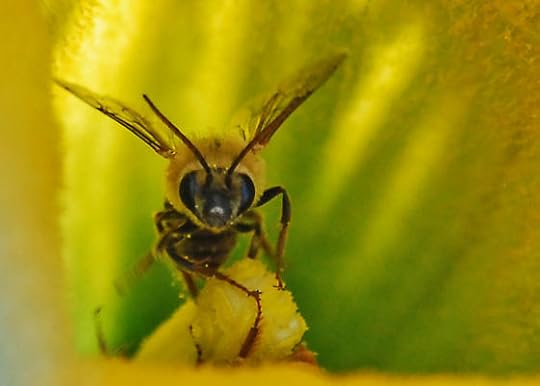
Peponapis pruinosa, Squash Bee Inside Coyote Gourd Blossom. Squash bees get their name from their very close association with squash flowers. Peponapsis is a small genus of 13 species limited to the Americas. They are most abundant and diverse in the deserts of Mexico and the southwestern United States, but one species, Peponapsis pruinose, is transcontinental and has spread as far north as Canada. [These specialize in pollinating pumpkins, squash/calabasas, and gourds, and can also pollinate melons and, I believe, cucumbers, which are in the same plant family.](254)
The first section of the book, “Pollinators and Pollination,” is a basic science primer on how pollination and pollinators work, what keeps them alive (their foraging and nesting needs), and threats to their existence. Four major factors are killing them off: loss and fragmentation of habitat, degradation of the remaining habitat (for example, by the use of herbicides), pesticide poisoning, and the international spread of diseases and parasites.
In the second section, “Taking Action,” five chapters address general strategies applicable to many situations. An additional six stand-alone chapters are targeted to specific clients — so, for example, "Pollinator Conservation on Farms;" “Home, School and Community Gardens;” and so forth. I questioned only one thing: several alternative procedures were given for establishing a wildflower meadow “from scratch” and one of them involved first killing off whatever was already there with supposedly short-term herbicides. I feel this represents a failure of imagination and a going-along with the American cultural imperative that things need to be done quickly and without assistance from the community.
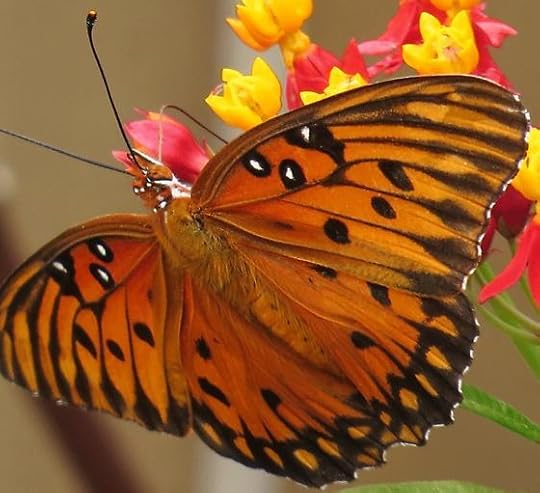
Agraulis vanillae, Gulf fritillary (335) A favorite host plant is passiflora (passionflower). The flower in this image looks to me like a tropical milkweed, maybe? In my garden, I see a lot of fritillaries around the passiflora and the lantana.
The third section is a beautifully illustrated guide to “Bees of North America. and the fourth, “Creating a Pollinator-Friendly Landscape” contains sample plans and drawings for community gardens, farm meadows, residential gardens, riparian (river and stream) borders, roadside planting, schools, office buildings, zoos, and botanical gardens. There’s also a basic best-choice guide to pollen and nectar sources for bees and host plants for butterflies (where they lay their eggs). There’s an effort to provide information for each region, though Mexico is a bit neglected.
Appendices provide resources for parents and educators, including suggested games and activities, a glossary, further reading recommendations and other resource lists.
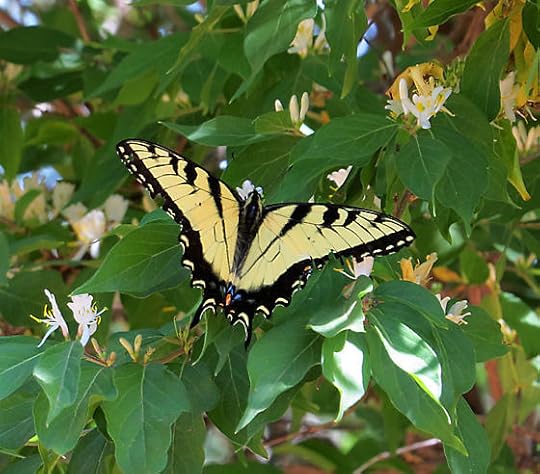
Papilio glaucus, Eastern tiger swallowtail (328) Lots of these in my backyard; black ones as well.
The authors are a team of five scientists (entomologists, plant scientists, an evolutionary ecologist-biologist) who are educators with a vast range of experience in beekeeping, agricultural consulting, and conservation projects. The Xerces Society for Invertebrate Conservation, named after the extinct Xerces blue butterfly, provides education, advocacy and policy guidance, publications and scientific research. Although a few years old, the information is mostly still current.
Images sourced from BugGuide.net
Augochlora pura, a metallic green “sweat bee” only found in the Americas (239)
Well-organized, beautifully-illustrated and useful resource that strikes just the right balance between scientific and action-oriented information.
Bombus morrisoni, Morrison’s bumble bee on a tomato flower Bumble bees can buzz-pollinate. Some flowers such as tomatoes [a native American plant] need to be vibrated to release the pollen (at roughly the frequency of a middle C musical note). Bumble bees do this by grabbing onto the flower and then vibrating their flight muscles without flapping their wings. There is an audible buzz as they do this…(260)
When you think about pollinators — if you think about them — for instance, when you eat a ripe, red tomato, a bowl of blueberries, a scoop of strawberry ice cream — or even a juicy steak from a pastured cow fed on alfalfa (lucerne) and clover — what image appears in your mind’s eye? Is it that lovely hardworking ginger-gold-and-black-striped creature, making honey in a hive? Well, ok, I rarely, maybe never, think about bees while I’m eating a bowl of ice cream either. But if you do, this is right and good. European honey bees have long been naturalized worldwide, and in North America they live in the wild as well as being our most important commercially managed crop pollinator. And for the most part, what’s good for them is good for other pollinators, and vice versa. But the devil is in the details -- so differences in things like nesting habits, food sources and maximum flight distance do make a difference in whether species of pollinators and plants can survive in a given environment.
Apis mellifera, the European honey bee
Less well-known than the honeybee, but extremely important in North America, not only for successful crop and orchard production, but for the sustainability of our non-crop flowering (and fruiting) plants and trees — are more than 4000 species of native bees of all shapes, sizes, and colors — with a supporting cast of pollinating wasps, flies, moths, butterflies, beetles, hummingbirds and bats -- each with its job to do. Native pollinators are often the most effective and efficient pollinators, and sometimes the only pollinators, for the plants they co-evolved with. And in some areas where native pollinators have declined or disappeared, non-crop trees and plants that propagate with the assistance of a pollinator are declining. The existing individual plants may live out their lifespans, but there will be no new ones without pollination, and pollination won’t happen if bees are only present when hives are brought in for a specific cash crop’s bloom cycle that doesn’t coincide with that plant’s bloom cycle -- or if the plant needs a different pollinator.
Peponapis pruinosa, Squash Bee Inside Coyote Gourd Blossom. Squash bees get their name from their very close association with squash flowers. Peponapsis is a small genus of 13 species limited to the Americas. They are most abundant and diverse in the deserts of Mexico and the southwestern United States, but one species, Peponapsis pruinose, is transcontinental and has spread as far north as Canada. [These specialize in pollinating pumpkins, squash/calabasas, and gourds, and can also pollinate melons and, I believe, cucumbers, which are in the same plant family.](254)
The first section of the book, “Pollinators and Pollination,” is a basic science primer on how pollination and pollinators work, what keeps them alive (their foraging and nesting needs), and threats to their existence. Four major factors are killing them off: loss and fragmentation of habitat, degradation of the remaining habitat (for example, by the use of herbicides), pesticide poisoning, and the international spread of diseases and parasites.
In the second section, “Taking Action,” five chapters address general strategies applicable to many situations. An additional six stand-alone chapters are targeted to specific clients — so, for example, "Pollinator Conservation on Farms;" “Home, School and Community Gardens;” and so forth. I questioned only one thing: several alternative procedures were given for establishing a wildflower meadow “from scratch” and one of them involved first killing off whatever was already there with supposedly short-term herbicides. I feel this represents a failure of imagination and a going-along with the American cultural imperative that things need to be done quickly and without assistance from the community.
Agraulis vanillae, Gulf fritillary (335) A favorite host plant is passiflora (passionflower). The flower in this image looks to me like a tropical milkweed, maybe? In my garden, I see a lot of fritillaries around the passiflora and the lantana.
The third section is a beautifully illustrated guide to “Bees of North America. and the fourth, “Creating a Pollinator-Friendly Landscape” contains sample plans and drawings for community gardens, farm meadows, residential gardens, riparian (river and stream) borders, roadside planting, schools, office buildings, zoos, and botanical gardens. There’s also a basic best-choice guide to pollen and nectar sources for bees and host plants for butterflies (where they lay their eggs). There’s an effort to provide information for each region, though Mexico is a bit neglected.
Appendices provide resources for parents and educators, including suggested games and activities, a glossary, further reading recommendations and other resource lists.
Papilio glaucus, Eastern tiger swallowtail (328) Lots of these in my backyard; black ones as well.
The authors are a team of five scientists (entomologists, plant scientists, an evolutionary ecologist-biologist) who are educators with a vast range of experience in beekeeping, agricultural consulting, and conservation projects. The Xerces Society for Invertebrate Conservation, named after the extinct Xerces blue butterfly, provides education, advocacy and policy guidance, publications and scientific research. Although a few years old, the information is mostly still current.
Images sourced from BugGuide.net

November 8, 2019
If you are into pollinator conservation, get your hands on this book. It is a good introduction to pollinator gardening and conservation.

March 16, 2021
Absolutely excellent resource, with ideas for any type of person managing any type of land.

Read
September 5, 2015By now it is a known fact that bees are dying. But when that subject is in the news, it is almost always honeybee populations that are discussed. This book could be subtitled, "Thinking Outside the Honeybee Box." This book says, there are other bees besides honeybees. There are mason bees, sweat bees, digger bees, bumble bees, leafcutter bees. They live in holes in the ground, or in cracks in walls, or in hollow stems. Some of them are better pollinators than honeybees, spending more hours a day foraging, going out in cold weather, or reaching into blossoms that honeybees don't.
Part of the solution to the pollinator problem is to save these other kinds of bees, as well as the wasps, flies, butterflies and moths that also help to pollinate flowers. That can be done by knowing the habits and needs of these bees, recognizing and protecting their habitats, planting lots of the right kind of flowers, and providing nesting sites. Also, DO NOT SPRAY.
The book addresses nearly every circumstance: home gardeners, farms, public land, schools, community organizing. The photographs are gorgeous.
I learned more than I knew I wanted to know about bees in this book. I learned more than I knew there was to know about bees. There was enough bee information that I couldn't absorb it all. But I will certainly be watching the flowers with more knowledge and appreciation.
Part of the solution to the pollinator problem is to save these other kinds of bees, as well as the wasps, flies, butterflies and moths that also help to pollinate flowers. That can be done by knowing the habits and needs of these bees, recognizing and protecting their habitats, planting lots of the right kind of flowers, and providing nesting sites. Also, DO NOT SPRAY.
The book addresses nearly every circumstance: home gardeners, farms, public land, schools, community organizing. The photographs are gorgeous.
I learned more than I knew I wanted to know about bees in this book. I learned more than I knew there was to know about bees. There was enough bee information that I couldn't absorb it all. But I will certainly be watching the flowers with more knowledge and appreciation.
October 2, 2019
Very comprehensive reference book with a lot of information, especially for folks managing large areas like farms, park spaces, golf courses, etc. There is also good identification information too.
May 23, 2024
Brilliant, a wealth of information and surprisingly easy to read and enjoy. I learned a lot which will be massively helpful in creating my pollinator garden. I never realized how little I (or the average person) knows about bees, especially native bees, let alone other pollinators. I read this book like I would read any other — cover to cover, aside from the index — and took notes and had a fantastic time! I have a new appreciation for (and fascination with) pollinator insects. My only critique is that some parts are repetitive (which can only be avoided so much in this type of book) and the butterfly host plant section seemed like it could have been better designed for the reader; I would have liked to see the listed host plants paired with some kind of location code, like “SE” or “NW”, so I could see what to focus on for my region.
P.S. This book is the sole catalyst for my pollinator/bee fixation and consequent info dumping on everyone who will listen to me about it. The amount of times I have said, “did you know [bee/pollinator fact]?” is absurd.
P.S. This book is the sole catalyst for my pollinator/bee fixation and consequent info dumping on everyone who will listen to me about it. The amount of times I have said, “did you know [bee/pollinator fact]?” is absurd.

June 4, 2026
This was the textbook for my college course Pollinator Diversity & Conservation. The course was specifically focused on bee diversity and conservation, so those are the chapters in the book we focused on. There are also sections on important beetle, butterfly, moth, and even fly pollinators, which are too often overlooked in conservation. Threats to each of the above pollinators are mentioned and paired with conservation recommendations. For example, most bees are solitary and ground nesting. Frequent mowing can destroy their nests. Leaving bare ground supports solitary bees. This is one of many practical recommendations. I also really appreciate how the book is written in clear, straightforward language. This is an approachable read for someone who knows nothing about pollinators. It is also my favorite textbook of my college career. Attracting Native Pollinators is an excellent book for anyone concerned about the pollinators around them and who wants to support them.

June 8, 2018
This is a practical, sensible reference book, as most reviewers agree. It’s also fun to browse through. And there’s another bonus. I also enjoyed simply reading the chapters on pollinators in parks, farms, and urban areas, which opened my eyes to the value of the mini-habitats these areas offer. I can look at a median strip, a lawn, a field of weeds, bare soil, or landscaping around a parking lot, and think about how each of these might be useful to some bee. There are practices that I can encourage in my own neighborhood or community. It’s a joy to look around me and realize that with a little care almost every place in our environment can help support these fascinating creatures.

April 4, 2020
A great resource for anyone with even a small bit of outdoor space they want use to encourage native wildlife.

June 6, 2020
An excellent overview of bees and what they need to survive (and resources to help).
February 4, 2021
Good information on different types of bees.

July 23, 2022
I’m dreaming about my future native pollinator garden.
April 6, 2023
Focus of this book is on bees and butterflies.
May 5, 2023
Great book! Wonderful resource for what to do with your yard when you want to make it better for the environment and for native species.
December 6, 2023
Too bad noxious weeds are listed as great to plant for pollinators. What is Xerces thinking?

May 31, 2026
Never knew how many different types of bees there are. Very educational book.
March 5, 2017
Abundant basic pollinator and pollination information. Lots of bee, butterfly, & plant details as well as presentation of possible actions one can take no matter what type, size, and purpose an area may be.

February 21, 2017
Packed with scientific information in an easy to digest form. The pictures are an added bonus

on-pause
November 22, 2018DPL 631.52 ATTRACTING
28 December 2018 Putting on pause as had to return it. Have on wishlist.
28 December 2018 Putting on pause as had to return it. Have on wishlist.
March 5, 2015
A "Bee-friendly" focus in our garden club had me searching for a source of relevant local information. I hit the jackpot with this Xerces Society Guide which not only has a whole section on Bees of North America (Part 3, includes photos, list of identifying features, drawings close to scale), but also practical advice on garden planning, native plants to encourage healthy pollinators, and how to grow them (Part 4).
A great reference guide that I will definitely come back to.
Four parts:
1. Pollinators and Pollination - How pollination works, introduction to pollinators and their threats
2. Taking Action - Strategies to help pollinators from protecting habitat, to creating friendly sites, to rethinking how common activities (agricultural or urban) affect pollinators
3. Bees of North America - Photos, list of identifying features, drawings close to scale
4. Creating a Pollinator-Friendly Landscape - Sample gardens and recommended plants
A great reference guide that I will definitely come back to.
Four parts:
1. Pollinators and Pollination - How pollination works, introduction to pollinators and their threats
2. Taking Action - Strategies to help pollinators from protecting habitat, to creating friendly sites, to rethinking how common activities (agricultural or urban) affect pollinators
3. Bees of North America - Photos, list of identifying features, drawings close to scale
4. Creating a Pollinator-Friendly Landscape - Sample gardens and recommended plants

December 11, 2011
Attracting Native Pollinators is worth buying just for the eye candy. Every page has at least one stunning photograph or fascinating drawing, and I found it hard to tear my eyes away.
The text is a bit more hit or miss. The information is spot on, but the book is written by a committee who couldn't seem to decide whether they were working on a textbook or a guide for enthusiastic DIYers. I suspect some of the early chapters will turn many enthusiasts like me away, but if you keep plugging along, you'll find some great information. And a short field guide to the main types of pollinators, including a lot of the native bees!
The text is a bit more hit or miss. The information is spot on, but the book is written by a committee who couldn't seem to decide whether they were working on a textbook or a guide for enthusiastic DIYers. I suspect some of the early chapters will turn many enthusiasts like me away, but if you keep plugging along, you'll find some great information. And a short field guide to the main types of pollinators, including a lot of the native bees!

May 3, 2011
As a simple home gardener, this book had way more information than I needed, but I loved it. It's practically a college course on pollination, local ecosystems, and agriculture. I liked the regional recommendations for growing pollinator gardens, and found much of the information to be fascinating if not useful on a small level. For city planners, farmers, or anyone in control of a lot of land, this book would be a fantastic resource! Still great for a home gardener too - especially with the great pictures of bee and butterfly varieties as well as all the plants.

July 23, 2012
Book 51 2012 Reading Challenge- An excellent book about establishing pollinator gardens and spaces. The text covers butterflies, wasps, and flies, which are all pollinators in their own rights, but it focuses on bees and native bees in particular. Establishes a convincing argument for identifying and creating habitat for native bees. Covers creating year round habitat, plant choices both native plants and ornamentals for each area of the U.S.

July 26, 2015
A great book about native pollinators. Admittedly, I just skimmed many of the chapters as they weren't totally applicable to what I'm doing. I learned so much from reading this book. I had no idea that there were four thousand(!!!!) species of native bees in North America that have nothing to do with honey bees (which are imports from Europe). Good info, and I'm inspired to do more to help native pollinators.

June 25, 2011
Now I just need to find plants that thrive in the clay "soil" of my lawn and attract native pollinators. But it was a good start and reminded me that butterflies and honey bees are not the whole game, not by a lot shot. I wonder if it's legal to just steal plants from out of the ditches along the side of the road ...

June 7, 2013
Great field manual on how to attract pollinators, particularly bees. Nice appendix provides information on bee identification along with different flora for bees. Since we live in a place with no outdoor space, there is not as much I can act on, apart from writing my political representatives to keep the bees going.

July 25, 2013
A fabulous resource for anyone who cares about creating and supporting thriving pollinator populations. No stone is left unturned with ideas for city, school, golf course, and farm. The photographs alone are worth the price. Many thanks to the Xerces Society for creating this valuable resource.

September 8, 2013
Fantastically illustrated, clearly and concisely written, accurate without being overwhelming. This is an excellent guide to our native bee species and other pollinators, and what we can do to help them in our home gardens and elsewhere.

April 23, 2014
One of my goals for this summer is to plant some native flowers. I skipped all the chapters that were about pollinators and land use that didn't apply to our property. It's a good resource! The garden plans were rather laughable.
May 17, 2011
Excellent book with so many color pics of bees, butterflies. Great tips on helping out the pollinators, what to plant, etc.
Displaying 1 - 30 of 41 reviews