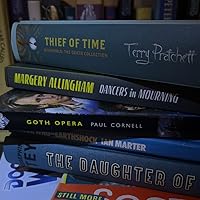
Alison Parmeter can read anything—body language, expressions, the shape of a city. Squadron Leader Leyton is a pilot from a utopian future. He’s dropped back in time, but it’s startlingly different from anything he learned in history lessons. Jocelyn, his navigator, is a head without a body, captive in a world she can’t trust. This group must map out a quest for Alison's best friend, who was stolen by the Golden Men, who some call Angels. This quest reaches back to the New Testament, and forward to the end of time.
Paul Cornell is a British writer of science fiction and fantasy prose, comics and television. He's been Hugo Award-nominated for all three media, and has won the BSFA Award for his short fiction, and the Eagle Award for his comics. He's the writer of Saucer Country for Vertigo, Demon Knights for DC, and has written for the Doctor Who TV series. His new urban fantasy novel is London Falling, out from Tor on December 6th.
This was close to five stars...one of those books I couldn't stop reading. A fascinating mix of good vs. evil; sci-fi time travel and the coming of age of a young woman who has empathic abilities and a degree in math and ends of working for a bookie.
Very fun - especially as a who fan, for whom this book demonstrated that Cornell NEEDS a call back at least 10 years ago! (He certainly balances RTD's warm characterisation and hits of realism with Steven Moffat's scope and whimsical use of sci fi concepts) The politics and pastiche were sometimes a bit on the nose, and I still don't quite understand why on earth they were called 'Bears' but overall, very entertaining and readable.
A sci-fi story with political thriller, theology, romance, spy novel and philosophy all thrown in. There is a lot of story in these pages, and it will keep you wondering what is going to happen next.
I think this is the most underrated book I've read this year. I found out about British Summertime through looking at Paul Cornell's website, where he lists the books he's read. Cornell is one of my favourite Doctor Who writers and I was interested to see what non-Who stories he had done.
British Summertime was immediately appealing to me, from its title to its cover and the blurb. I actually think the UK Gollancz cover is one of my favourite book covers ever. It's bizarrely minimalistic for the type of story it is, but the haunting image of one of the Golden Men breaking through the rest of the cover is brilliant. It reminds me of something I'd see looking at early 3D sci-fi renders.
I didn't really know what to expect with this book going in; the blurb itself gives a short rundown on our characters, more than a glimpse at what the plot could be. I was thoroughly impressed, though. Outside of Doctor Who, I haven't read any contemporary sci-fi novels and even though this novel is set during the year 2000, a time I wasn't around for, it was all very familiar. I've never been to Bath (at least I don't think I have), but after reading this I certainly feel I know the place now, and would quite like to visit one day.
Bath is the main location for this novel, but we travel all over during this book. I found the sections set during the time of Jesus Christ's crucifixion, following Judas and his betrayal of Jesus, tremendously interesting. I'm not religious myself, and the crucifixion is twisted in a way to involve the Golden Men, so I don't know how someone of faith would find those sections, but it was an enjoyable break from Bath from time to time.
The characters in this novel were great too; of our main 4 characters, there wasn't one I disliked and seeing how their lives came together was really well done. Coincidence is a major theme of this book, but it never feels trite or a "get out of jail free card". At times there is a real sense of mystery to the plot. Our main character, Alison, is left piecing together the events of the previous night, during which her friend, Fran, goes missing, setting the plot in motion. We follow this for the first half of the book, and it concludes in a terrific Chapter 15 that was horrifically fascinating to read; it left me with a real sour taste in my mouth, but the kind you'd get from a sour sweet. The fallout of this chapter is also expertly done, in my opinion, with Alison regaining her own agency in a very extreme way, which was quite shocking to read.
Our other main character, Squadron Leader Douglas Leyton, described by Steven Moffat as an "impeccable pastiche of Dan Dare" (a description I totally agree with) was a very fun character to read. I could see a world where his "man of the future" schtick could become very tiring very quickly, but Cornell manages to avoid all the pitfalls of this type of character, and creates someone who tries their hardest to fit in to a world which his history has long since left behind. The scattered descriptions of his time sound almost utopian. Whilst I'm glad not much time was spent with their war against the Rods, it would have been nice to have spent some time during the prologue in this future Earth which has abandoned capitalism and money, resorting to a sort of positive spin of communism and economic equality that has let the human race flourish.
If you like Cornell's Doctor Who work (I'd compare this novel to that of Father's Day, Timewyrm: Revelation and No Future), I would highly recommend reading British Summertime. I think it's quite a shame this book flew under the radar by my assumptions; there could've been a cracking television adaptation of this during the 2000s, I'm sure.
This was a story with a grand sweep through time and history ... but ultimately it felt like the author was trying too hard. I found the characters inconsistent and the story too convoluted to be convincing.
The phrase "British summer time" is a reference to British "day light savings time". I assume this supposed to symbolically allude to the parallel time lines that play out in the story.
It felt like the book was supposed to be a grand story about grand ideas and events. In the end, I felt it was a muddle of ideas with a conclusion that was convenient and unbelievable.
The all powerful beings that were redefining all of history were just too easily defeated.
I feel it end the time new testment without map i feel it golden men stole y angel take somthing from ya lost in math bears thee still fealing that autumn road rain faith come alive i cant accept the far the end the lost i will be search to find years hours still y remmber old time sweet moment togather laugh move elephent joke stile y insid me r y remmber me our coffy time our speed heart my news thee come to kill the soul to make end true
I really liked Cornell's Shadow Police series, but to be fair they were written years later. Looking at the rest of his work, including Doctor Who etc., I see an author who, were he a fighter, would be all wild haymakers rather than scientific jabs and ripostes. That's what we have here.
You can't fault Cornell for lack of boldness. Alien civilization, time travel, the Crucifixion, disembodied heads, an obvious Dan Dare takeoff, ... lots of fun there.
But, as with nearly every time travel story ever written, the tale bogs down with the need to tie all the loops off and resolve all the impossibilities. Cornell does that, but I just didn't find it satisfying.
I never really bought the premise of the Golden Men. Not could I accept that with all their powers, That last part felt like the work of an author who was really tired of bringing all the loose ends together and just wanted to get the blasted thing done and off to the publisher.
All in all, too much [impossible thing happens] --> [explained by handwaving], all very Doctor Who and probably easier to accept on TV than in a book. I mean, really, I doubt that the Weeping Angels would work in a book either, but didn't we all watch that one from behind the sofa?
A strange but ultimately compelling blend of sci-fi action-adventure, socialist polemic, and sincere affirmation of Christian faith, Paul Cornell's time-twisting tale gets top marks for originality. A 20-year-old woman with the power to read the emergent patterns of reality finds herself allied with a square-jawed, timelost space pilot and his hilariously, awesomely British navigator (a cheerily disembodied head) to battle a nefarious quartet of devils in angels' clothing. Unless these Golden Men -- the living embodiment of greed itself -- are stopped, they'll alter history to replace the pilot's paradisical future with a ruinous hell of capitalism run amok. I found this book weirder and less accessible than Cornell's top-flight work on "Doctor Who," and the mix of Cornell's open-hearted, deeply admirable take on Christianity and his apparently vehement disgust with capitalism is a bit difficult to wrap one's head around. I can't say I entirely agree with his philosophy, or at least the economic parts of it. But the book's plenty entertaining all the same; Cornell's use of Christian symbology in his imagery and plot is quite clever, and the book's remarkable closing chapters establish a dizzying and dazzling array of temporal loops to make all the storyline's loose ends fit.
Very good imagery. Unique story mixing religion, economics, time travel, and two main characters: - a woman with an amazing ability to deeply read situations who ends up working setting odds for a bookie and sees the end of the world coming - a man from another future timeline where things are better
The story weaves a complicated time travel theme with all of the above from the time of Jesus to the future and sorts it out in the end. I read this book twice separated by a few months and enjoyed it just as much the second time.
"A dense, thoughtful, idiosyncratic recursive time travel story that spans several histories of the world. Improbably, the author pulls it off. The writing is slightly more opaque than I usually like, but the sheer level of imagination and inventiveness, not to mention the writerly balls it took to even write this thing, are most impressive. Good characters, too. Only one moment that stuck out as implausible, no mean feat considering all the fantastic goings-on. Definitely recommended."
I really like Paul Cornell's work with Doctor Who and his most recent novel, "London Falling" so "British Summertime" was a bit of a disappointment. The pacing felt odd at times, and it was difficult to gain any traction in the story - some of the inventiveness in the telling detracted from the actual readability. That said, it wasn't a bad book and had some interesting ideas about time travel and timelines.
I went looking for this book after reading two excellent Paul Cornell short stories, "The Copenhagen Interpretation" and "One of our Bastards is Missing." It turned out to be an odd mix of space opera, time travel, alternate history, Ian McLeod politics, and CS Lewis-like religious allegory. Complicated time loops are not the least of it. It will be interesting to see what this author will come up with in the future, besides Dr Who scripts.
Very clever time travel SF, with the most desireable future being basically Dan Dare's. One main character is even called "the pilot from the future". Good women characters, and realistic religion - and set in Bath, which makes a nice change of location (London isn't the only city in the UK after all). But how the main characters suffer!