

What do you think?
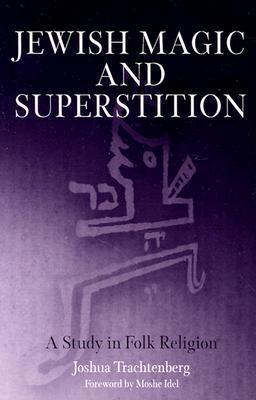
Jewish Magic and Superstition: A Study in Folk Religion
Alongside the formal development of Judaism from the eleventh through the sixteenth centuries, a robust Jewish folk religion flourished—ideas and practices that never met with wholehearted approval by religious leaders yet enjoyed such wide popularity that they could not be altogether excluded from the religion. According to Joshua Trachtenberg, it is not possible truly to understand the experience and history of the Jewish people without attempting to recover their folklife and beliefs from centuries past.
Jewish Magic and Superstition is a masterful and utterly fascinating exploration of religious forms that have all but disappeared yet persist in the imagination. The volume begins with legends of Jewish sorcery and proceeds to discuss beliefs about the evil eye, spirits of the dead, powers of good, the famous legend of the golem, procedures for casting spells, the use of gems and amulets, how to battle spirits, the ritual of circumcision, herbal folk remedies, fortune telling, astrology, and the interpretation of dreams.
First published more than sixty years ago, Trachtenberg's study remains the foundational scholarship on magical practices in the Jewish world and offers an understanding of folk beliefs that expressed most eloquently the everyday religion of the Jewish people.
Jewish Magic and Superstition is a masterful and utterly fascinating exploration of religious forms that have all but disappeared yet persist in the imagination. The volume begins with legends of Jewish sorcery and proceeds to discuss beliefs about the evil eye, spirits of the dead, powers of good, the famous legend of the golem, procedures for casting spells, the use of gems and amulets, how to battle spirits, the ritual of circumcision, herbal folk remedies, fortune telling, astrology, and the interpretation of dreams.
First published more than sixty years ago, Trachtenberg's study remains the foundational scholarship on magical practices in the Jewish world and offers an understanding of folk beliefs that expressed most eloquently the everyday religion of the Jewish people.
392 pages, Paperback
First published June 1, 1970
About the author
Joshua Trachtenberg
28 books5 followersJoshua Trachtenberg was a reform Rabbi based in the United States of America. He had a notable career as a congregational Rabbi and scholarly writer.
Ratings & Reviews
Friends & Following
Create a free account to discover what your friends think of this book!
Community Reviews
Displaying 1 - 17 of 17 reviews

February 25, 2012
Today you would never know but back in Medieval Germany and Northern Europe Jews were feared as sorcerers and magicians. The Jews lived separately from non Jews so there was lots of room for misunderstanding. While Jews were sought after for their medical expertise and knowledge of Herbs they were also feared as poisoners thanks to that same knowledge. If a Jewish doctor healed someone he ran risk because if the person dies he would be accused of poisoning that person.
The Jewish people got most of their anti witch prejudice from the surrounding Christians. It was forbidden in the Old Testament to practice witch craft. Witches were seen as people flying on broomsticks and cavorting with the devil. For Christians the Devil was a big deal for the Jews he was a mere after thought. Jews were not allowed to practice magic that transformed the very nature of things. There were different penalties for different types of magic. There was no penalty for working with Angels and Demons. Most Jewish magic consisted of working with Angels, Demon and different names of God.
Demons were thought to be an ever present threat. They were thought to inhabit desolate places, abandoned houses and what not. If some one moved into a barren place or into an abandoned house they had to placate the demon with offering. Sometimes the demon would drive them out. Most Jewish demonolatry came from Greek, Roman, and Babylonian sources. From the Jewish perspective there were shdeim who had human form and yet could be invisible. They could eat and drink. The Lilin which were succubae and incubi made love to people and drank their blood. Humans and demon could have offspring together. They were high up in the demon echelon. Some Demon lore came from the Germans. Mares would cause bad dream. There were others as well. Demons were thought to be created by God before Sabbath but due to the onset of the Sabbath he did not give them bodies. Lilith Adams first wife created a bunch of demon also by cavorting with animals.
Angels were servants of God. They could only do his will, yet in seemingly contradiction the magicians could compel them as long as it was in line with the angel’s basic creation. The Angels name changed according to the name that it was given. There were names given to Angels in the bible and Talmud but during medieval times there names proliferated. Where did those names originate from? Some of them are acronyms while others are permutations. Still others were derived from the name of Greek and Roman Gods.
The Dead sometimes came back especially if they had unfinished business. Sometimes they would tell a friend or loved one what life was like on the other side. Sometimes part of their spirit would haunt places and an exorcism would have to be done. If someone was really evil they became a demon. Medieval Jews believed in Astrology and propitious times for doing things. They had certain hour for when it was beneficial to pursue healing operation and others for money. For each day and time a different angel or arch angel was assigned and those name could be changed. The waxing moon was thought of as good for building enterprise while waning moon was for death and destruction.
This book is an old classic. You will get lots of good background information on it but no particular magical workings that will take further research. The foot notes are well tracked and documented although it takes up to 40 percent of the book. Since the sources by and large are not in English that could be a bit of a draw back. The book covered more than what I summarized so you will have to read it yourself to dig out those precious nugget.
The Jewish people got most of their anti witch prejudice from the surrounding Christians. It was forbidden in the Old Testament to practice witch craft. Witches were seen as people flying on broomsticks and cavorting with the devil. For Christians the Devil was a big deal for the Jews he was a mere after thought. Jews were not allowed to practice magic that transformed the very nature of things. There were different penalties for different types of magic. There was no penalty for working with Angels and Demons. Most Jewish magic consisted of working with Angels, Demon and different names of God.
Demons were thought to be an ever present threat. They were thought to inhabit desolate places, abandoned houses and what not. If some one moved into a barren place or into an abandoned house they had to placate the demon with offering. Sometimes the demon would drive them out. Most Jewish demonolatry came from Greek, Roman, and Babylonian sources. From the Jewish perspective there were shdeim who had human form and yet could be invisible. They could eat and drink. The Lilin which were succubae and incubi made love to people and drank their blood. Humans and demon could have offspring together. They were high up in the demon echelon. Some Demon lore came from the Germans. Mares would cause bad dream. There were others as well. Demons were thought to be created by God before Sabbath but due to the onset of the Sabbath he did not give them bodies. Lilith Adams first wife created a bunch of demon also by cavorting with animals.
Angels were servants of God. They could only do his will, yet in seemingly contradiction the magicians could compel them as long as it was in line with the angel’s basic creation. The Angels name changed according to the name that it was given. There were names given to Angels in the bible and Talmud but during medieval times there names proliferated. Where did those names originate from? Some of them are acronyms while others are permutations. Still others were derived from the name of Greek and Roman Gods.
The Dead sometimes came back especially if they had unfinished business. Sometimes they would tell a friend or loved one what life was like on the other side. Sometimes part of their spirit would haunt places and an exorcism would have to be done. If someone was really evil they became a demon. Medieval Jews believed in Astrology and propitious times for doing things. They had certain hour for when it was beneficial to pursue healing operation and others for money. For each day and time a different angel or arch angel was assigned and those name could be changed. The waxing moon was thought of as good for building enterprise while waning moon was for death and destruction.
This book is an old classic. You will get lots of good background information on it but no particular magical workings that will take further research. The foot notes are well tracked and documented although it takes up to 40 percent of the book. Since the sources by and large are not in English that could be a bit of a draw back. The book covered more than what I summarized so you will have to read it yourself to dig out those precious nugget.

December 25, 2021
This book is definitely in the library at Sunnydale High School, in the occult section. The evil eye, dream interpretation, when and under what conditions to battle the little demons that are everywhere--that kind of stuff is inside.
The author assumes the reader understands both German and Hebrew -- he quotes from both languages and does not translate.
Trachtenberg originally wrote this book in 1939, after Kristalnacht but before the Holocaust. He focuses on German Jewry in the middle ages, so there is a certain horrible ironic pall over the whole book.
In the middle ages, everyone was *really* superstitious--Christians as well as Jews. Life used to be a lot different when scientific research played little to no role in the life of ordinary folks.
In the end, the book fails because there's no thesis. There's just a lot of beliefs about a lot of different things jammed in there, presented by a detached speaker.
The author assumes the reader understands both German and Hebrew -- he quotes from both languages and does not translate.
Trachtenberg originally wrote this book in 1939, after Kristalnacht but before the Holocaust. He focuses on German Jewry in the middle ages, so there is a certain horrible ironic pall over the whole book.
In the middle ages, everyone was *really* superstitious--Christians as well as Jews. Life used to be a lot different when scientific research played little to no role in the life of ordinary folks.
In the end, the book fails because there's no thesis. There's just a lot of beliefs about a lot of different things jammed in there, presented by a detached speaker.
November 27, 2010
I would give this book a far higher rating. It is to this day the "go-to" book on this subject. Not only is it packed with information, covering a multitude of subjects, it is written in a thoroughly readable style, with authority and wit.
Another reviewer's statement that the author relied on "merely a handful of sources", and mainly on the Sefer Hasidim, is utterly absurd. While the Sefer Hasidim is deservedly well-represented, a glance at any page of notes will refute that reviewer's ill-considered statement. Trachtenberg had deep knowledge of the sources, from responsa to minhagim to talmud and many, many other obscure (to the average reader) sources, both in print and manuscript. His source list covers 15 full pages (5 pages of Hebrew sources + additional literature)!
Trachtenberg focused on the medieval European world that sprang from the Hasidei Ashkenaz, the school of Rabbi Judah the Pious that produced the Sefer Hasidim, thus its prominence (but very far from exclusivity) as a source. He chose this area because of its richness, and its absorption and "Judaization" of the folk beliefs current in the local cultures within which the Jews existed. His sources, within his area of focus, are indeed extensive, and more than sufficient for an introductory book of this nature, which aims to give an overview of a complex phenomenon.
On a personal note, I have collected and translated Hebrew magic manuscripts (kabbalah ma'asit) for many years, counting more than a hundred manuscripts and rare books in my modest collection. Trachtenberg's book provided the inspiration for choosing this area of study; it is still the best introduction by far for the non-specialist.
Read this book with confidence, and mostly, with pleasure.
Another reviewer's statement that the author relied on "merely a handful of sources", and mainly on the Sefer Hasidim, is utterly absurd. While the Sefer Hasidim is deservedly well-represented, a glance at any page of notes will refute that reviewer's ill-considered statement. Trachtenberg had deep knowledge of the sources, from responsa to minhagim to talmud and many, many other obscure (to the average reader) sources, both in print and manuscript. His source list covers 15 full pages (5 pages of Hebrew sources + additional literature)!
Trachtenberg focused on the medieval European world that sprang from the Hasidei Ashkenaz, the school of Rabbi Judah the Pious that produced the Sefer Hasidim, thus its prominence (but very far from exclusivity) as a source. He chose this area because of its richness, and its absorption and "Judaization" of the folk beliefs current in the local cultures within which the Jews existed. His sources, within his area of focus, are indeed extensive, and more than sufficient for an introductory book of this nature, which aims to give an overview of a complex phenomenon.
On a personal note, I have collected and translated Hebrew magic manuscripts (kabbalah ma'asit) for many years, counting more than a hundred manuscripts and rare books in my modest collection. Trachtenberg's book provided the inspiration for choosing this area of study; it is still the best introduction by far for the non-specialist.
Read this book with confidence, and mostly, with pleasure.

June 24, 2017
If you're interested in Medieval Jewish folklore, this is the book for you.
I bought it as research for a piece of fiction, and by the time I had written the relevant parts I was only halfway through this book. I found it a bit of a slog to continue reading; the writing is not overly engaging.
A wide range of topics is covered - such as astrology, beliefs in spirits, dream interpretation, magic systems, etc. I did not find all of the topics interesting.
As far as I am aware there is no other book on this topic, so if you want to learn about Medieval Jewish folklore, this is the book for you. I cannot enthusiastically recommend it, though I am happy for having read it.
I bought it as research for a piece of fiction, and by the time I had written the relevant parts I was only halfway through this book. I found it a bit of a slog to continue reading; the writing is not overly engaging.
A wide range of topics is covered - such as astrology, beliefs in spirits, dream interpretation, magic systems, etc. I did not find all of the topics interesting.
As far as I am aware there is no other book on this topic, so if you want to learn about Medieval Jewish folklore, this is the book for you. I cannot enthusiastically recommend it, though I am happy for having read it.

June 5, 2007
This is the author's doctoral dissertation in revised form. It was originally published in 1939. It is dated now, however any student of Jewish mysticism or western esotericism must be familiar with this seminal book, if for no other reason than to challenge it. Trachtenberg primarily relied on merely a handful of sources, Sefer Hasidim being the most primary.

June 1, 2015
Trachtenberg is apparently THE go-to text on the topic. A fascinating, surprisingly readable overview for the uninitiated.

January 5, 2019
This book looks at medieval magic from a specifically Jewish standpoint. Although Jewish and Christian magic had many things in common, there are differences that come about from using Hebrew rather than Latin, and from some Jewish proscriptions, such as the refusal to eat blood. The book was very interesting, and covered everything from how to "create" an Angel's name to necromancy to astrology. It has made me curious about medieval magic in general, and I wonder if I can find a book on that which is as straightforward and easy to read as this one.
All of the magic in this book predates kabbalah, which arose at the beginning of the 17th century. This looks specifically at medieval magic with some discussion of Talmudic era magic, and what was forbidden and allowed by the Talmud.
All of the magic in this book predates kabbalah, which arose at the beginning of the 17th century. This looks specifically at medieval magic with some discussion of Talmudic era magic, and what was forbidden and allowed by the Talmud.
February 23, 2023
I rate this book highly based on the content because it is truly a repository of interesting ideas and beliefs from Medieval Jewish folk practice, but I caution you that the book is Dense with a capital "D". Trachtenberg has written this for an initiated academic audience, and it shows; as someone without even a passing familiarity with Hebrew, there were parts where I found myself having to stop and research a concept or translate something mid-idea just to follow. Nevertheless, I could not ask for a more complete treasure trove of these beliefs and ultimately the book is a excellent on those merits alone.

October 22, 2017
A little dated at times (especially as applies to non-Jewish terms--Mohammedan, really?!?!) but a perennial classic. Paired with Gershom Scholem's Major Trends in Jewish Mysticism, the two works present a great survey of mysticism and folk religion from the Talmudic period to the beginning of the Renaissance.

May 2, 2024
Had to file as DNF. Overall a great book of odds and ends surrounding Jewish Medieval era history, but unfortunately a LOT of the book was in untranslated (and sometimes even untranslatable) German, French, and Hebrew, making it impossible to get through at a certain point (and this is coming from someone fluent in French and with some basic Hebrew literacy).
May 16, 2025
This was a great resource to learn and re-learn some things about Jewish magic and superstition for sure. I liked learning some of the mystical backstories for some rituals that have since been shrouded in halakhic excuses, lol! The book is a little dry and academic, obviously, and a bit outdated here and there, but pretty solid.
January 27, 2026
A dense and rewarding look at the subject, for those interested. Which very much includes me. Though i lack in the multiple research languages needed to fully comprehend this (german, hebrew, yiddish), i still feel very fulfilled and enlightened having read this.

July 16, 2023
An excellent overview of the traditions of folk Judaism in the Middle Ages.

September 24, 2013
A scholarly but not dry intro to many of the magical beliefs of the Jewish people. Very comprehensive, but lightened by the author's sense of humor. The rituals and beliefs are explained via tradition, religion, and magical theory, with plenty of examples given. Stories and anecdotes are told also to color the superstitions discussed.
One problem: quotes in foreign languages are not translated, so brush up on your German!
One problem: quotes in foreign languages are not translated, so brush up on your German!
June 6, 2011
Really interesting topics -- addresses the source of the mezuzah; addresses incantations, amulets, the evil eye, superstitions associated with pregnancy, death, illnesses, etc; omens, dreams. The books is a bit academic in nature so can be pretty dry reading. Lots of Hebrew that is not translated.
August 5, 2012
I'm so much interested to read this book..
Read
April 24, 2017The best.
Displaying 1 - 17 of 17 reviews