What do you think?
Rate this book


122 pages, Paperback
First published January 1, 2008
‘Perhaps in the end it was more about love than friendship? What other name is there for this urgent, violent marriage of minds, the appalling prospect of someone going to pieces, the impossibility of being indifferent, the joy you feel when at last they’re sleeping peacefully?’
‘Like the profuse material of life to which a text gives form and meaning, the turmoil and mystery of Fanny’s emotions demanded to be worked upon. She was the living example of what a Narrator has to confront every hour of every day. She was a book from before the book.’
‘ Perhaps we all have lives the person closest to us knows nothing of? And perhaps this is what really attracts us to each other: the presence of this secret life which, from time to time, is revealed to us through a gleaming, narrow slit. The vision is fleeting and comes as a complete surprise; all our convictions are shaken because, however observant we might be, we hadn’t noticed a thing.’
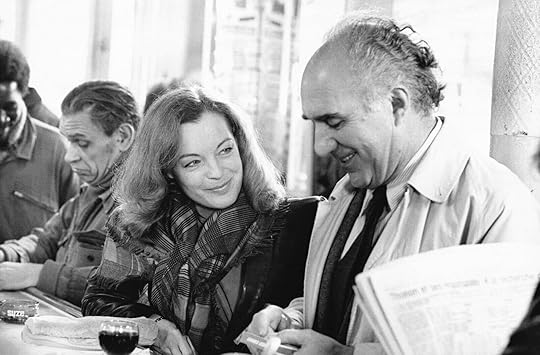
Just like The Beginners – and I have only written this sort of novel twice – it is a book of circumstance. A Leopard-Skin Hat came about after my younger sister’s probable suicide when she was 43. I wrote this book to make a tomb for her, so that her whole body and soul wouldn’t completely disappear. The only way I could express her struggle to live, her unhappiness, and also her unique genius, was to step out of my position as her sister and put myself in the place of a narrator who knows how to tell stories.”
“It’s really not fair,” declares Fanny, “that I and others whom you claim so fervently to love are the very people you fleece. You’re a wolf, narrator, and I detest your story. What on earth were you thinking when you set me down in a ‘country asylum’? Who do you take me for? How dare you turn me into a sort of paper puppet!” “But that’s the whole point,” mumbles the narrator, “it’s not you I have painted, it’s an image that you call to mind.” “And this body you describe. How dare you describe my body and my arms and my hands!” exclaims Fanny. “Because sometimes I bore that body,” grumbles the narrator. “Oh you did, did you? And why exactly did you bear it? So that you could make use of it perhaps? So that you could take possession of it? “Perhaps,” says the narrator. “Perhaps I do nothing cleanly. Perhaps, in spite of myself, I can only act inside a book.”
[...]
Fanny chimes in, “you describe all of us solely in terms of our weaknesses. That, narrator, is what is unacceptable. Your book is a way of seizing power, and by the same token, an attempt to destroy us.” “And when you do describe our qualities,” Madame Saintier pitches in, “you’re so supercilious and patronizing that they come across as ridiculous and pitiful!” “I think we’ll have to kill him,” someone remarks. “Or at least get him to write another book,” says another, a little alarmed by the turn events are taking.
It was like telling a story: you had to be extremely focused in order to piece the elements together, to be in an almost trancelike state where forms arise and take shape that never appear directly to reason. You had to formulate a question as accurately as possible and, in the painstaking work of edification that ensued, produce the kind of answer that never states its name but foists itself on the reader as one of the truths of human existence. Like the profuse material of life to which a text gives form and meaning, the turmoil and mystery of Fanny's emotions demanded to be worked upon. She was the living example of what a Narrator has to confront every hour of every day. She was a book from before the book.
No doubt we all have someone else inside us, thought the Narrator, though, to tell the truth, I've never felt this with anyone but Fanny. And if I examine my conscience, the Narrator went on, I know that I myself am that character, the writer's secret twin, the one writing this story and the stranger within. But unlike this blonde-haired woman hiding behind her curtain, I work. When my master cries out to me for a story, even if I'm accustomed to not answering him at once, playing hard to get because I'm not servile, I always respond in the end because I would get bored otherwise and because it's my role in life.
For were you to place Fanny on a sculptor's stand and slowly revolve the object you had before you, the number of facets you would discover would be quite astonishing. Turn it again, and still others would appear, each different from the last, depending on the lighting o your mood that day - if you were angry rather than affectionate, happy rather than sad, certain details would change - conversations you'd had that morning, memories you'd brought with you. 'Suppose I were to place other friends on that turntable and, like a phrenologist, examine them closely, with my fingers: would I glean as much information, would I discover as many crannies, craters, mountains, and landscapes?' the Narrator wonders. He thinks of friends he is fond of, and tells himself, no, the whole thing would be wrapped up in ten pages. Perhaps it's mental illness that transforms you into a landscape.
Perhaps we all have lived the person closest to us knows nothing of? And perhaps this is what really attracts us to each other: the presence of this secret life which, from time to time, is revealed to us through a gleaming narrow slit. The vision is fleeting and comes as a complete surprise; all our convictions are shaken because however observant we might be, we hadn’t noticed a thing.
Can we write more or less accurately when we start from nothing? That would certainly seem to be the case, and yet, all things considered, it is rather surprising. This nothing isn't altogether nothing after all. It's frantic desire to understand - which is not nothing- an accumulation of delights dread largely from reading; which is not nothing either. There's a good deal of happiness and desire, in other words. Is that what we write with, then? Happiness and desire? At the same time, the Narrator worries that he might simply be serving a very peculiar writer... At the same time, you work in the mercilessly medieval attic inhabited by all serious Narrators, at something which neither he (the writer) nor you (the Narrator) fully understand, and yet here you are, the pair of you, thrumming away at the heights, happy and content, and you can work like this for hours on end, describing your wonderful friend Fanny, who is unfathomable and who is dead, and whose death, the m moment you embark on your story, has turned into fiction.