

What do you think?

Kibogo
In four beautifully woven parts, Mukasonga spins a marvelous recounting of the clash between ancient Rwandan beliefs and the missionaries determined to replace them with European Christianity.
When a rogue priest is defrocked for fusing the gospels with the martyrdom of Kibogo, a fierce clash of cults ensues. Swirling with the heady smell of wet earth and flashes of acerbic humor, Mukasonga brings to life the vital mythologies that imbue the Rwandan spirit. In doing so, she gives us a tale of disarming simplicity and profound universal truth.
Kibogo’s story is reserved for the evening’s end, when women sit around a fire drinking honeyed brew, when just a few are able to stave off sleep. With heads nodding, drifting into the mist of a dream, one faithful storyteller will weave the old legends of the hillside, stories which church missionaries have done everything in their power to expunge.
To some, Kibogo’s tale is founding myth, celestial marvel, magic incantation, bottomless source of hope. To white priests spritzing holy water on shriveled, drought-ridden trees, it looms like red fog over the village: forbidden, satanic, a witchdoctor’s hoax. All debate the twisted roots of this story, but deep down, all secretly wonder—can Kibogo really summon the rain?
When a rogue priest is defrocked for fusing the gospels with the martyrdom of Kibogo, a fierce clash of cults ensues. Swirling with the heady smell of wet earth and flashes of acerbic humor, Mukasonga brings to life the vital mythologies that imbue the Rwandan spirit. In doing so, she gives us a tale of disarming simplicity and profound universal truth.
Kibogo’s story is reserved for the evening’s end, when women sit around a fire drinking honeyed brew, when just a few are able to stave off sleep. With heads nodding, drifting into the mist of a dream, one faithful storyteller will weave the old legends of the hillside, stories which church missionaries have done everything in their power to expunge.
To some, Kibogo’s tale is founding myth, celestial marvel, magic incantation, bottomless source of hope. To white priests spritzing holy water on shriveled, drought-ridden trees, it looms like red fog over the village: forbidden, satanic, a witchdoctor’s hoax. All debate the twisted roots of this story, but deep down, all secretly wonder—can Kibogo really summon the rain?
4 pages, Audible Audio
First published March 12, 2020
About the author
Scholastique Mukasonga
23 books389 followersBorn in Rwanda in 1956, Scholastique Mukasonga experienced from childhood the violence and humiliation of the ethnic conflicts that shook her country. In 1960, her family was displaced into the under-developed Nyamata. In 1973, she was forced to leave the school of social assistance in Butare and flee to Burundi. She settled in France in 1992. The genocide of the Tutsi swept through Rwanda 2 years later. Mukasonga learned that 27 of her family members had been massacred. Twelve years later, Gallimard published her autobiographical account Inyenzi ou les Cafards, which marked Mukasonga's entry into literature. Her first novel, Notre-Dame du Nil, won the Ahamadou Kourouma prize and the Renaudot prize in 2012.
(from http://www.citylights.com/info/?fa=ev...)
(from http://www.citylights.com/info/?fa=ev...)
Ratings & Reviews
Friends & Following
Create a free account to discover what your friends think of this book!
Community Reviews
Displaying 1 - 30 of 203 reviews

September 23, 2022
Even peoples without writing love their libraries.
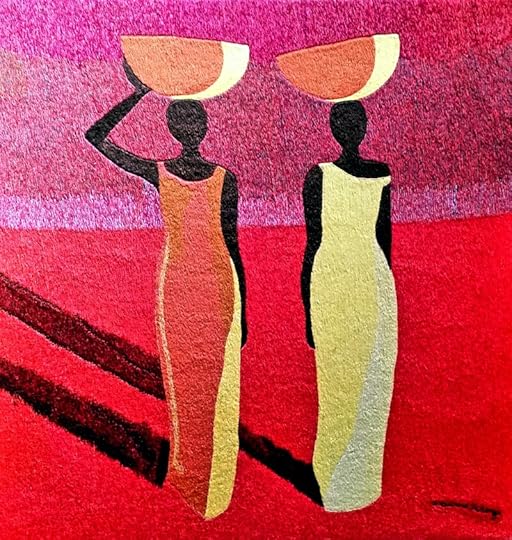
Mukamwezi’s silhouette floated and undulated in the grain of the dusty fog like a reflection in the flowing water of a river. At times her pale face seemed to drift away from the rest of her body and hover on the swirls of mist.
Having been wanting to read France-based Rwandan author Scholastique Mukasonga since Katia’s fascinating review on Our Lady of the Nile put her firmly on my radar about five years ago, I was thrilled getting the chance to read Kibogo, the English translation of Kibogo est monté au ciel as a first acquaintance with Mukasonga’s work, as none of her books are available in the local library.
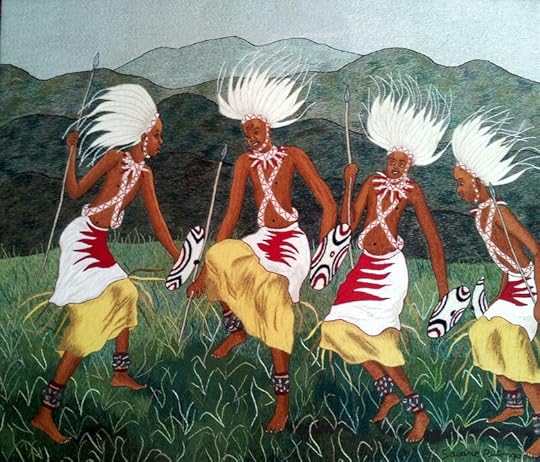
Kibogo surpassed my (high) hopes and expectations. How to portend that Mukasonga would weave a fairy tale-esque, humorous, satiric folktale out of elements as drought, famine, (German and Belgian) colonisation and the supplanting of Rwandan mythology and cults by forced evangelisation?
Told in four interlocking fragments, Mukasonga’s tale is not only well-composed and written in a gorgeous, gossamer prose larded with Rwandan history and culture, but it is also an astute commentary on colonialism and exploitation. She lampoons Western Christian proselytism, superiority thinking and preposterous appropriation of African historiography. Notwithstanding the import and weight of these topics, this book surprises with its light tone, and so probably shows a quite different side of Mukasonga’s craft than her account on the Rwandan genocide (Cockroaches). The joy of writing this clearly splashes from Mukasonga’s imaginative storytelling. She breathes life into the priestess/sorceress Mukamwezi and the befuddled seminarian Akayezu with panache. Depicting the old men of the village rivalling to tell the tallest stories to give a French professor coming around to jot down their legends - hoping to find traces of cannibalism that fit into his theories - value for his money, she shows her keen eye for colourful detail.
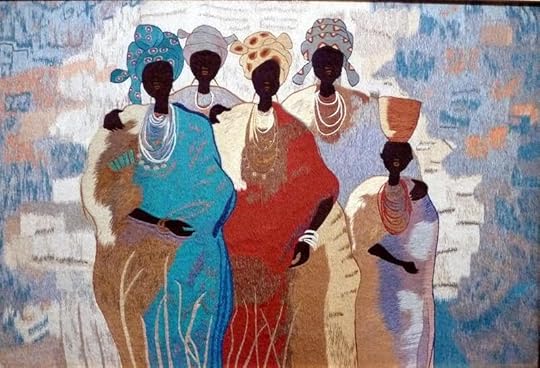
I was quite amused by the way Mukasonga toys with religious paradigms, drawing parallels between the pagan beliefs and some core points of belief in Christianity, applying her irreverent brush to the twists and connections between them (the worshipping of the statue of Maria, a circle of women as apostles, the self-sacrifice, Ascension and Assumption of Jesus/Mary and Kibogo/Akayezu/Mukawezi). With barbed understatement and irony Mukasonga shows how the padri, the white missionaries, don’t really practise what they preach on the Christian values but rather use their doctrines to scare off and intimidate their newly converted flock into obedience.
The legend of Mukamwezi became part of the storytellers’ nocturnal repertoire. In it, she was reunited with Kibogo and his retinue behind the clouds and dancing on the crest of the mountain, she adorned herself with pearls of rain. And the murmur of the story blended with the dreams of the child Akayezu nestled in his mother’s pagne, half dozing in the warmth of the heart, until they were one and the same.
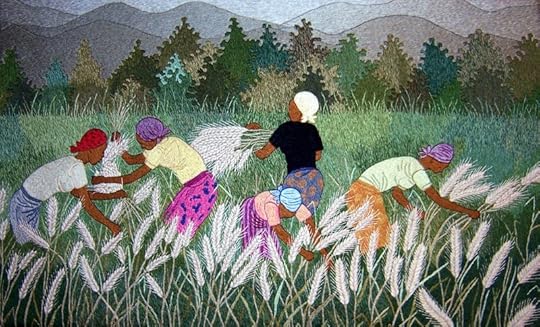
A wondrous tribute to the art of storytelling, I couldn’t have dreamt of a more marvellous introduction to a new-to-me writer.
(****1/2)
(The illustrations are pictures of the textile art created by women belonging to the Savane Rutongo-Kabuye workshop from a mountain village close to Kigali).
Many thanks to the author, Netgalley and Archipelago Books for generously granting me an ARC.
Mukamwezi’s silhouette floated and undulated in the grain of the dusty fog like a reflection in the flowing water of a river. At times her pale face seemed to drift away from the rest of her body and hover on the swirls of mist.
Having been wanting to read France-based Rwandan author Scholastique Mukasonga since Katia’s fascinating review on Our Lady of the Nile put her firmly on my radar about five years ago, I was thrilled getting the chance to read Kibogo, the English translation of Kibogo est monté au ciel as a first acquaintance with Mukasonga’s work, as none of her books are available in the local library.
Kibogo surpassed my (high) hopes and expectations. How to portend that Mukasonga would weave a fairy tale-esque, humorous, satiric folktale out of elements as drought, famine, (German and Belgian) colonisation and the supplanting of Rwandan mythology and cults by forced evangelisation?
Told in four interlocking fragments, Mukasonga’s tale is not only well-composed and written in a gorgeous, gossamer prose larded with Rwandan history and culture, but it is also an astute commentary on colonialism and exploitation. She lampoons Western Christian proselytism, superiority thinking and preposterous appropriation of African historiography. Notwithstanding the import and weight of these topics, this book surprises with its light tone, and so probably shows a quite different side of Mukasonga’s craft than her account on the Rwandan genocide (Cockroaches). The joy of writing this clearly splashes from Mukasonga’s imaginative storytelling. She breathes life into the priestess/sorceress Mukamwezi and the befuddled seminarian Akayezu with panache. Depicting the old men of the village rivalling to tell the tallest stories to give a French professor coming around to jot down their legends - hoping to find traces of cannibalism that fit into his theories - value for his money, she shows her keen eye for colourful detail.
I was quite amused by the way Mukasonga toys with religious paradigms, drawing parallels between the pagan beliefs and some core points of belief in Christianity, applying her irreverent brush to the twists and connections between them (the worshipping of the statue of Maria, a circle of women as apostles, the self-sacrifice, Ascension and Assumption of Jesus/Mary and Kibogo/Akayezu/Mukawezi). With barbed understatement and irony Mukasonga shows how the padri, the white missionaries, don’t really practise what they preach on the Christian values but rather use their doctrines to scare off and intimidate their newly converted flock into obedience.
The legend of Mukamwezi became part of the storytellers’ nocturnal repertoire. In it, she was reunited with Kibogo and his retinue behind the clouds and dancing on the crest of the mountain, she adorned herself with pearls of rain. And the murmur of the story blended with the dreams of the child Akayezu nestled in his mother’s pagne, half dozing in the warmth of the heart, until they were one and the same.
A wondrous tribute to the art of storytelling, I couldn’t have dreamt of a more marvellous introduction to a new-to-me writer.
(****1/2)
(The illustrations are pictures of the textile art created by women belonging to the Savane Rutongo-Kabuye workshop from a mountain village close to Kigali).
Many thanks to the author, Netgalley and Archipelago Books for generously granting me an ARC.

September 17, 2022
The more I read from Rwandan writer Scholastique Mukasonga, the more I appreciate the themes and forms she pursues across her work. Kibogo is a set of four stories, translated into English by Mark Polizzotti. The stories are linked thematically and with many of the same characters so that the entire book can be seen as a novella. The stories are episodic, giving the feel of tales told by an elder storyteller in the village over four successive nights. A recurring theme is the interplay between traditional Rwandan beliefs and an insidious form of Roman Catholicism imposed on Rwandans by the colonizing Belgians. The result is a practical syncretism, sometimes to humorous effect, but the result is also an eventual erasure of Rwandan culture and self identity. As a western reader, the stories sometimes felt like they lacked heft, focusing on characters who were less interesting than the post-colonial critiques running between the lines. But of course, the book isn't written primarily for a western reader. Instead, these are entertaining character driven stories, largely for a Rwandan audience that already has an acute understanding of the havoc wreaked by colonialism. Read in that light, Mukasonga's primary objective is to return a mythology to the Rwandan people, a step toward undoing the erasure of their culture while retaining an awareness of what was lost and how it was taken.

September 19, 2022
In Kibogo Scholastique Mukasonga pays tribute to the storytelling of her mother Stefania, who passed on lore and legend from her own past in Rwanda to her daughter. Set in 1940s and 1950s Rwanda, Mukasonga’s novel’s composed of a series of interlinking stories centred on an unnamed, rural, hillside community. Each episode recounts elements of the battle between Christian colonisers and locals striving to hold onto their traditional belief systems, together they form a fascinating commentary on the connections between the imposition of Western religious practices and imperialism. And, despite a definite fable-like quality, Mukasonga’s book’s firmly rooted in Rwanda’s history. There are numerous references to actual colonialist policies as well as the propaganda spread by figures of colonial authority like Pierre Ryckmans.
Mukasonga’s narrative opens in 1943 during the Ruzagayura Famine in which countless Rwandans died. The Belgian, colonial, administration siphoned off food that could have alleviated suffering in Rwanda, diverting it instead to Belgian wartime forces and those of the British in Uganda and Tanganyika, a project that fuelled protests across Rwanda. Mukasonga’s reflection on the impact on one small community slowly turns into a critique of the uses of religious institutions to shore up colonialism and “naturalise” material exploitation. The villagers are torn about how to end the drought, many recalling the ancient legend of Kibogo, a princely figure who ascended to the heavens to bring rain during a similar period in Rwanda’s past. The colonial administration spreads a rumour that a man called Hitler is to blame. But the “White Fathers “or “padri”, the white, Christian priests, make it clear that it’s the fault of individual Rwandans, whose stubborn clinging to “pagan” forms of worship has stirred up their God’s wrath. Desperate for rain, the beleaguered villagers debate their likeliest route to salvation. Is it via Kibogo and his earthly bride, village outcast Mukamwezi or the Christian God and the Virgin Mary?
The next sections take place several years later when a local boy, who was dispatched to a seminary to train as a priest, unexpectedly comes home. Horrifyng his white mentors, Akayesu's (little-Jesus) solution to the ongoing conflict between his ancestral religion and Christianity is to merge the two. Akayesu’s actions lead him to Mukamwezi. Branded a witch by the local Christian priests she’s now living on the outskirts of the village. Akayesu and Mukamwezi' relationship is set to become part of the rich mythology surrounding Kibogo, in a bizarre fusing of Rwandan and Christian notions of sacrifice, resurrection and miracles – echoing the ways in which the colonised managed to retain vestiges of their own cultural systems while outwardly submitting to their colonisers’ religion.
In her final chapter, Mukasonga weaves a wonderfully satirical tale around the arrival of a pompous, European professor who, rather ironically, is set on collecting imigani, the Rwandan folk tales his fellow Europeans have worked so hard to eradicate. But he too, has his own agenda, greedy for anything that confirms his suspicions about hidden sites of human sacrifice and sinister pagan rites. Mukasonga’s novel’s a compelling take on the cultural violence that went hand-in-hand with the literal violence of the "Bazungu’s" (white) colonialist methods, and the central role of various incarnations of the Christian church in enforcing and maintaining colonial rule. But it’s also an act of redemption, a means of rescuing the rich, oral histories Rwanda’s colonists tried so hard to destroy. Translated by Mark Polizotti.
Thanks to Netgalley and publisher Archipelago Books for an ARC
Rating: 3.5
Mukasonga’s narrative opens in 1943 during the Ruzagayura Famine in which countless Rwandans died. The Belgian, colonial, administration siphoned off food that could have alleviated suffering in Rwanda, diverting it instead to Belgian wartime forces and those of the British in Uganda and Tanganyika, a project that fuelled protests across Rwanda. Mukasonga’s reflection on the impact on one small community slowly turns into a critique of the uses of religious institutions to shore up colonialism and “naturalise” material exploitation. The villagers are torn about how to end the drought, many recalling the ancient legend of Kibogo, a princely figure who ascended to the heavens to bring rain during a similar period in Rwanda’s past. The colonial administration spreads a rumour that a man called Hitler is to blame. But the “White Fathers “or “padri”, the white, Christian priests, make it clear that it’s the fault of individual Rwandans, whose stubborn clinging to “pagan” forms of worship has stirred up their God’s wrath. Desperate for rain, the beleaguered villagers debate their likeliest route to salvation. Is it via Kibogo and his earthly bride, village outcast Mukamwezi or the Christian God and the Virgin Mary?
The next sections take place several years later when a local boy, who was dispatched to a seminary to train as a priest, unexpectedly comes home. Horrifyng his white mentors, Akayesu's (little-Jesus) solution to the ongoing conflict between his ancestral religion and Christianity is to merge the two. Akayesu’s actions lead him to Mukamwezi. Branded a witch by the local Christian priests she’s now living on the outskirts of the village. Akayesu and Mukamwezi' relationship is set to become part of the rich mythology surrounding Kibogo, in a bizarre fusing of Rwandan and Christian notions of sacrifice, resurrection and miracles – echoing the ways in which the colonised managed to retain vestiges of their own cultural systems while outwardly submitting to their colonisers’ religion.
In her final chapter, Mukasonga weaves a wonderfully satirical tale around the arrival of a pompous, European professor who, rather ironically, is set on collecting imigani, the Rwandan folk tales his fellow Europeans have worked so hard to eradicate. But he too, has his own agenda, greedy for anything that confirms his suspicions about hidden sites of human sacrifice and sinister pagan rites. Mukasonga’s novel’s a compelling take on the cultural violence that went hand-in-hand with the literal violence of the "Bazungu’s" (white) colonialist methods, and the central role of various incarnations of the Christian church in enforcing and maintaining colonial rule. But it’s also an act of redemption, a means of rescuing the rich, oral histories Rwanda’s colonists tried so hard to destroy. Translated by Mark Polizotti.
Thanks to Netgalley and publisher Archipelago Books for an ARC
Rating: 3.5

October 31, 2022
The written word can be obliterated. Conversely, the stories that pass from mouth to mouth will continue to endure. The whispers and inflections that inspired written codification are timeless, echoing in the air forever.Scholastique Mukasonga’s novel” Kibogo” is a paean to storytelling and oral tradition, reaffirming the power of the spoken word while excoriating the effects of colonial subversion of culture and tradition.
The novel is structured in four interconnected sections that present layered versions of a Rwandan salvation myth. The first section begins in the 1940s when Rwanda was a Belgian colony. Each subsequent section moves forward in time, culminating sometime before the Rwandan genocide in 1994. Each story retells and adds depth to the original legend, coalescing into a four part allegory that blurs the lines between history and myth.
The central narrative strand highlights repression and conflict between Rwandan tradition and colonial bureaucratic and theological officials. In 1943, Rwanda was in the midst of the Ruzagayura Famine. During a period of drought, thousands of Rwandans starved while the Belgian colonial authorities diverted food and resources to the war effort on the African continent. Desperate for a solution, local villagers remembered and resuscitated the legend of Kibogo, an ancient figure who rose to the sky to bring rain to the land during a previous drought,
The famine brought the dormant legend to life and created tensions with proselytizing Christian priests and colonial rulers, who disparaged the story as a pagan belief. This conflict propels the novel forward. Each section has a different character and voice retell the legend with different textures and unique embellishments that complicate the stories and reveal the rifts in the political and theological entities.We meet Akayesu, a defrocked priest whose crime was trying to merge Rwandan legend with Christian religion. Mukamwezi, a “ sorceress” and village pariah, adds additional perspective. Finally, we encounter the village elders, who were young boys at the outset of the novel. Their conflicting accounts add additional layers of fact and awe to the legend.
The sections fuse to create a kaleidoscopic view of Rwandan history and culture.Each retelling adds a layer to the panorama of colonial suppression and cultural rapacity. Mussonga’s talent is revealed in her narrative style. She couches the horrors that have beset her homeland in a tone that is whimsical and ironic, exposing these horrors with subtle humor. Most importantly, the author reminds us that stories and foundational legends prevent physical oppression from transforming into spiritual degradation. In this way, stories and legends that travel in the air assume a power that defies eradication and allows cultures to survive into the future.
The novel is structured in four interconnected sections that present layered versions of a Rwandan salvation myth. The first section begins in the 1940s when Rwanda was a Belgian colony. Each subsequent section moves forward in time, culminating sometime before the Rwandan genocide in 1994. Each story retells and adds depth to the original legend, coalescing into a four part allegory that blurs the lines between history and myth.
The central narrative strand highlights repression and conflict between Rwandan tradition and colonial bureaucratic and theological officials. In 1943, Rwanda was in the midst of the Ruzagayura Famine. During a period of drought, thousands of Rwandans starved while the Belgian colonial authorities diverted food and resources to the war effort on the African continent. Desperate for a solution, local villagers remembered and resuscitated the legend of Kibogo, an ancient figure who rose to the sky to bring rain to the land during a previous drought,
The famine brought the dormant legend to life and created tensions with proselytizing Christian priests and colonial rulers, who disparaged the story as a pagan belief. This conflict propels the novel forward. Each section has a different character and voice retell the legend with different textures and unique embellishments that complicate the stories and reveal the rifts in the political and theological entities.We meet Akayesu, a defrocked priest whose crime was trying to merge Rwandan legend with Christian religion. Mukamwezi, a “ sorceress” and village pariah, adds additional perspective. Finally, we encounter the village elders, who were young boys at the outset of the novel. Their conflicting accounts add additional layers of fact and awe to the legend.
The sections fuse to create a kaleidoscopic view of Rwandan history and culture.Each retelling adds a layer to the panorama of colonial suppression and cultural rapacity. Mussonga’s talent is revealed in her narrative style. She couches the horrors that have beset her homeland in a tone that is whimsical and ironic, exposing these horrors with subtle humor. Most importantly, the author reminds us that stories and foundational legends prevent physical oppression from transforming into spiritual degradation. In this way, stories and legends that travel in the air assume a power that defies eradication and allows cultures to survive into the future.

September 16, 2022
NATIONAL BOOK AWARD FOR LITERATURE IN TRANSLATION FINALIST!
It's my annual six-stars-of-five read!
Rating: 6* of five
The Publisher Says: In four beautifully woven parts, Mukasonga spins a marvelous recounting of the clash between ancient Rwandan beliefs and the missionaries determined to replace them with European Christianity.
When a rogue priest is defrocked for fusing the gospels with the martyrdom of Kibogo, a fierce clash of cults ensues. Swirling with the heady smell of wet earth and flashes of acerbic humor, Mukasonga brings to life the vital mythologies that imbue the Rwandan spirit. In doing so, she gives us a tale of disarming simplicity and profound universal truth.
Kibogo's story is reserved for the evening's end, when women sit around a fire drinking honeyed brew, when just a few are able to stave off sleep. With heads nodding, drifting into the mist of a dream, one faithful storyteller will weave the old legends of the hillside, stories which church missionaries have done everything in their power to expunge.
To some, Kibogo's tale is founding myth, celestial marvel, magic incantation, bottomless source of hope. To white priests spritzing holy water on shriveled, drought-ridden trees, it looms like red fog over the village: forbidden, satanic, a witchdoctor's hoax. All debate the twisted roots of this story, but deep down, all secretly wonder--can Kibogo really summon the rain?
I RECEIVED A DRC FROM THE PUBLISHER VIA EDELWEISS+. THANK YOU.
My Review: Come and sit down. Settle in for a winter afternoon's pleasure-reading of someone else's culture's stories. This novella-in-stories is, in under 150pp or about three hours'-worth of reading, going to tell you about Rwanda. Not the country that threw itself a genocide in 1994. The foreign colony undergoing coerced christianization, the colonizers whose need for men and food to fight a war on another continent was the only thing they saw, the people of Ruanda-Urundi whose bodies and souls were the raw material and the means of production but never just themselves. What happens when Nature decides to withhold her usual munificence and deny Mankind her fecundity is always very, very educational to the mass of the people.
What Kibogo does, then, is tell you the stories of the people. They're funny, they're poignant, they're sometimes befuddlingly different from our Global Northern expectations. But they are alive, they sing on the pages of this book, they make their world felt and heard and seen through Author Scholastique Mukasonga's careful, gentle, unsparingly honest eyes. Translator Mark Polizzotti comes in for a heap of praise as well. I could hear Author Scholastique speaking to me, and he is the reason I wasn't slugging through the book with La Petite Larousse ten centimeters from my elbow at all times.
Kibogo is a god, a divine creature whose rule over Ruanda's people is challenged by the Catholic priests. If you know anything about that religion, the focus of worship is what they start with changing...Jesus, not Kibogo...while syncretizing as much of the pre-christian myth structure and storytelling architecture as possible. In the event, who's the god isn't always clear...it comes down to the name one calls when one is in extremis...and that name can surprise even the caller.
The worst part of believing in a super-natural being, a creature above the natural world we must perforce inhabit, is that there is always, always a loose end to tuck in, a wrinkled page to smooth out and make readable. When a man works to make this his life's gift to the world, he neglects the woman whose gift the world is in: No birth happens without a man and a woman agreeing to make it happen. The issues for the Ruandan god's bride and the Catholic church's groom grow urgent. Both seek a spirit, see a world for what it has and can be made into; the world, meanwhile, just Is. How can this end except in tears? Watch and learn, people without belief.
Or just follow Author Scholastique as she, seeming as bemused as the rest of us, watches the borning Rwandan African attempts to put flesh on the hollow bones of ancestral skulls. It is here that I felt the sting of tears as, not free of sarcasm, Author Scholastique offers up the flesh of a bumbling, pompous Western world in sacrifice to the simple, bright, carnivorous land we all must share. The land is the only god worth worshiping because it is the only god we can touch and who responds to us, who feeds our families and accepts our worn-out remains for its eventual reuse, recycling what can not be reduced more than it is by the myriad eating mouths and excreting guts of Life.
This was a rare, perfect reading experience for me. It came exactly when I wanted and needed it. It answered some call I made, unknowing, as I looked for a reason for winter's cold and brilliance not to weigh me down. Thank you for it, Author Scholatique, Translator Polizzotti, and Archipelago Books via Edelweiss+. Gifts of this great value come when they're most needed.
It's my annual six-stars-of-five read!
Rating: 6* of five
The Publisher Says: In four beautifully woven parts, Mukasonga spins a marvelous recounting of the clash between ancient Rwandan beliefs and the missionaries determined to replace them with European Christianity.
When a rogue priest is defrocked for fusing the gospels with the martyrdom of Kibogo, a fierce clash of cults ensues. Swirling with the heady smell of wet earth and flashes of acerbic humor, Mukasonga brings to life the vital mythologies that imbue the Rwandan spirit. In doing so, she gives us a tale of disarming simplicity and profound universal truth.
Kibogo's story is reserved for the evening's end, when women sit around a fire drinking honeyed brew, when just a few are able to stave off sleep. With heads nodding, drifting into the mist of a dream, one faithful storyteller will weave the old legends of the hillside, stories which church missionaries have done everything in their power to expunge.
To some, Kibogo's tale is founding myth, celestial marvel, magic incantation, bottomless source of hope. To white priests spritzing holy water on shriveled, drought-ridden trees, it looms like red fog over the village: forbidden, satanic, a witchdoctor's hoax. All debate the twisted roots of this story, but deep down, all secretly wonder--can Kibogo really summon the rain?
I RECEIVED A DRC FROM THE PUBLISHER VIA EDELWEISS+. THANK YOU.
My Review: Come and sit down. Settle in for a winter afternoon's pleasure-reading of someone else's culture's stories. This novella-in-stories is, in under 150pp or about three hours'-worth of reading, going to tell you about Rwanda. Not the country that threw itself a genocide in 1994. The foreign colony undergoing coerced christianization, the colonizers whose need for men and food to fight a war on another continent was the only thing they saw, the people of Ruanda-Urundi whose bodies and souls were the raw material and the means of production but never just themselves. What happens when Nature decides to withhold her usual munificence and deny Mankind her fecundity is always very, very educational to the mass of the people.
What Kibogo does, then, is tell you the stories of the people. They're funny, they're poignant, they're sometimes befuddlingly different from our Global Northern expectations. But they are alive, they sing on the pages of this book, they make their world felt and heard and seen through Author Scholastique Mukasonga's careful, gentle, unsparingly honest eyes. Translator Mark Polizzotti comes in for a heap of praise as well. I could hear Author Scholastique speaking to me, and he is the reason I wasn't slugging through the book with La Petite Larousse ten centimeters from my elbow at all times.
Kibogo is a god, a divine creature whose rule over Ruanda's people is challenged by the Catholic priests. If you know anything about that religion, the focus of worship is what they start with changing...Jesus, not Kibogo...while syncretizing as much of the pre-christian myth structure and storytelling architecture as possible. In the event, who's the god isn't always clear...it comes down to the name one calls when one is in extremis...and that name can surprise even the caller.
The worst part of believing in a super-natural being, a creature above the natural world we must perforce inhabit, is that there is always, always a loose end to tuck in, a wrinkled page to smooth out and make readable. When a man works to make this his life's gift to the world, he neglects the woman whose gift the world is in: No birth happens without a man and a woman agreeing to make it happen. The issues for the Ruandan god's bride and the Catholic church's groom grow urgent. Both seek a spirit, see a world for what it has and can be made into; the world, meanwhile, just Is. How can this end except in tears? Watch and learn, people without belief.
Or just follow Author Scholastique as she, seeming as bemused as the rest of us, watches the borning Rwandan African attempts to put flesh on the hollow bones of ancestral skulls. It is here that I felt the sting of tears as, not free of sarcasm, Author Scholastique offers up the flesh of a bumbling, pompous Western world in sacrifice to the simple, bright, carnivorous land we all must share. The land is the only god worth worshiping because it is the only god we can touch and who responds to us, who feeds our families and accepts our worn-out remains for its eventual reuse, recycling what can not be reduced more than it is by the myriad eating mouths and excreting guts of Life.
This was a rare, perfect reading experience for me. It came exactly when I wanted and needed it. It answered some call I made, unknowing, as I looked for a reason for winter's cold and brilliance not to weigh me down. Thank you for it, Author Scholatique, Translator Polizzotti, and Archipelago Books via Edelweiss+. Gifts of this great value come when they're most needed.

September 19, 2022
Winner of the 2024 Oxford-Weidenfeld Prize for Mark Polizzotti's translation
Finalist for the National Book Award for Translated Literature
On the Inaugural Longlist of Barrios Book in Translation Prize from the National Book Critics Circle
“We’re preserving your nocturnal tales,” the priests said, “for your children and especially your grandchildren, for the day when they’re advanced, civilized, literate. Then we’ll explain to them what your tales really meant, which you were unable to understand because they announced our coming to reveal the true God. Your grandchildren will be able to read these tales without believing in them."
"Vos contes pour les veillées", disaient les pères, "nous les conservons pour vos enfants et surtout pour vos petits-enfants quand ils seront évolués, civilisés, lettrés. Alors nous leur expliquerons ce que vos histoires voulaient vraiment dire et que vous étiez incapables de comprendre parce qu'elles annonçaient notre venue pour vous révéler le vrai Dieu. Eux, vos petits-enfants, ils seront capables de le les lire sans y croire."
Kibogo (2022) is Mark Polizzotti's translation of Scholastique Mukasonga's Kibogo est monté au ciel (2020). This is the third of the author's works I have read in translation after Jordan Stump's National Book Award Finalist The Barefoot Woman and Melanie L. Mauthner's Republic of Consciousness shortlisted Our Lady of the Nile.
The novel is based around the oral tales told to her every evening by her mother Stefania, whose death in the Rwandan genocide was the inspiration for the memoir Barefoot Woman, including the story of Kibogo who was taken to heaven so that rain could come back to Ruanda, as the author remarked in this interview in the Italian press.
The book is split into four stories, each an account of the clash of cultures between Christianity and the traditional religion of Rwanda.
The first, Ruzagayura, is set during World War 2. The war is a backdrop with resources diverted by the Belgian colonial rulers to Belgain Congo, to support the mines than in turn supported the war effort. But the focus of the story is in on the 1943 drought and famine. The people of the area in which the novel is set, desparate for rain, turn to both the Catholic church but some of the elders also secretly appeal to Kibogo, and his last surviving priestess Mukamwezi.
The story reminded me of both elements of 1 Kings 18 (the contest between the priests of Baal and Elijah as God's priest, and the latter's prayers for rain), but here while rain eventually comes, and while both sides claim credit, it's not clear whether either the elders nor the white priests have really been useful.
This story also contains the quote that opens my review - the Catholic priests suppressing the local myths, but also preserving them, which leads us to the second story, 'Akayezu' (or 'son of Jesus').
Akayezu is a seminarian, training to become one of the few Rwandan ordained priests, but while his father gave him his religious name, his mother still tells the stories of Kibogo (rather like the differings perspectives of the author's own parents as recorded in The Barefoot Woman). As a result Akayezu preaches a syncretic Christianity whch leads to him being expelled from the seminary, but still ministering unofficially locally. Here the Elijah influence is more explicit since Akayezu's beliefs include identifying Kibogo explicitly with Elijah, particularly the events of 2 Kings 2.
The third story 'Mukamwezi' has Akayezu go in search of the ancient woman from the first story, ostensibly to convert her but in practice the two fuse their beliefs further: As some saw it, the marriage between she who had been betrothed to the spirit of Kibogo and he who had stolen the wisdom of the padri and been driven insane could only augur the greatest ill.. Both journey to the summit of the mountain from where Kibogo was reputed to have been taken in a heavy storm, and are not seen again.
The final story 'Kibogo' is set some years (perhaps a decade) later when Akayezu and Mukamwezi's story has also passed into legend. A professor of African studies comes to visit, hoping to uncover myths and histories of the local religions, rather disappointed to find that the former shrine to Kibogo is now home to a statue to the Virgin Mary. And he's keen to spin the stories he is told in to one of human sacrifices.
In a 2020 interview in the White Review, the author talked about the serious intent beneath the humour in this story:
And when the Professor meets an untimely end, and in a neat echo of the trial-by-rain from the first story, the two competing belief systems vie for credit as to how took revenge for his sacrilige.
Ultimately, these are relatively simply told stories but which gain more depth from the historical and cultural context and an appreciation of the author's wider works (mine is far from complete).
3.5 stars, rounded to 4 while I reflect.
Thanks to the publisher via Netgalley for the ARC.
Finalist for the National Book Award for Translated Literature
On the Inaugural Longlist of Barrios Book in Translation Prize from the National Book Critics Circle
“We’re preserving your nocturnal tales,” the priests said, “for your children and especially your grandchildren, for the day when they’re advanced, civilized, literate. Then we’ll explain to them what your tales really meant, which you were unable to understand because they announced our coming to reveal the true God. Your grandchildren will be able to read these tales without believing in them."
"Vos contes pour les veillées", disaient les pères, "nous les conservons pour vos enfants et surtout pour vos petits-enfants quand ils seront évolués, civilisés, lettrés. Alors nous leur expliquerons ce que vos histoires voulaient vraiment dire et que vous étiez incapables de comprendre parce qu'elles annonçaient notre venue pour vous révéler le vrai Dieu. Eux, vos petits-enfants, ils seront capables de le les lire sans y croire."
Kibogo (2022) is Mark Polizzotti's translation of Scholastique Mukasonga's Kibogo est monté au ciel (2020). This is the third of the author's works I have read in translation after Jordan Stump's National Book Award Finalist The Barefoot Woman and Melanie L. Mauthner's Republic of Consciousness shortlisted Our Lady of the Nile.
The novel is based around the oral tales told to her every evening by her mother Stefania, whose death in the Rwandan genocide was the inspiration for the memoir Barefoot Woman, including the story of Kibogo who was taken to heaven so that rain could come back to Ruanda, as the author remarked in this interview in the Italian press.
The book is split into four stories, each an account of the clash of cultures between Christianity and the traditional religion of Rwanda.
The first, Ruzagayura, is set during World War 2. The war is a backdrop with resources diverted by the Belgian colonial rulers to Belgain Congo, to support the mines than in turn supported the war effort. But the focus of the story is in on the 1943 drought and famine. The people of the area in which the novel is set, desparate for rain, turn to both the Catholic church but some of the elders also secretly appeal to Kibogo, and his last surviving priestess Mukamwezi.
The story reminded me of both elements of 1 Kings 18 (the contest between the priests of Baal and Elijah as God's priest, and the latter's prayers for rain), but here while rain eventually comes, and while both sides claim credit, it's not clear whether either the elders nor the white priests have really been useful.
This story also contains the quote that opens my review - the Catholic priests suppressing the local myths, but also preserving them, which leads us to the second story, 'Akayezu' (or 'son of Jesus').
Akayezu is a seminarian, training to become one of the few Rwandan ordained priests, but while his father gave him his religious name, his mother still tells the stories of Kibogo (rather like the differings perspectives of the author's own parents as recorded in The Barefoot Woman). As a result Akayezu preaches a syncretic Christianity whch leads to him being expelled from the seminary, but still ministering unofficially locally. Here the Elijah influence is more explicit since Akayezu's beliefs include identifying Kibogo explicitly with Elijah, particularly the events of 2 Kings 2.
The third story 'Mukamwezi' has Akayezu go in search of the ancient woman from the first story, ostensibly to convert her but in practice the two fuse their beliefs further: As some saw it, the marriage between she who had been betrothed to the spirit of Kibogo and he who had stolen the wisdom of the padri and been driven insane could only augur the greatest ill.. Both journey to the summit of the mountain from where Kibogo was reputed to have been taken in a heavy storm, and are not seen again.
The final story 'Kibogo' is set some years (perhaps a decade) later when Akayezu and Mukamwezi's story has also passed into legend. A professor of African studies comes to visit, hoping to uncover myths and histories of the local religions, rather disappointed to find that the former shrine to Kibogo is now home to a statue to the Virgin Mary. And he's keen to spin the stories he is told in to one of human sacrifices.
In a 2020 interview in the White Review, the author talked about the serious intent beneath the humour in this story:
In a chapter of my latest book, Kibogo est monté au ciel, I introduce an eminent and sententious professor, who comes to Rwanda to demonstrate the existence of human sacrifices similar to those of the Mayas or the Aztecs in Latin America. It’s a caricature – I obviously don’t denounce the important contribution of the humanities – but how can we not be irritated to see our culture and our history interpreted according to Marxism, psychoanalysis, structuralism and other scientific modes? Kibogo may well punish the professor’s arrogant science with his wrath.
And when the Professor meets an untimely end, and in a neat echo of the trial-by-rain from the first story, the two competing belief systems vie for credit as to how took revenge for his sacrilige.
Ultimately, these are relatively simply told stories but which gain more depth from the historical and cultural context and an appreciation of the author's wider works (mine is far from complete).
3.5 stars, rounded to 4 while I reflect.
Thanks to the publisher via Netgalley for the ARC.

September 18, 2022
The grammar and syntax are simple. The simplicity of the language gives this brief allegorical novel the feel of scripture. The rhythms reminded me of the Jewish Bible, in particular, of Genesis and Exodus, which were also, in their time, a people's attempt to write their own history. This novel could just as easily have reminded me of origin stories of another culture because all of the origin stories I've read seem to be preserved, or translated at least, in a style that is direct, and almost simple. Scholastique Mukasonga has created an origin myth for contemporary Rwandan history that uses the same rhythms of these ancient stories and it's a marvelous and confounding read, both easy to understand on its surface and profoundly challenging to understand for all its implications.
July 12, 2022
An excellent novella set in a remote hillside village in Rwanda and dealing with the clash between ancient beliefs/myths and the Catholic faith as promoted/imposed by Belgian missionaries. It starts in 1943 when a famine, the Ruzagayura, rages as a result of drought, bad agricultural decisions and reduced manpower. The desperate villagers secretly defy the 'padri's' instructions and revert to worshipping their old gods, in particular Kibogo, in the hope he will bring rain. When the rains finally arrive was it Holy Mary or Kibogo who sent them?
I had wanted to read something by Rwandan author Scholastique Mukasonga for a while (her most famous novel is Lady of the Nile and she regularly appears on lists with possible next Nobel prize winners) and this was a great place to start. Very engaging, easy to read, it never gets boring, the writing is excellent and clever, there is witty humour. And the last chapter is brilliant. I also found it very interesting to - for once - read about the colonial period from an African perspective, especially how they deal with precolonial religious beliefs.
Many thanks to the excellent archipelago books for an arc.
I had wanted to read something by Rwandan author Scholastique Mukasonga for a while (her most famous novel is Lady of the Nile and she regularly appears on lists with possible next Nobel prize winners) and this was a great place to start. Very engaging, easy to read, it never gets boring, the writing is excellent and clever, there is witty humour. And the last chapter is brilliant. I also found it very interesting to - for once - read about the colonial period from an African perspective, especially how they deal with precolonial religious beliefs.
Many thanks to the excellent archipelago books for an arc.

September 13, 2022
Kibogo is another fine release under the archipelago imprint, which would never have found an audience in the English reading public otherwise. Translated from French, it presents four stories highlighting the colonial disruption of Rwanda, most particularly as regards the attempts by the church in trying to undermine native religions. Highly recommend.

October 13, 2022
There’s much to enjoy and think about in this book about Rwandan folktales, legends and stories, and how they change over time with the effects of colonisation and the religion of the missionaries. Beautifully written with much humour, it shows the importance of storytelling.

June 14, 2023
Υπάρχει ένας κοινός Θεός, τον οποίο όλοι μοιραζόμαστε. Η Γη. Είναι ένας Θεός άλλοτε μεγαλόψυχος και άλλοτε θυμωμένος, πλημμυρισμένος, ξερός, γόνιμος, άγονος.
Το Ο Κιμπογκό ανέβηκε στον ουρανό είναι ένα παραμύθι που εμείς ρίχνουμε πάνω του τα δυτικά μας μάτια και μετά από λίγο μας καταπίνει η ξηρασία που μοιάζει να μην τελειώνει, μαζί και με τη μεγάλη πείνα. Ξαφνικά φαίνονται αναγκαίες οι προσευχές στους Θεούς και τα είδωλα του Διαβόλου, το μεγάλο δοξασμένο όρος Ρουνανί στο οποίο ανέβηκε ο Κιμπογκό να ξαναφέρει τη βροχή, ο Κιμπογκό ένας θεϊκός πρίγκιπας και η θολότητα του ανάμεσα σε ιστορία και παραμύθι, ανάμεσα σε Ιησού και πολύτιμο μύθο που θα φανεί χρήσιμος αργότερα στα βιβλία των ιστορικών μας. Φαίνονται σημαντικές οι προσπάθειες των ανθρώπων να τρυπήσουν τα σύννεφα. Όταν η βροχή θα φτάσει, ποιος θα την έχει φέρει; Ποιος πρέπει να δοξαστεί και ποιανού την οργή πρέπει να φοβούνται;
Η Μουκασονγκά πλέκει τις ιστορίες σε κεφάλαια λες και αναλογούν σε ώρες που κρατάνε μέχρι να αποκοιμηθούμε, όσο εκείνη παραμένει άγρυπνη γύρω από τη φωτιά. Οι αφηγήσεις αυτές είναι οι παραδοσιακές πεποιθήσεις της Ρουάντα εμποτισμένες με τον ρωμαιοκαθολικισμό των Βέλγων και της αποικιοκρατίας. Αυτό το μωσαϊκό ακροβατεί ανάμεσα στο σκοτεινό ή πιο φωτεινό χιούμορ και στην ταυτότητα των κατοίκων και της Ρουάντα. Η Μουκασονγκά με τρόπο λιτό και απλό, όπως αρμόζει σε παραμύθι, μιλάει για όσα επιβλήθηκαν και τα ανάγκασαν να αλλάξουν λες και ήταν λάθος, αλλά το κάνει με ευγένεια και καλοσύνη, σαν να λέει πως ένα χωριό πνίγηκε από ένα κύμα και μας δίνει όλες τις ευφάνταστες πληροφορίες, ένα χρύσωμα που οι μεν δεν αξίζουν αλλά οι δε πιθανό να έχουν ανάγκη. Οι ιστορίες πάντα έρχονται από στόμα σε στόμα και ζουν για πάντα με αυτόν τον τρόπο.
Όταν θα δεθούμε με τους μύθους και τους συμβολισμούς, όταν όλα αυτά τα λόγια θα σταματήσουν να είναι ασυναρτησίες και θα ξεχάσουμε τις τράπεζες, τα αυτοκίνητα, τις δουλειές και κάποιες αστικές νευρώσεις, τότε θα δούμε τους δυτικούς πλησιάζουν, λευκούς και κάπως αστείους μέσα στα κοντά σορτσάκια τους και τις ψηλές λευκές τους κάλτσες. Κάπως θα τρομάξουμε με το είδωλό μας στο καθρέπτη.
Το Ο Κιμπογκό ανέβηκε στον ουρανό είναι ένα παραμύθι που εμείς ρίχνουμε πάνω του τα δυτικά μας μάτια και μετά από λίγο μας καταπίνει η ξηρασία που μοιάζει να μην τελειώνει, μαζί και με τη μεγάλη πείνα. Ξαφνικά φαίνονται αναγκαίες οι προσευχές στους Θεούς και τα είδωλα του Διαβόλου, το μεγάλο δοξασμένο όρος Ρουνανί στο οποίο ανέβηκε ο Κιμπογκό να ξαναφέρει τη βροχή, ο Κιμπογκό ένας θεϊκός πρίγκιπας και η θολότητα του ανάμεσα σε ιστορία και παραμύθι, ανάμεσα σε Ιησού και πολύτιμο μύθο που θα φανεί χρήσιμος αργότερα στα βιβλία των ιστορικών μας. Φαίνονται σημαντικές οι προσπάθειες των ανθρώπων να τρυπήσουν τα σύννεφα. Όταν η βροχή θα φτάσει, ποιος θα την έχει φέρει; Ποιος πρέπει να δοξαστεί και ποιανού την οργή πρέπει να φοβούνται;
Η Μουκασονγκά πλέκει τις ιστορίες σε κεφάλαια λες και αναλογούν σε ώρες που κρατάνε μέχρι να αποκοιμηθούμε, όσο εκείνη παραμένει άγρυπνη γύρω από τη φωτιά. Οι αφηγήσεις αυτές είναι οι παραδοσιακές πεποιθήσεις της Ρουάντα εμποτισμένες με τον ρωμαιοκαθολικισμό των Βέλγων και της αποικιοκρατίας. Αυτό το μωσαϊκό ακροβατεί ανάμεσα στο σκοτεινό ή πιο φωτεινό χιούμορ και στην ταυτότητα των κατοίκων και της Ρουάντα. Η Μουκασονγκά με τρόπο λιτό και απλό, όπως αρμόζει σε παραμύθι, μιλάει για όσα επιβλήθηκαν και τα ανάγκασαν να αλλάξουν λες και ήταν λάθος, αλλά το κάνει με ευγένεια και καλοσύνη, σαν να λέει πως ένα χωριό πνίγηκε από ένα κύμα και μας δίνει όλες τις ευφάνταστες πληροφορίες, ένα χρύσωμα που οι μεν δεν αξίζουν αλλά οι δε πιθανό να έχουν ανάγκη. Οι ιστορίες πάντα έρχονται από στόμα σε στόμα και ζουν για πάντα με αυτόν τον τρόπο.
Όταν θα δεθούμε με τους μύθους και τους συμβολισμούς, όταν όλα αυτά τα λόγια θα σταματήσουν να είναι ασυναρτησίες και θα ξεχάσουμε τις τράπεζες, τα αυτοκίνητα, τις δουλειές και κάποιες αστικές νευρώσεις, τότε θα δούμε τους δυτικούς πλησιάζουν, λευκούς και κάπως αστείους μέσα στα κοντά σορτσάκια τους και τις ψηλές λευκές τους κάλτσες. Κάπως θα τρομάξουμε με το είδωλό μας στο καθρέπτη.

October 9, 2023
The clash between Christianity and earlier folk religion in eastern Africa, in a series of four stories. The inciting events occur off the page, well before the opening, and each iteration recalls, transforms, and re-encodes the story for those that follow. As in all legends, memory strains and details warp, but crystalline points remain clear. Each of the four parts re-examines the progression and appeals to the past in different ways, until, seemingly reversing the position of the missionaries who preceded them, European archeologists come in search of the stories their predecessors had attempted to stamp out. Yet even here, they're really only after self-interest and confirmation of the narratives they want to hear and which will advance their own careers. Mukasonga, as in Our Lady of the Nile, manages serious matters with a deceptively light sardonic touch, turning a mirror up to colonialism and its lasting effects. Sometimes much more is revealed than might be through direct political writing, just through deft shadings of words and phrases and inklings of a story in constant transofmation.

October 27, 2022
Intriguing, witty, and astute in its commentary on colonialism, this novel consists of four interrelated tales. It becomes apparent that the fable-like, timeless tone of the writing is a clever device, as the stories are set firmly in mid-twentieth century Rwanda. At the outset people are experiencing a terrible famine precipitated by colonial policies but blamed by the white ‘padri’ on the people’s imperfect Christian faith. The priests urge the populace to make a show of Christian devotion, but some old men in the community turn to Mukamwezi, an outcast said to be the bride of Kibogo, who was rumoured to have ascended into the sky from the local peak. The next stories concern Akayezu, a young black seminarian whose increasing Rwanda-centric apostasy brings him into collision with the church and closer to Mukamwezi. In the final section, a white academic comes to the area in search of stories of Kibogo, and a very definite idea of what such stories should consist of. Not my usual style of book at all - I enjoyed how it stretched me, including through the use of untranslated Kinyarwanda words, and the discovery of the relationship among the stories.

November 12, 2022
This is a story of Rwanda in the 1940s when it was a part of German East Africa under the control of Belgium. It explores colonial exploitation and the introduction of the Christian religion into Rwandan culture. It is based around the Rwandan myth of Kibogo, who is said to have sacrificed himself while summoning rain to save the people from famine and drought. It is told in four parts, which form different perspectives of the same narrative. Storytelling is a recurring theme. It is a critique of colonialism and the damage done through imposing external beliefs. I appreciated it but did not find it particularly engaging.

October 9, 2025
Just unbelievably good – the characterization, the pace, the pure pleasure of storytelling, and the weight and depth of the story. I’m going to read everything translated into English by this author, she is fantastic.

October 19, 2022
This is the second book I've read by Scholastique Mukasonga. Once again she has left me in awe of her perspective and her talent in expressing it. Once again she writes about her homeland Rwanda. This time she centers her attention on the interplay between the white priests of the county's Belgian colonialists and the ancient myths of the Rwandan people
It is in a low-keyed tone of irony that she makes clear what that interplay has cost on both sides.
At first, I was quite confused but when I realized she was casually throwing Rwandan words into the text (words which the translator kept) and then discovered definitions for such words easily found on the internet, my confusion evaporated and I was all in.
She left me pondering the subtle changes wrought when cultures collide. It is the storytellers who spin these collisions into entertainment but also understanding for all.
Kibogo has been shortlisted for the National Book Award Prize for Translated Literature.
It is in a low-keyed tone of irony that she makes clear what that interplay has cost on both sides.
At first, I was quite confused but when I realized she was casually throwing Rwandan words into the text (words which the translator kept) and then discovered definitions for such words easily found on the internet, my confusion evaporated and I was all in.
She left me pondering the subtle changes wrought when cultures collide. It is the storytellers who spin these collisions into entertainment but also understanding for all.
Kibogo has been shortlisted for the National Book Award Prize for Translated Literature.

November 17, 2022
This short novel consists of connected stories from four perspectives and time periods. It’s set in a small Rwandan rural hillside community where, for generations, missionaries have been imposing colonialism and Christianity on the inhabitants with threats of punishment for those who try to maintain their deeply-held, ancient cultural beliefs.
The focus of each story is the god-like Kibogo who is revered by locals for bringing rains to the parched community, saving their crops and, thus, their people. The book culminates in the final story as a professor arrives to much excitement, as they’ve been told he will record their stories in a book! He has come to the community intent on collecting the rich oral history that’s been gathered, related and passed down through the generations—especially stories of Kibogo who is said to be a hero to Rwanda, bringing rains that save the inhabitants from the devastating droughts that all Rwandans fear. As the professor sits with the community elders each evening, it becomes quite amusing as each of them tells their story—tales that become more and more embellished with each re-telling. But after hearing their stories, he’s excited to get started exploring the hillside in search of evidence these stories are based in fact.
It’s quite an engaging novel, and though it’s my first by Mukasonga, I have a few others by her that I look forward to reading. I happily recommend Kibogo.
4 stars ⭐⭐⭐⭐
The focus of each story is the god-like Kibogo who is revered by locals for bringing rains to the parched community, saving their crops and, thus, their people. The book culminates in the final story as a professor arrives to much excitement, as they’ve been told he will record their stories in a book! He has come to the community intent on collecting the rich oral history that’s been gathered, related and passed down through the generations—especially stories of Kibogo who is said to be a hero to Rwanda, bringing rains that save the inhabitants from the devastating droughts that all Rwandans fear. As the professor sits with the community elders each evening, it becomes quite amusing as each of them tells their story—tales that become more and more embellished with each re-telling. But after hearing their stories, he’s excited to get started exploring the hillside in search of evidence these stories are based in fact.
It’s quite an engaging novel, and though it’s my first by Mukasonga, I have a few others by her that I look forward to reading. I happily recommend Kibogo.
4 stars ⭐⭐⭐⭐
July 6, 2022
An excellent novella set in a remote hillside village in Rwanda and dealing with the clash between ancient beliefs and myths and the Catholic faith as promoted/imposed by Belgian missionaries. It starts in 1943 when a famine, the Ruzagayura, rages as a result of drought, bad agricultural decisions and reduced manpower. The desperate villagers secretly defy the padri's instructions and revert to worshipping their old gods, in particular Kibogo, in the hope he will bring rain. When the rains finally arrive was it Maria or Kibogo who sent them?
I had wanted to read something by Rwandan author Scholastique Mukasonga for a while (her most famous novel is Lady of the Nile and she regularly appears on lists with possible next Nobel prize winners) and this was a great place to start. Very engaging, easy to read, it never gets boring, the writing is excellent and clever, there is humour, the last chapter is brilliant and it is just very interesting to read about the colonial period from an African perspective, especially how they deal with precolonial religious beliefs.
Many thanks to the excellent archipelago books for an arc via edelweiss.
I had wanted to read something by Rwandan author Scholastique Mukasonga for a while (her most famous novel is Lady of the Nile and she regularly appears on lists with possible next Nobel prize winners) and this was a great place to start. Very engaging, easy to read, it never gets boring, the writing is excellent and clever, there is humour, the last chapter is brilliant and it is just very interesting to read about the colonial period from an African perspective, especially how they deal with precolonial religious beliefs.
Many thanks to the excellent archipelago books for an arc via edelweiss.

December 22, 2022
This is the story, of rather four stories as one, of two outcasts from a tormented Rwandan village who try to save their country.
Though the genocide of the 1990s is a fresh and tragic memory, the drought, famine and war of the 1940s and 50s also brought huge devastation to the country. It is here when the tale begins, when five old men pluck up the courage to consult Mukamwezi, a pagan priestess disowned by the community for her faithfulness to deified Kibogo, a self-sacrificing prince.
From this story the others grow amidst a background of superstition, persecution and faith. A defrocked seminary student, Akayezu, joins forces with Mukamwezi, both convinced that only Kibogo with bring salvation.
This is a novel of legends about legend, or the power of story-telling. How, for example, the story of Kibogo becomes legend, as it resonates across generations to provide hope for those villagers who refuse to conform to the European missionaries.
Though the genocide of the 1990s is a fresh and tragic memory, the drought, famine and war of the 1940s and 50s also brought huge devastation to the country. It is here when the tale begins, when five old men pluck up the courage to consult Mukamwezi, a pagan priestess disowned by the community for her faithfulness to deified Kibogo, a self-sacrificing prince.
From this story the others grow amidst a background of superstition, persecution and faith. A defrocked seminary student, Akayezu, joins forces with Mukamwezi, both convinced that only Kibogo with bring salvation.
This is a novel of legends about legend, or the power of story-telling. How, for example, the story of Kibogo becomes legend, as it resonates across generations to provide hope for those villagers who refuse to conform to the European missionaries.

February 11, 2023
This is a beautiful interweaving of Rwandan legend & theology with the country's 20th century travails as foreign religions, businesses, and governments, with the help of local bureaucrats, seek to control Rwanda, claim its assets & resources, and impose their will on its people.
The legend of Kibogo has it that a devastating drought was destroying the land and killing the people of Rwanda. Kibogo offered himself as a sacrifice to restore the rains, and he arose into the sky, and subsequently the rains came. The people awaited the day of his return.
When another drought came, the legend of Mukamwezi was born. Mukamwezi had dedicated her life to serve as an attendant at the hut established in the king's compound to honor Kibogo and maintain the sacred fire. She returned to her village when Belgians took over Rwanda and the king declared the country to be Christian. But she never swerved from her dedication to Kibogo.
In a subsequent dry season that seemed without end, comes the legend of Akayezu. He was chosen to attend school and eventually seminary. But he was expelled when word spread that he was preaching his own brand of theology and had purportedly resurrected a new-born from death.
As the story goes, Akayezu and Mukamwezi joined together to climb Mount Runani and go to the forbidden place where the lightning took Kibogo into the sky, to seek his return, which would herald the salvation of Rwanda.
These legends of Rwanda are explained in this novel, in my version in translation from French, within the larger story of how this history was at times venerated, at times suppressed, at times subverted, but somehow manages to be passed on among Rwandans throughout it all. "And in the deepest secret of night, the storytellers spin and spin again the tale of Kibogo."
The legend of Kibogo has it that a devastating drought was destroying the land and killing the people of Rwanda. Kibogo offered himself as a sacrifice to restore the rains, and he arose into the sky, and subsequently the rains came. The people awaited the day of his return.
When another drought came, the legend of Mukamwezi was born. Mukamwezi had dedicated her life to serve as an attendant at the hut established in the king's compound to honor Kibogo and maintain the sacred fire. She returned to her village when Belgians took over Rwanda and the king declared the country to be Christian. But she never swerved from her dedication to Kibogo.
In a subsequent dry season that seemed without end, comes the legend of Akayezu. He was chosen to attend school and eventually seminary. But he was expelled when word spread that he was preaching his own brand of theology and had purportedly resurrected a new-born from death.
As the story goes, Akayezu and Mukamwezi joined together to climb Mount Runani and go to the forbidden place where the lightning took Kibogo into the sky, to seek his return, which would herald the salvation of Rwanda.
These legends of Rwanda are explained in this novel, in my version in translation from French, within the larger story of how this history was at times venerated, at times suppressed, at times subverted, but somehow manages to be passed on among Rwandans throughout it all. "And in the deepest secret of night, the storytellers spin and spin again the tale of Kibogo."

Read
September 22, 2022a brilliant, beautiful book about myth and knowledge production that operates at multiple literary registers to really fantastic effect. short and powerful; highly recommend!

December 16, 2023
’Even peoples without writing have their libraries.’
Scholastique Mukasonga vertelt een verhaal in vier delen over de botsing tussen oude Rwandese geloofsovertuigingen en mythologieën en de vastberadenheid van de missionarissen om deze te vervangen door het Europese christendom. Kibogo is een rijk en krachtig verhaal over hoe echte mensen en gebeurtenissen worden omgezet in legendes. Over hoe die legendes mensen de wilskracht geven om door te gaan en over de kracht van verhalen. Een prachtige roman, die je tegelijkertijd veel leert over de koloniale geschiedenis van Rwanda.
Scholastique Mukasonga vertelt een verhaal in vier delen over de botsing tussen oude Rwandese geloofsovertuigingen en mythologieën en de vastberadenheid van de missionarissen om deze te vervangen door het Europese christendom. Kibogo is een rijk en krachtig verhaal over hoe echte mensen en gebeurtenissen worden omgezet in legendes. Over hoe die legendes mensen de wilskracht geven om door te gaan en over de kracht van verhalen. Een prachtige roman, die je tegelijkertijd veel leert over de koloniale geschiedenis van Rwanda.

October 15, 2022
Four linked stories set in rural Rwanda explore the clash between the old beliefs and the new ones imposed by the missionaries. Westerners don’t come out of it at all well in this scathing portrait of their insistence that only they can know the truth, and as a post-colonial examination of the harm they do, this is powerful stuff. The clash between past and present is vividly evoked and closely observed with insight and empathy. Excellent storytelling indeed, but whilst I can appreciate the novel’s merits, it’s not one that I particularly enjoyed as I don’t relate to tales of myth and legend, so overall not one for me.

February 17, 2023
Now this was interesting. Its a complex multilayered read that required my full attention but it was an astounding read. Its a bit hard to get into the story but i found myself intrigued by the plot and characters.

December 24, 2022
Centred around overlapping ascension stories in Catholicism and Rwandan folk tales, set against several generations of evolving colonial rule, Kibogo is a satire that mimics the oral storytelling tradition. Reading along, you can imagine two elders simultaneously telling the story and competing with each other.
Some bits feel heavy-handed (the story of the visiting professor hoping to hear human sacrifice stories, for one), the book still manages to feel both very specific to Rwanda under Belgian rule and to colonial attitudes towards local beliefs worldwide. So while I didn't find it as singularly powerful as some of Mukasonga's other work, I think the universal elements will make it more accessible for a wider audience.
Some of the story breaks were oddly broken up on the page, but as I read an eARC from Archipelago, I assume this will be corrected for publication.
Some bits feel heavy-handed (the story of the visiting professor hoping to hear human sacrifice stories, for one), the book still manages to feel both very specific to Rwanda under Belgian rule and to colonial attitudes towards local beliefs worldwide. So while I didn't find it as singularly powerful as some of Mukasonga's other work, I think the universal elements will make it more accessible for a wider audience.
Some of the story breaks were oddly broken up on the page, but as I read an eARC from Archipelago, I assume this will be corrected for publication.

October 23, 2023
"When the urchins told their tale, everyone told them to hush, that these weren't things to repeat to every passerby, that they should just forget all about it. The catechist threatened to denounce them to the padri; their story had clearly been inspired by Satan, prince of liars, for it was neither Kibogo nor Akayezu who was meant to return on a cloud, but Yezu himself. There were no other stories worth telling."
I have previously read Our Lady of the Nile by Scholastique Mukasonga so this is my second book by her. It is simpler compared to Our Lady, building upon local oral storytelling traditions in a newly colonised Rwanda much before the horrifying genocide that has now become eponymous with the country's name. This short narrative is made up of four loosely connected sections or stories, a recurring cast of characters, and linear, if episodic, movement. There is not much of a plot here or complex discourse. The exploration of imperial subjugation is straightforward but subtextual.
Mukasonga looks at what kind of stories we tell about ourselves, how we make sense of our history and eulogise the past. As a result, there is a contestation of narratives within the subjugated communities as well as between the coloniser and the colonised at large, a power imbalance writ large. The narrow divide between fact and myth is unilaterally determined and any syncretism is artificial. Kibogo, a symbol of Rwandan self-identity, is meticulously being erased. Through its small rebellions in style and story, the novel, translated by Mark Polizzotti, stages a return.
(I received a finished copy from the publisher in exchange for an honest review.)

September 7, 2022
Kibogo was a delightful and interesting read. The text in this translation flowed beautifully and was easy reading, yet it was packed with intriguing themes and a wonderful dose of satiric humour. The four stories interlinked seamlessly, and it was fascinating to see the clash between traditional belief and culture and colonial Christianity, and how the two sides attempted to marry the two, whether through outright replacement or via a blending of beliefs. It was certainly a thoughtful work and I would definitely pick up more books by this author in the future. It gets four stars from me.
I received this book as a free eBook ARC via NetGalley in exchange for an honest review.
I received this book as a free eBook ARC via NetGalley in exchange for an honest review.

October 3, 2022
This is a wonderful, multi-layered look at the various impacts colonialism and religious and economic oppression had on mid-20th century Rwanda. It's also a defiant answer to these injustices via the power of myth, belief, and storytelling. There is such a specificity in the writing here - word choices and story choices - that really forces you to pay attention, even though the prose is relatively simple in style.
Very highly recommended.
Very highly recommended.

April 10, 2023
Spirits in the sky…
It is the time of WW2 and Rwanda is under Belgian colonial control. The young men have been sent to mine metals for weapons; children are forced to pick the flowers that will make medicines for the soldiers in Europe. In the village where the story is set, the villagers have been forced to change their crops from ones they grew to feed themselves to cash crops, such as coffee. Their masters have taken their cattle by force or, if they are lucky, have bought them for a pittance. So when drought comes, the famine is extreme. The Christian padri, tools of colonial power, tell them the drought is a punishment because they still hold to their pagan beliefs. Pray to Yezu and Maria, they say. Doesn’t work. Five old men from the village decide to seek the intervention of Kibogo, who once long ago was snatched up to heaven from the top of the mountain and sent back rain. They visit a hermit woman, Mukamwezi, who is the virgin bride who awaits Kibogo’s promised return, in her hut high on the mountain.
Mukamwezi leads them in a pagan rite, but Kibogo doesn’t bring rain. Eventually rain comes. The padri give the credit to Maria. But in the evenings the elders of the village still tell the tales of Kibogo…
This novella may be short but is packed full of ideas. It is written in the third person, but entirely from the perspective of the villagers, and in a kind of language that sounds like a transcription of oral story-telling. There are many Rwandan words sprinkled throughout, mostly readily understandable from the context, and they serve as a constant reminder of the perspective. Not outwardly polemical, it has much to say about colonialism in the mid-20th century, and of how the Church operated on behalf of the colonisers as a tool of social control and subjugation. It is not, however, grim or bleak. There is a lot of open humour, and also a thread of resilience as, despite the constant preaching, Kibogo refuses to be driven from the land. The colonisers may have taken the crops, the cattle, the labour of the villagers, but try as they might they cannot take away the legends that are repeated by the old late at night when the day’s work is done.
The story is told in four parts and covers a period, I’d guess, of around forty or fifty years though no dates are given. There are long gaps of years between each part, and by the end two generations of villagers have grown old since the war-time famine. In that time, the padri have done everything they can to replace the villagers’ mythos with Christianity, for surely their written Bible is a greater authority than any oral story passed down unreliably from the memories of the old could be. They have chopped down sacred trees and in their place planted statues of Maria. They have taken the brightest of the boys and trained them as clerks or even padri to continue the work they have started.
But still in the evenings the old stories are told, ever evolving, ever changing, slowly blending in aspects of the new religion.
And now the old colonialism is dying, and the new white men come, this time not to preach but, they say, to learn – to record the old legends before they are forgotten, to write them in a book, as Yezu’s story was once written in a book. But the villagers have learned that the white men have certain expectations of “pagan” legends – cannibalism is always good, human sacrifice even better. And the white men offer money – a pittance, to be sure, but still. And so the old men tell them the stories they want to hear…
It took me a little while to get attuned to the style and the sprinkling of unfamiliar words, but once I had I felt the language sang from the page. (Oddly, it reminded me of the style Rider Haggard used in Nada the Lily, which made me realise what a wonderful job he had done of capturing that oral style, as Mukasonga does here.) The translation is generally excellent, managing to keep the feeling of “foreignness” which sometimes gets lost along the way, although there are occasional Americanisms which jarred my British ear – gotten, oldsters, etc.
Colonial-style Christianity doesn’t come out of it well. The white men are cruel, and the Church legitimises their cruelty. There are deliberate parallels between the story of Yezu and the legend of Kibogo – the ascension to heaven, the promised return – so that the gradual blending of the two in the stories of the villagers has logic. Subtly, Mukasonga seems to be comparing the hard power of the written word – fixed, immutable – with the softer power of oral story-telling – evolving, incorporating new ideas and changing values, and perhaps with a greater ability therefore to stay relevant. I loved how she showed the outward obedience to the new forced religion failing to silence the old stories, and the old sacred places retaining their power however desecrated they may have been. It seemed to me, though I may be extrapolating too much, that the white men and their colonial power were being mocked – you came, you saw, you conquered, but now you’re gone, and look! We’re still here – fundamentally unchanged.
A fascinating book – an enjoyable story in itself, which also has much to say about the power and resilience of story as a means of creating and maintaining a kind of cultural strength. I look forward to reading more from Mukasonga.
NB This book was provided for review by the publisher, Archipelago Books.
www.fictionfanblog.wordpress.com
It is the time of WW2 and Rwanda is under Belgian colonial control. The young men have been sent to mine metals for weapons; children are forced to pick the flowers that will make medicines for the soldiers in Europe. In the village where the story is set, the villagers have been forced to change their crops from ones they grew to feed themselves to cash crops, such as coffee. Their masters have taken their cattle by force or, if they are lucky, have bought them for a pittance. So when drought comes, the famine is extreme. The Christian padri, tools of colonial power, tell them the drought is a punishment because they still hold to their pagan beliefs. Pray to Yezu and Maria, they say. Doesn’t work. Five old men from the village decide to seek the intervention of Kibogo, who once long ago was snatched up to heaven from the top of the mountain and sent back rain. They visit a hermit woman, Mukamwezi, who is the virgin bride who awaits Kibogo’s promised return, in her hut high on the mountain.
“And I, Mukamwezi, tell you this: it's from Runani that we must call to the rain, and you elders know why. Do you think I'm unaware what you'll be doing that day? It's the day when the padri plans to go parading his statue throughout the hillside and all the people of the hillside will follow him and will lose the last of their strength. As for me, I tell you, come with me, all five of you, and only you five, I don't want any others, and we'll see who, between Kibogo and Maria, commands the rain; but make sure all of you are there, woe unto all of you if one of you is missing at sunrise, and we’ll climb to the top of the mountain and Kibogo will tell me to summon the clouds, the thunder, the rain, and we shall call the clouds and thunder, and the rain will fall on our hillside and on all of Rwanda.”
Mukamwezi leads them in a pagan rite, but Kibogo doesn’t bring rain. Eventually rain comes. The padri give the credit to Maria. But in the evenings the elders of the village still tell the tales of Kibogo…
This novella may be short but is packed full of ideas. It is written in the third person, but entirely from the perspective of the villagers, and in a kind of language that sounds like a transcription of oral story-telling. There are many Rwandan words sprinkled throughout, mostly readily understandable from the context, and they serve as a constant reminder of the perspective. Not outwardly polemical, it has much to say about colonialism in the mid-20th century, and of how the Church operated on behalf of the colonisers as a tool of social control and subjugation. It is not, however, grim or bleak. There is a lot of open humour, and also a thread of resilience as, despite the constant preaching, Kibogo refuses to be driven from the land. The colonisers may have taken the crops, the cattle, the labour of the villagers, but try as they might they cannot take away the legends that are repeated by the old late at night when the day’s work is done.
The story is told in four parts and covers a period, I’d guess, of around forty or fifty years though no dates are given. There are long gaps of years between each part, and by the end two generations of villagers have grown old since the war-time famine. In that time, the padri have done everything they can to replace the villagers’ mythos with Christianity, for surely their written Bible is a greater authority than any oral story passed down unreliably from the memories of the old could be. They have chopped down sacred trees and in their place planted statues of Maria. They have taken the brightest of the boys and trained them as clerks or even padri to continue the work they have started.
But still in the evenings the old stories are told, ever evolving, ever changing, slowly blending in aspects of the new religion.
And now the old colonialism is dying, and the new white men come, this time not to preach but, they say, to learn – to record the old legends before they are forgotten, to write them in a book, as Yezu’s story was once written in a book. But the villagers have learned that the white men have certain expectations of “pagan” legends – cannibalism is always good, human sacrifice even better. And the white men offer money – a pittance, to be sure, but still. And so the old men tell them the stories they want to hear…
It took me a little while to get attuned to the style and the sprinkling of unfamiliar words, but once I had I felt the language sang from the page. (Oddly, it reminded me of the style Rider Haggard used in Nada the Lily, which made me realise what a wonderful job he had done of capturing that oral style, as Mukasonga does here.) The translation is generally excellent, managing to keep the feeling of “foreignness” which sometimes gets lost along the way, although there are occasional Americanisms which jarred my British ear – gotten, oldsters, etc.
Colonial-style Christianity doesn’t come out of it well. The white men are cruel, and the Church legitimises their cruelty. There are deliberate parallels between the story of Yezu and the legend of Kibogo – the ascension to heaven, the promised return – so that the gradual blending of the two in the stories of the villagers has logic. Subtly, Mukasonga seems to be comparing the hard power of the written word – fixed, immutable – with the softer power of oral story-telling – evolving, incorporating new ideas and changing values, and perhaps with a greater ability therefore to stay relevant. I loved how she showed the outward obedience to the new forced religion failing to silence the old stories, and the old sacred places retaining their power however desecrated they may have been. It seemed to me, though I may be extrapolating too much, that the white men and their colonial power were being mocked – you came, you saw, you conquered, but now you’re gone, and look! We’re still here – fundamentally unchanged.
“In our tales, Kibogo too can shake the sky and set off the thunder: isn't the tale of Kibogo equal to the tale of Yezu?”
And in the deepest secret of night, the storytellers spin and spin again the tale of Kibogo.
A fascinating book – an enjoyable story in itself, which also has much to say about the power and resilience of story as a means of creating and maintaining a kind of cultural strength. I look forward to reading more from Mukasonga.
NB This book was provided for review by the publisher, Archipelago Books.
www.fictionfanblog.wordpress.com

September 4, 2023
Interesting that of the three Mukasonga books I've read thus far, each has used a different translator. This one was translated by Mark Polizzotti. I can't say I've noticed any major differences. Her narrative voice continues to have a disarming charm through a sort of simple storytelling that slowly reveals incredibly complex social and cultural dynamics, as well as giving voice/life/character to those lost in the genocide. In this novel, she tackles the collision of Christian religion and missionary work with Rawandan belief and culture during the colonial era.
Displaying 1 - 30 of 203 reviews