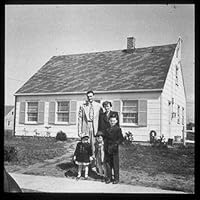
As old as a roadway that was once a Native trail, as new as the suburban subdivisions spreading across the American countryside, the cultural landscape is endlessly changing. The study of cultural landscapes―a far more recent development―has also undergone great changes, ever broadening, deepening, and refining our understanding of the intricate webs of social and ecological spaces that help to define human groups and their activities. Everyday America surveys the widening conceptions and applications of cultural landscape writing in the United States and, in doing so, offers a clear and compelling view of the state of cultural landscape studies today.
These essays―by distinguished journalists, historians, cultural geographers, architects, landscape architects, and planners―constitute a critical evaluation of the field’s theoretical assumptions, and of the work of John Brinckerhoff Jackson, the pivotal figure in the emergence of cultural landscape studies. At the same time, they present exemplary studies of twentieth-century landscapes, from the turn-of-the-century American downtown to the corporate campus and the mini-mall. Assessing the field’s accomplishments and shortcomings, offering insights into teaching the subject, and charting new directions for its future development, Everyday America is an eloquent statement of the meaning, value, and potential of the close study of human environments as they embody, reflect, and reveal American culture.
This book offers a sampling of reflections and essays in the field of cultural landscape studies written in the years immediately following the death of J.B. Jackson—a prolific and influential writer of commentary on cultural landscapes. In "Everyday America: Cultural Landscape Studies after J. B. Jackson" edited by Paul Groth and Chris Wilson, every essay either has J. B. Jackson as the chief focus of the study or a guiding quote of his that buttresses the main argument. The book demonstrates the diversity of disciplines, directions, and conclusions that have been inspired by Jackson’s “indeterminate disciplinary boundaries” of cultural landscape studies, but it contends that this polyphony of diversity is not necessarily a cacophony of confusion— a common unity of mining landscapes for cultural meaning exists.
As mentioned, many essays speak primarily to the general lessons to be learned from J. B. Jackson’s overall personality and style. Patricia Limerick asserts that J.B. Jackson used an aggressive, contact-sport like style to jar academics to engage with, challenge, and address his writings on the American landscape. She comes up with “eight Jacksonian propositions for the play of the mind,” and what’s more, she illustrates these propositions with Jacksonian quotes that are very convincing to her argument. In much the same way that Muhammad Ali used psychological strategy to engage his opponents and frustrate them throughout his career as a world class boxer, J. B. Jackson used a brazen boldness in his writing that brought widespread reaction but also admiration throughout his career as a world class landscape writer. Not only did his unique strategies save him research time in order to maximize the amount of writing he could produce, but more importantly, it also got scholars and students to engage with the landscape and spend the time to find meaning therein. His method survives because it is continually tested. With a similar goal in mind, Gwendolyn Wright focuses on Jackson’s fluency in multiple “modern vernaculars”—disciplinary and topical languages. She asserts that scholars often limit themselves with “disciplinary blinders” when they should “continually strive to liberate [themselves], as Jackson did, to experience the world in more than one mode of description and analysis.” By comparison, Denise Scott Brown’s essay probes more into the psychological underpinnings of the mysterious and often contradictory life of J. B. Jackson in order to re-affirm his brilliance as a writer but also to justify some of his less than academic consistency and even partially excuse his somewhat sexist views.
Other authors chronicle J.B. Jackson’s influence on fostering a more human-centered understanding of landscapes. Timothy Davis maps out Jackson’s invention of the term “odology”—the study of roads and journeys. Continuing in the contact-sport mentality of going against academic assertions, Davis points out that whereas most critical scholars of the mid-twentieth century viewed roads and cars as antisocial influences that destroyed traditional communities, “Jackson argued that the road and the car were unifying cultural forces.” Davis is quick to point out that Jackson didn’t think automobile landscapes were perfect, but rather, Jackson sought “a middle ground between the democratic chaos of vernacular roadsides and the orderly but highly restrictive environments proposed by highway engineers and scenic beautifiers.” Jackson championed a more human geography: one that balanced the needs of common people with safety and beauty for all. This sentiment is further iterated by George L. Henderson. He shows that J.B. Jackson hoped that landscape study would not only consider surface appearances but also move toward “social and economic justice.” Richard Stein applies the normative dimension of landscape studies, introduced by Henderson, to a series of racialized landscapes in St. Louis, MO and Lexington, KY. Applying Jackson’s assertion that “no landscape . . . can be comprehended unless we . . . ask ourselves who owns or uses those spaces, how they were created and how they change,” Stein brings Jacksonian assertions to fruition to show how a landscape’s normativity speaks not only of a “collective American past, but also [serves as a cultural signpost] toward our collective future.”
As we have seen in Stein’s essay, some authors primarily use Jacksonian quotes and observations to guide their own investigations into cultural landscape studies. Landscape architect Lousie Mozingo applies a cultural landscape approach to the discussion of how “the corporate campus, the corporate estate, and the office park gave corporate capitalism a front yard, with, as Jackson said, ‘its vague but nonetheless real social connotations.’” Historian David Sloane discusses how the appearance of traditional health care practitioners in mini-mall locations blurs the line “between traditionally educated physicians and alternative medical practitioners such as chiropractors and acupuncturists, between doctors and patients, and between commerce and professional practice.” Again, a diversity of scholarly disciplines have adopted cultural landscape studies and taken them in discreet directions, but they all owe a debt of gratitude to J. B. Jackson and they all have a common goal of understanding the human causes and effects found in the built environment.