

What do you think?

Starman: The Truth Behind the Legend of Yuri Gagarin
On April 12 1961, Yuri Gagarin became the first human to leave the Earth's atmosphere and venture into space. An icon of the 20th century, he also became a danger to himself and a threat to the Soviet state. At the age of 34, he was killed in a plane crash. Based on KGB files, restricted documents from Russian space authorities, and interviews with his friends and colleagues, this biography of the Russian cosmonaut reveals a man in torn apart by powerful political pressures, fighting a losing battle against alcoholism and rebelling against the cruelties of a corrupt totalitarian regime. 2011 marks the fiftieth anniversary of Gagarin's flight. This new edition of "Starman" includes a new afterword that celebrates the importance of that momentous expedition and reflects on Gagarin's legacy.
252 pages, Paperback
First published January 1, 1998
Ratings & Reviews
Friends & Following
Create a free account to discover what your friends think of this book!
Community Reviews
Displaying 1 - 30 of 133 reviews

April 17, 2012
"After his flight he was always saying how special the world is, and how we had to be very careful not to break it."
This book, in a dry journalistic non-yellow-press style tries to give us a more objective portrait of this extraordinary man. It succeeds at that, I think. And the message I get out of it is that Gagarin did not need the Party to construct an image of him as an extraordinary man - he already had all the qualities that made him amazing, no embellishment necessary.
This book gives us a detailed account of Gagarin's short life. His childhood, marred by living in the occupied territories during the World War II, witnessing near-death of his little brother at the hands of the Nazis. His youth as a steel foundryman apprentice who discovered a passion for flying and joined a pilot school. His selection as a member of the select few future Cosmonauts and months and months of grueling physical training and quite merciless medical experiments (little was known about the potential dangers of space for human body, and so future cosmonauts were expected to be able to survive everything). His orbiting of Earth - for the first time. The following years of him being the best ambassador that the Soviet Union could have hoped for. His ascent to and fall from grace of the Soviet leadership. His failed attempts to get back into the space program. His last flight from which he did not return.
Left - Gagarin and Khruschev, the leader of the Soviet Union and Gagarin's fervent supporter (a fellow farmboy, after all!) - and the reason for Gagarin's fall from grace as Brezhnev came to replace Khruschev.
Right - Gagarin and Korolev, the man behind the space program in the USSR, who was forced to really stay behind the scenes due to the overwhelming secrecy of those times.
And more - besides just a look at this man's amazing life, this book gives us a glimpse of what the Soviet space program was like, of what the other cosmonauts were like, of the people behind the scenes, of the political and power struggles involved. It broadens its scope beyond just Yuri Gagarin, and does an excellent job at conveying the spirit of that time from the 20-20 vision of hindsight.
Yuri Gagarin can be easily dismissed by the cynics of the new generation as the man manufactured by the Soviet government to serve the purpose they wanted him to serve. But it is not so. He was loved for who he was - not an icon of the time but a true friend with the personality that made people want to die to save him. I'm not exaggerating - one of his closest friends, a fellow cosmonaut Komarov, chose not to turn down a clearly flawed space mission, the one that ultimately cost him his life, because Yuri had been his back-up and would have forced to undertake the doomed mission had Komarov refused. Yes, Gagarin apparently was a man worth dying for:
Yuri Gagarin has had a place on my list of personal heroes since I was a kid. The first human in space, the first one to see our planet as "a tiny blue ball drifting through the infinite cosmic darkness." I remember once, as a kid, trying to imagine that all we are, all our problems, our hopes, our aspirations, everything we cared about - all that was confined to a tiny little planet that was located on the outskirts of one tiny galaxy, a speck of nothing on the cosmic scale. Even in that rare existential moment of childhood, I was scared and humbled. How must it have felt, then, for Gagarin to be the first one to escape the confines of our atmosphere, the first one to see Earth from space? He was the first one to experience something larger than life, something that until then humanity only dared to dream about. He was the first to do it, in a tiny Vostok space capsule, on April 12, 1961.
"A place that no one else in all human history can occupy. Number One. The First Man in Space."
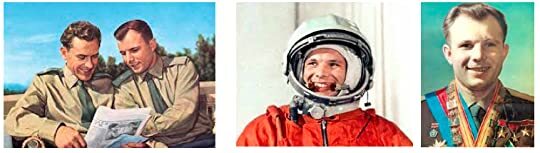
"Young or old, privileged or poor, most Russians still smile with pride at the merest mention of his name. They recall with the genuine affection a peasant boy with a winning smile, who stunned the entire world with his achievement. Russians don't hesitate to remind us Westerners, "He was the first, you know."It's easy to idolize a man who achieved what Gagarin did. As a matter of fact, that was done for decades. It was desirable to present him as what the Party needed him to be - a simple farmboy with a winning smile, who took the Soviet Union to the stars.
The first man in space: Yuri Alexeyevich Gagarin."
This book, in a dry journalistic non-yellow-press style tries to give us a more objective portrait of this extraordinary man. It succeeds at that, I think. And the message I get out of it is that Gagarin did not need the Party to construct an image of him as an extraordinary man - he already had all the qualities that made him amazing, no embellishment necessary.
"This apt metaphor of a pyramid helps illustrate that Gagarin's life was full of contradictions. He was an ambitious and competitive individual, acutely aware that the central achievement of his life was based on the efforts of many others who were not even permitted to reveal their names, let alone share in his public glory. He was a peasant boy at ease with complex engineering equations; a programmed technician who could think for himself; a loyal member of a conformist society who rebelled against the system. He was impetuous, occasionally thoughtless, yet highly disciplined in his work and responsible towards others, often at great risk to himself. He knew little of politics, while displaying a remarkable knack for diplomacy, both at home and abroad. He was an adulterer who never really betrayed his wife and family. As all these conflicting elements of his life intermingle, the story that emerges is one of an essentially decent and brave man giving his best in extraordinary circumstances. He was a hero, in the best and most honest sense of the word."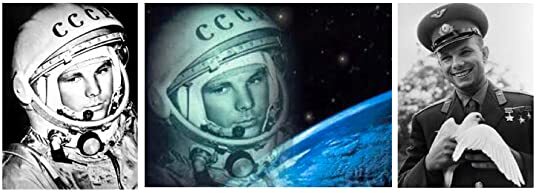
This book gives us a detailed account of Gagarin's short life. His childhood, marred by living in the occupied territories during the World War II, witnessing near-death of his little brother at the hands of the Nazis. His youth as a steel foundryman apprentice who discovered a passion for flying and joined a pilot school. His selection as a member of the select few future Cosmonauts and months and months of grueling physical training and quite merciless medical experiments (little was known about the potential dangers of space for human body, and so future cosmonauts were expected to be able to survive everything). His orbiting of Earth - for the first time. The following years of him being the best ambassador that the Soviet Union could have hoped for. His ascent to and fall from grace of the Soviet leadership. His failed attempts to get back into the space program. His last flight from which he did not return.
"He had no particular knack for getting things right the first time. He had to work quite hard at his tasks, practising them repeatedly."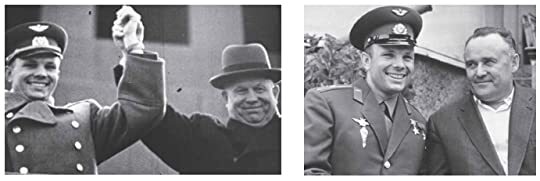
Left - Gagarin and Khruschev, the leader of the Soviet Union and Gagarin's fervent supporter (a fellow farmboy, after all!) - and the reason for Gagarin's fall from grace as Brezhnev came to replace Khruschev.
Right - Gagarin and Korolev, the man behind the space program in the USSR, who was forced to really stay behind the scenes due to the overwhelming secrecy of those times.
And more - besides just a look at this man's amazing life, this book gives us a glimpse of what the Soviet space program was like, of what the other cosmonauts were like, of the people behind the scenes, of the political and power struggles involved. It broadens its scope beyond just Yuri Gagarin, and does an excellent job at conveying the spirit of that time from the 20-20 vision of hindsight.
"He made many enemies because he behaved with more charm, and could talk more wisely and honestly, than the official Soviet heads of foreign delegations. Superiors never forgive you for something like that."
"In all, the First Cosmonaut was turning out to be an extraordinary asset to Soviet diplomacy, but, as he confessed to Golovanov in a quiet moment, the strain of playing the perfect ambassador was beginning to wear him down."
"I think his personality began to split. On one side he was the welcome guest of kings, presidents and even the Queen of England, but on the other side he never lost his ties with the ordinary people. I think he began to sense the lower classes' lack of rights, their hardship, and he saw the corruption of the top layers of society. He saw our drunken leaders dancing on the table and behaving badly, and that can't have left his honest soul unwounded."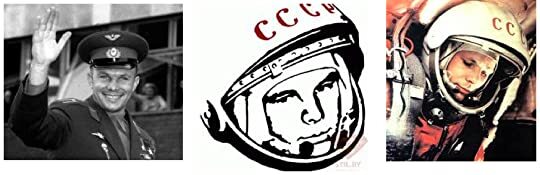
Yuri Gagarin can be easily dismissed by the cynics of the new generation as the man manufactured by the Soviet government to serve the purpose they wanted him to serve. But it is not so. He was loved for who he was - not an icon of the time but a true friend with the personality that made people want to die to save him. I'm not exaggerating - one of his closest friends, a fellow cosmonaut Komarov, chose not to turn down a clearly flawed space mission, the one that ultimately cost him his life, because Yuri had been his back-up and would have forced to undertake the doomed mission had Komarov refused. Yes, Gagarin apparently was a man worth dying for:
"As I knew the state of affairs, I asked him, "If you're so convinced you're going to die, then why don't you refuse the mission?" He [Komarov] answered, "If I don't make this flight, they'll send the back-up pilot instead. That's Yura, and he'll die instead of me. We've got to take care of him."It is a very well-written book about an extraordinary man and the environment in which this extraordinarity was achieved. I highly recommend it to the post-Soviet and Western readers alike. 4.5 stars - for the Starman. And a cheeky quote to end this review:
"The West quickly developed an obsession with the Space Race, much to the bemusement of cosmonaut Gherman Titov and his friends. "What kind of race were they thinking about? There wasn't a race, because we Russians were already ahead of the entire planet."

March 11, 2020
I was quite dubious about this book at the beginning. The first chapter concerns Gagarin’s childhood during the WW2 years. He grew up in an area that was occupied by the Nazis from 1941-43 – he was seven years old when they arrived. I don’t doubt the occupation was a hellish experience, but the book tells of how the young Yuri apparently engaged in sabotage of German Army vehicles, contaminating chemicals, blocking exhaust pipes with potatoes etc. Low level stuff, but enough to have got any Russian child shot if they had been caught. The stories might be true but to me they had the feel of Soviet mythologizing. It’s just something about the way they were told.
However the book really picks up when it moves onto the early Soviet space programme. The downside of the “space race” was that Party bosses and officials often pressurised Soviet scientists and engineers to cut corners in order to get launches away by a set date. This led to some disastrous accidents and to near misses affecting the first two Soviet flights, made by Gagarin and by Gherman Titov. To some extent the same pressures affected the early American space programme.
This section of the book is probably as much about the space race itself as about Gagarin, but it does have an interesting angle in respect of the rivalry between Gagarin and Titov over who was to be the first cosmonaut. The decision was only made the day before the launch. Titov contributed interviews for the book and is quite gracious about Gagarin, but you sense that he never quite got over the disappointment.
The story of Gagarin’s flight is dramatically told, and the overall tone of the book is one of deep respect for the bravery, skill, determination and intelligence Gagarin displayed. It’s not hagiography though, and in the second half the author has to tackle some trickier issues around Gagarin’s character. After the first flight, he wanted to go back into space, or at least continue as an air force pilot, but Khrushchev considered him too valuable to risk, keeping him well and truly grounded. After the fall of Khrushchev, Gagarin also found he had lost his political influence, since Brezhnev saw him as Khrushchev’s protégé. On top of everything the Soviet space programme itself started to run into trouble as the 1960s progressed, since the country could not compete with the resources the US government poured into the Apollo missions. Initially flushed with success and later frustrated by being sidelined, Gagarin turned to parties, drinking sessions, and adulterous one-night stands. Some bizarre incidents are described! The author is as sympathetic as he can be.
The last chapter provides an interesting summary of the likely cause of the 1968 air crash that caused Gagarin’s death. A sad end, though I was pleased to read that Gagarin’s two daughters have both had successful careers and fulfilling lives.
Overall, a 7/10 rounded up to a slightly generous four stars.
However the book really picks up when it moves onto the early Soviet space programme. The downside of the “space race” was that Party bosses and officials often pressurised Soviet scientists and engineers to cut corners in order to get launches away by a set date. This led to some disastrous accidents and to near misses affecting the first two Soviet flights, made by Gagarin and by Gherman Titov. To some extent the same pressures affected the early American space programme.
This section of the book is probably as much about the space race itself as about Gagarin, but it does have an interesting angle in respect of the rivalry between Gagarin and Titov over who was to be the first cosmonaut. The decision was only made the day before the launch. Titov contributed interviews for the book and is quite gracious about Gagarin, but you sense that he never quite got over the disappointment.
The story of Gagarin’s flight is dramatically told, and the overall tone of the book is one of deep respect for the bravery, skill, determination and intelligence Gagarin displayed. It’s not hagiography though, and in the second half the author has to tackle some trickier issues around Gagarin’s character. After the first flight, he wanted to go back into space, or at least continue as an air force pilot, but Khrushchev considered him too valuable to risk, keeping him well and truly grounded. After the fall of Khrushchev, Gagarin also found he had lost his political influence, since Brezhnev saw him as Khrushchev’s protégé. On top of everything the Soviet space programme itself started to run into trouble as the 1960s progressed, since the country could not compete with the resources the US government poured into the Apollo missions. Initially flushed with success and later frustrated by being sidelined, Gagarin turned to parties, drinking sessions, and adulterous one-night stands. Some bizarre incidents are described! The author is as sympathetic as he can be.
The last chapter provides an interesting summary of the likely cause of the 1968 air crash that caused Gagarin’s death. A sad end, though I was pleased to read that Gagarin’s two daughters have both had successful careers and fulfilling lives.
Overall, a 7/10 rounded up to a slightly generous four stars.

April 28, 2019
Изключително приятна и много леко написана книга.
Като човек, който фатално се увлича по космоса и фантастиката, за мен беше особено интересно да прочета не толкова за Гагарин, колкото за руската космическа програма като цяло. Фактите са изложени. С подробности. Доколко и тази истина е глазирана и разкрасена... Е, несъмнено е усилието да се гримира малко, но е напълно простимо.
Накратко - добре написана книга, хареса ми и препоръчвам, дори ако Космосът и полетите в него не са ви в костния мозък.
Като човек, който фатално се увлича по космоса и фантастиката, за мен беше особено интересно да прочета не толкова за Гагарин, колкото за руската космическа програма като цяло. Фактите са изложени. С подробности. Доколко и тази истина е глазирана и разкрасена... Е, несъмнено е усилието да се гримира малко, но е напълно простимо.
Накратко - добре написана книга, хареса ми и препоръчвам, дори ако Космосът и полетите в него не са ви в костния мозък.

May 4, 2017
This is the definitive book on Yuri Gagrin. No other book out there could possibly match the exhaustive research, interviews and access to key personnel close to the Gagarin legend.
"Starman" is truly a combination of feel-good rags-to-riches story, Cold War spy thriller, space disaster movie, rockstar biography, episode of Air Crash Investigations and a Shakespearean tragedy. Often it reads like a KGB informant just handed you a top secret document that you were never entitled to read - it's gripping stuff and a testament to the authors in uncovering so many facts surrounding Yuri Gagarin and the Space Race.
It is a remarkable story about one of the world's most remarkable men. The first man in space; one of mankind's greatest and most spectacular achievements. Yet in the West, Yuri Gagarin's achievements are so often overlooked, for some reason overshadowed by the Apollo moon landings some 8 years later in 1969.
Yuri Gagarin's story is an inspirational one. His childhood in German-occupied Smolensk region was tough to read. His humble beginnings and tormenting of German soldiers help demonstrate th development of Yuri's iconic personality traits from a young age. The innocent, yet pivotal moment where he discovers a plane thereby igniting his passion for flying, gave me goosebumps.
The vigorous training of cosmonauts and medical experiments of the "testers" was harrowing reading. So too often, key figures making huge sacrifices for the Soviet space program were kept secret or overlooked - finally, this book makes sure these brave men and women get credit. The man most responsible for putting Yuri in space - Chief Designer Korolev was heartbreakingly kept a state secret and never officially recognised (he had even spent time in a gulag). The Space Race is spoken about extensively with it intriguing to learn just how far ahead the Soviets were to USA for the majority of the 1960s.
Other parts of the book I found incredibly interesting were the use of animals in space, "Ivan Ivanovich" and his orbit prior to Yuri, the disaster in 1960 which killed 190 people, the heartbreakingly tragic Komarov incident, the aftermath and impact of Yuri's fame on his family - especially his Father and younger brother, Boris.
"The Truth Behind The Legend" really picks up from the secretive problems with his re-entry and follows along Yuri's increasing frustration at his "legend" and the Soviet regime. It's clear that there was no need for propaganda involving Yuri - the truth about who he was is far greater than any made up story the Soviets could create.
One confusing aspect of the book is the Russian use of names - they use numerous variations of each name, so at times you may initially think you're reading about 3 different people, when in fact it's just the one. This is more to do with Russian culture than it is the writing of the book.
Space and its surrounding science can be a very complicated topic to read about, yet Jamie Doran writes about it in an easy to understand way. It's very easy to like this book, much like it was very easy to like Yuri Gagarin thanks to his bucket loads of charisma. Yuri's kindness and generosity helping others, using his fame for greater good and the dedicated letter replies, all demonstrate the type of hero he was and continues to be.
"When I orbited the Earth in a spaceship, I saw for the first time how beautiful our planet is. Mankind, let us preserve and increase this beauty, and not destroy it!" - Yuri Gagarin
A must read.
"Starman" is truly a combination of feel-good rags-to-riches story, Cold War spy thriller, space disaster movie, rockstar biography, episode of Air Crash Investigations and a Shakespearean tragedy. Often it reads like a KGB informant just handed you a top secret document that you were never entitled to read - it's gripping stuff and a testament to the authors in uncovering so many facts surrounding Yuri Gagarin and the Space Race.
It is a remarkable story about one of the world's most remarkable men. The first man in space; one of mankind's greatest and most spectacular achievements. Yet in the West, Yuri Gagarin's achievements are so often overlooked, for some reason overshadowed by the Apollo moon landings some 8 years later in 1969.
Yuri Gagarin's story is an inspirational one. His childhood in German-occupied Smolensk region was tough to read. His humble beginnings and tormenting of German soldiers help demonstrate th development of Yuri's iconic personality traits from a young age. The innocent, yet pivotal moment where he discovers a plane thereby igniting his passion for flying, gave me goosebumps.
The vigorous training of cosmonauts and medical experiments of the "testers" was harrowing reading. So too often, key figures making huge sacrifices for the Soviet space program were kept secret or overlooked - finally, this book makes sure these brave men and women get credit. The man most responsible for putting Yuri in space - Chief Designer Korolev was heartbreakingly kept a state secret and never officially recognised (he had even spent time in a gulag). The Space Race is spoken about extensively with it intriguing to learn just how far ahead the Soviets were to USA for the majority of the 1960s.
Other parts of the book I found incredibly interesting were the use of animals in space, "Ivan Ivanovich" and his orbit prior to Yuri, the disaster in 1960 which killed 190 people, the heartbreakingly tragic Komarov incident, the aftermath and impact of Yuri's fame on his family - especially his Father and younger brother, Boris.
"The Truth Behind The Legend" really picks up from the secretive problems with his re-entry and follows along Yuri's increasing frustration at his "legend" and the Soviet regime. It's clear that there was no need for propaganda involving Yuri - the truth about who he was is far greater than any made up story the Soviets could create.
One confusing aspect of the book is the Russian use of names - they use numerous variations of each name, so at times you may initially think you're reading about 3 different people, when in fact it's just the one. This is more to do with Russian culture than it is the writing of the book.
Space and its surrounding science can be a very complicated topic to read about, yet Jamie Doran writes about it in an easy to understand way. It's very easy to like this book, much like it was very easy to like Yuri Gagarin thanks to his bucket loads of charisma. Yuri's kindness and generosity helping others, using his fame for greater good and the dedicated letter replies, all demonstrate the type of hero he was and continues to be.
"When I orbited the Earth in a spaceship, I saw for the first time how beautiful our planet is. Mankind, let us preserve and increase this beauty, and not destroy it!" - Yuri Gagarin
A must read.

December 6, 2013
This became perfectly clear--I, as a person raised in the American education system, did not get enough world history. This is an unfair statement, come to think of it. I wasn't a fan of history classes. Perhaps they were not taught in a way to make them fascinating to youngsters. When I look back, all I remember was a dull skimming of decades full of names and dates with perhaps numbers thrown in. Now I take responsibility for not rectifying my lack of knowledge as an adult. I still haven't engaged in a systematic study of history. The historical novels I've picked up here and there have been luring me into a state of curiosity, which is why I read Jamie Doran's non-fiction accounting of Yuri Gagarin.
Truth be told, I bought the book for my husband because of his interest in astronomy, and then I stole it back. What I've learned is how little we Americans are exposed to history of the rest of the world. To refine that thought--we have to seek out what the rest of the world has been up too and can't rely on what's held under our noses by the common media fire hoses aimed at us daily.
I recommend reading this Starman book. It is about the Russian space program, and in case you don't know it, they accomplished man's first fight in space. Their story is interesting, especially as it brings to life the hopes and dreams of humanity over the geographical and cultural divisions. At the same time, it highlights the unique path determined by Russian culture and politics. Do I contradict myself? Give the book a read and let me know if you still think so.
Truth be told, I bought the book for my husband because of his interest in astronomy, and then I stole it back. What I've learned is how little we Americans are exposed to history of the rest of the world. To refine that thought--we have to seek out what the rest of the world has been up too and can't rely on what's held under our noses by the common media fire hoses aimed at us daily.
I recommend reading this Starman book. It is about the Russian space program, and in case you don't know it, they accomplished man's first fight in space. Their story is interesting, especially as it brings to life the hopes and dreams of humanity over the geographical and cultural divisions. At the same time, it highlights the unique path determined by Russian culture and politics. Do I contradict myself? Give the book a read and let me know if you still think so.

December 20, 2012
I loved this book. It's well written and easy to read. It paints the intertwined stories of the life of Yuri Gagarin and the early space exploits of the Soviet Union without loosing either thread. It both humanizes people within the Soviet infrastructure while pointing out the bureaucracy, red tape, and failings of the system without getting political. Finally, it presents Gagarin not strictly as a hero, but as a man: "a pesant boy at ease with complex engineering equations; a programmed technician who could think for himself; a loyal member of a conformist society who rebelled against the system...impetuous, occasionally thoughtless, yet highly disciplined in his work and responsible toward others... a decent and brave man giving his best in extraordinary circumstances."

August 9, 2011
My main quibble with this book is that it could easily be 200 pages longer. I suppose it is better to be left wanting a bit more than to be bored with trivialities, but Bizony and Doran could have given readers a bit more without suffering the slightest loss in interest. Their prose propels the story along quite satisfyingly, which in the end only makes the book seem shorter. Clearly exhaustively researched, complete with interviews of many of the principal people in Gagarin's personal and professional lives. Originally published in 1998, this book has been reissued (for the 50th anniversary of Gagarin's flight) with a thoughtful afterword and the bittersweet recognition of the passing of many of the interviewees. Because of the change in the political climate in Russia over the last 13 years one suspects such a book would be impossible to produce today, even if many of the people who knew Gagarin best had not finally joined him in the Great Beyond. Well worth the time of anyone who seeks informed and unvarnished perspective of Gagarin's entire life.

October 29, 2017
A thrilling and often humorous account of the early days of the Soviet space program. Focuses mainly on the relationships between Gagarin, Kruschev, and Chief Designer, Korolev (Spoiler alert) whose death will have you sniffing and reaching for the vodka.

March 26, 2017
Юрий Гагарин – човекът зад образа на героя на СССР: http://knigolandia.info/book-review/y...
Когато преди няколко месеца излезе биографията “Първият човек. Животът на Нийл Армстронг” на Джеймс Хенсън, я прочетох с голямо удоволствие – чепат човек е първият стъпил на Луната, и животът му хич не е бил лек, макар че той не дава особен достъп до себе си, до мислите и спомените си. И все пак един от фактите, които ме впечатлиха в книгата, е, че е носел медал в чест на Юрий Гагарин, загинал година по-рано в нелепа самолетна катастрофа, обвита в неясноти, както толкова неща в СССР. И нямах търпение тогава да завърши преводът на “Юрий Гагарин. Истината зад легендата“ на Джейми Дорън и Пиърс Байзъни, защото основната ми мотивация да излезе тази книга на български бе, че не знаех почти нищо за руския пилот. И подозирам, че дори съвременниците му не са знаели, защото неговият образ бе образ не на човек, а на герой на СССР – шлифован, излъскан, бляскав до заслепяване.
CIELA Books
http://knigolandia.info/book-review/y...
Когато преди няколко месеца излезе биографията “Първият човек. Животът на Нийл Армстронг” на Джеймс Хенсън, я прочетох с голямо удоволствие – чепат човек е първият стъпил на Луната, и животът му хич не е бил лек, макар че той не дава особен достъп до себе си, до мислите и спомените си. И все пак един от фактите, които ме впечатлиха в книгата, е, че е носел медал в чест на Юрий Гагарин, загинал година по-рано в нелепа самолетна катастрофа, обвита в неясноти, както толкова неща в СССР. И нямах търпение тогава да завърши преводът на “Юрий Гагарин. Истината зад легендата“ на Джейми Дорън и Пиърс Байзъни, защото основната ми мотивация да излезе тази книга на български бе, че не знаех почти нищо за руския пилот. И подозирам, че дори съвременниците му не са знаели, защото неговият образ бе образ не на човек, а на герой на СССР – шлифован, излъскан, бляскав до заслепяване.
CIELA Books
http://knigolandia.info/book-review/y...

March 15, 2011
This is a fascinating book that explores as much about the Soviet-era space program as the life and times of Gagarin. The authors pull in many sources, who would otherwise fade away in silence, and use these to assess some of the unknowns about Gagarin's life -- including his death. They build a compelling portrait of the personalities that made the Soviet-era space program successful, without coloring the tale too strongly from a Western perspective. When I got to the last page, I began to wish that they'd continued their research and writing. So much is unknown about the Russian space program, even now. (I say this having worked in human space flight for the past ten years and having worked sporadically with Russians during that time.)

March 22, 2011
Amazing! I've always been a little curious about Yuri Gagarin - the man who beat the US into the great beyond. He was just a poor farm boy who had a passion for airplanes and landed the opportunity of a lifetime - to become a cosmonaut. This book chronicles Yuri's journey from a childhood haunted by Nazi occupation to worldwide fame. Family stories, anecdotes from colleagues and friends, as well as information from former KGB officers make this book one of the most comprehensive and personal biographies I've ever come across. And yet, somehow, there is still so much secrecy surrounding Gagarin and the Soviets that we simply cannot confirm certain details - his death, for one.
Excellent book - a MUST read!
Excellent book - a MUST read!

March 24, 2019
Ciekawe, choć trochę zbyt zdawkowe. 190 stron, nawet drobno zapisanych, to trochę mało na te historię, zwłaszcza gdy autorzy próbują jednocześnie podejść do nich z różnych stron: jako portretu Gagarina, zarysu radzieckiego programu kosmicznego i obrazu mechanizmów władzy i polityki w ZSRR. Co nie zmienia faktu, że ta wielowątkowość ma swoje ogromne zalety: w stosunkowo niedużym czasie daje spore wyobrażenie i przy okazji zawiera sporo zaskakujących epizodów.

July 22, 2011
I've always been fascinated by the early days of space exploration. I've read "The Right Stuff" and watched the film close to 20 times. But the early days of the Soviet space program have always remained mysterious. The great early strides that the Soviets made were shrouded in state secrecy mixed in with propaganda.
This book first came out in 1998, but was re-released in 2010. It is a brief history of the very short career of the first cosmonaut, Yuri Gagarin. Gagarin came from a humble background and happened to be in the right place at the right time along with being the right size to be chosen to be the first man in space.
Upon his return to earth (by parachute after he ejected on re-entry as the Soviets didn't have an effective landing method in 1961), Gagarin became an international hero. However, Gagarin may have looked the part, but he was not prepared to be a hero. He started to drink heavily. He found that other women wanted him because he was, well, the only guy who had been in outer space at the time.
Gagarin never got a chance to go into space again. He was considered too valuable to risk on a flight again. He did manage to get assigned as the backup for the flight of Soyuz 1 in 1968. Gagarin likely knew that the capsule for that flight was disastrously flawed. Nevertheless, Vladimir Komarov took command and lifted off. His capsule's parachutes failed to deploy on re-entry and he was killed instantly when he slammed into a mountainside. Gagarin went into a deep depression over this. He left the cosmonaut service to get some more experience flying jets and died in a still controversial crash in March of 1968.
Doran and Bizony benefited greatly from the collapse of the Soviet Union and the willingness of the surviving people from the early days of the Soviet space program to shed light on a mysterious era. The Space Race may not be hotly contested now, but in its early days, it was. And it was often done in a disastrous manner.
This book first came out in 1998, but was re-released in 2010. It is a brief history of the very short career of the first cosmonaut, Yuri Gagarin. Gagarin came from a humble background and happened to be in the right place at the right time along with being the right size to be chosen to be the first man in space.
Upon his return to earth (by parachute after he ejected on re-entry as the Soviets didn't have an effective landing method in 1961), Gagarin became an international hero. However, Gagarin may have looked the part, but he was not prepared to be a hero. He started to drink heavily. He found that other women wanted him because he was, well, the only guy who had been in outer space at the time.
Gagarin never got a chance to go into space again. He was considered too valuable to risk on a flight again. He did manage to get assigned as the backup for the flight of Soyuz 1 in 1968. Gagarin likely knew that the capsule for that flight was disastrously flawed. Nevertheless, Vladimir Komarov took command and lifted off. His capsule's parachutes failed to deploy on re-entry and he was killed instantly when he slammed into a mountainside. Gagarin went into a deep depression over this. He left the cosmonaut service to get some more experience flying jets and died in a still controversial crash in March of 1968.
Doran and Bizony benefited greatly from the collapse of the Soviet Union and the willingness of the surviving people from the early days of the Soviet space program to shed light on a mysterious era. The Space Race may not be hotly contested now, but in its early days, it was. And it was often done in a disastrous manner.

Read
May 15, 2022Iako je „Zvezdani“ biografija Jurija Gagarina, knjiga se čita kao da je u pitanju napet špijunski triler, uzbudljiva svemirska avantura i detektivski roman o misterioznoj smrti.
Samo na trenutke sam imao osećaj da je u pitanju dokumentaristička proza jer je ceo Gagarinov život više bio avanturistički roman, nego neka uobičajena priča.
Ono što mi je ostavilo zaista veliki utisak jeste opis tog sveta, društva na planeti od pre šest decenija, koji veruje u nauku, racionalni um, veruje u čoveka i sa radošću očekuju sve lepote koje će im budućnost doneti.
Više o ovoj dobroj i zanimljivoj knjizi možete pročitati u malo dužem tekstu na ovom linku: http://www.bookvar.rs/recept-za-corbu...
Samo na trenutke sam imao osećaj da je u pitanju dokumentaristička proza jer je ceo Gagarinov život više bio avanturistički roman, nego neka uobičajena priča.
Ono što mi je ostavilo zaista veliki utisak jeste opis tog sveta, društva na planeti od pre šest decenija, koji veruje u nauku, racionalni um, veruje u čoveka i sa radošću očekuju sve lepote koje će im budućnost doneti.
Više o ovoj dobroj i zanimljivoj knjizi možete pročitati u malo dužem tekstu na ovom linku: http://www.bookvar.rs/recept-za-corbu...

January 10, 2012
"So there's a cosmonaut up in space, circling the globe, convinced he will never make it back to Earth; he's on the phone with Alexei Kosygin — then a high official of the Soviet Union — who is crying because he, too, thinks the cosmonaut will die."
So begins Robert Krulwich’s NPR piece entitled, “Cosmonaut Crashed into Earth Crying in Rage." I couldn’t resist the title or the lead paragraph, both of which are based on Krulwich’s reading of Doran and Bizony’s Starman. I have slightly mixed feelings about the book. It’s not nearly as “juicy” as the excerpt Krulwich chose to highlight, and it’s not the best writing I’ve come across. However, the authors were able to gather a lot of first-hand information that had never before seen the light of day or been uttered in public. In addition to gaining access to archival documents, they also conducted interviews with Gagarin’s family, friends, and colleagues. Most of it is fascinating.
Starman does a good job of relating Gagarin’s childhood, including his family surviving the Nazi invasion; discussing cosmonaut training and Gagarin’s eventual selection to be the first man in space; and showing how the instant catapult into the spotlight disrupted his family life and dreams, directly leading to his struggles with alcoholism.
While reading Starman, I ended up watching the film adaptation of Tom Wolfe’s The Right Stuff (which I haven’t read). The secrecy surrounding the development of the Soviet space program is a stark contrast to the rollicking, rolling PR machine that swirled around NASA’s fledging efforts. Though the Mercury 7 astronauts became household names, it was Yuri Gagarin’s contribution that paved the way by his becoming the first man to orbit the earth. Yet, as Starman relates, when Gagarin and his fellow cosmonauts were first recruited, they weren’t initially told for what purpose they were being recruited.
As with their American counterparts, they were put through a “bewildering array of medical, physical and psychological tests” – moreso experiments - aimed at finding the limit of what humans can endure. There are graphic descriptions of things like oxygen deprivation tanks, isolation chambers, and catapult sleds that are fun but disturbing to read. Obviously these tests were somewhat necessary because nobody knew what conditions would be like in space, but I was particularly enthralled by the 1,200 or so ‘testers’ whose contributions were a vital part of the early space race. Starman talks about how the testers, all of whom were less accomplished on the academic/aviation ladder than the cosmonauts, were “invited” to participate – the kind of invitation where 'no' comes with such scary consequences that it's not a real option. As Doran and Bizony tell it, the testers “were seduced with great care by their recruiters into a feeling of privilege and self-worth, but in truth their status was barely better than that of disposable laboratory rats. When they received injuries – and they did receive injuries – there were no special arrangements to compensate them or their families because the authorities were unwilling to acknowledge any of their work in public.”
When Gagarin made his historic flight, his family didn’t find out until neighbors heard about it on the radio. From that moment onward, he unofficially became an international ambassador for the Soviets, but they never allowed him to fly again, unwilling to risk the safety of their “Hero of the Soviet Union.” Though Khrushchev loved him, his successor Brezhnev was not a fan, and this became a problem in Gagarin’s life. He rose in the administrative ranks but didn’t feel he had any true control. The incident that Krulwich highlighted is the pinnacle of that truth. Gagarin and others knew the flight was doomed, but despite Gargain’s position, he was unable to convince the Politburo to cancel the launch; his close friend died aboard that flight of the Souyez I. From the time of his flight to his untimely death in a plane crash at the age of 34, Gagarin was constrained by the machinery (no pun intended) of the Soviet totalitarian regime.
My quibbles with the book are minor. Overall, it is one that I can recommend to people interested in the history of the space race or Soviet politics. Even if I didn’t always feel that the writing was up to snuff, I was placated by depth of research the authors’ conducted. Their interviewees included Gagarin’s siblings; his personal driver as assigned to him when he planted his feet back on terra firma; fellow cosmonauts (including Gherman Titov, who became the second human to orbit the planet and Alexei Leonov, the first human to conduct a space walk); and the cosmonauts’ academic trainer Sergei Belotserkovsky. They had access to the diaries of Nikolai Kaminin, the Head of Cosmonaut Training and through secondary interviews with the era’s Soviet space programme's technical administrators, they also managed to paint a picture of the Chief Designer, Sergei Korolev, the father of modern astronautics.
In the book's afterward, Doran and Bizony speak to the 'short window of expressive freedom' that makes Starman work, stating “Our narrative is a record gleaned almost entirely from those who were at the scene: a firsthand account from men and women … whose voices had been for so long silenced by a fear of a visit [from the KGB]. We were fortunate to be in Russia at a time of unprecedented freedom, largely because the old security apparatus collapsed in disarray upon dissolution of the USSR. … Freedom of speech really did emerge, at least for a while. People who had worked on top secret Soviet projects could speak openly for the first time. Prior to this book, all previous publications on Gagarin were KGB-sanctioned. … The KGB media minders were unimaginative and obsessed with secrecy. They failed understand that what makes us human makes us great…."
As a side note unrelated to the book and its authors, there is a film available called First Orbit that combines archival flight audio from Gagarin’s trip with footage filmed aboard the International Space Station, while it travelled a similar orbit to the one that Gagarin took fifty years earlier, on April 12, 1961. It was pretty thrilling to watch, especially after having read Starman.
So begins Robert Krulwich’s NPR piece entitled, “Cosmonaut Crashed into Earth Crying in Rage." I couldn’t resist the title or the lead paragraph, both of which are based on Krulwich’s reading of Doran and Bizony’s Starman. I have slightly mixed feelings about the book. It’s not nearly as “juicy” as the excerpt Krulwich chose to highlight, and it’s not the best writing I’ve come across. However, the authors were able to gather a lot of first-hand information that had never before seen the light of day or been uttered in public. In addition to gaining access to archival documents, they also conducted interviews with Gagarin’s family, friends, and colleagues. Most of it is fascinating.
Starman does a good job of relating Gagarin’s childhood, including his family surviving the Nazi invasion; discussing cosmonaut training and Gagarin’s eventual selection to be the first man in space; and showing how the instant catapult into the spotlight disrupted his family life and dreams, directly leading to his struggles with alcoholism.
While reading Starman, I ended up watching the film adaptation of Tom Wolfe’s The Right Stuff (which I haven’t read). The secrecy surrounding the development of the Soviet space program is a stark contrast to the rollicking, rolling PR machine that swirled around NASA’s fledging efforts. Though the Mercury 7 astronauts became household names, it was Yuri Gagarin’s contribution that paved the way by his becoming the first man to orbit the earth. Yet, as Starman relates, when Gagarin and his fellow cosmonauts were first recruited, they weren’t initially told for what purpose they were being recruited.
As with their American counterparts, they were put through a “bewildering array of medical, physical and psychological tests” – moreso experiments - aimed at finding the limit of what humans can endure. There are graphic descriptions of things like oxygen deprivation tanks, isolation chambers, and catapult sleds that are fun but disturbing to read. Obviously these tests were somewhat necessary because nobody knew what conditions would be like in space, but I was particularly enthralled by the 1,200 or so ‘testers’ whose contributions were a vital part of the early space race. Starman talks about how the testers, all of whom were less accomplished on the academic/aviation ladder than the cosmonauts, were “invited” to participate – the kind of invitation where 'no' comes with such scary consequences that it's not a real option. As Doran and Bizony tell it, the testers “were seduced with great care by their recruiters into a feeling of privilege and self-worth, but in truth their status was barely better than that of disposable laboratory rats. When they received injuries – and they did receive injuries – there were no special arrangements to compensate them or their families because the authorities were unwilling to acknowledge any of their work in public.”
When Gagarin made his historic flight, his family didn’t find out until neighbors heard about it on the radio. From that moment onward, he unofficially became an international ambassador for the Soviets, but they never allowed him to fly again, unwilling to risk the safety of their “Hero of the Soviet Union.” Though Khrushchev loved him, his successor Brezhnev was not a fan, and this became a problem in Gagarin’s life. He rose in the administrative ranks but didn’t feel he had any true control. The incident that Krulwich highlighted is the pinnacle of that truth. Gagarin and others knew the flight was doomed, but despite Gargain’s position, he was unable to convince the Politburo to cancel the launch; his close friend died aboard that flight of the Souyez I. From the time of his flight to his untimely death in a plane crash at the age of 34, Gagarin was constrained by the machinery (no pun intended) of the Soviet totalitarian regime.
My quibbles with the book are minor. Overall, it is one that I can recommend to people interested in the history of the space race or Soviet politics. Even if I didn’t always feel that the writing was up to snuff, I was placated by depth of research the authors’ conducted. Their interviewees included Gagarin’s siblings; his personal driver as assigned to him when he planted his feet back on terra firma; fellow cosmonauts (including Gherman Titov, who became the second human to orbit the planet and Alexei Leonov, the first human to conduct a space walk); and the cosmonauts’ academic trainer Sergei Belotserkovsky. They had access to the diaries of Nikolai Kaminin, the Head of Cosmonaut Training and through secondary interviews with the era’s Soviet space programme's technical administrators, they also managed to paint a picture of the Chief Designer, Sergei Korolev, the father of modern astronautics.
In the book's afterward, Doran and Bizony speak to the 'short window of expressive freedom' that makes Starman work, stating “Our narrative is a record gleaned almost entirely from those who were at the scene: a firsthand account from men and women … whose voices had been for so long silenced by a fear of a visit [from the KGB]. We were fortunate to be in Russia at a time of unprecedented freedom, largely because the old security apparatus collapsed in disarray upon dissolution of the USSR. … Freedom of speech really did emerge, at least for a while. People who had worked on top secret Soviet projects could speak openly for the first time. Prior to this book, all previous publications on Gagarin were KGB-sanctioned. … The KGB media minders were unimaginative and obsessed with secrecy. They failed understand that what makes us human makes us great…."
As a side note unrelated to the book and its authors, there is a film available called First Orbit that combines archival flight audio from Gagarin’s trip with footage filmed aboard the International Space Station, while it travelled a similar orbit to the one that Gagarin took fifty years earlier, on April 12, 1961. It was pretty thrilling to watch, especially after having read Starman.

November 18, 2025
Very interesting, learned so much I didn't know before. I was a bit worried starting out that the whole book was going to be anti-Soviet, disagree with every decision made just because it was a Russian person making it and generally just be a bit tedious. Thankfully in the end the authors were pretty fair and even-handed, pointing out situations where both the Soviet Cosmonaut programme and NASA had made both good decisions and bad decisions.
The two major deaths at the end of the book (Garagin's cosmonaut colleague Vladimir Komarov and Gagarin himself) were described in what I thought was needlessly graphic detail in places, and I felt the authors went a little easy on Gagarin for basically constantly cheating on his wife, but other than those two issues a thoroughly engaging and informative book. The authors were also very good at describing what is a very complex technical subject, literally rocket science, in a way that I found very easy to follow and understand.
The two major deaths at the end of the book (Garagin's cosmonaut colleague Vladimir Komarov and Gagarin himself) were described in what I thought was needlessly graphic detail in places, and I felt the authors went a little easy on Gagarin for basically constantly cheating on his wife, but other than those two issues a thoroughly engaging and informative book. The authors were also very good at describing what is a very complex technical subject, literally rocket science, in a way that I found very easy to follow and understand.

January 12, 2019
Книгата е за 4 звезди, но имаше нещо в превода, което ме смущаваше. Може и в моя телевизор да е проблема, кой знае. Дава много информация и наистина показва, че Гагарин е бил човек от плът и кръв със своите недостатъци. Доста любопитно четиво.

January 31, 2018
С огромно удоволствие, споделям впечатленията си от една книга, която спада към нехудожествената литература (което е малко нехарактерно за мен). Веднага, обаче, щом се появи на пазара, поисках да я прочета. Книгата за Юрий Гагарин. Бързичко си признавам, че зад желанието ми, освен любопитството, се крият две лични причини, обвити донякъде с носталгия. Моят баща (Светла му памет!) беше авиоинжинер. Домът ни непрекъснато бе пълен с онези усмихнати, духовити и по свой начин особени „небесни хора“. Разговорите им, смехът им, широкият им поглед за света, разбираемо са оставили в мен своята следа. А по една случайност (или може би не?) голяма част от ученическите ми години премина под покрива на училище, което носеше името Юрий Гагарин. В двора му има алея с борчета. Всичките са посадени от космонавти, посещавали през годините училището, а в средата е най-големият, първият бор, засаден там от Първия. Първият човек в космоса. (Днес, за мое огромно съжаление, училището вече има друго име.) Ние, естествено, учехме за Гагарин, но всичко в голяма степен, носеше и знака, и характеристиките на тогавашния строй. В съвремието- имах усещането, че този удивителен човек и неговият подвиг, са леко позабравени. За това изненадата и удоволствието да видя съвременна книга за Гагарин, бяха много големи.
Първото нещо, с което ме впечатли книгата, е огромното уважение, с което е написана- към личността на космонавта, както и към останалите личности, взели участие в тогавашната съветска космическа програма. Адмирации към авторите!
Друг момент, на който искам да спра вниманието Ви, е свързан със заглавието. „....истината зад легендата“. За обремененото ми от днешния бит съзнание, това прозвуча сякаш някакви грозни истини ще изскочат от кориците. Но реалността се оказа съвсем друга. Книгата всъщност дава много, много повече основания от „първия полет“ за това да възприемаме Гагарин като наистина легендарна и голяма личност.
Изграден е един изключително пълнокръвен образ. Невероятно много ме впечатли описанието на характера на Гагарин. Човек, преживял нацистката окупация, тоталитарния диктат, всички изпитания на подготовката за полета (описани в големи детайли и наистина страховити), задкулисните игрички, сенките на КГБ и въпреки това запазил своята целеустременост, сърдечност и весел нрав. Някои наричат това „голямата руска душа“. Аз бих го нарекла „лекота на характера“- умението да приемаш нещата, такива каквито са, без хленч, и да гледаш напред, напред.
Представени са много любопитни факти за инжинерните постижения и разработки на Гагарин СЛЕД полета. Лично за мен, това бе съвсем ново. И не на последно място- много умело е показан Юрий с неговите малки човешки слабости, но това само го прави още по-истински. Както самите автори казват: „Той бил герой в най-добрия и най-честния смисъл на думата“.
Освен житейския път на Гагарин, в книгата е разгледата историята на цялата ранна космическа програма, връзката и с програмата за ядрено оръжие, отделено е особено място на ключовите личности в нея. Такъв е генералният (а аз бих казала „гениалният“) конструктор Сергей Корольов. Широтата и амбициозността на мисълта му, не са имали аналог в света в онова време. Но не мислете, че нещата са се получавали толкова гладко. Много са интересни взаимоотношенията им с държавата и управляващия апарат.
Другата личност, на която е отделено много внимание е „вторият“- космонавтът Герман Титов. Ще Ви бъде интересно защо всъщност е втори и дали в нещо пък не е първи.
Разбира се, още много хора са намерили място в книгата, но няма да влизам в детайли, за да не разваля Вашето удоволствие от прочита.
Авторите обръщат сериозно внимание на реакциите в света след полета и т.нар. „космическа надпревара“ между СССР и САЩ, както и огромното и значение за напредъка в овладяването на космоса.
Книгата е написана в един много приятен за четене стил, като дори техническите подробности са представени напълно разбираемо.
Благодаря на изд. Сиела, че тази чудесна книга се появи в България.
Благодаря лично на Христо Блажев, който насочи вниманието ми към тази „нехудожествена книга“, със своята публикация в групата Какво четеш....
След като я завърших, се сетих за онази фраза „Истинският живот може да ти предложи много по-невероятни неща от всяка фантазия“.
Ако по книгата се направи филм, предвиждам голям успех.
А преди това- прочетете я.
Струва си. Много си струва!
Първото нещо, с което ме впечатли книгата, е огромното уважение, с което е написана- към личността на космонавта, както и към останалите личности, взели участие в тогавашната съветска космическа програма. Адмирации към авторите!
Друг момент, на който искам да спра вниманието Ви, е свързан със заглавието. „....истината зад легендата“. За обремененото ми от днешния бит съзнание, това прозвуча сякаш някакви грозни истини ще изскочат от кориците. Но реалността се оказа съвсем друга. Книгата всъщност дава много, много повече основания от „първия полет“ за това да възприемаме Гагарин като наистина легендарна и голяма личност.
Изграден е един изключително пълнокръвен образ. Невероятно много ме впечатли описанието на характера на Гагарин. Човек, преживял нацистката окупация, тоталитарния диктат, всички изпитания на подготовката за полета (описани в големи детайли и наистина страховити), задкулисните игрички, сенките на КГБ и въпреки това запазил своята целеустременост, сърдечност и весел нрав. Някои наричат това „голямата руска душа“. Аз бих го нарекла „лекота на характера“- умението да приемаш нещата, такива каквито са, без хленч, и да гледаш напред, напред.
Представени са много любопитни факти за инжинерните постижения и разработки на Гагарин СЛЕД полета. Лично за мен, това бе съвсем ново. И не на последно място- много умело е показан Юрий с неговите малки човешки слабости, но това само го прави още по-истински. Както самите автори казват: „Той бил герой в най-добрия и най-честния смисъл на думата“.
Освен житейския път на Гагарин, в книгата е разгледата историята на цялата ранна космическа програма, връзката и с програмата за ядрено оръжие, отделено е особено място на ключовите личности в нея. Такъв е генералният (а аз бих казала „гениалният“) конструктор Сергей Корольов. Широтата и амбициозността на мисълта му, не са имали аналог в света в онова време. Но не мислете, че нещата са се получавали толкова гладко. Много са интересни взаимоотношенията им с държавата и управляващия апарат.
Другата личност, на която е отделено много внимание е „вторият“- космонавтът Герман Титов. Ще Ви бъде интересно защо всъщност е втори и дали в нещо пък не е първи.
Разбира се, още много хора са намерили място в книгата, но няма да влизам в детайли, за да не разваля Вашето удоволствие от прочита.
Авторите обръщат сериозно внимание на реакциите в света след полета и т.нар. „космическа надпревара“ между СССР и САЩ, както и огромното и значение за напредъка в овладяването на космоса.
Книгата е написана в един много приятен за четене стил, като дори техническите подробности са представени напълно разбираемо.
Благодаря на изд. Сиела, че тази чудесна книга се появи в България.
Благодаря лично на Христо Блажев, който насочи вниманието ми към тази „нехудожествена книга“, със своята публикация в групата Какво четеш....
След като я завърших, се сетих за онази фраза „Истинският живот може да ти предложи много по-невероятни неща от всяка фантазия“.
Ако по книгата се направи филм, предвиждам голям успех.
А преди това- прочетете я.
Струва си. Много си струва!

May 3, 2012
I was about to start my trip to Scandinavia when this book got in my hands. I began it on the day when I got on a train to Saint-Petersburg. I am only mentioning this because the first part of the book portrays the young years of Yuri, describing his life in a village in central Russia/USSR. There is no better example to learn what Russia is about than to observe it from a window of a train. Small villages, big cities, railway stations, soviet charm, chaos and what followed after - behold the viewer.
For a Russian speaking person who was born in the USSR and brought up with the idea that Yuri Gagarin was one of the greatest heroes of the century, it was quite surprising to find out that in fast the book was written by the Americans. Apart from some small discrepancies, though, it's almost not noticeable at all. Good job, guys. Seriously.
I was surprised to learn some facts about Gagarin's personal life, his personality, relationships with friends and colleagues. Some part of this was revealing in a good way, but not all of that.
The best part of the book is the portrayal of the Soviet Union attitude to a life of an individual. It didn't really matter at all in front of the country's prestige.
The part which described the career of Komarov is purely shocking. Especially taking in consideration the fact that his death story was only revealed after 1991.
I would recommend this book to anyone who's fascinated by the history of space exploration, but isn't a professional to read specialized literature.
Although, you know, I believe everyone should read it. We need to know our history no matter how glorious or shady it is.
For a Russian speaking person who was born in the USSR and brought up with the idea that Yuri Gagarin was one of the greatest heroes of the century, it was quite surprising to find out that in fast the book was written by the Americans. Apart from some small discrepancies, though, it's almost not noticeable at all. Good job, guys. Seriously.
I was surprised to learn some facts about Gagarin's personal life, his personality, relationships with friends and colleagues. Some part of this was revealing in a good way, but not all of that.
The best part of the book is the portrayal of the Soviet Union attitude to a life of an individual. It didn't really matter at all in front of the country's prestige.
The part which described the career of Komarov is purely shocking. Especially taking in consideration the fact that his death story was only revealed after 1991.
I would recommend this book to anyone who's fascinated by the history of space exploration, but isn't a professional to read specialized literature.
Although, you know, I believe everyone should read it. We need to know our history no matter how glorious or shady it is.

November 3, 2013
Reading this book was a whole experience, first of all, I found it by chance, after reading a short article about Vladimir Kamarov's death and got interested on finding out a little bit more about him and "why he sacrificed himself" to protect Gagarin. I had heard about Yura's story before but never really wondered what his life was like. Well this book really shed some light in this great character and it may have it's flaws, but it did a good job telling his story and now I must say that: I consider Yuri Gagarin a personal hero.
Some chapters of this book were a bit tough to read, because they are to full of historical details and felt like reading a history textbook from high-school, to many dates, to many names and little prose, I understand that it was necessary for the background, but they could have made it a bit more enjoyable. Though when the prose flowed I got really into it, imagining and getting excited (the launch chapter it's simply awesome) and then the eventful death of our beloved Cosmonaut. The last chapter was my least favorite, they spent too much time trying to explain the various theories surrounding his death, and again, I get it, history, but I wanted to really know more about Yuri's family, how they reacted, what were the social response to the news, after all, he was a hero to the Russian. The epilogue does a decent job filling that aspect up. In the end the book was a good experience and I felt sad of how things ended for the First Cosmonaut Yuri Gagarin. Knowing him through this book, and reading the accounts of how "friendly, honest and simple" he was, I must say, they sound true, because I grew to like him.
Some chapters of this book were a bit tough to read, because they are to full of historical details and felt like reading a history textbook from high-school, to many dates, to many names and little prose, I understand that it was necessary for the background, but they could have made it a bit more enjoyable. Though when the prose flowed I got really into it, imagining and getting excited (the launch chapter it's simply awesome) and then the eventful death of our beloved Cosmonaut. The last chapter was my least favorite, they spent too much time trying to explain the various theories surrounding his death, and again, I get it, history, but I wanted to really know more about Yuri's family, how they reacted, what were the social response to the news, after all, he was a hero to the Russian. The epilogue does a decent job filling that aspect up. In the end the book was a good experience and I felt sad of how things ended for the First Cosmonaut Yuri Gagarin. Knowing him through this book, and reading the accounts of how "friendly, honest and simple" he was, I must say, they sound true, because I grew to like him.

August 30, 2014
Starman tells story Yuri Gagarin the first man in space and by doing so tells us the story of the start of the space race. It is easy to forget that the USSR was miles ahead of the US in the early years of the space race and had an impressive list of firsts. Which included first object put in space and the first man and woman in space.
The author has crafted a well-balanced book that delivers both an entertaining and informative read. I entered this book with only cursory knowledge of Yuri and was fascinated to see how the son of a potato farmer became the first man in space. Even more fascinating was his life afterwards and how he was used as a political tool in the emerging Cold War. I am drawn to books on the Soviet Union like a moth to light and this one did not let me down. I always love having a peek behind the Iron Curtain.
As mentioned before to tell the story of Yuri is to tell the story of the start of the space race. The author goes to great length to give the reader an understanding of how much Yuri's flight and other achievements of the USSR impacted on the psyche of the West. It is easy to forget through the fog of time that the space race was a direct reflection of the might and threat posed by the Superpowers, and in the beginning the Soviets reigned supreme.
The author has crafted a well-balanced book that delivers both an entertaining and informative read. I entered this book with only cursory knowledge of Yuri and was fascinated to see how the son of a potato farmer became the first man in space. Even more fascinating was his life afterwards and how he was used as a political tool in the emerging Cold War. I am drawn to books on the Soviet Union like a moth to light and this one did not let me down. I always love having a peek behind the Iron Curtain.
As mentioned before to tell the story of Yuri is to tell the story of the start of the space race. The author goes to great length to give the reader an understanding of how much Yuri's flight and other achievements of the USSR impacted on the psyche of the West. It is easy to forget through the fog of time that the space race was a direct reflection of the might and threat posed by the Superpowers, and in the beginning the Soviets reigned supreme.

May 17, 2011
An affective biography of Yuri Gagarin, first man to orbit the earth. It benefits from interviews with the likes of Gherman Titov, Alexei Leonov, and members of Gagarin's family. His story in many ways is similar to the stories of the first American astronauts -- an early fascination with airplanes and rockets, keen intelligence, huge ambition. Gagarin was cruelly used by the Soviet system, and his early patronage by Kruschev was used against him by Brezhnev, and his death was truly caused by the system. The story of Kamorov's death was well told, too, and the book is very meticulous about investigating explanations of some events (Komarov's and Gagarin's deaths). A valuable book, a fascinating read.

April 16, 2012
It was great to learn more about the life of one of my childhood heroes. As it often the case, these men and women we idolize end up changed (if not ruined) by the publicity. I finished the book feeling very sorry for this farm boy suddenly thrust into the global limelight. Quite an extraordinary individual under the circumstances with substantial flaws. In other words, just as human as any other person we'd call a hero.
The prose didn't exactly flow. Very choppy. Especially when describing an incident from multiple perspectives. Felt more like a compilation of individual accounts. These could have been woven better.
The prose didn't exactly flow. Very choppy. Especially when describing an incident from multiple perspectives. Felt more like a compilation of individual accounts. These could have been woven better.

November 25, 2014
Incredibly overrated book. The writing is of the style, "Gather around children, allow me to tell you the story of this legendary hero of whom you know nothing, a story which I have unlocked from the most secretive cave where you would be starved and tortured... " and so on. No hyperbole is spared. No insult to the audience's intelligence. And that's just in the foreword. By the first chapter, Soviet hero worship stories are hagiographed as absolute truth. A Paul Bunyan didn't appear but a Goliath like character did. I found the chapter called for a paean which wasn't forthcoming, so I gave up reading the book.

March 31, 2014
While informative, I kept feeling as if I was reading a book written for young adults. The writer's style is very simplistic, as if he's writing down to his audience. Yet there are some quite graphic descriptions of the death of Gagagin, himself, as well as Vladimir Komarov's, a fellow cosmonaut.
I was looking forward to reading the book, because, like everyone else, I knew of Yuri Gagarin, but knew little about him. I'm hoping there's another book somewhere about this brave and fascinating man.
I was looking forward to reading the book, because, like everyone else, I knew of Yuri Gagarin, but knew little about him. I'm hoping there's another book somewhere about this brave and fascinating man.

October 30, 2011
A great read about a great man, much more interesting than Buzz Aldrin's book i read earlier this year.
All three sections (pre Space, Space, and post Space) are interesting in their own way. Some really interesting parts early on, like a young Yuri taking on the nazis in the Second World War, and Yuri and his fellow cosmonauts racing to rescue a dog from an early space flight which had crash landed.
All three sections (pre Space, Space, and post Space) are interesting in their own way. Some really interesting parts early on, like a young Yuri taking on the nazis in the Second World War, and Yuri and his fellow cosmonauts racing to rescue a dog from an early space flight which had crash landed.

October 19, 2011
This was an excellent book. Even if you don't know who Gagarin is, I believe that you would enjoy his story. And for all aviation/space nerds out there, I would consider it a must read. It's almost the Russian version of 'The Right Stuff'. Prior to this book, I only knew who Yuri Gagarin was, and what he did. Afterwards, I felt like I knew the man.

June 28, 2011
The fast-moving prose of this book belies the detailed research and myriad interviews that went into telling the true story of the first man in space. Also a fascinating snapshot of life behind the Iron Curtain during a pivotal era in world history. Highly recommended.

September 2, 2012
Nicely written, well paced, thoroughly researched and balanced account of Gagarin's life, achievements and personality. An insightful glimpse of the Soviet era and space race. The second half of the book slightly better than the first, as the availability of material increased.

March 25, 2011
You think you know something about a guy, and it turns out you maybe know half the story. The early Russian space program was scary as f***.
Displaying 1 - 30 of 133 reviews