A sneak attack by an enemy power leaves thousands of Americans dead. A minority group in America is harassed for its ties to a foreign country. A worldwide conflict tests our resolve in combat abroad and our commitment to justice, equality, and liberty at home…
Within months after Pearl Harbor, 110,000 Japanese Americans were forcibly “evacuated” from the West Coast, losing their jobs, their property, and their homes. In less than a year, they were “relocated” and incarcerated in desolate camps throughout the West, Southwest, and South. Yet, incredibly, thousands of young men from the camps joined the Army, to defend the country that had denied them their rights. This is the dramatic story of the segregated Japanese American 100th Battalion/442d Regimental Combat Team—and what they did to affirm their full citizenship. As Gen. Jacob L. Devers put it, in World War II the soldiers of the 100th/442d had “more than earned the right to be called just Americans, not Japanese Americans."
During the fall of 1944, the combat team made headlines when it rescued the “lost battalion” of the 36th “Texas” Division. At the same time, with the 1944 elections looming, the Roosevelt Administration was debating whether to close the camps. And while the soldiers of the 100th/442d were sacrificing their lives in Europe, the Supreme Court was deciding the infamous Korematsu and Endo cases, which challenged the notion that “military necessity” justified the “relocation.”
Through interviews with surviving veterans, archival research, maps, and photos, Robert Asahina has reconstructed these fateful events of October-November 1944. From breathless battle scenes, masterfully handled in all their detail; to the unbreakable bonds of friendship in the field; to heart- wrenching stories of loss and discrimination on the mainland and in Hawaii, Just Americans tells the story of what Gen. George C. Marshall called the “most decorated unit in American military history for its size and length of service.” It is also the story of soldiers in combat who were fighting a greater battle at home—a struggle that continues for minority groups today—over what it means to be an American.
The story of Japanese American soldiers in the 100th Battalion/442nd Regimental Combat Team is told in this shocking yet inspiring book. Even as family members were forced into 'relocation camps' these young men distinguished themselves fighting for democratic principles that SCOTUS had denied them. Sent on the most dangerous missions (often without adequate logistical support) they were often overlooked when it was time to hand out medals. This book should be read for two very important reasons: 1). for those who think SCOTUS is the final arbiter of what is 'legal' and 2). the trap of 'otherness' that always seems set and ready to 'trip' in times of war.
I was concerned about the political slant of this book when I saw the two “celebrity” blurbs at the start, both of them bland, meaningless BS pap about how we are all Americans regardless of color, creed national origin, etc. Well, that was not true in 1941 because the Japanese-Americans were rounded up and placed in concentration camps solely based on national origin.
The book gives a brief but good background to the genesis of the roundup and how sneaky Roosevelt was in directing it. Executive Order 9066 is a masterpiece of saying nothing and yet giving authority to do evil things.
The experiences of the mainland Nisei differed greatly from the Hawaiian Japanese-Americans:
I am so humbled by the patriotism of the mainland Nisei. An example of the turmoil faced by the stateside volunteers:
You come to find out there were several American Banzai charges. Here is an account of a battle where 3 MoHs were won in short order (although the medals wouldn’t be awarded until decades later.
Can you imagine being in the front line, facing the enemy and hearing that your parents’ house had been destroyed by the people you are supposedly protecting?
General Mark Clark loved the 442nd and finally got it back in the Mediterranean Theater from the ETO, where it had been fighting in the Vosges Mountains. Senator Daniel Inouye’s fight in Italy shows why the 442nd was so valued, these guys were tough:
Here is a young woman, marched out of a concentration camp in Germany who believes she is about to be killed by the Nazis:
So what is the difference between a German POW camp and the Relocation Centers?
General Stilwell was a fierce defender of the Nisei combat veterans:
The author is angry for us. I think he could have let the facts speak for themselves more. If you don't get that these acts were despicable then telling you won't likely help.
Not Japanese Americans, not Asian Americans, not Americans of Japanese descent, just Americans.
Mr. Ravina presents this as the answer to the question: How did those that chose America as their home, but had ancestral ties to America’s World War II enemy of Japan want to be considered? Unfortunately, many of their elected leaders and neighbors did not see them as just Americans and the results were disturbingly different for this population than those with ties to America’s other two World War II opponents: Germany and Italy.
The author takes the reader through the initial reasoning and drive for exclusion zones, relocation and internment policies that affected 110,000 Japanese Americans. He reveals that policies had much more to do with political expedience than military necessity and that tacit approval of those that condoned racism as an expression of patriotism was common.
Mr. Ravina explores the contradiction in government policy as it was applied to Japanese Americans in Hawaii, close to the war zone, but part of a majority ethnic Japanese population versus how it was applied to areas far from any battle where ethnic Japanese populations made up a tiny minority. He explains the "catch 22" of Japanese aliens being denied citizenship due to Japanese exclusion laws of the early 20th century resulting in the conclusion that their unwillingness to assimilate was evidence of potential disloyalty.
The stories of Japanese Americans from many walks of life are told. Ones that involve uprooted families, loss of homes and livelihoods, coercion, imprisonment and loyalty tests. In spite of these factors, it is also a story of patriotism, pride in being an American, belief in democracy and a willingness to fight and die to preserve the country in which some were born and others chose to be their home.
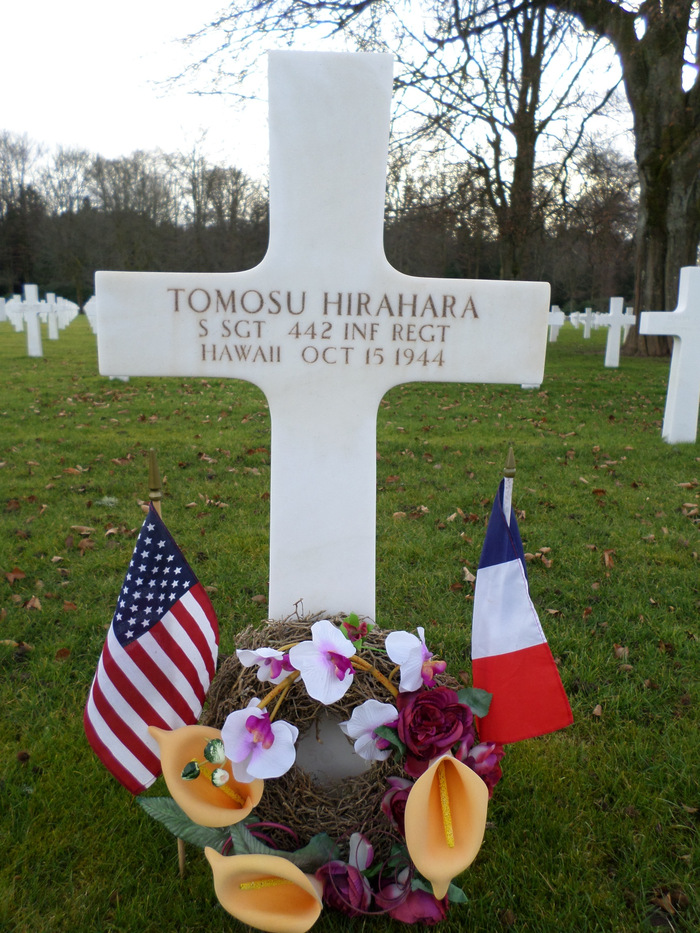
Mr. Ravina covers the recruitment, training and deployment of the US Army’s segregated Japanese American units that fought in the ETO: the 100th Battalion and 442nd RCT. I’ll admit that this book has special relevance to me. In chapter 5, there is a mention of an attack on Hill A near Bruyeres, France: “B Company fought continuously throughout the day, took five prisoners, but suffered one KIA.” The one KIA was Staff Sergeant Tomosu Hirahara, my wife’s great uncle. His body was laid to rest not far from where he fell in battle in the Epinal American Cemetery.
The stories of many other heroic soldiers are also told including that of late Senator Daniel Inouye, who lost an arm in combat. There is also good coverage of the costly rescue of the “lost battalion” in France, the recognition these units received from their commanders resulting in a high number of Presidential Unit Citations, and the re-evaluation after the war of medal applications that may have been tainted by prejudice. The result of this re-evaluation led to a number being upgraded to higher honors, including the Congressional Medal of Honor for Senator Inouye and others.
This book is a great overview of the plight of Japanese Americans during World War II, but not an exhaustive account of any one topic, so further reading would be recommended.
Wow! This is one of the best books that I have read in a very long time. While their families were put into camps and denied basic human rights the men of the 100th Battalion and the 442 Regimental Combat Team fought for the US in Italy and France. Their heroism can best be summed up from the book itself.
In less than two years of World War II, the 442nd 'had participated in seven major campaigns in Italy and France, received seven Presidential Distinguished Unit Citations, and suffered 9,486 causalities," according to the Selective Service System, and was "awarded 18,143 individual decorations." As Gen. Mark Clark, commander of the Fifth Army, to which the 442nd was attached in Italy, pointed out, this was the record of a unit whose "original strength was about 3,500 men. (pg. 5)
This book is very good. It tells the story of how the U.S placed the Japaneses Americans frrom the West Coast in internment camps. The Japanese americans from the Islands weren't. The Military or the FBI didn't want them enterned for verious reasons. FDR's cronies on the west coast did.
This also a story of how the Japanese from Hawaii and the mainlans didn't get along at first. They did bond together to become one of the most decorated units of WW 2.
As the years roll by and distant memories fade, newer generations have less context of the wars fought in the last century. At one point there seemed to be no end to the literature generated by historians, veterans and others affected by World War II. Tom Brokaw called those men and women who served "the Greatest Generation" and who is to question that claim? Of the conflicts preceding and following WW2 perhaps none were as influential in the effects that that war had on Europe, the United States and Japan or the direction that technology would take us in the following years.
The US emerged from the war as the most powerful nation in the world and there was no doubt that it had reaped all of the spoils that were to be had. However, not all aspects of America's conduct were without fault and one strategy in particular hid a terrible injustice that not only opposed common sense but also raised the specter of humanity's worst characteristics: xenophobia. It was a widely known fact that Nazi Germany had secretly established and run concentration camps for even years before their invasion of the other countries of Europe began. Although most of those forced into these locations constituted Jewish Europeans, the camps also included individuals from any group that Hitler and his generals deemed unworthy of the society they envisioned. However, in the United States a similar fate befell only one specific group following the attack on Pearl Harbor. Executive Order 9066 justified the military relocation and detainment of 110,000 mostly American citizens of Japanese descent for more than two years. Of these detainees, several thousand still chose to serve the country that was imprisoning their families with valor.
Asahina's book is a meticulously researched and detailed account of the events, political proposal and execution of this internment. So much so that the extensive footnotes that are found on nearly every page can be a bit of a distraction at times. Much of the information describing the bureaucratic side of Executive Order 9066 is quite dry and demonstrates the irrational paranoia that the Japanese exclusively were subjected to throughout the war. The account of the Japanese divisions (442nd and 100th) describe the accounts not only of the bravery of American soldiers but of a fierce determination motivated through a unique allegiance to a country that expressed none in return. It would take years for most of the Japanese soldiers to receive the recognition that they deserved and even this came in the face of contemporary objections to racial favoritism or overt political abstractions from both the conservative and liberal sides of the aisle. In the end, the Japanese enlisted and their families proved that they were as much citizens and anyone else regardless of skin tone or heritage. They also proved that in a haunting sense that in respect of the horrors of Germany's concentration camps half a world away it can also happen here.
Just Americans is the first book I have been able to find from the Japanese American perspective of WWII. We all know about the famous act signed by Roosevelt to have Japanese Americans place in camps during the war. Something that was incredible given that many of them were in fact legal American citizens. I bought this book because I figured it would be much like Band of brothers or any other book that follows a group of men during the war. But it was not that. The first third of the book is very much a legal battle author has with the law and what the Democratic president Roosvelt did after the bombing of Pearl Harbor. Some information was new, but not much. It was insightful but a bit hard to read through. Once you get to the formation of the 1ooth Battalion/442d the book gets juicier and full off information and questions that you would not think about. One example is how the segregated group still had clicks inside itself and for silly typical human reasons. But as always combat has a way of clearing those things up. It's not until you are almost halfway that battle ground fights come to life. I had really hoped like Band of Brothers more men would have been interviewed. But despite the quotes feeling sparse at times the actions does come to life, and as with all combat the reader questions the choices of those in command. But Dick Winters also was upset how his men were treated, so it's up to the reader to decided why these men were asked to fight so hard and for something that was suddenly given up, much to the frustration of anyone with a head. The last part of the book I stopped reading as it became a place to bash other writers, mostly in the Appendix section, if you want to debate someone that is still alive do it fact to face, not on paper where they cannot respond back. (poor form) But I am grateful for this book and hope to find more on these amazing men asked to give to a country that at the time was taken everything away from them. Their determination, grit and desire to prove their loyalty is so humbling. The deed of saving the Texas division all while getting mail from family about their homes being burned down, families stuck behind barbed wire, and not knowing what they would return to was crushing, yet inspiring. They did so with little to almost no credit, not until years later. I urge everyone to read this book to learn about such extraordinary men. Read the book to honor them and thank them for their service and sacrifices.
I picked up this book because I wanted to read more about the Japanese-American fighting units in WW2. I had heard about them being the most decorated units in WW2, and recently finished Ken Burns's documentary on WW2 which featured them and included interview clips with the late Senator Daniel Inouye, who was part of it. And just last month I spent two days at the WW2 Museum in New Orleans and saw them mentioned.
So, when I saw this book at my library, I grabbed it.
While it does touch on the military exploits of the unit, particularly their rescue of the "Lost Battalion" in the Vosges Mountains of France, it spends more time dealing with the politics and repercussions of FDR's Executive Order 9066, which authorized the American military (and allowed FDR some political cover) to force Japanese-Americans from their homes and into concentration camps. We usually see them called "internment camps" because of the negative connotations of what the Germans were also doing at the time, but they were concentration camps, pure and simple.
The order was supported by the ACLU of all people, and declared legal by the Supreme Court in Korematsu vs. United States in 1944. FDR had appointed EIGHT (!) justices to the Supreme Court during his tenure. The court has a total of nine justices, so all but one were his appointees. Six of his appointees sided with his executive order. The Court's decision is widely considered one of the most shameful decisions in its history, along with Dred Scott vs. Sanford in 1857.
The books closes with an appendix that discusses the moral and legal ramifications of the order as well as stating the fact that after some time, it was really just a massive social engineering experiment on the part of a progressive experiment. It also discusses present-day revisionist history that essentially has conservatives and progressives flip-flopping positions on it, with conservatives trying to justify it and progressives denouncing it, although their side was behind it. The author goes through a brief history of the civil rights movement and the current-day identity politics in an attempt to explain this shift.
The books is worth reading for this appendix alone. While the book was not what exactly what I was looking for, I was fascinated and learned a lot. I recommend it.
While I knew of the existence of the internment camps for Americans of Japanese decent, I never knew the details behind this black chapter of our nation's history. As such citizens living along the mainland's west coast were rounded up and forced into lock-ups in godforsaken areas of the county (leaving behind and losing everything they worked for and owned), similar citizens living on the island of Hawaii were embraced as vital to the war effort simply because of the crucial roles they played within the Hawaiian workforce (i.e., the US could never have waged war against Japan without them). To add insult to injury, the U.S. military had no reservations about showing up at the internment camps with "leave clearance" forms for males willing to sacrifice their lives in military service. This book tells the story of the segregated 442d Regimental Combat Team, ultimately considered to be the most decorated U.S. military unit in history. Those few who returned home at the end of the war (including Hawaii's future Senator Daniel Inouye) found rampant discrimination against them, even as decorated war veterans.
The author (himself an American of Japanese descent) draws parallels between the aftermath of the Pearl Harbor attack and the continuing mistreatment of Americans of Muslim faith after the World Trade Center attacks. "A continuing struggle over what it means to be an American."
The shocking facts made this not an easy book to read, but one that every American of every ethnicity should pick up and familiarize themselves with. (940.54)
I can vividly recall a time from my early teens when my grandfather had told me the story of George Sakato's brave actions in the taking of Hill 617. I was captivated as he described how his friend who he called Joe had lost a fellow soldier in his arms and then led what can only be described as a "banzai" charge against the enemy position and personally killed 12 German troops as he rallied those around him to take the strong point. This was years before Sakato had received the Medal of Honor in 2000 but his story was somewhat legendary for those like my grandfather who knew him.
Sakato's story is just one of so many of the brave members of the 442nd Regimental Combat Team. Asahina has assembled numerous accounts of bravery from those like Joe Sakato, Barney Hajiro, and Daniel Inouye and one can understand just why the 422nd was as highly decorated as it was. Asahina also provides insight into the cultural clashes within the unit between the mainland and Hawaiian Japanese Americans while at Camp Shelby which sounded exactly like what my grandfather had also described to me over 30 years ago from his own personal experiences while there.
This work gave great insight into the events that led to the internment camps, beginning with the signing of Executive Order 9066 which casts FDR in quite an unfavorable light for someone who is held in such high regard by so many. It also explores the lives of some of these heroes as they returned home following their time in Europe and the challenges that they faced, especially those that had volunteered from the camps.
In October, 1944, there were four companies of a Texas Division of soldiers who were stranded in eastern France behind enemy lines. They were without reinforcements or supplies, but they ended up being rescued by the 442nd Regimental Combat Team, which was composed of Nisei, men of Japanese ancestry.
The 442nd “had participated in seven major campaigns in Italy and France, received seven Presidential Distinguished Unit citations, and suffered 9,486 casualties and was awarded 18,143 individual decorations, “ all within a period of less than two years.
Their motto was “Go For Broke.”
More than 22,500 Japanese Americans served in the Army in WWII, 18,000 of them in segregated units, most of the rest used in the Pacific theater as translators.
Keep in mind, though, that this was at a time when many of their families were being kept behind barbed wire in internment camps on the US mainland. The people had not been charged with any crime, yet their rights were taken away from them and they were basically treated like criminals.
Once Pearl Harbor was attacked, things changed radically for the persons of Japanese ancestry in Hawaii, but not as radically as those who lived on the West Coast. Lt. Gen. Delos Emmons, the military commander of the islands, considered evacuation and relocation of the persons of Japanese ancestry living in Hawaii, but instead of making a quick decision he talked to others and realized that evacuation and relocation wasn't necessary or practical.
The main thing was that the persons of Japanese ancestry in Hawaii were more integrated into the American culture than were those living on the West Coast. The reason for that deals mainly with prejudice; the AJA (Americans of Japanese Ancestry) who lived in Hawaii did not have to deal with anywhere near the level of prejudice those on the West Coast did. The AJAs in Hawaii formed about a third of the population, and they were major factors in the economics of Hawaii. The AJAs on the West Coast, though, had been disliked and hated for years; they white farmers were jealous of how successful the AJA farmers were, and the so-called community leaders often took strong anti-AJA stands along with the newspapers.
So the AJAs on the West Coast were never really given a chance to fully integrate into the larger “American” society, while those in Hawaii were able to.
On May 28, 1942, Emmons was ordered to reorganize Japanese American soldiers into the 298th and 299th provisional battalions. The groups a week later had sailed to San Francisco, where they were then called the 100th battalion, and then shipped to Wisconsin for training.The book also describes the differences between the AJAs from Hawaii (the “Buddhaheads” and the AJAs from the mainland (the “kotonks.”) The two groups did not get along at all well at first. They had rather different cultures that tended to clash.
The book also talks about the “no-no's” caused by the controversial questions 27 and 28 on a questionnaire, and how they ended up at the Tule Lake internment camp. There is also a discussion of the call for volunteers, and how more AJAs from Hawaii volunteered than did AJAs from the US, which is not surprising considering they and their families were in internment camps.
May, 1943. Assistant Secretary of War McCloy says “there [is] no longer any military necessity for the continued exclusion of all Japanese from the evacuated zone.” Still, the internees were not free to return and were not wanted.
The book points out that in the six months after Pearl Harbor, Nazi subs sunk 185 ships off the East and Gulf Coasts of the US, yet there was no cry to intern persons of German ancestry in the Eastern US.
FDRs plan was basically to disperse the persons of Japanese ancestry throughout the United States and not allow them to remain concentrated on the West Coast. Thus, the internment program was actually partially a social program to force the relocation of an entire race of people. This could have been planned to help them assimilate, or it could have been planned as a means of destroying the unity of the Japanese American community with the eventual goal of “phasing out” that community.
One reason for not allowing the internees to return earlier to the West Coast was that there was an election year and FDR didn't want to stir up any political on the West Coast by releasing the internees and allowing them to return to their former homes.
Problems arose when there was an effort to draft some of the internees. This caused a lot of personal difficulties. Here they were, locked up behind barbed wire, their homes gone, their jobs gone, and they were expected to respond positively to an order to fight, and maybe die, for the country that was denying them their rights as American citizens. The men would have to decide whether to go along with the draft or refuse to and take the consequences.
The book then goes into a lot of detail about the 100th Battalion and their fighting in Europe. The book is worth buying just for this section alone.
In November of 1944 “...the American Lesion post in Hood River, Oregon, erased the names of sixteen Japanese American soldiers from a memorial honoring servicemen from the area.”
The move was denounced by the Secretary of War, Stimson, who called it “wholly inconsistent with American ideals of democracy.”
The commander of the Salinas Valley American Legion said “We don't want Japanese here and we said so bluntly in a recent resolution. There appears nothing we can do about it however.”
”Within the first five months after the announcement that the 'relocation centers' would be closed, incidents of violence against returning Japanese Americans 'had reached such proportions that Secretary Ickes issued a public statement denouncing the perpetrators and demanding more effective protection for the returning evacuees.”
The East Coast, on the other hand, was much more open to the returning of the evacuees, and the 442nd got a “hero's welcome” in New York City.
This is a very informative account of the internment of Japanese Americans during WWII. At a time when we were at war with Italy and Germany too, only Japanese Americans were forced to leave their homes and businesses behind and live in makeshift barracks, losing everything they owned.
I loved the fact that they were striving so hard to be known as “Just Americans”, not Japanese Americans. They were proud of their culture and heritage and didn’t feel that was threatened by dropping “Japanese” from the way they referred to themselves. How I wish all Americans felt the same way.
My only disappointment is that “Just Americans” is written in a more documentary style and I was looking for a more personal first hand account.
An amazing read if you're interested in the subject. There are also a lot of interesting facts regarding happenings on U.S. soil during the war. The author easily keeps you informed about names and what unit they belong to, as there are MANY names to remember!
One complaint I have is that the author claimed that President Roosevelts' head was on Mount Rushmore, when it actually was Theodore Roosevelt, the 26th President of the U.S. Who si there, and not the head of the 32nd Pres.
A powerful and vivid telling of the battles for freedom and justice at home and overseas for Americans of Japanese backgrounds in WW2. An eye-opening read all around.
This was such a powerful read! Each individual story highlighted the trials and strife that Japanese servicemembers had to endure during WW2. There were so many stories that just beautifully tied in together. The personal and universal narratives sparks an emotional journey. I was so compelled to each story because we all know what happens at the end of WW2, but we never were really introduced to personal stories, especially for Americans who were of Japanese descent. I highly recommend this book if you’re looking for historical significance during WW2 and to be educated on what a lot of our servicemembers who were minorities went through. AND, if you’re really into politics, like die-hard leftist/rightist, PLEASE read the Epilogue and Appendix!
It is a familiar story to since I am from Hawaii. A surprise attack by Japan on Pearl Harbor takes its toll of thousands of American lives. Japanese Americans are persecuted for no other reason but for their race. Within months after Pearl Harbor, 110,000 Japanese Americans were forcibly "evacuated" from the West Coast, losing their jobs, their property, and their homes. Furthermore the are relocated into concentration camps in desolate areas around the country. Thousands of Japanese American men, however, volunteer to fight for America despite having their constitutional rights violated to prove they are loyal Americans. This is the story of the Japanese American 100th Battalion and the 442d Regimental Combat Team. The book takes us to the European theater and the costly battles the Japanese American soldiers fought in and their triumphs.
Through oral history and other research, Asahina gives an entertaining yet factual account of the Japanese American soldiers’ WWII experience. I began reading with suspicion, for I noticed an inaccuracy in the first few pages. However, this inaccuracy was really tangential to the story and had little bearing over what the author was trying to accomplish. I am a “buddahead,” and most of the stories I have read and listened to came from that perspective. I believe that Asahina is a “kotonk”. For that reason I appreciated and enjoyed reading a story that contained more “kontonk” views. I liked the way he boldly disagreed with Senator Dan Inouye’s assessment of Franklin Roosevelt. I liked hearing the stories of the “kotonks” experiences in the concentration camps. The book is faced-paced and easy to read, a definite thumbs up.
I picked this book up for my military history class. WWII is often a difficult subject to read about, but I thoroughly enjoyed reading this book.
Here is an excerpt from my book review for my course:
"This book was an absolutely wonderful read and I will likely purchase a copy for my own personal library. It worthily honored the stories of thousands of brave men, who may have fallen through the cracks of history without the efforts of individuals like Robert Asahina. These veterans’ stories were both emotionally compelling as well as deeply insightful into the life of a soldier at this time. This book also addressed the difficult subject of racism tactfully and expertly in a way that was both candid and meaningful. The history of Japanese Americans during WWII is often confined to the subject of interment camps, when it is not glossed over entirely. This leaves the experience of Japanese American soldiers nearly completely absent from the public’s resources concerning WWII. Thus, this book is a shining example of taking an important, and often-overlooked, piece of history and giving it its due. I can only hope that more books like this are published so that future generations can have as a complete view of history as possible."
7/27/09 Disc 6 out of 7: So far, I'm finding the book excellently written, with a lot of insight and first-person accounts from the 100th Infantry Battalion (Special)/442nd RCT. I've read before stories of internment life, and treatment of ethnically Japanese in the United States mainland. But to hear about stories from the front line of war is new. Very insightful. New found respect for these gentlemen. Asahina did his homework, and is a masterful storyteller, that you feel like you get to know some of these soldiers.
(Not-so) small annoyance: the reader should have been coached better on the pronunciation of Japanese surnames and Hawai'i place names. It's petty, but it grates on my nerves every time I had to hear him drawl out names like Ito (EE-toe) and Inouye (ee-know-WAY) repeatedly, and then just butcher others like I'olani (eye-oh-laaan-ee) Palace, yet gives a fairly graceful and practiced pronunciation of French and German place names. Just a little coaching would have done wonders. Also, when the reader quotes individuals, with an exaggerated American Southern drawl, and German and French accents, it is just annoying and tacky.
I was first made aware of the internment of Japanese-Americans during World War II as a teenager in the 1970's, when I read Farewell to Manzanar by Jeanne Wakatsuki Houston and James D. Houston. Other books, such as Ronald Takaki's Strangers From a Distant Shore and George Takei's autobiography To the Stars added to my knowledge. Robert Asahina's Just Americans further chronicles the experiences of dozens of members of the Army's 100th Battalion and 442nd Regimental Combat Team -- segregated units of Japanese-Americans from Hawaii and the mainland U.S. -- who fought in Europe. Back in the United States, however, these soldiers' families had been relocated to such camps as Tule Lake and Manzanar. Many of these units' accomplishments were minimized by the wartime press and veterans often returned to the States unwelcome by their neighbors and so-called friends. Decades would pass until these veterans would receive their just acknowledgment and honors. Highly recommended, not just to those interested in the history of race relations in America but to students of military history as well.
This book goes far beyond any I have read concerning the Japanese removal during WWII. It also goes into the national hysteria following 9/11 and our attitudes towards muslins and arabs. What an eye opener.
It also follows the 100/442 in their combat during the Italian campaign and the Southern France campaign, including the lost battalion mission. Very well researched, and that did slow down reading somewhat with the numerous footnotes.
A fascinating (and often horrifying) story of the 442nd Regimental Combat Team and the treatment of their friends and relatives in internment camps back home. Not the best writing in the world; it was often overly grand in terms of the prose, but still a very readable and interesting book.
I listened to the audiobook on this one. interesting story about how Japanese-American proved themselves in battle in Europe, despite bad treatment before, during and after the war. The description of their rescue of the "Lost Battalion" was a little confusing, but quite exciting.
Excellent discription of the fear of invasion against the Japanese Americans. The surprise is FDR's lead in the messy relocation. Great story about the J-A efforts in against the Germans
An interesting read on a seldom told story of how Japanese Americans fought for the US in World War II. An insight in racism and prejudice and the men who fought to overcome it.